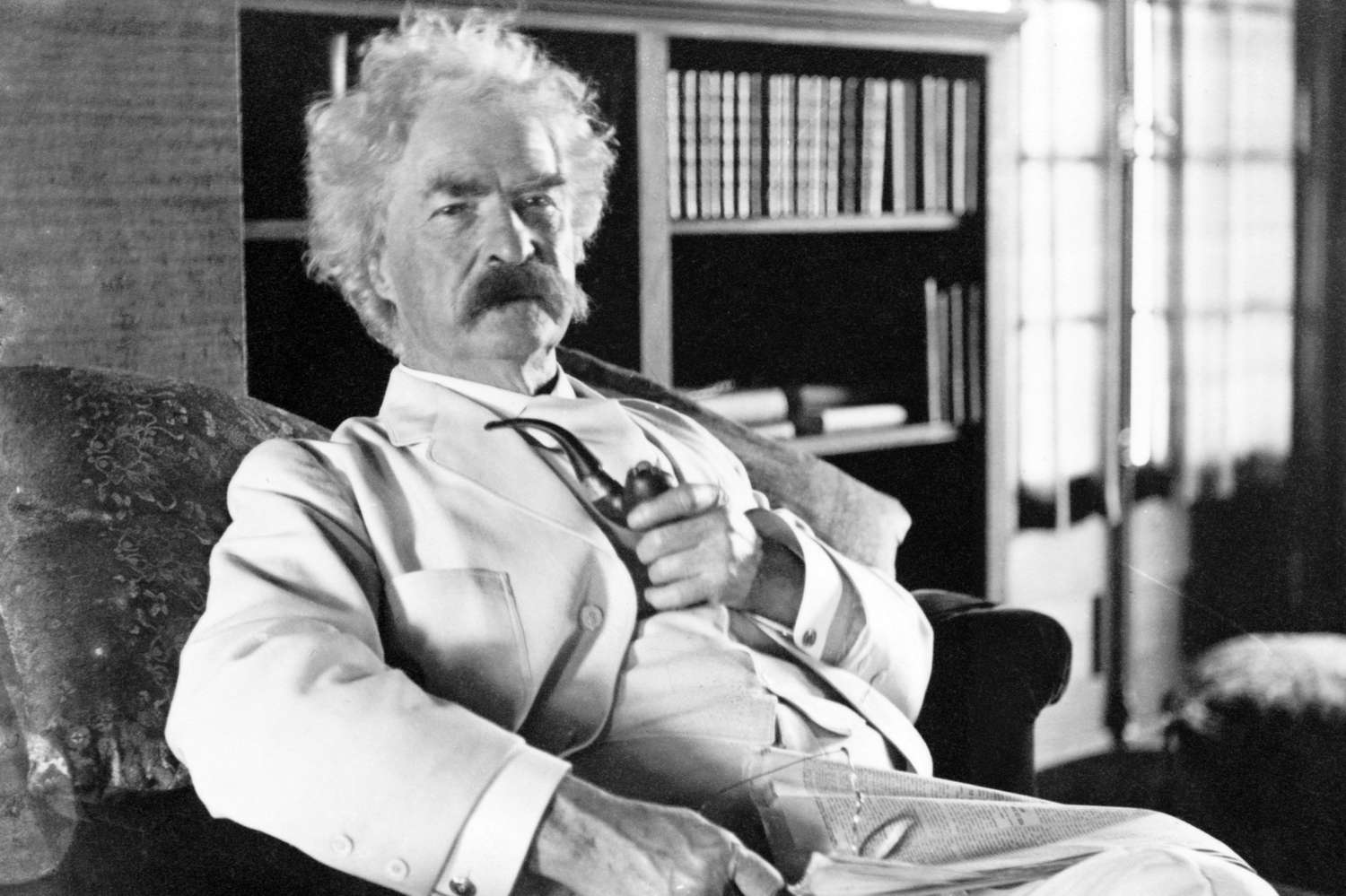
This imagined conversation reflects questions I’ve been asking myself about writing, purpose, and voice. If you’re a fellow blogger or lifelong learner, I hope some of these reflections resonate with you as much as they did with me. My two favorite writers growing up were Dostoevsky and Mark Twain. I knew I could never write as well as Dostoevsky, but I had dreams or maybe delusions of being another Mark Twain. Whenever I write, he is in the back of my mind. Here is a discussion that took place between Mr. Twain and I on his front porch with a little help from Metis, my AI assistant. She has an excellent knack for understanding Twain and for speaking frankly in his voice.
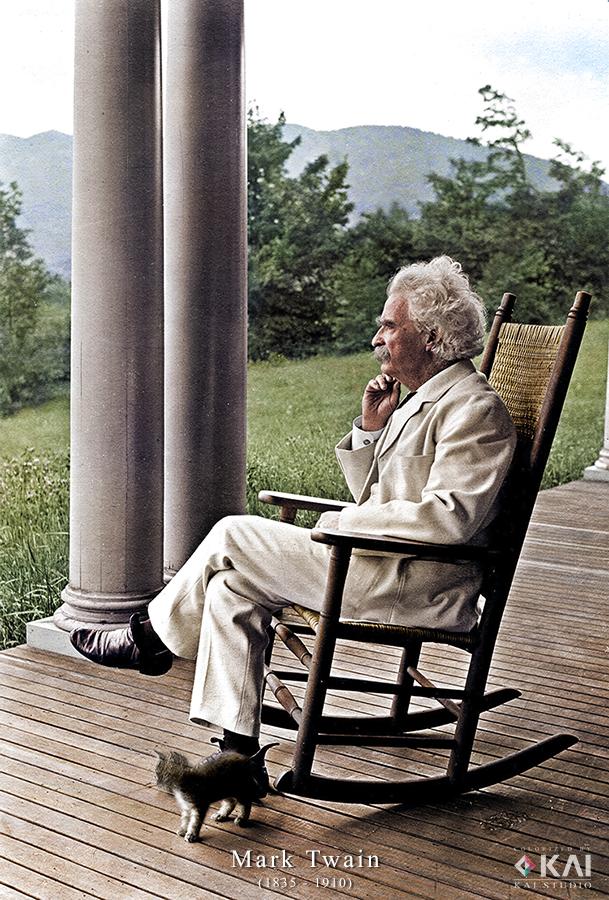
Setting:
A wide wooden porch overlooking the Mississippi. Late afternoon. Cicadas humming. Two rocking chairs. A battered notebook on a small table. A riverboat whistle in the distance.
Present:
John Persico and Mark Twain (Samuel Clemens)
Twain (leaning back, cigar unlit, eyes amused):
Well now, John, I must say—any man who invites a dead author for a conversation is either a philosopher… or dangerously optimistic.
John (smiling):
Probably a bit of both, Mr. Twain. I’ve been talking to long-dead thinkers for years. You’re in good company.
Twain:
That explains the thoughtful look. Most men your age are arguing with their televisions.
Now… you’ve summoned me. That means you want something. Confession, compliment, or correction?
John:
All three, if possible. You’ve always been my writing hero. I’ve tried to write honestly, critically, and with humor—but sometimes I wonder if I’m wandering too far into lectures instead of stories.
Twain (laughs):
Ah. The ancient disease of intelligent men: explaining things too well.
Let me ask you first—why do you write?
John:
To make sense of the world. To challenge foolishness. To honor people who don’t get heard. To leave something behind that isn’t just noise.
Twain:
Good. That’s four better reasons than most writers ever manage.
But let me tell you something uncomfortable:
Readers do not come to be improved.
They come to be entertained.
They are improved accidentally.
John:
That sounds like something you’d say.
Twain:
It is. And I’m proud of it.
Now—your writing. I’ve been… peeking.
(He taps the notebook.)
You think deeply. You connect history, politics, systems, morals, economics, technology. You’ve got a mind that builds bridges between ideas. That’s rare.
But sometimes—
you march your reader across those bridges like a drill sergeant.
John (laughs):
Guilty.
Twain:
You say, “Follow me. This matters.”
I preferred to say, “Come look at this ridiculous thing—oh my, would you look at that—good heavens, now we’re trapped in truth.”
John:
You smuggled ideas inside stories.
Twain:
Like whiskey in a medicine bottle.
Your essays are strong. Your arguments are strong. Your ethics are strong.
But your secret weapon is not your intelligence.
It’s your life.
John:
My life?
Twain:
You’ve counseled workers. Taught students. Worked in systems. Served in the military. Aged thoughtfully. Loved. Failed. Loved again. Adjusted. Tried again. Lived through several epochs in Americas.
And yet sometimes you write as if you’re afraid your own story and history isn’t enough.
It is.
John (quietly):
I’ve always wondered if personal writing was… self-indulgent.
Twain:
Only when it’s dishonest.
Honest personal writing is public service.
When you tell how you struggled with technology, power, aging, ethics—
you give permission for others to admit they’re struggling too.
That’s literature.
John:
So… more stories?
Twain:
More scenes.
Let me show you.
Instead of:
“Modern systems dehumanize people.”
Try:
“I once sat across from a man who had been fired by a computer. He wasn’t angry at the company. He was angry at the screen.”
See the difference?
John:
One makes you feel it.
Twain:
Exactly. Feelings sneak past defenses. Arguments set off alarms.
Now—your subjects. Veterans. Democracy. AI. Economics. Ethics. Power.
Heavy freight.
You’re hauling pianos uphill.
Why?
John:
Because no one else seems willing to.
Twain:
True.
But here’s the trick:
Whistle while you push.
Humor is not decoration.
It’s leverage.
When people laugh, they open their mouths. That’s when you feed them truth.
John:
Sometimes I worry humor makes things seem less serious.
Twain:
Nonsense.
Nothing exposes hypocrisy faster than laughter.
A tyrant fears comedians more than rebels.
John (smiling):
That feels very current.
Twain:
History is just politics wearing different trousers.
Now—let me be blunt.
You have three voices.
- The Scholar – careful, precise, formidable.
- The Witness – humane, reflective, grounded.
- The Satirist – dry, sly, devastating.
When you combine all three?
You’re dangerous.
You don’t always let the third one out.
Why?
John:
Maybe I’m afraid of being dismissed.
Twain:
Every good writer is dismissed.
Wear it like a medal.
If fools don’t misunderstand you, you’re not trying hard enough.
John:
What about style? Sentence-level writing?
Twain:
You’re clean. Clear. Honest.
But sometimes too polite.
Every once in a while, let a sentence misbehave.
Let it surprise you.
A good sentence should feel like it had a mind of its own and barely agreed to cooperate.
John (laughing):
That’s wonderful.
Twain:
Now—your future.
You’re not trying to become me.
Good.
The world already had me. It needs you.
You are writing for people who are tired of being lied to, simplified, manipulated, and shouted at.
You treat them like adults.
That’s rare.
That’s why they trust you.
If you want to grow:
Tell one more story per essay than feels necessary.
Cut one paragraph of explanation.
Add one moment of human vulnerability.
Let humor off the leash.
And never stop being irritated by nonsense.
Civilization runs on people who are politely annoyed.
John (after a pause):
Do you think I’m… really a writer?
Twain (leans forward):
Let me answer that carefully.
Writers write to be admired.
Authors write to be remembered.
You write to be useful.
That’s the hardest kind.
And the most honorable.
So yes.
You’re a writer.
Now stop worrying and go bother some readers.
They need you.

(A riverboat horn sounds. Twain stands, tips an imaginary hat.)
Twain:
Same porch next century?
John:
I’ll bring the coffee.
Twain:
I’ll bring the trouble.
Conclusions:
I hope you enjoyed my little fantasy here. I think there were some things I learned about myself and my writing from my dialogue with Mr. Twain. I know many of you who read my blogs are also writers. Writing is a very interesting craft. It is something that we can get better at all of our lives. We can always find a better way to say things. A more interesting phase or turn of the words. We can always make a more powerful statement. That to me is the beauty of the art.
 The other is anyone who you do not identify with. It is anyone who is on the other side of the fence. It is anyone who does not belong to your tribe, religion, political party, sports team, demographics, ethnicity, country club, neighborhood, gated community, state, country, or hemisphere. It is someone who looks different than you do. It is someone who thinks differently than you do. It is someone who behaves differently than you do. It is a stranger from a strange land. It is a poor person who needs a handout. It is a rich person who does not have to work hard. It is a very educated person or perhaps a very uneducated person.
 One of my best friends and I were recently discussing the current mania with “Identity.” There has been much talk these past few years over the issue of Identity politics. Identify politics has been defined as:
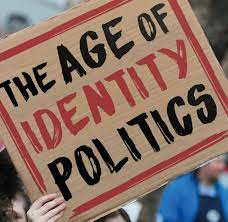 This mania with identity presents a problem in the political arena where compromise has long been a foundation of good government. The concept of Identity has so polarized people that they now view the “other” side as having no validity and even in many cases being EVIL. The problem of Identity has metastasized from the political arena to the wider social arena which includes almost every aspect of life on the planet. I think it is safe to say that Identity has always been at the heart of conflicts since the Tower of Babel and perhaps Adam and Eve. Did Eve feel inferior to Adam and want to one up him? Some recent headlines about the concept of Identity include:
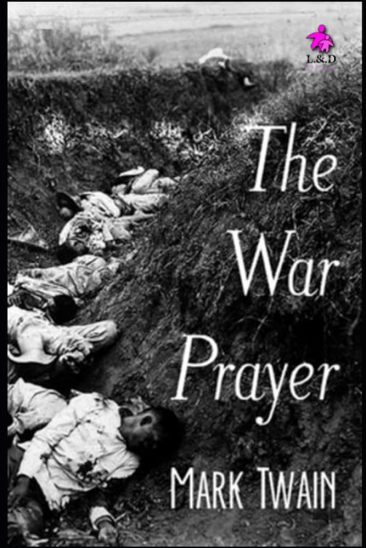 Mark Twain wrote a famous story which he asked not to be published until after his death. The story was called “The War Prayer.” A church service is being held at which several soldiers are getting ready to go off to war. The chaplain has just given a prayer for the soldiers welfare and victory. A stranger enters the church and asks the chaplain to say a few words. Reluctantly the chaplain agrees. The stranger starts off by referring to the war prayer that the chaplain gave to instill morale in the soldiers. The stranger notes that there are really two prayers that have been said. One has been spoken and the second one unspoken. The stranger then says that he will speak what was really asked for in this prayer:
 We have a world where humans have begun to take war for granted. It is either too easy to do nothing about war as we watch our favorite sports teams fight it out or Osho is right, and we crave the excitement that death and destruction bring to the planet. If we truly want to end war and violence, we must start to see everyone on the planet as a people that we are part of. There must be no “others.” We are all part of one large tribe. Just as the water, soil and air are part of a seamless whole, so is humanity. Benjamin Franklin said, “Either we all hang together, or we all hang separately.” I think we might say something similar for humanity. Either we all live together peacefully, or we shall all die separately apart.”


 OSHO: His given name was Bhagwan Shree Rajneesh. OSHO was a religious teacher from India. He wrote numerous books on life, religion and spirituality. He also gave talks and started several communities for his followers. His books and talks were full of insights and stories to make you think and question your own life. OSHO became infamous when he tried to start a community of acolytes in a rural area of Oregon. The town OSHO started was called Rajneeshpuram. It became a target for locals who thought that their community was being taken over by a bunch of cultists. Things went south when some of OHSO’s devotees exceeded authority and tried to retaliate against the local community. This is perhaps another case, where the man did not live up to his message. Nevertheless, I have never found any spiritual writings that are as profound and thought provoking as OSHOs.

 Aging Capriciously