
Mr. Wardell Stephens is a 95-year-old Navy veteran. He was born in 1930 in St. Louis. Wardell joined the Navy in 1947 at the age of seventeen. He retired twenty years later in 1967 at the age of 37. He had a long and distinguished career as a Navy diver conducting deep sea rescue operations. He is a rare man, and it is my pleasure to provide a brief overview of his life. I call it a Profile in Courage, Character and Integrity. Reading this testimonial, I think you will agree that these terms aptly apply to Mr. Stephens.
I first met Mr. Stephens several years ago at one of the Eloy Veterans Day celebrations. Mr. Stephens was the guest of honor and a keynote speaker. He was mild mannered and humble. He briefly thanked the people for his being there and said a few words about how much the Navy mattered to him. He was a Navy diver who had conducted several deep-sea rescue operations back when the equipment was much more primitive than it was today. No bragging about his bravery or how dangerous the job was. I was impressed with his humility.
Several years went by and one day shortly after they opened the new Eloy Veterans Center, (January 2025) Mr. Stephens dropped by to visit. Wardell was now 95 but had not seemed to age a day. He still walked like a young man with none of the shuffling you often see with the aged. He was ramrod straight and looked in better health than many people half his age.
We had a talk about some of his career exploits and again I was very impressed with his courage and humility. I asked if I could interview him and he agreed. That was more than two months ago. Mr. Wardell was sick for a while (as was I) with the damn bug that went around this spring. We finally set a date for me to interview him. Earlier he had left a packet of information about his Navy ships and projects for me to look at. Some of the material that follows are taken from his Navy record and some will include my interview with Wardell on May 7th, 2025. The interview lasted about 2 hours. Many veterans are inclined to some exaggeration as the years have passed. Wardell was just the opposite. I had a hard time getting him to be anything more than modest about his adventures.
Here is what one of his commanders said about him in a Navy Review:
“Stephens is an extremely conscientious Petty Officer in that he invariably will take charge of an operation. He goes out of his way to correct other divisional personnel who are performing work in an unseamanlike manner. His timely suggestions and technical ability have contributed greatly to the ability of the diving division to perform submarine repair work in an expeditious manner. He is always in a clean complete uniform and wears it in a shipshape fashion at all times. Definite credit to his rate and to the Naval service. Highly recommended for advancement in rate. Stephens when in charge of an evolution uses excellent judgement and disposes his men for maximum effectiveness in accordance with their abilities thereby assuring a smooth operation.” — J. H. Lindsay, CDR, USN
I had a chance to look at Mr. Stephen’s training record. It was full of very difficult diving techniques including the following:
- Deep sea diving school
- Salvage diving school
- Diving school instructor
- Submarine rescue
A number of years ago I went to scuba training and received my PADI certification. I then went on a trip to Belize to do several dives in the area of Ambergris Caye and Caye Caulker. I was sixty years old at the time. Some of my dives were fun but some were scary. Swimming among large sharks. Swimming through some narrow channels in dark conditions. Having to think about time for compensation stops to avoid getting the bends. Watching my air and depth gauges. Trying to avoid scraping coral. Trying to manage my buoyancy to stay with the other divers. It was very challenging, and I was only recreational diving. I never went below 150 feet and was never down for more than thirty minutes.
Wardell was diving in pitch black conditions. Sometimes using helium instead of oxygen and going down to do rescue and salvage operations at depths of 350 feet. Here is a Letter of Commendation describing one operation that Wardell completed:
“On May 13, 1964, NEREUS completed the water-borne replacement of the propeller on the USS Scamp. The old and new propellors weigh approximately 12 tons. As far as is known the replacement had never been accomplished in the water. As a member of the diving crew, you did the work assigned and thus contributed to the overall success enjoyed. In each instance, the reliance placed on you by the Master Diver and diving officer was justified and your contribution was significant.” — M. des Granges, Commanding Officer, USS NEREUS
The following video talks about what it is like to be a Navy Rescue and Salvage diver.
https://www.youtube.com/watch?v=AnihhBnzowg
I would like to describe one more operation that Wardell did from the Commendation letter that he received. After this I will go to the interview that I did with Wardell. I am glad that he sent me some of his service records because it was hard to get Wardell to “brag” about any of his Navy exploits. I am trying to give you a sense of the danger and difficulty of what Mr. Stephens did for twenty years. I don’t often think of all military people as heroes, but it is certainly an appropriate designation for Wardell.
“In the early evening of December 3, 1958, a Marine Corps helicopter flying under conditions of darkness and poor visibility crashed in the Potomac River near Jones Point, Alexandria, Virginia. While enroute to commence the salvage operation on the assigned helicopter, you were advised of a second aircraft crash. This second crash was a Navy Beechcraft with a crew of two which crashed in the Potomac river off Haines Point. Throughout the daylight hours of 4 December under adverse weather conditions, the officers and men of your entire organization worked expeditiously in the salvage of the downed Beechcraft. On December 5th, you were also able to complete the salvage of the downed helicopter.” — Commandant, Potomac River Naval Command
On my last Scuba Diving trip to Belize in April of 2024, the weather conditions were pretty bad. A storm had come through the area and the water visibility was very poor. The waves and current were quite rough. I had a hard time reading my depth gauge and my air gauge and ended up getting separated from the other divers on our ship. I came up to the surface and could not see the dive boat. I had left my safety flag back with my pack. I also had not bothered to take my snorkel. My tank was almost out of air, and I had no way to alert anyone as to where I was. When the oxygen ran out of my tank, I had to keep propelling myself above the waves to get a breath of air. With the waves running high, I could do little except bob up and down and hope someone would find me. About 90 minutes later, the boat finally found me. I was picked up and spent the next two hours trying to barf up the seawater that I had swallowed.
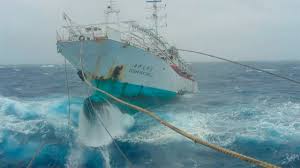
I tell you the above story because Mr. Stephens had made many operations where he had to arrange a tow in weather ten times worse than I experienced. To link a tow ship with a disabled vessel is not as easy as simply throwing a rope to someone on the other ship. This short video might give you some idea of what courage it would take to engage in such an operation.
Rescue Salvage Towing operations on rough sea
https://www.youtube.com/watch?v=-JhLJoCYi-g
Here are my interview questions and Wardell’s replies. On the day of the interview, we had not scheduled a definite time. I had said that I would be at the Veterans Center between 10 AM and 2 PM and that he could stop by anytime he wished. Shortly after 10 AM, my cell phone rang, and it was Wardell. I expected that he was calling to say that he was not feeling well. Not an unexpected event for a man 95 years old. Instead, he had called to tell me that he might be a little late since he had a phone problem at his house and the repair person was coming out that morning. I thanked him for his call and told him that any time he arrived it would be okay. I can’t tell you how surprised I was at his call. I cannot get repair people to give me a date and time that they will arrive much less call me if they are going to be late. Wardell receives not one penny from this interview and yet he is courteous and diligent beyond what any norm is today.

John and Wardell Interview:
John: Can you tell me a little about yourself when you were growing up. Friends, school, culture, family, dreams?
Wardell: I was raised by my mom and aunt. I had no siblings. I grew up in East Saint Louis in the Rush City Area. We called it the bottoms. I started working as a pin setter in a bowling alley when I was 14. I drove a coal truck when I was 16. My dream was to own my own truck and go into the coal business. I never got a drivers license. I joined the Navy when I turned 17
Wiki describes the Rush City area as follows:
“Rush City is a historically African-American community within East St. Louis, Illinois, that is unique in the American Bottom region. It’s characterized by a rural Southern influence, dispersed housing, and vernacular architecture, making it a distinct “country life” pocket within a struggling urban environment. The community has faced challenges related to economic disinvestment, environmental pollution, and industrial encroachment.”
John: Why did you pick the Navy?
Wardell: Well, one day during the second World War, the Navy brought an LST to St. Louis. I went down to see it and was very impressed. Later when I decided to leave St. Louis, I enlisted in the Navy.

John: What are you most proud of in terms of your military service?
Wardell: The work I did as a rescue and salvage diver and my Sailmaker rate
John: Can you tell me more about your work in the military? Challenges etc.?
 Wardell: There was a lot of things to learn. Setting up a tow. Different type of rigging on different ships. Working cables in rough weather. Using hoists in rough weather. It was easy to get hurt if you were not careful.
John: What were your biggest difficulties in the military?
Wardell: Only had a few minor negative experiences. Most of my career was positive.
John: What were the negative experiences?
Wardell: Well Truman changed some of the policies for the better. Before Truman there were some bases where they separated Blacks and Whites in the dining halls.
John: How did the transition to civilian life go for you?
Wardell: At first it was very chaotic. In the military things are very orderly and predictable.
John: Can you tell me a little about your family life? Spouse, kids?
Wardell: Well, I was married twice. I have four children and ten grandchildren.
John: Wardell, for a 95-year-old guy, you are in great shape. How do you do it?
Wardell: I lift weights three times a week. I don’t smoke or drink. I eat lots of protein. Three times per week, I go for a walk. I walk as much as I can. I always park as far away from a store in the parking lot so I get more walking in. I have a treadmill at home I walk on when the weather is too hot or bad.
John: What advice would you give young people today?
Wardell: I would tell them that you have to learn and study to get something good in life. You have to study hard and pay attention in school. I would tell them that they should learn another language.
John: What were the highs and lows of your life Wardell?
Wardell: The high was completing Navy diving school in 1954. I also finally completed my GED since I never graduated high school.
John: What would you do over if you could?
Wardell: I would go for more school. Continue education all your life.
John: Am I leaving anything out you would like to share?
Wardell: That’s about it. Except I also had a stint in the Merchant Marine after I retired from the military.
John: Thank you for taking the time to share some of your life and thoughts with us Wardell. It has been a pleasure talking to you.
That’s it folks. I hope you have enjoyed learning about a very remarkable human being. In addition to a depth of character and integrity that is more than noteworthy, Mr. Stevens is a kind man who said not one bad word about anyone during the entire interview or the time that I have known him. His integrity and character stems from his taking the responsibility to live life according to what his mother and aunt taught him and what his religious beliefs have inspired in him.
PS: I still see Wardell every few weeks when he comes down to the Veteran Center in Eloy. Yesterday, he asked me to add a little something to the bio I did for him. I was quite surprised to learn that Wardell is a Life Association Member of the Buffalo Soldiers. He officially belongs to the “9th and 10th (Horse) Cavalry Association – Official Army Unit Association.” For those of you who have never heard of the Buffalo Soldiers, I give you the following brief excerpt from Wikipedia. For more information, click on the Wikipedia link or simply go to any Arizona Library. There are many books written about the Buffalo Soldiers.
Buffalo Soldiers were United States Army regiments composed exclusively of Black American soldiers, formed during the 19th century to serve on the American frontier.
-
Courage and Discipline:The Buffalo Soldiers had the lowest desertion and court-martial rates in the army, demonstrating exceptional discipline and courage.Westward Expansion:They played a crucial role in the expansion of the United States, though this placed them in the complex position of enforcing policies that displaced Indigenous populations.Paving the Way for Civil Rights:Their exemplary service and perseverance in the face of discrimination helped to advance the cause of civil rights and military integration, which was fully realized in 1948.

 Aging Capriciously