Introduction: by J. Persico
A few weeks ago, while our regular pastor was on a sabbatical, one of the elders of the church gave the following sermon. Sadly, I cannot duplicate the passion that went along with her words, but she gave me permission to reprint her sermon. The words she used and the story she tells are very powerful in themselves and seem most appropriate for us to remember on this Christmas Day when Jesus Christ was born.
Living here in Arizona less than 130 miles from the border, the immigration issue is not theory but reality. Karen and I have made over 40 trips across the border. We have many friends whose families came from Mexico. We live with the reality of a hostile suspicious anti-immigrant culture that seems to be growing every day as right-wing politicians preach hate, fear, and suspicion and accompany it with hateful innuendos about our Mexican neighbors. I will not say anymore, but I will let our Elders words speak for themselves.
2ND SCRIPTURE: Leviticus 19: 18, 33-34
18 Thou shalt not take vengeance, nor bear any grudge against the children of thy people; but thou shalt love thy neighbor as thyself: I am Jehovah.
33 “‘When a foreigner resides among you in your land, do not mistreat them. 34 The foreigner residing among you must be treated as your native-born. Love them as yourself, for you were foreigners in Egypt. I am the LORD your God.

WHO IS MY NEIGHBOR by Elder J. Hammond
Good morning!
Some of you asked about me when I was here two weeks ago and since we’re talking about who is my neighbor, I thought I’d share just a little bit of my story. Usually, you’ll find me at the second service—sometimes serving as a Beadle, sometimes up in the booth helping. Before coming here, I was part of the Methodist churches in Casa Grande and Eloy, where I took classes as a Lay Servant and then a Lay Speaker. I also trained as a Stephen Minister, and during that time I became an affiliate member of First Presbyterian so I could share in that ministry. Then about a year ago, I became a full member of this congregation.
Spiritual Growth Through Retreats
One of the most meaningful parts of my faith journey has been attending retreats at the Redemptorist Renewal Center in Tucson. If you’ve ever been there, you know it’s a beautiful, quiet place—a setting for learning, sharing, and deep reflection.
Now, for those of you who know me, you won’t be surprised that the hardest part of the experience, was the “quiet” part! From evening prayers until breakfast – no talking. But it was in those quiet times that God often spoke the loudest.
At my most recent retreat, the guest speaker was Karen González, author of The God Who Sees. Karen, herself an immigrant and a Christian, writes about what the Bible says regarding immigrants and refugees. She reminded us that God is not silent on this issue. If you remember my sermon from 2 weeks ago, God again gave us very specific instructions about how we are to treat the immigrant—with love, with respect, and with protection.
A Lesson from Nogales
Part of our retreat took us across the border to Nogales, Mexico. We visited shelters where families had come for safety and help. On one wall, there was a picture with these words: “The best place to live is where you do not fear anyone or anything. Where you can run without fear and not run because of fear.”
As we watched families preparing food, children painting and laughing, and teenagers practicing for a school debate, those words hit me deeply. Isn’t that what we all want? A place where we don’t have to live in fear. But later as we stood near a crossing point, where the barbed wire ran across, and there were pilings set in the ground, so no vehicle could get through, there stood a large white monument, with Mexico written on one side, and the US on the other. The Border Patrol had been alerted to our visit, so we were able to go back and forth freely, but I couldn’t imagine having trudged through the desert, clothes on my back, and no food or water, and then seeing the promised land, but not being able to enter it. And still later, we stood at a border crossing, and looked at “the fence”. “One of the uglier things I have seen, it made me think of the ugliness of the entire situation. There were people with children, just sitting waiting their turn to make an appointment to see about legally getting a way to cross the border. One woman actually gave birth while waiting in line, because she had nowhere else to go and didn’t want to lose her place in line.
Scripture Foundation
The Bible is clear: we are called to love our neighbor. You heard the scripture from Leviticus, but it bears repeating: In Leviticus 19, God says, “When immigrants live in your land with you, you must not cheat them. Any immigrant who lives with you must be treated as one of your citizens. You must love them as yourself, because you were immigrants in the land of Egypt.” Now I can take Leviticus with a grain of salt, because it is all about ancient laws and rules, but the New Testament also echoes the same sentiment.
- Jesus repeats this commandment in Matthew 22 and Mark 12, calling it the second greatest commandment—right alongside loving God himself.
- Romans 13:10 tells us, “Love does no wrong to a neighbor; therefore love is the fulfilling of the law.”
- Galatians 5:14, John 13:34–35, And 1 John 4:20, all echo the same instructions
So here’s the big question: Who is my neighbor? Who is God talking about? That question might seem easy—but is it really? When I first moved here to AZ from the Northeast, I noticed something:. Many people don’t even know the name of their next-door neighbors. The walls around the yards were more than just physical walls, Where I came from, in New Jersey and Pennsylvania, and even in the Poconos with large lots and more space, I knew all my neighbors. But the Bible stretches “neighbor” far beyond our next-door fence. As Karen González writes, Abraham, Moses, Ruth, Mary, Joseph—even Jesus—were all refugees at some point in their lives. They were strangers, they were immigrants, there were ‘people seeking safety. So our neighbors are not just the people who look like us or live near us. Our neighbors are the immigrants and refugees at our borders, and the people we might be tempted to see as “others.” And their reality is hard.
According to Amnesty International, more than 60 percent of women crossing the border into the U.S. are sexually assaulted along the way. Many take precautions before they even start their journey, because they know what is likely to happen. We also hear the narrative that immigrants are criminals or that they’re “stealing jobs.” But research shows the opposite: immigrants actually commit fewer crimes than native-born citizens, and they often take the difficult, low-paying jobs that others won’t do. God created this earth without borders. He gave it to all of us and called it good. Human beings built walls and drew lines. But nowhere in Scripture does God say, “Build borders and keep people out.”
Dr. Martin Luther King, Jr. put it this way:
“Man-made laws assure justice, but a higher law produces love. No code of conduct ever persuaded a father to love his children. A good father is obedient to the unenforceable. The Good Samaritan represents the conscience of mankind because he was obedient to that which could not be enforced.” That’s what Jesus calls us to—a love that cannot be legislated, but must be lived.
After visiting the shelters and borders , I felt overwhelmed. What can I possibly do to change any of this? In our small group discussions, someone reminded me of the story of the starfish. A man watched a boy throwing starfish back into the sea. “Why bother?” he asked. “You can’t save them all.” The boy picked up another one, tossed it into the waves, and said, “I saved that one.” We may not change the whole world. But we can change the world for someone.
A Story of Francisco
Karen González shares the story of Francisco, who crossed the border out of desperation. He married a U.S. citizen, had children—including one with special needs—but because of restrictive Laws (the 3 & 10 law), he was never able to adjust his status. One night, after drinking, he chose not to drive but to sleep it off in his car, keys in his pocket, not in the ignition, but. In Maryland, even that counts as a DUI. He was arrested, and ICE stepped in. Despite being a hardworking husband and father, a judge decided he was “undesirable” and deported him. Now his wife and children, U.S. citizens, were left without their provider and had to rely on public assistance. Deporting a father didn’t protect the family—it broke it.
This is what happens when we see immigrants only as “others” instead of neighbors.
Conclusion: Who Is My Neighbor?
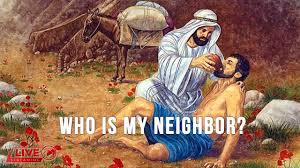
When Jesus was asked, “Who is my neighbor?” he told the parable of the Good Samaritan. Today, the answer is the same. Our neighbors are the immigrants and refugees at our borders. Our neighbors are the people across the street. Our neighbors are the ones who need love, not suspicion. And while laws cannot love our neighbors, we can. I may not change the world. But I pray that I can make a difference in one life. And if each of us does the same, then together—we can bring change.
Let it be so. Amen.

 Aging Capriciously