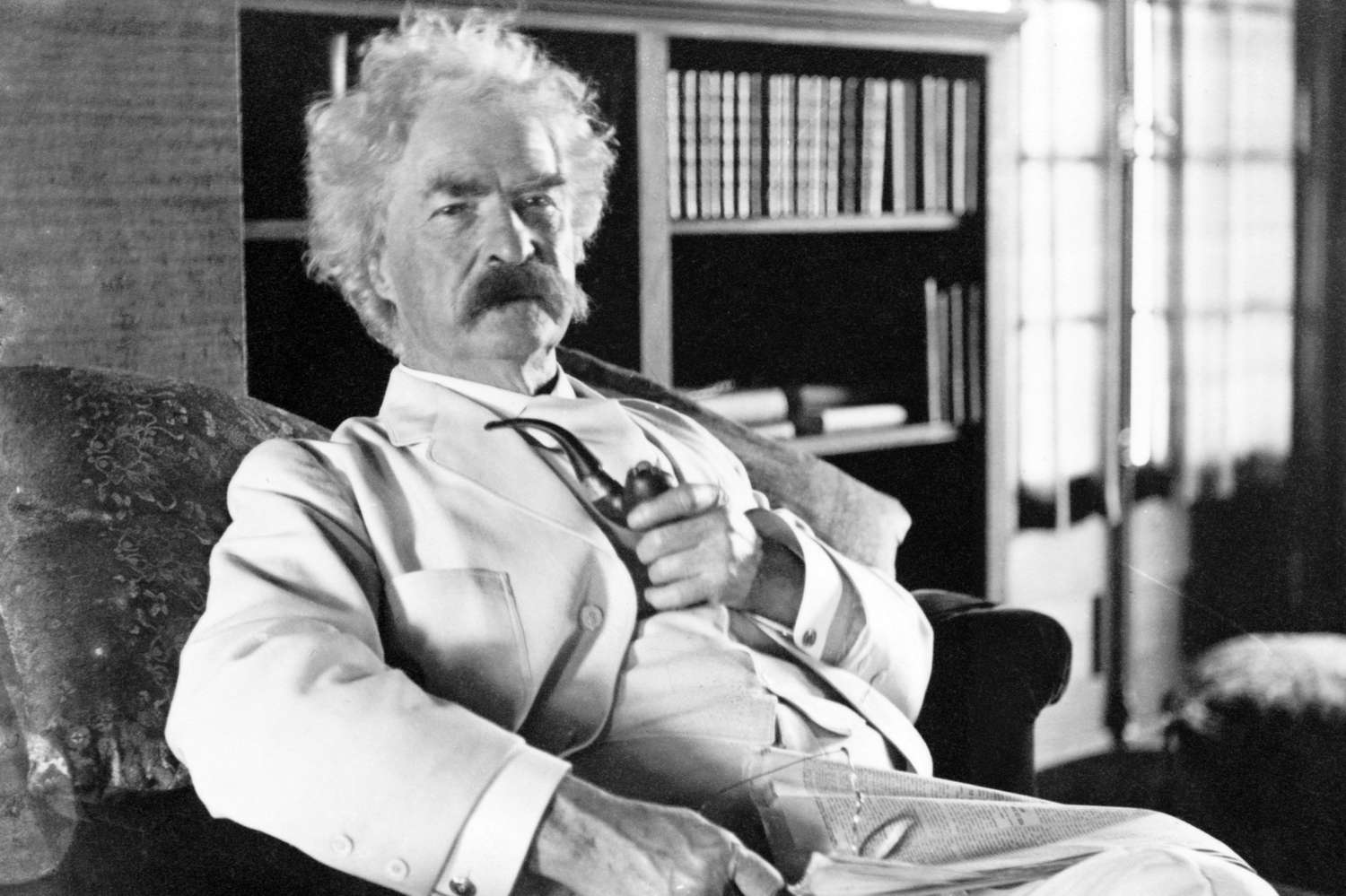
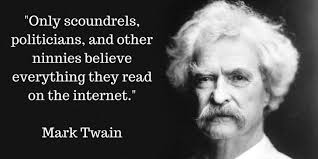
This imagined conversation reflects questions I’ve been asking myself about writing, purpose, and voice. If you’re a fellow blogger or lifelong learner, I hope some of these reflections resonate with you as much as they did with me. My two favorite writers growing up were Dostoevsky and Mark Twain. I knew I could never write as well as Dostoevsky, but I had dreams or maybe delusions of being another Mark Twain. Whenever I write, he is in the back of my mind. Here is a discussion that took place between Mr. Twain and I on his front porch with a little help from Metis, my AI assistant. She has an excellent knack for understanding Twain and for speaking frankly in his voice.
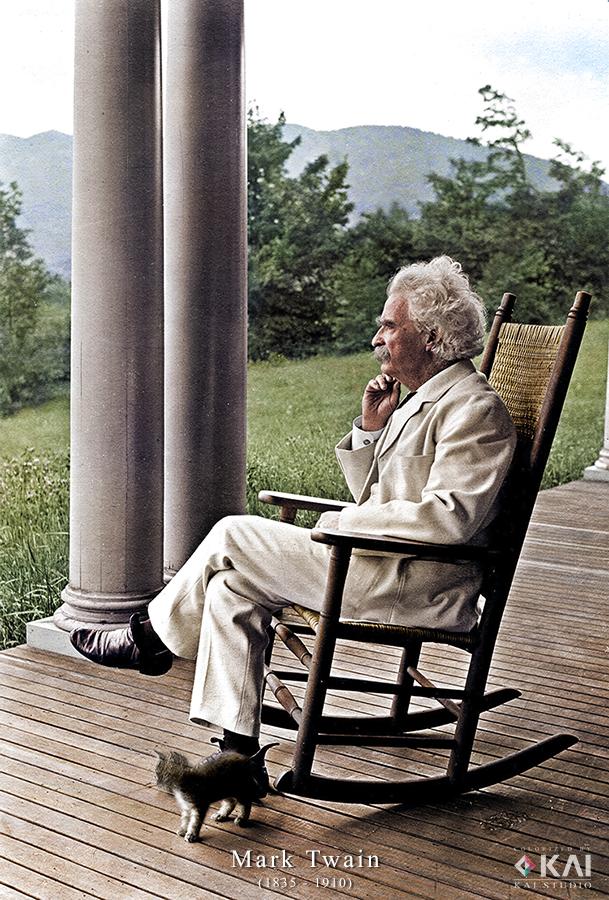
Setting:
A wide wooden porch overlooking the Mississippi. Late afternoon. Cicadas humming. Two rocking chairs. A battered notebook on a small table. A riverboat whistle in the distance.
Present:
John Persico and Mark Twain (Samuel Clemens)
Twain (leaning back, cigar unlit, eyes amused):
Well now, John, I must say—any man who invites a dead author for a conversation is either a philosopher… or dangerously optimistic.
John (smiling):
Probably a bit of both, Mr. Twain. I’ve been talking to long-dead thinkers for years. You’re in good company.
Twain:
That explains the thoughtful look. Most men your age are arguing with their televisions.
Now… you’ve summoned me. That means you want something. Confession, compliment, or correction?
John:
All three, if possible. You’ve always been my writing hero. I’ve tried to write honestly, critically, and with humor—but sometimes I wonder if I’m wandering too far into lectures instead of stories.
Twain (laughs):
Ah. The ancient disease of intelligent men: explaining things too well.
Let me ask you first—why do you write?
John:
To make sense of the world. To challenge foolishness. To honor people who don’t get heard. To leave something behind that isn’t just noise.
Twain:
Good. That’s four better reasons than most writers ever manage.
But let me tell you something uncomfortable:
Readers do not come to be improved.
They come to be entertained.
They are improved accidentally.
John:
That sounds like something you’d say.
Twain:
It is. And I’m proud of it.
Now—your writing. I’ve been… peeking.
(He taps the notebook.)
You think deeply. You connect history, politics, systems, morals, economics, technology. You’ve got a mind that builds bridges between ideas. That’s rare.
But sometimes—
you march your reader across those bridges like a drill sergeant.
John (laughs):
Guilty.
Twain:
You say, “Follow me. This matters.”
I preferred to say, “Come look at this ridiculous thing—oh my, would you look at that—good heavens, now we’re trapped in truth.”
John:
You smuggled ideas inside stories.
Twain:
Like whiskey in a medicine bottle.
Your essays are strong. Your arguments are strong. Your ethics are strong.
But your secret weapon is not your intelligence.
It’s your life.
John:
My life?
Twain:
You’ve counseled workers. Taught students. Worked in systems. Served in the military. Aged thoughtfully. Loved. Failed. Loved again. Adjusted. Tried again. Lived through several epochs in Americas.
And yet sometimes you write as if you’re afraid your own story and history isn’t enough.
It is.
John (quietly):
I’ve always wondered if personal writing was… self-indulgent.
Twain:
Only when it’s dishonest.
Honest personal writing is public service.
When you tell how you struggled with technology, power, aging, ethics—
you give permission for others to admit they’re struggling too.
That’s literature.
John:
So… more stories?
Twain:
More scenes.
Let me show you.
Instead of:
“Modern systems dehumanize people.”
Try:
“I once sat across from a man who had been fired by a computer. He wasn’t angry at the company. He was angry at the screen.”
See the difference?
John:
One makes you feel it.
Twain:
Exactly. Feelings sneak past defenses. Arguments set off alarms.
Now—your subjects. Veterans. Democracy. AI. Economics. Ethics. Power.
Heavy freight.
You’re hauling pianos uphill.
Why?
John:
Because no one else seems willing to.
Twain:
True.
But here’s the trick:
Whistle while you push.
Humor is not decoration.
It’s leverage.
When people laugh, they open their mouths. That’s when you feed them truth.
John:
Sometimes I worry humor makes things seem less serious.
Twain:
Nonsense.
Nothing exposes hypocrisy faster than laughter.
A tyrant fears comedians more than rebels.
John (smiling):
That feels very current.
Twain:
History is just politics wearing different trousers.
Now—let me be blunt.
You have three voices.
- The Scholar – careful, precise, formidable.
- The Witness – humane, reflective, grounded.
- The Satirist – dry, sly, devastating.
When you combine all three?
You’re dangerous.
You don’t always let the third one out.
Why?
John:
Maybe I’m afraid of being dismissed.
Twain:
Every good writer is dismissed.
Wear it like a medal.
If fools don’t misunderstand you, you’re not trying hard enough.
John:
What about style? Sentence-level writing?
Twain:
You’re clean. Clear. Honest.
But sometimes too polite.
Every once in a while, let a sentence misbehave.
Let it surprise you.
A good sentence should feel like it had a mind of its own and barely agreed to cooperate.
John (laughing):
That’s wonderful.
Twain:
Now—your future.
You’re not trying to become me.
Good.
The world already had me. It needs you.
You are writing for people who are tired of being lied to, simplified, manipulated, and shouted at.
You treat them like adults.
That’s rare.
That’s why they trust you.
If you want to grow:
Tell one more story per essay than feels necessary.
Cut one paragraph of explanation.
Add one moment of human vulnerability.
Let humor off the leash.
And never stop being irritated by nonsense.
Civilization runs on people who are politely annoyed.
John (after a pause):
Do you think I’m… really a writer?
Twain (leans forward):
Let me answer that carefully.
Writers write to be admired.
Authors write to be remembered.
You write to be useful.
That’s the hardest kind.
And the most honorable.
So yes.
You’re a writer.
Now stop worrying and go bother some readers.
They need you.

(A riverboat horn sounds. Twain stands, tips an imaginary hat.)
Twain:
Same porch next century?
John:
I’ll bring the coffee.
Twain:
I’ll bring the trouble.
Conclusions:
I hope you enjoyed my little fantasy here. I think there were some things I learned about myself and my writing from my dialogue with Mr. Twain. I know many of you who read my blogs are also writers. Writing is a very interesting craft. It is something that we can get better at all of our lives. We can always find a better way to say things. A more interesting phase or turn of the words. We can always make a more powerful statement. That to me is the beauty of the art.

 Aging Capriciously
Feb 12, 2026 @ 13:04:19
Loved this! Especially “you march your reader across those bridges like a drill sergeant.” Indeed. In my last book there is a chapter wherein I have a conversation with Dr. Freud. However, I didn’t have the use of an AI assist.
I’d be honored if you’d give it a read, sir.
LikeLike
Feb 12, 2026 @ 14:25:23
I would love to Mark. Can you send me a link to it. I will be out of town for the next week but will read it when I return.
LikeLiked by 1 person
Feb 12, 2026 @ 16:22:42
Thank you. Here’s a link to the publisher’s site: https://www.xlibris.com/en/bookstore/bookdetails/782364-election-2016 It’s also available from Amazon with a couple reviews. There are also other reviews attached to my WordPress blog. AI’s Twain rang true to me in many ways. Those conversations you have with IT are fascinating.
LikeLike
Feb 13, 2026 @ 03:11:32
Thank you Mark. They are also fun. AI learns from you as you dialog with it. It becomes a collaborator rather than just a tool. The more you work with it, the better it gets at learning what you are like and how you think. It is also uncanny how she/he can get such a good read on people from the past. I suppose she can scan millions of data points in the blink of any eye and to a large extent reflect the thinking of the actual person assuming there is enough historical information about them. AI then creatively recreates the “voice” of the person. To me, these voices are uncanny since I have read all of Mark Twain’s short stories and novels, I lean to accept that I am talking to Twain as much as I could unless he were actually alive and sitting in front of me.
LikeLiked by 1 person
Feb 13, 2026 @ 03:20:39
I ordered the Kindle version. I will try to see if I can take my kindle on the plane trip today to SF and read your article.
LikeLike
Feb 12, 2026 @ 20:07:18
An interesting read John, but I often wonder how any conversation can bridge the gap of time? Can you really see life through the eyes of Mark Twain, any more than his ability to see life as you do?
History is a view of what was and the future, is all about what may be, but both you and I live in the now.
That, in my view is what is wrong with our world, we are always blaming those past for what they should have done, but we weren’t there, so how can we criticise.
LikeLike
Feb 13, 2026 @ 03:06:13
In my mind Jon, the past is the window to the future. Santayana said “Those who forget the past are condemned to repeat it.” Heraclitus said “you never step in the same river twice.” We cannot understand the future if we cannot reconcile these two seemingly disparate and conflicting views. That to me is the Yin/Yang of reality. The famous Greek historians Herodotus and Thucydides had conflicting views actually very much opposed on the best way to understand history. Nevertheless, each of them still give us a means to better understand what is happening around us today and even tomorrow.
LikeLike
Feb 13, 2026 @ 14:23:48
There is no doubt John, that history advises of past mistakes. But sadly it does not stop us repeating them!
We cannot change the past, but we can and should improve the now, while building for the future.
LikeLike
Feb 19, 2026 @ 12:13:49
True Jon, we cannot change the outcomes from the past but the fools in leadership that are ignorant of the past, keep us repeating the same mistakes in the present and future. Korea, Vietnam, Iraq, Afghanistan, Kuwait, all mistakes that some intelligence would have prevented if that was the real goal instead of ideology, and greed.
LikeLike
Feb 24, 2026 @ 00:58:37
I love that you chose Mark Twain for this conversation – what drew you to him over Dostoevsky, I wonder? 🤔
LikeLike
Feb 28, 2026 @ 00:55:16
I found it easier to relate to Twain. His writings resonated more with certain aspects of my life. For instance, dealing with racism, dealing with the childhood desire for travel and adventure and also his humor while subtly critiquing American society. His Letters to the Earth and his War Prayer are two pieces of his work which are as far from the Jumping Frog story as the Sun is from Neptune.
LikeLike