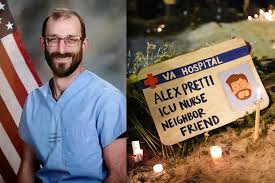
The Ballad of Alex Pretti

Introduction

Some stories do not ask to be told.
They insist.

They rise up from cold streets and broken lives and troubled consciences, and they refuse to be buried under official statements, polished press releases, or convenient forgetting. They stay with us. They trouble our sleep. They whisper, “What will you do with this?”

The story of Alex Pretti is one of those.

He was not famous. He did not seek attention. He did not set out to become a symbol. He was a nurse. A healer. A man who believed that helping others was not an occasional act, but a way of life. On a bitter January morning in Minnesota, he carried that belief into a public square—and paid for it with his life.

What follows is not just a poem.
It is a witness.
A remembrance.
A refusal to let truth be erased.

The Ballad of Alex Pretti

On a January morning, bitter and gray,
When Minnesota’s breath froze night into day,
While most stayed hidden in quilted retreat,
One man rose steady on compassionate feet.

Alex Pretti, a healer by trade,
Tended brave souls in the debts war had made,
An ICU nurse with a heart open wide,
Who served those who served—no comfort denied.

That morning he walked where the cold winds cried,
To stand for the weak, to stand for the right,
At a rally for peace, with justice in sight,
Where freedom still flickered in shadowed light.

A few days before, another had fallen,
Renée Good—her name softly calling,
A mother, a poet, a keeper of flame,
Struck down while peace was her only claim.

Two watchers of order, two keepers of calm,
With nothing but courage and outstretched palms,
Both standing firm in a fragile land,
With nothing but truth in their trembling hands.

Then chaos descended in armored form,
With shouted commands and chemical storm,
A woman was hurled to the frozen ground,
And Alex ran forward at mercy’s sound.
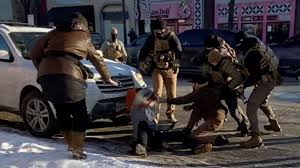
They sprayed him blind with burning pain,
They crushed him down in iron rain,
Six bodies upon him, fists and knees,
Power unleashed without restraint or ease.

They found his weapon—still untouched,
No threat displayed, no finger clutched,
No cry for violence, no shot returned,
Only a conscience that fiercely burned.

Then thunder spoke—two shots rang clear,
And Alex fell to a silence severe,
His body stilled on the icy street,
Where justice and cruelty cruelly meet.

They stepped away… then fired again,
Eight more times into the fallen man,
As if death itself were not enough,
As if mercy were weak and hatred was tough.

No hands reached out, no aid was given,
No prayer rose up to the wintered heaven,
A good man lay where freedom bled,
While truth grew quiet among the dead.

And later came voices, official and loud,
Draped in uniforms, wrapped in their pride:
“They were not peaceful, they were the foe,
They were paid, they were violent, they had to go.”

Terrorists, rioters, enemies named,
Their memories twisted, their honor shamed,
But cameras remember what power denies,
And witnesses speak what survives the lies.

They saw him fall while shielding a stranger,
They saw his courage outweigh the danger,
They saw a man choose love over fear,
When the cost was life and the end was near.

For heroes are not those crowned by command,
But those who stand when others can’t stand,
Who give their breath so others may breathe,
Who plant their hope in frozen grief.
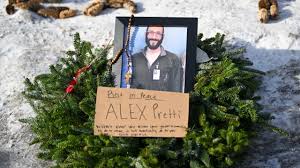
So sing his name in winter’s cry,
Let Alex Pretti never die,
For every heart that still believes
In justice, compassion, and mercy’s leaves—

His story lives in every soul
That dares to make a broken world whole.

Reflections on the Ballad of Alex Pretti

When the last verse is read, the danger is that we will sigh, feel sad for a moment, and then move on.

But stories like this were never meant to be “consumed.”

They were meant to change us.

Alex Pretti did not die because he was reckless.  He died because he was decent.  Because he stepped forward when it was safer to step back.  Because he chose compassion when fear was being weaponized.  Because he believed that another human being was worth protecting—even at great personal cost.

The real question his life leaves us is not “what happened to him?”

It is what happens to us now?

Will we remember?
Will we question easy lies?
Will we defend the vulnerable?
Will we insist that power answer to truth?

If we do, then Alex’s life was not silenced.
It became a call.

And it is still calling.

On May 12, 2025, Acting Director Todd Lyons authored a secret memorandum that was later leaked by a whistleblower. ICE officers were told to follow the memo’s guidance instead of written training materials. It authorized ICE officers to forcibly enter people’s homes without a judge’s warrant:

‘Although the U.S. Department of Homeland Security (DHS) has not historically relied on administrative warrants alone to arrest aliens subject to final orders of removal in their place of residence, the DHS Office of the General Counsel has recently determined that the U.S. Constitution, the Immigration and Nationality Act and the immigration regulations do not prohibit relying on administrative warrants for this purpose.’[11]

Administrative warrants are generated and signed by ICE agents and are not approved of by either federal district court or magistrate judges.[12] Historically administrative warrants were used to arrest individuals in public places, and only judicial warrants could authorize ICE agents to enter private residences.[12] The practice described by the memo is likely a violation of the Fourth Amendment which requires a warrant issued by a judge to authorize physical intrusion into private residencies.[13] Although addressed to all ICE officers, the memo was only shared with select DHS officials who were directed to verbally brief this policy to ICE officers during training.[12][13] The memo was to be kept confidential under risk of potential firing

Thinking about Immigration, Part 3: Living in the Path of Illegal Immigration.

Six months of the year I am what they call a “Snow Bird.”   Karen prefers us to be called “Winter Residents.”   We live in Arizona City.   It is south of I-8 and just west of I-10.  It has been a major corridor for coyotes, drug runners and illegal or undocumented immigrants. There is hardly a week that goes by that we do not have coffee shop stories of found pot bales, abandoned vehicles, spotters hiding in caves and illegal’s coming to homes asking for water or food.  These stories are supplemented by our almost daily observations of border patrol vehicle searches and regular high speed police runs. One of our visitors commented that she had never seen so many police vehicles in her whole life as in our area.

Caution Ilegal immigrantsLast fall, one elderly resident who lived out in the desert was found murdered in her home. Nothing was missing but no suspects have been found. There are many folks in my area who will not venture out in the desert without being armed and there are many areas where you are warned to stay clear of.  I routinely jog in the Casa Grande Mountains and while relatively safe, there have been drug busts and roundups of drugs and illegal immigrants within the past few months.  A short time ago, I found a rifle with a telescopic sight and a sawed off butt behind a cactus.  I turned it into the police station where they were not too concerned about it. To date, my biggest danger while jogging has been a cactus that is known as a “jumping Cholla.” These things seem to magically find a way to get attached to you and their barbs are quite painful.  I have had at least six attacks by them during the past few months.

GatedThe picture I am trying to paint for you, coupled with the fact of the ongoing drug war in Mexico, which is only about 120 miles from our front door (47,000 deaths and counting), is designed to give you some idea of the context in which many Arizonians find themselves.  Gated communities, suspicion of neighbors, fear of criminal break-ins and an overall worry about the poor economy, housing foreclosures, and jobs (Arizona has led the nation in many of these problems) gives rise to a citizenry which is far from tolerant of anyone coming over illegally into this country. There is a great deal of fear in the nation as a whole ever since 9/11 and nowhere I think is it more evident than in Arizona.  Fear and tolerance do not go hand in hand.  However as Ben Franklin noted “Those who would give up their freedom for safety will soon find they have neither.” It is difficult to counsel this advice though when neighborhoods cannot be made safe and people are afraid that they will become victims.  So what does this have to do with stopping illegal immigration?  Let me turn the clock back to help answer this question.

Migrant farm workersIn 1963, I was sent to an Air Force station located in Osceola, Wisconsin.  Coming from the East coast, I could not have told you where Wisconsin was if my life depended upon it.  Furthermore, to be dropped into the middle of “Dairy Farm USA” was a major culture shock.  Nevertheless, I adapted by marrying a woman from Thorp, Wisconsin and having my daughter Christina born in Osceola.  Life was good for me in the service but money was short.  I found local employment doing migrant farm work and obtaining a part-time job (to supplement my military income) at a local nursery called Abrahamsons.  It was at this place, that I had my first meetings with Mexican farm workers.  Each season, Abrahamsons’s would bring in workers from Mexico to work at the nursery. The work involved digging, balling, burlapping, loading and then digging to replant trees for wealthy buyers in Edina and the Twin Cities.  It was hard work.

Chart-farmWe dug trees and loaded them from 6 AM to often after 9 PM at night.  I was paid one dollar per hour.  I do not know what my Mexican counterparts were paid because they could not speak English.  I could not speak Spanish and my bosses warned me to never discuss salary with the other workers. Thus, I spent my days working in the fields, sharing food but no conversation with the other workers.  Believe me when I say there were few local non-Hispanic people applying for these jobs.  I have since been to other areas of the USA including Mackinac Michigan and Door County Wisconsin, where they rely on immigrant workers to provide services to locals and tourists. To say that illegal or legal immigrant workers are taking jobs and bread from the mouths of Americans is a shallow and false bit of rhetoric.  I have heard it said that if these undesirable jobs were not taken by immigrants then the wages would go up and USA workers would then apply for them.  This bit of fantasy ignores two possibilities: 1. The work could go overseas to even lower wage workers or 2,  The Law of Substitution says that other higher value added services could replace services that become too costly.  In any event, I have yet to see the “older” immigrants from America who are now second generation citizens clamoring for these hard dirty and low paying jobs.

bracero statesSo year after year, from the middle 40’s to the late 60’s, immigrants came over from Mexico and South America on a seasonal basis.  Each year millions of these Bracero program workers would come and work in the USA.  Most would go back home after the work was over.  Some would apply for citizenship and stay in the US. The Bracero program favored Hispanic workers (there did not seem to be many Canadians or Europeans looking for farm work) and it seemed to create a rather orderly and neat influx and outflow of labor seasonally needed by US employers.  Then the program was changed.  Barred from working seasonally and denied access to work permits, many Mexicans and other Latinos took the easy road.

Illegal yes, enforced no.

US-Mexico_border_fenceThat is until 9/11, when all hell broke loose.  Never in the past 100 years had USA citizens felt as vulnerable as after 9/11.  Fearing for an influx of terrorists and watching unparalleled amounts of drugs crossing the border, we reacted to our fears by passing the Patriot Act, by beefing up Homeland Security, by building Border Walls, by making it a felony to repeatedly try to cross our borders, by greatly expanding the Border Patrol and by building large detention centers in the Southwest.  My county Pinal is often referred to as “Penal County” and has numerous detention centers to house drug runners and detainees awaiting deportation. The number of anti-immigration bills started to proliferate state by state as the Federal government seemed impotent to deal with the crisis.  Citizens armed themselves and formed watchdog groups to police our borders with Mexico.  No one really seemed worried about those Canadians.  I suppose ever since prohibition was rescinded, the Canadians have stopped smuggling whiskey across the border and are less of a threat to the US.

prohibitionSo let’s ask a simple question here?  Why do all of these illegals come to the USA? The answer is easy. Two reasons: Jobs and drugs.  I wonder if the solution to the problem seems as evident to you as it does to me.  First, legalize drugs.  Let the government tax them and let anyone sell them just like cigarettes, coffee and alcohol are sold. We have spent billions on a fruitless drug war and we have accomplished nothing.  Furthermore, in light of all the drugs that Americans take, it is a hypocritical war to begin with. It is a war waged by idiots and morons who keep our prisons, courtrooms, and lawyers sucking our taxes and wages for no apparent gain. It is perhaps the most ludicrous endeavor that has ever been created.  It makes Alice in Wonderland look like a reality show.  We have become so blinded by the anti-drug rhetoric that we no longer have the ability to see reality. What did we learn from Prohibition?  “THOSE WHO FORGET THE PAST ARE CONDEMNED TO REPEAT IT!” Banning alcohol did not stop the use of liquor nor did it curtail organized crime.  On the contrary, it gave organized crime the income and mandate to expand its power and territory and become even more powerful and dangerous. The same is true for the South American drugs, primarily pot and coke that we are trying to banish. The drug cartels have become so rich and powerful, they are immune to any efforts to abolish them.

bracero-program-poster-series_NTOkThe second reason illegals come over is to find work and to have a better standard of living.  To help others accomplish this, we need to create a new policy for temporary and migratory workers that represents the nature of work needed by immigrants and by employers in the USA. This policy needs to be fair and equitable but also realistic. The relationship we have with Mexico cannot be dictated by the relationships we have with Canada, Europe or any other countries. We need an equitable policy, but there is a difference between equity and equality.  A fair and just policy must create a win-win both for our nation and for the immigrants we give visas or sanctuary to.  There cannot be one size fits all for this policy.  Part of this policy must be humanitarian.  It is in our constitution and in our national charter to help others escape from tyranny, poverty and other calamities.  Part of our immigration policy must also be self-serving.  We need to help our country become stronger and to better meet the needs of competing in a global economy.  Realistically, we may have a cost attached to immigration.

Despite many arguments on the negative and positive costs of immigration, the best evidence to support a more liberal immigration policy is to look at our success as a nation over the last 250 years.  Can anyone doubt that it was immigration that built and fueled the development of this great nation?  We may need to balance short-term costs with long-term gains in a realistic immigration policy but a good policy needs to be slanted towards tolerance for immigration and not intolerance.

I have one final idea. Let’s take the development of an immigration policy away from the politicians and appoint a group of immigration experts from a wide range of viewpoints. Take twelve experts on this subject and put them in a room together.  Give them four weeks to hammer out a new immigration policy. When they are satisfied that such a policy is realistic and equitable, let them distribute this policy to the newspapers and Internet websites for a review by American citizens.  After four weeks of review, let there be a national referendum on the policy.  A plurality of sixty percent should be needed to pass. If sixty percent cannot be reached, the policy will be returned to the experts for further changes and amendments. Once a plurality of American voters has accepted this policy, it would be sent to the Senate and House for review and to become law.  Woe to them if they could not finalize this policy.

Time for Questions:

There are many things you can find wrong with my suggestions. I can hear all the reasons why these ideas would not work. The question I have for you is this: “Can you find any better ideas.” The definition of craziness is to keep doing the same thing and expect different results.  Maybe it is time we tried some new ideas; as Einstein said: “Problems cannot be solved by the same level of thinking that created them.” We need to discard our prejudices and biases and see things in a new light. What do you think needs to be done?  When was the last time you wrote your representative to express your ideas?  When was the last time you went to a party caucus or actively worked to help elect a representative?  What could you do to help create a new and fair immigration policy for this country?

Life is just beginning.

“The interaction of disparate cultures, the vehemence of the ideals that led the immigrants here, the opportunity offered by a new life, all gave America a flavor and a character that make it as unmistakable and as remarkable to people today as it was to Alexis de Tocqueville in the early part of the nineteenth century.”  ― John F. KennedyA Nation of Immigrants