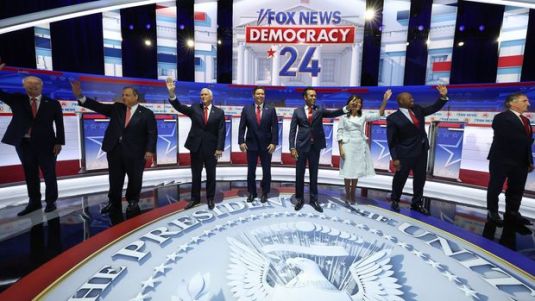
Emcee:
We are here tonight for the 17th of the 20 Presidential debates. After the first sixteen debates, 10 of the candidates dropped out leaving only three remaining candidates. For tonight’s debate we have Senator Tweedle Dee former Senator from Iowa, Governor Tweedle Dumb from Virginia and CEO Tweedle Dumber, a billionairess who has risen rapidly in the polls.
There are three moderators for tonight’s debate. Angelica Cutesy from Fox News, Whiney Adams from CNN, and Gotcha by the Balls from MSNBC. There will be three questions for the candidates from five different subject areas. The areas will include climate change, the economy, abortion, gun rights and schools. Each moderator will select one question in each subject area from a pool that was compiled by voters. Candidates will each have an opportunity to answer the questions. We will start with climate change. Angelica will select the first question.
Climate Change:
Angelica Cutesy: For the first question, I would like to ask Senator Tweedle Dee what he would do about climate change?
Senator Tweedle Dee: (softly singing)
Thus be it ever, when freemen shall stand
Between their loved homes and the war’s desolation!
Blest with vict’ry and peace, may the heav’n rescued land
Praise the Pow’r that has made and preserved us a nation.
Angelica Cutesy: Isn’t that the second refrain from the “Star Spangled Banner” Senator and how will that help climate change Senator.
Senator Tweedle Dee: It’s clear that Americans are patriotic and if we all work together, we can solve climate change.
Governor Tweedle Dum: I support my opponent’s position on climate change 100 percent. Everyone in my state knows that I have done a great job to help keep things cooler in Virginia. I signed a bill authorizing payment of over $10,000.000 dollars to start up companies to help make more affordable air conditioning units. Most of the US Senators are now running air conditioners built in Virginia factories.
Whiney Adams: My question is addressed to CEO Tweedle Dumber. CEO Dumber, how would you go about dealing with some of the tragic aftermaths of climate disruptions that seem to be epidemic in the world today?
CEO Tweetle Dumber: That’s a good question Whiney. I think the answer is simple. As Margaret Thatcher said, “Any woman who understands the problems of running a home will be nearer to understanding the problems of running a country.” I not only run a home with a husband and three kids, I run a billion dollar a year business. I think that shows how qualified I am to solve the climate problems in this country. It is a simple matter of putting the bread on the table which I have demonstrated I can do.
Governor Tweedle Dumb: Well, a “stitch in time saves nine” CEO Dumber and you have never done any stitching in Government.
Senator Tweedel Dee: That’s right. It is one thing to run a business that has to be profitable, its another thing to run a government agency.
Gotcha by the Balls: Well, I get the third and last question in this category and my name isn’t Gotcha by the Balls for nothing. Many Americans are concerned that water temperatures are rising, and it will be harder to get a good suntan at the beach if you can’t cool off in the ocean. If you are elected President, what will you do about it. I would like to have each of you answer this question.
Governor Tweedle Dumb: Coming from the great state of Virginia I have repeatedly talked about this problem. I formed a team of advisers to discuss what could be done to help cool off the ocean waters. One of the best suggestions we had is something we are now working on. We are developing feasibility studies to test how large an iceberg and how many icebergs we would need to cool our waters off during the summer beach season.
CEO Tweetle Dumber: I propose that we need more sun shelters on our beaches. I would sponsor a reality show contest to bring more projects to fruition for new and innovative beach umbrellas.
Whiney Adams: And how would these projects be paid for?
CEO Tweedle Dumber: We would put containers that look like surfboards for voluntary contributions wherever we have a state lottery or scratch offs. My advisors estimate that we would easily get at least one million dollars a year in contributions.
Senator Tweedle Dee: But your idea CEO Dumber only puts the burden on the poorest people in your state. The ones who can least afford it and who might not be interested in getting a good beach tan. Liberal ideas like yours are what is ruining this country.
Emcee: We will now move on to our second subject matter area, the economy. Mr. Whiney Adams from CNN will start us off with the first question.
The Economy:
Whiney Adams: I would like to address the first question on the economy to Governor Tweedle Dumb. Governor, how would you help make America more competitive, bring jobs back to our shores, give people a living wage and eliminate inflation without raising taxes?
Governor Tweedle Dumb: That’s a very good question Whiney and I think I am the only one running who is really qualified to answer that question. As Governor I had to manage a state budget and many or at least a lot of state employees. Let me tell you, it was not always an easy job. We have a saying in Virginia that “You buy cheap and weep.” We would never want to go cheap and have our citizens weeping. If I am elected as your president, I promise to never cheap out on what we need to do to keep America great. This is the greatest nation that ever existed on this earth, and I am proud to be an American, God bless the USA.
The Audience gives a standing ovation for the Governor
Whiney Adams: Great answer Governor. What do you think Senator Tweedle Dee and CEO Dumber?
Senator Tweedle Dee: Well, I think the Governor exaggerates quote a bit. If I remember an old phrase, it’s something like “Well, you ain’t no John Kennedy, Governor.”
CEO Tweetle Dumber: I’m a billionaire. I’ve managed and made more budgets than Governor Tweedle Dumb can probably count. My companies have run on time and made profits that would be the envy of any state government. In my companies, all of my managers know how to count.
Angelica Cutesy: For the second question on the economy, I would like to know how each of the candidates would deal with the rising threat from the Chinese? CEO Tweetle Dumber, you get to answer first.
CEO Tweetle Dumber: I would never have let the Chinese Spy balloon cross over into our economic airspace. This Biden government gives the Chinese too much leeway. I would start off by firing the Chinese Prime Minister and all of his economic advisers. Then I would make the Chinese send back most of the jobs that they have stolen from us. If they would not do this, I would cut off loans and economic aid to the Chinese government. In addition, I would ban the purchase of T-Shirts made in China in the USA.
Another Standing Ovation and Rousing Applause from the Audience
Gotcha by the Balls: Hold on a minute there Partner. Some of those ideas will never fly. You can’t ban T-shirts made in China. Where would Nike, Harley Davidson, Budweiser Beer, and Elon Musk get their T-shirts?
CEO Tweetle Dumber: Well, I would allow an exemption for certain companies to insure that the law does not negatively impact some of our great companies.
Senator Tweedle Dee: CEO Dumber’s ideas seem like flagrant favoritism. As a 100 percent dyed in the wool American, I am dead set against favoritism. “We need to stop planting flowers in people’s yards who are not going to water them.”
Governor Tweedle Dumb: I always water my own flowers. I don’t care where we water our flowers as long as it is not in China.
Not Quite a Standing Ovation but Rousing Applause from most of the Audience
Gotcha by the Balls: I guess I get the final question on the economy. Not much left to discuss in terms of the economy but I am going to try to punch for the BALLS. My question concerns the tax filings for each of the candidates. Governor Tweedle Dumb, you reported earnings of only five thousand dollars in the past five years. Senator Tweedle Dee, you reported earnings of only one thousand dollars in the past five years. CEO Tweedle Dumber, you reported negative earnings for the past ten years. Can each of you explain how you were able to live on such meager earnings. Governor Tweedle Dumb, you get to go first.
Governor Tweedle Dumb: “Gotcha”, that is a great question, and I am glad that you asked it. You know when I was growing up my family believed in hard work and frugality. I grew up on a little farm in Wisconsin and every day before walking five miles to school I had to milk our cows. I learned the meaning of thrift and respect for the common laborer. If I am elected, I will do everything I can to help make sure that no children have to walk five miles to school after milking their cows.
Senator Tweedle Dee: I am going to jump right in on this question. I also think it is a great question. I want my constituents to know, and I think that most of them do, that I never rest. I am looking out for their interests every minute I am on the job. We live in the greatest nation on the face of the earth. When our forefathers founded this country, they wanted to insure that every American had the right to life, liberty, and the pursuit of happiness. If I am elected, I will do my best to guarantee that every red-blooded loyal patriotic American has these rights. You know, I wish I had somebody to help me sing this
America, America, God shed his grace on thee
America, I love you America, you see
My God he done shed his grace on thee
And you oughta love him for it.
Angelica Cutesy: Stands up and applauds loudly. “Wonderful job Senator. You have my vote.”
Whiney Adams: Hold on there Angelica, we are not supposed to be endorsing any candidates
Angelica Cutesy: Sorry, I just lost it for a minute.
Gotcha by the Balls: Lets get back to the question Ok. We still have not heard from CEO Tweedle Dumber. CEO Dumber, how do you explain your negative tax returns when you are a billionairess?
CEO Tweedle Dumber: Its not easy being rich. You have people on all sides who want something from you. I give to charities on one side, schools on another side. Not a day goes by when I am not giving money away. My boats, planes and cars cost me an arm and a leg. My alimony for my ex-wives would bankrupt most Americans. Truth be told, even though I am a billionairess, I can hardly afford a Starbuck’s Carmel Macchiato Latte Almond Cream coffee every day. I have two accountants just to pay my bills. Many the day when I wish I was only a millionairess again.
Angelica Cutesy: Very sorry CEO Dumber, I wish we could help you out. Maybe someone in the audience could start a Go Fund site to help you out with the Starbucks Coffee
CEO Tweedle Dumber: Such a nice offer Angelica, as we say in my business, we get BUY with other people’s money.
Emcee: Well folks, so far, it’s been a great debate. Many questions and issues addressed but we still have more issues to deal with. Right now, we are going to take a break and let everyone catch a breath. We will be back soon with Part 2 of our debate dealing with the remaining three issues: abortion, gun rights and schools
Stay tuned Bloggers. Part 2 will be out soon.

 When I started working with Process Management International in 1986 after completing my doctorate degree at the University of Minnesota, I met the famous quality improvement expert and renowned statistician, Dr. W. E. Deming. Over the next seven years, he had the most profound influence on my life in terms of helping me to understand process improvement, statistics, quality and the use of Data to improve everything from widgets to health care. Under the influence of Dr. Deming, our company adopted his motto “In God we trust, all others bring Data.” Dr. Deming also said “Without Data, you’re just another person with an opinion.” So what is Data?
  If we understand what Data is, you have now entered the deep forest. However, we have a long way to go before we can get out of the forest. There are numerous obstacles along the way. Referring again to the concepts of validity and reliability, we must ask ourselves the same questions we asked about our Facts. Is our Data reliable and valid? How did we collect the Data? What method did we use to collect the Data? Are we taking a few samples each day for several weeks or are we taking a few samples for only a few days? Are we using a random sample or a stratified random sample? Different methods of collecting Data will lead to different results. And we are not even talking about interpreting the Data yet. For instance, when I worked at W.T. Grants cutting shades back in the late 60’s, I was told to make sure I took my measurements with a metal tape measure and not a cloth or plastic measure. The reason given was that it was easier to stretch a cloth tape measure and get a false result. This would lead to cutting a shade that was too large and would not fit.
 Unfortunately, the scientific method is not infallible. It is subject to bias and disagreement over Data and interpretations. Even more problematic is that the scientific method is not a strong method when it comes to testing subjective theories that cannot be verified by Fact. For instance, “Is the Mona Lisa beautiful?” As stated, this is a subjective question that each individual will hold a different opinion on. However, if I asked: “Is the Mona Lisa the most beautiful painting in the world?” I could attempt to answer that question with a bit more objectivity. I could conduct a survey to see what percentage of people think it is the most beautiful. Subjective studies are not as strong as objective studies since they usually lead to results that follow a bell shaped curve. Thus, if we conducted the above survey, we would probably find that a certain percentage of people thought it was the most beautiful painting and a certain percentage did not. As in politics, opinions of beauty would be all over the place. This is why politics is so much more difficult to “Fact check” than issues like the atomic mass of hydrogen. Politics is a very subjective field that resists efforts to test and Fact check. Some examples that would be difficult to test with the scientific method would include:
 Finally, if I have left you with some understanding of the difficulty with interpreting Data, I will have felt successful. The first step to knowledge is awareness of our cognitive limitations. We also need to be more skeptical when people present us with Facts and Data. My father used to say “Believe nothing of what you hear and half of what you see.” I still consider this good advice. There are too many fools and charlatans out there trying to convince us of things for a multitude of reasons that will benefit them and not us. Just as we would not walk down a dark alley in an unknown city by ourselves, we need to exercise caution when presented with Data and Facts. The more we understand the limits of Data and Facts, the more prepared we will be to make decisions based on Data and Facts that have a higher degree of validity and reliability. If the Data, Facts and Evidence that you base your knowledge on are not accurate than everything you think you know will be at best a half truth and at worst a total lie.
 Aging Capriciously