 Introduction:
In the next few weeks, I am going to write a four-part series on Immigration. I am going to use Canada and Mexico as contrasts to demonstrate some of the issues concerning Immigration. Several years ago, I wrote a three-part series on Immigration policy. I have not gone back to review the former series as I wanted this series to be new and current. However, I strongly suspect that much of what I wrote about Immigration ten years ago would still be relevant today. If you are truly interested in Immigration, you can find my former series at “Thinking about Immigration – Part 1: We Need a Fair Immigration Policy – Not an Anti-Immigration Policy!”
What are the differences between Mexico and Canada? The most obvious difference is that Canada is North of the USA and Mexico is South. There are other obvious differences. The heritage of much of the population of Canada tends to be British and French. The heritage of much of Mexico and Latin America tends to be Spanish. Canadians speak mostly British, French, and sometimes American. Mexicans speak mostly Spanish and sometimes Spanglish. Canadians coming to the USA are usually Snowbirds and Mexicans and many Latin Americans come to the USA as Immigrants. Canadian summers may still find icicles hanging from roofs while in winter some Mexicans are laying on the beach drinking Margaritas. 😊 That’s all for the obvious differences.
Before I speak to the subtle differences, you might be wondering where all this is going to take you. Well, I hope to solve a question that occurred to me this morning while hiking in the desert. I thought “Why is there so many rocks in the Sonoran desert and no sand? Shouldn’t there be more sand if this is a desert?” Not really the pertinent question but it was a thought in my feeble brain. But I am taking you off on a tangent. The more pertinent question that popped into my mind was “Why do Mexicans who come to the USA want to stay and Canadians usually want to go home?”
Many Mexicans and Latin Americans come as immigrants and Canadians come as Snowbirds. Snowbirds go home. Immigrants stay. One obvious answer might be that many Mexicans feel a connection or heritage with the Southwest. Much of the states that are part of the USA today were once part of Mexico until 1854 and the Gadsden Purchase ceded a large area of Mexico to the USA. Many people living in Arizona have a family history that goes back hundreds of years, and many Mexican Americans have families that live just “South of the Border.” This alone would make a large difference in a propensity to immigrate versus Snowbird.

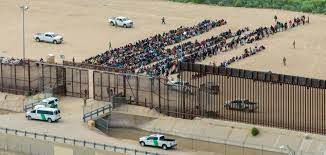
I thought “What if we could figure out why Canadians go home. If we knew the answer to that question, perhaps we could figure out a way to get more Mexicans and Latin Americans to go home or not come here in the first place.” This could greatly lessen the migrant problem at our Southern border. Make no mistake, whether you are radical, liberal, progressive, conservative, Democrat or Republican, there is a humanitarian crisis going on in the USA.
Thousands of people come to our borders every day seeking asylum or a better life. “The predominant reasons immigrants say they came to the U.S. are for better work and educational opportunities, a better future for their children, and more rights and freedoms. Smaller but still sizable shares cite other factors such as joining family members or escaping unsafe or violent conditions.” (KFF.org). Many of these people are unjustly accused of crimes or other deviances that we do not want in our country. The poem on the Statue of Liberty reads in part:
 “Give me your tired, your poor,
Your huddled masses yearning to breathe free,
The wretched refuse of your teeming shore.
Send these, the homeless, tempest-tost to me,
I lift my lamp beside the golden door!”
Fine sounding words but simply words to many people in the USA. Many Americans do not want ANY immigrants at all. Many people feel that we have too many immigrants seeking to come to America. No one that I am aware of in politics has ever addressed the issue of just how many immigrants can America absorb. According to the 1900 census, the population of the United States was 76,212,168. This was a 21.01% increase from the 1890 census, which recorded 62,979,766 people. The 1900 census also found that 14% of the population, or about 10.4 million people, were born outside of the United States. Today the population of the USA is close to 341,000,000 people. If we said that we could absorb 14% of this number for Immigration that would mean almost 48,000,000 people would be immigrants. Can our social structure and infrastructure really support this many people?
The main point that I made in my former series on Immigration was that we need a sensible Immigration policy and not an anti-Immigration policy. I had a t-shirt made with this thought printed in Spanish on the back. “Necesitamos una política de inmigración sensata y no una política anti-immigración.” Many Americans would have agreed with this sentiment when I bought this shirt ten years ago. Nevertheless, nothing substantial has been accomplished since then due to the partisanship of both political parties in the USA.
As I hiked my trail, I wondered more and more about the differences between Mexico and Canada. Not the obvious differences, but the subtle unseen differences. Differences like per capital income, infant death mortality, average life span, etc. Could these differences explain why so many Mexicans and Latin Americans want to immigrate to the US? The weather cannot be a factor since if it was the weather, we would expect to see millions of Canadians trying to sneak across our Northern border and apply for Immigration status. Instead, they come for a short while, soak up the sun and go home, where they promptly put on their parkas and mukluks. 😊
I am going to write this series in four parts. Part 1 is both an Introduction and what I will call a Narrative. Part 2 will deal with what I call Fantasies and Illusions of Immigration. Part 3 will deal with Immigration Facts. This part will look at the demographics and socioeconomics of both Canada and Mexico. Part 4 will deal with Lies or what the politicians say about Immigration to their constituents. Throughout this series, I am going to contrast Mexico and Canada since they are both our neighbors and to date probably account for most of both the Immigration and snowbirds who arrive at our borders. My main focus will be on the Immigration issue and to see whether or not the contrasts between the two countries can help us to focus on policies that will alleviate our current border crisis.
Narrative:
Karen and I have several friends who are either from Mexico or Canada. I decided to ask a good friend from Acapulco who married a US citizen why she chose to stay in the USA and what she liked and disliked about the USA. I will call her Margarita. She has been living in the USA for over forty years now. I also asked one of our Canadian friends (Emily) who has snow birded down to Arizona and the states for over twenty years what she liked and disliked about the USA. Following are the replies from each of our friends.
Margarita:
Margarita was 26 years old when a frequent vacationing visitor from the USA to Acapulco fell in love with her. They married and she moved from Mexico to Illinois with her husband. They raised a family of three children in Illinois. Margarita retired in Arizona after living in Illinois. Margarita has become one of our best friends in Arizona. She frequently drives down to Mexico and visits a variety of places where she donates food and other necessities to some of the needy in Mexico. She is now in her 80’s and full of energy. She is very well informed and active in her church and the local community. The following is taken from an interview with Margarita by our good friend Socorro who is helping out with research for this blog. Margarita was asked by Socorro what she liked about the USA and what she liked about Mexico and what she disliked about each country.
“I had a beautiful life in Mexico. My family was close and loving. My uncle had an orchestra, and we were invited to dances and parties. By comparison, what I like now living in the United States, is that I can buy anything I want and need. But I did face discrimination at first in Illinois. We were criticized as the only Mexican family in town even though my husband was an American of Polish Slovakia descent. I had to show what I could do for the city and prove myself. The biggest project was fundraising for school band uniforms. Then can you believe that I introduced people to food like tacos?”
Mexico has changed by her observations. A nephew who came to the United States to work, and returned with the intent of forming a business was kidnapped and held for ransom. Even though it was paid, he was killed by the crime cartel. Her relatives don’t tell anyone that she lives in the United States for fear, that the same could happen to her when she comes to visit.
Her family has done well. Margarita attributes her home and travels to her husband’s providing for her financially. Her nephew who is a medical doctor wanted to come to the United States. It seems that he needed what seemed like a million dollars to show his worth. He made contacts in the medical community but is still an immigrant with Mexican credentials. While Margarita has coverage for her health in Arizona, she prefers to go to Mexico for her dental work to save money. So do many of her friends not only for a dentist but also for lower cost prescriptions.
Margarita is happy and healthy. Her children have moved to California for their own lives and work. She keeps busy with friends and church. She sums it up by saying, “I’m happy because I’m a happy person.”
Emily:
Emily is from Canada and is in her early seventies. She has been snow birding for over twenty years now to various places in the USA. For the past eight years she has been coming down to Arizona. Karen and Emily have a mutual interest in music and meet weekly to play dulcimers and ukeleles together. I asked her to describe what she likes about the USA and what she dislikes. The following is unedited and in her own words.
“Hi John, here you go!”
“The differences between our two countries are easily discernible on political, economic, and social platforms, but this old snowbird is going to address the question from a more personal perspective.
What do I like most about the United States? I love exuberance, the open-hearted generosity of spirit. Americans are the middle-schoolers of the world, in both the best and worst sense of that statement. If it can be done, there’s an American somewhere doing it. If it can be built, there’s an American building it. You embrace challenges, and face obstacles with courage. Individualism is applauded, encouraging self-expression. You have an unshakeable confidence in your own abilities, a confidence that is usually tempered by time and life. Visiting the United States is like a five-month trip to an amusement park, full of good times with friends, laughter, new experiences, colour, sparkles, loud music, and tasty food that isn’t good for us.
So why don’t I want to stay? For all the reasons above. Five months in an amusement park populated by middle-schoolers isn’t a comfortable lifestyle.
What do I like most about Canada. If Americans are middle-schoolers, Canadians are middle agers, again, in all the best and worst of that statement. When I return to my Canadian prairie home in the spring of each year, my shoulders relax, and my jaw unclenches. I feel physically safer, emotionally less stressed, and strangely, more optimistic. I embrace the sense of social responsibility that comes from living in the (gasp!) socialist environment of my home where poverty and illness are seen as circumstances, not character defects. The reticence of middle-age is reflected in our more restrained social interactions. I don’t know my neighbours’ political or religious affiliations. Those aren’t the things that bring us together in laughter over the yard fences, and we’re all ok with that. I like our differences; they show me the world through different lens. Perhaps what I like best about Canada is a return to the natural world of my prairie home, the calm of big skies and open grasslands, the sense of belonging, of home.”
Conclusions:
Draw what you may from these two observations. They are certainly not a random sample much less a stratified random sample of Canadians or Mexicans, but they provide some insights into at least two people who have experienced the USA in great depth. Much like the evening news, such narratives may carry more weight with many people than the facts and figures that deal with statistics and demographics. In Part 2, my next blog will deal with the Fantasies and Illusions of coming to the USA.
Who is Socorro Luna? The Friend that is helping me with this Blog
I am the “Good Friend Socorro” who is helping out with research for this blog as John Persico, PhD has written.
Moving from Arizona where I knew and worked with John, Karen, and Mexicans and Canadians to an unwilling retiring on the Texas border teeming with legal immigrants and illegal migration.
When John ruminated on the topic of immigration, I volunteered. My Mexican mother worked in El Paso, Texas where she decided to have all her children born. It’s where I came to visit my remaining living siblings and I haven’t left yet.
Before me in El Paso the immigration crisis unfolded: Walmart shooting, Venezolonos all over town, egregiously breaching in The Trump Border Wall reported on the nightly news, translating from English to Spanish referrals, taking necessities to refugee camps by my sister, brother, and me, conversing in English with Ukrainians, Chinese, Africans, Europeans, and seeing hundreds of relocating Afghans at the airport after I flew at night.
The upcoming series on immigration by John Persico is going to be another means of trouble shooting to improve a broken system.










 Aging Capriciously