How We Can Leverage AI to Create a “Jobless” society: Part 1

Introduction:

Political pundits and other so-called experts are all taking sides on the advantages and disadvantages that AI poses for humanity.  Many are fixated on the large number of jobs that will be rendered obsolete by AI.  They seem to forget that throughout history, new jobs replaced old jobs when technology changed.  From sails to steamships, horse and buggies to cars, history is one vast unfolding of technology changing the way societies do work and are structured.

For the sake of compromise, I will assume the worse.  Let me speculate that in fifty years, AI will eliminate 95 percent of all jobs on the earth.  There are two ways that such a situation could be viewed.  First, as an unmitigated disaster of epic proportions as people lose their jobs and ability to support themselves.  Or as an opportunity of epic proportions based on an abundance of leisure time.  An opportunity that enables people to use this leisure time to pursue more rewarding and creative activities.  AI could eliminate the drudge of 9-to-5 work.  However, we are still going to need an economic system.  I believe such a system would be vastly different that any system that we have ever had either today or in the past.  The world stands at the threshold of a post-labor era.  Machines now do the work that once defined our lives, yet the rewards of that labor remain unevenly shared.  We need a new economic philosophy — one that aligns technological abundance with human fairness.

How could we structure an economic system in which people did not work but could still have access to health care, education, food, shelter and clothes?  Would this be possible?  We see Sci-Fi movies with civilizations on other worlds or in the future who live in a Utopia where robots and AI take of all the basic needs.  But how would a new economic system distribute the goods and services that are basic to humanity?  This is a lightning rod activity since many people are quick to oppose any efforts wherein someone seems to get something for nothing.  Witness, the ongoing criticism of social services such as welfare, unemployment and even social security.  A new economic system is going to call for new thinking.  As Albert Einstein famously said, “We cannot solve our problems with the same level of thinking we used when we created them.”
To think about what such a system might look like, I want to bring up an analogy that portrays a very different way of looking at life.  The people that we call Indians who were indigenous to this country before Europeans arrived had a way of distributing food and shelter that was quite admirable.  They believed that the land, water, resources belonged to everyone.  No one could own the land, lakes or seas.  If a buffalo hunt took place, the resultant meat was shared among all the tribal members.  No one said “I killed that buffalo, so the meat belongs to me.  But I will sell you some if you want any.”

Equalitarianism:

I want to propose that we cannot have a new economy based on selfish individualistic thinking that ignores any kind of social obligations.  If AI and automation do 95% of the work, we’ll need an economic system that (1) guarantees the basics, (2) steers scarce resources wisely, and (3) keeps meaning, dignity, and innovation alive.  I will call this new economy “Equalitarianism” as opposed to capitalism, socialism, communism or any other economic system that you have heard of. “Equalitarianism” is a democratic economic philosophy grounded in fairness, shared ownership, and universal well-being.  It envisions a society in which the fruits of automation and intelligence—both human and artificial—are distributed to ensure dignity, opportunity, and balance for all.

Core Principles of Equalitarianism:

  • Shared Prosperity: Wealth produced by automated systems and AI is treated as a collective inheritance, not private privilege.
  • Universal Security: Every person is guaranteed access to health, education, housing, food, and connectivity as rights of citizenship.
  • Democratic Ownership: Data, infrastructure, and automation are managed for the public good through civic and cooperative institutions.
  • Ecological Balance: Progress is measured not by growth alone but by sustainability and planetary stewardship.
  • Purpose Beyond Profit: Humans pursue creativity, service, and learning as the highest expressions of freedom in a post-labor world.
  • Transparency and Trust: Economic algorithms and institutions operate openly, accountable to citizens, not corporations.
  • Responsibility and Contribution: Freedom is balanced with duty—to community, environment, and future generations.
  • Cultural Flourishing: Arts, education, and civic engagement become the new engines of meaning.
  • Global Solidarity: Equalitarianism recognizes that abundance must be shared across borders to preserve peace and human dignity.
  • The Equilibrium Principle: Every policy seeks harmony between technological power and human values.

Building an Economy When Work Disappears:

Imagine it’s the year 2075.  Ninety-five percent of all jobs once done by humans are now performed by artificial intelligences and robots.   Factories hum without workers, crops harvest themselves, and algorithms handle every clerical task once requiring a cubicle.  Humanity’s most ancient concern—how to earn a living—has been replaced by a new question: “How to live meaningfully when earning is no longer required?”

For centuries, economies balanced two core elements: labor and capital.  Labor created value; wages distributed it.  The Twentieth Century saw “information” added to the two core elements. Productivity once dependent on land and labor has become increasingly dependent on information and data.  Humans cannot compete with AI when it comes to producing and managing such data.   When increased automation and AI can provide nearly all productive labor, the former equilibrium collapses.  Yet people will still need food, housing, healthcare, education, and belonging.  We will also need purpose.  The challenge is no longer how to produce, but how to share.  Here are some ideas on how resources could be managed in an Equalitarian economy:

A Universal Basic Bundle:

Instead of handing out only cash, the new economy could guarantee a Universal Basic Bundle (UBB)—a set of public services as reliable as electricity.  Healthcare would be universal, food credits digital, housing guaranteed, education lifelong, and connectivity and mobility free.  This bundle would ensure dignity without removing freedom; citizens choose providers and can upgrade privately.

An Automated Productivity Dividend:

While the UBB guarantees basics, citizens also receive an Automated Productivity Dividend (APD)—a monthly stipend reflecting humanity’s collective ownership of the machines that now do the work.  The APD would draw from public wealth funds, resource rents, and automation taxes.  It grows as automation grows—return on shared capital, not charity.

Ownership in an Age of Algorithms:

Without shared ownership, AI profits concentrate into a few hands.  Society must broaden who owns the means of computation through sovereign and municipal wealth funds, data trusts, and cooperative platforms.  This mosaic of ownership spreads wealth and gives every citizen a stake in the future.

Managing Scarcity in an Age of Plenty:

Even a post-labor world will face scarcities—prime land, rare minerals, medical specialists, and peak energy hours.  Instead of rationing by privilege, we can ration by fairness: dynamic pricing for peak resources, lotteries for non-market goods, and caps and dividends for carbon and material use.  Money remains, but it serves coordination rather than domination.

Purpose Beyond the Paycheck:

While work may vanish, meaning and purpose must not.  Society can elevate civic, creative, and ecological missions as the new currency of status—with prizes, recognition systems, open laboratories, and local media supported by public dividends.  In place of employment, people pursue engagement; work shifts from income to contribution.  In the early 1950’s, the Japanese created a prize for quality based on the ideas of Dr. Deming and named it the Deming Prize.  This effort greatly helped to catapult Japan to a world leadership in product quality and reliability.  The old saying that “Two heads are better than one” can now be changed to “Two heads with AI are better than only two heads.”  Together we can think our way to a better world.

Bottom Line for Humanity:

A society freed from compulsory labor can become either a gilded palace for the few or a renaissance of the many.  It can become a world of haves and have nots.  A world with a few super rich and billions of poor people with no jobs and no skills.  If we share the fruits of intelligence—both human and artificial—we can fulfill the dream that every prophet and philosopher has always embraced: a world where work is a choice, not a chain.  Where labor from 9 to 5 is replaced by time for family, friends and creativity.

How We Can Leverage AI to Create a “Jobless” society:  Part 2

In my next blog, I will dive deeper into some of the concepts and ideas that I presented in this blog.  I want to describe how many of the economic elements that I noted could actually work and discuss the pro’s and con’s of some of them.  We will discuss the feasibility of the scenario that I am advocating.

Taking It to Extremes – Part 5 of 5 – Rights of the Individual versus Rights of the Group

download

Introduction: (Skip if you have read Part 1 and go to Part 5 below)

A number of years ago, I wrote an article about the famous “Golden Mean” of Greek philosophy.  The mean was basically a rule that said the best way of living is to balance extremes.  Another way of looking at what this rule implies is that evil or bad things happen when we over do something.  We need to take all things in moderation.  Thus, drugs, smoking, guns, watching TV etc., are not evil or bad in themselves but when we take them to extremes, they became dangerous and counterproductive.

Life is an ongoing struggle to find our proper balance.  However, it may never be a question of equal balance because the proper balance can never be static.  There are many dimensions or polarities in life where it is not really a matter of moderation or balance but more a matter of dynamically imposing a temporary order between two extremes.  The concept of Hegelian Dialectics comes to my mind as an aide in thinking about this process.

Dialectical thinking can be described as: “The ability to view issues from multiple perspectives and to arrive at the most economical and reasonable reconciliation of seemingly contradictory information and postures.”  This is a much more complex process than simply balancing extremes.  The more I thought about it the more I decided to add a corollary to the Greek Rule.  Since I think time has easily proved the value of the Golden Mean, a corollary by definition is a proposition that follows from and is appended to one already proved.  My corollary is as follows:

John’s Corollary:

Anytime, one concept in a set of opposing concepts is allowed to dominate the other concept, extreme dysfunction will result.

I want to discuss this more by using five pairs of concepts that I think are critical to our world today.  I want to show you how the distortion created by proponents of each concept is dangerous to life as we know it.  I do not use the word dangerous loosely or frivolously or for effect.  The battle between these ideas is destroying life as we know it on this planet.   The proponents of each side of these polarities seek to destroy the proponents on the other side.

Rather than looking at things from a systems perspective and trying to dynamically adjust the system, opponents are driven to allow one idea to dominate to the exclusion of the other idea.  Witness the name calling between conservatives and liberals today.  Each side demonizes the other side and assumes God is on their side and Satan is on the other side. Liberals are evil to conservatives and conservatives are evil to liberals.

Here are the five pairs of concepts we will look at in the next few weeks.  This week we will look at number three on my list.  We have already discussed the “efficiency versus effectiveness” dimension in part one of this blog series and the “growth versus development” dimension in part two.

  1. Efficiency versus Effectiveness
  2. Growth versus Development
  3. Society versus the Economy
  4. Conservative versus Liberal
  5. Rights of the Individual versus Rights of the Group

Part 5.  Rights of the Individual versus Rights of the Group

Hofstede_4_countries_6_dimensions

Gerard Hendrik Hofstede was a Dutch social psychologist who pioneered research into scales that characterize different cultural attributes.  He eventually ended up with six dimensions.  Using his six dimensions of cultural characteristics, you can profile countries to help better understand what drives their politics and diplomatic relations.  (See Hofstede Dimensions) The six dimensions that became integral to his research included one measuring individuality versus Collectivism.  Collectivism is simply another word for group self-interest versus individual self-interest.  Hofstede studied many countries using various survey techniques and placed each country depending on their orientation somewhere along his scale. 

In terms of Individuality versus Collectivism, the United States ranks as one of the highest in individuality. 

what-are-individualistic-cultures-2795273-5bcdfc01c9e77c0051d808e1

“Individualism holds that a person taking part in society attempts to learn and discover what his or her own interests are on a personal basis, without a presumed following of the interests of a societal structure.” Wikipedia

Contrasting the United States with China, we find China (and many other Asian countries) on the other end of the dimension, i.e., China is high in Collectivism or Group orientation and low in Individuality.

2794962-what-are-collectivistic-cultures-5ae8d1598023b90036891d34

“Collectivism is a value that is characterized by emphasis on cohesiveness among individuals and prioritization of the group over the self. Individuals or groups that subscribe to a collectivist worldview tend to find common values and goals as particularly salient and demonstrate greater orientation toward in-group than toward out-group.”Wikipedia

john-wayneThe significance of these orientations cannot be underestimated.  For instance, we have seen considerable controversy during the Covid Pandemic concerning masks, social distancing, and the closing of public and private venues such as businesses, restaurants, and religious organizations.  Many countries have witnessed protests and even riots challenging restrictions in these areas.  Basically, I suspect that research will show that countries higher in Individuality have resisted constraints more than countries that are higher in Collectivism or Group Orientation. 

In the United States, this orientation towards Individuality has been taken to the extreme as key leaders have acted like morons and spurned the advice of top scientists and medical people.  The results have been disastrous.  The United States has the dubious distinction of having the worst record of handling the Corona Pandemic in terms of numbers of cases and deaths.  This is a prime example of what I am calling Johns Corollary: “Anytime, one concept in a set of opposing concepts is allowed to dominate the other concept, extreme dysfunction will result.”

Demonstrators Protests At Texas State Capitol Against Governor's Stay At Home Order

AUSTIN, TX – APRIL 18: A protester holds up a sign protesting wearing a mask at the Texas State Capital building on April 18, 2020 in Austin, Texas. The protest was organized by Infowars host Owen Shroyer who is joining other protesters across the country in taking to the streets to call for the country to be opened up despite the risk of the COVID-19. (Photo by Sergio Flores/Getty Images)

The dysfunction in the case of the Pandemic has been thousands of deaths that did not have to happen. 

Many people in the USA are still protesting their individual rights and will blatantly enter stores and buildings that are marked “Mask Required.”  YouTube is full of videos of these “individualists” loudly proclaiming that it is “My right not to wear a mask.” 

Collectivism or Group Rights can also be taken to an extreme.  When the rights of a group such as a religion or political organization takes precedence over the rights of the individual, we can have instances of fanaticism and cultism.  Numerous examples come to my mind.  The KKK, Mafia, Anti-Semite Groups, Neo-Nazis groups are all instances of organizations that put the rights of the group over the rights of the individual.  Some of these fanatic groups tell would-be members that the only way out of the group is death.  There is no room for individuality in these groups. You either do it their way or you suffer dire consequences. 

51A3WUKdHbLThe Japanese ethic during WWII was one of extreme fanaticism towards the Group Orientation.  Few nations had anything even close to the Kamikaze or Banzai attacks that the Japanese army used against their opponents.  In these attacks, the individual was expected to die for the good of their country.  What differentiated these attacks from other attacks was the wanton disregard for the lives of the soldiers.  It was a foregone conclusion that the individual soldier was going to die.  Again, we see extreme dysfunction when one element of a dimension is pursued to the detriment of any rational balance.

As I write this blog, my state of Arizona has now taken first place in terms of the increase of deaths and new cases of the Corona virus.  Many of the states that eschewed masks, shutdowns, and social distancing requirements followed the examples set by their Republican leaders who in turn followed the example of the man running this country.  The United States is in the throes of a disaster made not only by nature but also by the extremism of its belief in the rights of the individual over the rights of the group.   

individualism and collectivism

The problems and conflicts between individualism and society have been going on since well before the present crisis.  For a good article describing some of the earlier medical confrontations, I have attached an excerpt that I hope will entice you to read the entire article.   Failure to learn from the past is a recipe for disaster in the future.  

“Across the spectrum of threats to the public health—from infectious diseases to chronic disorders—are inherent tensions between the good of the collective and the individual. To acknowledge this tension is not to foreordain the answer to the question ‘How far should the state go?’; rather, it is to insist that we are fully cognizant of difficult trade-offs when we make policy determinations.”  — The continuing tensions between individual rights and public health. Talking Point on public health versus civil liberties by Ronald Bayer, EMBO Rep.  2007 December, 8(12), 1099-1103

Taking It to Extremes – Part 3 of 5 – Society versus the Economy

Figures to modify for web

Introduction: (Skip if you have read Part 1)

A number of years ago, I wrote an article about the famous “Golden Mean” of Greek philosophy.  The mean was basically a rule that said the best way of living is to balance extremes.  Another way of looking at what this rule implies is that evil or bad things happen when we over do something.  We need to take all things in moderation.  Thus, drugs, smoking, guns, watching TV etc., are not evil or bad in themselves but when we take them to extremes, they became dangerous and counterproductive.

Life is an ongoing struggle to find our proper balance.  However, it may never be a question of equal balance because the proper balance can never be static.  There are many dimensions or polarities in life where it is not really a matter of moderation or balance but more a matter of dynamically imposing a temporary order between two extremes.  The concept of Hegelian Dialectics comes to my mind as an aide in thinking about this process.

Dialectical thinking can be described as: “The ability to view issues from multiple perspectives and to arrive at the most economical and reasonable reconciliation of seemingly contradictory information and postures.”  This is a much more complex process than simply balancing extremes.  The more I thought about it the more I decided to add a corollary to the Greek Rule.  Since I think time has easily proved the value of the Golden Mean, a corollary by definition is a proposition that follows from and is appended to one already proved.  My corollary is as follows:

John’s Corollary:

Anytime, one concept in a set of opposing concepts is allowed to dominate the other concept, extreme dysfunction will result.

I want to discuss this more by using five pairs of concepts that I think are critical to our world today.  I want to show you how the distortion created by proponents of each concept is dangerous to life as we know it.  I do not use the word dangerous loosely or frivolously or for effect.  The battle between these ideas is destroying life as we know it on this planet.   The proponents of each side of these polarities seek to destroy the proponents on the other side.

Rather than looking at things from a systems perspective and trying to dynamically adjust the system, opponents are driven to allow one idea to dominate to the exclusion of the other idea.  Witness the name calling between conservatives and liberals today.  Each side demonizes the other side and assumes God is on their side and Satan is on the other side. Liberals are evil to conservatives and conservatives are evil to liberals.

Here are the five pairs of concepts we will look at in the next few weeks.  This week we will look at number three on my list.  We have already discussed the “efficiency versus effectiveness” dimension in part one of this blog series and the “growth versus development” dimension in part two.

  1. Efficiency versus Effectiveness
  2. Growth versus Development
  3. Society versus the Economy
  4. Conservative versus Liberal
  5. Rights of the Individual versus Rights of the Group
  1. Society versus the Economy:

moses-and-rameses-were-raised-as-brothers-but-took-different-paths-to-become-great-leaders

Today we are faced with an epic pandemic.  This threat has led to a battle between those who want to protect the economy and those for whom society is more important.  This is not the first time such a battle has been waged.  Four thousand years ago Moses battled Ramses over the same issue.  Pharaoh Ramses had cheap labor with the Israelites.  The Egyptian economy was purring along.  Pharaoh did not want to change anything.  The Israelites were not so happy.  Their society was in chaos as it was being slowly but inevitably destroyed by Egyptian culture.  A few hundred more years and there would be no Israelites.  A leader named Moses decided his people must leave Egypt.  He first tried to convince Ramses to simply “let my people go.”  Ramses would have none of this idea.  He had a good thing going with cheap labor and he was not about to rock the boat.

bc612c3d-adee-4839-afd7-6c8bdd972466-18563-00000de10390ef11

Moses decided to play hard ball.  He brought a plague to hurt the Egyptians.  Ramses was aggrieved and decided to allow the Israelites to leave.  However, at the last-minute Ramses changed his mind.  It was a question of what would be good for the economy or what would be good for the Israelites.  The economy won out.  Moses brought another plague and then another.  Each time, Ramses would acquiesce and then at the last minute he would change his mind.  He finally let the Israelites leave but once they were “on the road” he had his last-minute regrets again and sent his army to bring them back.  The rest is (as they say) “history.”

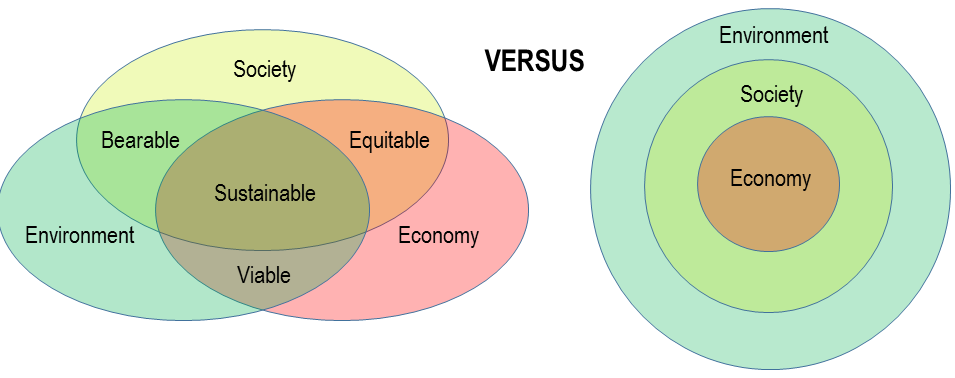
Fast forward to the world in 2020.  A pandemic more widespread and as lethal as any in history has struck the world.  The battle is again engaged between leaders like Donald Trump who care more about the economy and leaders who care more about society.  A false dichotomy if ever there was one.  Under John’s corollary, taking either position and ignoring the other position can and will only result in a destruction of both.  You cannot have a society without an economy, and you can not have an economy without a society.  But what is the purpose of each?  What is a society and what is an economy?

relationship-between-culture-and-society-2-638

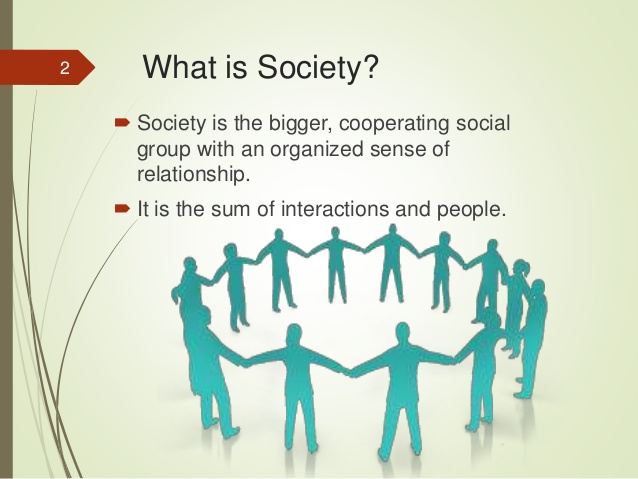
A society is a group of people, perhaps a tribe, a nation, or a family that choose to live together to share mutual resources.  People that live together beget relationships that involve feelings of community that grow out of common concerns.  These feelings range from love to sometimes hate.  There is a mutual interdependence in a society that implies the good of the society is based on the good of the individual and vice versa.  Societies develop a strong bond based on this mutual interdependence.

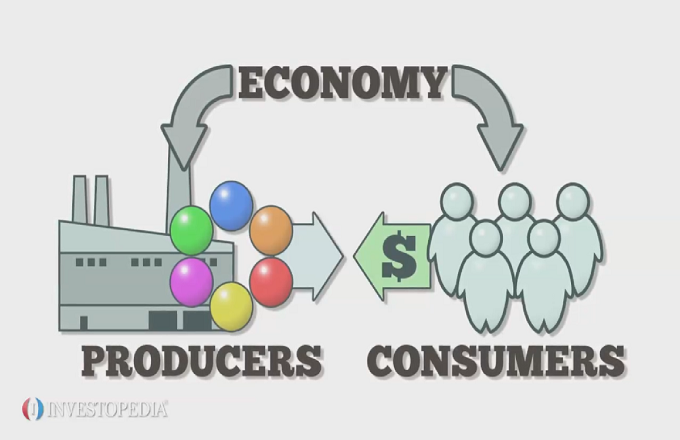
An economy is a means of providing resources for a society.  It is the means towards an end.  The end being the perpetuity of the society.  No society can exist without an economy.  Social economies have existed since the cave people and at one point simply involved people hunting and gathering together.  In modern times, we see economies based on a much more complex web of “hunting and gathering.”  The hunting and gathering in a modern society may involve Internet hunting or gathering crops at the local supermarket.

whatstheeconomy

A supply chain exists in modern societies based on what economists’ call “comparative advantage.”  This involves multiple components of a supply chain each doing what they do best.  Farmers raise dairy cattle.  Dairies make milk.  Trucking companies transfer the milk.  Retail stores sell the milk and other dairy products.  Consumers work at some part of a supply chain (there are thousands of supply chains that exist in the world today) to earn money to purchase goods and services sold at one or more other supply chains.  This is a simple version of an economy.  The bottom line is that in the 21st Century, no jobs mean no money.  No money means no ability to purchase goods and services.  Ergo, you starve to death or rely on the charity of your neighbors in your society.

Since the Covid-19 Pandemic began, leaders seem to have chosen sides in a fruitless and ignorant battle between “society” and the “economy.”  Over and over again we have seen leaders propose one extreme position or the other.  “We must shut everything down or we must open everything up!”  In the USA, there has been endless wrangling over a second stimulus bill.  Instead of intelligently looking at the balance between society and the economy, both Democrats and Republicans have used the crisis to further their own goals and agendas.

coronavirus

This lack of leadership of both parties directly dovetails with the lack of leadership set by the former President of the United States.  A man whose own agenda was based on keeping an economy going to further his chances for reelection.  For a man who scorned Marxism and socialism, he realized that the economy always plays a major role in the life of the common person.  He thought that if the economy was going strong, people would overlook the thousands of deaths of their friends and neighbors.  He created a narrative that the entire pandemic was “false.”  The deaths were false.  He claimed falsely that the hospitals were reporting everything as Covid-19 deaths when they were actually due to something else.  I personally talked to many Trump supporters who told me that doctors and hospitals did this because the reimbursement rates were higher for deaths due to Covid-19 than for other causes.

trump on virus magic

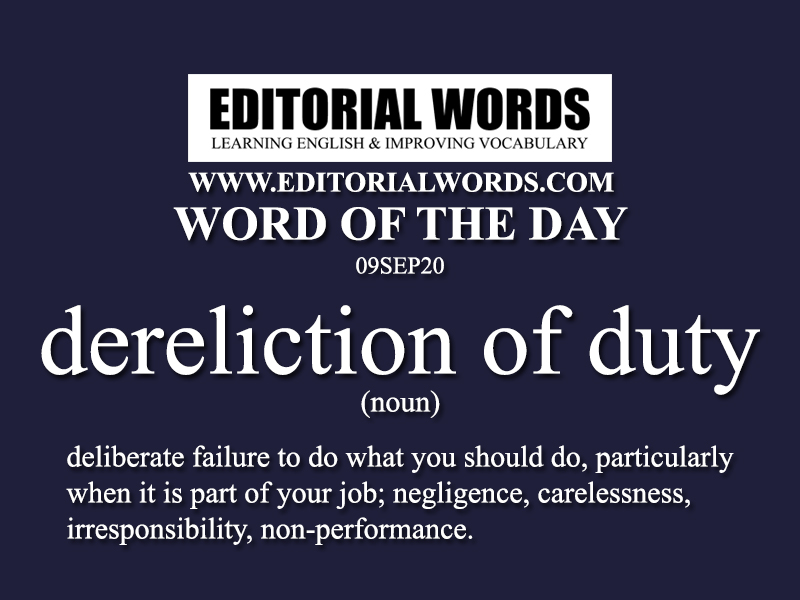
I served four years in the United States Air Force.  I learned while in the military that a commander, whether of a battalion, a squadron or a platoon has a major responsibility to keep his soldiers as safe as possible.  Any military leader who recklessly and needlessly puts his or her soldiers in harm’s way will be tried and court martialed for “dereliction” of duty. Following are two examples from a Marine publication titled: “Leadership, Ethics and Law of War Discussion Guide for Marines” by Marine Corps University, Lejeune Leadership (2008)

“The platoon commander was charged with violations of Article 92 (Dereliction of Duty), Article 109 (Willful and wrongful damage to an automobile), Article 118 (Premeditated murder) and Article 133 (Willful and wrongful failure to safeguard the detainees) of the Uniform Code of Military Justice on 1 Feb 2005.”

“1st Lt Lawson was charged with dereliction of duty for failing to account for LCpl Rother’s welfare by posting him alone as a road guide. He was also charged with disobeying an order for two violations: failing to post guides in pairs as Judgment Case Study 5 Dependability Proficiency as directed and failing to provide a roster of the guides to the logistics officer before they were posted.”

Word-of-the-Day_09SEP20

We have a former President who claims to be the Commander in Chief, yet he violated every canon of military law by recklessly and needlessly putting the entire US population in harm’s way by his disregard for the lives of these people.  His actions resulted in the deaths of thousands and yet I hear no outcry for justice.  I hear no strong voices noting his responsibility for these thousands of deaths.  As the primary person responsible for politicizing this Pandemic, he must be held accountable for these deaths.  The liars and sycophants who supported him must also be held accountable.

I blame the Democrats for their continuing stupidity to face reality.  I blame the Republicans for their lack of integrity and for their greed.  Both parties have made the pandemic in the USA much worse than it needed to be.  The lack of courage on one side and the greed on the other side created a perfect storm for the Covid-19 Virus to spread.  As I speak, we are witnessing a spike and increase in cases that seems beyond belief.

online-school-socialization

Part of the reason for the increase in Corvid-10 cases has been the rush by both parties to open the schools.  So-called well-meaning educators and health experts even supported this rush.  On one side it was the belief that “day care” was needed to get the economy going again and on the other side, it was the need for teachers and schools to regain income.  Both sides used such flimsy excuses as “students need socializing” and would not get it at home or “students would fall behind” if they did not have direct contact with teachers.  No one ever defined what “socializing” children means or how schools accomplish this.  As for students falling behind, were they talking about their ability to take these ridiculous standardized state tests which add little or nothing to a student’s ability to think and reason for themselves?   No one ever defined what these children would be “falling behind.”

I realize that I have digressed from my original thesis.  To sum it up, a failure to balance the needs of both the society and the economy has led to disastrous results.  Add to this, the overall lack of leadership by the US President and both parties and we have a crisis that has never before been witnessed in the USA.  Some of these same problems beset the rest of the world.  The stupidity we have seen is not simply a manifestation of American ignorance, greed, and short-sightedness.  The world abounds in bad leadership.  Will we learn anything from our mistakes?  Will we admit that we were so polarized that neither side would listen to the other side?  Will we make progress under a new President?  Only time will tell.