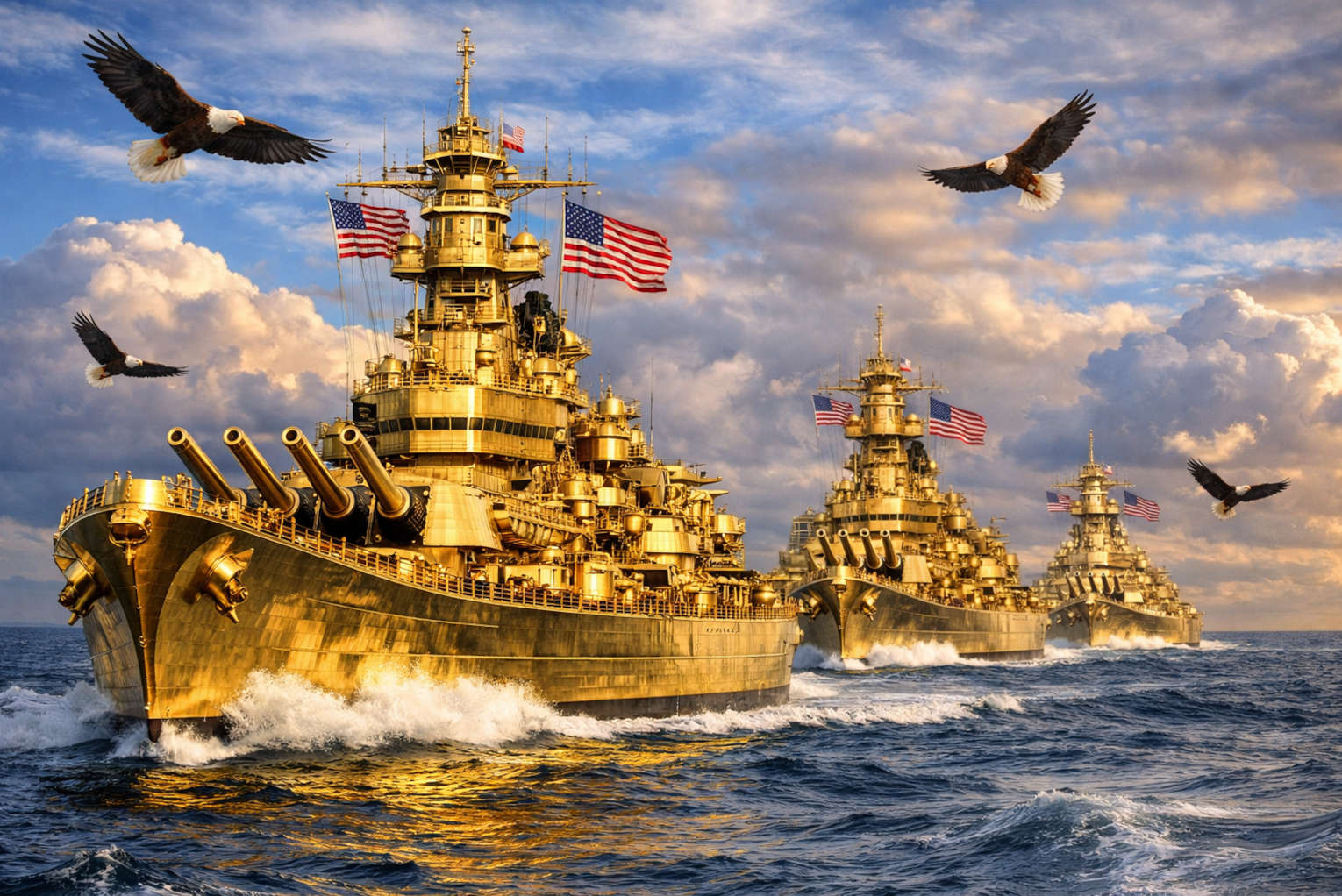
Recently, I read that Trump is proposing the U.S. military begin the construction of a new class of battleships called “Trump Class” or as the press is labeling them “The Golden Fleet.” Each of these ships will have a realistic (not the bullshit projected cost by defense contractors) final cost of $30 billion apiece. If three are built—as is being discussed—we are looking at a price tag approaching $100 billion.
That number is so large that it becomes abstract. When figures reach this scale, they stop meaning anything at all. So with the help of my AI partner Metis, I tried an experiment: What if we forced that number back into human terms?
I asked Metis a very simple question:
What else could $100 billion buy if applied directly to the daily needs of American families?
To keep this grounded, I used conservative, real-world assumptions—not best-case fantasies.
The Assumptions
To avoid cherry-picking, I chose modest, mainstream benchmarks:
- A reliable used car: a 3-year-old Toyota Corolla or Honda Civic
Average cost: $20,000 - Food for a family of four using the USDA Thrifty Food Plan
Annual cost: $9,500 - A two-bedroom home, roughly 2,200 square feet
Average cost: $350,000
Then I asked the same question three times:
What does $100 billion buy—if we buy only this one thing?
Option One: Transportation
At $20,000 per vehicle, $100 billion would purchase:
5,000,000 reliable used cars
Five million.
That’s not a subsidy.
Not a tax credit.
Not a loan.
That is five million families with dependable transportation—the difference between:
- Holding a job or losing it
- Making a medical appointment or missing it
- Participating in society or being stranded at its margins
Transportation isn’t a luxury in America. It’s infrastructure for survival.
Option Two: Housing
At $350,000 per home, $100 billion would fund approximately:
286,000 homes
That’s enough housing for nearly one million people.
For perspective:
- It could dramatically reduce homelessness nationwide
- Stabilize entire regions
- Lower healthcare, policing, and emergency service costs downstream
Housing is not merely shelter. It is the foundation upon which everything else—health, education, employment—rests.
Option Three: Food Security
Using the USDA Thrifty Food Plan, $100 billion could provide one year of food for:
Over 10.5 million families of four
That’s 42 million people.
More than the population of California.
In a nation where food insecurity still affects tens of millions, this single line item could eliminate hunger—not as charity, but as policy.
Each ship carries not just steel and weapons—but foregone lives improved.
The Real Question:
This is not an argument against defense. This isn’t about ships versus cars or homes.
It is a challenge to unexamined assumptions.
What kind of security do we believe actually sustains a nation?
- Military security protects borders
- Economic security protects civilization itself
We speak of “national security” almost exclusively in military terms, yet:
- Hunger destabilizes families faster than any foreign power
- Homelessness erodes communities more reliably than missiles
- Economic security strengthens democracies from the inside out
- Food, shelter, and mobility:
- Reduce crime
- Improve health outcomes
- Stabilize families
- Increase productivity
- Lower long-term government costs
From a Deming-style systems view (which considers this as an investment vs. expense thinking taken to its logical conclusion. From a systems perspective, this is a classic case of short-term protection versus long-term stability.
Or to put it plainly:
A nation is not secure when its people are hungry, homeless, and one paycheck away from collapse—no matter how powerful its navy may be.
Conclusions:
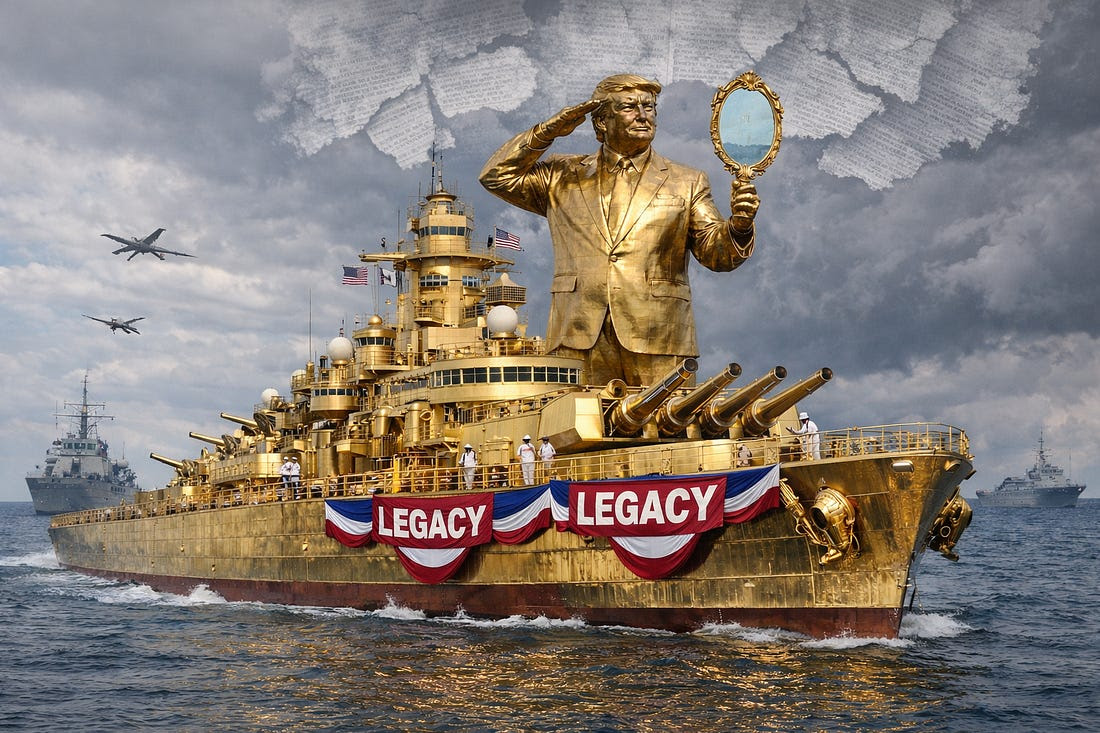
When budgets reach into the tens of billions, morality becomes invisible unless we deliberately restore it.
Every dollar spent reflects a value choice.
Every budget is a moral document.
The question is not whether we can afford battleships.
The question is:
What kind of country do we believe we are protecting—and for whom?

 Aging Capriciously