One of my hobbies over the years has been listening to, reading, and collecting the great speeches of history. From Socrates’s speech at his trial to Pericles’s Funeral Oration speech to Napoleon’s speech to his Old Guard to Martin Luther King’s Dream speech, I have always been fascinated by oratory that mesmerizes, galvanizes and exhorts people to goals and endeavors that they would never have believed possible. The list of great speeches is exhaustive. It would take an encyclopedia to catalog all the wonderful speeches of history. I am sure that there are blogs dedicated to this effort. For the next few weeks, I am going to present my humble attempt to look at a few of these magnificent oratorical achievements. Few things in life are more beautiful that a well worded speech.

One of the most interesting things about a great speech is that you can find yourself being moved by it even when you disagree with the arguments or premises of the speaker. For instance, General Douglas MacArthur delivered his “farewell speech” to a joint session of Congress on April 19, 1951. This speech is sometimes referred to by its most famous line “Old soldiers never die; they just fade away.” MacArthur spoke to defend his militaristic war policy in Asia after being rebuked by President Truman for his resistance to Truman’s position.

I have listened to MacArthur’s speech dozens of time. I disagree with everything he says in his speech. Nevertheless, I find myself oddly moved and thinking “Right On! Let’s go in and blast those guys.” I catch myself getting ready to sign up with the Marines and remember that MacArthur would probably have started WW III if not for Truman. But great speeches are like that. They move us, they hypnotize us, they motivate us to efforts that were not for the speech, we would never have thought possible.
I have this habit in my blog of doing things or writing about ideas and issues in groups of seven. I think this is the limit to my attention span on any one topic or issue. Thus, I wrote about capitalism, medicine, immigration, education, prophets, and several other issues in groups of seven or sometimes less when my focus ran out even sooner than seven. In respect to talking about great speeches, I could write about one great speech each day and not live enough lives to cover all the great speeches of history. Thus, in keeping with my limited attention to seven of any particular subject, I will spend the next seven blogs “reconstructing” some of my (perhaps not the greatest) favorite speeches.
Now, I carefully chose the word “reconstruct.” If I had said that I was going to “deconstruct” several great speeches, then these next blogs would be quite a bit different. To deconstruct can be defined as:
“A method of critical analysis of philosophical and literary language which emphasizes the internal workings of language and conceptual systems, the relational quality of meaning, and the assumptions implicit in forms of expression.” —Dictionary.Com.
I have no desire or the skill level to “deconstruct” historic speeches. Instead, I would like to “reconstruct” several of these speeches by reinterpreting what the original speakers wanted to achieve. To understand this, we must understand the relationship of the speech to the context that the speech was given in. Too often you hear a speech, but the context of the speech is often left out of the speech. This is a major failing of listening to any speech since the context in which the speech occurs is essential to fully understanding and appreciating the speech. I will also try to reconstruct the meaning that these speakers had by updating and rephrasing some of their vocabulary for a modern audience. This will probably horrify some purists out there who believe that things once said should never be rephrased.
Let me give you an example from one of Napoleon’s famous speeches. First, though we need to establish the context for his speech.
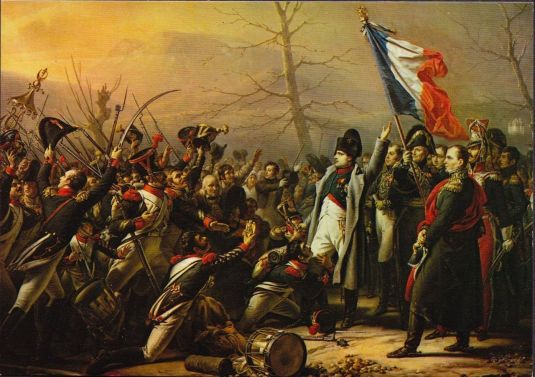
History teaches us today that either Napoleon was a great military leader or that he was a megalomaniac bent on world domination. If we journey back to the times right after the French Revolution (1789- 1794) we find Europe in turmoil. The French people have not only overthrown their King and Queen, they have beheaded them. Monarchies all over Europe are still in power. Spain, Italy, Austria, Hungary, Germany, Russia, Norway, Sweden, Belgium, and others all have their reigning rulers ordained by God. Imagine their horror at seeing the French get rid of their royalty. Imagine, if we suddenly took all our politicians and drowned them in the Potomac. Or what if instead of storming the Bastille as the French Peasants did, we would storm Hollywood and throw out all the actors and actresses. “Off with their lovely gorgeous heads!”
 France is in chaos. Heads are rolling faster than you can say “jack rabbit.” No one knows whose head will be on the guillotine next. In the middle of this pandemonium, the Monarchs surrounding France decide to put a stop to the changes going on in France. They plan to reestablish the French royalty and bring things back to where they were. European royalty marshal their armies to attack France. In steps Napoleon. A young French solider with extraordinary military skills. Napoleon galvanizes the French People and singing the Marseillaise they fight back and defeat all of the opposing enemies. The Following is an excerpt from a speech given by Napoleon to his army in Italy delivered on May 15, 1796:
“SOLDIERS! You have precipitated yourselves like a torrent from the Apennines. You have overwhelmed or swept before you all that opposed your march. Piedmont, delivered from Austrian oppression, has returned to her natural sentiments of peace and friendship toward France. Milan is yours, and over all Lombardy floats the flag of the Republic.
Basically, Napoleon is congratulating his army on their spectacular victories over the combined armies that attacked France: “You guys did great. You really rocked. You kicked some real butt out there today.”
But, and this is a big BUTT, “Power corrupts, and absolute power corrupts absolutely.” Napoleon’s victories and the rewards from these victories soon went to his head. It was not enough to simply defend France; Napoleon then decides that there are more wars to win and more power to obtain. He plans to establish a Grande Paix Française, wherein France will rule most of Europe with himself as emperor. From the same speech in Italy:
“Yes, soldiers, you have done much; but much still remains for you to do. Shall it be said of us that we knew how to conquer, but not to profit by victory? Shall posterity reproach us with having found a Capfia in Lombardy? Nay, fellow soldiers! I see you already eager to cry ‘To arms!’ Inaction fatigues you! and days lost to glory are to you days lost to happiness.”
“Okay Guys, we kicked butt. Wasn’t it fun? But look, we can kick more butt and have more fun. I guarantee glory and fame awaits us. As we sing the Marseillaise:
To arms, citizens!
Form your battalions,
Let us march, let us march!
That their impure blood
Should water our fields.
Sacred love of the fatherland,
Guide and support our vengeful arms.
Liberty, beloved liberty.

Over the course of my next seven blogs, with interludes as needed, I will “reconstruct” seven of my favorites speeches. The speeches that I want to look at will include the following:
- The Defense Speech – Socrates
- Here I stand – Martin Luther
- Dare, Dare Again, Always Dare – Danton
- If There is No Struggle, there is No Progress – Frederick Douglas
- I Am an Anarchist – Lucy Parsons
- Give Me Blood and I Will Give You Freedom – Subhas Chandra Bose
- Police Brutality Speech – Malcolm X
There are thousands of great speeches and dozens of “The Greatest Speeches in History” lists. For my reconstructions, I wanted to take some of my favorite speeches that are less well known, and which were very controversial at the time. It is one thing to get up and say something that everyone will agree with (Trump Speech), it is another thing entirely to give a speech that threatens the status quo and which may leave the audience hating you. Each one of the above speeches is challenging and provocative. The speakers were not afraid to generate animosity and hostility towards themselves. I think this fearlessness in the face of adversity is truly one of the characteristics of a great speech.
“Persuasion is achieved by the speaker’s personal character when the speech is so spoken as to make us think him credible. We believe good men more fully and more readily than others: this is true generally whatever the question is, and absolutely true where exact certainty is impossible and opinions are divided.” — Aristotle

 Did you know that if I am in Wisconsin this summer, I will migrate down to southern Mexico and northern Panama each winter? I go by myself because hummingbirds tend to be loners. No flocks or “birds of a feather” for us. I enjoy the trip down each year by myself. It takes me about a week to reach my final destination area. The most remarkable part of my voyage is crossing the Gulf of Mexico. I will fly non-stop up to 500 miles to reach Central America. It takes approximately 18-22 hours to complete my solitary flight. I do this each year of my life. I think even Charles Lindbergh would be impressed with my journey.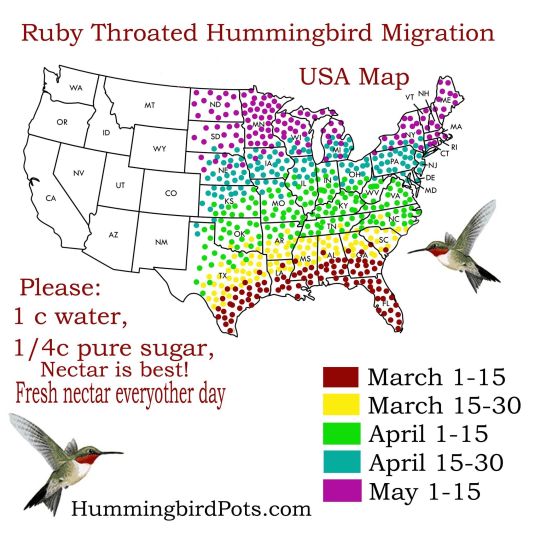
 Now I know you are all wondering about my sex life. I have observed that this is an especially important part of a human being’s life. So, you are probably asking how often does a hummingbird have sex and how many kids do we have in our short lives. I probably find a female about three or four times a year to mate with. I spend a great deal of time trying to impress a suitable mate. I make the Blue Angels look like novices with the aerobatics I perform to attract a female of my species. Compared to the time spent attracting a female, our mating goes pretty rapidly. In about 4 seconds we are both done. I have heard that some human males are even faster.
 Now as far as friends and enemies go, I do not have much of either one. There is good and bad in this. Humans have many friends and they tend to come and go like the weather. I don’t have to deal with “fair weather” friends because I never make any friends. If I miss out on the companionship, it never bothers me.
 Now we come to the biggest and most important part of my day. Since I expend so much energy just moving and staying alive, I have an enormous appetite. I love to eat. My life is one constant search for food. My favorite meals are nectar and insects. Because of my high metabolism, I must eat all day long just to survive. I consume about half my body weight in bugs and nectar each day. To do this I must feed about every 10-15 minutes and visit 1,000-2,000 flowers throughout the day. I will eat a few dozen to several hundred or even a thousand or more insects in one day, depending on the availability of insects, the type of insects, and my dietary needs. Imagine a 200-pound human eating about every 15 minutes a day and consuming 100 lbs. a day of meat. Judging by some of the humans I see, I think some have this as a goal. It might work for them if they were as energetic as I am, but this seldom seems to be the case with humans.

 I was born on October 14, 1973 in Fayetteville, North Carolina. I grew up in Houston Texas. I was always big for my age and I loved sports where I excelled. I also loved music and was part of a hip-hop group called “Screwed Up Click”. My stage name was “Big Floyd.” I was or thought I was headed for greatness. Somehow though greatness never came. I did not make any major league teams and I never got any big breaks on the music scene. Like many young Black men with no foreseeable future, I stumbled into drugs.





 Aging Capriciously