The Obesity Epidemic in the USA Meets the Drug Epidemic

191218155510-obesity-rates-by-state

Everyone knows or has heard that there is an epidemic of obesity in the USA.  The statistics are staggering.  The health problems associated with obesity are well known and cited often enough that if Tchaikovsky were alive, he would have written Symphony No. 7 in B Minor: Op. 74 “Obesity”“Physiologically, adolescents with obesity have an increased risk of developing adverse health outcomes such as type 2 diabetes, hypertension, elevated serum cholesterol and triglyceride levels, respiratory disorders such as asthma, and joint problems.”  — “Obesity Stigma and Bias

I was at a party in Prague over 25 years ago and I was approached by a younger woman who sat down next to me.  She promptly asked me, “Why are so many Americans overweight?”  I gave the usual uninformed answer and replied, “Because they are lazy and do not exercise enough.”  This was part of my belief system back then and is probably still shared by many Americans today.  Since that time, Karen and I have traveled to several other countries.  I think we are at about 43 now.  Over the past few travels, we have noticed that not only the USA, but many other countries are also suffering from the same “Epidemic of Obesity.”  If it is a psychological problem of motivation and willpower, than a whole bunch of countries are suffering from the same lack of motivation and willpower.

“Obesity is a complex physiologic condition influenced by genetics, hormones, sleep, environment, cultural norms, and economics.  The oversimplistic assumption that obesity is a choice and can be “fixed” by moving more and eating less is outdated and inaccurate in the current science of obesity.  Over the last 20 years, researchers have begun to shed light on the multifaceted complexity of obesity.”  — “Obesity Stigma and Bias”

images

I started thinking about this problem more recently after observing some of the children in my high school classes.  I am a substitute at three high schools in Casa Grande Arizona.  I noticed that many of the kids are overweight.  Back sixty years ago when I was in high school, there might have been one or two overweight children in the entire high school.  Today the statistics say that as of 2023, 1 in 5 children in the United States are obese, and this number is increasing yearly.  The rates of obesity are higher for Latino (43%) and Black (40%) youth. — Obesity or Oveweight Now Affect 1 In 3 Youth: How Experts Are Responding.

I wondered how these children deal with this problem.  Has obesity become acceptable?  We now have many stores with Plus Size clothes and there is an entire industry of “Plus Size Models.”  Do these children feel the weight stigma that is allegedly associated with obesity?  If they do feel it, how does it impact their socialization, personal image, and mental health?  Are they blamed for being overweight as much of the research suggests?

“As the rates of overweight and obesity rise, weight discrimination in America has increased by 66% over the past decade and is equivocal to racial discrimination.  Perceived provider weight discrimination often causes individuals with overweight and obesity to be reluctant to seek medical help, not only for weight reduction but also for any health-related problems…Bias against those with obesity appears to be socially acceptable and is reinforced by the media.  Mass media has stigmatized obese individuals.  A review of research over the past 15 years related to weight bias in media has reported that many media sources such as animated cartoons, movies, situational comedies, books, weight loss programming, news coverage, and YouTube videos have represented individuals who are overweight and obese in a stigmatizing manner.” —  Obesity Stigma and Bias

How Can We Help People with an Obesity Problem?

Someone once told me that we are either part of the solution or we are part of the problem.  I have noticed that I am part of the Obesity Problem.  I have looked many times at obese people and thought “They need to get out and exercise more.”  I have been less than empathetic to their problems and less than supportive of their physical and mental state.  I have not been helpful.

“Obesity stigma is characterized by prejudiced, stereotyped, and discriminatory views and actions towards people with obesity, often fueled by inaccurate ideas about the causes of obesity.  Despite decades of research supporting the dominant influence of genetic and environmental factors in the development of obesity, in the public consciousness, obesity continues to be viewed as a result of individual-level decision-making.”Obesity Stigma: Causes, Consequences, and Potential Solutions

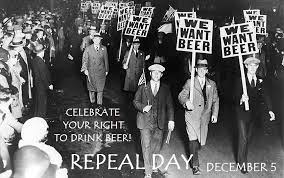
In my opinion, the health experts have not been very helpful nor have our politicians.  We allow many of the sources of the problem to continue to add fuel to the fire.  These include inappropriate media images, stereotypes of obese people, purveyors of low-quality high-fat junk foods, poverty conditions, lack of health education in poor and rural areas and overall a political system that almost totally ignores the “Epidemic of Poverty” but is more than happy to spend billions of dollars on any war against drugs.  Starting with the war on heroin, then the war on alcohol, the war on pot, the war on cocaine, the war on crack, the war on methamphetamine, the war on oxycodone and now the war on fentanyl, we spend billions of dollars on drug enforcement and drug incarceration for those convicted of selling the drugs.  How much do we spend on health education in our schools?
download (1)

“This summer, the war turned 52 years old.  It was June 1971 when President Richard Nixon declared drug abuse to be “public enemy No. 1” that required a “new all-out offensive” and additional government funding.

Since then, the country has spent more than a trillion dollars fighting drug use, according to some estimates.  That includes more than $39 billion the federal government spent last year alone, according to the Government Accountability Office. 

And, of course, illegal drugs and drug abuse are still very much with us.  In 2021, a Gallup Poll found 64% of Americans said the nation’s drug problem was “extremely serious” or “very serious,” though the primary scourge changes.  In the 1980s, cocaine and crack cocaine were the dominant stories.  In 1989, President George H.W. Bush held up a bag of crack cocaine during his first White House address and announced the war on drugs would be a primary focus of his time in office.” — Costs in the war on drugs continue to soar, NBC News

This article does not say anything about the costs spent fighting heroin or pot or alcohol long before some of these other drugs became “epidemic.”  I wonder what “prohibition” would have cost in today’s dollars?  As for health education, who has ever heard of a “War on Obesity.”  The obesity problem kills more people than drugs, but it would not benefit our economy to wage such a war.  “According to the National Institutes of Health, the obesity epidemic is responsible for an estimated 300,000 deaths per year.  The World Health Organization (WHO) estimates that at least 2.8 million people die from being overweight or obese each year.”  As for the comparison figures for the “Fentanyl Epidemic” the overdose death rate topped 112,000 in a 12-month period ending in December 2023 according to the Centers for Disease Control and Prevention.
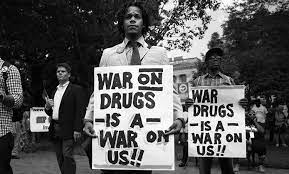
download (2)You may wonder where I am going.  From obesity to drugs and back to obesity.  Well, what if the two epidemics are related?  What if there is not really two epidemics but one huge epidemic?  What if one is correlated with the other or what if one even causes the other?  Could the stigma of obesity lead to more drug use or could more drug use lead to more obesity?  What if all the money we spend on arresting drug users adversely impacts the health of poorer communities where most drug abusers seem to come from?  Is there any possibility that the two epidemics are related?  Consider the following:

“Since the declaration of the U.S. drug war, billions of dollars each year have been spent on drug enforcement and punishment because it was made a local, state, and federal priority.  For the past half century, the war on drugs has subjected millions to criminalization, incarceration, and lifelong criminal records, disrupting or altogether eliminating access to adequate resources and supports to live healthy lives.

Drug offences remain the leading cause of arrest in the nation; over 1.1 million drug-related arrests were made in 2020, and the majority were for personal possession alone.  Black people – who are 13% of the U.S. population – made up 24% of all drug arrests in 2020.”  — How the war on drugs impacts social determinants of health beyond the criminal legal system, published online 2022 Jul 19.

Do you think it is a coincidence that Black people suffer the highest rates of obesity in the USA and are also targeted the most for drug related offences?  It is much sexier to arrest, try and convict a person for a drug related offence than to work to change a system that systematically poisons people with unhealthy foods.  Our drug enforcement system keeps lawyers, police, and judges employed.  Our nutrition system if you can call it that employs millions of people to sell junk foods in fast food restaurants and grocery stores.  Obese people are part of a system that promotes obesity and drug use.  Make no mistake at that.  As my mentor Dr. Deming used to say, “Put a good person in a bad system and the system will win every time.” 

downloadWe need more than a drug war and more than health education to fix the ONE large epidemic in America.  We need to have a war on a callous system that condemns millions of people to prison and death all in the name of selling things.  Our purveyors of unhealthy foods are just as guilty of being “Drug Pushers” as anyone selling fentanyl in a back alley.  The only difference is that “Fruit Loop” cereal is legal and legally spends millions of dollars on advertising each year while fentanyl is illegal and unadvertised.


Mexico versus Canada: Immigration Issues:  What are the Differences?  — Part 1 of 4 Parts

border crisisIntroduction:

In the next few weeks, I am going to write a four-part series on Immigration.  I am going to use Canada and Mexico as contrasts to demonstrate some of the issues concerning Immigration.  Several years ago, I wrote a three-part series on Immigration policy.  I have not gone back to review the former series as I wanted this series to be new and current.  However, I strongly suspect that much of what I wrote about Immigration ten years ago would still be relevant today.  If you are truly interested in Immigration, you can find my former series at “Thinking about Immigration – Part 1: We Need a Fair Immigration Policy – Not an Anti-Immigration Policy!”

What are the differences between Mexico and Canada?  The most obvious difference is that Canada is North of the USA and Mexico is South.  There are other obvious differences.  The heritage of much of the population of Canada tends to be British and French.  The heritage of much of Mexico and Latin America tends to be Spanish.  Canadians speak mostly British, French, and sometimes American.  Mexicans speak mostly Spanish and sometimes Spanglish.  Canadians coming to the USA are usually Snowbirds and Mexicans and many Latin Americans come to the USA as Immigrants.  Canadian summers may still find icicles hanging from roofs while in winter some Mexicans are laying on the beach drinking Margaritas. 😊 That’s all for the obvious differences.

Before I speak to the subtle differences, you might be wondering where all this is going to take you.  Well, I hope to solve a question that occurred to me this morning while hiking in the desert.  I thought “Why is there so many rocks in the Sonoran desert and no sand?  Shouldn’t there be more sand if this is a desert?”  Not really the pertinent question but it was a thought in my feeble brain.  But I am taking you off on a tangent.  The more pertinent question that popped into my mind was “Why do Mexicans who come to the USA want to stay and Canadians usually want to go home?”

Many Mexicans and Latin Americans come as immigrants and Canadians come as Snowbirds.  Snowbirds go home.  Immigrants stay.  One obvious answer might be that many Mexicans feel a connection or heritage with the Southwest.  Much of the states that are part of the USA today were once part of Mexico until 1854 and the Gadsden Purchase ceded a large area of Mexico to the USA.  Many people living in Arizona have a family history that goes back hundreds of years, and many Mexican Americans have families that live just “South of the Border.”  This alone would make a large difference in a propensity to immigrate versus Snowbird.

canadian snowbirds

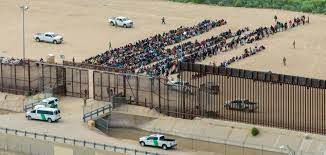
I thought “What if we could figure out why Canadians go home.  If we knew the answer to that question, perhaps we could figure out a way to get more Mexicans and Latin Americans to go home or not come here in the first place.”  This could greatly lessen the migrant problem at our Southern border.  Make no mistake, whether you are radical, liberal, progressive, conservative, Democrat or Republican, there is a humanitarian crisis going on in the USA.

Thousands of people come to our borders every day seeking asylum or a better life.  “The predominant reasons immigrants say they came to the U.S. are for better work and educational opportunities, a better future for their children, and more rights and freedoms.  Smaller but still sizable shares cite other factors such as joining family members or escaping unsafe or violent conditions.” (KFF.org).  Many of these people are unjustly accused of crimes or other deviances that we do not want in our country.  The poem on the Statue of Liberty reads in part:

download“Give me your tired, your poor,

Your huddled masses yearning to breathe free,

The wretched refuse of your teeming shore.

Send these, the homeless, tempest-tost to me,

I lift my lamp beside the golden door!”

Fine sounding words but simply words to many people in the USA.  Many Americans do not want ANY immigrants at all.  Many people feel that we have too many immigrants seeking to come to America.  No one that I am aware of in politics has ever addressed the issue of just how many immigrants can America absorb.  According to the 1900 census, the population of the United States was 76,212,168.  This was a 21.01% increase from the 1890 census, which recorded 62,979,766 people.  The 1900 census also found that 14% of the population, or about 10.4 million people, were born outside of the United States.  Today the population of the USA is close to 341,000,000 people.  If we said that we could absorb 14% of this number for Immigration that would mean almost 48,000,000 people would be immigrants.  Can our social structure and infrastructure really support this many people?

The main point that I made in my former series on Immigration was that we need a sensible Immigration policy and not an anti-Immigration policy.  I had a t-shirt made with this thought printed in Spanish on the back.  “Necesitamos una política de inmigración sensata y no una política anti-immigración.”  Many Americans would have agreed with this sentiment when I bought this shirt ten years ago.  Nevertheless, nothing substantial has been accomplished since then due to the partisanship of both political parties in the USA.

As I hiked my trail, I wondered more and more about the differences between Mexico and Canada.  Not the obvious differences, but the subtle unseen differences.  Differences like per capital income, infant death mortality, average life span, etc.  Could these differences explain why so many Mexicans and Latin Americans want to immigrate to the US?  The weather cannot be a factor since if it was the weather, we would expect to see millions of Canadians trying to sneak across our Northern border and apply for Immigration status.  Instead, they come for a short while, soak up the sun and go home, where they promptly put on their parkas and mukluks.  😊

I am going to write this series in four parts.  Part 1 is both an Introduction and what I will call a Narrative.  Part 2 will deal with what I call Fantasies and Illusions of Immigration.  Part 3 will deal with Immigration Facts.  This part will look at the demographics and socioeconomics of both Canada and Mexico.  Part 4 will deal with Lies or what the politicians say about Immigration to their constituents.  Throughout this series, I am going to contrast Mexico and Canada since they are both our neighbors and to date probably account for most of both the Immigration and snowbirds who arrive at our borders.  My main focus will be on the Immigration issue and to see whether or not the contrasts between the two countries can help us to focus on policies that will alleviate our current border crisis.

Narrative:

Karen and I have several friends who are either from Mexico or Canada.  I decided to ask a good friend from Acapulco who married a US citizen why she chose to stay in the USA and what she liked and disliked about the USA.  I will call her Margarita.  She has been living in the USA for over forty years now.  I also asked one of our Canadian friends (Emily) who has snow birded down to Arizona and the states for over twenty years what she liked and disliked about the USA.  Following are the replies from each of our friends.

Margarita:

Margarita was 26 years old when a frequent vacationing visitor from the USA to Acapulco fell in love with her.  They married and she moved from Mexico to Illinois with her husband.  They raised a family of three children in Illinois.  Margarita retired in Arizona after living in Illinois.  Margarita has become one of our best friends in Arizona.  She frequently drives down to Mexico and visits a variety of places where she donates food and other necessities to some of the needy in Mexico.  She is now in her 80’s and full of energy.  She is very well informed and active in her church and the local community.  The following is taken from an interview with Margarita by our good friend Socorro who is helping out with research for this blog.  Margarita was asked by Socorro what she liked about the USA and what she liked about Mexico and what she disliked about each country.

“I had a beautiful life in Mexico.  My family was close and loving.  My uncle had an orchestra, and we were invited to dances and parties.  By comparison, what I like now living in the United States, is that I can buy anything I want and need.  But I did face discrimination at first in Illinois.  We were criticized as the only Mexican family in town even though my husband was an American of Polish Slovakia descent.  I had to show what I could do for the city and prove myself.  The biggest project was fundraising for school band uniforms.  Then can you believe that I introduced people to food like tacos?”

Mexico has changed by her observations.  A nephew who came to the United States to work, and returned with the intent of forming a business was kidnapped and held for ransom.  Even though it was paid, he was killed by the crime cartel.  Her relatives don’t tell anyone that she lives in the United States for fear, that the same could happen to her when she comes to visit.

Her family has done well.  Margarita attributes her home and travels to her husband’s providing for her financially.  Her nephew who is a medical doctor wanted to come to the United States.  It seems that he needed what seemed like a million dollars to show his worth.  He made contacts in the medical community but is still an immigrant with Mexican credentials.  While Margarita has coverage for her health in Arizona, she prefers to go to Mexico for her dental work to save money.  So do many of her friends not only for a dentist but also for lower cost prescriptions.

Margarita is happy and healthy.  Her children have moved to California for their own lives and work.  She keeps busy with friends and church.  She sums it up by saying, “I’m happy because I’m a happy person.”

Emily:

Emily is from Canada and is in her early seventies.  She has been snow birding for over twenty years now to various places in the USA.  For the past eight years she has been coming down to Arizona.  Karen and Emily have a mutual interest in music and meet weekly to play dulcimers and ukeleles together.  I asked her to describe what she likes about the USA and what she dislikes.  The following is unedited and in her own words.

“Hi John, here you go!”

“The differences between our two countries are easily discernible on political, economic, and social platforms, but this old snowbird is going to address the question from a more personal perspective.

What do I like most about the United States?  I love exuberance, the open-hearted generosity of spirit.  Americans are the middle-schoolers of the world, in both the best and worst sense of that statement.  If it can be done, there’s an American somewhere doing it.  If it can be built, there’s an American building it.  You embrace challenges, and face obstacles with courage.  Individualism is applauded, encouraging self-expression.  You have an unshakeable confidence in your own abilities, a confidence that is usually tempered by time and life.  Visiting the United States is like a five-month trip to an amusement park, full of good times with friends, laughter, new experiences, colour, sparkles, loud music, and tasty food that isn’t good for us.

So why don’t I want to stay?  For all the reasons above.  Five months in an amusement park populated by middle-schoolers isn’t a comfortable lifestyle.

What do I like most about Canada.  If Americans are middle-schoolers, Canadians are middle agers, again, in all the best and worst of that statement.  When I return to my Canadian prairie home in the spring of each year, my shoulders relax, and my jaw unclenches.  I feel physically safer, emotionally less stressed, and strangely, more optimistic.  I embrace the sense of social responsibility that comes from living in the (gasp!) socialist environment of my home where poverty and illness are seen as circumstances, not character defects.  The reticence of middle-age is reflected in our more restrained social interactions.  I don’t know my neighbours’ political or religious affiliations.  Those aren’t the things that bring us together in laughter over the yard fences, and we’re all ok with that.  I like our differences; they show me the world through different lens.  Perhaps what I like best about Canada is a return to the natural world of my prairie home, the calm of big skies and open grasslands, the sense of belonging, of home.”

Conclusions:

Draw what you may from these two observations.  They are certainly not a random sample much less a stratified random sample of Canadians or Mexicans, but they provide some insights into at least two people who have experienced the USA in great depth.  Much like the evening news, such narratives may carry more weight with many people than the facts and figures that deal with statistics and demographics.  In Part 2, my next blog will deal with the Fantasies and Illusions of coming to the USA.

Who is Socorro Luna? The Friend that is helping me with this Blog

I am the “Good Friend Socorro” who is helping out with research for this blog as John Persico, PhD has written.

Moving from Arizona where I knew and worked with John, Karen, and Mexicans and Canadians to an unwilling retiring on the Texas border teeming with legal immigrants and illegal migration.

When John ruminated on the topic of immigration, I volunteered. My Mexican mother worked in El Paso, Texas where she decided to have all her children born. It’s where I came to visit my remaining living siblings and I haven’t left yet.

Before me in El Paso the immigration crisis unfolded: Walmart shooting, Venezolonos all over town, egregiously breaching in The Trump Border Wall reported on the nightly news, translating from English to Spanish referrals, taking necessities to refugee camps by my sister, brother, and me, conversing in English with Ukrainians, Chinese, Africans, Europeans, and seeing hundreds of relocating Afghans at the airport after I flew at night.

The upcoming series on immigration by John Persico is going to be another means of trouble shooting to improve a broken system.

Were the Good Old Days Really Happy Days?

download

Once upon a time there were the “Good Old Days.”  Now before you laugh or proclaim, “Oh No, not another Geezer gig;” allow me to issue some disclaimers.  First, If you are not at least 60 years old, you will not remember the “Good Old Days”.  The “Good Old Days” took place in the USA between 1954 and 1964.  They have also been called “The Happy Days.”  If you are under 60, you will be too young to remember these days.  Second, if you are an African American, you may not subscribe to my paean to “Happy Days”.  You will more than likely have had recurring experiences of overt racism in a country using Jim Crow laws to keep Blacks in their place and to put as many in prison as possible.

If you are Gay or LGBTQI+, you also may not remember these times very fondly.  Chances are you were forced to deny your sexual preferences and had to watch out on the streets for fear of being molested and assaulted.  If you are a woman, you might not remember these times very fondly either.  Back then, a woman’s place was said to be in the kitchen and her role was to be barefoot and pregnant.  There was no place for women in politics, business, military, or senior positions in any organization.  When it comes to other minorities, Jews, Latinos, Asians, Pacific Islanders, all would have stories of subtle and not so subtle discrimination during the “Good Old Days”.

But there is no denying that a large number of Americans do look back upon some of these days with a great deal of fondness.  I am one of them.  I do not tend to be overly nostalgic.  I do not spend much time looking back.  However, I have to admit, as a young White male during the period of time noted, life was not so bad.  The same was true for many older White men as well.  Even some of the groups excluded or ostracized by mainstream America during this period had a few exceptions.  People of color and other minority groups who may look back upon at least a few of these days with happy memories as well.

I was eight years old in 1954.  My age of innocence ended in 1964 along with many other young men who heard the Siren calls of war in Asia.  “Come save America from the Communists.  If you don’t stop them in Vietnam, before you know it, they will be in California.”  Kennedy was assassinated in 1963 and we put a man on the moon in 1969.  I joined the USAF in 1964 to save the USA from “Godless Communism.”  It would be another two years before I learned what is true of most wars.  They are waged by stupid people for stupid reasons and the people who suffer the most during these wars have the least to gain.

With these disclaimers out of the way, what are some good things that I remember about “My Good Old Days.”  Remember this is looking back and comparing the old days to the times I am now living in.  Some of these good things might not have been as good as I thought, but back then I was still in my “Days of Innocence” as well as in the my “Happy Days”.  Here is my list of good memories from the “Good Old Days:”

  1. Little evidence of environmental degradation
  2. No climate change
  3. Never heard of serial killers
  4. No worry about getting shot in school
  5. Plenty of snow during the winter to play in
  6. Water was drinkable everywhere and lakes were clean
  7. Floods and other natural disasters were much rarer
  8. I could walk to school by myself
  9. There were no anti-heroes only heroes
  10. Never heard of pedophiles
  11. I did not have to worry about a razor blade being put in an apple on Halloween
  12. Movies were 25 cents and candy was five and ten cents. Popcorn was 15 cents
  13. Gas was 21 cents per gallon and hamburger was 12 cents per pound
  14. Mom was home when I got out of school to make me a snack
  15. Lots of time to play sandlot ball on Saturdays with my friends
  16. The USA was in a brief period of peace between the end of the Korean War in 1953 and the ramp up of the Vietnam War in 1964
  17. We still had large family gatherings since people were not spread all over the globe or country
  18. We had bright starry nights since light pollution was not prevalent in many areas
  19. No concealed carry. You did not worry about being mowed down on the street by some maniac with a gun
  20. The Boy Scouts were still a respected group
  21. The really bad kids in school were those who chewed gum
  22. School bullying was uncommon
  23. Obesity was uncommon
  24. No such thing as road rage
  25. I could make a few bucks with a paper route
  26. The USA was at its peak of economic prominence. We were the major exporters of goods to the world
  27. Grid lock had not become common on our highways
  28. People were able to make a living on family farms and family fishing boats
  29. Speed limits were sensible
  30. Teachers, lawyers, and politicians were respected
  31. The average inflation rate in the United States between 1954 and 1964 was 1.37% per year
  32. Economic prosperity: The economy overall grew by 37% during the 1950s and unemployment remained low, about 4.5%.  At the end of the decade, the median American family had 30% more purchasing power than at the beginning.

Times have changed a bit.  No doubt you could make an even bigger list of good things going on today.  But there is no denying that once upon a time in a land called the USA, there was a set of days that for many people will never be forgotten.  For those of us who lived well during this period, we can’t deny our feelings of regret that so many of the things in my list have become shadows of the past.

Tell Me About the Good Old Days” by the Judds

Grandpa, tell me ’bout the good old days

Sometimes it feels like this world’s gone crazy

Grandpa, take me back to yesterday

When the line between right and wrong

Didn’t seem so hazy

Did lovers really fall in love to stay

And stand beside each other, come what may?

Was a promise really something people kept

Not just something they would say

Did families really bow their heads to pray?

Did daddies really never go away?


Whoa, whoa, grandpa, tell me ’bout the good old days

Grandpa, everything is changing fast

We call it progress, but I just don’t know

And grandpa, let’s wander back into the past

Then paint me the picture of long ago.

The Silence of the Damned by Chris Hedges


There is no effective health care system left in Gaza. Infants are dying. Children are having their limbs amputated without anesthesia. Thousands of cancer patients and those in need of dialysis lack treatment. The last cancer hospital in Gaza has ceased functioning. An estimated 50,000 pregnant women have no safe place to give birth. They undergo cesarean sections without anesthesia. Miscarriage rates are up 300 percent since the Israeli assault began. The wounded bleed to death. There is no sanitation or clean water. Hospitals have been bombed and shelled. Nasser Hospital, one of the last functioning hospitals in Gaza, is “near collapse.” Clinics, along with ambulances – 79 in Gaza and over 212 in the West Bank – have been destroyed. Some 400 doctors, nurses, medics and healthcare workers have been killed — more than the total of all healthcare workers killed in conflicts around the world combined since 2016. Over 100 more have been detained, interrogated, beaten and tortured, or disappeared by Israeli soldiers. 

Israeli soldiers routinely enter hospitals to carry out forced evacuations – on Wednesday troops entered al-Amal Hospital in Khan Younis and demanded doctors and displaced Palestinians leave – as well as round up detainees, including the wounded, sick and medical staff. On Tuesday, disguised as hospital workers and civilians, Israeli soldiers entered Jenin’s Ibn Sina Hospital in the West Bank and assassinated three Palestinians as they slept. 

The cuts to funding for the United Nations Relief and Works Agency for Palestine Refugees in the Near East (UNRWA) — collective punishment for the alleged involvement in the Oct. 7 attack of 12 its 13,000 UNRWA workers  —  will accelerate the horror, turning the attacks, starvation, lack of health care and spread of infectious diseases in Gaza into a tidal wave of death. 

The evidence-free charges, which include the accusation that 10 percent of all of UNRWA’s Gaza staff have ties to Islamist militant groups, appeared in the Wall Street Journal. The reporter, Carrie-Keller Lynn, served in the Israel Defense Forces (IDF). Given the numerous lies Israel has employed to justify its genocide, including “beheaded babies” and “mass rape,” it is reasonable to assume this may be another fabrication. 

The allegations, of which details remain scant, are apparently based on confessions by Palestinian detainees — most certainly after being beaten or tortured. These allegations were enough to see 18 countries including the U.S., Canada, U.K., Germany, France, Australia and Japan cut or delay funding to the vital U.N. agency. UNRWA is all that stands between the Palestinians in Gaza and famine. A handful of countries, including Ireland, Norway and Turkey, maintain their funding. 

Eight of the UNRWA employees accused of participating in the Oct. 7 attack in southern Israel, where 1,139 people were killed and 240 abducted, were fired. Two have been suspended. UNRWA has promised an investigation. They account for 0.04 percent of UNRWA’s staff. 

Israel is seeking to destroy not only Gaza’s health care system and infrastructure, but UNRWA which provides food and aid to 2 million Palestinians. The object is to make Gaza uninhabitable and ethnically cleanse the 2.3 million Palestinians in Gaza. Hundreds of thousands are already starving. Over 70 percent of the housing has been destroyed. More than 26,700 people have been killed and over 65,600 have been injured. Thousands are missing. Some 90 percent of Gaza’s pre-war population has been displaced, with many living in the open. Palestinians have been reduced to eating grass and drinking contaminated water.

Noga Arbell, a former Israeli foreign ministry official, during a discussion in the Israeli parliament on Jan. 4, stated: “It will be impossible to win the war if we do not destroy UNRWA, and this destruction must begin immediately.”

“UNRWA is an organization that perpetuates the problem of the Palestinian Refugees,” Prime Minister Benjamin Netanyahu said in 2018. “It also perpetuates the narrative of the so-called ‘right of return’ with the aim of eliminating the State of Israel, and therefore UNRWA must disappear.” An unnamed senior Israeli official praised the suspension of funding to UNRWA, but insisted on Wednesday gggthe government was not calling for its closure. 

More than 152 of UNRWA’s employees in Gaza — including school principals, teachers, health workers, a gynecologist, engineers, support staff and a psychologist — have been killed since the Israeli attacks began. Over 141 UNRWA facilities have been bombed into rubble. The death toll is the largest loss of staff during a conflict in the U.N.’s history.

The destruction of healthcare facilities and targeting of doctors, nurses, medics and staff is especially repugnant. It means the most vulnerable, the sick, infants, the wounded and elderly, and those who care for them, are often condemned to death. Palestinian doctors are pleading with doctors and medical organizations from around the world to decry the assault on the healthcare system and mobilize their institutions to protest. 

“The world must condemn the acts against medical professionals happening in Gaza,” writes the director of Al-Shifa hospital, Muhamad Abu Salmiya, who was arrested along with other medical personnel by the Israelis in November 2023 while evacuating with a World Health Organization (WHO) convoy, and who remains in custody. “This Correspondence is a call for every human being, all medical communities, and all health-care professionals around the world to call for these anti-hospital activities inside and around the hospitals to stop, which is a civilian obligation according to international law, the UN, and WHO.”

But these institutions — with a few notable exceptions such as The American Public Health Association that has called for a ceasefire — have either remained silent or, as with Dr. Matthew K. Wynia, the director of the Center for Bioethics and Humanities at the University of Colorado, attempted to justify Israeli war crimes. These doctors — who somehow find it acceptable that in Gaza a child is killed every 10 minutes on average — are accomplices to genocide and stand in violation of the Geneva Convention. They embrace death as a solution, not life. 

Robert Jay Lifton in his book “The Nazi Doctors: Medical Killing and the Psychology of Genocide” writes that “genocidal projects require the active participation of educated professionals — physicians, scientists, engineers, military leaders, lawyers, clergy, university professors and other teachers — who combine to create not only the technology of genocide but much of its ideological rationale, moral climate, and organizational process.”  A group of 100 Israeli doctors in November 2023 defended the bombing of hospitals in Gaza, claiming they were used as Hamas command centers, a charge Israel has been unable to verify. 

The deans of U.S. medical schools and leading medical organizations, especially the American Medical Association (AMA) have joined the ranks of universities, law schools, churches and the media to turn their backs on the Palestinians. The AMA shut down a debate on a ceasefire resolution among its members and has called for “medical neutrality,” although it abandoned “medical neutrality” to denounce Russia’s invasion of Ukraine.

There is a cost to denouncing this genocide, a cost they do not intend to pay. They fear being attacked. They fear destroying their careers. They fear losing funding. They fear a loss of status. They fear persecution. They fear social isolation. This fear makes them complicit. 

And what of those who do speak out? They are branded as antisemites and supporters of terrorism. George Washington University clinical psychology professor Lara Sheehi was pushed out of her job. The former head of Human Rights Watch, Kenneth Roth, was denied a fellowship at Harvard’s Carr Center for Human Rights Policy because of his alleged “anti-Israel bias.” San Francisco professor Rabab Abdulhadi was sued for supporting Palestinian rights. Shahd Abusalama was suspended from Sheffield Hallam University in the U.K after a vicious smear campaign, although the institution later settled her discrimination claim against it. Professor Jasbir Puar at Rutgers University is an ongoing target for the Israel lobby and endures constant harassment. Medical students and faculty in Canada face suspension or expulsion if they publicly criticize Israel. 
 
The danger is not only that the Israeli crimes are denounced. The danger, more importantly, is that the moral bankruptcy and cowardice of the institutions and their leaders are exposed. This brings me to Dr. Rupa Marya, a professor of medicine at the University of California, San Francisco (UCSF), whose call to halt bombing hospitals and to examine the impact of Zionism as a racist ideology unleashed a torrent of vitriolic attacks against her, attacks tacitly endorsed by the medical school where she works. 

She has been slandered as an antisemite and targeted by the Canary Mission, a Zionist organization that seeks to defame and destroy the careers of students and faculty that criticize Israel and defend Palestinian rights. She has had speaking engagements rescinded and received death threats and messages such as: “kill yourself you retarded grifting n*gger,” “Jew baiting c*nt,” and “White people are the greatest people on Earth. You know this.” 

You can see her statement on the campaign against her here. There is a striking contrast between the treatment of Dr. Marya and the physicians who cheer on the genocide. UCSF physician Matt Cooperberg, who is the Helen Diller Family Chair in Urology, ‘liked’ social media posts such as “REMOVE Palestinians FORM [sic] MAP” and a quote by former Israeli prime minister Golda Meir: “We are able to forgive the the [sic] arabs for killing our children. We are unable to forgive the arabs for forcing us to kill their children.”

“Cooperberg’s endowed chair comes from the Helen Diller Family Foundation, UCSF’s largest donor, which to date has gifted some $1.15 billion dollars to the health campus,” Marya writes. “In 2018, due to a mistake on a tax form, the Helen Diller Family Foundation was exposed as a funder of the Canary Mission. The Foundation attempted to erase its connection after this exposure.”  She goes on:

As a faculty member at UCSF, disgraced dermatologist Howard Maibach exposed and injected over 2,600 imprisoned Black and brown people with chemicals in experiments that echoed the experiments put on trial at the Doctors’ Trial just a few years before he went to medical school in Pennsylvania,” she goes on. “There he studied under Albert Kligman, who taught him how to exploit Black people for medical experimentation, documented extensively in the horror nonfiction book, Acres of Skin.  Maibach also advanced notions of racial differences in skin, furthering racist ideas from the pseudoscience of eugenics. Race is a social construct that enshrines supremacism. It is not a biological reality.

Most of Maibach’s experiments were conducted without informed consent, and while UCSF issued an apology, Maibach is still employed by the University of California. His family supports the Friends of the IDF, and he is represented by Alan Dershowitz, who also argued for the bombing of hospitals in Gaza. Dershowitz attempted to prevent me from speaking at the AMA’s first National Health Equity Grand Rounds, where scholar Harriet Washington, who studies medical experimentation on Black people, highlighted Maibach’s racist practices. In the wake of George Floyd’s murder, UCSF faculty, trainees and students of color brought Maibach’s story to light, and many have expressed their horror that they have to continue to sit in the same room as this man during Dermatology Grand Rounds. But the problem is not just one man. It is a system that allows someone with these values and actions to continue to be present in our learning and practicing community.

The dehumanization of Palestinians is lifted from the playbook of all settler colonial projects, including our own. This racism, where people of color are branded as “human animals,” is coded within the DNA of our institutions. It infects those chosen to lead these institutions. It lies at the core of our national identity. It is why the two ruling parties and the institutions that sustain them side with Israel. It feeds the perverted logic of funneling weapons and billions of dollars in support to Israel to sustain its occupation and genocide. 

History will not judge us kindly.  But it will revere those who, under siege, found the courage to say no. 

Share

The Chris Hedges Report is a reader-supported publication. To receive new posts and support my work, consider becoming a free or paid subscriber.