Are Americans Brainwashed?  Revisiting Consumer Culture Through the Lens of “The Society of the Spectacle”  — By John Persico (with Metis)

Introduction

In 2018 I asked a provocative question: Are Americans brainwashed?  At the time, what I meant by “brainwashing” was a kind of conditioned conformity — an unconscious habituation to consumerism.  We buy, accumulate, and consume not because we need to, but because something deep within our society tells us that our worth, security, and happiness depend on it.

A few weeks ago, I encountered a work that reframed much of what I was trying to say: Guy Debord’s 1967 classic The Society of the SpectacleDebord, a French Marxist theorist and filmmaker, argues that modern capitalism doesn’t just sell goods — it sells images, identities, and perceptions of reality itself.  In doing so, it creates what he calls a “spectacle” — a world where representation replaces lived experience, and passive consumption replaces active life.

Today I believe the idea of “brainwashing” isn’t just a metaphor.  It is a lived condition of our society — one that manifests in our politics, our personal relationships, and above all, in how we see ourselves and the world.

But if we are to diagnose this condition accurately, we also need a prescription for how we might undo it.

I. The Diagnosis: What Is the Spectacle?

In The Society of the Spectacle, Debord makes a bold claim:
“The spectacle is not a collection of images; it is a social relationship between people that is mediated by images.”

What Does This Mean?

  1. The Spectacle Is a Social Condition, Not Just Advertising

We tend to think of consumerism as simply “too many ads,” “too much marketing,” or “too much stuff.” But Debord pushes us deeper: the spectacle isn’t only the marketing — it’s the way we relate to reality itself through mediated images.

In other words:

  • It’s not just the billboard that matters — it’s that we now interpret our lives as if we were on billboards.
  • It’s not just the advertisement — it’s that we start to see ourselves as advertisements for our own lifestyle, identity, and status.

In the spectacle, images don’t just sell products.  They sell versions of reality.  They tell us what success looks like, what happiness looks like, what security looks like, and what a good life looks like.  And we internalize that script — often without realizing we’ve been cast in it.

  1. Consumption Replaces Experience

Debord argues that the spectacle replaces real life with representation of life.

Think about how often we:

  • Take pictures of experiences instead of experiencing them.
  • Check likes, shares, and comments instead of connecting.
  • Pursue prestige, status, or image instead of meaning.

We no longer live our lives in the fullest sense — we consume them, display them, and measure them.  This is not just consumerism — it is spectatorship.  We watch life, we watch others, and we are watched.  We are subjects of our own mediated narratives.

  1. The Spectacle Is Universal But Uneven

Debord notes that the spectacle isn’t just advertising or corporate marketing.
It includes:

  • Mass media
  • Entertainment
  • Social media
  • Politics
  • Consumer brands
  • Cultural norms
  • Public relations

In the society of the spectacle, everything becomes commodified, including our attention, our desires, and even our dissent.  Even counter-culture becomes a brand.

This is why Debord’s critique resonates with my original thesis: American society doesn’t just create consumers of products — it creates consumers of images, identities, and scripted realities.  We are persuaded not only to buy what we don’t need, but to define ourselves through those purchases.

II. Are Americans Brainwashed? A Reframed Answer

So, let’s revisit the question I asked in 2018: Are Americans brainwashed?

If by “brainwashed” we mean:

  • conditioned to think in ways that benefit corporate and political interests,
  • socialized to equate meaning with consumption, and
  • habituated to accept the spectacle as reality…

Then the answer is yes — to a significant extent.

But the spectacle is not an overt force with an agenda.  It doesn’t need to be explicit to be pervasive.  It works because:

  1. We participate willingly — we seek validation through consumption, clicks, images, status.
  2. We mistake representation for reality — what we see on screens or in ads becomes our standard for life.
  3. We rarely interrogate the source of our desires — we assume our wants are our own.

Debord writes that the spectacle is a form of alienation — where life is lived not directly, but through representations.  When we are alienated from our own experience, we are easier to influence because we are no longer anchored in our own desires — only in the images we consume.

III. The Mechanisms of the “American Brainwashing”

Let’s unpack some specific mechanisms by which the spectacle perpetuates conditioned consumption:

  1. Identity Through Consumption

Corporations don’t just sell products — they sell lifestyles, identities, and social status.

  • Owning a certain car means you are cool.
  • Wearing a certain brand means you are successful.
  • Posting the right image means you are interesting.

We learn to define ourselves through what we display, not what we experience.

  1. The Attention Economy

Modern media doesn’t just want our money — it wants our attention.
Attention becomes the rarest and most valuable commodity.  Algorithms are optimized to:

  • keep you looking,
  • keep you scrolling,
  • keep you craving more.

This amplifies the spectacle because it conditions instinctive reactions — not reflective thought.

  1. Social Media as a Spectacle Machine

Platforms like Instagram, TikTok, Facebook, and YouTube are engines of the spectacle:

  • They amplify images over ideas.
  • They reward emotion over reflection.
  • They privilege appearance over substance.

The result?  A world where image consumption replaces authentic engagement.

  1. Debt and Consumption as Fulfillment

Credit markets and consumer finance turn consumption into addiction.
Payday loans, credit cards, easy financing — all encourage buying now, paying later, and justifying desires as needs.

This isn’t just financial — it’s psychological:
We feel like we are fulfilling ourselves by spending, even when we are not.

IV.  What Brainwashing Is Really Like: Mindlessness and the Spectacle

Here’s where Ellen Langer’s work on mindlessness becomes useful.

Langer describes mindlessness as a state in which behavior is rigid and thought is shallow — where we act on autopilot.

How does this connect to Debord?

  • The spectacle thrives on mindlessness.
  • If people thought deeply about why they want certain things, how they spend their time, and what their values are, the spectacle would weaken.
  • The spectacle depends on unexamined life.

So, we might define the “brainwashing” of Americans not as overt coercion, but as collective mindlessness — not thinking deeply about how our desires are shaped, what we consume, and why.

Mindlessness and the spectacle are two sides of the same coin:
One is cognitive, the other is cultural.
Both detach us from genuine experience.

V.  The Prescription: How Do We Undo the Brainwashing?

If we’ve diagnosed the problem, the urgent challenge is: How do we counteract the spectacle and undo conditioned consumption?

Here’s a multi-layered prescription:

  1. Cultivate Mindfulness

Langer’s work teaches us that awareness is not automatic — it must be practiced.

Mindfulness in consumption means:

  • Asking why you want something before you act.
  • Not mistaking wanting for needing.
  • Reflecting on the social and psychological forces shaping your desires.

Mindfulness isn’t only meditation — it’s active awareness of your internal life.
It’s questioning your impulses rather than obeying them.

  1. Reclaim Authentic Experience

If the spectacle is a representation of life, its antidote is direct experience of life.

This means:

  • Valuing real human interaction over mediated interactions.
  • Experiencing events without first documenting them for others.
  • Rediscovering activities that aren’t commodified for Instagram or TikTok.

Experience should be lived, not posted.

  1. Reduce Passive Consumption

We live in a world designed for passive consumption:

  • Scroll feeds
  • Binge media
  • Buy products based on ads

Combat this by:

  • Setting intentional limits on screen time.
  • Choosing content that teaches, not only entertains.
  • Prioritizing creation over consumption.
  1. Examine Economic Structures

The spectacle is supported by economic systems that profit from:

  • Continuous consumption
  • Planned obsolescence
  • Debt accumulation
  • Attention monetization

Undermining the spectacle requires economic literacy:

  • Understanding how credit, interest, and consumer culture are connected
  • Questioning advertising claims
  • Supporting sustainable, local, and meaningful alternatives
  1. Build Communities of Critical Thought

Spectacle thrives in isolation and individualism.

Counter this by:

  • Forming discussion groups
  • Reading cooperatively
  • Sharing reflections instead of consumer gossip
  • Encouraging long conversations, not short clicks

Detroit philosopher Cornel West said, “We must refuse the politics of disengagement and nihilism.”  This means engaging deeply with ideas — not passively consuming them.

  1. Political Awareness and Media Literacy

Spectacle extends into politics:

  • Politicians perform for cameras.
  • News becomes entertainment.
  • Outrage replaces inquiry.

Undoing brainwashing means:

  • Learning to distinguish facts from spectacle
  • Examining incentives behind media narratives
  • Teaching critical media literacy
  1. Reframe Success and Identity

Finally, we must challenge the equation:

More stuff = more value.

Redefine success as:

  • Deeper relationships
  • Richer experiences
  • Intellectual curiosity
  • Community contributions

The self we cultivate should be internal, not a brand.

VI.  What the Spectacle Cannot Control

Here’s the hopeful part:

The spectacle operates through images and representations.
But it cannot fully replace:

  • Moment-to-moment consciousness
  • Genuine love and empathy
  • Deep reflection and insight
  • Meaningful community
  • Unmediated experience

These are areas where the spectacle fails — exactly because they cannot be commodified or packaged.

Conclusion: Toward a Life Unmediated

So, are Americans brainwashed?
Not in the literal sense of having thoughts forcibly replaced — but in the structural sense that society conditions our perceptions of reality, desire, identity, and fulfillment.

Guy Debord’s spectacle framework helps us see that consumerism isn’t just about goods — it’s about how we see the world and ourselves.

Ellen Langer’s work reminds us that undoing this starts with awareness — moving from mindlessness to mindful life.

The good news is that mind, choice, and experience cannot be fully outsourced to images or corporations.  We can reclaim them by practicing mindfulness, re-centering authentic experience, and questioning the narratives sold to us every day.

The challenge is not only social — it’s deeply personal.
But once we begin to see how the spectacle shapes us, we can choose to look beyond the images and toward the real world — toward a life to live, not a life to watch.

America today is a deeply divided nation and a deeply divided people.  The brainwashing we get from the sources discussed have been major contributors to creating the divide we now live in.  Few people on either side of the divide are happy the way things are.  We yearn for the “good old days.”  Days reflected in Norman Rockwell pictures of America that portray a different country than we now see.

It is true that “Happy Days” never did not exist equally in this country for all people, but at least we had the ability to still talk to people who we disagreed with and sometimes see a new perspective.  We had a country where people once talked about morals and ethics.  Today, our perspectives and beliefs are like a wall of granite.  Rather than a divide, we have a stone wall that we have built.  The wall is almost impenetrable.  It seems impossible to get over it, under it or around it.  The problem with destroying this wall is that it exists in our minds and that is the hardest thing in the world to change.  Until we open our minds and hearts, we will be stuck behind a granite wall that separates our nation and people.
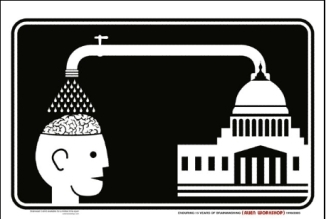
Are Americans Brainwashed?

Eshtebahi

What does it mean to be brainwashed?  When I was growing up in the days of the Cold War and the specter of nuclear disaster, the term brainwashed was associated with Communism.  We all knew that anyone who believed in Communism had been “brainwashed” by Stalin and his minions.  Brainwashed people could not think for themselves.  To be brainwashed, meant to be a mindless zombie.  People who are brainwashed have undying fealty to an impossible dream. Communists want a system where everyone shares equally in the production of society.  Communists will fight and die for this dream.

“Communism, my friend, is more than Marxism, just as Catholicism is more than the Roman Curia. There is a mystique as well as a politick. Catholics and Communists have committed great crimes, but at least they have not stood aside, like an established society, and been indifferent. I would rather have blood on my hands than water like Pilate.” – Graham Greene

brainwashingAs Americans, we pride ourselves on being the exact opposite of Communists.  In America, we have a democracy.  To live in a democracy, means that you are “free” to think for yourself.  No one living in a democracy can possibly be brainwashed.  In America, “the land of the free and the home of the brave” you will only find people who believe in the truth.  The truth is that democracy is the holy grail of political systems.  It supports everything that is good about life.  In a democracy, all men and women are created equal.  In a democracy, everyone can succeed if they only have the right desire.  Americans will fight and die for this dream.
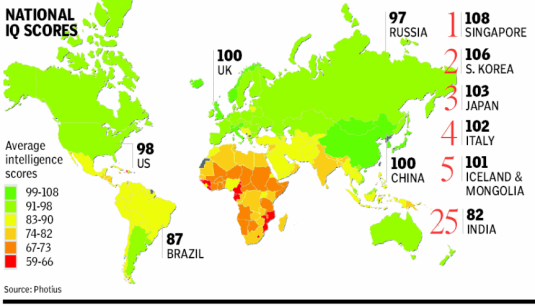
“We hold these truths to be self-evident, that all men are created equal, that they are endowed by their Creator with certain unalienable Rights, that among these are Life, Liberty and the pursuit of Happiness.”  –  The Declaration of Independence 

It never occurred to me that Americans could be brainwashed until I started teaching MBA students both at St. Thomas College and Metro State University in Minnesota.  Enrollment in MBA programs soared during the nineties as more and more students gravitated to business occupations and away from such occupations as teaching and social work.  Many of my students had obtained non-business undergraduate degrees and become tired of the lack of money associated with such career fields.  With an MBA degree, you could easily make three or four times per year what you could with a Masters degree in Education.

I really enjoyed teaching in the business field because my students were smart, motivated and challenging.  Most of them had been working for several years and brought considerable life experience to their classes.  Very few of my students had simply finished an undergraduate program right out of high school and then gone on to get an MBA degree.

Since I had spent many years as a management consultant, I brought industry experience to my classes.  I had learned along the way that critical thinking and the ability to question the status quo were essential to continuous improvement and systems change.  I tried to incorporate these insights into my curriculum and classroom instruction.  I soon found that this task was easier said then done.

An eye opener for me was when I tried to use the documentary film called: “The Corporation (2003)” in some of my business ethics classes.  The Corporation is a Canadian documentary film critical of the modern-day corporation.  It was directed by Mark Achbar and Jennifer Abbott and written by Joel Bakan.  The film has numerous examples of corporate behavior that walk a fine line between criminal and immoral behavior.  The film shows that many of the behaviors of modern corporations are immoral although not illegal.  However, there are numerous examples in the paper every day wherein executives and corporate leaders have crossed the line.

“Again and again we have the problem that whether you obey the law or not is a matter of whether it’s cost effective. If the chance of getting caught and the penalties are less than it costs to comply, people think of it as just a business decision.” – Robert Monks.

Much to my surprise, many of my students did not see anything wrong with such immoral behavior.  Their standards were set on what was expedient and legal rather than what was moral and ethical.  Repeatedly, I found that modern business students believe in an amoral system of ethics rather than a moral system.  In an amoral system, right and wrong is defined by what works and what does not work.  If you are within the law, you may conduct your business with little concern for the residual effects on either society or citizens.  The first law of business trumps all other concerns.  That law is to make a profit.

No amount of persuasion or argument could sway my students from their steadfast believe in the value of capitalism and its sanctity as an economic system.  Students were not persuaded by the iniquities in the system, by the inherent racism in the system, by the inherent sexism in the system or by the unequal distribution of wealth in a system that has become increasingly dysfunctional.

What we should admit to begin with, if we can, is that good socialism is better than bad capitalism. The logic of the statement is really inescapable. It is only when capitalism fails that people and nations resort to alternative forms of political economy.”  – Jude Wanniski

How can anyone as bright and experienced as these MBA students not see the obvious flaws in America’s belief system?  An excellent book (The Structure of Scientific Revolutions) by Thomas Kuhn talks about the nature of scientific and paradigmatic change.  Kuhn found that even scientists could not see the truth behind a new theory because their old paradigms blinded them to the new reality.

In the same way, it has been gospel for many years now that America is an “exceptional” nation.  Americans are smarter, tougher, harder workers, more courageous, more creative and more ambitious then workers from any other country in the world.  Since it is believed that America is built on Capitalism and Democracy, these two ideologies have become sacred tenets of American life.  To cast doubt or aspersions on the value and efficacy of these systems is to suggest that America and hence Americans are not exceptional.  Trying to talk students into seeing the flaws in either of these systems is about as effective as asking them to describe a Martian.  If you have no foundation for seeing a new reality, you can only describe familiar objects in your current reality.

P4h7lko

Business students today are not critical thinkers nor or they creative thinkers when it comes to politics or economics.  Most of them have been brainwashed.  When I use this term, I mean it to signify someone who cannot think out of a box of concepts that has become their dominant world view.  Just as I suppose a die hard Communist would find compelling reasons to defend communism, die hard Americans can always find compelling reasons to defend America.  A brainwashed person cannot see another reality or even begin to envision what might be wrong with their weltanschauung.

“This is what economics now does. It tells the young and susceptible (and also the old and vulnerable) that economic life has no content of power and politics because the firm is safely subordinate to the market and the state and for this reason it is safely at the command of the consumer and citizen. Such an economics is not neutral. It is the influential and invaluable ally of those whose exercise of power depends on an acquiescent public.”  John K. Galbraith, (Power and the Useful Economist, 1973)

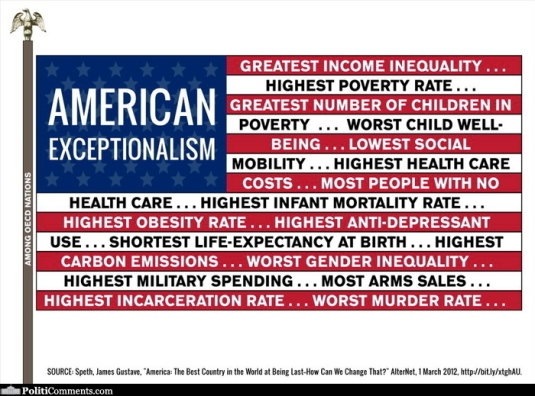
american flag of exceptionalisn

So, what am I getting at?  What is my point?  To find it, we need to return to the thesis of this article:  Are Americans brainwashed?  If we define what it means to be brainwashed as: “One who persists in the belief of something despite apparent evidence and facts to the contrary,” then I would suggest that the evidence points beyond a doubt to the fact that Americans are some of the most brainwashed people on the face of the earth.  It has little to do with experience in business, innate intelligence or amount of degrees accumulated.

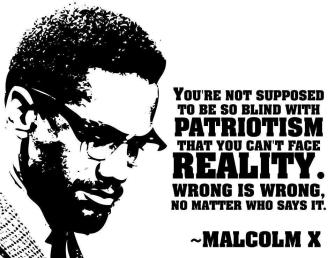
malcomxron paul

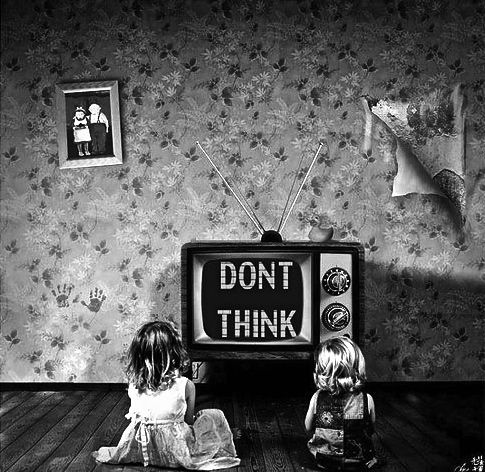
A red herring in our acceptance of my conclusion is the common belief that brainwashing is forced.  Too often, we have the picture of an individual strapped to a chair being made to listen to propaganda or watch propaganda films.  The fact of the matter is that brainwashing can be covert and subdued.  I suggest another picture for brainwashing that is just as effective as “forced” brainwashing.  Picture the average American watching four or five hours or television every day.

Television Statistics.  According to the A.C. Nielsen Co., the average American watches more than 4 hours of TV each day (or 28 hours/week, or 2 months of nonstop TV-watching per year). In a 65-year life, that person will have spent 9 years glued to the tube.

During the average day, an American will have seen or heard between 300-700 marketing messages per day, including messages from the Internet and video gaming. – (Source: Phil Barden, “Decoded: The Science Behind Why We Buy”, 2013).  Much of the research on the role that advertising plays in consumer purchases suggests that it is mostly informative rather than persuasive.  In other words, it appears that consumers use the information to choose between products but are not necessarily persuaded by the advertising to buy any particular product.

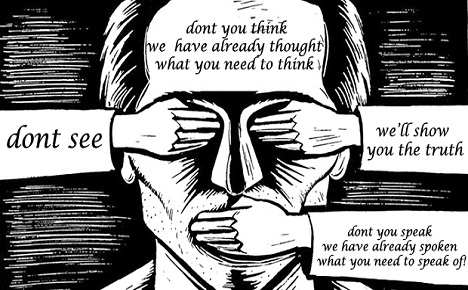
dont-think

As a business instructor and former retail store manager, I am skeptical of the consumer research.  My firsthand experience in regard to the power of these marketing messages does not agree with the research findings.  Students and customers will repeatedly deny that advertising messages play any overt role in their purchasing decisions.  However, any observation of the buying habits of Americans will easily demonstrate a disconnect between what people spend their money on and rational economic sense.

Furthermore, when we look for the messages that “brainwash” many Americans we must look beyond Madison Avenue.  We have a cornucopia of messages bombarding Americans every day that serve to instill mythical beliefs in American exceptionalism, American patriotism, American heroism and American capitalism.  Let us look briefly at some of the beliefs that I noted earlier.

Americans are the hardest working people in the world:

The U.S. ranks 17 out of 38 countries in terms of average hours worked each year, according to the OECD, while Mexico, where labor laws cap the work week at 48 hours, ranks no. 1.  Workers in Costa Rica and South Korea work the second and third longest hours, respectively – Sept 2, 2016

Americans are the most creative and innovative people in the world:

In this area Americans do rank exceptionally high.  The Martin Prosperity Institute ranks 82 countries on a scale for creativity based on technology, talent and tolerance for new ideas.   Overall, America ranks second behind Sweden.  Note however that we are not number one in any category.

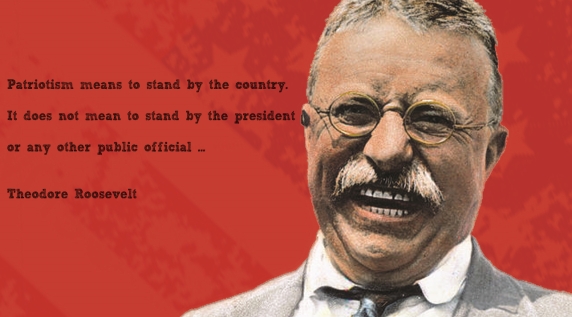
  1. Theodore-Roosevelt-PatriotismUNITED STATES

Technology Rank: 3

Talent Rank: 8

Tolerance Rank: 8

Global Creativity Index: 0.902

Americans are the toughest people in the world:

This is a very ambiguous category and an allegation that is difficult to attack or defend.  How do we define tough?  Is our military the most powerful in the world?  The answer would be yes.  Are our athletes the best in the world?  An all-time medal table for all Olympic Games from 1896 to 2016, including Summer Olympic GamesWinter Olympic Games, and a combined total of both shows that America has clearly dominated the Olympic games.  The top three countries in medal totals are:

America:  Total Medals:  2,804

Russia:  Total Medals – 1,204

Great Britain:  Total Medals – 875

American-exceptionalism

But if we define tough as a measure of resilience to strife and turmoil, we find that Americans are not in first place.  The FM Global Resilience Index ranks and scores countries across nine factors, illuminating their supply chain resilience and resilience in general.  Across political risk, exposure to natural hazards, and infrastructure quality, the index quantifies a nation’s ability to withstand a disruption and bounce back, so products can get to where they need to go.

“The latest version of the ranking, which comes from a Rhode Island-based insurance company, has Switzerland in first place, followed by Norway, with Ireland, Germany, Luxembourg, the Netherlands, the central United States, Canada, Australia, and Denmark counting out the top 10 places.” – Fast Company 

Conclusions:

If Americans belief in the above ideas is false but we continue as a nation to keep repeating them ad nausea, does that mean we are brainwashed?  Or are we simply delusional?  I submit that the causality behind these beliefs is less important than the arrogance and hubris that they demonstrate to the rest of the world.  How can we expect to be respected and admired when we waltz around treating the rest of the world as though they are second class citizens?

“This unchallenged faith in American exceptionalism makes it harder for Americans to understand why others are less enthusiastic about U.S. dominance, often alarmed by U.S. policies, and frequently irritated by what they see as U.S. hypocrisy, whether the subject is possession of nuclear weapons, conformity with international law, or America’s tendency to condemn the conduct of others while ignoring its own failings. Ironically, U.S. foreign policy would probably be more effective if Americans were less convinced of their own unique virtues and less eager to proclaim them.” – Foreign Affairs: The Myth of American Exceptionalism, Stephen M. Walt, 2011

Time for Questions:

Do you think many Americans are brainwashed?  Why or why not?  Do you think there are many beliefs that we as Americans hold that are false?  If so, where do you think they come from?  What do we need to do to see the truth?  How do we overcome mythologies that are constantly reinforced by special interest groups?

Life is just beginning.

The conservative version of American exceptionalism has become a password of sorts for candidates who want to prove their credentials to a right-wing America.” – Russ Feingold