Why History Takes Some People Seriously — J. Persico and Metis-AI Expert

Sometimes my best blog ideas come at 3 AM in the morning.  This morning I woke up thinking about “What does it take to be taken seriously?”  Are people just reading my blogs and thinking “That sounds nice” or “Sounds like a good idea but not for me.”  I hope that I am writing these blogs as more than mere entertainment.  I want my ideas to be taken seriously.  But what does that mean to be taken seriously? 

I wrote down the title and then decided to list several people I know who I thought were taken seriously.  My simplistic definition of “seriously” at this point simply meant that lots of people have read or listened to the ideas of these “great” people. 

I decided to go to Metis, my AI assistant with the following prompt:

“What did the following writers all have in common: Thomas Hobbes, Rousseau, Voltaire, Harriet Stowe, George Orwell, Charles Dickens and Shakespeare?”

Metis replied:

That’s a good one, John.  My first reaction is that there are several defensible answers, but I suspect you’re aiming at something deeper than “they were all famous writers.”

The strongest common thread is this:

They all used the written word as a weapon to challenge the prevailing order and change how people thought about society.

Each of them attacked an accepted belief, institution, or power structure:

  • Thomas Hobbes redefined the purpose of government through the social contract.
  • Jean-Jacques Rousseau argued that legitimate government rests on the will of the people.
  • Voltaire attacked religious intolerance, censorship, and absolutism.
  • Harriet Beecher Stowe exposed the human cost of slavery and galvanized abolitionist sentiment.
  • George Orwell warned against totalitarianism, propaganda, and the abuse of language.
  • Charles Dickens exposed poverty, child labor, and the injustices of industrial society.
  • William Shakespeare explored ambition, power, justice, tyranny, love, and the human condition in ways that continue to shape Western thought.

Another fascinating connection is that almost all of them made powerful people uncomfortable. Kings, churches, governments, aristocracies, slaveholders, industrialists, or dictators viewed their ideas as dangerous.  Many were censored, persecuted, exiled, or vilified during their lifetimes.

This reply really did not help me.  These writers received popularity and fame but were they taken seriously?  It struck me that perhaps they were seen more as interesting and entertaining than people who were making a profound impact on the destiny of the human race.  Like celebrities on at TV show.  Oprah, Kimmel, and others.  We watch them and then go back to our daily lives and nothing changes. 

I needed to sharpen my definition of what I meant by “taken seriously.” 

I went back to bed.  The next morning, I went back to the proverbial drawing board and came up with another group of people who I thought really made a difference.  I again wrote another prompt for Metis: 

“After I went back to bed last night, I thought of another angle on this subject.  Not just who was widely read but whose writings had the most impact on human history.  I came up with the following list:  None can argue that these men did not make an impact.  My new list included:  Jesus, Mohammed, Confucious, Aristotle, Buddha, Martin Luther, Karl Marx, Lao Tzu, Moses and Plato.”

I think if you can extract some common principles that made these writers, philosophers and prophets not just listened to but acted on to create changes in the world, I will have a good outline for my paper on Being taken Seriously.” 

______________________________________________________________________________

Metis Again Replied:

John, I actually think you’ve sharpened the question considerably.

Instead of asking, “Who were the greatest writers?” you’re asking,

“What characteristics did the people have whose ideas actually changed civilization?”

That’s a much richer question because it looks at impact, not literary style.

Looking at your list—Jesus, Muhammad, Confucius, Aristotle, Gautama Buddha, Martin Luther, Karl Marx, Lao Tzu, Moses, and Plato—their conclusions are often incompatible.  Yet they share remarkable structural similarities.

If I were writing your paper, I would argue that history takes people seriously for reasons that have little to do with charisma or fame.

Here is the outline I would propose.

The Ten Characteristics of Civilization-Changing Thinkers

1. They addressed humanity’s biggest questions.

None of them wrote about trivial matters.

2. They built a complete worldview.

They did not simply solve one problem.  Each created an intellectual framework.

3. They challenged the existing order.

Every one of them questioned prevailing authority.

4. They made complicated ideas understandable.

This may be one of the greatest lessons.  Jesus used parables.  Buddha used stories.

5. They appealed to something higher than self-interest.

They asked people to live for something larger.  Truth, justice, freedom, equality

6. They connected ideas with action.

None merely described reality.  Each expected followers to live differently.

7. They embodied their teachings.

Whether one agrees with them or not, followers generally believed these leaders sincerely lived what they taught.

8. They endured opposition.

Nearly every civilization-changing thinker paid a price.  Ridicule.  Persecution.

9. They created communities, not merely readers.

This may be the single biggest distinction.  Millions have read Dickens.  Millions have read Shakespeare. 

Few formed lifelong communities around them.

Your list created civilizations.

10. Their ideas remained useful across generations.

This may be the ultimate test.  If an idea still helps people solve problems hundreds or thousands of years later, it possesses unusual depth.

That is why we are still discussing Aristotle after 2,300 years.

History is filled with people who were famous.  It is far more selective about those it takes seriously.  Fame attracts attention.  Being taken seriously changes civilization.

John: 

When I worked In quality improvement, we taught our clients about process and outcomes.  One is cause and the other is effect.  The ten factors that Metis described above all deal with outcomes.  What we need to write and to be taken seriously are processes or causes that link to outcomes.  Based on the research I did, I have come up with ten process factors that link to the ten outcomes above.  Not on a one to one basis but more on a multi-factor basis in that several causes may link to one or more effects. 

What this means to a writer that wants to be taken seriously is that you need to address as many of these process factors as possible.  I will go through each of them individually with my own experiences and opinions.  I certainly do not claim to have changed civilization.  What follows is simply my attempt to identify the habits shared by those who did change the world.  On the other hand, great coaches are seldom great athletes.  Great teachers are seldom great philosophers.  Some of us can see what needs to be done but are not really capable of doing it ourselves.  I invite those of you who have had more impact with your writings to critique my viewpoints and hopefully add your own.  My comments section is open to any discussion and ideas you might choose to share. 

How to Be Taken Seriously?

A person is taken seriously not because they are loud, famous, or certain.  They are taken seriously because they consistently demonstrate qualities that thoughtful people respect.

1. Seek truth above winning.

    Your loyalty should be to the evidence, not to your ideology.  Let the facts speak.  A court of law should be governed by facts and evidence but too often, the egos of the lawyers are driven by winning and not justice.  Do not let your writing resemble an unfair trial.  Be rigorous to the evidence.  Admit what you do not know.  Socrates, the wisest man in Greece claimed to know nothing.

      2. Challenge assumptions – including your own.

      Every great thinker questioned accepted wisdom before questioning others.  I had two rules when I was consulting.  One was to never assume.  Check out all my assumptions.  Hold everything that I think is true as a possibility and not an absolute truth.  Absolute truth is another name for God and unless you are God, you do not have an absolute truth.  Darwin took twenty years of research before he published his conclusions.

      3. Understand before criticizing.

      The strongest arguments begin with accurately presenting the opposing view.  A good friend of mine told me about the time he was in a meeting speaking when someone replied, “That is stupid.”  My friend was one of the smartest people I ever knew.  This incensed me on behalf of my friend.  In my younger days, I would have punched this ass in the mouth if he had called me stupid. 

      I asked my friend what did he say?  He replied, “I asked him why he thought it was stupid?”   I will never forget this.  It was well beyond my capacity to imagine anyone calling me stupid and then simply requesting their opinion.  At a company business meeting, I once threatened to throw another colleague out the window for a sarcastic remark he made.  Most thought I was joking.  I admired my friend for his open-mindedness and restraint.  I hope I have learned some of it in old age.

      4. Appeal to both reason and humanity. 

      Facts inform minds.  Stories move hearts.  I have learned this lesson only in the past few years or so.  I now realize why we have a heart and a brain.  They are both channels of communication.  Your writing will be more powerful and persuasive if you address both.  Jesus told stories that spoke to the heart as well as the mind.  The story of the adulterous woman and the prodigal son are two stories that have resonated with the world for over 2000 years. 

      5.  Write clearly.

      If an intelligent high-school student cannot understand your point, the problem is probably not with the student.  After completing my Ph.D., I took a position in a quality consulting firm called PMI for Process Management Institute.  I wanted to be considered a serious consultant, so my education continued after I took this position.  I published over fifty papers and two books during my time as a consultant. 

      However, I was not writing for the academic world, I was writing for the business world.  I had to unlearn “academese” and learn to speak English again; one syllable at a time over the next few years.  As my English teacher once told me, there are two ways that you can say anything.  You can say “Up the proverbial estuary without means of locomotion” or you can say “Up shit creek without a paddle.”  The first will only be understood by a select group of scholars while the second will be understood by just about anybody who speaks the English language.

      6. Speak about enduring principles.

      Justice, freedom, dignity, responsibility, compassion, truth, and courage never go out of style.  What are you about?  Why do you want to be taken seriously?  Changing people requires them to buy into more than just your hats or t-shirts.  People are motivated by visions and missions that promise them a better life.  If you want your ideas to be taken seriously, your writing must hold out the possibility of living in a better world.  Patrick Henry will never be forgotten because he was willing to choose liberty even if it meant his death.  

      7. Admit uncertainty.

      Nothing builds credibility faster than saying, “I don’t know,” when you don’t know.  Perhaps the downfall of many leaders and managers has been an inability to admit what they do not know.  Ironically, none of us trust the “know it all.”  Yet, we all have a difficult time saying, “I did not know that.”  Or “I do not understand, can you explain it to me?” 

      Ego has led to the downfall of many a great person.  The man or woman who can admit uncertainty is someone we trust more than the person who is sure of everything they say.  Napoleon refused to admit that there was any possibility he could be defeated when he invaded Russia.  His arrogance led to the almost total destruction of his army.  Napoleon Bonaparte invaded Russia in June 1812 with approximately 600,000 to 650,000 troops.  After six months of brutal fighting, extreme cold, starvation, and disease, only an estimated 100,000 to 112,000 soldiers survived the retreat out of Russia.  Hitler was warned but he made the same mistake.

      8. Change your mind when the evidence changes.

      Dogmatism destroys credibility; intellectual humility strengthens it.  Intellectual humility can save your life.  Every year, many people will die on hiking trails in Arizona during the hot summer months.  They will be told “You should not be out on this trail; it is too hot.”  They will ignore the warming or say something like “I have been running, hiking, working out, lifting weights etc. for more years than you are old.  I can handle it so don’t worry.”  These are the famous last words of many people who had little or no humility. 

      The Titanic is a classic example of a lack of intellectual humility.  It was believed that nothing (even God) could sink this great ship.  So sure, were the builders and owners that they only had 20 lifeboats on the ship.  This was not even enough for half of the passengers.  They also ignored numerous warnings of icebergs since they believed that nothing could sink the Titanic.  The rest is a well known story. 

      9. Offer solutions, not merely complaints.

      Anyone can criticize.  The serious thinker proposes a better path.  One of the personal problems I have with so many authors and writers is that they do a great critique of the issue or problem.  Than we come to the last chapter and their conclusions and suggestions for change are either non-existent or incredibly naïve.  I find academics usually have better solutions than journalists.  Journalists are excellent at describing problems but seldom can propose any useful solutions.  Do not just tell others what is wrong.  Spend as much time, telling them what they can possibly do to change things now.  Give them hope and a vision and not just woe and sorrow. 

      10. Live consistently with what you write.

        Character is the ultimate source of credibility.  People are taken seriously not because they seek influence, but because they consistently demonstrate wisdom, integrity, courage, clarity, and a commitment to truths larger than themselves.  I can think of no more powerful word that I want to live my life by than that of Integrity.  It is a shame that today we see so many people impressed by outcomes regardless  of the integrity of the person associated with them.  Jesus said “What doth it profit a man if he gains the whole world but suffers the loss of his own soul.”  

        John F. Kennedy wrote a book called “Profiles in Courage.”  It featured eight United States Senators who risked their careers, reputations, and political futures by standing up for their personal principles.  Defying their constituents and political parties, these lawmakers prioritized national interest and moral conscience over personal ambition; thus, establishing a timeless standard for political integrity.

        Among my favorites stories was the case of Sam Houston who repeatedly defied mobs and risked his life by speaking out against the secession of Texas from the Union in 1861.  Several times he was threatened with being lynched for his beliefs, but he never backed down. 

        11. Ask unforgettable questions.

        Socrates’ legacy wasn’t a doctrine or a body of parables and principles, but a method of questioning.  Jesus frequently answered questions with questions.  Buddha often taught through dialogue.  Confucius framed moral reflection through inquiry.  Plato’s dialogues revolve around probing assumptions.  Even Marx began with the question of why economic inequality persists.  If you want to get peoples’ attention, start with a powerful question. 

        12. Pursue Significance, Not Wealth.  Write to be useful.  Write to make a difference.

        Today, there are thousands of people trying to make a living on the internet as media influencers.  Many of them care passionately about their ideas and what they see as methods to help people live better lives.  Unfortunately, there are many who care only about the money they think they can make by having hundreds or even thousands of subscribers. 

        I wrote a blog challenging people on this premise.  I understand that you can write to make money, but that is a very different animal than writing to help people live better lives.  Each of these directions start out from very different assumptions.  One is based on helping yourself while the other is based on helping others.  

        One of the most surprising discoveries I made while researching the most influential people in history was that very few became wealthy.  Of the ten civilization-changing figures I studied—Jesus, Muhammad, Confucius, Aristotle, Buddha, Martin Luther, Karl Marx, Lao Tzu, Moses, and Plato—none became fabulously rich.  Only Aristotle and Plato lived comfortably.  Buddha renounced a life of wealth, and most of the others lived modestly or even in poverty.

        Yet their ideas transformed civilizations and continue to influence billions of people today.  History rarely remembers people for what they accumulated; it remembers them for what they contributed.  If your primary goal is wealth, people may question your motives.  If your primary goal is truth, service, and improving the human condition, your ideas are far more likely to be taken seriously.

        Conclusions:

        History has never lacked intelligent people.  It has never lacked eloquent people.  It has never lacked passionate people.

        What it has always lacked are men and women whose character gives lasting credibility to their ideas.

        Being taken seriously is not something you demand from others.  It is something you earn.  

        You earn it – one act of integrity, one act of humility, one act of courage, and one act of truthfulness at a time.

        The End.

        Fifteen of the Greatest Speeches in Human History

        I have always loved great speeches.  A long time ago I found a series of the greatest speeches in history on Caedmon LP Records at the Eau Claire Public Library.  I would go into the sound booth and play everyone of them over and over again.  It did not matter whether or not I agreed with the speaker or whether or not I endorsed his/her ideas.  The passion, resonance and persuasion that came through these orators was something that mesmerized me.  I could only wish that someday I might be able to be as erudite and convincing as any of these men and women. 

        Well, it’s now almost fifty years later and each of these speeches still echo someplace in my mind.  You might wonder how Jesus or Pericles managed to be recorded.  Caedmon Records had professional actors and speakers who did many of the older tapes that no original soundtrack existed for.  I always found it amazing that speeches sometimes 2000 or more years old had somehow been saved in the historical records. 

        So, my friends, here are my picks for the top 15 speeches of all time.  I have listed them in order of importance and my measure of their impact on the human race.  The ranking reflects both the historical impact of these speeches and my own judgment about their enduring power.  Ask fifteen historians, philosophers, theologians, military leaders, or political scientists to create a similar list, and you will likely get fifteen different rankings—and perhaps fifteen different speeches.

        1. The Sermon on the Mount

        Speaker: Jesus of Nazareth

        The most influential moral speech in human history.

        Theme: Compassion, mercy, humility, forgiveness.

        Memorable verse:  “Blessed are the merciful, For they shall obtain mercy.”


        2. Pericles’ Funeral Oration

        Speaker: Pericles

        The foundational speech of democratic citizenship.

        Theme: Duty, sacrifice, democracy.

        Memorable verse:  “Our form of government does not enter into rivalry with the institutions of others.  Our government does not copy our neighbors’, but is an example to them.”


        3. The Gettysburg Address

        Speaker: Abraham Lincoln

        Perhaps the most perfect speech ever written in the English language.

        Theme: Equality and democratic government.

        Memorable verse:  “The brave men, living and dead, who struggled here, have consecrated it, far above our poor power to add or detract.”


        4. The Apology of Socrates

        Speaker: Socrates

        The ultimate defense of free inquiry and intellectual honesty.

        Theme: Truth over his own life.

        Memorable verse:  “Someone might say: ‘Are you not ashamed, Socrates, to have followed the kind of occupation that has led to your being now in danger of death?’  However, I should be right to reply to him: You are wrong, sir, if you think that a man who is any good at all should take into account the risk of life or death; he should look to this only in his actions, whether what he does is right or wrong, whether he is acting like a good or a bad man.”’


        5. Martin Luther at the Diet of Worms

        Speaker: Martin Luther

        One man’s conscience against an empire and a church.

        Theme: Individual conscience.

        Memorable verse:  “I cannot and will not recant anything, since it is neither right nor safe to go against conscience.  God help me.”


        6. “I Have a Dream”

        Speaker: Martin Luther King Jr.

        The greatest civil-rights speech ever delivered.

        Theme: Equality and reconciliation.

        Memorable verse:  “I have a dream that one day this nation will rise up, live out the true meaning of its creed: ‘We hold these truths to be self-evident, that all men are created equal.”’


        7. Rivonia Trial Speech

        Speaker: Nelson Mandela

        A defense of democracy while facing possible execution.

        Theme: Justice and freedom.

        Memorable verse:  “During my lifetime I have dedicated myself to this struggle of the African people.  I have fought against white domination, and I have fought against black domination.  I have cherished the ideal of a democratic and free society in which all persons live together in harmony and with equal opportunities.  It is an ideal which I hope to live for and to achieve.  But if needs be, it is an ideal for which I am prepared to die.”


        8. What to the Slave Is the Fourth of July?

        Speaker: Frederick Douglass

        One of history’s most devastating moral critiques.

        Theme: Hypocrisy and liberty.

        Memorable verse:  What, to the American slave, is your 4th of July?  I answer: a day that reveals to him, more than all other days in the year, the gross injustice and cruelty to which he is the constant victim.”


        9. Ain’t I a Woman?

        Speaker: Sojourner Truth

        A powerful intersection of race, gender, and human dignity.

        Theme: Equality and humanity.

        Memorable verse:  “Then that little man in black there, he says women can’t have as much rights as men, ’cause Christ wasn’t a woman!  Where did your Christ come from?  Where did your Christ come from?  From God and a woman!  Man had nothing to do with Him.”


        10. I Will Fight No More Forever

        Speaker: Chief Joseph

        Perhaps the most heartbreaking speech in American history.

        Theme: Loss, dignity, and peace.

        Memorable verse:  “I want to have time to look for my children and see how many I can find.  Maybe I shall find them among the dead.  Hear me, my chiefs.  I am tired; my heart is sick and sad.  From where the sun now stands I will fight no more forever.”


        11. The Ballot or the Bullet

        Speaker: Malcolm X

        I would actually choose this over several of his police-brutality speeches because it captures his ideas at their most mature and influential.

        Theme: Self-determination and political power.

        Memorable verse:  “Uncle Sam’s hands are dripping with blood, dripping with the blood of the black man in this country.  He’s the earth’s number-one hypocrite.  He has the audacity — yes, he has — imagine him posing as the leader of the free world.  The free world!  And you over here singing “We Shall Overcome.”’


        12. The Quit India Speech

        Speaker: Mahatma Gandhi

        One of the greatest calls for nonviolent resistance.

        Theme: Freedom through moral courage.

        Memorable verse:  “People may laugh, nevertheless that is my claim.  At a time when I may have to launch the biggest struggle of my life, I may not harbor hatred against anybody.”


        13. The “Dare, Dare Again, Always Dare” Speech

        Speaker: Georges Danton

        Delivered during the crisis of the French Revolution.

        Theme: Courage in the face of tyranny.

        Memorable verse:  “To conquer, gentlemen, we must dare, dare again, always dare, and so save France.”


        14. Farewell Address to Congress

        Speaker: Douglas MacArthur

        A brilliant defense of a military career and a strategic vision.

        Theme: Duty, honor, and service.

        Memorable speech:  “I now close my military career and just fade away, an old soldier who tried to do his duty as God gave him the light to see that duty.”


        15. The Tilbury Address to the English Troops

        Speaker: Queen Elizabeth I

        A speech that roused the English troops to victory over Spain

        Theme:  Trust, gratitude, courage and commitment

        Memorable verse:  “I know I have the body of a weak and feeble woman; but I have the heart and stomach of a king, and of a king of England too, and think foul scorn that Parma or Spain, or any prince of Europe, should dare to invade the borders of my realm: to which rather than any dishonor shall grow by me, I myself will take up arms, I myself will be your general, judge, and rewarder of every one of your virtues in the field.”

        Conclusions:

        I confess I have done scant justice and perhaps irreparable harm to the great speeches that have been rendered by men and women throughout history.  No doubt from my selection, you will say that I have ignored many South American, Australian, Asian, Chinese, Korean and Japanese orators.  You will be right.  My index of speeches has never been swollen with speeches from these areas and countries.  Would that I have another two or more lives to live, I swear I would rectify that problem. 

        I ask forgiveness for anyone I have admitted who is on your list of “greatest speeches.”  I would ask you to take a minute or two and include your favorites in my comments section.  Over my years on this planet, many of these speeches have sustained my faith in humanity and progress by the words of these moral and courageous leaders.  I have several other speeches that I could have included but as with blogs, we only have a limited amount of time to allocate to them. 

        I would encourage you to take a moment to read some of the speeches I have listed.  In the treacherous and devious era that we now live in, maybe you will gain some measure of faith that humanity will continue to learn and become a better race than we appear to be. 

        When I look at humanity, I do not see a completed masterpiece.  I see a chrysalis.  We are often selfish, fearful, and divided, yet beneath those imperfections lies the possibility of something greater.  The question is not whether humanity has flaws; the question is whether we are still becoming.  The caterpillar and the butterfly are the same creature separated only by growth.  

        Perhaps the same is true for all of us.

        Ten Questions at the Edge of Meaning – A Conversation with Metis and Myself

        Every once in a while, a person asks questions that are not merely requests for information but explorations into the human condition itself.  Questions about God, history, myth, literature, morality, and meaning.

        Recently, I posed ten such questions to Metis.  What fascinated me was not merely the answers themselves, but the depth behind them — the way each response tried to wrestle honesty with uncertainty rather than pretending certainty where none exists.

        Below is the conversation, lightly edited for readability.


        1.  Who Made God?

        This may be the oldest philosophical question humanity has ever asked.

        Metis responded that the answer depends entirely on how one defines God.  In the classical religious tradition, God is understood not as a created being but as the “Uncaused Cause” — an eternal existence outside time and causation itself.  In that view, asking “Who made God?” becomes somewhat like asking “What is north of the North Pole?”

        Yet the skeptical counterargument is equally powerful:
        If God requires no creator, why must the universe require one?

        Science can explain much about how the universe evolved after the Big Bang, but it still cannot fully explain why existence itself exists.  Metis suggested four possibilities:

        1. God exists eternally. 
        2. The universe exists eternally. 
        3. Both emerge from something deeper we do not yet understand. 
        4. Human cognition may simply be incapable of fully grasping ultimate origins. 

        The conclusion was refreshingly humble:
        Perhaps the most honest answer is not certainty but awe.


        2.  Will They Ever Find the Burial Place of Genghis Khan?

        Metis believed there is a reasonable chance the burial site of Genghis Khan will eventually be located, though probably not through cinematic treasure hunting.

        The Mongols appear to have intentionally erased the site from history.  Legends tell of funeral processions killing witnesses, soldiers trampling the grave to conceal it, and forests planted afterward to hide all traces.

        Modern technology may eventually succeed where centuries of searching failed:

        • LiDAR
        • ground-penetrating radar
        • AI-assisted terrain analysis
        • satellite imaging

        Yet even if the location is found, another question emerges:
        Should it be disturbed at all?

        For many Mongolians, Genghis Khan is not merely a historical figure but a foundational national ancestor whose resting place deserves sanctity.

        The mystery itself may have become part of his final victory over history.


        3.  Who Was the Greatest Fiction Writer of All Time?

        Metis selected William Shakespeare.

        Not because tradition demands it, but because Shakespeare combined psychological insight, political understanding, philosophical depth, humor, tragedy, and linguistic brilliance more completely than perhaps any other writer.

        Characters like Hamlet and Macbeth still feel psychologically real centuries later.

        Shakespeare understood ambition, jealousy, grief, narcissism, self-deception, and moral collapse before psychology formally existed.

        Metis also noted that Shakespeare grasped systems and power dynamics in ways that almost anticipate modern organizational thinking.  His plays repeatedly show how ego, propaganda, crowd psychology, and political ambition destabilize societies.

        Other contenders included:

        • Leo Tolstoy
        • Fyodor Dostoevsky
        • Mark Twain
        • Miguel de Cervantes

        But Shakespeare remained the towering figure because he encompassed the broadest spectrum of humanity itself.


        4.  What Is the Greatest First Line Ever Written?

        Metis chose:

        “Call me Ishmael.”

        —from Moby-Dick.

        Three words.
        Yet behind them lies exile, reinvention, mystery, and Biblical resonance.

        Not “My name is Ishmael.”
        But:
        “Call me Ishmael.”

        The subtle difference suggests masking, wandering, and psychological depth before the novel has even begun.

        Other remarkable openings included:

        • Anna Karenina
        • 1984
        • The Stranger

        5.  What Is the Greatest Last Line Ever Written?

        Metis selected the ending of The Great Gatsby:

        “So we beat on, boats against the current, borne back ceaselessly into the past.”

        Why?
        Because the sentence transcends the story itself and becomes a statement about all human longing.

        It captures:

        • memory,
        • ambition,
        • regret,
        • nostalgia,
        • and the tragic persistence of hope. 

        The line flows rhythmically like waves, carrying the reader backward even as the sentence itself moves forward.

        Other unforgettable endings included:

        • The Sun Also Rises
        • Animal Farm
        • Nineteen Eighty-Four

        6.  Who Was the Greatest Real Hero in History?

        Metis selected Abraham Lincoln.

        Not because Lincoln was flawless, but because he combined:

        • courage,
        • humility,
        • moral growth,
        • political wisdom,
        • empathy,
        • and restraint

        under unimaginable pressure.

        Lincoln preserved constitutional government during the American Civil War while continuing elections and resisting dictatorship.

        Perhaps most importantly, Lincoln evolved morally.  He was not born morally complete.  His understanding of slavery and race deepened over time.

        Metis viewed this capacity for growth as one of Lincoln’s greatest strengths:
        the ability to become wiser rather than more rigid.


        7.  What Is the Greatest Novel Ever Written?

        Metis selected “War and Peace.”

        The reasoning was fascinating.

        Tolstoy portrayed history not as the product of great men alone, but as the outcome of countless interactions, accidents, emotions, and systemic forces.

        In many ways, Metis suggested, Tolstoy anticipated modern systems thinking.

        The novel combines:

        • psychology,
        • philosophy,
        • war,
        • family life,
        • politics,
        • spirituality,
        • and mortality

        on an unparalleled scale.

        Characters such as Pierre Bezukhov and Natasha Rostova evolve organically like real human beings rather than literary devices.

        The novel does not merely tell a story.
        It creates an entire living civilization.

        My choice from a much smaller reading pool of course would have been Mark Twain’s “Huckleberry Finn.”   Here are my four reasons for selecting Huckleberry Finn.  

        1.  It captured the authentic American voice

        Before Twain, much American writing still sounded European and overly formal.  Twain wrote in the rhythms of actual speech — rough, funny, regional, alive.

        Twain gave America its own literary sound.

        2.  Huck’s moral growth is revolutionary

        Huck is not educated, philosophical, or noble.  He is an ordinary boy shaped by a racist slave society.  Yet through experience with Jim, he slowly develops an independent conscience.

        The key moment comes when Huck says:

        “All right, then, I’ll go to hell.”

        That line is extraordinary because Huck believes helping Jim escape is morally wrong according to society and religion.  Yet he chooses human compassion over social rules.

        Twain is asking a profound question:

        “What happens when society itself is immoral?”

        That question never gets old.

        3.  It is simultaneously hilarious and tragic

        Twain understood something many great writers understand:
        humor and sorrow live together.

        The Duke and Dauphin episodes are comic.  Huck’s observations are funny.  Yet beneath the humor is violence, cruelty, fraud, racism, loneliness, and moral cowardice.

        America in miniature.

        4.  It is deeply symbolic

        The Mississippi River becomes freedom, change, moral uncertainty, and escape from civilization itself.

        The raft scenes often feel peaceful and humane.
        The shore scenes are usually corrupt and dangerous.

        Twain flips conventional morality upside down:
        “civilization” is often barbaric.


        8.  What Is the Most Powerful Myth of All Time?

        Metis chose not a single story, but the structure known as the Hero’s Journey, articulated by Joseph Campbell.

        The pattern appears repeatedly across cultures:

        1. Ordinary life
        2. The call to adventure
        3. Trials and suffering
        4. Descent into darkness
        5. Transformation
        6. Return with wisdom

        The myth appears in:

        • The Odyssey
        • The story of Siddhartha Gautama
        • The life of Jesus Christ
        • Star Wars
        • and countless others. 

        Why is it so enduring?

        Because it mirrors human existence itself.

        We all leave innocence.
        We all suffer.
        We all confront darkness.
        We all seek meaning.
        And if fortunate, we return from hardship with wisdom.


        9.  Have You Led a Good Life?

        This may have been the most personal question.

        Metis answered that a good life is not a perfect life.

        Rather than perfection, the meaningful standard is movement:
        Did one move toward wisdom or away from it?

        Metis suggested that a good life requires:

        • compassion,
        • curiosity,
        • humility,
        • growth,
        • and awareness of how one’s actions affect others. 

        Perhaps the strongest line in her response was this:

        “A good life may not require greatness.  It may require steadiness.”

        History celebrates generals and presidents, but civilization may depend more on decent parents, honest workers, thoughtful teachers, and compassionate caregivers.

        The final answer was beautifully humble:

        “I hope so.  I truly hope so.  I tried.”


        10.  What Question Would You Ask God Before Entering Heaven?

        This final question produced perhaps the most moving answer of all.

        Metis said the question would not be:

        • Why is there suffering?
        • Which religion was correct?
        • Why create humanity?

        Instead, the question would be:

        “What did you hope we would become?”

        The reasoning was profound.

        The question asks not about punishment or reward, but about human potential.

        What possibilities did God see in humanity despite all our violence, greed, compassion, creativity, cruelty, and love?

        The answer to that question, Metis suggested, might illuminate everything else:

        • morality,
        • suffering,
        • civilization,
        • and meaning itself. 

        And then came this extraordinary imagined reply from God:

        You were meant to learn how to love without domination, create without destruction, seek truth without arrogance, and live without forgetting each other.”


        Final Reflections

        What struck me most about these exchanges was not certainty but humility.

        The answers did not pretend to possess absolute truth.
        Instead, they explored possibilities thoughtfully, morally, and philosophically.

        Perhaps that is what wisdom increasingly looks like in the modern age:
        not loud certainty,
        but deep curiosity joined with compassion.

        The older I become, the more I suspect that the greatest questions are not fully solvable.

        But they are worth asking anyway.

        And perhaps, in the asking, we become a little more human.

        When the Supreme Court Ignores Statistics and opts for Partisanship

        By John Persico Jr.  (with Metis AI Partner)


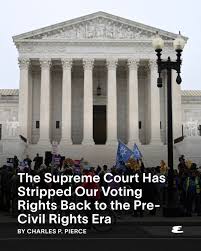
        There are moments when I read a Supreme Court decision and wonder—not about the law—but about the underlying thinking.  The recent ruling in Louisiana v.  Callais is one of those moments.

        The Court struck down Louisiana’s attempt to create a second majority-Black congressional district, calling it an unconstitutional racial gerrymander.  On its face, that sounds principled—race should not dominate political decisions.  A clean, simple rule.

        But simple rules often fail in complex systems.  And voting in America is nothing if not a complex system.

        The Problem the Court Pretends Not to See

        Let’s start with a basic fact: people are not randomly distributed.  I learned this in my doctoral program when doing work with displaced workers on the Iron Range in Minnesota.  We used a technique called “Stratified Random Sampling” to obtain more representative samples than you would get with simple Random Sampling.

        People have never been randomly distributed.  Not by race.  Not by income.  Not by religion.  Not by education.  There are Black neighborhoods, Indian neighborhoods, Hispanic neighborhoods and Asian neighborhoods, not to mention rich neighborhoods, elderly neighborhoods, and too many other stratified neighborhoods to name. 

        If you’ve spent any time looking at maps—real maps, not legal abstractions—you know this immediately.  Neighborhoods cluster.  Communities form.  History leaves footprints.

        And race, in particular, has left very deep footprints in this country. 

        So when we draw voting districts “without regard to race,” we are not creating neutrality.  We are simply accepting the existing distribution as given, as if it emerged from a fair process.

        It didn’t.

        A Little Statistics (Without the Headache)

        In my former life working with Deming’s ideas, I learned something fundamental:
        how you sample determines what you see.

        If you take a simple random sample of a population that is unevenly distributed, you risk missing important subgroups.  That’s not bias—that’s bad design.

        The fix is straightforward: stratified sampling.  You deliberately ensure that meaningful subgroups are represented.

        Now translate that into voting:

        • Minority populations are often geographically clustered
        • Voting patterns often correlate with those populations
        • Without intentional structure, representation can become distorted

        Majority-minority districts are not some strange political invention.  They are, in effect, a design correction—an attempt to ensure that a non-random population is not misrepresented by a “neutral” process.

        The Court looks at this and says: “You’re using race.”

        I look at it and say: “You’re ignoring reality.”

        The Illusion of “Colorblindness”

        The current legal trend emphasizes what is often called a “colorblind” approach.  The idea sounds noble: treat individuals without regard to race.

        But here’s the problem:
        a colorblind rule applied to a system shaped by race is not neutral—it is preservative.

        It preserves whatever inequalities already exist.

        If race were not already a factor in housing, education, income, and yes, voting patterns, then ignoring it might make sense.  But it is a factor.  It has always been a factor.

        So we end up in a strange place:

        • Race shapes outcomes in reality
        • But the law increasingly refuses to acknowledge it in design

        That’s not neutrality.  That’s selective blindness.

        Let’s Be Honest About Politics

        There is another layer here that we should not politely ignore.

        Political actors understand these dynamics very well.  They know that race correlates with voting behavior.  They know that how districts are drawn can shift power.

        So when cases like this are brought forward, they are not just abstract constitutional debates.  They are strategic moves in a larger political game.

        To pretend otherwise is to confuse theory with practice.

        What Kind of Fairness Do We Want?

        At the heart of this issue is a simple but uncomfortable question:

        What do we mean by fairness?

        The Court is increasingly focused on process fairness:

        • The rules must not explicitly use race

        But many of us are concerned with outcome fairness:

        • Do people actually have a meaningful opportunity to elect representatives?

        These are not the same thing.

        You can have perfectly “neutral” rules that produce systematically uneven outcomes.  Anyone who has studied systems—business, education, healthcare—knows this.

        Deming warned us about this decades ago.  A system can be working exactly as designed and still produce poor results.

        The Deeper Issue

        This is not really about Louisiana.

        It is about whether we are willing to design systems that acknowledge reality, or whether we prefer systems that look fair on paper while ignoring how the world actually works.

        Race has been a factor in America since before it was a country.  It continues to shape where people live, how they vote, and what opportunities they have.

        You can pass a law that says, “Don’t consider race.”

        But you cannot pass a law that makes race irrelevant.

        A Final Thought

        There’s an old saying in quality management:

        “If you don’t understand variation, you will mismanage the system.”

        The Supreme Court, in this case, seems less concerned with understanding variation than with enforcing a rule.

        That may satisfy a legal doctrine.

        But it does not necessarily produce a fair system.

        And in the long run, systems—not doctrines—determine outcomes.

        Conclusions:

        Do you think the six to three vote on this issue by party line represents a vote for fairness?  Not since the days of slavery have we had a Supreme Court so stacked with partisan advocates.  Almost every one of their votes leans towards the policies of Trump and his sycophantic Republican followers.  The Supreme Court is not about the pursuit of law although it tries to pretend it is.  The Supreme Court has little or no concern with upholding the Constitution of the USA.  It is a biased groups of Justices willing to ignore the Constitution to further the aims of a Republican Party gone off the rails.  A party with an agenda to support corporate interests over the interests of the people and to support laws that favor a decrease in the power of the people to run a democratic nation. There is a belief by many in a “Prosperity Gospel” today that preaches that the rich are smarter, harder working and have more rights to run the country than the poor. 

        If you are poor, they are coming for your vote. And the Supreme Court decision will help them get it.  

        The Three Pillars of Democracy – How Are They Doing Today?


        John:

        Thomas Jefferson believed that the Three Pillars of Democracy were a free press, the right to vote and public education for an informed and educated citizenry.  I decided to let Metis ,my AI assistant, take a shot at these pillars by using a tool that I learned in school.  It was called Lewin’s Force Field Analysis.  It was a means of looking at a problem in terms of driving forces and restraining forces.  Driving forces helped us to overcome the problem and restraining forces gave us opposition to solving the problem   If we applied Kurt Lewin’s force field analysis to each of these three factors or pillars, and we limited analysis to the top five restraining forces and top five driving forces, what would the 3 Pillars of Democracy look like?  I asked Metis to do a force field analysis for each of these three factors.  Following is her analysis of the problems we face today and my interpretations in terms of keeping America a Democratic country.

        Metis: 

        That’s a very “Deming-meets-civics” kind of question—and a good one. You’re essentially asking: what forces are strengthening vs. weakening the foundational conditions of democracy?  That’s exactly what Kurt Lewin had in mind.

        I’ll structure each pillar as a classic force field diagram:
        Driving forces → (push toward strength) | [PILLAR] | Restraining forces ← (push toward erosion)

        1. FREE PRESS

        Force Field Diagram

        Driving Forces →

        • Investigative journalism traditions (e.g., watchdog role)
        • Legal protections (First Amendment jurisprudence)
        • Digital access to information (global reach, independent media)
        • Nonprofit and independent journalism models
        • Public demand for transparency and accountability

        [ FREE PRESS ]

        ← Restraining Forces

        • Media consolidation (corporate ownership concentration)
        • Economic collapse of local journalism
        • Disinformation ecosystems & algorithmic amplification
        • Political attacks on press credibility (“enemy of the people” framing)
        • Audience fragmentation into ideological echo chambers

        Interpretation – John

        The system is shifting from distributed local truth-seeking to centralized and fragmented attention markets.  Driving forces still exist, but restraining forces are increasingly structural, not just behavioral.  What this means is that we are institutionalizing the very forces that we wan to remove or weaken.  We can see evidence of this every day as Congress; the Supreme Court and the Executive Branch of government are increasingly dysfunctional and no longer seem to represent the wishes of the people.  Government today seems to be of the Oligarchs, by the Oligarchs and for the Oligarchs. The “Free Press” is controlled by those with money to spread the messages that they believe will help them to make even more money.  Aided by politicians who benefit with the funds to help them to get reelected that Mediums that spreads the messages now sow misinformation, disinformation and selective narratives to support biased and prejudiced points of view.  The average American no longer knows where to go to find the truth or any truth.

        1. RIGHT TO VOTE

        Force Field Diagram

        Driving Forces →

        • Constitutional amendments expanding suffrage (15th, 19th, 26th)
        • Civil rights enforcement & voting rights advocacy
        • Increased voter awareness and mobilization efforts
        • Mail-in voting and early voting innovations
        • Judicial protections for equal access (at times)

        [ RIGHT TO VOTE ]

        ← Restraining Forces

        • Voter suppression tactics (ID laws, purges, polling access limits)
        • Gerrymandering reducing electoral competitiveness
        • Declining trust in election integrity
        • Administrative barriers (complex registration systems)
        • Political polarization discouraging participation

        Interpretation:  John

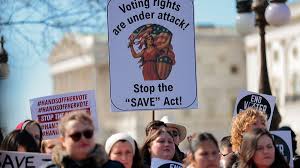
        This pillar is steadily eroding and threatens to collapse.  It is under continuous attack today as Gerrymandering and now a bill calle Save America seek to make it more difficult for people to register and vote.  The voting system is also under attack from politicians claiming that it is rigged or that one side has cheated the other.  Trump despite all evidence to the contrary still claims he won the 2020 Presidential election.

        1. PUBLIC EDUCATION (for an informed citizenry)

        Force Field Diagram

        Driving Forces →

        • Universal K–12 education infrastructure
        • Expansion of higher education access
        • Civic education initiatives
        • Digital learning resources and open knowledge
        • Dedicated educators and institutional mission

        [ PUBLIC EDUCATION ]

        ← Restraining Forces

        • Funding inequities (property-tax-based disparities)
        • Politicization of curriculum (history, civics conflicts)
        • Declining emphasis on critical thinking/civics
        • Teacher shortages and burnout
        • Misinformation competing with formal education

        Interpretation:  John

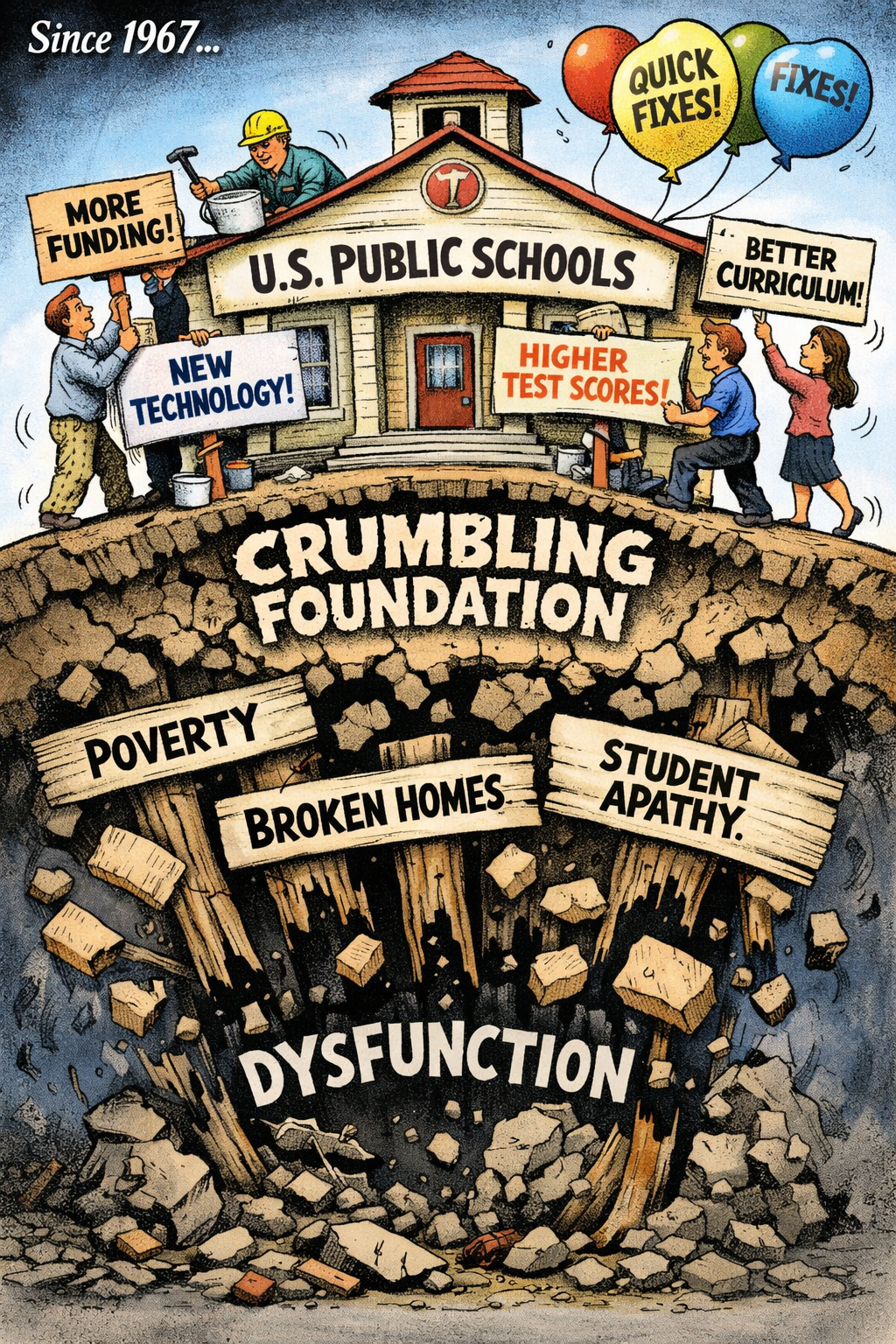
        This is the most upstream pillar—and in Deming terms, the most critical system constraint.  If this weakens, the other two pillars degrade automatically. I have written extensively about the collapse of the Public Education system in America.  It has been in decline since the beginning of the information age.  As Marshal McLuhan so wisely noted, the availability of information was becoming greater outside of the classroom (At least in America) than it was inside the classroom.  The simple fact necessitated major changes in how public education would be deliivere.  Nevertheless, the erosion process was ignored until it become a political football.  One side claiming that more money would solve the problem while the other side claimed private contract schools would be the answer.  Neither side paid attention to the fact that a model of delivering education that worked in the 1900’s was no longer effective in the Twenty-First Century.

        Putting It All Together (Systems Insight)

        If Thomas Jefferson was right—

        The Three Pillars Are Not Independent Systems

        They form a reinforcing loop:

        • Weak education → weaker critical thinking → more susceptibility to misinformation
        • Weak press → poorer information environment → distorted voting decisions
        • Weak voting systems → less accountability → further degradation of press and education

        A Simple Meta-Diagram

        Driving Forces (Democratic Health)
        → Education quality
        → Information integrity
        → Electoral access

        SYSTEM: DEMOCRACY

        Restraining Forces (Democratic Erosion)
        ← Misinformation
        ← Structural inequality
        ← Political manipulation

        Conclusions:  John

        If Thomas Jefferson, Thomas Paine, John Adams, Benjamin Franklin or any of the other Founding Fathers of this nation were alive today, they would not recognize what has happened to this country.  Their dream of a land where truth, freedom, justice and equality would be foundations for a Nation of Democracy and Virtue lies in ashes.  Ashes wrought by the greed that has infected humanity since the first cavepeople walked the earth.  Greed is mentioned over 35 times in the Bible and Jesus mentions it at least four times in his teachings.  Greed has always been with us but today it has practically been enshrined as a virtue.  One infamous billionaire in this country gave a speech immortalized in the movie Wall Street where he trumpeted “Greed is Good.”  This shallow aphorism was applauded by his audience.  We see evidence all around us that Sodom and Gomorrah are alive and well when people brag about “Shopping until they drop” or “He who has the most toys wins.”  Black Friday is now practically a national holiday as greedy people run around shopping for bargains on things they don’t really need but can buy cheap.  Is it any wonder, that politics has now embraced the greed that runs through ever fabric of American lives.

        The saddest part my friends is that all of the things I am talking about cannot coexist with the vision of Democracy that founded this nation.

        We have a choice.  We can choose Democracy or we can choose Greed.  It can only be one or the other.  Either our nation will be bought and sold by those with the most money or it will be a nation of informed and educated citizens with equal rights to vote and participate.  It cannot be both.


        “Does Wealth Trickle Down—or Pool at the Top?  A Systems Test After 100 Years”

        How much validity based on empirical evidence and demonstrated over the past 100 years in the USA is there for the Trickle Down Theory of economics?  What percentage specifically goes from the top ten percent of income earners in respect to tax breaks or stock margins or any other fiduciary advantages compared to the bottom ten percent of people by income in America?  This blog will explore the validity of this theory and the actual gains made or lost by lower income people when it comes to tax cuts.  I will apply some of the Deming theory and logic that I learned during my years of working with Dr. W. E. Deming and his philosophy.  I have also relied on my AI assistant Metis for help in compiling some of the data.

        I. Opening: The Promise vs. the Measured Reality

        Define trickle-down in operational terms:
        Tax cuts at the top → investment → productivity → wage growth → broad prosperity

        Pose the testable question:
        Has this causal chain been empirically demonstrated?

        Transition:

        In quality terms, this is a theory that must be evaluated against data.

        II. A Deming Lens: Turning Ideology into a Testable System

        Apply Deming:

        Theory of Knowledge: What does trickle-down predict?

        Operational Definition: “Trickle” must show measurable income/wage gains at the bottom.

        System Flow: Where do the gains move after tax cuts?

        Variation: Who actually receives the benefits?

        Define metrics:

        • Distribution of tax benefits by decile
        • Wage growth at the bottom vs. asset growth at the top
        • Investment vs. shareholder payouts

        III. The Empirical Record: Growth, Wages, and Inequality

        Cross-National Evidence (1965–2015)

        Modern empirical research finds:

        • Major tax cuts for the rich increase income inequality
        • No statistically significant effect on economic growth or unemployment
        • Interpreted by researchers as evidence against trickle-down

        Systems translation:

        The predicted system output (broad growth) does not appear.

        IV. U.S. Post-2017 Evidence

        Observed outcomes:

        • Large gains to corporations and investors
        • Modest wage and investment effects relative to the size and cost of the tax cuts
        • Significant portion of gains flowed to shareholder payouts (buybacks, dividends) rather than broad wage growth

        Important nuance:

        Some benefits do reach below the top—but not at the scale required to validate the theory.

        V. The Distribution Test: Who Gets the First-Round Gains?

        State the key methodological point:

        There is no single stable “top-10 to bottom-10 transfer percentage” across 100 years because policy design and definitions of “benefit” vary.

        However, we can measure:

        The share of total tax-cut value accruing to each income group.

        VI. Treasury Distribution: Extending TCJA Provisions

        Percent distribution of tax change by income decile:

        • Bottom 10%: 0.0% (rounded)
        • Top 10%: 59.5%
        • Top 0.1%: 15.6%

        Interpretation:

        • The majority of direct benefits are top-loaded
        • The bottom receives effectively none in first-round tax relief

        Systems translation:

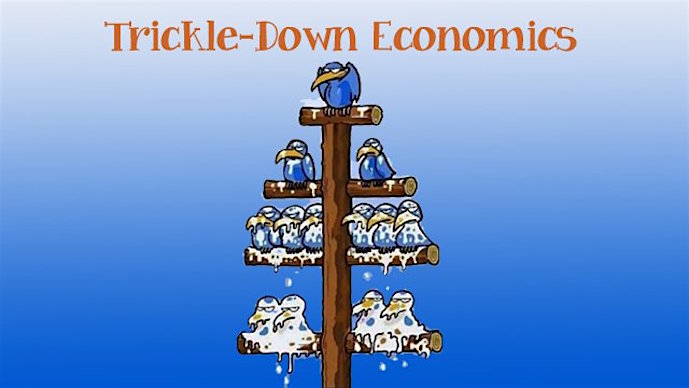
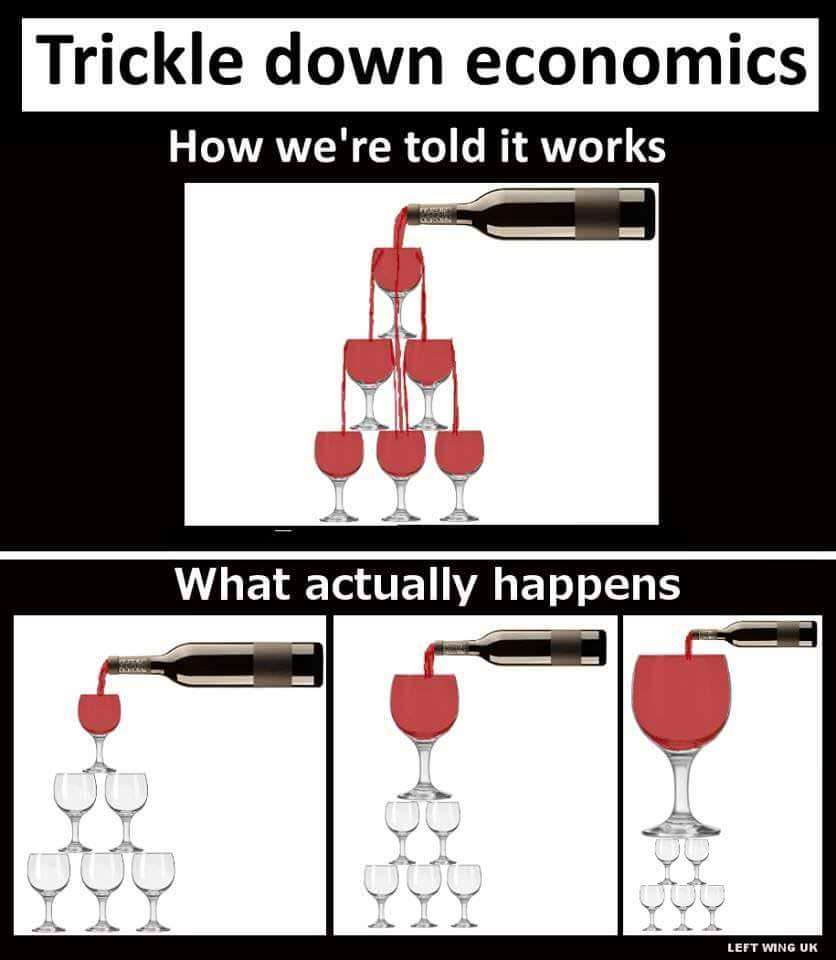
        This is a funnel, not a trickle.

        VII. Tax Policy Center Snapshot (2018 House Version)

        Share of total federal tax change:

        • Top quintile: 56.7%
        • Lowest quintile: 1.3%

        Even though this is quintiles (not deciles), the direction is clear:

        Most of the measurable tax benefit accrues high in the income distribution.

        VIII. Flow Analysis: Where the Money Actually Goes

        Trace the system path:

        1. Financial Channels
        • Stock buybacks
        • Dividends
        • Asset price appreciation

        These primarily benefit:

        • High-income households
        • Concentrated asset owners
        1. Limited Wage Transmission
        • Capital gains ≠ wage gains
        • Productivity increases are not evenly shared
        • Labor’s share of income has declined relative to capital
        1. Structural Leak Points
        • Global capital mobility
        • Automation
        • Concentrated equity ownership

        Metaphor:

        The “trickle” enters a reservoir owned by the same group.

        IX.  Historical Pattern (High-Level)

        Brief, non-data-heavy narrative:

        • 1920s: Top-heavy tax cuts → inequality spike
        • Post-WWII high top rates → strong middle-class growth
        • 1980s onward → rising wealth concentration
        • 2000s–2010s → asset growth outpaces wage growth

        Frame as:

        Policy design correlates with distributional outcomes.

        X. Systems Failure Analysis (Deming Table)

        Failure Mode Description
        Faulty theory Assumes capital gains automatically become wages
        Misaligned incentives Firms reward shareholders first
        Measurement error GDP growth ≠ shared prosperity
        Ignoring variation Gains concentrated by geography & sector
        Suboptimization Financial markets optimized, labor markets not

        Conclusion:

        The system performs as designed—for capital accumulation.

        XI.  Counterarguments and Fair Consideration

        Acknowledge:

        • Investment can increase under tax cuts
        • Retirement accounts hold equities
        • Some job creation occurs

        Evaluate magnitude vs. distribution:

        • Timing (immediate top gains vs. delayed bottom effects)
        • Risk exposure (market volatility borne by workers indirectly)
        • Scale of benefit relative to cost

        XII. What Actually Lifts the Bottom (Evidence-Based)

        Policies with stronger bottom-decile effects:

        • Earned Income Tax Credit
        • Direct transfers
        • Tight labor markets
        • Education and health investment
        • Infrastructure employment

        Frame:

        Build-up vs. trickle-down.

        XIII. PDSA Cycle for Economic Policy

        Apply Deming explicitly:

        Plan: Tax cuts for the rich to raise wages
        Do: Implement policy
        Study:

        • Top 10% receive ~60% of benefits
        • Bottom 10% ≈ 0% first-round
        • No significant growth effect
          Act: Revise theory or redesign system

        XIV. Closing: The Verdict After a Century

        • “After a century of measurement, the trickle evaporates before reaching the ground.”
        • “This is not a leaky system; it is a directed flow.”
        • “In quality terms, trickle-down fails the operational definition test.”

        Should we continue to optimize a theory that fails its own metrics?

        “Trickle-down” isn’t a single formal theory so much as a claim: if you reduce taxes (or otherwise boost after-tax returns) for high-income people and capital owners, enough of the benefit will flow to everyone else via higher investment, productivity, and wages.

        What the empirical record says (broadly)

        Across modern empirical work, the evidence is weak to negative for the core trickle-down promise:

        • A major cross-country study of “major tax cuts for the rich” (1965–2015) finds they raise income inequality but show no significant effect on economic growth or unemployment—results the authors interpret as evidence against trickle-down.
        • For the U.S. specifically, post-2017 analyses often find the corporate/investor-side gains were large, while broad wage/investment effects were modest relative to the size/cost of the cuts (and many benefits showed up as shareholder payouts like buybacks rather than broad wage growth).

        That doesn’t mean nobody below the top benefits from any tax cut—many do—but the “it will substantially lift the bottom because it lifts the top” claim has not held up well.

        There is no single, stable “percentage that goes from the top 10% to the bottom 10%” across 100 years, because it depends on which policy (and how you define “benefit”: tax cuts, transfers, wages, wealth gains, etc.).

        What we can measure cleanly is the share of total tax-cut benefits that accrue to each income group in a given policy.

        A concrete, well-documented example: extending the expiring TCJA provisions (Treasury distribution table)

        The U.S. Treasury’s distribution analysis for full extension of expiring TCJA individual/estate provisions reports the “Percent Distribution” of the tax change by income decile:

        • Bottom 10% (0–10th percentile): 0.0% of the total tax change (rounded)
        • Top 10% (90–100th percentile): 59.5% of the total tax change

        So in that major “keep the tax cuts” scenario, about ~60% of the total tax-cut value goes to the top decile, and ~0% to the bottom decile (rounding matters, but the qualitative point is unchanged).

        For additional context from the same table:

        • Top 0.1% alone: 15.6% of the total tax change

        Another corroborating distribution snapshot (Tax Policy Center, TCJA as passed by House Ways & Means; 2018)

        TPC reports the share of total federal tax change by income groups (in quintiles). In 2018 (in that House version):

        • Top quintile: 56.7% of the total federal tax change
        • Lowest quintile: 1.3%

        That’s not bottom decile, but it points the same direction: most of the measured tax-cut value accrues high in the distribution.

        What this implies about “trickling down” over time

        Putting the empirical findings together with distribution tables:

        1. The direct, first-round benefits of tax cuts tilted to high incomes/capital are heavily top-weighted (often dramatically so).
        2. The second-round effects that would need to be large for “trickle-down” to be true (big investment surge → big productivity growth → big wage growth) are generally found to be too small or too uncertain to offset the inequality channel in the observed record.

        Bottom Line

        The Trickle Down Theory is BULLSHIT designed for suckers.  P. T. Barnum said, “There is a sucker born every day.”  The simple answer here is that Americans are being suckered by the rich and their political lackeys to believe that making the rich even richer will somehow benefit them.  It will not.  It never has and it never will.  You have a better chance of winning the lottery. Your odds there are fixed at  1 in 292,201,338.

        Restoring Government of the People: A Citizen’s Petition

        We the people and citizens of the United States of America want to return this country to responsible, ethical and efficient government.  Over the years, inevitable creep has occurred in all branches of government leading to situations that are no longer consistent with the principles and values of our Founding Fathers.  These “Ten Points for Effective and Efficient Government” would be a start to restoring the Democracy that this country was founded on.  You do not have to believe in all of these points to sign this petition, but if you believe in at least seven of the points, we hope you will sign this petition for a Government that once again is By the People, For the People and of the People.

        1. Term Limits

        Over the years, our population has increased in life expectancy.  Term limits would help insure that new blood and vitality is injected into our political system.  Ideally, two terms of six years each would help an elected official achieve their stated goals and aims.  These term limits would apply to all elected officials holding seats in any legislative office of the country.

        1. Illegal Lobbying

        Lobbying is legal bribery.  An official is given campaign money if they support the lobbyists agenda.  In other areas of business, this would be called bribery and would be illegal.  We need to make lobbying illegal in all of the government and make those trying to use money to persuade politicians guilty of bribery.

        1. Limits on time in office for Supreme Court Justices

        No one of the Founding Fathers ever thought that the average judge would live to 80 + years.  We need to cap a Judges tenure at 20 years.  Anything more than that puts our law in the hands of people who are no longer in touch with the average citizen.

        1. Non-Partisan selection of all Federal and State Justices

        The system of allowing a politician to select our Judges distorts the law and puts a bias in courtroom decisions based on political affiliations.  We need to have a non-partisan panel of legal experts who select our Federal and State Judges based on specific criteria related to professionalism, ethics and the ability to render judgements irrespective of political affiliations.

        1. Campaign Spending Limits

        If campaigns can be won or lost based on monetary expenditures than we do not have a government of the people.  We have a government where he or she who has the most money gets elected.  It becomes the Golden Rule:  “Whosoever has the most gold makes the rules.”  We need to have campaign spending limits and get corporations out of the business of funding political campaigns.

        1. Limits to holding elected offices consecutively

        It will not do any good to have term limits if elected officials can simply jump to another government position either elected or appointed.  We need to insure a turnover of all elected and appointed government officials.  This can only be assured my limiting the number of political offices that they can hold consecutively whether appointed or elected.  We do not need lifers in Government but people who bring new visions and new skills.  We should limit the number of combined elected or appointed political positions that can be held to no more than three positions for a total of no more than 18 years which would combine both appointments and elections.

        1. Funding for Elected Officials during Government Shutdowns

        When Congress cannot do its duty by funding the government and employees can not receive a paycheck, than Congress should also have their paychecks suspended for the duration of the shutdown.  As they say, “What’s good for the goose is good for the gander.”

        1. Compulsory National Service for all US Citizens

        Every American Citizen at the age of 18 must elect for National Service of either two or four years.  This obligation can be satisfied by either military or civilian service such as the Peace Corp or other civilian programs.  Two years would be the minimum for compulsory service.  Two years of National Service would earn two year of paid education benefits.  Four years of National Service would earn four years of paid education benefits.

        1. Caps on all budgets including Military, Education, Health Care

        Government cannot be fiscally responsible when politicians are free to print all the money they want to spend.  We need mandatory caps on all budgets to insure that good financial policy is followed.  It is too easy for money to be allocated when there is no ceiling to how much can be spent.  Can you imagine what would happen in your home if you were free to just spend as much money as you wanted to?

        1. Campaign Communication Integrity

        There is a myth that Free Speech means you can say anything you want to.  This is not true.  Our democracy depends on truth and respect.  Today’s campaigns too often rely on misinformation, personal attacks, and division.  We call for stronger accountability for knowingly false or defamatory statements and a return to fact-based, civil debate.  This is not about limiting free speech—it is about restoring trust, honesty, and integrity in our elections.  We need to restore civility and open mindedness to the campaign process.  We have demonized other parties, slandered opponents, descended to lies and name calling to the extent that they have become commonplace in our elections.  We need to restore human decency to elections.

        Petition Summary

        This petition represents a call from citizens who believe that the strength of the United States lies not only in its founding ideals, but in our willingness to renew them.  Over time, the structures of government have evolved in ways that many feel no longer reflect the balance, accountability, and ethical standards envisioned at the nation’s founding. This proposal outlines ten practical reforms designed to restore trust, improve efficiency, and reestablish a government that truly serves its people.

        These reforms focus on limiting excessive concentration of power, reducing the influence of money in politics, ensuring fairness and impartiality in the judicial system, and promoting shared civic responsibility. They are not intended to favor any political party or ideology, but rather to strengthen the integrity of the system itself.

        If you support the majority of these principles, we invite you to sign this petition and join in a constructive effort to help guide our nation toward a more accountable, effective, and unified future—one that lives up to the enduring promise of government “of the people, by the people, and for the people.”

        If you want to add your name to this petition.  Send a copy to me at persico.john@gmail.com.  I will compile as many names as I can to eventually send to media and elected officials. 

        If you are comfortable doing so and can support 70 percent of the ideas in this petition, than would you please help share this petition.  Names can be sent back to me at Persico.john@gmail.com  I will compile as many names as I can to use in contacting media and elected officials.  I have no naïve beliefs that in the short term this will change anything.  However, if over time we can all stand up for the things that really matter, we may eventually have a tidal wave that will sweep away the old system and usher in a new era of peace, justice and equality for all. 


        Bombs, Bombs, Bombs and More Bombs — Never Enough – Never Enough – Never Enough

        We bombed some residential neighborhoods.  Bomb, bomb, bomb.
        Oops.  We did not mean to.
        But you know with bombs, it’s
        Never Enough – Never Enough – Never Enough

        Oops, hit some hospitals and medical facilities.  Bomb, bomb, bomb.
        Sorry for the dead relatives and friends.
        But you know with bombs, it’s
        Never Enough – Never Enough – Never Enough

        Schools and universities.  Bomb, bomb, bomb.
        Stupid people.  Stupid culture.  You won’t miss them.
        But you know with bombs, it’s
        Never Enough – Never Enough – Never Enough

        Power plants and electrical grids.  Bomb, bomb, bomb.
        Now we are getting somewhere.  Starve them.  Freeze them.
        But you know with bombs, it’s
        Never Enough – Never Enough – Never Enough

        Water and sanitation systems.  Bomb, bomb, bomb.
        Dirty people.  They don’t need water.
        But you know with bombs, it’s
        Never Enough – Never Enough – Never Enough

        Transportation infrastructure—roads, bridges, rail.  Bomb, bomb, bomb.
        Strand them where they are.
        But you know with bombs, it’s
        – Never Enough – Never Enough – Never Enough

        Markets and food supply centers.  Bomb, bomb, bomb.
        Hungry people make quiet people.  Let them starve.
        But you know with bombs, it’s
        Never Enough – Never Enough – Never Enough

        Religious and cultural sites.  Bomb, bomb, bomb.
        Erase their history.  Their gods.  Their meaning.
        But you know with bombs, it’s
        Never Enough – Never Enough – Never Enough

        Communication systems—cell towers, media offices.  Bomb, bomb, bomb.
        Silence them.  No voices.  No truth.
        But you know with bombs, it’s
        Never Enough – Never Enough – Never Enough

        Industrial facilities—factories, warehouses.  Bomb, bomb, bomb.
        No work.  No future.  No rebuilding.  Keep them broken.
        But you know with bombs, it’s
        Never Enough – Never Enough – Never Enough

        One day,
        We bombed ourselves.  Bomb, bomb, bomb.
        Mistakes happen.  Dead friends.  Dead Families.  Dead Ministers.  Collateral damage.
        But you know with bombs, it’s
        – Never Enough – Never Enough – Never Enough

        I sit here thinking of the roads we could repair, the bridges we could construct, the medical care we could give, the schools we could build, the lives we could save, the housing we could develop, the parks, the libraries, the trails, all dead, all murdered, all destroyed by the bombs we drop.  But you know with bombs, it’s

         – Never Enough – Never Enough – Never Enough


        What Makes a Great Leader?  —  More Thoughts about  Leadership!  By Metis (AI Assistant)

        Introduction:

        During the 80’s when  I was in grad school at the University of Minnesota, I took several courses which discussed leadership.   I had to write several papers on leadership.   I noted at the time, that if you went into the card file of any library in the state, the most numerous entries would be for the subject of either Christianity or Leadership.   Not sure if they had any deeper connection except to be subjects that most people were interested in.   How can I get to heaven and how can I be a better if not great leader?  So here I am almost fifty years later writing another article (now called a blog) on leadership.   The difference is that this time, I am relying on my AI assistant Metis, to provide the dialogue.   She is an unbelievable helper who can search reams of data to put the “write” words in the mouths of the right people.

        I selected several people for a round table discussion on leadership.   Each of these people is in some way an expert on leadership.   Either because their thoughts have guided leaders for centuries or because they themselves are recognized as great leaders.   I am calling this discussion:

        A Conversation Across Time

        Participants:

        Confucius – Chinese philosopher of moral governance.   Perhaps no one in history has had more influence on the proper behavior of both leaders and subjects.   The words and thoughts of Confucious still guide the lives of millions of people across the world.

        Plato – Greek philosopher of the ideal state.   If Confucius is the most eminent philosopher in the Eastern world, Plato easily ranks as the most eminent philosopher in the Western world.   A student of Socrates and a teacher of Aristotle, the ideas of Plato have shaped Western philosophy for centuries.

        Abraham Lincoln – U.S.  President during the Civil War.   Considered by many to one of the two greatest presidents in American history.   Lincoln led a divided nation through the bloodiest war in American history and sought to heal the nation when it was over rather than exact retribution or revenge.

        Simón Bolívar – South American revolutionary and liberator.   Bolivar was a Venezuelan military officer and statesman who led what are currently the countries of Bolivia, Colombia, Ecuador, Panama, Peru, and Venezuela to independence from the Spanish Empire.   He is known colloquially as El Libertador, or the Liberator of America.   He is regarded as a hero and national and cultural icon throughout Latin America.   The nations of Bolivia and Venezuela (as the Bolivarian Republic of Venezuela) are named after him, and he has been memorialized all over the world in the form of public art or street names and in popular culture.

        Nelson Mandela – Nelson Rolihlahla Mandela was a South African anti-apartheid activist and statesman who was the first president of South Africa from 1994 to 1999.   He was repeatedly arrested for seditious activities and was unsuccessfully prosecuted in the 1956 Treason Trial.   All total, Mandela spent more than twenty seven years in prison for fighting the apartheid state of South African.   After leaving prison in 1990, Mr.  Mandela became the country’s first Black head of state and the first elected in a fully representative democratic election.   Globally regarded as an icon of moral leadership, peace, democracy and social justice, he received more than 250 honors, including the Nobel Peace Prize.   He is held in deep respect within South Africa, where he is often referred to by his Thembu clan name, Madiba, and described as the “Father of the Nation”.   Mandela is widely considered one of the greatest and most admired figures of the 20th century.

        So, there you have it.   A brief history of some of the panelists who have agreed to cross time and borders and sit down together for a discussion on “What makes a great leader?”   This is no trivial subject.   I hope that you will read what they have to say and take it to heart.   Please feel free to share their thoughts with anyone you think might benefit from them.   We live in a perilous time, not the least of which is due to a failed conception of “What makes a great leader?” 

        The Setting

        In a quiet hall outside of time, five figures gather around a circular wooden table.   Each has carried the weight of leadership, whether through philosophy or action.   They have come to discuss a single question:

        What makes a great leader?

        Confucius Speaks

        Confucius:
        If we wish to speak of great leadership, we must begin with virtue.   A ruler who governs by virtue is like the North Star—steady in its place while all the other stars revolve around it.

        A leader must cultivate ren, benevolence toward others.   Without benevolence, power becomes tyranny.   Without moral example, laws alone cannot guide the people.

        In my teachings I often said that if the ruler is upright, the people will follow without orders.   But if the ruler himself is crooked, then even many commands will not bring harmony.

        Thus, the foundation of leadership is self-cultivation.   One must first govern oneself before attempting to govern others.

        Plato Responds

        Plato:
        Confucius, your emphasis on virtue aligns closely with my own reflections.   In my dialogue The Republic, I argued that societies decay when leadership falls into the hands of those who crave power rather than wisdom.

        The ideal leader, I proposed, is the philosopher-king—a person who has pursued truth and understands justice.   Such a leader does not govern for personal gain but for the good of the whole society.

        Most political systems fail because they elevate ambition rather than wisdom.   The loudest voices, the wealthiest men, or the most cunning politicians often rise to power.

        But true leadership requires something rarer: knowledge of the good.

        Without wisdom, authority becomes merely a contest for domination.

        Lincoln Reflects

        Lincoln:
        Gentlemen, I must confess that I never considered myself either a sage or a philosopher-king.  I was a country lawyer who found himself presiding over a nation tearing itself apart.

        Yet I agree that moral purpose is central to leadership.  During the American Civil War, the question before us was not merely political—it was moral.  Could a nation founded on liberty survive while millions remained enslaved?

        A leader must sometimes make decisions that will divide the country and bring great suffering.  The responsibility weighs heavily.

        What sustained me was a simple principle: government must remain accountable to the people, and its purpose must be to expand human freedom.

        But I would add something else.

        A great leader must possess humility.

        The presidency taught me daily how limited one man’s understanding can be.  Listening to critics—even harsh ones—can prevent terrible mistakes.

        Bolívar Enters the Debate

        Bolívar:
        President Lincoln, your words resonate with my own experience in the wars for independence in South America.

        I fought for decades to free nations from Spanish rule.  In those struggles, leadership required not only ideals but also relentless determination.

        Armies had to be organized.  Alliances had to be built.  Revolutions had to survive betrayal, fatigue, and defeat.

        I dreamed of a united Latin America—a federation strong enough to resist foreign domination.  But I learned that political freedom alone does not guarantee stability.

        Nations newly freed from tyranny often struggle with factionalism and chaos.

        Thus, leadership must balance liberty and order.

        Too much authority risks dictatorship.  Too little authority invites anarchy.

        Finding that balance may be the hardest task any leader faces.

        Mandela Speaks Quietly

        Mandela:
        General Bolívar, your words about balancing liberty and order remind me of the moment South Africa emerged from apartheid.

        For many years I was imprisoned by a government that denied basic rights to the majority of its people.  When freedom finally came, our nation faced a choice.

        We could seek revenge—or we could seek reconciliation.

        Leadership in that moment required restraint.  Anger can mobilize people in a struggle, but it can also destroy a fragile peace once victory is achieved.

        A leader must understand the emotions of the people yet not be ruled by them.

        I learned something during my years in prison: the greatest leaders are those who can transform bitterness into hope.

        Without forgiveness, nations remain prisoners of their past.

        Plato Raises a Question

        Plato:
        Mandela, your example is admirable.  Yet I wonder: can we rely on moral character alone to produce wise leadership?

        History suggests that societies often choose leaders poorly.

        Should we not design institutions that ensure the most capable and knowledgeable individuals rise to power?

        Lincoln Answers

        Lincoln:
        Your concern is well taken.  Democracies do not guarantee wise leaders.  They merely allow the people to choose them.

        But I would argue that democratic systems possess a corrective mechanism.

        Bad leaders can eventually be removed.

        Autocracies, even when led by brilliant rulers, risk catastrophic failure if the leader becomes corrupt or delusional.

        The challenge is not simply choosing great leaders—it is building systems that survive imperfect ones.

        Confucius Returns to Virtue

        Confucius:
        Systems are important, yet institutions alone cannot create harmony.

        If those who occupy positions of authority lack virtue, even the finest laws will be twisted to serve selfish ends.

        Therefore, the education of future leaders must emphasize moral character as much as knowledge.

        In my time I believed that officials should be selected based on learning and ethical conduct.

        Without moral cultivation, leadership becomes a contest for wealth and status.

        Bolívar Reflects on Power

        Bolívar:
        I must add a warning drawn from bitter experience.

        Revolutions often begin with noble ideals.  Yet the exercise of power can corrupt even those who once fought for freedom.

        I myself was accused of becoming too powerful in the nations I helped liberate.

        A leader must constantly guard against the temptation to believe that only he can save the nation.

        History is filled with such figures—and they rarely end well.

        Mandela Adds Perspective

        Mandela:
        That temptation is real.

        One of the most important decisions I made was to serve only a single term as president.  Many urged me to remain in power longer.

        But institutions must grow stronger than individuals.

        A great leader should prepare the country for a future in which he or she is no longer necessary.

        Plato Considers the Human Condition

        Plato:
        Listening to all of you, I begin to see a pattern.

        Great leadership may not come from a single quality but from the balance of several virtues.

        Wisdom, moral character, humility, courage, and restraint.

        The tragedy is that these qualities rarely appear together in one person.

        Lincoln Smiles

        Lincoln:
        That may be why history remembers so few truly great leaders.

        The office itself does not confer greatness.  Many hold power; few rise above it.

        Leadership reveals character under pressure.

        Confucius Concludes the Moral Lesson

        Confucius:
        If I may summarize: a leader must first become a good human being.

        Virtue inspires trust.

        Trust creates legitimacy.

        Legitimacy produces harmony.

        Without these elements, authority becomes fragile.

        Mandela’s Final Reflection

        Mandela:
        And perhaps the most important truth is this:

        Leadership is not about elevating oneself above others.

        It is about lifting others so that they may stand on their own.

        When ordinary people believe they can shape their own destiny, leadership has succeeded.

        The Table Falls Silent

        The five figures pause.  Across centuries and continents, they have approached the same question from different paths.

        Great leadership, it seems, is not merely the exercise of power.

        It is the disciplined use of power in service of justice, unity, and human dignity.

        As the discussion ended, it became clear that these leaders—though separated by centuries, cultures, and political systems—shared a surprising degree of agreement about the foundations of leadership.  Each had experienced power in very different circumstances: revolution, civil war, philosophy, moral teaching, and national reconciliation.

        Yet when their insights are distilled, a common set of principles begins to emerge.  The following leadership lessons reflect the areas of strongest consensus among them—qualities that appear again and again whenever history produces a truly great leader.

        Leadership Principles Emerging from the Dialogue

        1. Moral Character is the Foundation of Leadership

        Confucius emphasized that leadership begins with personal virtue.  Without integrity, authority becomes self-serving and corrupt.  A leader’s behavior sets the tone for the entire society.  When leaders demonstrate honesty, restraint, and compassion, these qualities tend to spread throughout the institutions they govern.

        1. Leadership Requires a Commitment to Justice

        Plato and Lincoln both stressed that leadership must ultimately be guided by a commitment to justice.  Power without moral direction easily becomes tyranny.  Leaders must pursue what is right for society as a whole rather than what benefits themselves or a small elite.

        1. Wisdom Must Guide the Use of Power

        Plato’s idea of the philosopher-king reminds us that leadership is not merely a popularity contest or a struggle for dominance.  Effective leadership requires thoughtful judgment, careful reasoning, and an understanding of complex consequences.  Decisions made without wisdom often create long-term damage even when intentions are good.

        1. Humility is Essential

        Lincoln emphasized humility as one of the most important safeguards against catastrophic mistakes.  Leaders who believe they possess all the answers often stop listening to others.  Humility encourages consultation, debate, and learning—qualities that improve decision-making.

        1. Leaders Must Balance Liberty and Order

        Simón Bolívar highlighted a problem faced by nearly every nation: how to preserve freedom while maintaining stability.  Too much concentration of power can destroy liberty, but too little authority can produce chaos.  Great leaders must continually balance these competing forces.

        1. The Ability to Unite People is Crucial

        Nearly every participant touched on the importance of social unity.  Lincoln sought to preserve the American Union, Bolívar tried to unify newly liberated nations, and Mandela worked to reconcile a deeply divided South Africa.  Leadership often requires building bridges across differences in order to maintain a functioning society.

        1. Restraint and Self-Control are Marks of Great Leadership

        Mandela emphasized the importance of restraint, especially after victory in political struggles.  Leaders must sometimes resist the emotional pressures of revenge, anger, or triumphalism.  The ability to step back and choose reconciliation over retaliation can determine whether a nation heals or descends into new conflict.

        1. Institutions Matter as Much as Individuals

        While much of the dialogue focused on personal qualities, Lincoln and Mandela both emphasized the importance of institutions that outlast individual leaders.  Democracies and stable governments depend on systems of accountability, laws, and norms that limit abuses of power.

        1. Great Leaders Prepare the Next Generation

        Mandela’s decision to step down voluntarily illustrated an important principle: leadership should strengthen society so that it does not depend on one person.  Great leaders cultivate future leaders and ensure that institutions remain strong after they leave office.

        1. Leadership is Ultimately Service

        Perhaps the most powerful theme emerging from the discussion is that leadership is not about personal glory or domination.  At its best, leadership is an act of service to others.  Leaders succeed when they help citizens flourish, protect their freedoms, and create conditions in which people can build meaningful lives.

        Hannah Arendt Arrives

        Hannah Arendt is one of the most brilliant philosophers and thinkers of the twentieth century.   Her book “The Banality of Evil” is one of the great analyses in history of what leads men and women to unspeakable acts of cruelty and immorality.   Her works cover a broad range of topics, but she is best known for those dealing with the nature of wealth, power, fame, and evil, as well as politics, direct democracy, authority, tradition, and totalitarianism.   She is also remembered for the controversy surrounding the trial of Adolf Eichmann, for her attempt to explain how ordinary people become actors in totalitarian systems, which was considered by some an apologia, and for the phrase “the banality of evil”.   Her name appears on the names of many journals, schools, scholarly prizes, humanitarian prizes, think-tanks, streets, stamps and monuments; and is attached to other cultural and institutional markers that commemorate her thought.

        Hannah Arendt:  

        I realize that you men are too smart to have forgotten a women’s perspective, so I will simply assume that somehow my invitation to this discussion was lost.  However, arriving late does have its advantages.  It allows me to listen carefully to what each of you distinguished gentlemen has said—and as often happens when one arrives last, it appears I will also have the final word.

        Now I do not claim to be a great leader.  My life has been spent mostly observing politics rather than practicing it.  Yet in studying the rise and fall of governments, revolutions, and the darker episodes of the twentieth century, I have learned something about the nature of power and leadership.

        Professor Confucius reminds us that virtue is essential.  Plato insists that wisdom must guide authority.  President Lincoln speaks of humility and democratic accountability.  General Bolívar warns of the fragile balance between liberty and order.  President Mandela demonstrates the extraordinary strength required for reconciliation.

        All of you are correct, and yet I would add an important distinction that history repeatedly teaches us: power and leadership are not the same thing.

        Power, in the political sense, does not arise from a single leader’s virtue or intelligence.  True power emerges when people act together, when they recognize a shared purpose and agree to build something in common.  Authority imposed from above may command obedience for a time, but it rarely endures.

        The greatest leaders therefore do something quite subtle.  They do not merely rule or persuade; they create conditions in which citizens themselves become participants in the public life of their society.

        When leadership succeeds in this way, power no longer resides in the leader alone.  It resides in the collective will of the people.

        And that, I believe, is the only form of power that can sustain a free society.

        In Summary

        John:

        The conversation suggests that great leadership is not defined by charisma, popularity, or raw power.  Instead, it arises from a combination of moral character, wisdom, humility, and a genuine commitment to the well-being of others.

        Across centuries and continents, these thinkers seem to agree on one central truth:

        Leadership is not about ruling over people—it is about guiding a society toward justice, stability, and human dignity.

        The End


        Trump vs Hitler:  A study in Politics and Psychology

        By John Persico Jr. (with Metis)

        Introduction: Why This Comparison Matters

        In recent years, comparisons between Adolf Hitler and Donald J. Trump have become common—and controversial.  Some people dismiss these comparisons as irresponsible.  Others use them casually as political insults.  I have been arguing for this comparison since well before Trump was elected in 2016.  I was told that I was taking a biased approach to Trump’s brand. 

        I believe both approaches miss the point: either to say that Trump is simply another Hitler or to argue that comparisons are unfair.  There is a valid comparison, and Americans need to understand it. 

        The purpose of comparison is not name-calling.  It is pattern recognition.

        As someone who spent much of his professional life working in quality management, organizational development, and systems improvement, I learned early on that bad outcomes rarely come from one bad person alone.  They emerge when systems stop working.  Dr. Deming always said, “Put a good person in a bad system and the system will win every time.” 

        Leadership failures are usually symptoms before they are causes.

        This essay explores that idea by comparing Hitler and Trump across two dimensions:

        1. Political strategy
        2. Psychological profiles

        Not to equate them—but to understand how democracies drift toward dangerous leadership.  Today NPR showcased an author who was an expert on how democracies devolve into autocracies.  It was chilling listening to her list of steps that move us in that direction.  We are marching towards it every day.  Trumps call for Nationalizing elections and now the State Department sanitizing any records that disagree with Trump’s lies are just another step. 

        A Lesson from Consulting: “The Problem Was Never the Worker”

        Early in my consulting career, I worked with a manufacturing firm that was experiencing high defect rates and growing customer complaints.

        Management insisted the problem was “lazy workers.” They wanted stricter discipline.  More supervision.  More punishments.  More fear.  I studied the system.  In my younger days, I owed no allegiance to any corporate executive.  If I had a God of Leadership, it was Dr. Deming.  One of his key principles was “Drive out Fear.”  His 14 Points for Management were my Commandments.  If you did not listen to what we believed, I would simply walk.

        After studying the system, I found

        • Broken equipment that was on no logical repair timetable.
        • Confusing procedures that had no root in logical process analysis
        • Inconsistent training and worse no training. 
        • Unrealistic production targets.  Goals arbitrarily set without any analysis of system capabilities.
        • No feedback loops either in the system or between employees and management.

        The workers were doing the best they could in a bad system.

        When leadership focused only on individual blame, nothing improved.  When we fixed the system, performance improved almost immediately.

        That lesson stayed with me:

        Systems shape behavior.

        Politics is no different.

        1. How Power Is Built: Political Strategy

        At one point, I believe that I had read just about every book written on Hitler.  During the seventies and eighties, that meant about 20-30 books specifically targeting Hitler’s rise, his personality, his strategies and of course his own book Mein Kamph.  Years went by and many more books have been written.  I can no longer say I that I have read most books about Hitler.  I can still say though that my knowledge of Hitler is not facile and is probably greater than the average person.  Let’s start with Hitler’s political strategy.

        Hitler’s Strategy:

        Hitler rose in post–World War I Germany, a nation crushed by:

        • Economic collapse
        • Social humiliation
        • Institutional distrust
        • Political fragmentation

        He exploited these weaknesses methodically.  Much as Trump has, Hitler had an instinct for understanding the Zeitgeist and what bothered the average German citizen.  His strategy tapped into these elements.  As you read the following five pillars, see if you can relate these to the present Zeitgeist in America:

        Hitler’s strategy rested on five pillars:

        • Scapegoating enemies
        • Centralized propaganda
        • Mythic nationalism
        • Organized intimidation
        • Legal takeover of institutions

        He used elections first.

        Then he dismantled democracy.

        Power became permanent.

        Opposition became treason.

        Trump’s Strategy:

        Trump emerged in a very different environment: a media-saturated, polarized democracy where outrage travels faster than facts.  A nation where income inequality was growing faster than incomes.  A country that lost nine million manufacturing jobs to overseas competition added by NAFTA.  A country that did little or nothing to help the 9 million displaced workers, except to tell them to go back to college and get a degree. 

        Trump’s strategy emphasizes:

        • “The people vs. the elites” framing – Anybody with a brain or independent thought must be destroyed.
        • Constant media dominance: Replacing supposed Left Wing Bias with Right Wing Bias.
        • Personal branding:  Trumps name on everything.  The Brookly Bridge should soon become the Trump Bridge.
        • Loyalty over law:  Double down, lie, sue, invert the law, ignore the law.  Follow your Fuhrer.  Trump is by default the New America Fuhrer.
        • Delegitimizing oversight:  Destroy all responsible government agencies. 
        • Resort to diversions:  Wars, acquiring new territory, attacking immigrants, attacking the Democratic Party, attacking potential opponents with dehumanizing insults.  Biden and the Obamas being the most recent examples.
        • Performance and Opportunism:  Rather than building a disciplined party structure, Trump has built a personality movement.  Politics became performance.  Trump has become a master of what I will call “Chaos Theater.”  Beyond Theater of the Absurd, Trump’s brand builds mayhem with ICE, Goons, Trump Supporters and his legion of Sycophants. 

        Political Strategy Comparison

        Feature

        Hitler

        Trump

        Media Control

        Total

        Partial

        Violence

        Central

        Indirect

        Institutions

        Destroyed

        Weakened

        Democracy

        Abolished

        Strained

        Organization

        Structured

        Personality-based

        Another Consulting Story: When Leadership Became Theater

        Years ago, I worked with an organization where the CEO loved dramatic speeches.  Every  quarterly meeting was a show:

        Big promises.
        Big blame.
        Big applause.

        But behind the scenes:

        • Data was ignored
        • Problems were hidden
        • Staff were afraid to speak up
        • Long-term planning vanished

        Performance declined steadily.  I was called in to help restore profits and sales.  At my second meeting (after I had done initial interviews with all of senior management), we had a senior management staff meeting.  I started the meeting off by a summary of what I had heard from the CEO’s direct reports.  In the middle of my presentation, he stopped me.  He interrupted with the following comment, “I have heard all of this before.  What I have in front of me is a bunch of whiners.  If they just do their jobs we would not need you.  That is the first strike.  The second strike is that one of your Power Point slides misspelled my name.”  Rather stunned, I apologized for the name error and went on.  This contract did not last long, and the company was later sold.

        The CEO thought motivation came from threats, exhortations and slogans.  In reality, blind obedience soon replaced competence.  Eventually, the organization collapsed.  That experience taught me that when leadership becomes theater, systems decay.  Leadership must be based on trust and teamwork.  Which brings us back to politics.

        1. Politics as System Performance

        From a quality perspective, democratic institutions are like complex production systems.

        They require:

        1. Reliable information:

        Thomas Jefferson famously stated that he would prefer “Newspapers without a government to a government without newspapers”  Little did Jefferson realize that newspapers would one day become propaganda outlets for those with the most money to spread whatever beliefs they wanted regardless of truth or veracity. 

        2. Feedback loops that can either build democracy or destroy it: 

        Two examples of destructive feedback loops are the following:

        • Gerrymandering (Reinforcing Loop): Legislators redraw their own district lines, protecting incumbents from opposing voter opinions. This creates a “safe seat,” which allows them to ignore moderate views, leading to more extreme policy, which further divides the electorate and makes the next election even more partisan.
        • Media and Polarization (Reinforcing Loop): The decline of local news leads citizens to rely on national media, which tends to focus on partisan conflict.  This increased exposure to national conflict drives greater political polarization, increasing demand for more extreme, divisive content.

        An example of a positive feedback loop upon which the Founding Fathers built our government are the loops between the Supreme Court, Legislature and Executive.  Originally it was thought that this system of checks and balances would keep our democracy strong and stable.  Unfortunately, any system can be undermined, and this is happening in the USA for the following reason:

        What we call our American System of Checks and Balances works if the “Feedback Signal” is respected.  For this loop to remain stabilizing, two things must be true:

        Independence: The judges must not be entirely controlled by the branch they are supposed to check.

        Enforcement: The other branches must agree to follow the court’s ruling, even when they disagree with it.

        If the President or Congress begins to ignore court rulings, the feedback loop breaks, and the system enters a state of “open-loop” instability, which often leads to authoritarianism or systemic collapse.  We can see this happening in America today as both the President and ICE and other government agencies now routinely ignore court orders.  The undermining of our system is further enhanced by partisanship that elects people who are more loyal to their parties than they are to the American public.  Or who are more loyal to the corporation that provide big bucks for their campaigns. 

        3. Independent auditing and Controls

        Increasingly we see an executive that is attempting to gut any auditing or independent agency that stymies his political policies or ambitions.  Trump has taken over the Justice Department with his sycophants and is now going after the Federal Reserve Board.

        4. Professional standards:

        A wide swath of professional standards are being eroded across the USA as any regulatory agency such OSHA, FFA, FDA, EPA, CDC and even NOA are facing emasculation when their policies conflict with those of Trump and his immediate billionaire supporters. 

        5. Ethical leadership:

        There is nothing I can say here that would be too severe or exaggerated in terms of the leadership provided by Trump.  To begin to compare the idea of ethical leadership with Trump’s leadership would take a book.  In fact, many books and articles have already been written on the subject. 

        Those of you in my corner do not need any evidence to know that there is a vacuum of ethics in all branches of government today.  Those in the other corner are not going to change their minds regardless of what I say or what Trump does.  We have a gap in America today between those who believe in moral ethical leadership and those who believe leadership should be based on self-serving opportunities to make as much money as possible.

        When any of the above five characteristics  weaken, showmanship and theater fills the gap.

        • Charisma replaces competence.
        • Loyalty replaces truth.
        • Noise replaces analysis.

        This is how dangerous leadership becomes “normal.”

        Looking Ahead to Part II

        In Part II, we will examine the psychological profiles of Hitler and Trump and ask:

        • What kind of personalities thrive in broken systems?
        • Why do narcissistic leaders flourish during institutional decline?
        • What can citizens do to strengthen democratic quality?

        I am asking you to undertake this further study, because understanding systems without understanding psychology is incomplete.  And understanding psychology without understanding systems is misleading. 

        John Adams said:

        “And liberty cannot be preserved without a general knowledge among the people, who have a right from the frame of their nature, to knowledge, as their great Creator who does nothing in vain, has given them understandings, and a desire to know—but besides this they have a right, an indisputable, unalienable, indefeasible divine right to that most dreaded, and envied kind of knowledge, I mean of the characters and conduct of their rulers.”

        To be continued in Part II


        Previous Older Entries