Restore Democracy to America:  Ban the Lobbyists

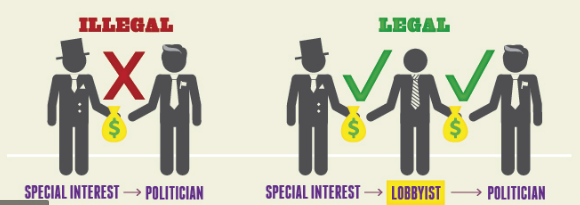
Lobbying is legal bribery.  Lobbying keeps politicians in the pay of vested interests.  As long as we have PAC’S, Paid Lobbyists, Cross-State funding of politicians and corporate money going to political campaigns, we will never have Democracy in America.  The saying “He who has the gold makes the rules “is true.  Our political system is in the pocket of paid lobbyists whose job is to see that our political leaders vote the right way.  The right way is determined by who can provide the most money for their forever campaigning.  Our politicians spend more time trying to raise funds for their next campaign than they do working for the American public.
In 1924 over 100 years ago, Senator Bob LaFollette, ran for president on a Progressive Party platform calling for among other things the need to BAN LOBBYING.  There is not an American voter who is not sick and tired of the money that is being extorted by most politicians to finance their next campaign.  The day after an election, you will get a message in your email box telling you how essential it is for you to send money NOW to so and so to help them be reelected.

Rachel Maddow on her TV show the other night (3-1-25) was describing the dissent that is growing among voters nationwide within the voting public.  There are political protests taking place all over America at campaign rallies, town hall meetings, civic meetings and in public office buildings.  People are sick and tired of their elected leaders standing by while they get fleeced.  This dissatisfaction is rife within America and includes voters and citizens from across all political spectrums.  Americans are standing up and demanding that billionaires not be allowed to run America.  Rich oligarchs like Elon Rusk are running amok within the political system because they can provide billions of campaign dollars to our ever hungry for money elected leaders.

In an interview with the leader of the Democratic Party, Hakeem Jeffries, Maddow said the public wanted to know what the Democrats would do to stand up for the rights of the people.  Jeffries started to give a bunch of inchoate efforts the Democratic party was making and mentioned the political rallies taking place.  He sounded like these protest rallies were something the Democratic party was organizing.  Maddow cut him off very quickly with the remark “These rallies are being organized from the bottom up.  They are a grass roots movement and are not a result of Democratic party initiative.”  Jeffries then proceeded with a list of things the Democratic party was planning to do.  His ideas were so vacuous and vague, I have not a clue what they are going to do.  One thing I am certain of, Jeffries did not say one word about moving to ban lobbyists and lobbying from the halls of our Congress.
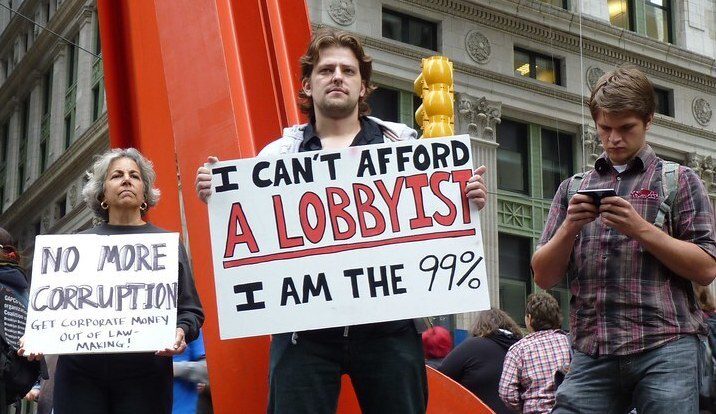
Until we ban lobbyists, we will never restore our government to the government envisioned by the founding fathers.

We need to have a focused movement to ban lobbyists.  Every dissent in America over the next year or so should include a message to ban lobbyists.  The only way the people can regain control of the political system in this country is by making lobbying illegal.  I am calling on all American citizens to stand up and speak out against lobbying.  If you don’t want to speak out, then buy a T-shirt that says, “Ban Lobbyists.”  But every grass roots group in America needs to start an outcry to “Ban Lobbyists.”  Imagine if every Church, Synagogue or Mosque in America was speaking out against Lobbying.  Every protest group should have at least one sign calling to “Ban Lobbying.”  We should be putting signs up outside every legislative building in America saying, “Ban Lobbying.”
There is some precedent in Christianity for throwing the lobbyists out.  In Matthew 21:12-13 it is written:

“Jesus entered the temple courts and drove out all who were buying and selling there. He overturned the tables of the money changers and the benches of those selling doves. “It is written,” he said to them, “ ‘My house will be called a house of prayer,’ but you are making it ‘a den of robbers.’” — New International Version NIV

Ask yourself what Jesus would do?  Would he stand idly by while the lobbyists bought and sold contracts and bills supporting more and more buying and selling?  I think not.  Jesus would have thrown them all out on their asses.  Those of you who claim to be Christians should take heed here.  There is much every religious organization could do to help clean the temple out, but they sit by doing nothing while our government is sacrificed to the false gods of materialism and profit.

Following, I suggest several ideas to take the money out of politics and to restore our political system to a semblance of a peoples democracy and not a democracy of Billionaires and Oligarchs.  If you like these ideas, than please share them with your friends, neighbors, families, church or whatever groups you belong to.

  • Make lobbying or trying to induce an elected official a crime akin to bribery because lobbying right now is legal bribery.
  • Call for the elimination of PAC money, Special Interest Groups and Corporate funding of political campaigns. Campaign funds should only come from eligible voters.
  • Set a limit of 1000 dollars maximum per year that any eligible voter can donate to political campaigns. You could spread this money across several campaigns or drop it all on one but the legal limit for one year would be 1000 dollars.  This money would be eligible for a tax deduction for the entire amount.
  • Ban the funding of political leaders in one state by voters from other states. You should only be allowed to support political leaders in your state of residence with exception of the office of President.
  • Repeal the Citizens United Decision.  This vote by the Supreme Court treats corporations as private citizens and as such they are entitled to free speech.  This finding is ludicrous in itself but it gets more ridiculous  The court then decides that free speech means corporations can act as private donors in campaign spending.  In other words, corporations are the same as private citizens and entitled to donate as much money as they want to politicians who will support their private programs.  Since when does any corporation have a soul or a heart or even a brain? 

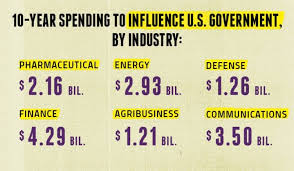
It has been said with a great deal of truth that America is a country run, Of the Corporations, By the Corporations and For the Corporations.  America is being run by special interest groups across a broad spectrum of interests, but all without concern for the interests of the larger American public.  Do we want a government of corporations, or do we want a government of the people, by the people and for the people?  Here are the top ten Lobbying groups in America as of 2025 with the amount purportedly spent on lobbying.  Personally, I doubt the money shown here is in any way a legitimate representation of the amount actually spent by any of these groups. I will discuss why this is true later.

Top Spenders

Lobbying Client                    Total Spent

    1. National Assn of Realtors           $86,385,941
    2. US Chamber of Commerce         $76,260,000
    3. Pharmaceutical Manufacturers  $31,720,000
    4. American Hospital Assn             $29,017,803
    5. Blue Cross/Blue Shield               $27,146,300
    6. American Petrochem Mfg          $26,310,000
    7. American Medical Assn             $24,782,000
    8. Meta                                              $24,430,000
    9. Business Roundtable                 $23,400,000
    10. American Chemistry Council    $22,330,000
 I queried ChatGPT to see how much money lobbyists spent in 2024 in total and came up with the following information:

“In 2024, lobbying spending reached a record-breaking $4.4 billion.” — OPENSECRETS.ORG

“The total amount spent by lobbyists on political campaigns annually is not separately tracked and is encompassed within the broader category of individual and PAC contributions.”

A majority of funding for the 2024 election — over 65%, or nearly $5.6 billion — comes from political action committees, also known as PACs. — USAFacts

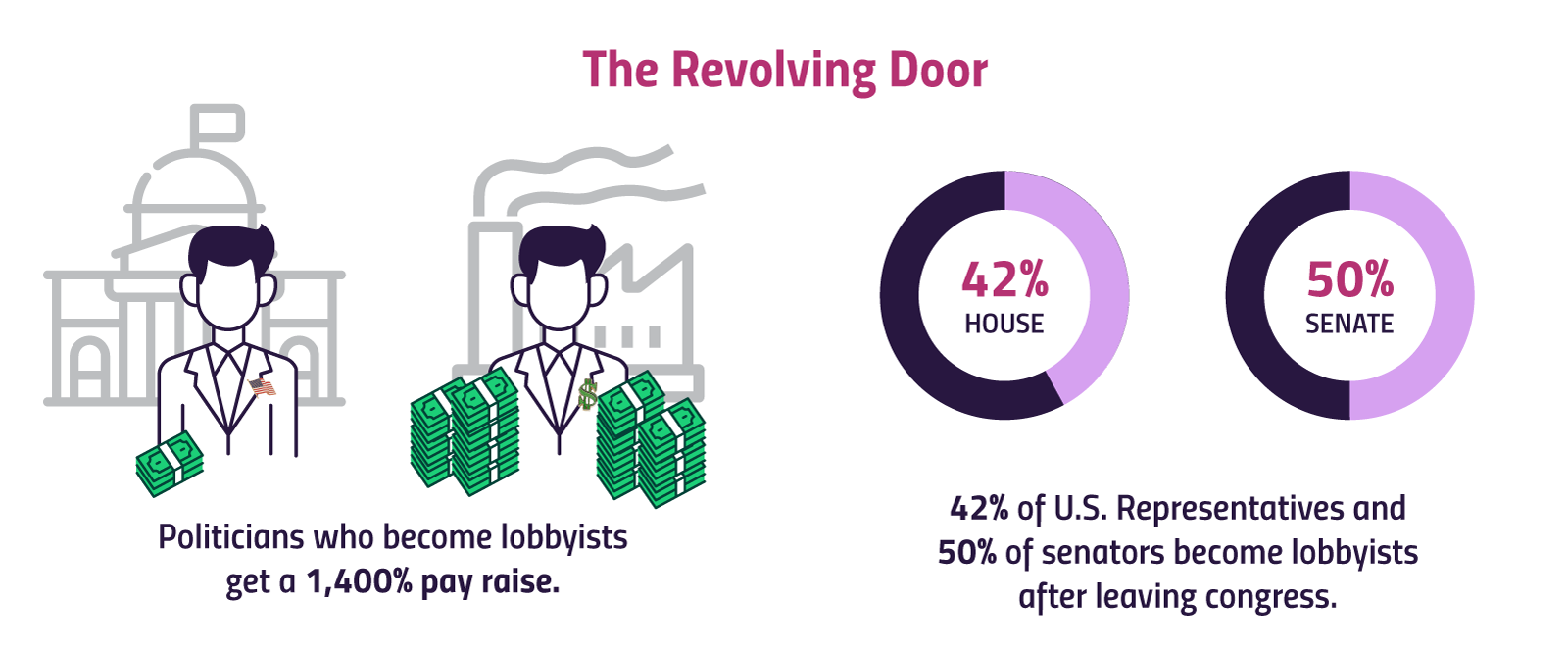
The above information leads to the inescapable conclusion that despite a slew of laws that allegedly govern the activities of lobbyists and PACs, the system is broken.  The system does not work to limit or proscribe the actual influence of lobbyists on our electoral system.   We must demand that the system be fixed.  The system is corrupt, misused and only serves to undermine and torpedo the democratic process in America.  We have enough media to educate people on laws and policies.  We do not need 12,000 paid lobbyists roaming the halls of Congress looking out for their interests and not the interests of the American people.
“The financial elite already have the politicians in their pockets, as a result of their lobbying.” — K. Eade

“Very few of the common people realize that the political and legal systems have been corrupted by decades of corporate lobbying.” — S. Magee

“The important thing to remember with the Internet is that there are large companies that have an interest in controlling how information flows in it.  They’re very effective at lobbying Congress, and that pattern has locked down other communication media in the past.  And it will happen again unless we do something about it.”  — E. Pariser

“As long as we, in the United States, continue to insist that our politicians have to spend all of their time raising millions of dollars for television ads, it will be corrupt.  If we leave it up to the politicians to clean up lobbying and finance reform, nothing is going to change.” — K. Spacey

Stand up and demand that your political leader take the money out of politics.  Ban Lobbying.  Ban Lobbyists. 

Restore Democracy to the American people.


Why Americans Hate the Government!

I sit here in my car driving the speed limit of 75 mph on the interstate and being passed by multitudes of cars doing at least 85 mph or maybe 90 mph.  It feels like I am standing still.  I watch as cars pass on the right, left and in-between in their hurry to get somewhere really important.  Speed limits and stop signs seem to be only ideologies obeyed at the discretion or whim of the drivers on the roads today.

Americans have always said that they want less government.  Today, it seems that they want NO government.  People clamor for their rights at every mention of some law or other injunction that they do not feel applies to them.  Hardly any American cannot find some law that they find unfair and unjust.

Edmund Burke said that the “Government that governs best is the government that governs least.”  Abraham Lincoln said that “If all men were just, there still would be some, though not so much, need of government.”  Many Anarchists would agree with these sentiments.  In the past, Americans have treated Anarchists as terrorists and revolutionaries.  Anarchists are despised by most Americans.  Yet, few Americans understand that many Anarchists share their same belief in “eliminating the government.” The January 6th attacks on the Congress of the USA could have been a picture-perfect representation of an Anarchist attack.  Unfortunately, for such simple depictions of Anarchists many are not violent revolutionaries.  One definition of an Anarchist given by the FBI is as follows:

“Anarchism is a belief that society should have no government, laws, police, or any other authority.  Having that belief is perfectly legal, and the majority of anarchists in the U.S. advocate change through non-violent, non-criminal means.” — FBI. Gov

The implications of this definition are profound.  Consider that “The majority of anarchists are non-violent” whereas the majority of those storming the US Capital on January 6th were engaged in violent criminal attacks.  How many of the people attacking the Capital would agree that they were engaged in the same type of criminal activities that they ascribe to Anarchists?  Nevertheless, both groups share a dislike for government.

A closer reading of Lincoln and Burke though does not show an advocacy for NO government, only less government.  What are the primary purposes of a government than and how can it reconcile achieving these purposes while at the same time not becoming a burden on the everyday lives of its citizens?   Here are the five most important functions of a government:

The five most important functions of a government typically include: (From ChatGPT)

  1. Maintaining Order and Security:

Enforcing laws, protecting citizens from crime, and ensuring national defense against external threats.

  1. Providing Public Services:

Offering essential services like education, healthcare, infrastructure (roads, bridges), and utilities that individuals or private businesses might not adequately provide.

  1. Protecting Individual Rights and Freedoms:

Upholding constitutional rights, such as freedom of speech, religion, and equal protection under the law.

  1. Economic Management:

Regulating trade, managing taxes and public spending, and addressing unemployment and inflation to foster a stable economy.

  1. Formulating and Enforcing Laws:

Creating legislation that reflects societal values and ensures justice, while maintaining systems to fairly enforce these laws.  (End of ChatGPT) 

Few people would disagree with any of these functions.  But if God lies in the details (or the Devil some might say), than our disputes are more around “what exactly will be done and how will it be done.”

Any one of these five functions can illustrate the problem that people have with the government.  For instance, what Public Services will be provided?  We accepted education many years ago as a public service, but now some want to privatize education.  Other people want childcare as a public service while there are people who disagree with the idea.

But the question of what services and what laws to provide are not the only problem people have with the government.  A bigger problem lies in the “how” of government.  By how, I refer to the efficiency of government.  The government has long been lambasted for its lack of efficiency.  Several years ago, Senator William Proxmire of Wisconsin created his “Golden Fleece Award.”  Periodically a government agency would receive this award for an egregious offense of efficiency.  Some of these became famous even if they might have been a gross exaggeration.  One that comes readily to my mind was the “Golden Toilet” bowls case.  Allegedly, a government office ordered gold-plated toilet bowls.  Whether this is an urban myth or not, there are indeed countless stories of government bureaucracy creating inefficiency.

When I worked as a principal strategic planner for the Metropolitan Council in Minnesota, I saw so many examples of government waste and stupidity that I often came home complaining to my spouse that, “If only the citizens of this state could see the waste and inefficiency that I am trying to deal with, they would grab guns, knives and even pitch forks and march on city hall.”

That was over twenty-five years ago, and people have finally marched (if not on city hall) on the Capital of the USA.  Unfortunately, as is the case with much anger, it is often misplaced and misguided.  It is not only the Federal Government that is inefficient, but also most state governments, county governments and city governments that are inefficient as well.  When I was teaching the concepts of quality and process improvement to companies, I would use a conceptual framework based on two key economic concepts to explain how a company could improve its operations.

There are two key economic concepts that every organization must be concerned with.  The first key concept is Effectiveness.  Effectiveness can be defined as “Doing the right things.”  The second key concept is Efficiency.  Efficiency can be defined as “Doing things right.”  In order for any organization to maximize productivity it must be both efficient and effective.  It does not matter if you do the right things, but you don’t do them right.  Vice versa, if you do the wrong things but you do them right, that is nonproductive as well.  We can summarize these maxims simply by the following idea:  Your clients and customers expect that you will give them “What they want or need at a price that they can afford.”  Price reflects the efficiency of an operation, while giving customers what they want or need reflects the effectiveness of the operation.

In my experience, both as a business teacher and a management consultant, business organizations focus more on efficiency than effectiveness.  There are countless examples of products and services that are neither needed nor wanted by people, but advertising can always be effective in convincing consumers otherwise.  I am thinking of cigarettes and carbon-based products as two such examples.

On the other hand, the government typically focuses more on effectiveness (that is giving people needed services) and much less on efficiency.  The government tries to reduce the waste and garbage that comes from industry as a direct offshoot of their so-called efficiency. The most noted example is the environmental degradation caused by many business products.  Today we face a world where climate change is destroying our lives and our environment.  If the trends noted today keep growing, we will eventually inhabit a planet where human life can no longer exist.  Much of this climate change could have been prevented.  However, companies and politicians in the pocket of big oil have spent billions of dollars in efforts to deny that climate change is taking place due to carbon-based fuels.

The secret of sustainability (a dirty word to some people) on a global scale is to have businesses and governments that are both effective and efficient.  Unfortunately for most governments, they get the worst of the publicity.  There is much less criticism of the ineffectiveness of big business to provide products that are compatible with a clean environment than there are criticisms of the government for inefficiently trying to regulate this business waste.  It is easy to see why that is the case.  As my friend Dick always said, “Follow the money.”

The government spends very little money trying to convince you that the climate is changing, or that too much production of carbon fuels is destroying our environment.  Big business has dozens of lobbyists padding the campaign budgets of politicians to convince them to ignore the effects of global warming and to deny that it exists.

Big business also spends billions of dollars trying to convince you that they can provide government services more efficiently than the government.  The last few years have seen ongoing attempts to privatize education, prisons, waste treatment plants and many other public services where big business think they can make a profit.  In addition, big business has been at the forefront of efforts to deregulate organizations such as banks, public utilities and airlines in order for them to manage these organizations without restrictions.  Having no restrictions, gives them free rein to make as much profit as they like. Yes, you may get these services cheaper and thus more efficiently than the government would provide them, but you will pay a hidden cost.  There are no free lunches in the world.  The Great Recession of 2007 followed the issuing of loans and mortgages that had too little collateral and too high interest rates leading to a catastrophic failure of banks and homeowners.

IF you want further corroboration regarding my above analysis of the 2007 recession, you can read the following from ChatGPT:

“The 2006 recession was actually part of a broader economic crisis that led into the Great Recession (which officially spanned from late 2007 to 2009), but the roots of the downturn started around 2006.

The major cause was the housing market crash. Here’s a quick breakdown of what happened:

Subprime Mortgage Lending: Banks and lenders gave out risky loans (subprime mortgages) to people with poor credit histories. These loans often had adjustable interest rates that started low but later spiked, making it hard for borrowers to keep up with payments.

Housing Bubble Burst: Housing prices had been soaring due to speculation and easy credit, but by 2006, home prices peaked and started to fall. As prices dropped, homeowners who couldn’t sell their homes or refinance their loans began defaulting.

Mortgage-Backed Securities (MBS): Banks bundled these risky mortgages into financial products called MBS and sold them to investors. When homeowners started defaulting, the value of these securities collapsed, causing massive losses for banks and financial institutions.

Foreclosures and Bank Failures: Foreclosures skyrocketed, and big financial players like Lehman Brothers collapsed or needed bailouts, which deepened the economic panic.

The domino effect triggered a credit crunch — banks stopped lending, businesses cut jobs, and consumer spending shrank, all of which pushed the economy into a full-blown recession by late 2007.”

Consumers and the American public paid a big price for the greed and stupidity of the banking industry.  A greed which was supported by Government deregulation which in turn was pushed by greedy politicians ignoring the need for regulation.  Behind all the politicians are legions of lobbyists for the banking industry.

Major insights I want to leave you with:

  1. People want a free lunch when it does not exist.
  2.  Politicians (first and MOST) represent those from whom they get the most gold. He who has the gold makes the rules.
  3.  Businesses and citizens will never regulate themselves without some help from a government to set norms that everyone must abide by.  Witness, the amount of gun violence, air pollution, water pollution, road rage and senseless speeding that exists today.  There are too many people and too many organizations which will not police themselves.
  4.  Efficiency and Effectiveness are the fundamental building blocks for any sustainable economic system that is going to deliver ongoing value to society.
  5.  We need a government that is fair, nonpartisan, educated and responsible to the citizens and not the lobbyists. We do not have that now. 

 Some Solutions I Would Like to Suggest:

  1.  Make lobbying illegal.  Lobbying is bribery.  Ban all lobbyists from congress.
  2.  Overturn Citizens United Ruling:  Corporations are not people and should not be allowed a vote.  Just as we separated Church and State, we must have a constitutional amendment to separate Corporations and State.
  3.  Term limits for all politicians. I recommend one six-year term for all elected positions.  Furthermore, once an elected politician leaves an office, they cannot hold another government position in any office for ten years. 
  4. Have Vouchers for Campaign Contributions: Every year, each eligible voting citizen of the USA would get a monetary voucher for 500 dollars to fund as many campaigns as they want to contribute to.  The voucher money could only be used to fund political campaigns.   The maximum that any citizen could contribute to political campaigns in a year would be 1000 dollars.   No PAC money, no corporate funds, no other funds except funds from individual registered voters would be allowed.
  5. Supreme Court Justices: Supreme Court Justices should serve a maximum of 15 years.  New justices should be selected by the following practice:  A bipartisan committee of judges nominates a total of 6 candidates.  The final candidate is selected at random from the pool of six.

These changes would be only a first step in bringing true democracy back to America.  There are many changes needed to make the Government bureaucracies throughout America more efficient and effective.  The ideas I have given above are only a start.  We need to bring efficiency and effectiveness to our Education, Health Care, Justice, Military, Social Services, Immigration and Diplomatic systems.  In several other blogs, I have suggested ideas on how to go about dealing with some of these systems.  However, nothing is more important than getting the corruption out of Government fostered by our present system of electing candidates to office.

What is a lobbyist?

Lobbyists are professionals hired by a special interest group to represent their interests to Congress.

The term “lobbyist” harkens back to the days when people hung around in lobbies waiting to get a word in with legislators heading to vote.

All kinds of groups hire lobbyists — from corporations and private companies to nonprofits and unions — to try to persuade the government to pass legislation that’s favorable to them.

Unbreaking America: Solving the Corruption Crisis

Dear Friends, 
 
I am very impressed with this video, the ideas promulgated and the presentation made to support the ideas.  To me it is brilliantly done and executed.  It might provide a pathway out of the morass that we are now experiencing politically in the USA.  Please take 12 minutes to watch this video.  Send it to others if you like it or tell me to go to hell if you hate it.  
 

Peace, Wisdom and a Long and Healthy Life,
John,
Dr. John Persico
612-310-3803
www.agingcapriciously.com

It’s the Economy Stupid! The Five Myths of Capitalism – Part 1 of 5

money

There are many theories about what drives progress and change in the world.  Some say Ideology changes the world.  Some say Technology is the main driver of change.  Karl Marx, one of the most famous or infamous men in history, (depending on your beliefs) argued that Economics is the main driver of change in the world.  Much of Marx’s theory is summed up by the term Historical Materialism which can be defined as:

“A theory of history which states that a society’s economic organization fundamentally determines its social institutions and the way that people live and benefit from the means of production in that society.”

marxism-capitalism-1-638Most of what people learn about Marx is far removed from his actual ideas.  Given that Capitalism has been diametrically opposed to the very name of Karl Marx, it is not surprising that he is routinely disparaged.  Even at the University level, it is rare to find anyone studying Marx very deeply.   Many educators and instructors describe Marx’s economic theories as “Totally Discredited.”  Few people in America have any good words for Karl Marx.  Any politician in the USA who might suggest that Marx ever said one good thing or had one good idea would court instant political death.  Marx is the devil in our Capitalistic system.

the economyMarx did of course hate capitalism.  He saw Capitalism as a system that exploited workers and allowed the greedy to benefit at the expense of those less fortunate or less aggressive.

“Capitalism: Teach a man to fish, but the fish he catches aren’t his. They belong to the person paying him to fish, and if he’s lucky, he might get paid enough to buy a few fish for himself.”  — Karl Marx

10665231_470379489743928_2447670465163187643_nThe antipathy directed towards Marx and his critique of Capitalism has discouraged any real in-depth understanding of the limits and myths of Capitalism by most Americans.  Capitalism resides in America on the same level as Mom, God, and Apple Pie.  Woe to anyone who would dare to attack Capitalism.  In the United States, Capitalism is as hallowed an institution as Christianity.  In fact, most Christians think that Capitalism and religion go hand in hand, which to a large extent they sadly do.  Unfortunately, not all Capitalism is the same.  In America, we have a home-grown version that is more appropriately called Corporate Capitalism.  What is the difference you might ask?  Well it gets even more complicated since economists define four types of Capitalism.  These are:  oligarchic capitalism, state-guided capitalism, big-firm capitalism, entrepreneurial capitalism.  The type of Capitalism that I am going to talk about is known as Big Firm Capitalism or Corporate Capitalism.  It has been defined as:

“Corporate capitalism is characterized by the dominance of hierarchical and bureaucratic corporations… A large proportion of the economy of the United States and its labor market falls within corporate control.  In the developed world, corporations dominate the marketplace, comprising 50% or more of all businesses.  Those businesses which are not corporations contain the same bureaucratic structure of corporations, but there is usually a sole owner or group of owners who are liable to bankruptcy and criminal charges relating to their business. Corporations have limited liability and remain less regulated and accountable than sole proprietorships.” — Wikipedia

Before we proceed further, you need to understand one thing.  I am not against corporations per se.  We gain many benefits from corporations.  Corporations are a large part of the foundation of our economy which from strictly a monetary perspective has been phenomenally successful.  The USA has perhaps the most successful economy in history.  I have no problems with the monetary contributions of corporations.

globalization

The problems arise however, in that there are Myths of Corporate Capitalism which serve to hide the negative impacts that corporations have on our country and the rest of the world.  Today, corporations are global entities and their excesses are felt not just in this country but all over the globe.  I believe that unless these excesses are reined in by intelligent oversight and a rewriting of corporate law, they will destroy this country.  Each of these excesses is a Deadly Disease that by itself could do the destruction.  Together these five excesses are leading America away from the vision of our founding fathers.  Life, liberty, and the pursuit of happiness were based on the belief in a democratic system of government that was of the people, by the people and for the people.  We are increasingly standing by while our country becomes a government of the corporation, by the corporation and for the corporation.

The Five Myths of Corporate Capitalism that are destroying America:

  1. Corporations are people

supreme court decisionOver the past 40 years, the Supreme Court has radically expanded constitutional rights for corporations.  The original charters for corporations written in the late 19th century, allowed corporations powers never before seen in companies.  The abuse of these powers soon led to a considerable amount of legislation designed to reign in some of the most egregious of these abuses.  Laws such as the Sherman Anti-Trust Act passed in 1890 to stop monopoly practices and the Clayton Antitrust Act passed in 1914 to stop unethical business practices were somewhat successful at ameliorating corporate abuses.  Unfortunately, corporations were still left with considerable power to thwart the goals of democracy and good government.

From the early 20th Century onwards, corporations continued to use their power to bribe, cajole, and persuade policy makers to give them privileges that once again extended their power. They have since more than made up for the power that they lost in the early part of the 20th century.

“Today, the biggest companies have upwards of 100 lobbyists representing them, allowing them to be everywhere, all the time.  For every dollar spent on lobbying by labor unions and public-interest groups together, large corporations and their associations now spend $34.  Of the 100 organizations that spend the most on lobbying, 95 consistently represent business.”  — “How Corporate Lobbyists Conquered American Democracy” — The Atlantic, Lee Drutman, April 20, 2015.  

corporate powerCorporate interests easily dominate the interests of the common person.  The common person has nowhere near the financial clout of corporations.  In 2010, the Supreme Court passed the Citizens United Decision which gave corporations unlimited power to finance and support political candidates running for office as well as to lobby on behalf of any laws that they wanted.  This decision basically upheld the idea that corporations had a right to free speech much like any citizen of the USA and that campaign spending was simply a manifestation of free speech.  Corporations are now being treated as living breathing people despite the fact that corporations can live forever, and corporations are not organic entities.  They are not born, and they do not die like any other creature on the face of the earth.

lobbyists

Corporations already had almost unlimited power to influence and coerce politicians to do their will.  The Citizens United Decision took all the brakes out of the system.  You have often heard the parody of the Golden Rule “He who has the gold makes the rules.”  This trope is now a fact of life in America.  Many people no longer bother voting because they believe that voting is a waste of time.  Everyone knows that politicians need an exorbitant amount of money to support their campaign and that once elected they immediately start building their money up for their reelection.   They get the lion’s share of this money from big business interests and associations that support big business interests such as the National Rifle Association (NRA).

AP_ArentPeople_Meme-300x300

According to campaign finance reports filed with the Federal Election Commission that cover activity from January 1, 2019 through June 30, 2019, congressional candidates collected $389 million and disbursed $172.2 million, political parties received $353.7 million and spent $279.9 million, and political action committees (PACs) raised $958.2 million and spent $818.7 million in the six-month period.  If you total these figures up for money raised in just the first six months of 2019, it equals $1.701 billion dollars.  If there were 100 people in the US Senate and 435 people in the US House of Representatives, this equals approximately $3,179,400 dollars for every one of those politicians in office.  Of course, some will get more, and some will get less, but the majority of this money will be spent helping to support the reelection of each and every one of these honorable men and women.

corporations-rule-ic-5-26-2017

Here is a little experiment to show you what this campaign funding could buy.  Consider that the Federal Minimum Wage in the United States as of 2020 is $10 dollars per hour.  A person on minimum wage working full time earns approximately $21,000 dollars a year.  According to the Bureau of Labor Statistics, 1. 8 million Americans work full-time at or below the minimum wage.  If you double the average election campaign fund to equal a full year of collecting money you will get approximately $6.2 million dollars.  Now divide this campaign fund by the average yearly minimum wage of $21 thousand dollars and you get 295.  In other words, one year of campaign funding (an average) would fund a person now working on minimum wage for 295 years.   If you earn the national average of $86,000 dollars a year, it could support you for 72 years.

To say that something is wrong here is an understatement.  We have a sort of self-perpetuating money machine here.  Every year corporations get greedier and seek more profits.  According to Corporate Law that is their primary reason for existence.  Numerous pundits and corporate sympathizers extol the virtue of greed.

Workers Should Be Very Thankful That Corporations Are So Greedy” by Jeffrey Dorfman

greed is goodOne of the most popular movies in the eighties was Wall Street.  In the movie, Michael Douglas gave a “Greed is Good” speech which was actually applauded by audiences all over the United States.  Some corporations have been sued by stockholders for not being greedy enough.

Every year budding politicians need more and more money to get elected.  Corporations are money banks for anyone desiring to run for office.  Corporations provide the funds that politicians need to wage a successful election campaign.  Once elected, elected officials are then beholden to the major corporations and lobbyists whose help they will need to raise the money to get reelected.

Corporations are more than happy to support candidates who will pass bills that help them to make more profits.  Other bills they like are designed to ensure that they can pay less taxes, have fewer environmental regulations, fewer safety and health regulations, pay lower wages, decrease employee pensions and benefits, defeat unions and avoid onerous consumer liability claims.  Any politician who is willing to support the former goals can find numerous corporate lobbyists willing to donate money to help them get elected.  The Citizens United Decision guarantees that corporations can give as much money as they want without breaking any laws.  After all, it is free speech.

0_x4jON4VvbNOVEOEy

“Warren Buffett worth nearly $80 billion dollars points to the Forbes 400, which lists the wealthiest Americans.  ‘Between the first computation in 1982 and today, the wealth of the 400 increased 29-fold — from $93 billion to $2.7 trillion — while many millions of hardworking citizens remained stuck on an economic treadmill.  During this period, the tsunami of wealth didn’t trickle down.  It surged upward’.”  — Entrepreneurs, January 24th, 2018

In Part 2, I am going to cover the second myth of Corporate Capitalism.  The Myth that laissez faire will somehow result in corporations being self-regulating entities for the common good.

“According to a survey from the Pew Research Center last year, 60 percent of American adults think that three decades from now, the U.S. will be less powerful than it is today. Almost two-thirds say it will be even more divided politically. Fifty-nine percent think the environment will be degraded. Nearly three-quarters say that the gap between the haves and have-nots will be wider. A plurality expects the average family’s standard of living to have declined. Most of us, presumably, have recently become acutely aware of the danger of global plagues.”  — The Atlantic, Kate Julian, April 17, 2020

I think you will enjoy my five part series. I write for the understanding of the average person and not necessarily the economist or the Ph.D. However, if you want a more rigorous and thoroughly detailed analysis of the problems with the Capitalist system. See the following study by the Roosevelt Institute.

https://rooseveltinstitute.org/publications/new-rules-for-the-21st-century-corporate-power-public-power-future-american-economy/#:~:text=In%20New%20Rules%20for%20the,thinking%20about%20the%20role%20of