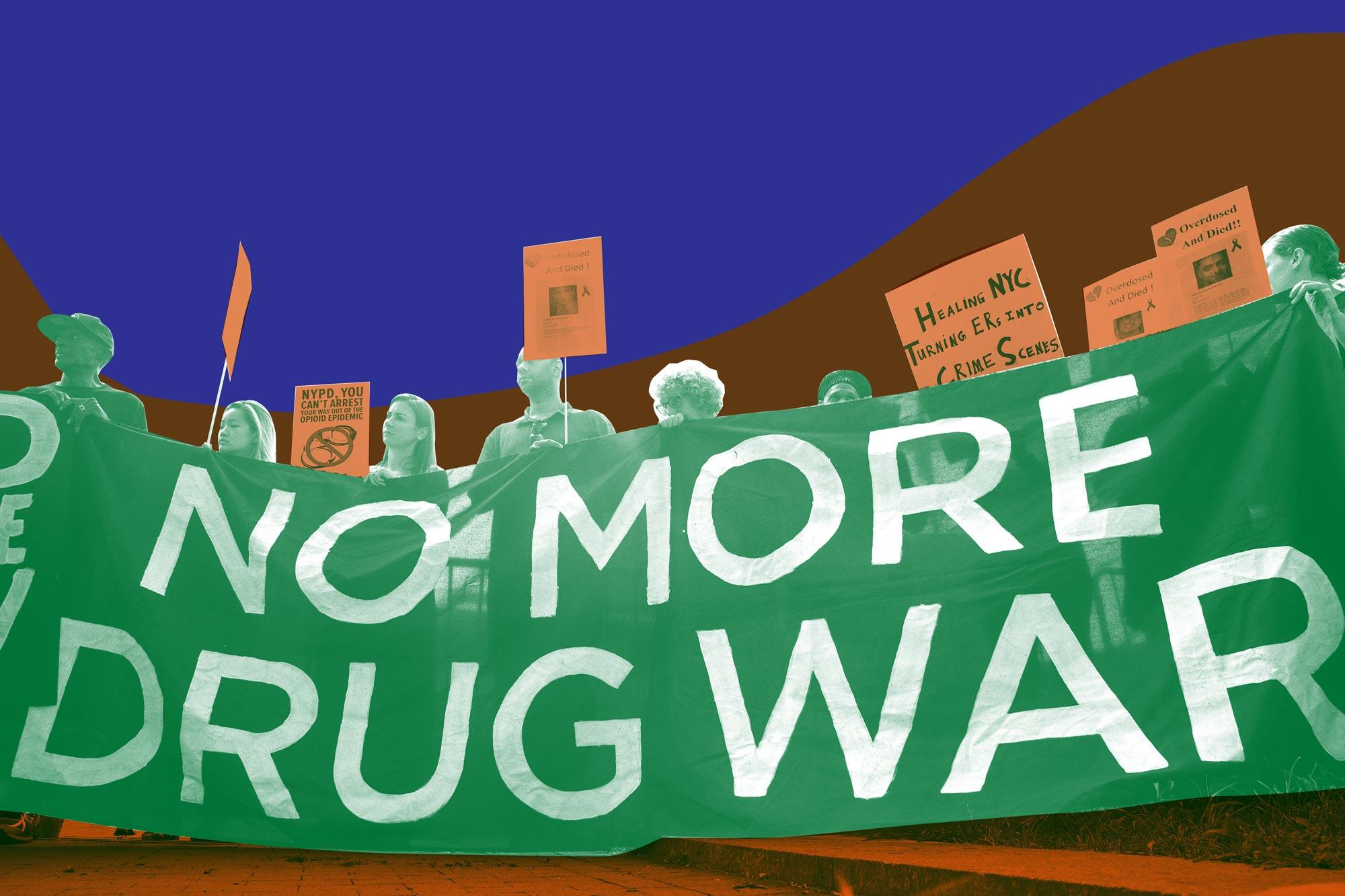
A popular quote has it that “The definition of craziness is continuing to do the same thing and expect different results.” Yet for nearly 100 years now, we have been doing the same thing when it comes to drugs. Beginning with marijuana, then heroin, then cocaine, then crack, then methamphetamines, then opioids and now fentanyl, every ten or fifteen years or so, we add another drug to the list of drugs that we are waging war on. The wars are always the same, arrest the people who use the drugs, arrest the drug dealers, interdict the drug suppliers and try to close down the drug factories.
For more than fifty years, the United States has been running what we officially like to call a “War on Drugs.” Nixon first used the phrase during a press conference on June 17, 1971. The truth is we have been waging a war on drugs since the first batch of alcohol was produced at some remote still in the Virginia mountains. The first “Illegal” stills began in 1791. Distilling became “illegal” only when owners refused to pay the Whiskey Tax of 1791. This was the first domestic tax imposed by the new federal government. Before this, private stills were common and perfectly legal.
The charts below tell us—without ideology, slogans, or moral judgment—how this war has actually gone. What these charts reveal is not a story of individual moral failure or a handful of reckless “bad actors.” What they reveal is something far more troubling:
A system that consistently produces harm at scale. A system where drugs are not the cause of the problem but the inevitable outcome of a larger problem.
Chart 1: Total U.S. Deaths from Drug Overdoses and Alcohol (2004–2023)

Total U.S. deaths from all drug overdoses (including prescription and illicit drugs) compared with alcohol-induced deaths, 2004–2023.
Why This Chart Matters
This chart shows the raw number of Americans dying each year from:
- Drug overdoses (all drugs: prescription and illicit)
- Alcohol-induced causes (poisoning and chronic disease; not accidents or violence)
The upward trend is unmistakable.
Drug overdose deaths rise from roughly 27,000 in 2004 to over 100,000 per year after 2021.
Alcohol-induced deaths nearly double over the same period, with a sharp surge during and after the pandemic.
At first glance, some will argue this is simply a matter of population growth: More people means more deaths. That explanation collapses when we look at the second chart.
Chart 2: Per-Capita Death Rates (Deaths per 100,000 Population)

Per-capita death rates (per 100,000 population) remove population growth from the equation, revealing true changes in risk over time.
Why This Chart Matters
This chart removes population growth entirely.
Measured per 100,000 Americans, drug overdose deaths more than triple over the past two decades. Alcohol-induced deaths nearly double per capita over the same period.
This is the critical point:
When harm grows faster than population, the problem is not demographic — it is structural.
Healthy systems dampen risk. Unhealthy systems amplify it.
This Is a Systems Failure, Not a “Bad People” Problem
American drug policy still rests on a comforting fiction: that addiction and overdose are primarily the result of individual weakness, criminal behavior, or poor moral choices. In other words, drugs are associated with low life scum bag assholes that bear no resemblance to us, our relative or our friends.
The per-capita data destroys that narrative.
Millions of people do not independently decide to fail in the same way, at the same time, across both legal and illegal substances. What is failing is the system — the structures that shape incentives, access, despair, treatment, and profit.
This is where the idea of Economic Apex Predators becomes unavoidable.
Economic Apex Predators and the Logic of Harm
In nature, an apex predator is not evil.
It simply occupies a position of unchecked advantage.
When ecosystems collapse, it is rarely because predators are malicious.
It is because balance and restraint disappear.
Our economic system has produced its own apex predators:
- Pharmaceutical industries that monetize dependency while externalizing risk
- Financial systems that profit from addiction through insurance, debt, and incarceration
- Legal systems that thrive on the drug war with lawyers, police, judges and courts all owing their existence to catching and prosecuting anyone in the illegal drug trade.
- Supply chains optimized for speed and efficiency, not safety
- Political institutions more responsive to capital than to human cost
None of these actors needed to intend mass death.
The system rewards behavior that makes drugs and drug deaths inevitable.
From Prescription Pills to Fentanyl: A Market Evolution
The overdose curve follows a grim but predictable logic.
Prescription opioids were aggressively marketed. When backlash came, access tightened — but demand remained. The market adapted.
Heroin filled the gap.
When heroin became risky to traffic, fentanyl replaced it — cheaper, stronger, deadlier.
This was not a failure of enforcement.
It was a success of market logic operating without ethical boundaries.
Fentanyl did not invade the United States. It emerged naturally from a system that prioritizes cost reduction, scalability, and profit over human survival.
Why Alcohol Strengthens the Argument
Alcohol’s curve matters because alcohol is:
- Legal
- Regulated
- Taxed
- Socially normalized
Yet its per-capita death rate rose alongside illegal drugs.
That tells us something deeply uncomfortable:
The crisis is not about legality.
It is about despair.
Despair does not care whether a substance is legal.
2020 Was Not an Aberration — It Was an X-Ray
The pandemic spike is often described as an anomaly. It wasn’t.
It was an X-ray.
When social supports vanished, when work and healthcare became unstable, and when isolation replaced community, the system’s fragility was exposed.
The pandemic did not create the overdose crisis.
It revealed it.
Why Individual Blame Is Comforting — and Wrong
- Blaming individuals is emotionally satisfying.
- It absolves institutions.
- It preserves the illusion that the system is sound and only people are broken.
But systems that function well do not produce exponential per-capita death curves across decades. If millions fail in the same way, the problem is not personal failure.
It is design failure.
A Closing Thought
Apex predators do not destroy ecosystems intentionally.
They do so when constraints vanish and balance collapses.
These charts are not just public-health data.
They are moral documents.
They show us what happens when an economic system evolves without ethical boundaries and treats human lives as acceptable losses.
This is not ultimately a story about drugs.
It is a story about power, incentives, and what we choose to tolerate. I have watched this war now for over fifty years. The craziness continues with bombings of so-called drug boats and now attacks on Venezuela with drones. It is as though people in this country are blind to the truth and reality of this war. You never hear the truth about this war in any media. The news proudly broadcasts arrests of drug dealers and busts of large drug hauls but no data or facts about the drug war are ever published. The media would rather ignore the real problem so they can make their blood money on advertising accompanied by their lurid stories of drug deals and drug related crimes.
As a nation we have stuck our collective heads in the sand. The only time we take them out is when a relative or friend is caught up in the war. Otherwise, it is them versus us. Them are low life people with no motivation or desire to improve themselves so they default to drugs. Them are other countries which find it lucrative to manufacture and sell drugs in the USA. Them are immoral people who sell drugs to anyone with the money to buy them. Do we ever ask “why are we alone in a drug war” when the rest of the world seems to look the other way and benefits at our expense.
I make a simple prophecy. Unless we change our tactics and strategy, we will never win the so called Drug War. Deaths will continue to escalate from drugs. New drugs will soon replace fentanyl as the target drug. Drug cartels will continue to manufacture and ship drugs to the USA where they will be eagerly purchased. Police and courts will continue to prosecute drug pushers, drug users and drug lords. The majority of people that get sentenced will be poor or minority if previous patterns of prosecution prevail. Leaders of major cartels will continue to be replaced by even more vicious leaders, and the illegal drug industry will continue to make billions of dollars each year in profits. Profits from the misery, despair and deaths of the customers who have made them rich. Meanwhile our leaders will continue to brag that they are against drugs. Politicians will continue to make more laws that do nothing to help us end the ravages of drugs in America. Politicians will continue to be quick to espouse anti-drug drivel like “just say no!” to make it look like they are really concerned about the public welfare.
Anyone want to place a bet against my prophecy?

 Aging Capriciously
Jan 02, 2026 @ 07:51:10
Thanks for sharing Ned. The more people that can get the message, the more chance we can have of stopping this insanity. I hope. John
LikeLike
Jan 02, 2026 @ 15:40:41
I agree John, the ongoing war on drugs is futile, it is just a waste of money and a face savour for politicians.
A far better option would be to licence all drugs, register manufacturers and tax the proceeds. This would ensure quality control, keep track of what is being used and where and allow governments to adjust and adapt legislation as required.
LikeLike
Jan 02, 2026 @ 22:29:42
Hi Jon, did you have a Merry Christmas and/or a Happy New Year? Sometimes hard to enjoy life these days being as crazy as it is. I agree with your ideas about the drugs. In addition, we could spend the money on the treatment of causes of drug addiction and drug neediness instead of locking them up and ruining lives. IMHO. Hope you are doing well. I always look forward to your comments.
LikeLike
Jan 03, 2026 @ 00:58:17
John, being of advanced years every day is Christmas for me, but I did enjoy the fireworks on New years eve, reminded me of my youth.
Back to drugs, I believe addiction is a genes/environmental issue in which a lack of self esteem plays a large part. But I could be way off the mark. But ones upbringing, education or lack of and cultural background seem to make some people more susceptible than others.
But the real issue is;, do we treat drug use as an illness or a crime? I see it as an illness.
LikeLike
Jan 03, 2026 @ 07:43:34
Jon, I am 79 so I think we may be close to the same age. I see drugs as a response to despair. Now true, some people can pick themselves up and get along with their lives but as a Vet I saw too many soldiers who could not overcome PTSD by themselves. I used to think that PTSD was a sign of weakness but then came to realize that we can all only handle so much stress (PTSD) and so much despair where drugs become the answer. Is it a social issue or an individual issue? A lot like asking which comes first the chicken or the egg. But nevertheless, the bottom line should not be criminalization as you note.
LikeLike
Jan 03, 2026 @ 21:20:35
I can only hope you never catch up, I’m 84 and loving it.
LikeLike
Jan 03, 2026 @ 22:00:45
Jon, Glad to hear someone happy about getting older. I would have felt that way about two months ago and then got diagnosed for a pacemaker after a routine physical and umpteen heart tests. Seven to be exact. Now I am recovering and trying to figure out how come my “plumbing” system was great but my “electrical system” went haywire. Oh, well I should be grateful that I am still alive.
LikeLike
Jan 04, 2026 @ 12:33:32
As discussed before John, I find the whole process fascinating, I often wonder what’s on the other side, which raises the question; is there another side?
LikeLike
Jan 04, 2026 @ 12:46:04
Yes Jon, I know I am going to die but I rather put it off just a little while longer. I need the Angel of Death to understand that I am very busy. 🙂 I am curious about the other side or sides or places or whatever they have been called but not curious enough to rush over to find out. 🙂
LikeLike
Jan 04, 2026 @ 12:58:45
Just think John of what you might be missing out on?
We might all be living in the basement of a tall building, just think what we might see from the top floor?
LikeLike
Jan 05, 2026 @ 09:14:46
Jon, I always say you need the long view and the short view. Otherwise, you miss seeing reality. The penthouse view does not see the dog poop right outside the front door.
LikeLike
Jan 05, 2026 @ 07:31:19
No John, I wouldn’t want to make a bet against your prophecy – sadly. I can only speak from my observational and work experience here in the UK and it’s remarkable how many people view differently alcohol versus drugs. Yes, alcohol is socially acceptable and to some extent regulated but statistical figures on deaths, accidents, job losses, family & marital breakdown, physical & mental abuse, financial hardship and ruin, (et al) is far greater overall when related to alcohol. Of course, we know that alcohol is a drug too. But for some reason ‘we’ are told we can drink alcohol within sensible limits compared to drugs which will “only lead to the hard stuff”! Does everyone who drinks alcohol become an alcoholic? No. Does everyone who takes drugs end up on heroin and cocaine? No! There are so many contradictions and irregularities as you say.
In my opinion drugs need legalising and regulating as Canada have done.
You’ve probably seen these but if not I fully recommend both of them:-
Painkiller: A 2023 Netflix limited series that is a fictionalized retelling of the origins and aftermath of the opioid epidemic. It stars Matthew Broderick as Richard Sackler, an executive at Purdue Pharma, and Uzo Aduba as an investigator, highlighting the stories of perpetrators, victims, and whistle-blowers.
Dopesick: A critically acclaimed 2021 Hulu (Disney Plus in the UK/Ireland) limited series based on the non-fiction book by Beth Macy. It provides a comprehensive look at the crisis from multiple perspectives: the boardrooms of Big Pharma, a distressed mining community in Virginia, and the halls of the DEA. Michael Keaton stars as a doctor in a small town whose patients become addicted to OxyContin.
LikeLike
Jan 05, 2026 @ 09:18:59
Thanks Marge, I will look these up. They all sound interesting. Thank you for your comment and perspective as well. I do not think there is enough public discourse on this issue. I even bought into the trope that a drink a night was good for you because it would help me to relax and sleep better. Amazing how the industry moguls spin their bs to con the rest of us into bad health and even death. How many years did it take us to “unhook” for cigarettes and then they can kids on these electric stuff. Very sad.
LikeLike