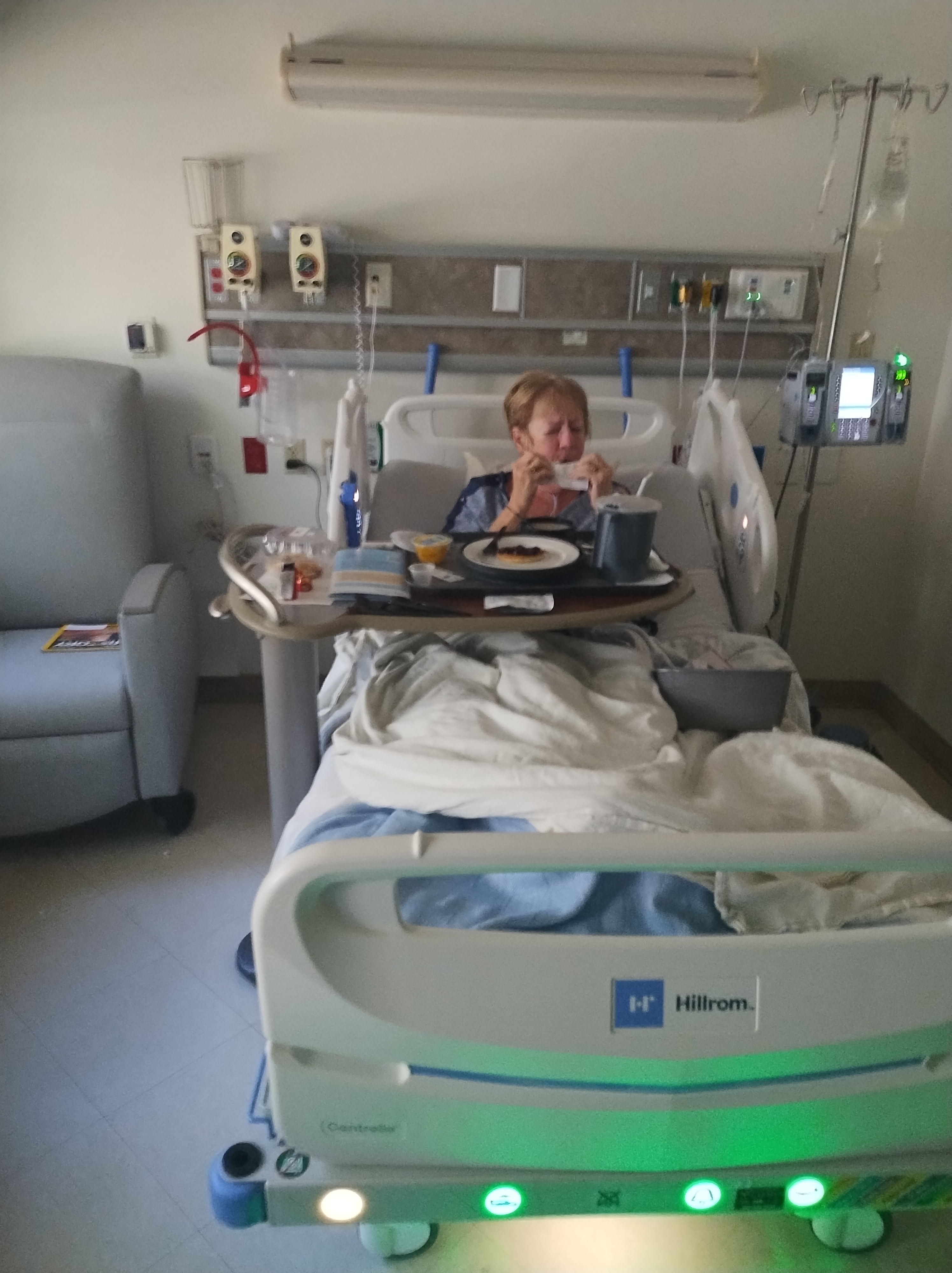
This last week has been really stressful. Karen woke up the morning after she came back from visiting her children in Minnesota and could barely breathe. I called 911. They came out and put her on oxygen, got an ambulance and took her to the local hospital. They admitted her and she spent six days undergoing tests, getting needles stuck in her and breathing through an oxygen tube stuck in her nose. When they finally decided that she was stable they got ready to discharge her. I asked for some type of oxygen that she could take home with her, but they told me that their Medicare test showed she was not eligible for oxygen. I told them I would pay for it but it went right over their heads. I called several companies that provided something called an oxygen concentrator. They would be more than happy to either sell me one or rent me one. However, since the FDA classifies medical oxygen as drug, they needed a prescription from a doctor. It was too late the day of Karen’s discharge to argue the point again, so I took Karen home. You already can guess what happened.
We arrived home at about 4 PM. Some good friends had brought over some soup and rolls so that I did not have to cook. We ate supper. Watched “Wild West Chronicles” and “Where the Heart Is” and went to bed. All seemed good. Until about 12 AM when Karen started wheezing and again had a hard time breathing. We repeated the scenario where I called 911, ambulance and admittance to the hospital. This time I was able to stay with her in the emergency room. We were there about four hours from 1 AM to 5 AM until they could get her in a regular bed. At about 1:30 AM, a woman came in pushing a computer on a cart. She asked me if I could make the co-pay now. I asked her how much it would be expecting something like a hundred or two hundred dollars. She informed me it would be $1750 dollars. I asked a few more questions and put the charge on my VISA card.
I started to do a slow burn. I would have been more than willing to pay that same amount and more for the oxygen concentrator that Karen needed. But no, they could not give her one even with me paying for it.
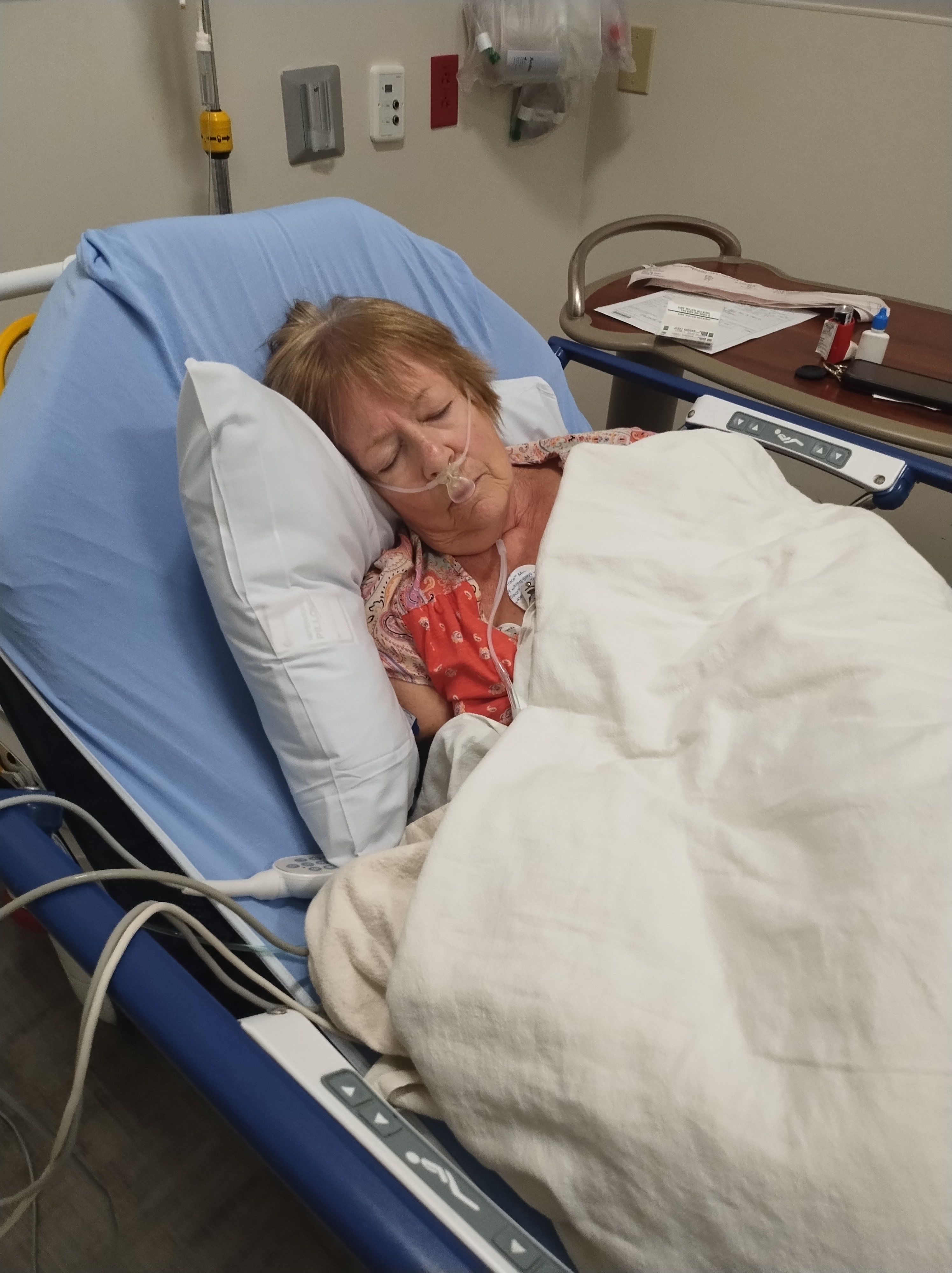
So now Karen was back in the hospital again and no closer to really finding out what is wrong with her. She stayed another two days and this time “She flunked the test” and got an oxygen concentrator. She is now back home sleeping peacefully. For the past two days she has only used the oxygen at night. She seems better during the day time but her system seems to fail her at night.
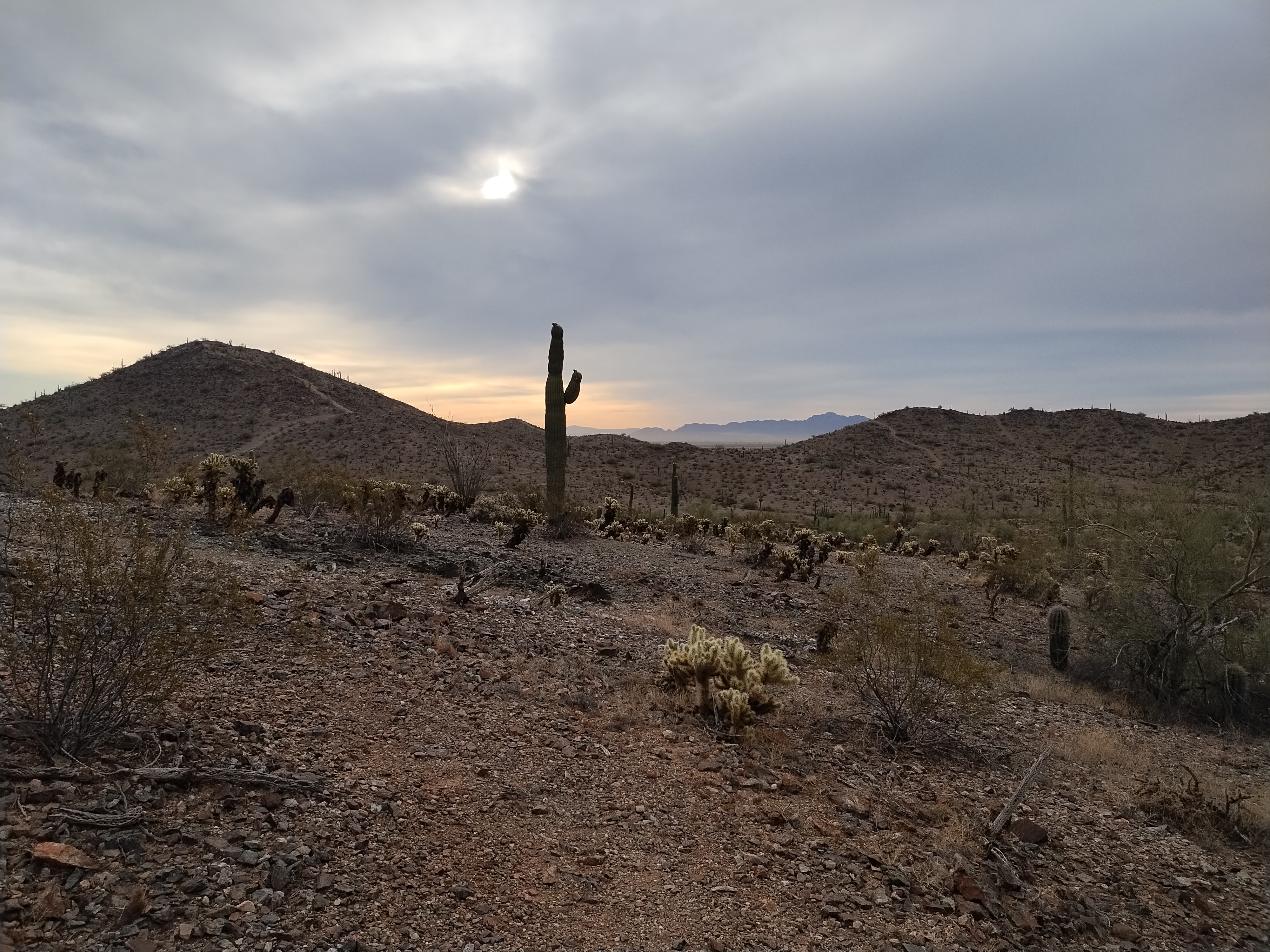
I got up this morning and decided to go out for a hike in the mountains. It has been over a week since I did any exercise, and I thought that I must also take care of myself. I chose a moderately difficult mid distance hike to do. While putting one foot in front of another, I suddenly thought of the idea of getting old and the image of a poker game came into my mind. I thought “aging is like a poker game.” You sit around a table with four or five friends. You raise, you bet and finally someone calls. The first player smiles and says, “I’ve got a pair of aces.” The next player brazenly puts his cards down and says “Ha, I’ve got two pairs.” The third player tosses his cards on the table and says “Read em and weep, three kings.” “Not so fast” says the next to last player on the table, “I’ve got a full house.” Now it is my turn, I simply fold em.

“What’s poker got to do with all this?”
Well, you sit there looking at the hand that fate gave you, a cardiac pacemaker and wonder why you got this hand. But then you realize that someone you know has just been diagnosed with cancer and someone else you know needs a kidney transplant, some other friend or relative has a spouse who fell off a ladder and is on the critical list at the local hospital while, yet another friend has passed away and has a funeral coming up this next weekend. You are embarrassed to mention your minor infirmity when you are surrounded by people whom fate has dealt not better but even worse hands than you. Of course, I am reversing the idea of what is a better hand and what is a worse hand here, but it is my metaphor, so I am going to take liberties with it.
I continued my hike and my thoughts on aging and illness. The real issue I reflected was one that I have never quite conquered. It is the issue of Gratitude and Ingratitude. St. Ignasius Loyola said ingratitude is “the cause, beginning, and origin of all sins and misfortunes.” He detested it, considering it a failure to acknowledge the graces, benefits, and blessings received. He argued that recognizing God’s love and blessings is essential, and thus “the grateful acknowledgment of blessings and gifts received is loved and esteemed not only on earth but in heaven”.
Now I have hardly ever denied that I am not a pessimist. That thought led me somewhere deeper than poker or luck. It led me to an issue that I’ve wrestled with most of my life: gratitude. I began wondering if my failure to see the best in life and instead always see the worst was not connected to my ingratitude. The answer is of course yes. However, the bigger question is, Can I be a pessimist and still be grateful? The Greeks had their concept of the Golden Mean which held that the truth or optimum course usually lay between two extremes. Is this true with gratitude and pessimism? Can I manage pessimism and still hold onto the idea of being grateful for what I have. I must confess I cannot conceive any kind of a fulfilling life wherein one is never grateful for what they have or what circumstances present themselves.
The discipline of gratitude is the explicit effort to acknowledge that all I am and have is given to me as a gift of love, a gift to be celebrated with joy. — Henri Nouwen
I want to continue this blog by looking at the two extremes that are consistent with the Greek idea of finding the golden mean. Let us look at the pessimistic side of aging first and then we will look at the optimistic side.
Aging from a Pessimistic Point of View:
My pessimistic side reflects on those who claim the we age like a fine wine. To paraphrase Scrooge from the novel A Christmas Carol, “If I could work my will, every idiot who goes about saying that we age like a fine wine should be boiled in wine and buried with a bottle of cheap Chianti in his coffin.” Here are my top reasons for being pessimistic about aging. These are in no particular order:
- Losing too many good friends and relatives to the Grim Reaper
- The fear of dealing with the Specter of loneliness
- Fading memories of good times gone by that will never happen again
- Dealing with a body that is wearing out and being replaced piece by piece
- Feeling sorry for myself that I never accomplished more and did not leave the world a better place
- Not being able to help others as much as I would like to anymore
- Memories of mistakes and cruelties that I subjected others to and never made up for
- Wondering where all the flowers went this year in the Casa Grande mountains
- Watching someone I love so much endure the pain of illness and not being able to do anything about it
Aging from an Optimistic Point of View:
You have my list of pessimistic views on aging. If these are forever on my mind, I know that I cannot be grateful. Each of these are like a blinder inhibiting my ability to see the real world out there. Nevertheless, each of these are part of the real world. Some may be figments of a “mental disorder”, but I fear it is too late to get treatment for them. Instead, I need to balance the scales some and find that Golden Mean. Herewith are those things that I know I should be grateful for:
- I have lived a long life and been healthy for the majority of it. I am now 79 and despite needing a pacemaker I am still ambulatory.
- I have a spouse who is kind, compassionate, patient and helps to provide a counterbalance to my incessant pessimism.
- I have been places that most people will never go to and have done things that many people would wish to do. I have had a good life.
- I can still read, write, travel and dream.
- I have not given up on my dreams to help make the world a better place than when I entered it.
- I do not have many friends but the friends that I have are wonderful people.
- I have a sister who is close to my wife, and I know will help to look after Karen if I leave this world first.
- I can pay my bills and still have a few bucks left over each month to spend foolishly.
- I still look forward to getting up each day and spending time with Karen.
- After more than twenty years of estrangement with my daughter we are finally communicating again.
So, there you have it. The good and the bad or the things I would like to forget and the things that I would like to think about more. Unfortunately , the reality is that life will never let us forget the bad. That seems to be a sad part of existence. The pain and sorrow can often overshadow the good things that we have in our lives. Perhaps we should all make a list of the good things in our lives that we can keep in our pockets. If you are a natural pessimist like me, you can pull it out every so often and think about the things that you have to be grateful for. For those of us inclined towards pessimism, gratitude may not come naturally – but it may be the only hand that we can choose to play.
Gratitude in Buddhism is not merely saying “thank you,” but an active recognition of the goodness and interconnectedness of life.
Bahá’u’lláh instructed, “Be generous in prosperity, and thankful in adversity,” emphasizing that gratitude should not depend on comfortable circumstances.
“Gratitude turns what we have into enough” (Native American Elder belief).
Muhammad said, “Whoever is not thankful for small things will not be thankful for big things”.


May 04, 2026 @ 04:56:23
I think that through adversity it can feel onerous to appreciate the good things in life. Even though we realise we have been fortunate in escaping the many misfortunes that others have experienced, the timing for appreciation seems inappropriate. When someone says to you, “it could have been worse”, you may agree but does it take away how you’re feeling at the time?
I rather like this meme and think it’s very true. What do you think John?
“Someone who drowns in 7 feet of water is just as dead as someone who drowns in 20 feet of water. Stop comparing traumas, stop belittling your or anyone else’s trauma because it wasn’t
“as bad” as someone else’s.
This isn’t a competition, we all deserve support and recovery.
Casey Rose
tinybuddha.co”
I hope Karen’s recovery is going well and that you are remembering the importance of taking care of the carers.
LikeLiked by 1 person
May 04, 2026 @ 09:10:07
Thanks Marge. Good words and very helpful. I can’t argue with the drowning metaphor. They say the Indian Ira Hayes who helped raise the flag over Iwo Jima died in a drainage ditch that he fell into while drunk. The Ballad of Ira Hayes by Johnny Cash tells the brief story of the life and death of Ira Hayes. I used it in my memorial to Ira Hayes this past Feb. Thanks for your thoughts and ideas Marge. You always have good insights. I will give Karen your regards. John
LikeLike
May 04, 2026 @ 12:48:23
Another thought provoking post, sir. So many topics woven together. 🙂 I come upon them almost daily. First – best wishes for you and Karen. That said, two pithy points: the Serenity Prayer; and “That’s what the whiskey’s for.” Of which brings a tight smile and nod from Psych-girl, with the caveat, “Don’t drink too much.” Hang in there. I’m rooting for you.
LikeLiked by 1 person
May 04, 2026 @ 15:01:06
Thanks Mark, I appreciate your comments very much and your taking the time to reply. I do like the Serenity Prayer and I repeat it to myself often, but probably not often enough. I will give your thoughts to Karen, she will appreciate them. I can use all the cheerleading you can send my way. John
LikeLiked by 1 person