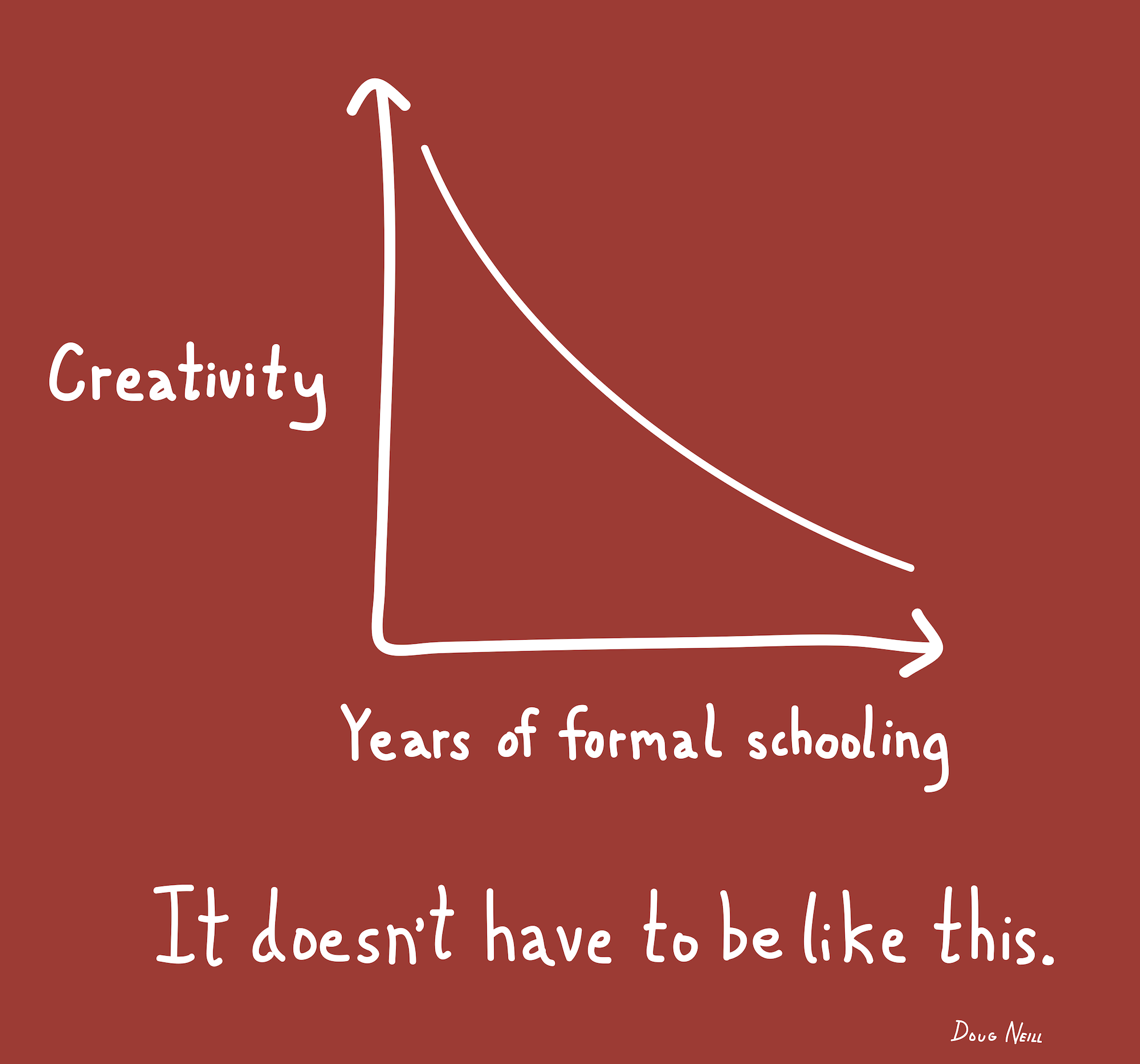
In Part 1 of “What is wrong with education?”, I described some of my history, experiences and beliefs about the American Educational System. I think most of my ideas are probably unconventional and in part that may be because I have been an outsider to the system. Dr. Deming used to say that “Change comes from the outside by invitation only.” I have never been asked to help bring change to our educational system and in fact many fellow educators are rather turned off when I tell them that I would close all schools in this country and turn them into 24 hour community centers or perhaps libraries. I have never been one for understatement and Karen keeps telling me that my hyperbole has the effect of killing my message. My problem is I mean it. Schools are dead and dying only they do not know it.
Marshall McLuhan knew this was true because the times have changed and both the Industrial Design of our educational system and the density of information transfer that can happen inside a school are now fundamental impediments to learning and education. For the past 40 years educational studies (The Goodlad Study, Nation at Risk, Fitting the Pieces) have continually shown that we need to make major changes in our school systems. Numerous studies point to the decline in standardized test scores of American students relative to students in other countries. I have been in and out of schools for the last 40 years (from kindergartens to university classes) and the only thing you will find changed in most schools is the technology. You will probably find computers, projectors and maybe the use of IPads or Smart Phones in some classes. In many schools, you will also find an increased emphasis of sports for the elite athletes and those that can afford to pay for athletics and a decreased emphasis on Physical Education for the majority of students.
So-called education experts, politicians and the ubiquitous “run it like a business advocates” all push for more “industrial era solutions” like
- Higher pay
- Teacher testing
- Pay for performance
- Stricter teacher selection criteria
- Getting rid of tenure
- More money for schools
Unfortunately, what made for success in the old paradigm cannot make success in the new paradigm. The new paradigm is gradually emerging as our schools collapse from within, our students drop out at alarming rates, the half-life of curriculum makes for obsolescence even before most students graduate and most destructive of all is the current cost of attending, maintaining and supporting schools today. Consider the irony, that most kids who are home schooled do better on standardized tests than kids in either public or private schools. At a home school, you often do not have any of the following:
- A certified and licensed teacher
- Large laboratories or extensive facilities
- Bonus pay
- Pay for Performance
- Tenure
And consider what it costs for Home Schools to achieve better than average results. The following facts about Home Schooling are from Investopedia, not exactly your usual biased pronouncements from school administrators:
There’s no doubt that research speaks very kindly of homeschooling. Not only is it cheap compared to other education options, but the results are generally better. Most parents who homeschool spend less than $600 per year compared to the $10,000 average spent per pupil by public school systems. However, parents who homeschool are still paying a portion of that $10,000 expense. Surprisingly, spending such a low amount on a child’s education produces impressive results. One study found that the average homeschooled student outperformed the average public school student by roughly 30 percentile points.
There is an excellent online article called “Eight Reasons Home Schooling is Superior to Public Education”. Some reasons given for its success may be open to criticism but they will surprise you:
- Free thinking is allowed and encouraged
- Focus is on education
- Freedom from Pop Influences
One would think that given the performance of home schooling that anyone in the traditional school paradigm would have some serious doubts about the effectiveness of the current educational system. Instead teachers, unions, and administrators all rally around the flag and continue to either resist change or support panaceas that offer no real change to the present educational system. The Teacher of the Year is heralded in every school district and local press as the solution to the problems that are seen as “individual centered” rather than system centered. Thus, if only we had better teachers or more caring teachers or more motivated teacher or smarter teachers than everything would be okay. No it would not be okay. And unfortunately, neither President Obama’s agenda for change or his new Education Czar have any real insights into the changes that are needed in American schools.
A recent article in the Economist Magazine was titled: Higher education: Not what it used to be: American universities represent declining value for money to their students. The problem with American education goes all the way from grade school on up to the university level. There is hardly any part of the American Education system that should be retained or that could be said to be useful to our country. We are falling behind the rest of the world, because they are catching up. Ironically, they are simply imitating a system that is failing in this country but with some modifications has allowed other countries to gain parity with the U.S. In my research and travels, I have found no reason to think that we should adopt a system used in Germany, China or Japan. They are more disciplined in their application of the U.S. Model, but it is no more effective in these countries at creating a New Paradigm for a new millennium of education than it has been or will be in this country.
You may be wondering “Well, what is the New Paradigm?” In a nutshell, the solution is to design a new educational system from the ground up. Some design factors for such a system must include the following:
- Eliminate school districts, school boards and 90 percent of all current school administration.
- Eliminate standardized school curriculums and create customized educational design programs for students based on need and interests. We don’t need a factory to produce learning for a limited time. We need a system that will produce learning and education for a lifetime not a lockstep grade by grade progression system that ends with a MBA.
- Develop Schools of Excellence with specific discipline foci that will be located where need and population are greatest. Thus, Minnesota might have 10-15 Art Schools in the state, 30-40 Math Schools, 10 Music Schools, 20 Vocational Education Schools and 30-40 writing schools. Students would attend these schools voluntarily and only for as long as indicated by their customized curriculum. Some students would go to three or four of these Schools of Excellence and others might just attend one.
- Hire experts as Teacher/Facilitators. Emphasis should be on critical thinking, hands on learning and blending theory with practice. Teachers should not need “credentials” if they can demonstrate competence in the subject being recruited for.
- Eliminate standardized test programs. All these tests do is encourage cheating by teachers and students.
- Eliminate generic diplomas and degree requirements. No longer should anyone have to go to school for 16 years and college for 4 years to get the training they need for gainful employment.
- Create a standardized education tax for the U.S. so that students regardless of where they live would have the same funds available for education.
- Provide parents and students educational vouchers to use at the school of their choice or to support the accomplishment of their child’s educational curriculum.
- Abolish seniority and tenure systems for all educators. Schools should be allowed to hire who they choose, when they choose. Schools should be “Employment at Will.”
- Schools would have to publish yearly “transparency” data including dropout rates, completion rates, grade averages and where relevant hiring and placement rates. All schools would have a financial statement available to the public and a standardized business plan or education plan. Such a plan would show need, customers and how customers were going to be served.
- All schools would be “education at will.” Schools would be free to terminate students at will and students would be free to leave at will.
Chris Hedges noted author, journalist and Pulitzer Prize winner says this about education in the US today:
“We’ve bought into the idea that education is about training and “success”, defined monetarily, rather than learning to think critically and to challenge. We should not forget that the true purpose of education is to make minds, not careers. A culture that does not grasp the vital interplay between morality and power, which mistakes management techniques for wisdom, which fails to understand that the measure of a civilization is its compassion, not its speed or ability to consume, condemns itself to death.” — (Empire of Illusion, 2007)
John Gatto, who was New York City teacher of the year in 1989, 1990 and 1991 has the following perspective on education:
“I’ve noticed a fascinating phenomenon in my thirty years of teaching: schools and schooling are increasingly irrelevant to the great enterprises of the planet. No one believes anymore that scientists are trained in science classes or politicians in civics classes or poets in English classes. The truth is that schools don’t really teach anything except how to obey orders. This is a great mystery to me because thousands of humane, caring people work in schools as teachers and aides and administrators, but the abstract logic of the institution overwhelms their individual contributions. Although teachers do care and do work very, very hard, the institution is psychopathic — it has no conscience. It rings a bell and the young man in the middle of writing a poem must close his notebook and move to a different cell where he must memorize that humans and monkeys derive from a common ancestor.” – (Dumbing Us Down: The Hidden Curriculum of Compulsory Education)
Andrew Hacker, Professor Emeritus at Queens College New York with over 40 years’ experience in Higher Education believes that:
College is not worth the cost. Our system of higher education is broken…Our principal premise is that higher education has lost track of its original and enduring purpose: to challenge the minds and imaginations of this nation’s young people, to expand their understanding of the world, and thus of themselves. — (Higher Education?: How Colleges Are Wasting Our Money and Failing Our Kids—and What We Can Do About It)
I have included some of the above quotes to show that I am not alone in my belief that “lower” and “higher” education in the USA today are outmoded, defunct, obsolete, wasteful and counter-productive. Higher educators commonly blame “Lower” educators for the problems they inherit at the “Higher level” while “Lower” educators blame parents, funding, administrators and students. “Kids today are lazy, do not read, watch too much TV, play too many video games, only care about making money and feel entitled to everything.” The “Last Great Generation” is fond of knocking the “latest” generation and calling them the “Entitlement Generation.” The problems with schools could all be solved if we did away with students, tenure, parents, administrators, unions and teachers. Colleges would be a lot better off if they only had “good” students who really wanted to get an education. These and other shibboleths continue to obscure the real problem which is the System. Dr. Deming noted that:
“The Appreciation of a system involves understanding how interactions (i.e., feedback) between the elements of a system can result in internal restrictions that force the system to behave as a single organism that automatically seeks a steady state. It is this steady state that determines the output of the system rather than the individual elements. Thus it is the structure of the organization rather than the employees, alone, which holds the key to improving the quality of output.” –(The New Economics for Industry, Government, Education, second edition)
My list of changes needed would only scratch the surface of providing a New Paradigm for education in the new millennium. I am suggesting that we strongly need to rethink every aspect of the delivery and provision of education in America today. Without making substantive changes in how we educate all of our population, not just children but adults as well, we will never regain the greatness that America had during the 20th Century.
Ok, time for questions.
Did you think school was fun when you went? Do you think school could be fun? What if we combined Play, Education and Work into the functions of a school? What do you think it would be like for students? Do you have any idea of what Higher Education costs today? Do you know what the average salary of an NCAA Football Coach is? Click on the link if you want to find out! Do you think teachers are paid too much? Do you think American schools are the best in the world? How do you explain the high ratings for Harvard? Should we allow students to leave high school to perform community service or join the military? What would you do to FIX education?
Life is just beginning.