
by Dr. John Persico Jr, October 27th, 2026
No doubt if you have been to any weddings, you have heard the following verse:
“Love is patient, love is kind. It does not envy, it does not boast, it is not proud. It does not dishonor others, it is not self-seeking, it is not easily angered, it keeps no record of wrongs. Love does not delight in evil but rejoices with the truth. It always protects, always trusts, always hopes, always perseveres.” – 1 Corinthians 13:4-7 NIV
To which I say bullshit. That’s right BULLSHIT! You show me one marriage that is anything close to this and I will write you into my will. Only in some la-la land that does not exist in our universe is love anything close to this definition.
Now, I could go with my skepticism, and I would say, “Love is really lust in disguise.” I have seen dozens if not hundreds of women that I FELL in love with on first sight. How do you fall in love with someone that you have never met and know nothing about? Easy, but I don’t want to get pornographic, so I won’t discuss the details here.
However, I have another view on what love really is and what love really means. This description does not come from skepticism or optimism. It comes from seeing life through my lens of 80 years on this earth.
My three word description – Love is sacrifice
Love is giving up things that may cost you much in life. Jesus said that “Greater love hath no man than this, that a man lay down his life for his friends.” — John 15:13
- Love means doing things you do not want to do
- Love means going places you do not want to go
- Love means putting up with people you do not like
- Love means taking responsibilities you do not want
- Love means forgetting as well as forgiving
- Love means TRYING to be kinder
- Love means TRYING to be more patient
- Love means TRYING to be more compassionate
As we grow older and our relationships with others change, so too will the roles that we can play with them change. Once upon a time, love meant having fun with my spouse. Going out to a nice dinner. Going to new places to visit.
Today, we spend more time going to doctor’s appointments. More time taking care of each other. My responsibilities in my relationship with Karen continue to grow despite my efforts to avoid any added responsibilities.
I wrote a blog a while ago about the differences between rights and responsibilities. Everyone demands their rights but few if any demand their responsibilities. Why is this so?
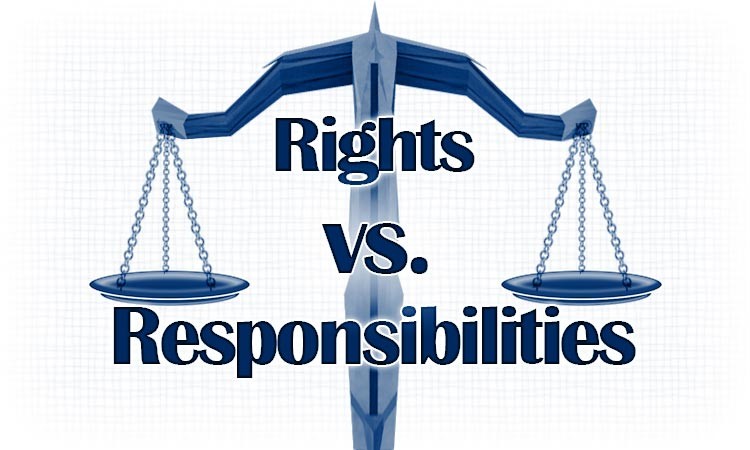
The answer is clear. Rights are a gift. You get rights seemingly free of charge. The illusion of those demanding their rights is that there is no cost. And of course everyone loves a freebie. The reality as I said is quite the opposite. For every right, there is a responsibility. The responsibility is the cost that you pay for your right.
Responsibilities mean work. Work is how we pay for what we get. There are no free lunches on this planet. None exist except in the minds of fools who think they deserve a free ride. We seem to be inundated, indeed swamped and drowning today in such fools.
I want my rights!. I want my rights!
Let me diverge a bit to explore with you what some of the great teachers and prophets had to say about rights and responsibilities. We will return to the subject of Love after this brief detour.
Jesus on Rights and Responsibilities:
Rather than demanding or protecting personal rights, Jesus repeatedly commanded his disciples to yield them for a higher spiritual purpose.
The Two Greatest Commandments: Jesus condensed all religious and ethical duties into two absolute responsibilities: loving God completely and loving one’s neighbor as oneself (Matthew 22:36-40).
Social and Communal Duties: He placed a heavy emphasis on caring for the marginalized, poor, sick, and imprisoned. He explicitly states that a person’s ultimate judgment is tied to how well they fulfilled their responsibility to the “least of these” (Matthew 25:40)
Bahá’u’lláh on Rights and Responsibilities:
Bahá’u’lláh, the founder of the Bahá’í Faith, directly addressed both rights and responsibilities, weaving them into a single, interdependent framework for global civilization. Writing in the 19th century, his teachings heavily anticipated modern concepts of universal human rights.
However, Bahá’u’lláh did not view rights as independent demands. In the Bahá’í framework, an individual’s rights are guaranteed only by the collective responsibility of humanity to uphold justice and unity. — https://bahaiteachings.org/bahai-principles-human-rights-for-all/
Rabbi Jonathan Sacks on Rights and Responsibilities:
The late Chief Rabbi Lord Jonathan Sacks wrote extensively on how the modern obsession with individual rights, divorced from communal duties, fractures society. In his philosophy, he championed what he called Radical Responsibility.
“Judaism is a religion of holy responsibility… It is God’s call to human responsibility.”
Rabbi Sacks argued that the ancient Greek and Western traditions are built on rights, while the Hebrew Bible is built on covenants and duties. He noted that a society focused entirely on “what I am owed” creates a culture of blame and victimhood. True human freedom and the protection of minority rights, he argued, only survive when individuals step up and say, “I am responsible.” —- https://rabbisacks.org/videos/rabbi-sacks-on-a-responsible-life-example/
Muhammad on Rights and Responsibilities:
Prophet Muhammad framed rights as sacred entitlements guaranteed entirely by our strict, divine responsibilities to God and humanity. His teachings demand absolute personal accountability across all social classes, fiercely binding individuals to structural obligations like protecting minorities, caring for the marginalized, and paying workers instantly.
In this divine framework, the rights of the vulnerable are only secured when believers actively fulfill their radical responsibilities, knowing they will answer directly to God for any failure to act. — From ChatGPT
Buddha on Rights and Responsibilities:
The Buddha did not speak in terms of personal “rights,” but built his entire ethical system around universal responsibilities, karma, and reciprocal duties (Dharma). In ancient India, the concept of legal entitlements did not exist. Instead, the Buddha taught that true freedom, peace, and harmony are achieved not by claiming what the world owes you, but by mastering your responsibility over your own mind and actions. — https://www.buddhistdoor.net/features/a-buddhist-understanding-of-the-dharma-and-human-rights/
Lord Krishna (The Bhagavad Gita) on Rights and Responsibilities:
The Teaching: Krishna introduces the concept of Svadharma—the specific, inescapable moral duty of an individual based on their unique position, life stage, and circumstances in society.
Focus on Responsibility: Krishna famously states: “You have a right to perform your prescribed duty, but you are not entitled to the fruits of your actions” (Gita 2:47). He teaches that human beings have zero control over outcomes or what the world owes them; our sole, supreme responsibility is to execute our moral duties with total detachment from personal gain. — https://en.wikipedia.org/wiki/Dharma
The responsibilities we have towards others is not easy to conduct. I am imagining a wedding ceremony where the participants take vows of responsibility to each other. The idea of “Love, honor and obey” does not say much that is practical. Here is my take on a:
Vows of Responsibilities
Today, I choose you as my partner, and I accept my responsibility for the marriage we begin together.
- I promise to consider how my words, my actions, and my decisions affect you.
- I will listen with the intention of understanding you, especially when we disagree. I will speak honestly and with kindness and make room for truths that may be difficult to hear.
- I take responsibility for my mistakes. When I hurt you, I will acknowledge it, offer a sincere apology, and work to repair the harm.
- I will respect your dignity, your boundaries, and your freedom to be yourself. I will support your friendships, your interests, and your dreams, and give you room to grow.
- I will carry my fair share of our responsibilities—the work that is visible and the work that often goes unnoticed. When circumstances change, I will help us find a fair balance again.
- I will be open with you about our resources, our commitments, and the decisions that shape our future.
- I will care for my own well-being, ask for help when I need it, and recognize that you, too, need care and support.
- In times of illness, uncertainty, and sorrow, I will offer my presence, my patience, and whatever strength I can give. I will respect your limits and be honest about my own.
- I will notice your efforts, express my gratitude, and make time for affection, laughter, and the ordinary pleasures of being together.
- When difficulties arise between us, I will face them with you. I will seek understanding, accept help when we need it, and do my part to keep our relationship a place of safety and trust.
- I cannot promise that I will always know what to do. I promise to keep learning, to reconsider when I am wrong, and to follow these words with action.
With love, freely given, I accept these responsibilities today—and commit myself to practicing them throughout our life together.
I only wish that I had been practicing these vows longer and more persuasively than has been the case. My excuse was to insist that I never wanted to be a saint. However, the closer the door gets to closing on my life, the more that I would like to go out knowing that I was trying to be a better person.
I leave it to the world to decide if I have succeeded.


