
Introduction:
Political pundits and other so-called experts are all taking sides on the advantages and disadvantages that AI poses for humanity. Many are fixated on the large number of jobs that will be rendered obsolete by AI. They seem to forget that throughout history, new jobs replaced old jobs when technology changed. From sails to steamships, horse and buggies to cars, history is one vast unfolding of technology changing the way societies do work and are structured.
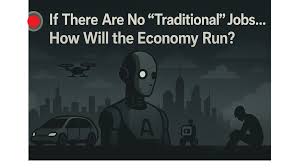
For the sake of compromise, I will assume the worse. Let me speculate that in fifty years, AI will eliminate 95 percent of all jobs on the earth. There are two ways that such a situation could be viewed. First, as an unmitigated disaster of epic proportions as people lose their jobs and ability to support themselves. Or as an opportunity of epic proportions based on an abundance of leisure time. An opportunity that enables people to use this leisure time to pursue more rewarding and creative activities. AI could eliminate the drudge of 9-to-5 work. However, we are still going to need an economic system. I believe such a system would be vastly different that any system that we have ever had either today or in the past. The world stands at the threshold of a post-labor era. Machines now do the work that once defined our lives, yet the rewards of that labor remain unevenly shared. We need a new economic philosophy — one that aligns technological abundance with human fairness.
How could we structure an economic system in which people did not work but could still have access to health care, education, food, shelter and clothes? Would this be possible? We see Sci-Fi movies with civilizations on other worlds or in the future who live in a Utopia where robots and AI take of all the basic needs. But how would a new economic system distribute the goods and services that are basic to humanity? This is a lightning rod activity since many people are quick to oppose any efforts wherein someone seems to get something for nothing. Witness, the ongoing criticism of social services such as welfare, unemployment and even social security. A new economic system is going to call for new thinking. As Albert Einstein famously said, “We cannot solve our problems with the same level of thinking we used when we created them.”
 To think about what such a system might look like, I want to bring up an analogy that portrays a very different way of looking at life. The people that we call Indians who were indigenous to this country before Europeans arrived had a way of distributing food and shelter that was quite admirable. They believed that the land, water, resources belonged to everyone. No one could own the land, lakes or seas. If a buffalo hunt took place, the resultant meat was shared among all the tribal members. No one said “I killed that buffalo, so the meat belongs to me. But I will sell you some if you want any.”

Equalitarianism:
I want to propose that we cannot have a new economy based on selfish individualistic thinking that ignores any kind of social obligations. If AI and automation do 95% of the work, we’ll need an economic system that (1) guarantees the basics, (2) steers scarce resources wisely, and (3) keeps meaning, dignity, and innovation alive. I will call this new economy “Equalitarianism” as opposed to capitalism, socialism, communism or any other economic system that you have heard of. “Equalitarianism” is a democratic economic philosophy grounded in fairness, shared ownership, and universal well-being. It envisions a society in which the fruits of automation and intelligence—both human and artificial—are distributed to ensure dignity, opportunity, and balance for all.
Core Principles of Equalitarianism:
- Shared Prosperity: Wealth produced by automated systems and AI is treated as a collective inheritance, not private privilege.
- Universal Security: Every person is guaranteed access to health, education, housing, food, and connectivity as rights of citizenship.
- Democratic Ownership: Data, infrastructure, and automation are managed for the public good through civic and cooperative institutions.
- Ecological Balance: Progress is measured not by growth alone but by sustainability and planetary stewardship.
- Purpose Beyond Profit: Humans pursue creativity, service, and learning as the highest expressions of freedom in a post-labor world.
- Transparency and Trust: Economic algorithms and institutions operate openly, accountable to citizens, not corporations.
- Responsibility and Contribution: Freedom is balanced with duty—to community, environment, and future generations.
- Cultural Flourishing: Arts, education, and civic engagement become the new engines of meaning.
- Global Solidarity: Equalitarianism recognizes that abundance must be shared across borders to preserve peace and human dignity.
- The Equilibrium Principle: Every policy seeks harmony between technological power and human values.

Building an Economy When Work Disappears:
Imagine it’s the year 2075. Ninety-five percent of all jobs once done by humans are now performed by artificial intelligences and robots. Factories hum without workers, crops harvest themselves, and algorithms handle every clerical task once requiring a cubicle. Humanity’s most ancient concern—how to earn a living—has been replaced by a new question: “How to live meaningfully when earning is no longer required?”
For centuries, economies balanced two core elements: labor and capital. Labor created value; wages distributed it. The Twentieth Century saw “information” added to the two core elements. Productivity once dependent on land and labor has become increasingly dependent on information and data. Humans cannot compete with AI when it comes to producing and managing such data. When increased automation and AI can provide nearly all productive labor, the former equilibrium collapses. Yet people will still need food, housing, healthcare, education, and belonging. We will also need purpose. The challenge is no longer how to produce, but how to share. Here are some ideas on how resources could be managed in an Equalitarian economy:
A Universal Basic Bundle:
Instead of handing out only cash, the new economy could guarantee a Universal Basic Bundle (UBB)—a set of public services as reliable as electricity. Healthcare would be universal, food credits digital, housing guaranteed, education lifelong, and connectivity and mobility free. This bundle would ensure dignity without removing freedom; citizens choose providers and can upgrade privately.
An Automated Productivity Dividend:
While the UBB guarantees basics, citizens also receive an Automated Productivity Dividend (APD)—a monthly stipend reflecting humanity’s collective ownership of the machines that now do the work. The APD would draw from public wealth funds, resource rents, and automation taxes. It grows as automation grows—return on shared capital, not charity.
Ownership in an Age of Algorithms:
Without shared ownership, AI profits concentrate into a few hands. Society must broaden who owns the means of computation through sovereign and municipal wealth funds, data trusts, and cooperative platforms. This mosaic of ownership spreads wealth and gives every citizen a stake in the future.
Managing Scarcity in an Age of Plenty:
Even a post-labor world will face scarcities—prime land, rare minerals, medical specialists, and peak energy hours. Instead of rationing by privilege, we can ration by fairness: dynamic pricing for peak resources, lotteries for non-market goods, and caps and dividends for carbon and material use. Money remains, but it serves coordination rather than domination.
Purpose Beyond the Paycheck:
While work may vanish, meaning and purpose must not. Society can elevate civic, creative, and ecological missions as the new currency of status—with prizes, recognition systems, open laboratories, and local media supported by public dividends. In place of employment, people pursue engagement; work shifts from income to contribution. In the early 1950’s, the Japanese created a prize for quality based on the ideas of Dr. Deming and named it the Deming Prize. This effort greatly helped to catapult Japan to a world leadership in product quality and reliability. The old saying that “Two heads are better than one” can now be changed to “Two heads with AI are better than only two heads.” Together we can think our way to a better world.
Bottom Line for Humanity:
A society freed from compulsory labor can become either a gilded palace for the few or a renaissance of the many. It can become a world of haves and have nots. A world with a few super rich and billions of poor people with no jobs and no skills. If we share the fruits of intelligence—both human and artificial—we can fulfill the dream that every prophet and philosopher has always embraced: a world where work is a choice, not a chain. Where labor from 9 to 5 is replaced by time for family, friends and creativity.
How We Can Leverage AI to Create a “Jobless” society: Part 2
In my next blog, I will dive deeper into some of the concepts and ideas that I presented in this blog. I want to describe how many of the economic elements that I noted could actually work and discuss the pro’s and con’s of some of them. We will discuss the feasibility of the scenario that I am advocating.


 I’d like to think when life is done,
 I asked her if she had any idea what she could do. She replied that she did not. I suggested that she take an employment aptitude test to see what kinds of work she might find interesting. It was all very theoretical to me, but I could not imagine what kind of work I could find for her in the local area that would pay enough for her to live on. She did not have any current job experience and no goals for a career. The aptitude test was simply an effort to do something even though I did not believe that I could help her much.


 Aging Capriciously