
My mentor, Dr. W.E. Deming used to say, “Put a good person in a bad system and the system will win every time.” The latest cop fiasco with five Black men beating a young Black man to death no doubt has many people either scratching their heads or gloating. Those scratching their heads are trying to understand how it can be that so many officers would beat a helpless man to death. Those gloating are no doubt saying “See, it was Black cops beating one of ‘Their’ own to death.” Still others are saying that if it were White cops, they would not have been charged with anything. The problem with each of these perspectives is that they ignore the system. Police operate within a system. A bad system produces bad results. Let me explain further.
We need to start off by understanding what a system is. Some definitions that work for me are as follows:
1.
A set of things working together as parts of a mechanism or an interconnecting network.
“The state railroad system”
2.
A set of principles or procedures according to which something is done; an organized framework or method.
“The public school system”
3.
Deming defined a system as ‘a network of interdependent components that work together to try to accomplish the aim of the system. The aim for any system should be that everybody gains, not one part of the system at the expense of any other’
A friend of mine said that the purpose of a police system is to to protect and serve the public.
Systems can be very complex and difficult to understand. When I was doing my management consulting, I would often bring a large group of senior managers from a company together to chart or map the “system” that they worked in. This was usually a prelude to defining objectives and looking at “systemic” problems more wholistically. That is a way of saying I wanted them to see the big picture. We could do the same thing with any system. In what is a very cursory or limited analysis of a “police” system, I offer the following factors or components. These four factors make up a large portion of the system that police work in every day. I would like to explain each and give my thoughts on how they create the dysfunction that seems to be prevalent in so many law enforcement agencies. ‘
- Authoritarianism
- Exclusion
- Jeopardy
- Fascism
I do not claim that all police systems are dysfunctional. I also do not claim that cops do not have a very difficult and demanding job. There is perhaps no job in America that is more difficult than being a police officer. Nevertheless, parts of the police system while designed to protect officers have been and still are major sources of dysfunction.

- Authoritarianism
There is a saying that “Power corrupts, and absolute power corrupts absolutely.” I speak from experience that many officers get corrupted by the power that the gun, badge and night stick welds. Growing up on a street corner society, I had my share of run in with cops. I was arrested before I was 18 for assault and battery and for felony larceny. This does not count my numerous other altercations with police for which I “escaped.” When I was young, I used to say that “The only good cop was a dead cop.” Later, my opinion changed 180 percent and I began to appreciate the need for good policing.
The problem though is that in many cases, police let the power that they are given go to their heads. This problem does not exist in isolation from the other factors that I will discuss but it is exacerbated by the tendency for police to think that they are above the law or that they do not have to answer to the public they serve. Many cops take umbrage at being questioned as they act like they have the absolute right to ask questions but not to answer them. How often have you heard in TV dramas the officer say, “I am asking the questions here.” The person who asks the question has the power and is the authority. The person answering is “powerless.” TV is not reality, but it reflects some of the attitudes that exist in law enforcement.

- Exclusion
Cops are for the most part isolated or segregated from the public. The old days of Officer O’Malley walking a beat and talking to kids and neighbors in a friendly demeanor no longer exists. Talk of “community policing” is for the most part a myth or a relic of a bygone age. We seldom see a cop unless we are in trouble, or we need something, or we are watching the 10 o’clock news.
Isolation is not a good thing. It creates an “us-them” atmosphere. We don’t see police as belonging to our neighborhood or as being “friends.” We view them with hostility and suspicion when they knock on our front doors. It does not matter whether they are Black and we are Black or whether they are White and we are White. They knock on our door and we immediately feel threatened.
- Jeopardy
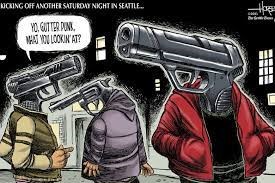
A police officer is in life threatening jeopardy every single moment of every single day. Perhaps, never in history have cops been so threatened. Their lives are on the line twenty-four seven. A cop can be blown away going to a domestic dispute or merely stopping a car to give a ticket or a warning. The proliferation of weapons has made police more vulnerable. The bad guy always gets the chance to shoot first and the cop must give a warning before he/she shoots. It is easy to see why some cops go over the edge and shoot first without asking questions. I do not say that this is justified but how would you like to go out every day not knowing whether or not you would be shot dead by some crazy who had an AK 47 or a AR 15 or a Glock 17.

- Fascism
Before exploring this facet of law enforcement, we need to define fascism. One definition from Wikipedia is as follows:
“Fascism is a far-right, authoritarian, ultra-nationalist political ideology and movement, characterized by a dictatorial leader, centralized autocracy, militarism, forcible suppression of opposition.”
Police exist to protect the status quo. There are many who mock the “Golden Rule” with, “Those who have the gold make the rules.” Cops are on the side of the system that pays the bills. They protect the government against protestors, marchers, and often peaceful gatherings of citizens who they think pose a threat to “law and order.” They also protect the government, companies and society against rioters, looters, thieves and not so peaceful protestors.
The major problem with cops is that they are on the other side of the equation when it comes to social upheaval and change. They did not see Civil Rights as a necessary antidote to racism. They did not see the suffragettes as giving women the right and dignity to vote. They often were and still are on the other side of the union-management divide during strikes and labor protests. It would seem to many people that cops work for corporate America and not the citizens of America.
I have pointed out four elements that in many cases define law enforcement to many Americans. There are many other elements that make up the law enforcement system in the USA. I have written several other blogs on this subject. The four elements that I described are the most problematic and I think help to best answer the questions that this blog started with. “How could five Black officers beat a young Black man to death.”
If you follow what I am proposing, you can understand that these five men were “just doing their job” as the system defined it. I am sure that any one of these five men would define virtues that many would call exemplary. I have no reason to think that they were “bad” men wanting to do bad things. Caught up in a bad system, you and I would more than likely have done exactly what they did. You can argue this latter point with me. But in my experiences, I have seen too many “good” people do bad things when working in an environment that fostered either negative, immoral or unethical behaviors.
PS: I watched the video today (Jan 28) of the beating that Tyre Nichols received. At first, I did not want to watch the video. I have seen too many videos of police brutality in the past. They are sickening, sad, tragic and pitiful. I did not think that I could bear to watch yet another one. However, I did. I do not feel that I have the right to comment on such cases if I do not see what has actually happened.
The one thought that I got out of this video was that it could have been YOUR SON, Your FATHER, YOUR BEST FRIEND, YOUR MOTHER, YOU or ME that was on the ground and beaten to death. Tased, Confused, Disoriented, Maced, Kicked, Punched, and Battered, would you have run? Would you have been able to comply with commands screamed at you?
In my next blog, I will offer some ideas that might help to change the system. Changing the system is the only way to change results. Dr. Deming insisted that 94 percent of variations observed in workers’ performance levels have nothing to do with the workers. Instead, most performance problems are caused by the system, of which people are but a part. “People cannot perform better than the system allows”, which he explains in his book, “The New Economics.”

For further thoughts on this subject of police violence, an excellent article that I came across is

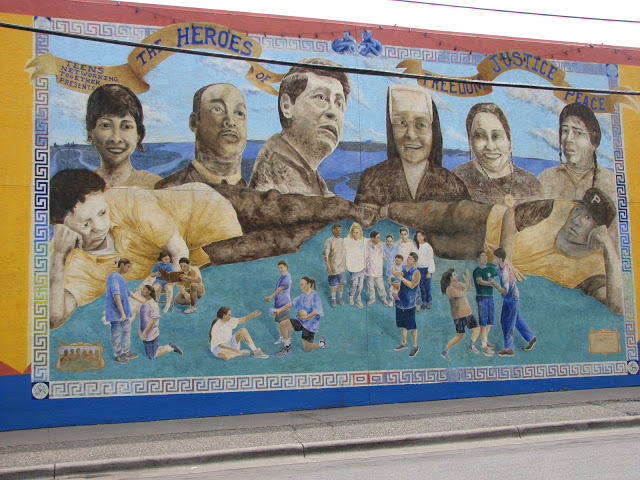
 One day a young student came to me and complained that he felt that his rights had been violated. At the time, I took any students complaints very seriously particularly when it concerned rights. I listened to his problem and asked him what he wanted me to do about it. He asked if I would intercede on his behalf with Sister Giovanni, who was our principal. I wanted to show the young man that I was concerned and caring and so I agreed to carry his problem to Sister G as she was known. She was feared and loved by almost all students so it did not surprise me that he thought I might have more luck with Sister G than he would have.
  I went to Sister G’s office and knocked on her door. She opened it and welcomed me in. We exchanged some pleasantries and she asked me what I needed. I began to explain the issue that the student had brought to me. Sister G listened attentively. When I was done, she smiled and nodded reassuringly. I thought “Great, I have been successful.” She then spoke, “This is your first year teaching right John?” “Yes, it is,” I answered. “Well, I have heard the issue and I may address it later, but I want to give you an important piece of advice now. Students just like the majority of people will always demand their rights, but they seldom demand their responsibilities.” Then, she gave me the philosophy that I have never forgotten. “John,” she continued, “for every right there is always a responsibility.” That was the end of our discussion.

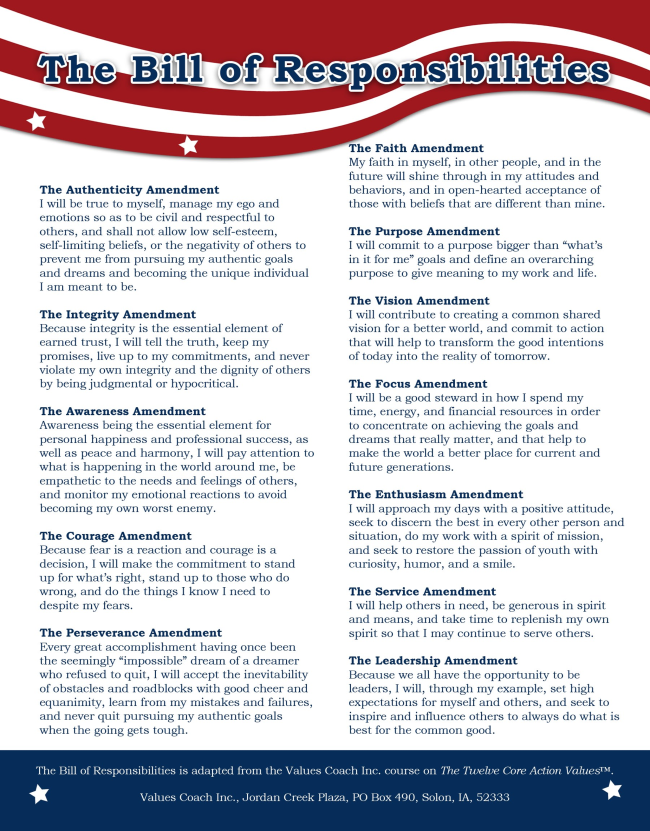
 What is the solution to the problem that we are facing today? A poisonous cultural stew of narcissism and entitlement driven by a rights only oriented mentality that thinks they are above responsibilities. I have reached the point in this essay where it would be easy to say, “Sorry, I don’t have the answer.” Or else, I could now list several bromides which may or may not have much effect. I have the following solution which I believe in 100 percent. I doubt that it would be acceptable to Americans as too many people have grown privileged, lazy, and indulgent in this country.
  My solution is for a National Required Service (NRS) that starts at the age of 18 for every man and woman in America. Upon finishing high school and before starting college, every American would need to attend the National Required Service. They would have two options. The first option would be to choose between a two-year service or a four-year service. A two-year service would be the minimum. The advantage of a longer service would lie in the educational benefits that would accrue. Serve two years and you would receive two years of financial credit towards any public education institution of your choice in the country including vocational education as well as liberal arts. Choose a four-year tour of service and you would receive four years of financial credit towards the public institution of your desire.


 Ladies and Gentlemen. How can you have a government of the people, by the people and for the people when it is a government of the rich by the rich and for the rich? A government of lawyers, political science majors and corporate people. An interlocking network of proponents who have a self-interest that nowhere matches the nature and interests of the general public of America.
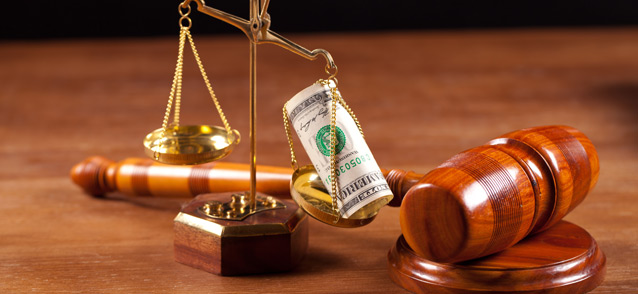 Many of the board members in the rural counties are farmers or laborers or educators who have little or no training in the laws that they are sworn to protect. Thus, they rely heavily on the lawyers that they hire to provide advice and perceived protection from lawsuits. This renders the board members subject to the legal opinion of the lawyer which is quite often at odds to what the public wants. The boards are frequently fearful of a lawsuit (often offered by the lawyer as a possibility) and will forego making an informed decision based on evidence that is presented at the hearings.
 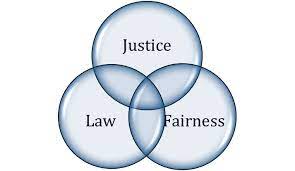 We need less lawyers. Lawyers and lawsuits are destroying America and Democracy. We need leaders with more diversity in education. We need leaders with more ethnic diversity. We need leaders with more gender diversity. We need greater representation that reflects the demographics of America. We need less lawyers. We need more justice and we need more fairness.


 Aging Capriciously