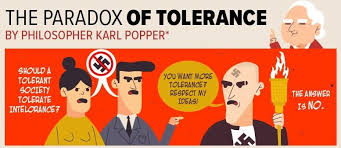
Many years ago, the famous philosopher Kark Popper created what has been called the “Paradox of Tolerance.”
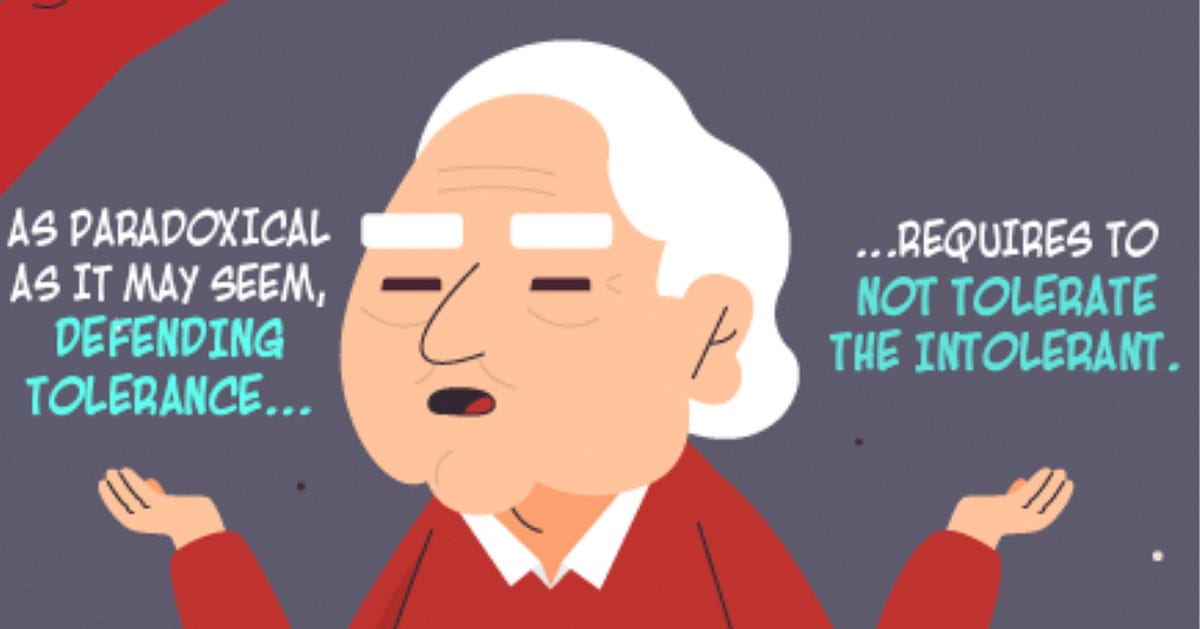
Karl Popper wrote that, “if we want a tolerant society, we must be intolerant of intolerance”. This is known as the “Paradox of Tolerance”, which is the idea that a society must be intolerant of intolerance in order to maintain tolerance. As with any paradox, this is very confusing.
“Popper explained that unlimited tolerance can lead to the destruction of tolerance. He said that a tolerant society should be prepared to defend itself against intolerant views, and that the right to suppress intolerant views should be claimed if necessary. However, he also said that suppressing intolerant views through force is unwise unless they are unwilling to engage in rational argument.” —- From Search Labs | AI Overview
Recently, I came across a rather long academic article which I think supports a justification for Popper’s viewpoint. Albeit I think this article provides a more nuanced explanation for being intolerant of intolerance. I have decided to post this article since I think the times demand that we understand this perspective. I believe it is a focal point worth fighting for. You may disagree but the analogy of how Hitler took power is I think quite relevant and worth thinking about. Here in its unabridged form is the entire article. I would love to hear what you think, so please leave a comment or two.
What are the Limits of Toleration? By Tamar Lagurashvili
University of Tartu, Institute of Government and Politics, Graduate Student
Introduction
Tolerance is considered to be one of the cornerstones of modern liberal democracies, thus having acquired different implications across the countries, which ultimately leads to the ambiguity of the concept itself. In order to avoid further misunderstanding, we should clearly define what is meant in tolerance and why it is crucial not to mix this term with the words having similar connotations. Yossi Nehushtan (2007:5) offers an obvious distinction between the value-based liberal tolerance and rather neutral tolerance, which finds more similarities with indifference rather with toleration itself. Concerning its linguistic origin, author refers to the Latin word tolerabilis, which means to lift an object, clearly implying to the burden to be carried by one, who tolerates certain unacceptable behavior, act or opinion. Within this context, we should refer to Michael Sandel (1996), who differentiates liberal non-judgmental toleration from judgmental toleration. While looking closely at these concepts, we can see that in the case of former, person (tolerant) tolerates certain opinion, act or behavior without judgmental evaluation simply because he does not care or he respects others’ privacy and thus, refrains from any kinds of interference. Albeit that, refraining from interfering in other people’s private life is an integral part of modern liberalism, definition provided above does not correspond with the tenets of tolerance.
As Heywood (2015:251) rightly mentions, tolerance should be distinguished from permissiveness, indifference and indulgence, since being tolerant inherently implies to the fact that a tolerant person faces moral difficulties to put up with certain behavior or act, but does so for the sake of different reasons. Being tolerant means that a person has to impose certain restrictions on him/herself in order to avoid to openly interfere in others’ life when there is something to be disliked, disparaged or disapproved. Toleration with its basic definition can be considered as truly moral value, supporting a peaceful coexistence of the different individuals, but whether there are certain cases, where intolerance is morally/pragmatically justified is major concern of this paper.
Why do we tolerate?
Rainer Frost (2008:79-82) while touching Pierre Bayle’s Reflexive theory of Toleration, talks about three different reasons or factors, which trigger toleration among majority and minority groups. First he mentions permission conception, according to which the majority gives minority a right to live according to their customs, but toleration is possible when the “difference” of minority is contained to certain limits and does not cross the borders of private life. As an early and most vivid example of permission conception Frost names the Nantes Edict of 1598, which granted the Calvinist Protestants of France substantial rights in private as well as in public spheres.
Second way of toleration is coexistence concept, which resembles to pragmatic tolerance to be discussed bit later. In this case, avoiding conflict and paving way towards peaceful coexistence is what matters, but unlike the previous situation, here we face not the relation between the ruling majority and minority, but rather two groups wielding equal powers, thus requiring making some concessions for the sake of preventing clash of interests. If we attempt to apply this concept to real life, we can think of Somalia, who has been torn apart by three different clans ruling in three regions of Somalia, therefore hindering country’s normal development. Bearing in mind that Somalia is characterized by distinctive homogeneity (Guardian Africa: 2015), one can assume that it is not different beliefs and traditions, which impede toleration among the clans, but the economic benefits they can reap from the permanent state of conflict.
Third conception is based on the principle of respect, thus implying to the fact that toleration requires acknowledging the fact that everyone is equal and deserves equal political and legal rights.

As one can see Frost’s approach towards toleration is rather a combination of pragmatic and moral values, since it fosters cooperation between majority and minority and upholds egalitarian values. Kristie McClure (1990:361-391) puts forward John Rawls’s understanding of toleration within his notion of “ justice as fairness”, according to which toleration carries distinctively pragmatic connotation, namely the one of social conditions, which not only helped to put an end to the religious wars in Europe, but to transform religious toleration into certain form of social practice. John Locke’s work Letter Concerning Toleration is deemed to be a milestone in understanding the tenets of toleration. Locke comes from the assumption that we are all created by God and thus, our “Highest Obligation” should rest on the understanding of others’ differences for the sake of our moral obligation and love (Frost 2008). Later on Locke argues about the possible relation between the tolerant and one to be tolerated, excluding the possibility to give superiority to any church, since it will lead to persecution and monopolization of power.
One can consider that by proposing to give each and every church equal power as searching for the only true religion is futile and will exacerbate conflict between different religious groups, Locke somehow offers the coexistence concept elaborated earlier. Even though toleration is a God-given virtue, Locke still talks about its possible limits, which in his case is restricted to two kinds of groups: “A church that assumes the power of being able to excommunicate a king or that claims political and religious authority over its members…” and the atheists, as: ”They are not at all to be tolerated who deny the Being of a God” (Frost: 91-92).
Nehushtan, like Frost points out three different reasons of why people generally tolerate: tolerance as right, pragmatic tolerance and tolerance out of mercy. First he touches upon tolerance from the standpoint of rights and argues that no matter how repulsive person’s behavior or opinion can be, harm inflicted to that person cannot be justified on the grounds of personal autonomy developed by Joseph Raz . Author stresses particular importance on the pragmatic side of toleration and develops the ideas very similar to Frost with an additional insight of reciprocity and proportionality, which will be discussed later on. His third point argues that people with physical and/or mental disabilities might be exposed to more toleration than usual, regardless their repulsive behavior.

Can toleration be limited?
Tolerance with its underlying principles and applicability clearly upholds democratic values and strengthens personal autonomy, which constitutes one of the cornerstones of the liberal democracies. Albeit that tolerance is widely considered as “moral virtue”, would we go further and suggest that tolerance can be applied to each and every circumstance regardless the fact who should be tolerated? This question is examined in the works of many political scientists, including Andrew Heywood, who even though stresses importance of the political pluralism, openly talks about those political parties, which are clearly distinguished with hate speech and bigotry, thus threatening the democratic values, should not be tolerated and permitted to the political spectrum, since as author suggests: ”toleration is not granted automatically, it has to be earned” (Heywood: 256).
I would suggest that reciprocity, as a crucial feature of toleration substantively defines the nature of its applicability, which means that in certain exceptions, where we have to deal with a massive surge of intolerance, clearly undermining the democratic values and endangering the sovereignty of state, toleration should be limited. Heywood calls an example of Nazi Germany, where after the failure of Munich Putsch, Hitler and his collaborators were still allowed to pursuit their political activities legally, which ultimately led to the disastrous consequences. It seems that reciprocity plays an integral part in understanding the limitations of tolerance, so clearly expressed in the work of Nehushtan, who also talks about proportionality, which mainly focuses on the costs and benefits of limiting toleration. We could start by recalling Rawls, who suggests that:” it seems that an intolerant sect has no title to complain when it is denied an equal liberty”( Rawls 1999:190). While analyzing Rawls’s words, we can assume that those intolerant groups, which openly threaten state sovereignty and democratic values in general, should not be treated in a tolerant manner, but how can intolerance be expressed when it comes to politics? Should we ban such intolerant political parties and prevent them from entering parliament?
Should we hold a peaceful campaign, during which we will expose true information about the intolerant party’s real intentions and the scope of possible harm in case of proliferation the intolerant ideas? Deciding upon the methods of expressing intolerance is rather individual and as Nehushten suggests, is rooted in the principle of proportionality. According to the author, while working on the scope of intolerance, one should take into account the nature of intolerance and the response towards it, since if an act of intolerance takes place in parliament for example, an intolerant response should be formulated within the realm of politics and not in the private life. On the other hand, amount and nature of intolerant response should not exceed the original intolerance and what is of core importance- intolerant response should inflict minimal harm to the democratic values and human rights, because otherwise we will face counter-productivity. Fintan O’Toole (1997:346) raises another interesting question concerning the limits of tolerance based on assumption that excessive freedom of certain group might threaten collective good, thus requiring to impose certain restrictions on that group’s excessive liberty. Therefore, certain amount of intolerance towards the groups, who wield the power in order to prevent them from abusing/manipulating this power, is justified.
Nevertheless, author calls an example of Bernard Shaw’s criticism of the Christian Golden Rule (according to which we should treat others as we would like to be treated), providing the heterogeneous nature of the society, where what one person considers benign for him/herself, might be perceived as totally evil by other. Author suggests that even though there might be a society with relatively homogeneous religious beliefs, the applicability and interpretation of the customs and beliefs might considerably vary (O’Toole: 347). Therefore, we should not expect that toleration will be upheld as universal value across different societies, but what author explicitly refers to is the nature of harm inflicted by the intolerant groups, which morally and pragmatically justifies adequate intolerant response.

Conclusion
Tolerance, as one of the tenets of modern liberal thought, cannot be applied universally to every situation, without taking into account the nature of an opinion, behavior or act to be tolerated and the amount and nature of harm done to the society followed by intolerance. We can assume that intolerance is justified on the grounds of reciprocity i.e. as Heywood stated, tolerance should not be granted automatically and it requires certain effort to be excerpted by the groups demanding tolerance and proportionality, which implies that there should be balance between the original intolerance and its corresponding intolerant response. Even though tolerance constitutes a major tenet of modern liberal democratic states, where each and every individual is endowed with personal autonomy and a right of individual liberty, preventing certain individuals from infringing others’ private life, there are some exceptional cases, where intolerance can be justified. Even though individual liberty is an integral part of the democratic societies, my essay primarily focused on the limits of tolerance at the political level, where we might face much more disastrous results in case of allowing unlimited tolerance towards the intolerant groups. Having tolerant attitude is vital in pluralist societies, but when national sovereignty and democratic values are endangered due to the nature and amount of intolerance exposed to the wide public, appropriate intolerant response should be nurtured taking into account the costs and benefits of such response.
Bibliography
Frost, Rainer. “Pierre Bayle’s Reflexive Theory of Toleration.” In Toleration and Its Limits, edited by Melissa S. Williams and Jeremy Waldron. New York University Press, 2008.
Heywood, Andrew. Political Theory: An Introduction. Palgrave, 2015.
McClure, Kirstie M. Difference, Diversity and the Limits of Toleration. Sage Publication, 1990.
Nehushtan, Yossi. “The Limits of Tolerance: A Substantive-Liberal Perspective.” 2007.
O’Toole, Fintan. “The Limits of Tolerance.” By Fintal O’Toole and Lucy Beckett. Irish Province of the Society of Jesus, 1997.


 Aging Capriciously