Oh, sinnerman, where you gonna run to?
Sinnerman where you gonna run to?
Where you gonna run to?
All on that day
So I run to the Lord, please hide me Lord
Don’t you see me praying?
Don’t you see me down here praying?
Lord said Sinner Man you should be praying
All on that day.
Run to the Devil. the Devil was a waiting
All on that day.
Oh, sinner man, where you gonna run to?
All on that day.
The above lyrics are from the African-American spiritual “Sinnerman” (famously recorded by Nina Simone) which explore a sinner’s desperate, doomed attempt to escape judgment on the final day, running to rocks, rivers, and even the Devil for protection.
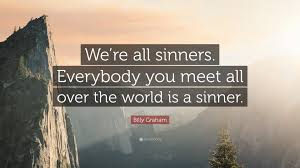
We have all heard the famous plaint by Christians that “we are all sinners.” This is often followed by some type of forgiveness blessing such as “Go, your sins are forgiven.” I am struck with how convenient this all is. The “Sinner” gets to hide his/her transgressions in two ways. First by pointing out that he/she is really no different from anyone else since “we are all sinners.” Second and perhaps more importantly, the sinner does not name his/her sins. Thereby being able to lump all sins together and not making the transgression personal.
For instance, let’s say I am a blatant sexist. I discriminate against women by abusing my wife and putting down the capabilities of women in general. I get a free pass simply by saying “I am a sinner. Forgive me Lord.” It would be much more honest to say “I am a sexist. Forgive me Lord.” Let’s take another example. A member of the KKK or some other racist group stands up in church and says “Forgive me Lord. We are all sinners.” What if he/she had said “Forgive me Lord, I am a racist.” Sounds different doesn’t it. That’s because the specificity and personal sin is not being blamed on everyone else or hidden among a possible multitude of sins.
In the song “Sinnerman”, the sinner runs from one place to another frantically seeking refuge, but the rock refuses to hide him/her. The narrative moves to the sea and river, which are depicted as “boilin'” or “bleedin’,” but offering no safety. The song continues with the sinner seeking refuge from the Lord and the Devil, highlighting the inevitability of judgment.
Many people wonder how so many self-professed Christians can support a man like Trump. Some studies show 80 percent or higher of Evangelical Christians voted for Trump. Many other self-professed Christians also supported Trump. But when you look at what these self-professed Christians say and what they actually do, the gap is profound. Jesus said, “Not everyone who calls out to me, ‘Lord! Lord!’ will enter the Kingdom of Heaven. Only those who actually do the will of my Father in heaven will enter.” (Matthew 7:21, NLT)
A few years ago, there was a large movement which created hats and t-shirts that read “WWJD.” They did not ask “what did Jesus say” which is surprising in itself. Asking what Jesus said would clearly have left them very vulnerable to attacks as being hypocrites. We are all hypocrites to some extent, but what would you call someone who professes to be a follower of Jesus and yet neither follows his words or deeds. Witness the behaviors that Trump has demonstrated in word and deed and see what Jesus would have done or at least said about these behaviors. You may ask yourself are these truly Christlike behaviors? If not, why are you following a man whose many behaviors are an insult to everything that Jesus tried to teach?
1. Mocking or Insulting Opponents vs. Loving Enemies
Jesus taught:
“Love your enemies and pray for those who persecute you.” (Matthew 5:44)
Trump has frequently used personal insults for political opponents, critics, journalists, and rivals, with nicknames such as “Crooked Hillary,” “Little Marco,” “Sleepy Joe,” and many others.
Critics argue this style is inconsistent with Jesus’ teachings on loving enemies, forgiveness, and blessing those who oppose you.
2. Treatment of Immigrants and Refugees vs. Welcoming Strangers
Jesus taught:
“I was a stranger and you welcomed me.” (Matthew 25:35)
Critics point to policies such as family separations at the southern border during Trump’s first administration and harsh anti-immigration rhetoric.
They argue these actions conflict with Jesus’ repeated concern for strangers, foreigners, and the marginalized.
3. Wealth and Materialism vs. Humility
Jesus taught:
“You cannot serve both God and money.” (Matthew 6:24)
and
“It is easier for a camel to go through the eye of a needle than for a rich man to enter the kingdom of God.” (Mark 10:25)
Trump has often highlighted his wealth, business success, luxury properties, and financial accomplishments.
Critics see this as contrary to Jesus’ emphasis on humility and caution regarding wealth.
4. Retaliation and Revenge vs. Forgiveness
Jesus taught:
“Turn the other cheek.” (Matthew 5:39)
and
“Forgive seventy-seven times.” (Matthew 18:22)
Trump has frequently spoken about getting even with opponents, punishing critics, or seeking retribution against those he believes wronged him.
Critics view this as directly contrary to Jesus’ emphasis on forgiveness and reconciliation.
5. Self-Exaltation vs. Humility
Jesus taught:
“Whoever exalts himself will be humbled, and whoever humbles himself will be exalted.” (Matthew 23:12)
Trump is known for making strong claims about his abilities, accomplishments, intelligence, electoral success, and leadership.
Critics argue that this self-promotional style conflicts with Jesus’ repeated calls for humility and servant leadership.
- Give to the poor.
- Avoid judging others.
- Practice humility.
- Tell the truth.
- Care for strangers.
- Seek peace.
What do you do if you support a man who has nothing in common with Jesus and whose very life and actions are an insult to everything that Jesus stood for. Do not worry. Just stand up in whatever so called Christian church you go to and loudly proclaim “I am a sinner and we are all sinners. I expect forgiveness.” Do not assign any credibility to the fact that Jesus put great store in behaviors and not just professing ones sins, as ambiguous as they may be.
Jesus repeatedly stressed that what matters is not merely acclaiming belief but how one lives.
In the parable of the sheep and goats, people are judged according to how they treated others:
“I was hungry and you gave me food… I was a stranger and you welcomed me.”
— Matthew 25:35
The emphasis is on compassion, mercy, and service.
Likewise:
“Blessed are the merciful, for they shall obtain mercy.”
— Matthew 5:7
The core teachings of Jesus are perhaps best summarized in the Eight Beatitudes. Yet across America we see efforts to place the Ten Commandments in schools, courthouses, legislative buildings, and other public spaces. Given that Christians profess to follow Jesus rather than Moses, one might reasonably ask why the Eight Beatitudes are so rarely if ever displayed with equal enthusiasm.
I have yet to encounter a public building in America where the Eight Beatitudes are prominently posted. Why is that? Perhaps because the Eight Beatitudes challenge us in ways that are far less comfortable than the Ten Commandments. They call upon us to be humble rather than powerful, merciful rather than judgmental, peacemakers rather than warriors, and compassionate toward those whom society often excludes.
If America truly wishes to call itself a Christian nation, then perhaps the place to begin is not with the commandments of Moses but with the teachings of Jesus. A nation built upon the Eight Beatitudes would be far less tolerant of racism, sexism, xenophobia, greed, and every form of prejudice that Trump subscribes to. It would be a country that measures success not merely by fame, or wealth or power, but by how it treats the poor, the vulnerable, and the stranger.
The uncomfortable truth is that the values celebrated by modern society often stand in tension with the values celebrated by Jesus. Wealth, status, competition, and dominance command more attention than mercy, humility, empathy, and service. Until that changes, many public declarations about Christianity will continue to sound less like a commitment to the teachings of Jesus and more like a commitment to some identity cult. The KKK, Christian Nationalists, Christian Identity Movement, Westboro Baptist Church and some Prosperity Gospel Followers come to my mind.
I leave you with this final thought:
If Jesus were walking through America today, which would he be more likely to carry under his arm—the stone tablets of Moses or the Sermon on the Mount?


Jun 17, 2026 @ 18:25:38
I truly find it inconceivable that most of the so called Christians can be so blind to reality.
LikeLiked by 1 person
Jun 18, 2026 @ 07:14:10
Wayne, who was it said that “they have eyes, but they do not see.” Too many of what I call Fake Christians have a large blind spot when it comes to self-preservation and they see chump as their savior. IMHO. How are things going for you these days. Hope all is well for you and family.
LikeLiked by 1 person
Jun 18, 2026 @ 11:08:24
Thanks John, all is well here as we move into summer and my golf game picks up! We have been doing a lot of travelling visiting kids and grandkids across Canada since early May which is tiring but invigorating. Currently finishing up in Thunder Bay, Ontario with a couple of graduations and then back home to enjoy summer.
Hope you manage to avoid some of the hype for now.
LikeLiked by 1 person
Jun 18, 2026 @ 12:13:59
Wayne, Did I ever tell you I worked with INCO for eight years in Thompson and Sudbury, I also worked with Paul’s Hauling, Gardwine, Petro Canada, Westcan Bulk, and Dominion bridge for about ten years as a Quality Improvement Consultant. Some of my best work, great friends and good times in Canada are associated with these memories. I have been in every Canadian Province and Territories. You guys are all A1 in my opinion.
Glad to hear you are still able to travel. I think unless Karen improves considerably our trip to Egypt in October is going to be cancelled and perhaps we will become more homebound. Have to wait and see. We have six grandchildren and Karen enjoys them very much. The youngest is now 25. Stay well, We will try to prevent Trump from invading you guys. 🙂
LikeLiked by 1 person
Jun 18, 2026 @ 13:49:39
I am not sure that “sin” has anything to do with religion and even it has, surely it would be all religions?
I see “sin” as being an action you take knowing is harmful to friends, the community and society in general and yes, we are possibly all sinners.
LikeLiked by 1 person
Jun 18, 2026 @ 16:02:14
Not all religions believe in sin and not all religions believe in confession.
1.Buddhism
Buddhism generally does not teach that humans are “sinners” who have offended a divine being.
2. Jainism
Jainism does not emphasize sin against a deity.
3. Hinduism
Hinduism varies widely, but generally:
• Wrongdoing is often understood through karma and dharma (duty/righteous conduct).
4. Unitarian Universalism
Many Unitarian Universalists reject the traditional concept of sin.
5. Religious Society of Friends
Quakers generally do not practice confession to clergy.
Religions That Have Sin but Usually No Formal Confession
• Judaism: Sin exists, but forgiveness usually comes through repentance, making amends, and seeking forgiveness from those harmed.
• Islam: Sin exists, but Muslims typically confess directly to God rather than to clergy.
Christians on the other hand strongly believe in sin and the power of confession to remove sin. When I was a practicing Catholic we had different levels of sin. Venal sin and Mortal sin. You went right to hell if you died with Mortal sin on your soul. Hence the last rites in Catholicism gave you the chance to repent and save your immortal soul. Venal sin only sent you to purgatory where after some indefinite stay you could collect your token and move on to Heaven. There was also Original Sin: Christian theology teaches that humanity inherited a “sinful nature” after the Fall (the first sin of Adam and Eve). This means all people have an inherent tendency to be selfish and act against God.
Given some of our earlier discussions about politics and society, you might appreciate this: if Dante were judging modern America, he might regard systematic deception, corruption, and betrayal of public trust as more serious than many acts of physical violence. He saw the deliberate breaking of trust as the sin most destructive to civilization itself.
Dante had different levels of sin which he describe in his book “Dante’s Inferno.” You might find it an interesting read. A famous line from his book was: “Lasciate ogne speranza, voi ch’intrate.”
John
LikeLiked by 1 person