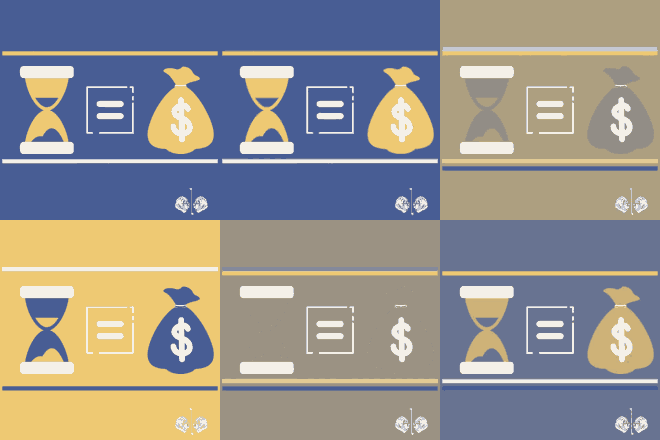
What is the cost of your soul?

Better-Faster-Cheaper, that’s the mantra for business and society in the 21st century. If we can’t do it, better, faster and cheaper, then some other company or country will. We are on a never ending treadmill where according to economists, we the consumer, benefit infinitely. We gain better and better products at lower and lower prices. Wal-Mart became the largest corporation in the world with its “Always the Lowest” strategy. We may complain about foreign goods and foreign workers and off-shoring jobs but it does not prevent us from buying the lowest priced goods we can find.

However, there are costs to this never ending gain which we have no way to calculate. There is more and more pressure to buy, buy, buy and spend, spend, spend. There is the gut level need to keep up with the Jones. There is the overwhelming obsession with having more and more stuff. Image takes precedence over substance. We live in a designer world with designer clothes, designer toys, designer dogs and designer people. We are all chasing an illusion of uniqueness through a maze of materialism. It is a game of smoke and mirrors and while we may think we are in a Fun House, it often is really a Mad House. We spend more than we can afford and more than we earn so we can present an image that reflects what the rest of the world thinks we should look like. We have t-shirts which read “shop till you drop” and “he who has the most toys win.” We lose our souls to gain a few more precious pieces of tomorrow’s obsolete junk.

Do material goods, regardless of quality, make us happier? No one wants inferior products, or to return to a primeval lifestyle, but how much is enough? Can we say, there are never enough goods and services? What about time? What about the quality of the time you spend in your pursuit of things? How much money would you give for one more year to live if you were going to die tomorrow? Are you calculating the cost of your time in your effort to be a designer person? What about the value of the time lost playing this game of trivial pursuit? Maybe we could find a mantra to live and work by that would focus more on happiness and less on things. What if we said that: “those who win have the most soul?” “What doth it profit a man if he gains the whole world and suffers the loss of his own soul?” (Mark and Matthew in the New Testament)

How much time do you have today?

FedEx has become one of the largest corporations in the world by expediting the packages that we send and receive. The United States Postal Service (USPS) left a wide open gap in the market by being more hum drum about the time it takes to send and receive packages. Little did the Postal Service realize the increased priority that people were placing on time! This created an incredible opportunity that was fulfilled by both FedEx and United Parcel Service. In today’s market place, someone will always jump into an opportunity and fulfill it. Products and services can always be: better, faster and cheaper. Faster is on of the three prime factors that can confer a competitive advantage. Time is money and money is time.

How many opportunities do you think are still out there in respect to time? If you could think about it differently, do you think you might find a great opportunity? I believe there are hundreds if not millions of opportunities still waiting for the wise entrepreneur in the area of time. Time is the most important item that anyone has and yet while we measure the Gross National Product (GNP) in terms of products and services, there are no measures for “GNT” or Gross National Time. There are no measures of PCT (per capita time). PCT could tell us how well as a nation we are doing in respect to managing time. Time is one of our most valuable assets and yet we continue to act like it is of less importance than capital or products.

How much “Per Capita Time” do you have each week left over after all your “chores” and works are done? Are you a rich person or a poor person in regards to time? Do you have more time than you need or do you have less? How could you find more time in your life for the things you really want to do?

How about "Daylight Spending Time?

Daylight Savings Time (DST) is an oxymoron. Who ever saved any time! Spring forward and fall back? So what, longer days, more time to do work, who needs it? I would like more hours of darkness, and then I could sleep longer and work less. If I work more, how am I saving time? Karen says we are really saving energy. That seems like an even bigger joke. We waste tons of energy with fuel inefficient cars and an oil based economy but we get religion twice a year and “save” energy?

If I work harder and longer, how am I saving energy? I feel like I am spending more energy every day trying to stay ahead or even just keep up. With DST, I get up earlier and work later. I can tell you a better way for us to save energy. Find a way for me to sleep longer. I would then be able to stay in my nice warm bed, keep the electric lights off, stay out of my inefficient gas guzzling car and not turn on anything in the world that consumes energy. I could stay under my nice warm blankets cuddled up with my warm spouse and keep the heat down as well. If I did not need to get out of bed, the house would not need to be heated. That would be one big energy savings.

So my suggestion for a new energy saving bill would be to mandate one day per week when no one would have to get out of bed. We could call the new policy “Daylight Spending Time.” One day per week, every loyal citizen would do their part to help the energy crisis by simply spending more time in bed. You could read a book, watch TV, get to know your partner better, play cards or have breakfast, lunch and supper in bed. Think of all the things you could do with a whole day in bed. Think of the benefits to the economy. The traffic congestion on roads would be lowered. Highway construction would be less of a necessity as less people used the roads. We would have fewer accidents. Insurance rates would go down. Gas savings would be astronomical. Road Rage would abate and stress levels and heart disease would go down. People who read more would be better educated and we could even institute a “read in bed and get your degree program.” More educated people would be happier people.

What if you had nowhere to go and nothing to do today and you could spend the entire day in bed? What would you do? Have you ever spent a day in bed when you were not sick? What was it like? What if every week, you had one extra day and you could just spend it in bed? Do you think Tuesday or Wednesday would be the best day to designate for “Daylight Spending Time?”

When will you have time?

No Time! No Time! A woman I worked with once passed me by in the office hallway and when I started to say “Good Morning”, she held up the palm of her hand facing me and loudly proclaimed: “No Time”, then continued to walk on by me. I thought she was very rude. I could not believe that anyone could have such manners or be in such a hurry that they simply could not reply to a “Good Morning.” The phrase “No Time” has become a sort of mantra for modern life. We have all heard the excuse used for lack of exercise, poor diets, failure to take better care of our health, our friends, our spouse and even our children. Who is not busy today or who would admit to not being busy? It is a status symbol to be so busy that we do not have time for anything. Are we so busy making a living that we have no time for making a life?

I thought about the above incident quite a few times in the past years. Recently, I had some second thoughts about her behavior. Instead of judging her; I have thought about the stress in her life and wondered if I do not often treat people the same way, albeit with different tactics. I might not loudly proclaim “No Time”, but I do it in more subtle ways. I don’t listen to what people are saying; I brush off other’s problems with no response; I do not take the time to spend with my friends or loved ones; I retreat to the TV or a book when I don’t want to spend time with people and I can find myriad excuses to avoid people when I want to. In my own way, I am keeping my time and not sharing it with others. I am just not as direct as my fellow co-worker was.

How often do you say “no time” to friends, kids, relatives and even your spouse? Do you have “No Time” today but you think you will have it tomorrow? How often are you “out of time” for your loved ones or the things you really enjoy doing? When will you have time? Tomorrow may be too late.

What does March mean to you?

March- the third month of the calendar. When you think of March do you think of the Ides of March, the March Hare or the “March” of time? In Minnesota, March is a time of iffy weather. March is often the last gasp of winter and it can be the snowiest month of the year or it may bring warm weather and an early spring. There have been a few years of late (most likely due to global warming) where I have even had my motorcycle out for an early run in March.

March 21st is (at least officially) the first day of spring. However, few in Minnesota expect to see flowers blooming yet. We will be getting the old ice houses off the lakes and putting away the snowmobiles. March was originally the first month of the Roman calendar because the winter months of January and February were unsuited for warfare. Military campaigns could begin as soon as the weather was suitable for “marching.” Today when March rolls around, we start thinking that summer cannot be far away. For many of us, particularly those who like to do things late, tax preparations will need to be finished before the April 15th deadline.

Many other Minnesotans will be returning from their winter sojourns to Florida, Arizona and Texas. These “fair weather” Minnesotans are called “snow-birds.” Snow-birds fly south about January or December each year and return when they sense the last days of winter are over. Minnesota probably has more snow-birds than any other state in the US. Not a bad way of living if you are rich or retired or have a portable job. For the rest of us, we must endure and hope that March is really the harbinger of warmer weather. Still, none but the foolish will put their snow throwers in storage yet.

What does March mean to you? What holidays, festivals or traditions stand out most for you in March? What do you do in March that makes it unique for you? Is March the beginning of your spring or the beginning of your fall? If you live in the southern hemisphere, no doubt you will have a different set of associations and expectations for fall.

What can we really control?

“Synchronicity is a word coined by the Swiss psychologist Carl Jung to describe the temporally coincident occurrences of acausal events.” (Wikipedia). In common language, this means that two things seem to both happen together that are unrelated. Often, we have the distinct feeling that while they may seem unrelated on the surface, there is more than coincidence at play. Some people might say they were preordained and some might say it was predestination but none would simply call these events simply random or luck.

When things happen that seem to be beyond possibility and beyond all coincidences we wonder if other forces are at work. Statisticians might scoff at this idea (are we positing divine intervention or a psychic phenomena?) but most of us have had something happen that we cannot just write off to chance. The day when you have just been notified that you lost your job and the phone rings with an offer of a new job. Or the day when you were just ending one relationship and someone new comes into your life. Or the day when you were down to your lost dollar and suddenly you find that you overpaid on your electric bill and are due for a rebate. Many people believe that these are not random events and that there is a definite “synchronicity” to the world/

What if things in the world were more predestined then we would like to believe? Some people believe our deaths are written in a book somewhere and that no matter what we do or how we live, we will meet our maker on a fixed day. An interesting story is called “Appointment in Samarra” that deals with this subject. In the story, a man’s effort to escape his fate is futile. What if your efforts to escape fate were futile? Suppose many events and occurrences were preordained or fixed in a cosmic clock, how would that affect your life? What if you did not have as much control as you thought you had?

What events in your life do you think you have less control over? Does synchronicity play a role in your life that you have not acknowledged? Is life a balance between those things you can control and those you can’t? Have you found the right balance in your life?

Are you stuck in the past?

According to one theory of time, events mark time. Without events, there is no time. We measure time by births, deaths, disasters, significant milestones etc. But is this all that time really is, the passing of events? Sometimes it seems this way as we count the weeks by each day passing and the months by each week passing and the years by each month passing. The seasons pass and soon our brief lives are over. The historians tell us what has been significant and what is worth remembering.

However, do we really only measure time by the passage of events? What if we stopped chronicling our bios, happenings and daily events? What if we could simply forget them as soon as they passed? Have you ever dwelled on some event long after it was over? Or, kept repeating some problem or issue in your mind? Some people can do this all their lives. We might tell them to “get over it” and move on but they are stuck in the event. They are still living in high school or college or with their first love. These individuals seem to be unaffected by the passage of events. They have found the one significant event for them and they want to stay with it forever. We all know somebody who fits this description. They cannot seem to move on with their lives. The big event might have been a tragedy, a touchdown pass or a fantastic vacation, but they will relive this over and over again. To some degree, we all do this. There are key people and events in our lives that we will never forget. However, we all must move on at least some of the time to continue growing and developing. To stay in the past is to relinquish the opportunity for new pleasures and new adventures. The past is safe though and the future is uncertain. That is what keeps many people stuck. Who wants to take the risk associated with moving forward and embracing the unknown?

How do you deal with the flow of life? Are you sometimes stuck in the past? Where are you stuck? What do you need to do to move on with your life? What events or issues can or should you forget and just let go of? What is holding you back? Are you afraid of the future?

Who would win today, the hare or the tortoise?

A hare and tortoise ran a race and we all know who won! This Aesop fable is probably familiar to most of the human race. The moral is that slow and steady wins over speed. Of course, this story grew out of a time when things were much slower than they are today. Would the turtle still win today? I am not so sure. What if the answer was no? What if speed were so important today that it did not matter how steady you were? Indeed, there are many areas of our lives where speed today is essential. Target Stores advertise their culture as “Fast, Fun and Friendly.” Notice that fast is the first “virtue” of working at Target that you must embrace. When was the last time your boss told you to take things slower? Times change and today speed has become increasingly important. Drive too slow on the freeway and you can get a ticket. The poor turtle today would probably get run over.

Nevertheless, the Aesop story still has a great deal of merit. Several studies have shown that we are really less intelligent when we attempt to multi-task. When we try to do too many things at the same time, we really do few of them well. Look at the most successful people in the world and you will find that they bring a great deal of focus to what they are doing. Success requires vision but it also requires focus. It is hard to find focus when you are trying to do three or four things at the same time. It is almost always an issue of finding the right balance in our lives. When do we need to multi-task and when do we need to really focus and do only one thing at a time? The Greeks understood the important of balance as it was written on the Temple of Delphi “All things in moderation.”

Can you really drive well and talk on the cell-phone? Are you always in a multi-task mode? When do you allow your life to go slower? Are you the proverbial hare that always loses the race? Where do you need to go faster today? Where do you need to go slower?

Do you hate Mondays?

Monday seems to be the day of the week that people hate the most. It is the beginning of the work week for many of us. We mostly think about the difficulties and problems that lie before us. Few people wake up on Monday morning feeling like they do on a weekend or vacation day. I try to make my Mondays different. I start out each Monday with the following reflection: “I give thanks for this new day and a new start. I give thanks for my health and for my friends and for my family and for my wife.” Monday is special for me because it is a new opportunity. It is a chance for a fresh start. It is my “Groundhog Day.”

Regardless of what went wrong last week or the mistakes I made, my reflection reminds me that this is a new week and a chance to start over. I could easily succumb to the negative thoughts about Monday but my reflection reminds me what I wonderful day it really is. It reminds me of my blessings and that today is a new start. Why start off the week with a down feeling? Life is a series of opportunities that are presented to us each day. The time I have on Monday is no different than the time I have on Saturday or Sunday. I choose my life by the choices I make with the time I have. So do you. There are no Mondays or Saturdays; these are only labels that we put on nature and the great cycle of life. These labels are simply conveniences and instead we turn them into traps. We have Mondays, Hump-days, TGIF days, work-days and holidays. Each of these days is what you make out of them. Each one is a potential to live a new life and to have a new beginning.

Do you see Mondays as a day to dislike or can you see Mondays as a springboard to a new beginning and a new life? Which way would you rather see Monday? What would make your life a new beginning this Monday? It is your choice!

How patient are you?

Patience is a virtue. A virtue is a character trait valued as being good. Saying that patience is a virtue also implies that patience is a good value. Indeed, many of us would like to have more patience in our lives. Patience allows time to flow without undue anxiety or anger. Patience alleviates stress in our lives. Patience cures road rage. A great deal of violence could be cured by a greater amount of patience in the world. All of the great prophets and leaders have shown inordinate amounts of patience. This is not to say that leadership always invokes patience. Sometimes leaders and prophets have demonstrated that even patience has limits.

So how do we get more patience? How can we become a more patient person? At my annual retreat, the Retreat Master spoke of those who pray for patience and complain that their prayers are not answered. He said “Praying for patience is like me praying to have muscles like Arnold Swartzenegger and then expecting God to just give them to me. I am here to tell you that you will have to do more than just pray. You will have to exercise to get muscles and you will have to exercise to get patience.” Furthermore, he went on, we are all given many opportunities each day to practice and exercise our patience. Think of the number of times each day you are upset or short with people whom you do not have time for. Think of the number of times you are in a hurry. Each of these is an opportunity to practice patience. Only by continuing to practice will you gain more patience.

The next time you are at a light and someone fails to move, take a minute to observe and practice patience. The next time you are at a long line in a grocery story, think about practicing patience with the coupon holder in front of you. The next time someone cuts you off on the road, practice patience. See how many times today you can practice patience. How many opportunities did you have? How many times did you succeed? Keep practicing. Practice makes perfect.

Previous Older Entries Next Newer Entries