Don’t Wait to Tell Them!

images

Tell them that you love them

Don’t wait to tell them

Tell them now

Tell them how much they mean to you

Tell them how much you admire them

Don’t wait to tell them

Tell them now

Tell them how special they are

Tell them how special they make you feel

Don’t wait to tell them

Tell them now

Tell them how beautiful they are

Tell them how intelligent they are

Don’t wait to tell them

Tell them now

Tell them today

Tell them this morning

Don’t wait to tell them

Tell them now

Tell them why they are special

Tell them why you need them

Don’t wait to tell them

Tell them now

Tell them how much you love them

Tell them why you love them

Don’t wait to tell them

Tell them now

Tell them how they brighten the world for you

Tell them how they brighten the world for others

Don’t wait to tell them

Tell them now

Tell them everyday

Tell them when you wake up

Tell them before you go to sleep

Don’t wait to tell them

Tell them now

Don’t be stingy with your praise

Let your praise be efficacious

Let your praise be effusive

Don’t wait to tell them

Tell them now

Share the light of your love

Share the beauty of your love

Don’t hide one atom of your love

Don’t wait to tell them

Tell them now

Tell them what is in your heart

Tell them what is in your head

Tell them what is in your soul

Don’t wait to tell them

Tell them now

Tell them as though your life depended on it

Tell them as though you may never see them again

Don’t wait to tell them

Tell them now

Don’t wait until they can’t hear you say it

Don’t wait until you have to say, “I wish I had told them”

Don’t wait until it is too late

Don’t wait to tell them

Tell them now

Please, for your sake and theirs

Don’t wait to tell them

Tell them Now!

The above thoughts came to my mind one day after noticing how much people liked being given a compliment, told that they were loved or admired for something that they had done.  It positively makes people beam and warm inside when you praise or acknowledge them.  There is nothing you can do for anyone as powerful as telling them why you love them or what makes them special.  I was told many years ago that praise is free and hugs are free so why be stingy with them.  I found as I got older that it was easy to keep these thoughts inside myself.  If I did let them out, I would abbreviate what I felt for someone without going the extra inch to say why or how I felt that way about them.  Many precious moments where I missed the opportunity and it will never be recovered.  Don’t wait until you are 77 to discover the power of sharing your love and your feelings for others.

images (1)


In Defense of Not Voting for the Lesser of Two Evils.

downloadThis years election is going to force people to decide between the lesser of two evils.  Trump is undoubtedly the winner in being the most evil person to ever run for president in the USA.  His former Chief of Staff said that Trump was the most vile man he had ever met.  Kelly declared:

“A person that thinks those who defend their country in uniform, or are shot down or seriously wounded in combat, or spend years being tortured as POWs are all ‘suckers’ because ‘there is nothing in it for them.’  A person that did not want to be seen in the presence of military amputees because ‘it doesn’t look good for me.’  A person who demonstrated open contempt for a Gold Star family—for all Gold Star families—on TV during the 2016 campaign, and rants that our most precious heroes who gave their lives in America’s defense are ‘losers’ and wouldn’t visit their graves in France.”  — The New Republic, Oct 2023

Running against a man who would further erode what democracy we have left in this country is a coward who is afraid to take on Netanyahu and his US lobbies.  Bernie Sanders had the courage to say that he would not give Israel one nickel for defense until a permanent cease fire was declared

“I will be damned if I’m going to give another nickel to the Netanyahu government in order to continue this war against the Palestinian people.”  — February 13, 2024, by John Nichols; The Nation

Just yesterday, Biden said that “There would be no red line for Israel.”  He takes this cowardly position even in the face of a horrible death toll and as Israel prepares another major offensive designed to kill as many Palestinians as they can in Southern Gaza.  Then Netanyahu spits in Bidens face and says that “Victory is close.”  The Israel Defense Force won’t be “getting off the gas” and eliminating Hamas in Rafah is a “prerequisite for victory.”  — NY Post, March 11, 2024

Let me add that not only do I hold Biden complicit in the genocide going on in Gaza but also for the number of soldiers killed in the Ukrainian War with Russia.  This war could have been prevented by pursuing more diplomacy with Russia.  Instead, we have a sitting President who is still dumb enough to be spouting the Domino Theory of Communism.  He tells us that if Russia defeats the Ukraine they will soon be after Europe and then America.  I had thought only fools still believed this theory, but Biden spouted it in his SOTU speech the other night.

One empirical study on the validity of the Domino Theory was done in 2009.  Using spatial econometrics and panel data that cover over 130 countries between 1850 and 2000, Peter T. Leeson and Andrea M. Dean empirically investigated the democratic domino theory.  They found the following:

“We find that democratic dominoes do in fact fall as the theory contends.  However, these dominoes fall significantly “lighter” than the importance of this model suggests. Countries “catch” only about 11% of the increases or decreases in their average geographic neighbors’ increases or decreases in democracy.  This finding has potentially important foreign policy implications.  The “lightness” with which democratic dominoes fall suggests that even if foreign military intervention aimed at promoting democracy in undemocratic countries succeeds in democratizing these nations, intervention is likely to have only a small effect on democracy in their broader regions.”  — “The Democratic Domino Theory: An Empirical Investigation” by Peter T. Leeson and Andrea M. Dean,  American Journal of Political Science, Vol. 53, No. 3 (Jul., 2009), pp. 533-551

Keep in mind that this is only one study, however politicians routinely use this theory to justify intrusions and violations of other country sovereignty all over the world.  The real truth is not a fear of communism but a fear that our capitalistic hegemony over the world will be put at risk.  But I am divulging from the main issue.  Do I vote for Biden who exemplifies the policy of continuing never-ending wars or Trump who will attack minorities, attack immigrants, attack women, attack veterans, attack disabled, attack people of other gender identities and attack every institution of democracy left in America?

Clearly Biden is the lesser of two evils.  But I will not vote for Biden.  I certainly will not vote for Trump even if my soul depended upon it.  I will vote for one of the independents who I admire.  So, say it now “You are going to throw your vote away.  A vote for anyone else but Biden is a vote for Trump.  Independents have no chance of winning and will only take votes away from Biden.  Do you want Trump to win?”  Eight years ago, I made this same argument against supporting Sanders rather than Hillary.  My arguments for Hillary became so aggressive that I lost several friends before the election.  People who have never talked to me since the election.  And who won?  Trump!  Trump won and I lost.  I lost on three counts.

  1. I lost the chance that Sanders might have beaten Trump
  2. I lost friends
  3. I lost my integrity by voting for someone I did not really like.   

Ironically by not voting for Biden this year, I may lose more friends.  Almost everyone I admire seems to have decided to go with the “lesser of two evils” argument.  Is there merit to this argument?  Can we really predict the future based on it?  Is it any more valid then the Domino Theory?  Here is another opinion besides my own with some reasons why this argument should lose its validity.

The “lesser of two evils” argument has been a mainstay of Democratic election strategy since 2016. The formula is clear: 1) Throw overwhelming institutional support at an often unpopular and watered-down candidate.  2) Tell primary voters not to actually vote for their desired candidate because they are “unelectable.” 3) After forcing through a politician that many voters did not want, tell voters to be a good citizen and choose the “lesser of two evils” in the general election.  This strategy is unsustainable, ineffective, and sabotaging the core of our democracy.

In 2020, voters accepted this premise.  “Unprecedented” times called for “unprecedented” measures, so people swallowed their tongues and checked their ballots.  This is how the Democratic party garnered record-breaking voter turnout for an aggressively mediocre candidate.  According to Forbes, 56% of voters in 2020 admitted to voting for Biden because he was “not Trump.”  The Democratic PACs (political action committees) leaned into this message, spending heavily on “anti-Trump” ads.

But this coming election is different.  Not only are Biden and Harris particularly unpopular, but voters are also beginning to understand that you can’t call the times “unprecedented” forever.  At some point, we enter into a new normal.   And with the rising stars of the Republican party, like Ron Desantis — whose platform and policies prove just as Trump-y as Trump himself — it is becoming evident that the DNC, if allowed, will make this pitch indefinitely.

The 2016 election was a trial run of this method for the Democratic party — they were testing the waters to see how far they could push the party’s base without facing repercussions.  Minor changes did take place following the election, like stripping some power from superdelegates to appease the outraged progressive faction of the party.  Still, when faced with lawsuits from Democratic voters, claiming that the 2016 primary was unjust, DNC lawyers tried to cling to their ability to choose the Democratic candidate behind closed doors without input from voters.  They argued that “the words ‘impartial’ and ‘even handed’ — as used in the DNC Charter — can’t be interpreted by a court of law.”  This laid the groundwork for the growing unabashed bias toward specific candidates that emerged first in 2020 and is now resurfacing for 2024.

In this primary, the Democratic party has become more aggressive than ever in pre-selecting the candidate for voters. For example, they are infamously attempting to shift primary dates to benefit Biden’s campaign and give him a stronger start in the primaries.  And despite the few challengers that are running collectively taking around 30% of the vote, the Democratic party is adamantly refusing to host a debate.

While in past primary elections, the Democratic Party maintained some semblance of plausible deniability when supporting candidates, in this election it is clear that the DNC is unequivocally backing Biden.

Voters are villainized for being apathetic toward a candidate that they did not even choose.  In 2016, op-eds stating “you do have an obligation to vote for the lesser of two evils” were plastered across major news outlets.   In 2020, Biden controversially quipped, “If you have a problem figuring out whether you’re for me or Trump, then you ain’t Black” while being questioned on a popular radio show.  In 2024, we are seeing a similar strategy play out again.

DNC Chair Jaime Harrison recently scolded Democratic challengers and third-party candidates, saying, “This is not the time to [sic] experiment.  This is not the time to play around on the margins … we got to re-elect Joe Biden.  We have to re-elect Kamala Harris.”  — Rhea Karty: The Lesser of Two Evils Argument Needs To Die, The Dartmouth, August 2, 2023

A poll taken back in January of this year gave the following results:

“Seventy percent of respondents – including about half of Democrats – agreed with a statement that Biden should not seek re-election.  Fifty-six percent of people responding to the poll said Trump should not run, including about a third of Republicans.” — Trump vs. Biden: The rematch many Americans don’t want, by Jason Lange, January 25, 2024

I am going to join the ranks of those who are sick and tired of having to choose between “The lesser of Two Evils”.  A choice where I was not given any real say in the making of.  In the words of Patrick Henry,

“For my own part, I consider it as nothing less than a question of freedom or slavery; and in proportion to the magnitude of the subject ought to be the freedom of the debate.  It is only in this way that we can hope to arrive at truth and fulfil the great responsibility which we hold to God and our country.  Should I keep back my opinions at such a time, through fear of giving offence, I should consider myself as guilty of treason towards my country, and of an act of disloyalty toward the majesty of heaven, which I revere above all earthly kings.” — St. John’s Church, Richmond, Virginia, March 23, 1775

So, there you have it my friends.  I am not going to allow the Democratic Party to keep running their game on me.  If Biden loses, we may forfeit any democracy we have left in this country.  However, if Biden wins, the Democratic Party will continue their support of unpopular wars and the propensity to elect people not popular with the majority of voters.  I have heard many people say that they do not want either man.  Yet here we are folks.  Both sides feeling like they are choosing between the lesser of two evils.

I have made my choice.  Choose now for yourself.

images (2)

John’s Ties – A Quilt Story

IMG_20240304_092534384

My wife Karen finished her first quilt about two weeks ago and entered it into a Quilt Show in Coolidge Arizona.  Karen had joined a Quilt Club in Coolidge about three months ago.  Every Thursday she drove to Coolidge to work on her quilt.  She learned a lot from women there who had been quilting for many years.

As it turned out, they have a yearly quilt show.  It is over two weekends in February and March of each year when Coolidge also celebrates Cotton Days.  I encouraged Karen to put her quilt in the show.  She needed encouragement as she did not feel that her quilt would stack up well against the others in the show.  The other problem she faced was whether she would be able to finish it in time for the show.  Karen can really focus when she needs to, and she spent the last month or so working almost full-time on the quilt.

Karen and I had volunteered to help take down some of the frames and other items used to hang the quilts.  We arrived there at the end of the show on Sunday at 4 PM.  As Karen walked into the club, several women took her excitedly by the arm and brought her over to “John’s Ties”, the name of her quilt.  You cannot imagine how surprised she was when they showed her that she had won the ribbon for “People’s Choice Award” for her quilt.  I simply said, “I knew it.”  It was beautiful and she had put a ton of time, (more than 500 hours I believe) into it.  Did I mention all the accessories and paraphernalia that she also bought for quilting.  Whoever invented this craft must have become a billionaire on the myriad accessories that you can buy.  At one point, I thought we might have to take out a mortgage on our house to help keep Karen quilting 😊.

IMG_20240304_092614819

But let’s back up a year or so.  Let’s begin at the beginning as they say.  How did Karen get into quilting?  How did my ties become a quilt?  Here is the sad but true story.

IMG_20240309_122503668 (1)In 2021, we decided to sell one of our houses.  We had small homes in both Arizona and Wisconsin, and we were snow birding between each.  Six months in one and six months in the other.  We started out snow birding in 2010 when we sold our Minnesota home and bought homes in Arizona and Wisconsin.  The two homes reflected our disparate needs.  Mine was for cool weather, plenty of green and blue and out in the country far from traffic.  Karen’s preference was for sunny skies, warm days and somewhere she could lie in the sun for a good portion of the year.

We both shared a desire to be no closer than fifty miles to a large city and we wanted small homes with minimum upkeep.  With the idea of sharing time between two homes, we thought we would have the best of both worlds.  We would each get our preferences met at least six months of the year.  The strategy worked great for nearly 12 years.

IMG_20240304_092611105Unfortunately, as they say time and tide waits for no man or woman.  We both got older.  We both quit working even part-time and the maintenance on both houses seemed to increase with each passing year.  Thus, we stood on the brink of a decision.  Which house should we sell.  Did we want to go sweltering heat or frigid cold?  No bugs and no water in Arizona or clean air and blue water everywhere you look albeit with bugs that could carry you away in Wisconsin.  An older house with more space and room or what Karen called her “happy home” with everything on one floor in Arizona?  Such decisions require the wisdom of Solomon.  We decided to toss a coin.  No actually, I decided to give into that old adage that “A happy wife makes a happy life.”  Thus, it was goodbye Wisconsin, here we come Arizona.

This of course meant that a great deal of accumulated STUFF would have to be gotten rid of.  If you want to know about stuff, be sure to watch George Carlin’s monologue on it.  If is available on YouTube and runs for about five minutes.  Well, the old house in Wisconsin was stuffed full of stuff.  It took us about a year to think about getting rid of the stuff and develop a viable strategy for doing so.  Thus, we finally started closing our eyes and tossing things into a bin for donations.  When it came to my closet, I donated boots, shoes, suits, jackets, and many other treasures.

IMG_20240309_121809871One day while tossing things, I came to my tie rack.  I had been a management consultant for nearly twenty years before going back into education.  The needs of that job required that I looked like I could make money and even had some money.  My suits were better than average and several of my shirts were custom made.  However, it was with ties that I went crazy.  I only wanted ties that stood out and looked like I came from royalty or at least money.  All of my ties were made of silk and many if not most of them were designer ties.  No micky mouse ties or ties with golf clubs on them for me.  My ties were classy and artistic.  When I picked up the rack of ties and looked at some for the first time in ten years, I could hardly think of donating them to people who I knew would never appreciate them.  One of the ties I purchased while working with Chevron in San Francisco, I paid three hundred and fifty dollars for and that was in 1992 dollars.  That’s what happens when you are making too much money and lose your common sense.

I brought some of my ties out to show Karen who was busy throwing her stuff in a Goodwill basket.  I said “Karen, I don’t want to give these ties away.  I still could not bring myself to part with them.  Do you think you could make something out of them?”  I had in mind a giant Rubik’s cube or some type of Andy Warhol collage.  Karen took one look at them and exclaimed loudly “Quilt.”  She then bundled them up and went back to throwing stuff away.  The fact that she had never made a quilt before did not deter her.

IMG_20240309_121816720A few days later she told me that she had an idea.  She had found a design for a kimono, and she thought she could slice and dice my ties into a number of what quilters call squares.  Each square would use a tie and each would be different.  Some would be female kimonos and some male kimonos.  She thought using silk was great and that I had enough ties for the job.  I wondered how long this would take but she was not sure.  She estimated that she would need 80 or more squares for the quilt.  I began to regret giving them to her.  I would be dead and buried before I ever saw my quilt.

As it turned out, the squares alone took between two to three hours each to make.  Add time for learning quilting techniques via YouTube, going to quilting shows, and attending quilting classes and this quilt took well over a year to make.  Don’t forget the money to buy the accessories that quilters seem to love.  I tried to calculate how much money I would need to sell the quilt for to break even on materials, accessories, and time that Karen put into it.  I figure $50,000 dollars or so would just about do it.

IMG_20240309_122454071

Well, that is the end of the story folks.  The quilt is now on our bed.  I have hired a Brinks guard to watch over it when we are not home.  Karen has a list of things that I can no longer do on the bed, like take naps on top of the quilt, fold my clothes on it, eat on it, etc.  I guess if I ever want to sell it, I will have to keep it pristine.  By the way, do any of you know anyone who might want to buy a “People’s Choice” quilt for $50,000 dollars?  Karen says that if we could sell it she could buy a Gammill Statler Long Arm Quilting Machine for $42,999.  I believe that is the sales price.  She says it is a bargain at that price.  😊

The picture below illustrates the paper piercing pattern that Karen used for each quilt square.  Some kimonos were male and some were female.  I am sure that I am leaving out much of the sewing and work that goes into quilting.  I am also sure that I would never have the patience for such an endeavor. IMG_20240309_095842438_PORTRAIT

What Will History Remember Me For?

download

God came to me in a vision last night and said “John, what do you want to be remembered for?”  I started thinking of all the good things that I have done.  I then started thinking of the 1000 or more blogs that I have written.  I thought of the four books that I have published.  I thought of the people that I have helped.  I thought of the speeches and presentations that I have given.  I thought of the classes and courses that I have taught.  I thought of the companies that I helped when I was consulting.  I had visions of all the great places that Karen and I have visited.  Soon I came up with a list of things that I really would like to be remembered for.  I had at least one hundred things on my list.

God I called out; I have my list.”  God replied back.  “John, I am sorry, but you only get one thing.”  “Only one thing I questioned?”  “Yes, said God, only one thing.”

“Okay God, but is that fair?  I feel like I have done many useful and productive things in the world.”

God replied, “Well, Einstein only gets to be remembered for E=MC2 and Theodore Sturgeon only gets to be remembered for “Fahrenheit 451” despite the over five hundred books he had written.  Beethoven is mostly remembered for his 9th Symphony and JFK is remembered best for his comment that ‘Ich Bein Ein Berliner.’  That is the way it works John.  I do make some exceptions, but I do not think it is warranted in your case.”

“God”, I said. “I don’t understand the logic of all this.  Many of your people have done so much good work in their lives, myself included and you mean all we will get to be remembered for is one tiny little thing”

“John, most people will not even get to be remembered for one thing.  You should consider yourself special that I am granting you ONE thing to be remembered for.  People have short memories and if I allowed everyone to list all the things that they wanted to be remembered for, no one would remember anyone.  By keeping the list to one item, you will be remembered and that is why you should choose wisely.”

“OK, God, I will get back to you.  This is going to take me more time than I thought.”

After God and I ended our conversation, I thought more about what he had said.  How do I pick out the ONE thing that I would really like to be remembered for?  Should I take a poll among my blog readers?  Should I ask all my friends?  Should I ask my wife Karen what she thinks?  How to decide?  Maybe Chat GPT would have the answer?  I will ask it.

Chat GPT “How can I pick what I want to be remembered for?”

Chat GPT Replied:

Deciding what you want to be remembered for is a deeply personal decision that often reflects your values, passions, and the impact you hope to have on the world.  Here are some steps to help you identify what you want to be remembered for:

  1. Reflect on Your Values: Consider what values are most important to you. Is it kindness, creativity, justice, or something else? Your values can guide you in choosing what you want to be remembered for.
  2. Identify Your Passions: Think about what activities or causes bring you the most joy and fulfillment. Your passions can be a good indicator of what you want to focus on in your legacy.
  3. Consider Your Impact: Reflect on the kind of impact you want to have on others and the world around you. Do you want to be remembered for making a difference in people’s lives, advancing knowledge, or improving your community?
  4. Set Goals: Once you have a clearer sense of what you want to be remembered for, set specific goals that align with your values, passions, and desired impact. This could involve taking concrete actions or pursuing certain achievements.
  5. Live Your Values: Actively incorporate your values into your daily life and interactions. This can help ensure that your actions align with what you want to be remembered for.
  6. Reflect Regularly: Take time to reflect on your progress and reassess your goals and priorities. As you grow and change, your aspirations for your legacy may evolve as well.
  7. Share Your Legacy: Consider how you can share your values, passions, and accomplishments with others. This could involve writing a memoir, creating art, or simply sharing your story with friends and family.

Remember, your legacy is not just about what you achieve but also how you live your life and the impact you have on others. It’s a process that evolves over time, so allow yourself the flexibility to adapt and grow as you work towards shaping the legacy you want to leave behind.

I must say I am always impressed by the ideas that AI will give in less time than I can blink my eyes or roll over and go back to sleep.  Nevertheless, I do not think that in this case it will be helpful.  My problem is to narrow down and prioritize what I think the ONE thing is that I want to be remembered for.  Now if Chat GPT could do that for me, it would be very helpful.  If only God would allow me TWO things, my life would be so much simpler.

I decided to think more about the problem and get some input from others.  I asked my spouse Karen, “What do you think is the one thing that I should be remembered for?”  She replied, “I think it would be your compassion and kindness for people you don’t even know.  Of course, you are not that kind and compassionate for people you do know.”  “Sorry, I asked.”  I next asked my good friend Socorro.  She told me, “Without a doubt it is your kindness and compassion for all the people of the world.  Except of course, those people you don’t like which includes Trump supporters, Republicans, lawyers, used car salespeople, insurance agents and…”  “That’s enough Socorro, I think you have given me something to think about.”  Next up were two of my best male friends.  I asked both of them the same question.  I got pretty much the same answer.  I tend to be kind and compassionate to people I like but not so much to people I dislike.  What was it Jesus said about it being easy to like people who like you but not so easy to like assholes?

All these replies left be in the middle of nowhere.  God was awaiting the one true thing that I wanted to be remembered for.  I was more lost than when I started this journey.  I decided to talk to God some more.

God, do I really have to be remembered for anything?”  “Look John, it was really more of a suggestion.  The majority of the human race will never be remembered for anything except maybe stupidity.  You are welcome to join the club of the ‘Not-Remembered’ for one darn thing if that is what you want.”  “Let me think about it more God okay?  Is there any rush?”  “Looking ahead, said God, I think you are probably safe for the next year or so.  After that I would not push your luck.  That scuba diving trip you took was not the brightest idea in the world, but I had your back on that one.”

After weeks of more pondering, more struggling, more interviews with strangers, relatives and former students and clients, I finally hit upon an idea.  I would toss a bunch of letters into a basket and draw out one at a time.  I would then see what they spelled.  I would rely on the great Karma of the universe to tell me what I should be remembered for.

The first letter I drew out was an S.  Not a bad start I thought.  Maybe I would be remembered for being Smart.  I next drew out an A and then another S.  SAS, SSA, ASS?  I did not like the looks of that last word.  Someone once told me if you start off your day with meeting an asshole, you might be having bad luck.  But if everyone you meet is an asshole, maybe you are really the asshole.  My days seem to tend to the latter.  Was the Universe trying to tell me something?  Maybe if I drew out a U next it was trying to reflect my belief that you should never Assume anything.  I would not mind being remembered for that thought.

I selected again and it was an E.  I knew it.  I was going to be remembered for never assuming anything.  I have so often criticized Karen for making unfounded assumptions.  I would go down in history as the “man who did not make assumptions.”  I picked another letter but this time, Karma was all wrong.  I drew an L.  That threw me out of the Assume position.  What I now had was Ass_ _ l e.  The letters were not rolling my way.  Maybe I should give this stupid idea up.  Or maybe start over again.  But that would be cheating.  I decided to draw again.  I next drew an H.  I now could spell Assh_le.  Was Karma going to spell out Asshole?

I have never been very good at scrabble.  Maybe I was missing something.  My ex-wife and sister were both scrabble experts.  Maybe I should give the letters I have to them before I pick again and see what else they could spell besides Asshole.  If any of my readers are following along so far, what else do you think the letters I have drawn so far could spell?  An online six letter word generator gives me the following possibilities: hassle, lashes, shales, sheals.  I don’t really know what these mean except for the word “hassle.”  I suppose many people think I have hassled them at one time or another.  I will draw one last time.

I stir the pot of letters up.  I close my eyes.  I reach in and pick out a letter.  Without looking, I drop it and pick out another one.  I pull the letter out.  I look at it.  I am astounded.  You would never believe the letter that I pulled or what it spelled.  I will accept my Karma.

I turned over and drifted back to a deeper sleep.  Life can be one great dream or one bad nightmare.  Some nights you don’t know which one it will be.  I hope I can remember what the letters spelled out when I wake up tomorrow.

Twelve Useful Thoughts to Live By

download

Why twelve you may ask?  Probably because I am tired of lists of ten.  Or perhaps because there are twelve eggs in a dozen.  In any case, here is my list of one dozen thoughts that I believe will help you to live a happier and healthier life.  If you find that any of these ideas are not useful, please send your complaints to Dr. John Persico Jr. and I will give you a full refund for any problems you have incurred by adopting these ideas.  That will be right after Trump pays off all the debts he now owes.  😊

1_PYmiTIy2OcgcB_D4ds2NRg

  1. The Greeks had it right with the Golden Mean; “All Things in Moderation.”   Fanaticism and extremism in any thing will probably make you miserable and unhealthy.

download (1)

  1. Question all assumptions. Remember, assume makes an “ass out of you and me.”  There is a good reason for not assuming things.  Assumptions are the enemy of logic and fact finding. 

images

  1. You catch more flies with honey than with vinegar. This is a very old thought, but it rings true more often than not.  The phrase was first printed in 1666 in “Piazza universale di proverbi Italiani”, or, A common place of Italian proverbs and proverbial phrases by Giovanni Torriano.

download (2)

  1. Watch your money as though you are going to live forever but live each day as though it were your last. Here the advice is to be frugal when it comes to spending and saving money but somewhat profligate when it comes to living.  I do not think this means that you should go bungee jumping off of Mount Everest but living each day fully is in accord with many of the messages we receive from the Bhagavad Gita, the Tao Te Ching, the Bible, and other wise books. (See my list at the end of this blog)

images (1)

  1. When life gives you lemons, make lemonade. Not a terribly profound sounding piece of advice, but very difficult to implement.  When adversity strikes as it will to all of us, do you fall to pieces, or can you see the silver lining in every cloud?  Can you turn adversity into something positive and life affirming?  This bit of advice may just help to keep you optimistic and positive about life until you come to your final day.

download (3)

  1. This piece of advice comes from my father who probably never read Edgar Allen Poe. I received both good advice from him and bad advice.  This is one message that I never forgot and in this day of misinformation, lies and disinformation, it is a very valuable thought.  He told me “John, believe nothing of what you hear and half of what you see.”   I use this thought to help me check out what people tell me and what I read.  I do not assume they are right or wrong.  I simply look for corroboration and supporting evidence before I accept anything as true or false.  In terms of seeing and believing, cognitive science has proven that “believing is more likely to govern what we see than the opposite thought that “seeing is believing”.  Eyewitnesses are seldom reliable and often report wildly different versions of the same event.

download (4)

  1. Love is the most important thing in the world. By this I do not mean passion.  Othello in Shakespeare’s play said, “I am one who loved not wisely but too well”.  People today use the word love to apply to everything from their dog to their cellphones.  Loving wisely applies to how we treat others.  It has nothing to do with things or events or what we own.  Jesus made love for others one of his two most important commandments.  Everything great in the universe begins and ends with love.  Love is the most precious thing in the world, but it cannot be put in a bottle.  Love is spread by compassion, mercy, joy, and happiness but consumed and destroyed by jealousy, envy, hatred, and greed.

download (5)

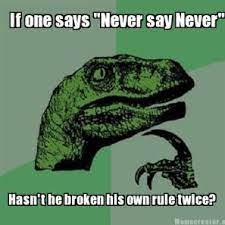
  1. Never say never or at least never say it too often. The older I get, the less absolutes I find in the world.  Absolutes create a paradox.  Never say never contradicts itself.  We must learn to live with paradoxes for though they may sound contradictory, and they are, they can still teach us something.  For instance, light has found to be both wave and particle.  How can this be?  See (25 Fascinating Paradox Examples.)  By the way, this statement teaches me to be careful when I say that I will never do something, or something can never happen.  Why constrain our lives by having too many “Nevers” in them?

download

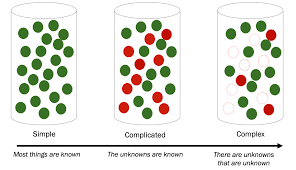
  1. The more you study something, the more complex it gets. My advisor in graduate school gave me this bit of wisdom.  I have also found that the older I get, the less I know.  I think this finding relates to the first thought.  We start out thinking about something and assuming it is very simple.  As we learn more about it, we find that it is much more complicated than we first thought.  The older we get the more things that this applies to.  Thus, the older I get, the less I know.

download (6)

  1. Oh, what a tangled web we weave when first we practice to deceive.  This bit of wisdom comes from an early nineteenth century Scottish author, Sir Walter Scott, a best-selling writer of novels, plays, and poems.  The quote is from Scott’s epic poem, “Marmion: A Tale of Flodden Field.”  A man pursues a complicated plot to attain the love of a rich woman.  He is unsuccessful.  This bit of advice can help lead us to the value of directness and honesty in our relations with others.  Any other path will usually lead us down a dark road that ends in despair.

images (2)

  1. Judge not others lest yea be judged yourself. It is not easy to live by this admonition.  Jesus himself was guilty of violating his own precept.  He judged the Pharisees and called them hypocrites and vipers.  In general, we are best lived by not judging others.  We will be happier contending with our own lives which will keep us pretty busy.  However, there are times when we must judge others.  For those times I offer the following three rules.
  • Judge frugally. Don’t be hasty to judge anyone
  • First look for other options to summary judgements
  • Always be open to other possibilities and that your initial judgement may be found wrong

download (7)

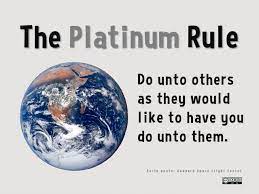
12.  Do unto others as THEY would have done unto them.  The traditional “Golden” rule says to do as You would have done unto you.  This is good advice except that it ignores the fact that THEY are not You.  It is much better to use what some have called the “Platinum” rule and do unto others as THEY would want to be done to them and not You.  In practice, I try to keep both rules in mind

I hope you find these ideas useful.  You should also look at the list of “Wisdom” books that follows and see how many of the 100 you have read.  I suspect none of us will have read all of them, but you should have read at least some of them.  Another thought I learned in business was not to reinvent the wheel.  There is no reason to create your own wisdom when there is so much great distilled wisdom already out there.

These books were identified as the best wisdom books in the world, based on recommendations from world experts, sales data, and millions of reader ratings

100 Best Wisdom Books of All Time

If you have any suggestions for other wisdom books or wise thoughts that you would like to share, please post them in my comments section. 


The Obesity Epidemic in the USA Meets the Drug Epidemic

191218155510-obesity-rates-by-state

Everyone knows or has heard that there is an epidemic of obesity in the USA.  The statistics are staggering.  The health problems associated with obesity are well known and cited often enough that if Tchaikovsky were alive, he would have written Symphony No. 7 in B Minor: Op. 74 “Obesity”“Physiologically, adolescents with obesity have an increased risk of developing adverse health outcomes such as type 2 diabetes, hypertension, elevated serum cholesterol and triglyceride levels, respiratory disorders such as asthma, and joint problems.”  — “Obesity Stigma and Bias

I was at a party in Prague over 25 years ago and I was approached by a younger woman who sat down next to me.  She promptly asked me, “Why are so many Americans overweight?”  I gave the usual uninformed answer and replied, “Because they are lazy and do not exercise enough.”  This was part of my belief system back then and is probably still shared by many Americans today.  Since that time, Karen and I have traveled to several other countries.  I think we are at about 43 now.  Over the past few travels, we have noticed that not only the USA, but many other countries are also suffering from the same “Epidemic of Obesity.”  If it is a psychological problem of motivation and willpower, than a whole bunch of countries are suffering from the same lack of motivation and willpower.

“Obesity is a complex physiologic condition influenced by genetics, hormones, sleep, environment, cultural norms, and economics.  The oversimplistic assumption that obesity is a choice and can be “fixed” by moving more and eating less is outdated and inaccurate in the current science of obesity.  Over the last 20 years, researchers have begun to shed light on the multifaceted complexity of obesity.”  — “Obesity Stigma and Bias”

images

I started thinking about this problem more recently after observing some of the children in my high school classes.  I am a substitute at three high schools in Casa Grande Arizona.  I noticed that many of the kids are overweight.  Back sixty years ago when I was in high school, there might have been one or two overweight children in the entire high school.  Today the statistics say that as of 2023, 1 in 5 children in the United States are obese, and this number is increasing yearly.  The rates of obesity are higher for Latino (43%) and Black (40%) youth. — Obesity or Oveweight Now Affect 1 In 3 Youth: How Experts Are Responding.

I wondered how these children deal with this problem.  Has obesity become acceptable?  We now have many stores with Plus Size clothes and there is an entire industry of “Plus Size Models.”  Do these children feel the weight stigma that is allegedly associated with obesity?  If they do feel it, how does it impact their socialization, personal image, and mental health?  Are they blamed for being overweight as much of the research suggests?

“As the rates of overweight and obesity rise, weight discrimination in America has increased by 66% over the past decade and is equivocal to racial discrimination.  Perceived provider weight discrimination often causes individuals with overweight and obesity to be reluctant to seek medical help, not only for weight reduction but also for any health-related problems…Bias against those with obesity appears to be socially acceptable and is reinforced by the media.  Mass media has stigmatized obese individuals.  A review of research over the past 15 years related to weight bias in media has reported that many media sources such as animated cartoons, movies, situational comedies, books, weight loss programming, news coverage, and YouTube videos have represented individuals who are overweight and obese in a stigmatizing manner.” —  Obesity Stigma and Bias

How Can We Help People with an Obesity Problem?

Someone once told me that we are either part of the solution or we are part of the problem.  I have noticed that I am part of the Obesity Problem.  I have looked many times at obese people and thought “They need to get out and exercise more.”  I have been less than empathetic to their problems and less than supportive of their physical and mental state.  I have not been helpful.

“Obesity stigma is characterized by prejudiced, stereotyped, and discriminatory views and actions towards people with obesity, often fueled by inaccurate ideas about the causes of obesity.  Despite decades of research supporting the dominant influence of genetic and environmental factors in the development of obesity, in the public consciousness, obesity continues to be viewed as a result of individual-level decision-making.”Obesity Stigma: Causes, Consequences, and Potential Solutions

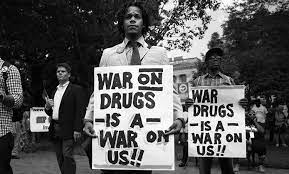
In my opinion, the health experts have not been very helpful nor have our politicians.  We allow many of the sources of the problem to continue to add fuel to the fire.  These include inappropriate media images, stereotypes of obese people, purveyors of low-quality high-fat junk foods, poverty conditions, lack of health education in poor and rural areas and overall a political system that almost totally ignores the “Epidemic of Poverty” but is more than happy to spend billions of dollars on any war against drugs.  Starting with the war on heroin, then the war on alcohol, the war on pot, the war on cocaine, the war on crack, the war on methamphetamine, the war on oxycodone and now the war on fentanyl, we spend billions of dollars on drug enforcement and drug incarceration for those convicted of selling the drugs.  How much do we spend on health education in our schools?

download (1)

“This summer, the war turned 52 years old.  It was June 1971 when President Richard Nixon declared drug abuse to be “public enemy No. 1” that required a “new all-out offensive” and additional government funding.

Since then, the country has spent more than a trillion dollars fighting drug use, according to some estimates.  That includes more than $39 billion the federal government spent last year alone, according to the Government Accountability Office. 

And, of course, illegal drugs and drug abuse are still very much with us.  In 2021, a Gallup Poll found 64% of Americans said the nation’s drug problem was “extremely serious” or “very serious,” though the primary scourge changes.  In the 1980s, cocaine and crack cocaine were the dominant stories.  In 1989, President George H.W. Bush held up a bag of crack cocaine during his first White House address and announced the war on drugs would be a primary focus of his time in office.” — Costs in the war on drugs continue to soar, NBC News

This article does not say anything about the costs spent fighting heroin or pot or alcohol long before some of these other drugs became “epidemic.”  I wonder what “prohibition” would have cost in today’s dollars?  As for health education, who has ever heard of a “War on Obesity.”  The obesity problem kills more people than drugs, but it would not benefit our economy to wage such a war.  “According to the National Institutes of Health, the obesity epidemic is responsible for an estimated 300,000 deaths per year.  The World Health Organization (WHO) estimates that at least 2.8 million people die from being overweight or obese each year.”  As for the comparison figures for the “Fentanyl Epidemic” the overdose death rate topped 112,000 in a 12-month period ending in December 2023 according to the Centers for Disease Control and Prevention.

download (2)You may wonder where I am going.  From obesity to drugs and back to obesity.  Well, what if the two epidemics are related?  What if there is not really two epidemics but one huge epidemic?  What if one is correlated with the other or what if one even causes the other?  Could the stigma of obesity lead to more drug use or could more drug use lead to more obesity?  What if all the money we spend on arresting drug users adversely impacts the health of poorer communities where most drug abusers seem to come from?  Is there any possibility that the two epidemics are related?  Consider the following:

“Since the declaration of the U.S. drug war, billions of dollars each year have been spent on drug enforcement and punishment because it was made a local, state, and federal priority.  For the past half century, the war on drugs has subjected millions to criminalization, incarceration, and lifelong criminal records, disrupting or altogether eliminating access to adequate resources and supports to live healthy lives.

Drug offences remain the leading cause of arrest in the nation; over 1.1 million drug-related arrests were made in 2020, and the majority were for personal possession alone.  Black people – who are 13% of the U.S. population – made up 24% of all drug arrests in 2020.”  — How the war on drugs impacts social determinants of health beyond the criminal legal system, published online 2022 Jul 19.

Do you think it is a coincidence that Black people suffer the highest rates of obesity in the USA and are also targeted the most for drug related offences?  It is much sexier to arrest, try and convict a person for a drug related offence than to work to change a system that systematically poisons people with unhealthy foods.  Our drug enforcement system keeps lawyers, police, and judges employed.  Our nutrition system if you can call it that employs millions of people to sell junk foods in fast food restaurants and grocery stores.  Obese people are part of a system that promotes obesity and drug use.  Make no mistake at that.  As my mentor Dr. Deming used to say, “Put a good person in a bad system and the system will win every time.” 

downloadWe need more than a drug war and more than health education to fix the ONE large epidemic in America.  We need to have a war on a callous system that condemns millions of people to prison and death all in the name of selling things.  Our purveyors of unhealthy foods are just as guilty of being “Drug Pushers” as anyone selling fentanyl in a back alley.  The only difference is that “Fruit Loop” cereal is legal and legally spends millions of dollars on advertising each year while fentanyl is illegal and unadvertised.


Mexico versus Canada: Immigration Issues:  What are the Differences?  — Part 1 of 4 Parts

border crisisIntroduction:

In the next few weeks, I am going to write a four-part series on Immigration.  I am going to use Canada and Mexico as contrasts to demonstrate some of the issues concerning Immigration.  Several years ago, I wrote a three-part series on Immigration policy.  I have not gone back to review the former series as I wanted this series to be new and current.  However, I strongly suspect that much of what I wrote about Immigration ten years ago would still be relevant today.  If you are truly interested in Immigration, you can find my former series at “Thinking about Immigration – Part 1: We Need a Fair Immigration Policy – Not an Anti-Immigration Policy!”

What are the differences between Mexico and Canada?  The most obvious difference is that Canada is North of the USA and Mexico is South.  There are other obvious differences.  The heritage of much of the population of Canada tends to be British and French.  The heritage of much of Mexico and Latin America tends to be Spanish.  Canadians speak mostly British, French, and sometimes American.  Mexicans speak mostly Spanish and sometimes Spanglish.  Canadians coming to the USA are usually Snowbirds and Mexicans and many Latin Americans come to the USA as Immigrants.  Canadian summers may still find icicles hanging from roofs while in winter some Mexicans are laying on the beach drinking Margaritas. 😊 That’s all for the obvious differences.

Before I speak to the subtle differences, you might be wondering where all this is going to take you.  Well, I hope to solve a question that occurred to me this morning while hiking in the desert.  I thought “Why is there so many rocks in the Sonoran desert and no sand?  Shouldn’t there be more sand if this is a desert?”  Not really the pertinent question but it was a thought in my feeble brain.  But I am taking you off on a tangent.  The more pertinent question that popped into my mind was “Why do Mexicans who come to the USA want to stay and Canadians usually want to go home?”

Many Mexicans and Latin Americans come as immigrants and Canadians come as Snowbirds.  Snowbirds go home.  Immigrants stay.  One obvious answer might be that many Mexicans feel a connection or heritage with the Southwest.  Much of the states that are part of the USA today were once part of Mexico until 1854 and the Gadsden Purchase ceded a large area of Mexico to the USA.  Many people living in Arizona have a family history that goes back hundreds of years, and many Mexican Americans have families that live just “South of the Border.”  This alone would make a large difference in a propensity to immigrate versus Snowbird.

canadian snowbirds

I thought “What if we could figure out why Canadians go home.  If we knew the answer to that question, perhaps we could figure out a way to get more Mexicans and Latin Americans to go home or not come here in the first place.”  This could greatly lessen the migrant problem at our Southern border.  Make no mistake, whether you are radical, liberal, progressive, conservative, Democrat or Republican, there is a humanitarian crisis going on in the USA.

Thousands of people come to our borders every day seeking asylum or a better life.  “The predominant reasons immigrants say they came to the U.S. are for better work and educational opportunities, a better future for their children, and more rights and freedoms.  Smaller but still sizable shares cite other factors such as joining family members or escaping unsafe or violent conditions.” (KFF.org).  Many of these people are unjustly accused of crimes or other deviances that we do not want in our country.  The poem on the Statue of Liberty reads in part:

download“Give me your tired, your poor,

Your huddled masses yearning to breathe free,

The wretched refuse of your teeming shore.

Send these, the homeless, tempest-tost to me,

I lift my lamp beside the golden door!”

Fine sounding words but simply words to many people in the USA.  Many Americans do not want ANY immigrants at all.  Many people feel that we have too many immigrants seeking to come to America.  No one that I am aware of in politics has ever addressed the issue of just how many immigrants can America absorb.  According to the 1900 census, the population of the United States was 76,212,168.  This was a 21.01% increase from the 1890 census, which recorded 62,979,766 people.  The 1900 census also found that 14% of the population, or about 10.4 million people, were born outside of the United States.  Today the population of the USA is close to 341,000,000 people.  If we said that we could absorb 14% of this number for Immigration that would mean almost 48,000,000 people would be immigrants.  Can our social structure and infrastructure really support this many people?

The main point that I made in my former series on Immigration was that we need a sensible Immigration policy and not an anti-Immigration policy.  I had a t-shirt made with this thought printed in Spanish on the back.  “Necesitamos una política de inmigración sensata y no una política anti-immigración.”  Many Americans would have agreed with this sentiment when I bought this shirt ten years ago.  Nevertheless, nothing substantial has been accomplished since then due to the partisanship of both political parties in the USA.

As I hiked my trail, I wondered more and more about the differences between Mexico and Canada.  Not the obvious differences, but the subtle unseen differences.  Differences like per capital income, infant death mortality, average life span, etc.  Could these differences explain why so many Mexicans and Latin Americans want to immigrate to the US?  The weather cannot be a factor since if it was the weather, we would expect to see millions of Canadians trying to sneak across our Northern border and apply for Immigration status.  Instead, they come for a short while, soak up the sun and go home, where they promptly put on their parkas and mukluks.  😊

I am going to write this series in four parts.  Part 1 is both an Introduction and what I will call a Narrative.  Part 2 will deal with what I call Fantasies and Illusions of Immigration.  Part 3 will deal with Immigration Facts.  This part will look at the demographics and socioeconomics of both Canada and Mexico.  Part 4 will deal with Lies or what the politicians say about Immigration to their constituents.  Throughout this series, I am going to contrast Mexico and Canada since they are both our neighbors and to date probably account for most of both the Immigration and snowbirds who arrive at our borders.  My main focus will be on the Immigration issue and to see whether or not the contrasts between the two countries can help us to focus on policies that will alleviate our current border crisis.

Narrative:

Karen and I have several friends who are either from Mexico or Canada.  I decided to ask a good friend from Acapulco who married a US citizen why she chose to stay in the USA and what she liked and disliked about the USA.  I will call her Margarita.  She has been living in the USA for over forty years now.  I also asked one of our Canadian friends (Emily) who has snow birded down to Arizona and the states for over twenty years what she liked and disliked about the USA.  Following are the replies from each of our friends.

Margarita:

Margarita was 26 years old when a frequent vacationing visitor from the USA to Acapulco fell in love with her.  They married and she moved from Mexico to Illinois with her husband.  They raised a family of three children in Illinois.  Margarita retired in Arizona after living in Illinois.  Margarita has become one of our best friends in Arizona.  She frequently drives down to Mexico and visits a variety of places where she donates food and other necessities to some of the needy in Mexico.  She is now in her 80’s and full of energy.  She is very well informed and active in her church and the local community.  The following is taken from an interview with Margarita by our good friend Socorro who is helping out with research for this blog.  Margarita was asked by Socorro what she liked about the USA and what she liked about Mexico and what she disliked about each country.

“I had a beautiful life in Mexico.  My family was close and loving.  My uncle had an orchestra, and we were invited to dances and parties.  By comparison, what I like now living in the United States, is that I can buy anything I want and need.  But I did face discrimination at first in Illinois.  We were criticized as the only Mexican family in town even though my husband was an American of Polish Slovakia descent.  I had to show what I could do for the city and prove myself.  The biggest project was fundraising for school band uniforms.  Then can you believe that I introduced people to food like tacos?”

Mexico has changed by her observations.  A nephew who came to the United States to work, and returned with the intent of forming a business was kidnapped and held for ransom.  Even though it was paid, he was killed by the crime cartel.  Her relatives don’t tell anyone that she lives in the United States for fear, that the same could happen to her when she comes to visit.

Her family has done well.  Margarita attributes her home and travels to her husband’s providing for her financially.  Her nephew who is a medical doctor wanted to come to the United States.  It seems that he needed what seemed like a million dollars to show his worth.  He made contacts in the medical community but is still an immigrant with Mexican credentials.  While Margarita has coverage for her health in Arizona, she prefers to go to Mexico for her dental work to save money.  So do many of her friends not only for a dentist but also for lower cost prescriptions.

Margarita is happy and healthy.  Her children have moved to California for their own lives and work.  She keeps busy with friends and church.  She sums it up by saying, “I’m happy because I’m a happy person.”

Emily:

Emily is from Canada and is in her early seventies.  She has been snow birding for over twenty years now to various places in the USA.  For the past eight years she has been coming down to Arizona.  Karen and Emily have a mutual interest in music and meet weekly to play dulcimers and ukeleles together.  I asked her to describe what she likes about the USA and what she dislikes.  The following is unedited and in her own words.

“Hi John, here you go!”

“The differences between our two countries are easily discernible on political, economic, and social platforms, but this old snowbird is going to address the question from a more personal perspective.

What do I like most about the United States?  I love exuberance, the open-hearted generosity of spirit.  Americans are the middle-schoolers of the world, in both the best and worst sense of that statement.  If it can be done, there’s an American somewhere doing it.  If it can be built, there’s an American building it.  You embrace challenges, and face obstacles with courage.  Individualism is applauded, encouraging self-expression.  You have an unshakeable confidence in your own abilities, a confidence that is usually tempered by time and life.  Visiting the United States is like a five-month trip to an amusement park, full of good times with friends, laughter, new experiences, colour, sparkles, loud music, and tasty food that isn’t good for us.

So why don’t I want to stay?  For all the reasons above.  Five months in an amusement park populated by middle-schoolers isn’t a comfortable lifestyle.

What do I like most about Canada.  If Americans are middle-schoolers, Canadians are middle agers, again, in all the best and worst of that statement.  When I return to my Canadian prairie home in the spring of each year, my shoulders relax, and my jaw unclenches.  I feel physically safer, emotionally less stressed, and strangely, more optimistic.  I embrace the sense of social responsibility that comes from living in the (gasp!) socialist environment of my home where poverty and illness are seen as circumstances, not character defects.  The reticence of middle-age is reflected in our more restrained social interactions.  I don’t know my neighbours’ political or religious affiliations.  Those aren’t the things that bring us together in laughter over the yard fences, and we’re all ok with that.  I like our differences; they show me the world through different lens.  Perhaps what I like best about Canada is a return to the natural world of my prairie home, the calm of big skies and open grasslands, the sense of belonging, of home.”

Conclusions:

Draw what you may from these two observations.  They are certainly not a random sample much less a stratified random sample of Canadians or Mexicans, but they provide some insights into at least two people who have experienced the USA in great depth.  Much like the evening news, such narratives may carry more weight with many people than the facts and figures that deal with statistics and demographics.  In Part 2, my next blog will deal with the Fantasies and Illusions of coming to the USA.

Who is Socorro Luna? The Friend that is helping me with this Blog

I am the “Good Friend Socorro” who is helping out with research for this blog as John Persico, PhD has written.

Moving from Arizona where I knew and worked with John, Karen, and Mexicans and Canadians to an unwilling retiring on the Texas border teeming with legal immigrants and illegal migration.

When John ruminated on the topic of immigration, I volunteered. My Mexican mother worked in El Paso, Texas where she decided to have all her children born. It’s where I came to visit my remaining living siblings and I haven’t left yet.

Before me in El Paso the immigration crisis unfolded: Walmart shooting, Venezolonos all over town, egregiously breaching in The Trump Border Wall reported on the nightly news, translating from English to Spanish referrals, taking necessities to refugee camps by my sister, brother, and me, conversing in English with Ukrainians, Chinese, Africans, Europeans, and seeing hundreds of relocating Afghans at the airport after I flew at night.

The upcoming series on immigration by John Persico is going to be another means of trouble shooting to improve a broken system.

Were the Good Old Days Really Happy Days?

download

Once upon a time there were the “Good Old Days.”  Now before you laugh or proclaim, “Oh No, not another Geezer gig;” allow me to issue some disclaimers.  First, If you are not at least 60 years old, you will not remember the “Good Old Days”.  The “Good Old Days” took place in the USA between 1954 and 1964.  They have also been called “The Happy Days.”  If you are under 60, you will be too young to remember these days.  Second, if you are an African American, you may not subscribe to my paean to “Happy Days”.  You will more than likely have had recurring experiences of overt racism in a country using Jim Crow laws to keep Blacks in their place and to put as many in prison as possible.

If you are Gay or LGBTQI+, you also may not remember these times very fondly.  Chances are you were forced to deny your sexual preferences and had to watch out on the streets for fear of being molested and assaulted.  If you are a woman, you might not remember these times very fondly either.  Back then, a woman’s place was said to be in the kitchen and her role was to be barefoot and pregnant.  There was no place for women in politics, business, military, or senior positions in any organization.  When it comes to other minorities, Jews, Latinos, Asians, Pacific Islanders, all would have stories of subtle and not so subtle discrimination during the “Good Old Days”.

But there is no denying that a large number of Americans do look back upon some of these days with a great deal of fondness.  I am one of them.  I do not tend to be overly nostalgic.  I do not spend much time looking back.  However, I have to admit, as a young White male during the period of time noted, life was not so bad.  The same was true for many older White men as well.  Even some of the groups excluded or ostracized by mainstream America during this period had a few exceptions.  People of color and other minority groups who may look back upon at least a few of these days with happy memories as well.

I was eight years old in 1954.  My age of innocence ended in 1964 along with many other young men who heard the Siren calls of war in Asia.  “Come save America from the Communists.  If you don’t stop them in Vietnam, before you know it, they will be in California.”  Kennedy was assassinated in 1963 and we put a man on the moon in 1969.  I joined the USAF in 1964 to save the USA from “Godless Communism.”  It would be another two years before I learned what is true of most wars.  They are waged by stupid people for stupid reasons and the people who suffer the most during these wars have the least to gain.

With these disclaimers out of the way, what are some good things that I remember about “My Good Old Days.”  Remember this is looking back and comparing the old days to the times I am now living in.  Some of these good things might not have been as good as I thought, but back then I was still in my “Days of Innocence” as well as in the my “Happy Days”.  Here is my list of good memories from the “Good Old Days:”

  1. Little evidence of environmental degradation
  2. No climate change
  3. Never heard of serial killers
  4. No worry about getting shot in school
  5. Plenty of snow during the winter to play in
  6. Water was drinkable everywhere and lakes were clean
  7. Floods and other natural disasters were much rarer
  8. I could walk to school by myself
  9. There were no anti-heroes only heroes
  10. Never heard of pedophiles
  11. I did not have to worry about a razor blade being put in an apple on Halloween
  12. Movies were 25 cents and candy was five and ten cents. Popcorn was 15 cents
  13. Gas was 21 cents per gallon and hamburger was 12 cents per pound
  14. Mom was home when I got out of school to make me a snack
  15. Lots of time to play sandlot ball on Saturdays with my friends
  16. The USA was in a brief period of peace between the end of the Korean War in 1953 and the ramp up of the Vietnam War in 1964
  17. We still had large family gatherings since people were not spread all over the globe or country
  18. We had bright starry nights since light pollution was not prevalent in many areas
  19. No concealed carry. You did not worry about being mowed down on the street by some maniac with a gun
  20. The Boy Scouts were still a respected group
  21. The really bad kids in school were those who chewed gum
  22. School bullying was uncommon
  23. Obesity was uncommon
  24. No such thing as road rage
  25. I could make a few bucks with a paper route
  26. The USA was at its peak of economic prominence. We were the major exporters of goods to the world
  27. Grid lock had not become common on our highways
  28. People were able to make a living on family farms and family fishing boats
  29. Speed limits were sensible
  30. Teachers, lawyers, and politicians were respected
  31. The average inflation rate in the United States between 1954 and 1964 was 1.37% per year
  32. Economic prosperity: The economy overall grew by 37% during the 1950s and unemployment remained low, about 4.5%.  At the end of the decade, the median American family had 30% more purchasing power than at the beginning.

Times have changed a bit.  No doubt you could make an even bigger list of good things going on today.  But there is no denying that once upon a time in a land called the USA, there was a set of days that for many people will never be forgotten.  For those of us who lived well during this period, we can’t deny our feelings of regret that so many of the things in my list have become shadows of the past.

Tell Me About the Good Old Days” by the Judds

Grandpa, tell me ’bout the good old days

Sometimes it feels like this world’s gone crazy

Grandpa, take me back to yesterday

When the line between right and wrong

Didn’t seem so hazy

Did lovers really fall in love to stay

And stand beside each other, come what may?

Was a promise really something people kept

Not just something they would say

Did families really bow their heads to pray?

Did daddies really never go away?


Whoa, whoa, grandpa, tell me ’bout the good old days

Grandpa, everything is changing fast

We call it progress, but I just don’t know

And grandpa, let’s wander back into the past

Then paint me the picture of long ago.

The Silence of the Damned by Chris Hedges


There is no effective health care system left in Gaza. Infants are dying. Children are having their limbs amputated without anesthesia. Thousands of cancer patients and those in need of dialysis lack treatment. The last cancer hospital in Gaza has ceased functioning. An estimated 50,000 pregnant women have no safe place to give birth. They undergo cesarean sections without anesthesia. Miscarriage rates are up 300 percent since the Israeli assault began. The wounded bleed to death. There is no sanitation or clean water. Hospitals have been bombed and shelled. Nasser Hospital, one of the last functioning hospitals in Gaza, is “near collapse.” Clinics, along with ambulances – 79 in Gaza and over 212 in the West Bank – have been destroyed. Some 400 doctors, nurses, medics and healthcare workers have been killed — more than the total of all healthcare workers killed in conflicts around the world combined since 2016. Over 100 more have been detained, interrogated, beaten and tortured, or disappeared by Israeli soldiers. 

Israeli soldiers routinely enter hospitals to carry out forced evacuations – on Wednesday troops entered al-Amal Hospital in Khan Younis and demanded doctors and displaced Palestinians leave – as well as round up detainees, including the wounded, sick and medical staff. On Tuesday, disguised as hospital workers and civilians, Israeli soldiers entered Jenin’s Ibn Sina Hospital in the West Bank and assassinated three Palestinians as they slept. 

The cuts to funding for the United Nations Relief and Works Agency for Palestine Refugees in the Near East (UNRWA) — collective punishment for the alleged involvement in the Oct. 7 attack of 12 its 13,000 UNRWA workers  —  will accelerate the horror, turning the attacks, starvation, lack of health care and spread of infectious diseases in Gaza into a tidal wave of death. 

The evidence-free charges, which include the accusation that 10 percent of all of UNRWA’s Gaza staff have ties to Islamist militant groups, appeared in the Wall Street Journal. The reporter, Carrie-Keller Lynn, served in the Israel Defense Forces (IDF). Given the numerous lies Israel has employed to justify its genocide, including “beheaded babies” and “mass rape,” it is reasonable to assume this may be another fabrication. 

The allegations, of which details remain scant, are apparently based on confessions by Palestinian detainees — most certainly after being beaten or tortured. These allegations were enough to see 18 countries including the U.S., Canada, U.K., Germany, France, Australia and Japan cut or delay funding to the vital U.N. agency. UNRWA is all that stands between the Palestinians in Gaza and famine. A handful of countries, including Ireland, Norway and Turkey, maintain their funding. 

Eight of the UNRWA employees accused of participating in the Oct. 7 attack in southern Israel, where 1,139 people were killed and 240 abducted, were fired. Two have been suspended. UNRWA has promised an investigation. They account for 0.04 percent of UNRWA’s staff. 

Israel is seeking to destroy not only Gaza’s health care system and infrastructure, but UNRWA which provides food and aid to 2 million Palestinians. The object is to make Gaza uninhabitable and ethnically cleanse the 2.3 million Palestinians in Gaza. Hundreds of thousands are already starving. Over 70 percent of the housing has been destroyed. More than 26,700 people have been killed and over 65,600 have been injured. Thousands are missing. Some 90 percent of Gaza’s pre-war population has been displaced, with many living in the open. Palestinians have been reduced to eating grass and drinking contaminated water.

Noga Arbell, a former Israeli foreign ministry official, during a discussion in the Israeli parliament on Jan. 4, stated: “It will be impossible to win the war if we do not destroy UNRWA, and this destruction must begin immediately.”

“UNRWA is an organization that perpetuates the problem of the Palestinian Refugees,” Prime Minister Benjamin Netanyahu said in 2018. “It also perpetuates the narrative of the so-called ‘right of return’ with the aim of eliminating the State of Israel, and therefore UNRWA must disappear.” An unnamed senior Israeli official praised the suspension of funding to UNRWA, but insisted on Wednesday gggthe government was not calling for its closure. 

More than 152 of UNRWA’s employees in Gaza — including school principals, teachers, health workers, a gynecologist, engineers, support staff and a psychologist — have been killed since the Israeli attacks began. Over 141 UNRWA facilities have been bombed into rubble. The death toll is the largest loss of staff during a conflict in the U.N.’s history.

The destruction of healthcare facilities and targeting of doctors, nurses, medics and staff is especially repugnant. It means the most vulnerable, the sick, infants, the wounded and elderly, and those who care for them, are often condemned to death. Palestinian doctors are pleading with doctors and medical organizations from around the world to decry the assault on the healthcare system and mobilize their institutions to protest. 

“The world must condemn the acts against medical professionals happening in Gaza,” writes the director of Al-Shifa hospital, Muhamad Abu Salmiya, who was arrested along with other medical personnel by the Israelis in November 2023 while evacuating with a World Health Organization (WHO) convoy, and who remains in custody. “This Correspondence is a call for every human being, all medical communities, and all health-care professionals around the world to call for these anti-hospital activities inside and around the hospitals to stop, which is a civilian obligation according to international law, the UN, and WHO.”

But these institutions — with a few notable exceptions such as The American Public Health Association that has called for a ceasefire — have either remained silent or, as with Dr. Matthew K. Wynia, the director of the Center for Bioethics and Humanities at the University of Colorado, attempted to justify Israeli war crimes. These doctors — who somehow find it acceptable that in Gaza a child is killed every 10 minutes on average — are accomplices to genocide and stand in violation of the Geneva Convention. They embrace death as a solution, not life. 

Robert Jay Lifton in his book “The Nazi Doctors: Medical Killing and the Psychology of Genocide” writes that “genocidal projects require the active participation of educated professionals — physicians, scientists, engineers, military leaders, lawyers, clergy, university professors and other teachers — who combine to create not only the technology of genocide but much of its ideological rationale, moral climate, and organizational process.”  A group of 100 Israeli doctors in November 2023 defended the bombing of hospitals in Gaza, claiming they were used as Hamas command centers, a charge Israel has been unable to verify. 

The deans of U.S. medical schools and leading medical organizations, especially the American Medical Association (AMA) have joined the ranks of universities, law schools, churches and the media to turn their backs on the Palestinians. The AMA shut down a debate on a ceasefire resolution among its members and has called for “medical neutrality,” although it abandoned “medical neutrality” to denounce Russia’s invasion of Ukraine.

There is a cost to denouncing this genocide, a cost they do not intend to pay. They fear being attacked. They fear destroying their careers. They fear losing funding. They fear a loss of status. They fear persecution. They fear social isolation. This fear makes them complicit. 

And what of those who do speak out? They are branded as antisemites and supporters of terrorism. George Washington University clinical psychology professor Lara Sheehi was pushed out of her job. The former head of Human Rights Watch, Kenneth Roth, was denied a fellowship at Harvard’s Carr Center for Human Rights Policy because of his alleged “anti-Israel bias.” San Francisco professor Rabab Abdulhadi was sued for supporting Palestinian rights. Shahd Abusalama was suspended from Sheffield Hallam University in the U.K after a vicious smear campaign, although the institution later settled her discrimination claim against it. Professor Jasbir Puar at Rutgers University is an ongoing target for the Israel lobby and endures constant harassment. Medical students and faculty in Canada face suspension or expulsion if they publicly criticize Israel. 
 
The danger is not only that the Israeli crimes are denounced. The danger, more importantly, is that the moral bankruptcy and cowardice of the institutions and their leaders are exposed. This brings me to Dr. Rupa Marya, a professor of medicine at the University of California, San Francisco (UCSF), whose call to halt bombing hospitals and to examine the impact of Zionism as a racist ideology unleashed a torrent of vitriolic attacks against her, attacks tacitly endorsed by the medical school where she works. 

She has been slandered as an antisemite and targeted by the Canary Mission, a Zionist organization that seeks to defame and destroy the careers of students and faculty that criticize Israel and defend Palestinian rights. She has had speaking engagements rescinded and received death threats and messages such as: “kill yourself you retarded grifting n*gger,” “Jew baiting c*nt,” and “White people are the greatest people on Earth. You know this.” 

You can see her statement on the campaign against her here. There is a striking contrast between the treatment of Dr. Marya and the physicians who cheer on the genocide. UCSF physician Matt Cooperberg, who is the Helen Diller Family Chair in Urology, ‘liked’ social media posts such as “REMOVE Palestinians FORM [sic] MAP” and a quote by former Israeli prime minister Golda Meir: “We are able to forgive the the [sic] arabs for killing our children. We are unable to forgive the arabs for forcing us to kill their children.”

“Cooperberg’s endowed chair comes from the Helen Diller Family Foundation, UCSF’s largest donor, which to date has gifted some $1.15 billion dollars to the health campus,” Marya writes. “In 2018, due to a mistake on a tax form, the Helen Diller Family Foundation was exposed as a funder of the Canary Mission. The Foundation attempted to erase its connection after this exposure.”  She goes on:

As a faculty member at UCSF, disgraced dermatologist Howard Maibach exposed and injected over 2,600 imprisoned Black and brown people with chemicals in experiments that echoed the experiments put on trial at the Doctors’ Trial just a few years before he went to medical school in Pennsylvania,” she goes on. “There he studied under Albert Kligman, who taught him how to exploit Black people for medical experimentation, documented extensively in the horror nonfiction book, Acres of Skin.  Maibach also advanced notions of racial differences in skin, furthering racist ideas from the pseudoscience of eugenics. Race is a social construct that enshrines supremacism. It is not a biological reality.

Most of Maibach’s experiments were conducted without informed consent, and while UCSF issued an apology, Maibach is still employed by the University of California. His family supports the Friends of the IDF, and he is represented by Alan Dershowitz, who also argued for the bombing of hospitals in Gaza. Dershowitz attempted to prevent me from speaking at the AMA’s first National Health Equity Grand Rounds, where scholar Harriet Washington, who studies medical experimentation on Black people, highlighted Maibach’s racist practices. In the wake of George Floyd’s murder, UCSF faculty, trainees and students of color brought Maibach’s story to light, and many have expressed their horror that they have to continue to sit in the same room as this man during Dermatology Grand Rounds. But the problem is not just one man. It is a system that allows someone with these values and actions to continue to be present in our learning and practicing community.

The dehumanization of Palestinians is lifted from the playbook of all settler colonial projects, including our own. This racism, where people of color are branded as “human animals,” is coded within the DNA of our institutions. It infects those chosen to lead these institutions. It lies at the core of our national identity. It is why the two ruling parties and the institutions that sustain them side with Israel. It feeds the perverted logic of funneling weapons and billions of dollars in support to Israel to sustain its occupation and genocide. 

History will not judge us kindly.  But it will revere those who, under siege, found the courage to say no. 

Share

The Chris Hedges Report is a reader-supported publication. To receive new posts and support my work, consider becoming a free or paid subscriber.

John’s Top Ten Almost Forgotten Great Movies – Part 2

John’s Top Ten Almost Forgotten Great Movies – Part 2

Here we are folks.  My Final Five in my list of “Top Ten Almost Forgotten Great Movies.”  As I did last week, I will briefly describe each movie and also explain what it was that appealed to me about the movie.  Why am I listing it as a “Great Movie?” Why do I think you would not be wasting an evening to watch this movie on Hulu or Amazon Prime or Netflix or perhaps find it on YouTube?  Even if you have seen these movies, any of them are well worth watching two or three times.  IMHO.

executive-suite-use-lakjdfklajs-e1632191516317

  1. Executive Suite – 1954

It is the early 50’s.  Some people would call this the era of “Happy Days” in America.  We were the kings of the world.  Europe, Asia, Russia were still recovering from the ravages of WW II. Africa was a developing country, and we were exploiting South America and the Mideast to get the oil and resources needed for our factories.  Our American economy dominated the world.  Everything was bought and sold in the USA except some cheap Japanese goods.

Deming was working with Japan under Mc Arthur to help them rebuild their economy.  He promised them that if they followed his methods of Quality and Statistical Process Control (SPC), they would come to dominate the world market in ten years.  Ten years was still far away by American standards.  Profit and mass production ruled the psyches of almost every major CEO in the USA.  Underneath the soft underbelly of our production-oriented economy was a split that was opening up that would destroy business as we knew it.  It was a split that Deming was aware of and tried to warn us about, but he was regarded as an old fogey who was behind the time.

This split was a battle between Quality and Quantity.  It involved a choice between getting it right or just getting it out the door as cheaply as possible.  Deming told companies that they could have mass production and also quality by using Statistical Process Control.  They laughed at him and as they tossed him out their doors, they told him

“That’s impossible.  You can’t have quality and quantity both as the same time.  We do not have time for SPC.  We only have time to make as many products as fast and as cheap as we can.  Our buyers are waiting for our products.” 

And that brings us to the “Executive Suite.”  The battle as seen by manufacturers between quality and quantity is the very plotline of the movie.  “Executive Suite” had what today would be known as an “ensemble cast.”  William Holden, Barbara Stanwyck, Frederic Marsh, June Alyson, Walter Pidgeon, Nina Foch, Shelley Winters, Dean Jagger, Tim Considine, Paul Douglas, and William Bouchey were just a few of the great actors that were in this movie.  The movie went on to be nominated for four Academy Awards at the 27th Academy Awards in 1955

The basic plot of Executive Suite is very simple.  The Tredway Corporation, once renowned for its fine products has fallen on hard times.  The CEO (Avery Bullard) has just died, and since he did not name a successor, his Board of Directors must elect a new CEO.  The company once known for its quality products has lost customers.  In his later years, Bullard had “Lost his way” in the words of his chief production engineer played by William Holden.

The Chief Financial Officer (CFO) played by Frederic March had helped the founder take the company down the road of cheap products to be mass produced.  William Holden described the Controller’s strategy as “fly specking” every penny to cut costs.  The battle for the CEO is waged in and out of the board room as prospective candidates try to enlist the aid of other board members for votes and proxy votes.  The actual battle comes down to quality or quantity.  This battle would play out in many board rooms across the USA from the fifties to the early eighties.  Who will win?

In real life America, cost cutting, and finance won out until the Japanese started “eating our lunch.”  By 1980, when NBC published its Special Report, “If Japan can why can’t we?”, thousands of US companies had lost market share to the emerging Japanese quality juggernaut.  I joined Process Management International in 1986 and met Dr. Deming at a seminar in San Francisco where I became one of his willing workers and acolytes.  Dr. Deming was sometimes called the “Father of Japanese Quality.”  The Deming Prize, (the highest award for quality in Japan) was named after Dr. Deming.  He was quite a thrill and inspiration to work with.

So, who or what will win out in this low-key but thrilling movie?  Watch it and see.

Cmw3mrxUsAA-wza

  1. Glengarry Glen Ross – 1992

The movie “Glengarry Glen Ross” was based on David Mamet’s 1984 Pulitzer Prize–winning play of the same name.  Mamet in my opinion is one of the greatest playwriters of all time.  He is also a filmmaker and author.     You will never go wrong watching a film based on his stories or plays.  They are always thought provoking and run against the grain of “action movies” and “shoot-em ups” that seem to dominate screens today.

Like “Executive Suite”, this movie also features an ensemble cast of some of the best Hollywood actors in history.  The cast includes:  Al Pacino, Jack Lemmon, Alec Baldwin, Alan Arkin, Ed Harris, Kevin Spacey, and Jonathan Pryce.  The film was a box office failure.  Nevertheless, many critics consider it one of the best movies of the 1990s.

Glengarry Glen Ross is about competition in the sales industry.  The setting is a real estate office.  The five salesmen are told by the sales manager Kevin Spacey, that a super salesman (Blake) from home office is coming down to “motivate” them.  Blake (Played by Alec Baldwin) rips the men apart in a no hold bars speech that questions their virility and masculinity.  He then tells them that only the top two closers will be kept on and the other men will be fired.  When challenged by the salesman Dave Moss (Played by Ed Harris) Blake says:

“And to answer your question, pal, why am I here?  I came here because Mitch and Murray asked me to.  They asked me for a favor.  I said the real favor, follow my advice and fire your fucking ass, because a loser is a loser!”

The dialogue in the film is often tough, raw, insulting, and difficult to listen to.  You feel sympathy for the men who must do anything to make a “close.”  “Closing” is making a sale.  If you have ever dealt with real estate salespeople, car salespeople or insurance salespeople, you know how tenuous their link to integrity can be.  In the “Ten Least Trusted Professions in America, three of the top ten include the professions I have noted above.  My experience with these three professions would certainly support their inclusion in the top ten.  The following comments in respect to the three professions noted are from Insider Monkey.

  1. Insurance Salesperson

“Insurance salespeople may face trust issues as they often demand potential hidden fees.  They are also blamed for misinterpretation of policies and tend to always prioritize their commissions. It is hence inevitable that such a behavior creates doubts about their transparency and customer-centric approach.”

  1. Used Car Salesperson

“Used car salespeople are distrusted due to their dishonesty, selling faulty vehicles, and pressure tactics. This creates skepticism about their integrity and the quality of their sales.  It is hence one of the least trusted professions in America.”

  1. Real Estate Agents

“Real estate agents are perceived to be responsible of potential conflicts of interest, commission-based motivations, and pressure to close deals quickly.  Some past instances of dishonest practices in the US have also contributed to this narrative of lack of trust.  Hence, it is one of the least trusted professions in America.”

The plot revolves around the efforts of the salespeople in this firm to obtain a set of leads which they hope will secure their jobs.  Politics, greed, and corruption become normal parts of their lives.  In a space of 24 hours, some of the men are willing to pull out all stops to keep their jobs.  The dialogue is hard rough edged street vernacular.  The men are victims of an exploitative capitalist system where getting a sale is more important than integrity.  A perfect reflection of art imitating life.  Every day we see examples of a system that rewards greed and perfidy and where lies and cheating are taken for granted.  You would probably not be surprised to find that Lawyers and Politicians are also in the top ten least trusted professions in America.  Ask yourself “What are they selling?”

national-ww2-museum-carmen-jones-film-screening

  1. Carmen Jones – 1954

This movie was a combination drama, romance and musical.  It was an Americanized remake of the Opera Carmen by George Bizet.  It had an all-Black cast that included some of the great African American actors and singers of the day.  Dorothy Dandridge, Harry Belafonte, Olga James, Pearl Bailey, Joe Adams, Diahann Carroll, Roy Glenn, and Brock Peters.  Some of the Tenor and Bass lyrics were dubbed in by African American singers like Marvin Hayes and LeVern Hutcherson.  Some of the Soprano lyrics were dubbed in by the wonderful Marilyn Horne who was White.

The screenplay by Harry Kleiner is based on the English lyrics and book by Oscar Hammerstein II, from the 1943 stage musical of the same name.  The original score from Carmen was in French.  The place setting for Carmen was Spain.  Escamillo was a bull fighter.  Don Jose was a soldier and Carmen was a Gypsy.  In the remake, Escamillo becomes a boxer named Husky Miller whose lyrics are dubbed in by Marvin Hayes.  Don Jose becomes Joe, a soldier played by Harry Belafonte whose lyrics are dubbed by LeVern Hutcherson.  Carmen becomes “Carmen Jones” a cigarette girl played by the uber sexy Dorothy Dandridge.  Dandridge’s lyrics were dubbed in by Marilyn Horne.

I love opera.  I grew up on an Italian neighborhood in Brooklyn, NY.  My father had all of Caruso’s 78’s.  People on my block sat outside on Saturday nights singing opera on their porches.  I loved listening to Enrico Caruso, Mario Lanza, Enzio Pinza, Giuseppe Di Stefano, Franco Corelli, Mario Del Monaco and much later Placido Domingo and of course Luciano Pavarotti.  Saturday afternoon was opera in the afternoon on the radio.  I always dreamed that if I was reincarnated, I would come back as a great Italian tenor.

“Carmen Jones”, whether you want to call it a movie or stage play, was still a tragic opera.  The handsome soldier Joe is engaged to be married to the sweet girl next door Cindy Lou, played by Olga James.  He is seduced by the cigarette girl Carmen and deserting his post runs off with her.  Tragic operas do not end “happily ever after.”  I will say not anymore about the plot.

Carmen is the “no good girl” that men lust for.  She lives for the moment.  She loves for the moment.  She seduces whoever takes her fancy for the moment.  She sings a famous aria, “The Habanera” in which she proclaims:

If you don’t love me, I love you

Beware

But if I love you, if I love you

Beware

The bird you thought you’d surprise

Flapped its wings and flew away.

I have seen some operas made into musicals like Madame Butterfly into Miss Saigon and La Boheme into Rent.  These were adapted for a modern audience and the lyrics translated into English.  I have never seen any as well done as Carmen into Carmen Jones.  The music and lyrics embody the essence of the original opera to a degree that I would not have thought possible.  For instance, in the Bizet Opera, Escamillo sings in the famous “Toreador Song”:

The bull goes, he comes

He comes and strikes again

By shaking his banderillas

Full of fury, he runs

The circus is full of blood.  

(The original lyrics are sung in French)

In Carmen Jones, Husky Miller the boxer sings “Stand up and Fight”:

Stan’ up an’ fight

until you hear de bell,

Stan’ toe to toe,

Trade blow fer blow,

Keep punchin’ till you

make yer punches tell,

Show dat crowd watcher know!

Until you hear dat bell,

Dat final bell,

Stan’ up an’ fight like hell!

The movie musical opera “Carmen Jones” has every bit of the drama, passion and musical quality of the original opera Carmen.  I will not say any more because I am very biased here.  Watch it when you have a chance.  Whether or not you love opera, if you love music, you will love Carmen Jones.

download (1)

  1. Captains Courageous – 1937

“Captains Courageous” is the story of a young, spoiled child who learns humility and compassion for others.  It is a sad but ultimately heart-warming story of the bonding between a rough immigrant sailor Manuel played by Spencer Tracy and a rich privileged child Harvey played by Freddie Bartholomew.  Again, another ensemble cast of great actors make up this film.  You may remember names like Lionel Barrymore, Melvyn Douglas, Mickey Rooney, John Carradine, Spencer Tracy and a then 13-year-old child actor named Freddie Bartholomew.  Freddie was nominated in 1999 as one of the 250 Greatest Male Screen Legends by the American Film Institute.

The film took twelve months to shoot and took place mostly at sea.  From a story by Rudyard Kipling, the plot revolves around the transformation of a young boy named Harvey played by Freddie Bartholomew.  He is picked up by a fishing boat after falling off his father’s yacht.  He demands to be returned immediately to his father.  The fishermen refuse since it is financially impossible for them to stop their work and just go looking for the brat’s father.  There is always the question of whether or not the boy is really telling the truth about his father being so rich.  He is put to work for the first time in his life with chores and responsibilities.  Freddie goes from spoiled brat to mature and responsible young man.

At first, he refuses to do any work, so they refuse to feed him.  In time, he begrudgingly starts to do the work assigned.  He is taken under the wing of the great Spencer Tracy who plays Manuel an itinerant fisherman.  They form a bond which is touching, and the end of the movie will bring tears to the eyes of even the most hardened cynic.  Spencer Tracy won the Academy Award for Best Actor for his work in this film.  The movie was also nominated for three other Academy Awards.  That is all I am going to say.  Go do yourself another favor and watch one of the great movies of all time.

download (2)

  1. 12 Angry Men – 1957

I can identify with this movie because I was a jury foreman in 1996.  Three months after the trial ended, I was hauled into court facing a possible charge of jury tampering.

“Appellant was convicted of disorderly conduct and acquitted of assault in the fifth degree.  Appellant moved to dismiss based on legally inconsistent verdicts.  The court denied appellant’s motion.  Prior to appellant’s sentencing, the court presented the parties with a copy of ‘Observations on Quality in the Courtroom: By a Juror,’ written by jury foreman Dr. John Persico, Jr., which alleged racial bias and misconduct by the jury.  Appellant moved for a new trial, but the motion was denied.” 

Minn. Stat. § 480A.08, subd. 3 (1996).

STATE OF MINNESOTA

IN COURT OF APPEALS

C9-97-1608

State of Minnesota,

Do I have to say it?  I am starting to sound repetitious.  It had an ensemble cast.  Awesome lineup of some of the best actors to ever step foot in Hollywood.  Some of the twelve jury members included Henry Fonda, Lee J. Cobb, Joseph Sweeney, Martin Balsam, Jack Klugman, E. G. Marshall, Jack Warden, and Ed Begley.  “12 Angry Men” is a 1957 American legal drama film directed by Sidney Lumet, adapted from a 1954 teleplay of the same name by Reginald Rose.

The film tells the story of a jury of 12 men as they deliberate the conviction or acquittal of a teenager charged with the murder of his father.  At first it appears that eleven of the jurors believe that the boy is guilty.  One holdout Juror 8 played by Henry Fonda still has a reasonable doubt.  His nemesis Juror 3, played by Lee J. Cobb angrily disagrees and becomes the antagonist to Fonda’s protagonist.  The battle for conviction between the two jurors finds the other jurors torn from one side to the other.  Evidence is presented.  Logic versus emotions creates rages in the jury room.  Not one juror can escape the heated arguments that ensue.  The conflict highlights the moral dilemmas that face all of us when we must decide the life or death of another human being.

“12 Angry Men” received acclaim from critics, despite a mediocre box office performance.  At the 30th Academy Awards, it was nominated for Best Picture, Best Director, and Best Screenplay.  It is regarded by many as one of the greatest films ever made.

If you have ever been on a jury, you may have some empathy for the “12 Angry Men” in this movie.  My jury misadventures helped me to see the strengths and weaknesses of the jury system.  A jury is only as good as the people on it.  But as Hubert Humphrey once said, “A democracy is a system that achieves extraordinary results with ordinary people.”  In the end, there will never be enough extraordinary people to make a difference.  We will always have to rely on the common man and common woman to keep our democratic system of government strong.

Conclusions:

 A great movie needs a stellar cast.  It needs a great script.  It needs a great screenplay.  It does not need people murdered or shot in one scene after another.  It does not need endless chase scenes.  It does not need grotesque scenes of people getting their bodies torn limb from limb.  Perhaps subtlety is a lost art.  One of the most moving and sad scenes I ever saw in a movie was from a Gary Cooper movie.  He arrives home after a band of Indians have attacked his home.  The house is in flames.  He goes looking for his wife.  He finds her on the other side of a rock fence.  You do not see her body.  You only see the look on his face.  It is heart breaking.  I get teary eyed just thinking about it.  You do not need to see her broken battered bloody body to know what happened to her.

That’s All for Now Folks! 

Leave a comment if you enjoyed my writeups or just go watch the movies. 

Previous Older Entries Next Newer Entries