The Seven Secrets of Everything: Part 2

Well, I feel much better this week.  My catheter was removed.  I am off pain killers and I am out walking at least once per day.  I can still not sit for too long but I want to stay on my schedule and publish one blog a week.  The mind needs exercise as well as the body when recovering from illness and this mental stimulation is essential to help me keep my spirits up.  I had felt some “why me” periods of depression this past week or two but I realize there is no answer.  I am truly starting a new beginning every day.  We are all starting “New beginnings every day”, a fact of life rather easy to say but often difficult to accept.

Here is the caveat with my Seven Secrets of Everything.  Like the New Year’s Resolution or the “Diet” to end all diets, the problem is often not with the solution but with the implementation.  Six weeks after New Year’s Day, the health clubs start to thin out as members realize that pounds don’t shed in weeks and muscles take work and not just desire.  The Seven Secrets of Everything are not simply constructs of the mind, nor of the heart.  They won’t do you one bit of good posted on your wall or inscribed someplace for you to peak at from time to time.  You must have a system and a program to help you follow these Secrets or they are simply worthless platitudes.  There is an old saying that goes “Pray to the Lord but row for the shore.”  Unless you ask yourself on a regular basis “How am I doing” and “What am I doing” to make these Secrets a reality, they will do you little good.  Strategy must have tactics and the key to any strategy lies in the effectiveness of implementation.  The Seven Secrets of Everything must become your strategy for living and you must develop an effective action plan to help make these Secrets a reality.  With the above caveats out of the way, let us look at each of my Seven Secrets of Everything.

1.  Aim high and plan to live for eternity. 

You have heard it said to aim high but I say aim for eternity.  Whether you are Buddhist, Hindu, Christian, Muslim or Atheist, what is the value of simply living like you are going to die someday?  I am not saying to deny death and I recognize the value of living “one day at a time” but I think these ideas are only stronger if you are not fixed on some earthy calendar of growing, living, aging and dying.  Who will live forever?  No one or perhaps all of us!  I submit it all depends on how you define living.  Some people do not live much of their lives because they live in fear of death each day.  Others like Martin Luther KingLuis Carlos GalanBetty Ann Olsen, Giovanni Falcone , Paolo BorsellinoMalala Yousafzai and Nelson Mandela, (to name only a few of the great people who have put their beliefs and ideals before their lives) all knew that death was imminent but life had to be focused on the future and not the past or even the present.

aimhighWhen I think about aiming high, two recent situations that exemplify this principle come to my mind.  One deals with the world of professional motorcycle racing and one with the world of chess.  In the world of motorcycle racing, Valentino Rossi is considered one of the greatest riders of all time.  He is one of the youngest champions of all time and has one of the best records for wins and podium appearances.  Nevertheless, it took him two years to win the World GP championship after he moved up to the elite class.  This year, a novice to the elite class named Marc Marquez became the youngest ever rider to clinch the premier class world title in Moto GP™.  Thanks to a truly amazing debut season, the 20-year-old from Cervera, Spain also becomes the first rookie premier class World Champion for 35 years.  When asked how come he had not accomplished this feat, Valentino replied: “I did not believe I could win the title the first year I entered the competition, Marc did.”  As high as the great Valentino Rossi aimed, Marc Marquez aimed even higher.  An African American man with the unlikely name of Barack Obama believed he could be President of the United States and he is.

This year in the world of chess, where the brainiest of the brainy and the highest mental geniuses all cavort, a young 22 year old Norwegian man named Magnus Carlsen beat 43 year old Viswanathan Anand of India to become the world chess champion.  Magnus now has a chess rating of 2872 which is the highest ever attained in the world of chess. This is even high than the rating attained by Garry Kasparov considered by many to be the greatest chess player of all time.  If you think you need age and years of experience to become a great chess player, consider the following fact:  On 1 January 2010, at the age of 19 years, 32 days, Magnus became the youngest chess player in history to be ranked world No. 1.  Consider the following comment by Magnus:

“Self-confidence is very important. If you don’t think you can win, you will take cowardly decisions in the crucial moments, out of sheer respect for your opponent.  You see the opportunity but also greater limitations than you should.  I have always believed in what I do on the chessboard, even when I had no objective reason to.  It is better to overestimate your prospects than underestimate them.” 

The First Secret of Everything has a Zen like quality to it:  Be realistic but aim high.  Live in the present but plan for eternity.  If you can grasp these dualities and see them as complimentary and not contradictory you will be able to practice the First Secret of Everything.

2.  Remember what Socrates, Buddha, Jesus, Mohammed, Lao Tzu and your mother always said. 

Can you listen to the wisdom of others and really understand it?  The Second Secret of Everything lies in realizing that the wisdom to live a good live surrounds us everywhere we turn.  We make a choice every second, every hour and every day whether or not to hear this wisdom and whether or not to act on it.  I went to a conference of educators a number of years ago with a few friends.  While we were presenting at the podium on the history of education, the ideas of Socrates and Plato were noted in this area.  Some of us were sitting in the audience and overheard a number of attendees inquiring as follows:  “Why are they talking about Socrates and Plato, they have been dead for centuries.”  We were astounded nee actually appalled that educators could not understand the relevance of what we were talking about because we used “old ideas.”

quote291012words-of-wisdomThe universe is showering you with advice and wisdom to help guide you to a better life.  Often we think we are smarter or that this wisdom does not apply to us.  After all, we are different and they lived in different circumstances or different times.  We fail to understand the universality of experiences that unite all of humanity through the ages and cultures both past and present.  Regardless of whether you were born in the Stone Age or the Jet Age, it is my bet that humans all evidenced similar emotions of fear, happiness, joy, love, revenge, concern, worry, depression and creativity.

There are many people who ask “WWJD” this translates “What would Jesus do?”  This is a simple but effective guide to living.  If you truly study Jesus and his disciples, read his gospels, read the entire New Testament and study it diligently, you will be in a good position to really know what Jesus would do.

I say don’t stop with Jesus. Read the Koran, read the Talmud, read Plato, read Aristotle.  Listen to your mother.  All of the great teachers had a love for humanity in common.  Thus, the great prophets have all tried to show us through love for humanity, a pathway to happiness and a joyous life.  Your mother loves you and wants the same thing for you.

I would look at the ideas from all of the various teachers as different perspectives on the world. You are no doubt familiar with the famous story of the Five Blind Men and the Elephant.  Each blind man had a perspective.  Each perspective gave a different view of the elephant.  Putting all of the perspectives together provides us with an even better view.  This is the job of living a good life.  To continue forever putting perspectives on living together to help guide us to a more fulfilled life.  The world is offering us a smorgasbord of perspectives to help us.  Some days we may find one thing useful and on another day we may find something else useful.  The wise person choices a variety and realizes that they cannot eat everything.  Next time we can try something else.  The foolish person ignores the bounty that is offered.  Likewise, many people ignore the advice of others.  I have one further caveat here.  Jesus, Buddha, Mohammed, Moses and Socrates are offering their advice for free and are not trying to sell you anything.

Beware the experts, gurus, talking heads, hucksters, professionals, and marketing types who will make you better, smarter, faster for a PRICE.  You should be suspicious of all ideas that you need to pay for.  Some might be valuable and some might not be.  However, like the treasure map that you can purchase in Arizona to guide you to the Lost Dutchman Gold Mine, it is very curious that none have yet found it.  My father always said “Believe nothing of what you hear and half of what you see.”  If you can incorporate my father’s advice when anyone tries to sell you something, you will be able to embrace the Zen like quality that is needed to truly implement my Second Secret of Everything.  There is a Zen poem that sums up this quality rather nicely:

“Before a person studies Zen, mountains are mountains and waters are waters; after a first glimpse into the truth of Zen, mountains are no longer mountains and waters are not waters; after enlightenment, mountains are once again mountains and waters once again waters.”

So study everyone, study everything.  When you think you know everything, you will really know nothing.  Once you realize that you truly know nothing, you will know everything.  This is the essence of the Second Secret of Everything.

In Part 3, I will describe the next three Secrets of Everything.

Time for Questions:

Do you aim low or high in your life?  Why?  What would your life be like if you aimed higher than you have in the past?  What would change for you?  How would your life be different if you knew you were going to live forever?  Why?  What would you change in your life if you could live forever?  Can you live in the present but also for eternity?  What would it take for you to accomplish this Zen like task?

Life is just beginning.

I was feeling for a short while right after my surgery, that life was just ending.  Pain really clouds the judgment.  However, thanks to God, friends, my spouse and modern medical science, I can truly say that “life is just beginning.”  All the reports indicate that I am cancer free and can thus live to die from something else. J
The Seven Secrets of Everything: Part 1

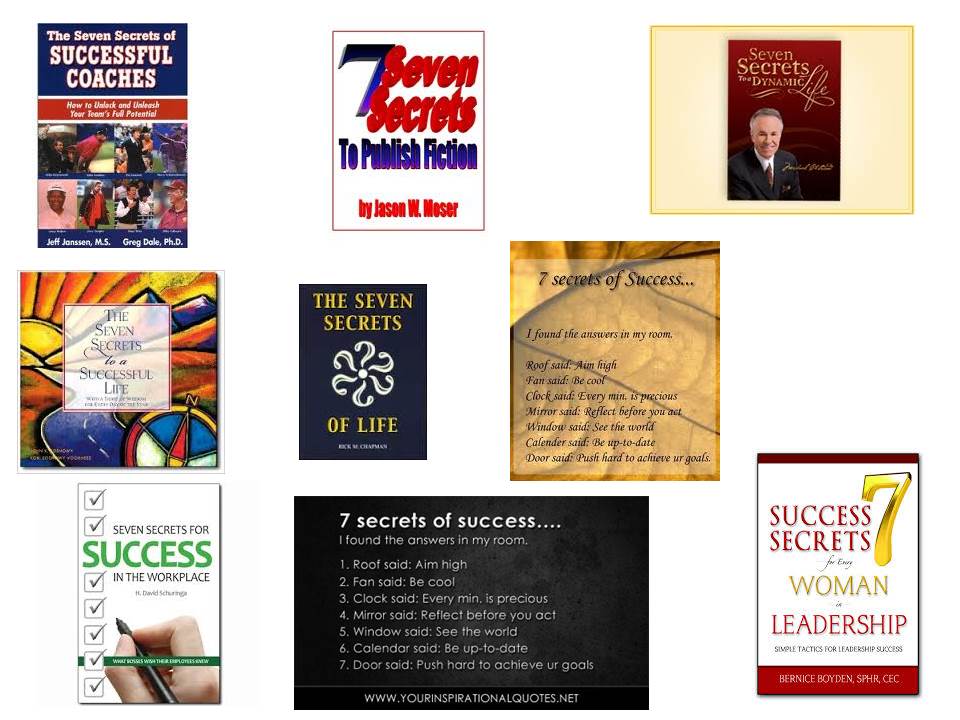
seven secrets cover pageI must apologize.  I know there are hundreds, perhaps thousands of books with “Seven Secrets” that you need to know for love, happiness, wealth, health or whatever.  Over the years, I have been amazed at the sheer volume of memoirs and self-help books that rely on the number seven to dispense their wisdom.  I remember learning in a psychology course, that the average person can remember seven unrelated items with the range being 5 to 9.  Statistically, we could say that five to nine defines a range of three (+/-)standard deviations within which 99.73 percent of a normal population will fall.  Practically speaking, this means that most human beings can remember between five to nine random numbers the ideal or mean being 7.

Thus having phone numbers, car license plates, or anything requiring memory retention based on the number seven makes a great deal of sense.  This also explains why there are so many books and writers who base their theories on the number Seven!  You did not really think that Seven of anything would suffice to provide you with success, wealth and happiness?  Not to mention happy polite children and a health regimen where you could eat whatever you want and not gain weight.  Of course, there is a multitude of “experts” trying to sell you their system who want you to believe that “Seven” is the magic number.

To explore the above hypothesis, I went to Amazon and typed in the following words in parentheses in the books section.  I then queried Google Search and tried them for results.  Below alongside the word pairs are the number of entries:

                                   Amazon Books            Google Search

  • Two secrets:              1,104                    212,000
  • Six secrets:                    597                    204,000
  • Seven secrets:           1,333                    1,090,000
  • Eight secrets:                 291                   43,000
  • Ten secrets:                   714                   211,000


You can clearly see that regardless of methods, “Seven Secrets” is by far the preferred theory.  On Google Search Seven Secrets was over 5 to 1 as numerous as any other combination.

Okay, so now that we have established the reason for and the importance of “Seven”, I will give you my list of Seven Secrets.  I call my list the Seven Secrets of Everything for the simple reason that my Seven Secrets will give you all the abilities, skills and talents that you need to know in life.  The other lists will be helpful when it comes to specifics.  However, my Seven Secrets are the keys to unlocking all the other Secrets that those more well-known authors (Covey et. al) and pundits will be trying to sell you.

My secrets are the keys to “Everything.”  Like Tolkien’s “One Ring to Bind them All,” my secrets are the keys to unlocking the power of all the other secrets in the universe.  Whether you are trying to overcome divorce, build a new business, find a life partner, relocate to another climate or simply find the best recipes on the web, my secrets will guide you to Total Personal Satisfaction in whatever you do 100 percent of the time.  And here is the best part of all.

Unlike other authors, writers, philosophers and lecturers, I will give you mine for free and I also promise that you will never be asked for an endorsement or any follow-up purchases.  I also promise not to bombard you with advertisements, send you text messages or spam email.  I also promise that I will not do any product related endorsements to compromise the value of my Seven Secrets of Everything.  You only get a deal like this once in a life-time so read on for the Seven Secrets of Everything.

Well, I have a confession to make before we go any further.  On Wednesday of this week, I had Prostate surgery and spent most of Wednesday (Jan 22) and Thursday at the Mayo Clinic in Scottsdale.  No, I did not forget the Seven Secrets of Everything, but I am home now spending most of my time in bed.  I noticed while writing this blog, that at the point of sitting for about one hour, I was hurting and tired.  Thus, I have decided to do this blog in two parts.  Next blog, I promise I will share my Seven Secrets of Everything with you and give you some good solid reasons for believing in these secrets.  For now, I will go back to bed, rest and write some more later.  Thanks for your patience.

Time for Questions:

Do you have a favorite list of Secrets?  How many Secrets do you practice or follow?  Why?  Would you share your List of Secrets with us in the comments section?  Can we really reduce life to Seven of anything?  Can these lists be helpful to guide us to more success and happiness?

Life is just beginning.

One of my physicians called me on Friday (Jan 24) to say that the lab results suggest they were able to get most of the cancer and that it had not spread out of my prostate.  Thus, I am minus one prostate, but also minus one cancer.  It was probably a good tradeoff and certainly an apt way to continue living the beginning of my life.

How do I know what to believe?

Lost and Confused SignpostMark Twain once said that there are two types of people, those who read the newspaper and those who don’t.  About these two types he said the following:

“If you don’t read the newspaper, you’re uninformed. If you read the newspaper, you’re mis-informed.”

Therein lays the dilemma of the 21st Century.  We are surrounded by Big Data.  Everywhere we look we find facts, opinions, statistics, surveys, scientific studies, research and think tanks.  The airwaves bring us 24/7 talking heads, academic experts, on-the-spot journalists, interviews with eye-witnesses, interviews with people who were standing nearby, interviews with relatives, interviews with friends, interviews with deceased friends. J  Anyone who might have remotely known anything about the subject or situation will be brought in to give their opinion.  Eventually, some of these opinions, facts, experiences, experts etc. will produce a book, or documentary on the subject.  In this morass of information, how can we sift the truth from the lies?  How do we know what or who we can trust?  How do we know what to believe?

Just for a factoid:  I went into the advanced search on Amazon Books and typed O. J. Simpson into the “Keywords” and then selected “Biographies” under subject.  There were 1,769 books written about O. J. Simpson by friends, relatives, acquaintances and hanger-on’s.  Of course, even Simpson got into the act with a few books.   Perhaps one book no one should miss is the one written by O. J’s dog (named Kato D’ Akita).  The book blurb promises:

“Kato, the proud, purebred Akita dog, has steadfastly maintained his silence over what he saw on the terrible night of the killings of Nicole Brown Simpson, former wife of O.J. Simpson, and Ron Goldman.  Now, lured by a multi-million dog-bone advance, Kato barks out what REALLY happened on that windy night outside the home of Nicole.  Kato also comments bitterly on the human foibles he saw going on around him-the aimless sexual couplings, the fervid rush to golf on Sunday morning, which Kato thought was a religious service, and the many women friends that O.J. juggled in the months leading up to the killings.”

The author of this book no doubt wanted to inject a little levity into the morass of books written about O. J. Simpson and his trial.

How do we know what to believe?  How do we know who to believe?  Do even dogs tell the truth these days?   A number of years ago, I came across a philosophy text which described four ways by which humans try to discern the truth and find answers to the questions of the universe.  Since then, I have found other writers and philosophers who describe anywhere from one to ten ways of knowing what is true.  These include the following:

  • Emotion
  • Faith
  • Imagination
  • Authority
  • Intuition
  • Language
  • Memory
  • Reason
  • Tradition
  • Empiricism/sensory data/experience

 The majority of experts on the subject usually list four major ways of knowing as:

  1. Empiricism/experience
  2. Reason
  3. Authority
  4. Intuition

To this list I would also include Tradition as an important method that is often used by people to find out what or who to believe.  Thus, for the purposes of this blog, I will talk about Five Methods of Knowing or Believing.  These will include:

  1. Empiricism/experience
  2. Reason
  3. Authority
  4. Intuition
  5. Tradition

Each method has pro’s and con’s.  No one method is full proof.  Each has disadvantages and advantages.  Making our task more difficult is the fact that the various methods are relatively independent.  You cannot just take and blend each or mix and match each and get a stronger result.  If you accept Authority as your mode of believing, you may be relatively immune to other modes of knowing such as Experience or Reason.   For instance, many Catholics believe that the Pope is infallible and thus accept what he says as the “Truth.”  Appeals to Reason or Tradition will have little impact on a Catholic who is convinced that the Pope is infallible.  Many people listen to Rush Limbaugh each week and take what he and other talk show hosts say as the 100 percent bona-fide truth.  Appeals to scientific research or logic will make little difference to these devotees of radio talk shows

A good question which I have ignored up to this point is; are knowing and believing the same?   Or we could put it another way, what is the difference, if any, between knowing and believing?  Endless debates could ensue over this question and its ideological distinctions.  I think that in order to believe something I must first “know” it.  However, I can know something without believing it.  For instance, my sister tells me that she has won the lottery.  I now know that she thinks she has won the lottery, but my natural skepticism stops me from believing it.  Believing anyone’s assertions rests on either being able to validate their assertions or simply trusting in what they say.  If I am unwilling to do either, then belief remains absent.  That is because belief carries with it the assumption of validation or trust that I have noted above.  Thus belief must follow knowing but knowing does not necessitate belief.

I can of course be wrong in my beliefs if my assumptions about what I think I know are wrong.  Thus, if I trust in the wrong authority or wrong facts or any of the various ways of knowing are compromised by errors or fallacies then I can come to believe the wrong things.  This is a very important observation because it is the foundation for errors, arguments and illegitimate conclusions.  If I trust the wrong method of knowing or if my method of knowing is somehow compromised by errors or bias, then my set of beliefs can be 100 percent wrong.  Now let us examine each way of knowing in some detail to see why no single way is infallible and that there are pros and cons to each way of knowing.

1.  Empiricism/Experience. 

I put my hand in the fire and it hurt, I won’t do that again.  I trusted you and you cheated on me, I won’t trust anyone again.  I lost a lot of money playing the slot machines and I won’t be gambling ever again.  Many say experience is the best teacher.  Dr. W. E. Deming always said “Experience without theory teaches nothing.”  Many managers have subscribed to a management theory called MBWA, or Management by Walking Around.  Others have called this, Management by Wandering Around.  Dr. Deming always said, if you don’t have a theory you are just bothering your employees by your MBWA.

Some say “experience is the best teacher.”  However as with all modes of knowing, there are pros and cons.  You cannot experience all life has to offer and some experiences may very well kill you.  You can learn a great deal from your experiences if you survive and if as Deming notes, you find the proper theory to address your experience.  However, experiences can become roadblocks to learning and growing if they imprint indelible memories on your mind that you are unwilling to challenge or go beyond.  Stereotypes and biases are generally rooted in limited experiences and eventually dominate our thoughts and behaviors.  Racism, homophobia, sexism and many other prejudices may grow out of a limited set of experiences that we then extrapolate to the whole world.

2.      Reason/Logic/Science

Spock would have said that the only way of knowing is by logic, reason and facts.  You put 1+1 together and it equals 2.  You make deductions from evidence that lead to incontrovertible truths.  Scientific studies, research and data point the way to absolute knowledge or do they?  In a day when one study contradicts another study, when one scientist disputes another scientist and when research findings continually reverse themselves, can we really rely on facts, evidence and scientific research to point out the truth?  Obviously, much of the public does not.  Intellectuals, professors and scientists are held in pretty low esteem by a large section of the population.   Few believe the pronouncements from the Olympic heights of the University Ivory Towers and can you blame them?   One day eggs are bad for you, the next day they are good.  One day cholesterol is bad, the next day it’s good.  One day, large amounts of protein are good for you and the next day, you need to eat more carbohydrates.

It has been said that man is a rational animal. All my life I have been searching for evidence which could support this.”  — Bertrand Russell

The rational man has often been considered the epitome of humanity, the individual who can divorce emotions from reason and make judgments based on logic and not feeling.  There are many jokes about our inability to do this, but the value is still extolled of reason and logic over emotion and feeling.  The problem lies in the underlying assumptions that govern the final product.  For instance, a jury is supposed to base its decision on logic and facts, but its facts are limited and sometimes fallible.  All science and research is based on a limited set of facts which have varying degrees of reliability and validity.

The precision of our judgments notwithstanding, they are often based on inputs of dubious reliability.   Take any recent court case that you can think of and you will find that the truth is never as simple as it seems at first.  Furthermore, one has only a limited time frame in which to uncover and study any facts.  There is never enough time to study all the facts that could potentially be uncovered and there is never enough time to study the facts that are uncovered.  We live in a world limited by the dimension of time.  While the constitution promises any accused the right to a speedy and impartial trial, the notion of speedy can be counterproductive to finding the truth.  The idea of impartial is a fiction that exists only in the ideal.  Finding a scientist, jury, doctor or lawyer that is impartial would be like finding a needle lost in the galaxies.

Facts, logic and reason have the virtue of objectivity and exclusion of emotions.  However, they are limited by factors of bias, time, quality of research and validity of data.  No perfect data set exists and no perfect human exists to interpret such a data set even if it did exist.  The individual who would strictly base their beliefs on science and data would be no further ahead than the individual who relied solely on intuition or authority.

3.     Authority

God told me that’s how I know.  The Pope is infallible so he can’t be wrong.  Rush Limbaugh always tells the truth.  My country right or wrong!   Unthinking fealty?  Unthinking  patriotism?   But if you can’t trust the President, who can you believe?  Why would God lie to me?  Who should I believe if not the Pope?

We elect, promote, hire and support “higher authorities” as our leaders because we are willing to suspend our belief in ourselves and hope that someone else out there might be closer to the truth than we are.  In essence, we transfer our faith in ourselves to a faith in others.  The pros of this position lay in the recognition that we do not have all the answers and that there are many others out there who have a better chance of grasping the truth than we do.  If you can’t believe God, who can you believe?

On the other hand, the world is full of uninformed, misinformed and simply mistaken people.  Many of them are in positions of authority.  Authorities are often no less biased than anyone else.  Politicians all have an ax to grind or they would not be in politics.  If you think the President or the Pope has all the answers, you must believe that they as human beings are infallible and omnipotent.  Since most Presidents and Popes are now buried, the statistics would seem to support their more mundane alliance with humanity.   A humanity that is often prejudiced, wrong and unenlightened.

God however is another story.  By some definitions, God is simply “Omniscience.”   By such a definition, God would have to know everything.  Even if we accept this idea, there is still a problem with the “Truth” received from God.  The problem however does not lie with God the Omniscient Speaker but Man the Receiver.  As any communications course will teach you, there is always a great deal of static between a speaker and a receiver.  God is the speaker and humans the receivers.  Humans do not always hear things clearly.  There is also the element of cognitive bias that all human receivers add to any intended message.  Thus, if God were speaking to you, you would have two basic problems:

  1.  Was his message distorted?   Did you hear him clearly?
  2. How do you interpret his message?  Is it really unambiguous or are you biasing his message with your own preconceptions?

Those who claim to have infallible information from God concerning “Truth: have an obligation to satisfy the above two constraints before expecting the rest of the world to truly believe that they know what God wants.

“If one has all the answers to all the questions, that is the proof that God is not with him.” — Pope Francis

4.     Intuition

Some people claim to know things by gut feeling or instinct.  In addition to our five senses which give us data about the world, many people believe in a sixth sense which they feel communicates information about the world to them.  This information does not take place in any visible manner and thus many people remain skeptical about intuition and other metaphysical ways of knowing such as telepathy and clairvoyance.

“Intuition provides us with views, understandings, judgments, or beliefs that we cannot in every case empirically verify or rationally justify.  For this reason, it has been not only a subject of study in psychology, but also a topic of interest in various religions and esoteric domains, as well as a common subject of New Age writings. The right brain is popularly associated with intuitive processes such as aesthetic or generally creative abilities. Some scientists have contended that intuition is associated with innovation in scientific discovery.”  —- Wikipedia

The pros of intuition as a means of knowing include the possibility of knowing things that sense data or facts and empirical evidence cannot demonstrate.  Given the limits to science and observation as ways of knowing, this single pro is extraordinarily alluring and powerful.  There are those who seem to rely almost exclusively on intuition as a means of knowing.  The dangers to such reliance are prodigious.  For instance, what if everyone simply chose to believe what their intuition told them to believe?  How many people would accept ideas and actions that the rest of the world had no way to validate or verify?  If trust is a precursor to believing and knowing, then any knowledge based on intuition would simply assume that everyone must trust everyone else.  My intuition would be as valid as your intuition.  Standards, common facts and most of science would be rendered useless since all knowing is now personal and subjective.

5.     Tradition

My fifth method of knowing comes from an article that I read many years ago in a philosophy book on ways of knowing.  The author included four ways of knowing and one of these was tradition.  I feel that if we are going to limit the discussion to the “most” important or most common ways of knowing that Tradition belongs in our list.

Whenever I think of the word tradition, I hear refrains from Fiddler on the Roof (Hyperlinked to the song here)

Who, day and night, must scramble for a living,
Feed a wife and children, say his daily prayers?
And who has the right, as master of the house,
To have the final word at home?
The Papa, the Papa!  Tradition.

Tradition has been relied upon for centuries as a way of knowing and believing.  In many societies, the methods of living, loving and dying have been predicated on centuries old ways of doing things that have been passed down from one generation to the next.   When Tevye says “You may ask, how did these traditions get started?”  He replies:  “I’ll tell you.  I don’t know.”  Such is the way of tradition that the basis for most traditions becomes lost in antiquity.  No one knows or really cares how the tradition got started.

The pros of tradition as a means of knowing depend on its robustness and resiliency.  Any means of knowing that can pass down useful knowledge for centuries is extraordinarily powerful.  Stories, metaphors, tales, custom and habits become enshrined as the way things are done.  They are the way they have always been done and these methods may have worked for decades, centuries or perhaps millenniums.  Few could dispute the value of such traditions.

Conversely, traditions can become strictures that strangle growth and progress.  “We have always done it that way” can be an excuse for a failure to find new ways or better ways of doing things.  Progress depends to a large extent on ignoring or even flaunting traditions.   You cannot go into the future with one foot still stuck in the past.  How do we know what traditions to let go of and what traditions to hold onto becomes a major cultural dilemma?  No simple formulas or answers exist to guide one through the maze.  In many ways, the disagreements between liberals and conservatives all pivot around this central question.  Liberals tend to want progress and to want to let go of the past, while conservatives want to hold onto traditions and time honored protocols.

Ut cognoscatis et credatis

All humanity is on a never ending quest for meaning in life.  We dispute our ideas of meaning based on what we perceive, what we know and what we believe.  Ideology is the basis for all disputes and dissension in the world.  What I know and believe is not consistent with your views.  What actions I take are based on my knowledge and beliefs about the world.  When these are in conflict with what others perceive as truth and knowledge, the outcome is often violence.  Humans cannot change their very nature but they can change the basis upon which they make their decisions and judgments.  The basis for truth and believing can be altered and reconsidered.  No one has to rely only on one means of knowing or perceiving the world.

In fact, anyone who does rely only on one means of knowing and believing is like someone who uses only one sense to perceive the world.  IF we have eyes, ears and nose, we use them all to guide us in the world.  It only makes sense to use as many modes of knowing as we can before we make a decision.  Furthermore, it must be understood and accepted that no single mode is infallible.  No single mode leads unalterably to the truth.  No single mode will always be right.  No single mode is perfect.

The wise person will ask themselves what and how have they arrived at their version of the truth?  What mode has informed their opinion?  Would other modes lead to different assumptions and different truths?  What biases exist in their ways of knowing?

Socrates had one day asked the Oracle at Delphi who was the wisest man alive and the Oracle had proclaimed that Socrates was.  Socrates could not accept this because he realized and accepted that he was mostly ignorant about the world.  So Socrates decided he would try and find out if anyone knew what was truly worthwhile in life, because anyone who knew that would surely be wiser than him.  He set about questioning everyone he could find, but no one could give him a satisfactory answer.  Instead they all pretended to know something they clearly did not.

Finally he realized that the Oracle might be right after all.  He was the wisest man alive because he alone was prepared to admit his own ignorance rather than pretend to know something he did not.

“The scientist is not a person who gives the right answers, he’s one who asks the right questions.”  ― Claude Lévi-Strauss

An excellent summary of the pros and cons of four of the above ways of knowing can be found at:  WAYS OF KNOWING,  a handout for use with chaplaincy research students — Chaplain John Ehman

Time for Questions:

What do you know?  How do you know things?  What is your preferred mode of knowing?  Do you ever rely on other modes for your truths about the world?  Which others do you use?  What do you think are the pros and cons of your modes of knowing?  What other modes could you use?  What stops you from using them?  Are you relying too much on one mode and ignoring other possible ways of knowing?  Are you too sure of your truths?  Are you the wisest man/woman in the world?

Life is just beginning.

How Could Life Be So Unfair or Why Did Richard Cory Get All the Luck?

Image

I curse the day I was born.  I curse my father.  I curse my mother.  I curse my sisters and I curse my brother.

   Oh, I wish that I could be, 

Oh, I wish that I could be

Richard Cory.

 I curse the life I am living.  I curse my name.  I curse my shame.  I curse the day I came.

 Oh, I wish that I could be,

Oh, I wish that I could be

Richard Cory.

 I curse my poverty.  I curse my mediocrity.  I curse my inability.  I curse my fate and my biology.

 Oh, I wish that I could be,

Oh, I wish that I could be

Richard Cory.

 No doubt many of you will know Richard Cory.  For those who don’t know him formally, I am sure you know him personally.  He is that person we all want to be.  He is rich, famous and good looking.  He is popular, likable and a wonderful human.  He is on everyone’s list of most:  most eligible, most likely to succeed, most likely to be president, most likely to be remembered.  We all know a Richard Cory.  We all have someone we dream we could change places with.

The papers print his picture almost everywhere he goes: 
Richard Cory at the opera, Richard Cory at a show. 
And the rumor of his parties and the orgies on his yacht! 
Oh, he surely must be happy with everything he’s got.

Oh, I wish that I could be, 

Oh, I wish that I could be

Richard Cory.

Why did God forget me?  Why was I not born wonderful, magical and fantastic?  Why does everyone else get the breaks?  What does he/she have that I don’t have?  Why couldn’t I be rich?  How come I am not famous?

 Oh, I wish that I could be, 

Oh, I wish that I could be 

Richard Cory.

Life’s not fair.  It has never been fair.  What did I do to deserve this kind of a life?  Why did I get a bunch of losers for friends and relatives?  If only things had been different.  I never had a chance.  It’s not right.  Everybody was always picking on me.  Even Mom and Dad never really liked me.  I hate everyone.  If only I could start my life over again.  Things would be different.

I curse the heavens above.  I curse the purgatory where I may go.  I curse the hells below.  I curse the places that might exist but none alive will ever know.

 Oh, I wish that I could be, 

Oh, I wish that I could be 

Richard Cory.

 What might I have been if things had worked out differently?  Where did I go wrong?  Why did fate deal me a stacked deck?  Why did so many bad things happen to me?  Why Lord? Why?  Why did thou hate me so much?

 Oh, I wish that I could be, 

Oh, I wish that I could be

Richard Cory.

Maybe you know how this story ends?  I worked in Richard Cory’s factory.  I had a wife who loved me and three young children who grew up healthy and happy.  I lived to a ripe old age.  I died in my sleep one night surrounded by my loved ones and several good friends.  I was never rich in material things but I was blessed with an abundance of spiritual goods.  I did not realize how many blessings I had until the angel took my hand to take me away.  I tried to speak out then and bless everyone for being so kind and loving to me, but it was too late.  The angel said that it was always that way with humans.  We think everyone has it better than us and that the grass is always greener next door.  I only wish I knew then what I know now.  I hope it’s not too late for you.

And he was rich – yes, richer than a king –

And admirably schooled in every grace:

In fine, we thought that he was everything

To make us wish that we were in his place.

So on we worked, and waited for the light,
And went without the meat, and cursed the bread;
And Richard Cory, one calm summer night,
Went home and put a bullet through his head. 

Some of the lyrics above are taken from Simon and Garfunkel’s Richard Cory, while some are taken from the poem “Richard Cory” by the original writer Edwin Arlington Robinson.  This poem was published in 1897.  The lyrics in the song differ from the lyrics in the poem. 

 Time for Questions:

Why did Richard Cory kill himself?  Do you ever covet your neighbor’s wife?  Why?  Have you ever cursed the life you have?  Why?  What blessings have you been given that you most commonly ignore or take for granted?  Why?  Are you happy?  Why or why not?  If not, what would make you happy?

Life is just beginning.

Who Cares About the Sun or How I learned to Love the Sun.

Here comes the Sun, here comes the Sun —- The Beatles, 1969
And I say it’s all right

Image

I am somewhat perplexed and sad.  The moon, the stars and the planets all seem to get a great deal of attention but the Sun is neglected.  There are many more songs, poems and stories about the moon and stars but much fewer about the Sun.  Why the moon should take precedence over the Sun is beyond my understanding.  If the moon suddenly left orbit and when sailing off into space, I am sure many of us would be very sad.  I for one would undoubtedly miss the moon.  I enjoy those evenings when there is a harvest moon and it fills the sky with its bright orange and yellow colors.  I also enjoy the full moon and the many phases it goes through weekly to come back to full again.

However, if the Sun flew off its orbit, or left its position, since I think it does not orbit.  (Last I remember reading; most scientists had agreed that the earth rotated around the Sun and not vice versa.)  Although, I think there were some Republicans and Tea Party members who disputed this scientific observation claiming it was a ploy by the Democrats to raise taxes for Sun screen and Sun protection.  Anyway, if the Sun did leave us, it would mean the end of life on earth.  No Sun, no life. No Sun, no photosynthesis. No Sun, no heat. No Sun, no plants.  No Sun, no sunsets. No Sun, no sun rises.

Here comes the Sun, here comes the Sun
And I say it’s all right

I will refrain from boring you with facts about the Sun.  Let’s just summarize with the following “awesome” statistics.  It is very big.  It is very hot.  It is very far away.  On the negative side, it is not very big as stars go and it will eventually burn out.  If you are (like me) concerned with solar burn out, the following remarks describe the death of the Sun or how long it is expected to last.  This material is from:  http://www.universetoday.com/18847/life-of-the-Sun/

In about 6 billion years, the Sun’s core will run out of hydrogen. When this happens, the inert helium ash built up in the core will become unstable and collapse under its own weight. This will cause the core to heat up and get denser. The Sun will grow in size and enter the red giant phase of its evolution. The expanding Sun will consume the orbits of Mercury and Venus, and probably gobble up the Earth as well. Even if the Earth survives, the intense heat from the red Sun will scorch our planet and make it completely impossible for life to survive. 

When the Sun has blasted off its outer layers, all that will remain will be central core of carbon. But it’s no longer generating solar fusion, and so it will slowly cool down until it becomes the same temperature as the rest of the Universe; just a few degrees above absolute zero. This will take about a trillion years to happen. The Sun’s death will be complete.

 Please note that the Sun will outlast the earth.  According to Universe Today, the earth only has about six billion years left before the death of the Sun ends all life on earth. The Sun will then slowly decay for another 994 billion years before finally burning out completely.

If you have been taking the Sun for granted, you might want to rethink those nice days when you stayed inside or those days when the Sun was shining and you passed up the chance to go on a picnic or simply sit on the patio.  Six billion years might seem like a lot of sunshine but if you live in the Northern Hemisphere, particularly in Wisconsin or Minnesota, you can go for weeks without seeing the Sun.  It really comes down to a lot fewer days of sunshine than six billion.  And of course, as we get older, particularly the baby boomers, six billion could be an irrelevant number, given that our days of sunshine will be considerably more limited than is reflected in this statistic.

Sun, Sun, Sun, here it comes

I would like to issue a warning here: 

“Go outside at your own risk.  This blog is not meant to substitute for sound medical advice concerning your health or the risk of Sun spots or skin cancer.  Please see your physician before going out in the Sun or taking any unnecessary Sun risks.  The author of this blog rejects all claims for liability resulting from heat stroke, Sun exposure, or Sun burn.”

There, now I feel safe from any liability claims or medical malpractice claims.  I have not heard of anyone being sued because of loving the Sun, but I suppose there is always a first time.

I want to tell you a story about the Sun.  There are the famous ones which you all know. The Sun and The Wind story is probably the most famous.  My story is a little different.  It begins with a confession. I confess I love rainy days.  This might seem strange to many if not most people.  Certainly, my wife Karen thinks it is very strange.   How did I come across this love for the damp cold drizzly days where the Sun is nowhere to be seen?  This was not an easy question to answer.

A psychologist that I was seeing a number of years ago taught me a technique to “unlearn” some old hidden childhood messages.  Through a form of mediation, I was taught how to replay some mental tapes that I had assimilated in child hood.  We all assimilate different messages and these messages can continue to dictate our behaviors in later life.  Sometimes these behaviors are very counterproductive.

The results from this technique were to me somewhat astonishing.  Why would  anyone love cold rainy damp overcast days?  Here was my tape:  Father:  “Get your butt outside, it’s too nice to be indoors.”  Now imagine this tape played over and over again a thousand times.  Never once could I stay inside if the Sun was out.  I had to be doing, doing and doing.  Since, I loved reading above every other activity in life, my reading life was relegated to those cold miserable damp days when even my father relented and allowed me to remain in doors.  Thus, a hundred years later and I still feel like I must go outside and play on a nice Sunny day.  I don’t know what or who to play with, but play I must do.  I feel like the police in the Pirates of Penzance:

Father
Then do not stay.

John 
Tarantara!

Father 
Then why this delay?

John 
All right, I go.

Mother/Sisters 
Yes, forward out the door!

Father
Yes, but you don’t go!

John
I go, I go

Mother/Sisters 
Yes, forward out the door!

Father
Yes, but you don’t go!

John
I go, I go

Mother/Sisters
At last he goes!
At last he really goes!

Yes, I left and when he was not looking, I snuck down to the library to find a good book to read until the Sun finally went down and I could return home.

Here comes the Sun, here comes the Sun
And I say it’s all right
Here comes the Sun, here comes the Sun
It’s all right, it’s all right

Yes, now it is truly all right. I can stay in or go out. I can enjoy the Sun or enjoy the rain.  My affection for the Sun has grown over the years.  My appreciation of the limited amount of time that it has left to shine on and my limited time left to appreciate its shine has enabled me to embrace the Sun and truly appreciate its ups and downs. I only hope that my fellow baby boomers can welcome the Sunrises and Sunsets with the same eagerness and enjoyment that I now have for them.  I suppose it will be difficult in heaven to decide whether the weather is going to be Sunny or rainy.  I will be outnumbered if it comes to voting or majority rule.  Do you suppose there will be a heaven for people who love rainy damp dreary days?  If so, I will periodically pay a visit to all the other people in the Sunshine heaven.  I can now appreciate the joys of both.

Time for Questions:

When was the last time you watched a beautiful sunset or a sunrise?  How do you feel when you are watching such a beautiful experience?  How many more sunsets or sunrises do you think you will have time for in your life?  What if you could never see another sunset or sunrise?  How can you make more time to simply watch the sun rise and set?  Is your life too busy?

Life is just beginning.


Educational Arrogance: Why my degree is better than your degree.

Let’s get the truth out of the way as soon as possible.  This may hurt. 

Truth:  Credits are overrated.  Degrees are overrated.  Diplomas are overrated.  If you think you got your certificate because you were the smartest guy in the room, think again.  You graduated from the “School of your Choice” because you could sit complacently on your butt for four or more years, agreed with the majority of your instructors, did not make waves and paid your tuition on time when it was due.  If you had been the smartest guy in the room, you might not have finished college.  In fact, you probably would not have gone to college in the first place.  Just like in the Marines, when you are in college, loyalty must trump smart.

In the Forbes list of 400 richest people in the world, non-college graduates are worth an average of 1 billion dollars more than the college graduates.  The average net worth of billionaires who dropped out of college, $9.4 billion, is approximately triple that of billionaires with Ph.D.’s, $3.2 billion. Even if one removes Bill Gates, who left Harvard University and is now worth $66.0 billion, college dropouts are worth $5.3 billion on average, compared to those who finished only bachelor’s degrees, who are worth $2.9 billion. According to a recent report from Cambridge-based Forrester Research, 20% of America’s millionaires never attended college.[3]  http://en.wikipedia.org/wiki/List_of_college_dropout_billionaires

Wow, what a jerk.  I just spent $80,000 dollars on my college education and this asshole says it isn’t worth it.  I know he must be a disgruntled college dropout; some dweeb who could not make the grade so he gets his jollies knocking those of us who could; just another loser with an ax to grind.” 

Sorry to disappoint you though. I did get a BA and BS degree in 1975 and 1976 from Rhode Island College, an MS degree in 1979 from the University of Wisconsin and a Ph.D. from the University of Minnesota in 1986.  I graduated Cum Laude in my undergraduate work and my graduate GPA’s were above 3.5.  I have published over 50 articles in various assorted journals and had two books published by mainstream presses.  I was an Adjunct Instructor at St. Thomas College in the evening MBA program.  I taught the Capstone Class for the MBA and undergraduate business degree at Metro State University for 11 years and I presently am an Adjunct Instructor at Globe University where I teach undergraduate, graduate and doctoral level classes.

What is my problem then?  Well, somewhere along the lines I began to realize that whatever is happening in most colleges and schools today could actually take place more efficiently and effectively “out” of school and with a different process.  Yes, many people do learn things in school and many people with a degree may be better off with it then without it.  However, the process that schools use to transfer knowledge is redundant, antique and obsolete.  In short, our schools and universities have fallen behind the times and are no longer a cost-effective bargain.

The cost of a college degree in the United States has increased “12 fold” over the past 30 years, far outpacing the price inflation of consumer goods, medical expenses and food.  According to Bloomberg, college tuition and fees have increased 1,120 percent since records began in 1978.   Bloomberg reports that the rate of increase in college costs has been “four times faster than the increase in the consumer price index.” It also notes that “medical expenses have climbed 601 percent, while the price of food has increased 244 percent over the same period.”  http://www.huffingtonpost.com/2012/08/15/cost-of-college-degree-increase-12-fold-1120-percent-bloomberg_n_1783700.html

Image

Nevertheless, the “Arrogance of Education” presupposes that courses, credits, degrees, diplomas and university affiliations are vital to one’s success.  The schools want you to believe this because they have become “institutionalized.”  Vast bureaucracies of inefficiencies and ineptness where coaches are paid fifty times what the President and professors are paid and college tuitions rise regularly at five to six times the rate of inflation.

“Educational Arrogance” can be defined as: “Feeling that you are better than someone else because of the degree that you received or the school that you attended.”  It can be further broken down into three components or types of “Educational Arrogance.”  I will describe each one and the negative effects that each has on students and society.  The three components are:  Credit Arrogance, Diploma Arrogance and Institutional Arrogance.

Credit Arrogance

If you have ever gone to college you may have experienced “Credit Arrogance.”  For instance, if you decide to transfer to another college, you may suddenly find that your former credits are discounted dramatically or even worse not even accepted.  Why?  Because the school you are trying to transfer to will say “Our standards are higher than theirs were.”  No proof is offered for this assertion and no evidence to support the reduction in credits is or will ever be seen.  The real reason is MONEY< MONEY< MONEY.  “Just give me money.”  This can even take place within institutions.  For instance, if you decide to transfer to another program, you may find that the courses you took cannot or will not be counted to your new program.  The same excuses will be given and there is no “court of appeals.”

When I was working at Metro State University, I once attended a meeting of the Minnesota State College and University System (MNSCU) organization. The attendees were primarily leaders from the assorted two year technical and community colleges that made up the system.  The subject was the transfer of credits between institutions.  Apparently, it was very difficult for students to transfer their credits and have them accepted when moving from one school to another within the system.  The meeting was an attempt to streamline this process and help students.  The attendees all had myriad excuses why accepting credits from each other was difficult if not impossible.  No one was honest and wanted to admit the real reason.  Who suffered because of these policies?  You want to guess?

I presently teach part-time at Globe University and we need to warn students who are considering attending that Globe credits will not be accepted “ANYWHERE” else they may decide to transfer to.  Of course, the “reason” is for the substandard education they receive from instructors like me at Globe College, who coincidently have taught at St. Thomas College and Metro State University.  I guess my standards of teaching and my abilities degraded when I joined Globe.  In fact, many Adjunct Instructors at Globe also teach part-time at other colleges and universities in the area.

Another irony to this “Game of Credits” is that whether you go to Harvard, Yale or Globe, chances are you will be using the same textbook. There are only four or five major college textbook publishers in the country.  Each publisher may publish a dozen or so different texts on a subject.  Thus, you have perhaps 50 or so textbooks to teach Intro to Business to select from.  Given that there are over 7000 accredited colleges in the USA, there is a very good chance, that your Ivy League school will be using the exact same textbooks as I use at Globe University.

Of course, at Harvard, you will have much better instructors than at Globe, right?  Well maybe, but there is also a very good chance that as an undergraduate, you will get a teaching assistant and not the renowned Harvard Professor that was listed on the course itinerary.  In fact, you may not even see the highly renowned Harvard Professor during your entire four years at Harvard.  He or she will be busy writing, researching, consulting and publishing.   Most tenured professors will do anything to avoid the grind and frustration of teaching entering college freshman.

In a Harvard Education Isn’t as Advertised,” Alexander Heffner states:

For three centuries, Harvard has led a masterful public relations campaign to claim the mantle of what is best in American education, even if that means less community, less intimate interaction with professors and classmates, less “we” and more “me.” In reality, more often than not, faculty here are inaccessible, students are unengaged interpersonally, and two way education is an anathema. After a recent class, I remarked to the tenured professor that I had completed more in-depth research papers in high school, where I had possessed unrivaled access to my teachers and unlimited guidance during the research process, than I had in my time in Cambridge. “That’s the problem with this place,” the professor grinned, not in the least surprised. “There is not enough contact between professors and students.”

Diploma Arrogance:

My Ph.D. degree trumps your Ed.D. degree.  My engineering degree is better than your liberal arts degree.  My MBA degree is worth more than your MS degree.  The universities work very hard to inculcate a sense of superiority that is based on the degrees they are providing.  Each department head will tell you why their degree is better than another degree.  Higher degrees are worth more than lower degrees.  Four year college degrees are worth more than two year college or high school degrees.  Endless charts are trotted out to show you how much more a college degree will earn than a high school diploma or an MS will earn than a BS or a Ph.D. will earn than an MBA.  In many cases, the data for these comparisons is out of date, erroneous or spurious.  For instance, the Economist ran an article in 2010 titled:  “The Disposable Academic.” The article noted many fallacies concerning a Doctoral Level degree.

“There is an oversupply of PhDs. Although a doctorate is designed as training for a job in academia, the number of PhD positions is unrelated to the number of job openings. Meanwhile, business leaders complain about shortages of high-level skills, suggesting PhDs are not teaching the right things. The fiercest critics compare research doctorates to Ponzi or pyramid schemes.”  http://www.economist.com/node/17723223

While earning my Doctorate degree at the University of Minnesota, I did some volunteer work as a Graduate Student Advisor for other students contemplating or working towards a Ph.D. degree.  I would often encounter angry students who were disgruntled at the inequities in their Ph.D. program.  I still remember my most cogent advice.  It went like this:  “Either fight the system and forget earning your degree or learn to kiss ass, keep your mouth shut and get out with a diploma.  You might beat the system but in over 125 years, I can’t think of anyone who has.”  Those who took my advice graduated and those who did not usually became what is known in Higher Education as ABD or All But Dissertation.   The attrition rate for Doctoral students has been cited as between 40 to 50 percent.  Another good article on this subject was published in the Chronicle of Higher Education, May 3, 2012 titled “The Future of the Ph.D. degree.”

I was told how prestigious a University of Minnesota degree would be and how much it would help my career.  I found it funny that in over 40 cases of working with clients as a management consultant, I cannot remember one who ever asked me a single question about my vaunted Doctoral level degree.   Not one client even asked where I got it from or what I got it in.  I will never forget meeting Dr. W. D. Deming for the first time and his comment about my degree.

I had been hired by Process Management Institute (PMI), a management consulting firm shortly before finishing my Ph.D. program.  PMI was working closely with Dr. Deming at the time and my boss (Lou) asked me if I would be a helper at one of the four day Deming conferences.  It was a request that could not be turned down.  I was really going to be more of a gopher running errands for Dr. Deming but it was also a chance to meet the famous Dr. Deming and to attend one of his four day training sessions.  I ended up attending four of these sessions as a helper during my time at PMI.

It was around noon on the first day of the conference and the attendees were breaking for lunch.  The conference was being held in San Francisco and everyone scattered to find a place to eat.  My boss Lou Schultz asked me to come up and meet Dr. Deming who was just leaving the podium.  Lou introduced me:  “Dr. Deming, this is our new employee, Dr. John Persico.  He has just finished his Doctoral Degree at the University of Minnesota in business.”  Dr. Deming took my proffered hand and replied “Humph!  Doctorate degrees in business, teach you all the wrong things.”  Needless to say, I was speechless.   All I could think about was the four years of work, the time and effort I had spent and the money I now owed to pay off this “worthless” degree wherein I had learned all the “wrong” things.  I thought he was an arrogant SOB but I had learned to keep my mouth shut in academia and thus managed to refrain from telling Dr. Deming what a pompous ass he was.

It took me four years more to learn how right Dr. Deming was.  What is it they say makes a genius?  They see things that other people don’t.  Or perhaps it was a case of the fish not seeing the water.  I learned much from Dr. Deming over the next seven years at PMI and I soon found out how erroneous the models and theories I had been taught at the university actually were.   In retrospect, I would say that Dr. Deming was 90 percent right about the University teachings I had acquired during my four years in a Doctorate program.  As a point of fact, most business textbooks still teach the same fallacies that Dr. Deming (1900-1993) spent most of his life condemning.  Perhaps after another one hundred years or so, business schools will manage to revise their business texts and teach graduates more appropriate theories.

I have been a proponent of getting rid of college business text books for many years now.  My efforts have been fruitless.  Several times while at Metro State University, I was told that I must select a textbook to use in my classes.  I eventually incurred the hostility and ire of the Dean and some of the faculty by my insistence that these textbooks were worthless.  They were worse than worthless since several of them cost over $200.  The inflated costs of textbooks would not be quite as bad if the information had any value.  However, when students are asked to pay $200 for a fallacious and obsolete book that does not even make a good paper weight, I think you have a grievous miscarriage of justice.  However as Thomas Kuhn noted paradigms do not change easily or without much strife.

Institutional Arrogance:

I saved the best or is it the worst for last.  The most egregious of the Educational Arrogances lies in the concept of which school is best or who has the better programs.  Harvard is better than Yale.  Yale is better than Boston College.  Boston College is better than the University of Massachusetts.  The University of Massachusetts is better than the University of Phoenix and the University of Phoenix is better than ———“Fill in the blanks.”  The more prestigious the school, the more renowned its academic reputation, the more the school can charge for tuition.

  • Estimated 4 Year Cost at Current Tuition for Harvard University:

At current published tuition rates, the estimated total tuition and living expense cost of a 4 year bachelor’s degree at Harvard University is $218,384 for students graduating in normal time. Our methodology for estimating the 4 year cost is a multiple of the most recent reported annual cost and does not factor in tuition increases.  http://www.collegecalc.org/colleges/massachusetts/harvard-university/#.UquTL_RDuSo

Now if you went to a “cheaper” less prestigious school, you could save a bunch of money.  For instance four years at Salem State University (also in Massachusetts) would only cost you $80,356, a savings of $138,028.  Of course, the first argument you might hear about such a choice would concern the “quality” of education you would receive.  Who in their right mind would imagine or choose Salem State University over Harvard?

Thomas Sowell in his book “Inside American Education notes:

A Harvard education is no better than your average state school education. The only reason they turn out the best graduates is because of name recognition, and for that reason, they attract the top high school graduates.  When you input the brightest students, your output is the brightest graduates.  It is not because an education at Harvard is any better than you would find at any state university.  In other words, it’s all hype with no actual substance. People are paying huge sums of money for the name Harvard and nothing more.

Dr. John Kotter, a Harvard business professor and rated as one of the greatest thinkers in the world today has noted in his ongoing study of MBA graduates, that it was not what they have learned at Harvard which allowed them to make substantially more money than those at public universities but it was factors such as individual motivation and high standards which correlated with subsequent earnings.  His twenty year study of the 1974 MBA graduating class is prolifically described in his book:  “The New Rules.” 

Every year, the US News and World Report publish an annual list of College Rankings.  The best schools, the best value schools, the best specialized schools, the best graduate schools, the best up and coming schools along with a cornucopia of other college related information is listed in their annual compilation.  I don’t have enough time to go into the problems with the rankings but if you are interested, go to:

http://www.washingtonpost.com/blogs/answer-sheet/post/the-problem-with-the-us-news-college-rankings/2011/09/13/gIQAY5zPQK_blog.html

The main problem I have though is the rankings themselves.  Prestige becomes the criteria for quality and for education.  Prestige means more money and more applicants.  The system is self-serving and perpetuates the status quo.  Substantive change cannot occur when academics brag about their schools, students fawn over certain colleges and parents will kill to get their children into the right school.   People are so dazzled by the hype and future earnings that they are blind to other possibilities.  The key question of what is the best way to learn or what is the best way to become educated is cast aside in a mad rush to attend the most prestigious schools, ostensibly because this will translate into higher earnings.  Earnings become more important than substance.

Think you’ll be making top dollar with that Harvard diploma hanging on your wall? Sure, the Cambridge, Mass. university topped U.S. News & World Report’s 2012 annual list of the best colleges in the nation (again), and is third best in the world according to the QS World University Rankings.  But no matter how many accolades Harvard rakes in or how much praise it garners, its graduates are paling in comparison to their peers at lesser institutions in one crucial field: starting salary. It’s a list on which Harvard ranks #37.  —-The School Ranking List Harvard does not Top.

Our desire for more stuff, for more prestige, for more money leads to an unbridled arrogance that tops everything really important in the world.  Where is the room for passion, where is the room for dreams and vision, where is the room for spirituality, where is the room for valuing the things that will really lead to a fulfilling life:  Friends, learning, health, love and service.  The dream of getting a “name” brand degree trumps all the real values and meaningful goals in life. Our students become “Corporate people” and not passionate citizens.  Our every effort is tied to success and upward mobility.  The final measure of happiness becomes the almighty dollar.

Arrogance means believing that you are better than others.  Our universities and colleges perpetuate this arrogance because it conforms to their desire to enroll you in their school and to be able to charge a hefty fee that students and society will unhesitantly accept.  Few people question the value of a college degree and fewer yet would substantively change the way we educate and train our citizens.  Unless, we start rethinking and recreating our system of education, we will find that rising costs, educational irrelevance, antagonism towards educators and a growing number of unskilled unemployed workers will come to define our “American System of Education.”   We need to focus our efforts on educating our citizens for life and not simply sending them to school to get a diploma.

Time for Questions:

Did you go to college?  What were the important lessons you learned in college?  How many of the facts that you were taught in college are still relevant to you?  Were you able to apply your degree to a meaningful career?  Why or why not?  How would you change your college experience if you could?  Do you think all people should go to college?  Why or why not?

Life is just beginning

Religious Arrogance: Will the Meek Really Inherit the Earth?

My religion is better than your religion.  “My God” is better than your God.  My beliefs are more righteous than your beliefs.  My faith is more valuable than your faith. Image

How many people have been killed in the name of “My God” and “My Religion?”  How many wars have been fought over religious differences? How many countries have been devastated and destroyed because of religious intolerance? How many true believers have killed the infidels because of religious beliefs?  How many heretics, witches, blasphemers and apostates have been burned at the altar of religious intolerance?  How many missionaries have persecuted and converted the “godless” pagans who did not share their religious ideologies?

The answers to these questions my friends are not blowing in the wind.  The answers to these questions are written in blood, murder, rape, assassination and pillage from the time of Cain and Abel to our present day battles between Christians and Moslems, Jews and Arabs and Hindus and Tamils.  From the battles between the Israelites and the Philistines to the Inquisition, to the Salem Witch Trials, to the Holocaust, to the Genocide in Rwanda and the rapes in Bosnia, religious beliefs and religious differences have been center stage to some of the most horrendous crimes in history.

 Lowest estimate killed

Highest estimate killed

Event

Place

From

To

Religions involved

3,000,000 11,500,000[10] Thirty Years’ War Holy Roman Empire 1618 1648 Protestants &Catholics
2,000,000 4,000,000[11] French Wars of Religion France 1562 1598 Protestants &Catholics
1,000,000 3,000,000[12] Nigerian Civil War Nigeria 1967 1970 Islam &Christian
1,000,000[13] 2,000,000 Second Sudanese Civil War Sudan 1983 2005 Islam &Christian
1,000,000[14] 3,000,000[15] Crusades Holy Land, Europe 1095 1291 Islam &Christian
130,000[16] 250,000 Lebanese Civil War Lebanon 1975 1990 SunniShiiteand Christian

http://en.wikipedia.org/wiki/Religious_war

I have a t-shirt that says “God Bless Everyone, No Exceptions.”   Most of the shirts that I wear sport some kind of a motivational quote or political idea.  I refuse to allow my apparel to advertise football teams, sporting companies, motorcycles or most any “for profit” endeavors.  I figure they make enough money so they can do their own marketing.  However, I do like to share my ideas about how the world should be run.  Of the several t-shirts I wear with a “motivational” message, the “God Bless etc.” shirt never fails to get a response.  I have had dozens of people who come up and say “I really like that message.”  I am sure some wonder just what I mean.  Can he really be suggesting that everyone deserves a blessing?

I find it gratifying that so many people are willing to endorse the idea of a God who knows “No Exceptions.”  This fact really surprises me since I have been to countless religious meetings and festivals wherein people shout and sing about “MY GOD.”  Here are some lyrics from a typical song about God.

My God is awesome, awesome, awesome, awesome

My God is awesome and awesome, awesome, awesome

Holy, Awesome, Awesome

He’s Great, He’s Great, He’s Great, He’s Great, Awesome, Awesome

He’s mighty, He’s mighty, He’s mighty,

Charles Jenkins – Awesome Lyrics | Metro Lyrics uo

I wonder as I listen to such outpourings of religious fervor, whether “MY” God is not also the same God as the Jewish God, Hindu God, Buddhist God, Catholic God, Muslim God and all the other Gods that various people believe in.  Is “MY” God the only “awesome” God?  Or am I so uncertain in my faith that I must continually recite how powerful and awesome “MY” God is.  The thought that the “Man doth protest too much” comes repeatedly to my mind.

Why do I have to keep repeating ad nausea how awesome “My God” is?   What is the difference between “MY God” and your God?  I guess your God is really a loser and probably a wimp.  Unless of course, your God and “MY God” are the same.  But then your God would be as awesome as “My God” and that could not be.  See, if your God was as awesome as My God, then your religion would be as awesome as my religion and that would never do.  How could I justify killing you or at the very least trying to convert you if your religion and God were as awesome as “MY God?”

“The earth is flat, and anyone who disputes this claim is an atheist who deserves to be punished.”Sheik Abdel-Aziz Ibn Baaz, Supreme religious authority, Saudi Arabia

“No, I don’t know that Atheists should be considered as citizens, nor should they be considered patriots. This is one nation under God.”– George H.W. Bush, USA

Many people in America believe that this is a Christian Nation.”  There is a firm belief that this country was founded by men who were deeply religious and had a profound commitment to the principles of Christianity and the rule of a Christian God.  The Ten Commandments are often noted as principles upon which this country was built.  The dollar and many USA coins say “In God We Trust.”   Unfortunately as with much of the erudition among our citizens, these beliefs do not mirror the conceptual foundation upon which the constitution was established nor the primary intentions of our Founding Fathers.

True, a substantial portion of the delegates to the 1787 Constitutional Convention were Christians but the leading Founders (Adams, Jefferson, Franklin, Wilson, Morris, Madison, Hamilton, and Washington) were not Christians but Deists.  One must remember that the foremost reason for our constitutional freedom of religious expression lay in the all too recent memories of many of the Founding Fathers regarding state sponsored religious oppression in Europe.  Thus the First Amendment:

Prohibits the making of any law respecting an establishment of religion, impeding the free exercise of religion, abridging the freedom of speech, infringing on the freedom of the press, interfering with the right to peaceably assemble or prohibiting the petitioning for a governmental redress of grievances.

It is true (as some have noted) that the Constitution does not call for a separation of church and state.  Nevertheless, there is no evidence that the Founders wanted a Christian state as opposed to a secular state.  By secular, I mean that their intentions were clearly to establish a nation wherein “Freedom of Religion” would be tolerated.  This means ALL religions and not just Christian religions.  Our dollars say “In God We Trust” not “In Jesus We Trust.”   The Old World was full of religious persecution.   Our Founding Fathers wanted to avoid the Religious Arrogance that had so dominated the Old World where Catholics, Jews, Muslims, Protestants, and many other sects all tried to eliminate each other.  “My God” is better than your god.  My religion is better than your religion.  My prophet is holier than your prophet.

“The supreme arrogance of religious thinking: That a carbon-based bag of mostly water on a speck of iron-silicate dust around a boring dwarf star in a minor galaxy in an underpopulated local group of galaxies in an unfashionable suburb of super cluster would look up at the sky and declare, it was all made so that I could exist!”Peter Walker

I suppose I should conclude this blog with some good advice on:  How to overcome “Religious Arrogance” or Ten steps towards becoming less of a militant Jihadist or How I personally overcame my desire to start a new Inquisition and learned to love everyone.  Alas, I doubt it would do any good.  Chances are those of you reading this are already among the “Tolerant.” Those who have not read it, would burn it, not heed any such advice or label it as the ranting of a Commie, Faggot, Intellectual, Atheist jerk doomed to hell.

Nothing is more fun than hating and despising those who don’t believe in the same things we do.  Those who fall in the category of the “Religious Arrogant” are well established in their beliefs and I doubt this blog or any number of blogs would have much impact on their thinking.  My advice (for what it is worth) is for those of you reading this to stand up and start speaking out against such arrogance and intolerance.   It is well said that when good people do nothing, say nothing and take no actions, then evil will surely triumph.  Add your voices to mine and let them be heard.  God Bless Everyone, No Exceptions. 

Time for Questions:

Why do religions persecute one another?  Did God say that one religion is superior to another?  Who decides who God is? What is wrong with believing in many Gods?  Do we anthropomorphize God?  Why should “My God” be any different than your God?

Life is just beginning.

Cultural Arrogance and How it Destroys our Goals: Part 1

ARROGANCE


Before you start reading my blog this week, you should understand one thing.  I am smarter than you are, stronger than you are, faster than you are, more disciplined than you are, more educated than you are, wealthier than you are and healthier than you are.

Paradoxically, I am also more humble than you are, more loving than you are, more compassionate than you are, have more friends than you, am better liked than you and have more love for others than you.  Believe me; it is truly hard to be humble when I am SOOOOO superior to you.

If you can stop gagging, you will notice in the first paragraph that my superiorities have to do with having more worldly or physical things than you.  In the second paragraph, I allude to having more of the virtuous or spiritual things than you.  Putting things and virtues together is the paradox.  Can I really be more of everything than you are as well as being more humble, more loving and more compassionate?  What is wrong with this idea?  Look closely, and you will notice the problem.  It is not wealth or health or things and it is not spiritual gifts.  The problem is “More.”   We want more and more and more.  It does not matter whether it is more health or more compassion.  More for the sake of more becomes our guiding principle.  When I have “More” than you, I am better than you.  Culturally, spiritually, or physically, I measure myself by the “more” I have than others have.  I have arrived when I have more.  More money, more clothes, more compassion, more humility becomes our goal in life.  When do we have enough?

In this blog and my next two blogs, I want to look at three areas where “more” causes or leads to substantial problems for us.  I refer to our quest for “more” in each of these areas as an evil of arrogance.  The three arrogancies that lead to disasters for us are:  Cultural Arrogance, Religious Arrogance and Educational Arrogance.  In my blog this week, I would like to address the subject of Cultural Arrogance.  Next week, I will address Religious Arrogance and the following week the subject of Educational Arrogance.  

Let’s start by defining the term arrogance.

: An insulting way of thinking or behaving that comes from believing that you are better, smarter, or more important than other people

Thus, Cultural Arrogance would imply that one believes or acts as though their culture was better than another culture.  E.g. Americans are better than Europeans or Japanese are superior to Chinese.   Here in the USA, we tend to believe that the “American Way of Life” is superior to other ways of pursuing our stated goals of life, liberty and the pursuit of happiness.  We often act as though Americans only included people from the fifty states.  It would surprise many Americans to know that Mexicans and Canadians and most indigenous people also live in America.  In fact, unless we distinguish North America from South America and Central America, we must also include people from about 22 other countries as Americans.   Time for a caveat!

This blog is going to be about the Cultural Arrogance that I specifically see in the USA.  This is not to say that Cultural Arrogance is not a universal trait.  Sadly, it is and does exist in probably every country and every culture in the world.  Each group thinks their group is better than the other group.  However, since the USA is perhaps the most dominant country in the world today, our attitudes (for better or worse) have far more impact on the world than say the attitudes and biases of people from Belize or Switzerland.  (Perhaps I am being arrogant in assuming this?)

The Cultural Arrogance of the USA may impact the peace and stability of the entire world.  My goal in sharing the negative issues that arise from this arrogance lies in the simple fact that all change starts with awareness.  Awareness precedes choice, choice precedes action and action precedes change.  Unless, we are aware of the attitudes, prejudices, biases and sometime simple minded assumptions we make about other countries and other cultures, we are doomed to keep making major strategic and tactical mistakes when it comes to dealing politically and also militarily with other nations.   Two examples will illustrate the negative impacts of Cultural Arrogance.

The first is funny and trivial.  It is one that has been repeated ad nausea in most college marketing Classes.   General Motors wanted to create a small economy car that would also sell in the Mexican market.  They created the NOVA and tried to sell it south of the border. The car never sold well.   As it turned out, when the experts went to do some market studies they found that the word NOVA in Spanish means “No Go.”  I guess no one wanted to buy a car that “Did not go.”

The second example is much more serious and concerns the Vietnam War.  This war was an unmitigated disaster for both the people in the USA and the people in Vietnam.  Part of our premise for the war was that the Vietnamese would go Communist and ally themselves with the Chinese to take over all of Southeast Asia.   The concept of the “domino effect” was endlessly repeated as a justification for this totally unjustified war.  A few years ago, I watched the documentary “The Fog of War” which was based on a series of interviews with Robert McNamara.  He was Secretary of Defense under Kennedy and Johnson and one of the leading architects of our Vietnamese war strategy.    McNamara was one of the “Brain Trust” that Kennedy appointed to his cabinet based on their accepted intellectual and cognitive abilities.  McNamara was over 80 years old when the “Fog of War” was produced and his comments are made with both the wisdom of age and the advantage of hindsight.  His conclusion was that the war was a total fiasco.  The question which McNamara still could not seem to answer was “Why?”  However, the answer was forthcoming.

McNamara Died Without Finding the Right Equation for the Vietnam War

During McNamara’s meeting with his counterpart in Vietnam, General Vo Nguyen Giap; Giap asked McNamara if he had ever read any Vietnamese History.  McNamara asked why?  To which, Giap replied that if he had, he would have understood that the Vietnamese hated the Chinese and given their history, there is no way they would have allied with the Chinese.  The Communist movement in Vietnam was a national movement for independence and not a movement to dominate Southeast Asia.  Our lack of understanding of the Vietnamese culture led to numerous mistakes in policy and war strategy.

My first professional exposure to the Cultural Arrogance endemic in the USA was in 1981.  I was attending a speech by Dr. Robert Cole at the University of Minnesota sponsored by the Minnesota Society for Training and Development.  Dr. Cole was talking about the Japanese quality effort. Dr. Cole spent seven years studying blue collar workers in Japan and is the author of numerous books on quality and productivity.  Dr. Cole noted that every major trade, scientific and technical journal published in the USA was reprinted in Japan in Japanese.  He asked how many Japanese trade and technical and scientific journals did we think were reprinted in English and available in the USA?  The answer was ZERO!  That’s right!  Not one Japanese article was reprinted in the USA.  Remember, this was 1981 before most Americans realized that the Japanese were already producing higher quality products in many areas then we were in the USA.  We have been working for 30 years now to catch up but the arrogance that led to our export problems has still not abated.

In 1971, I was in a grocery store in Racine, Wisconsin with a Mexican American friend.  We were waiting in the checkout line and when we finally were being rung up; the cashier said to my friend “Oh, I see you are a Puerto Rican.”  My friend simply replied: “No, I am Mexican American” to which the cashier replied “Oh well, Mexican, Puerto Rican, it’s all the same.”  Too many people in the USA still assume that “it’s all the same.”  The only measurement that counts is the standards we use in the USA.  Thus, our jury system is better than others, our government system is better than others, our constitution is better than others, our economic system is better than others, our workers are better than others, our culture is better than others.  These attributes are the heart of arrogance.

We go into Iraq and Afghanistan and because our democracy is “better than their systems” we are going to stay there until we see that the primitive Arabs are now voting regularly and have all the same benefits we do of a fair and impartial election system.  Ignored are the thousands of lobbyists working daily in the USA to subvert our democratic system or the hundreds of examples of cronyism, nepotism, greed and corruption that plague our political system.

Made in America trumps made in any country in the world except when it comes time to buy products and services as cheaply as we can.  We snap up the latest bargains regardless of where they are made in the world.  We used to say “Jap Crap” but we cannot use such phrases anymore since we are now importing low cost high quality products from over one hundred countries in the world.  We probably don’t have enough slang terms to scorn all the countries we buy from:  Polacks, Japs, Gooks, Slopes, Commies, Frogs, Limeys, Dago’s, that’s about all I can think of.  Only 90 more to go and I can denigrate the entire world import economy.

How do we overcome Cultural Arrogance?  This is a question that should concern each and every person in this country.  It is one thing to be proud of your country.  I have often stated that having visited 33 other countries, I have not found another nation I would want to live in. I am proud of my country and proud of my heritage.  However, remember the admonition: “Pride goeth before a fall.”  Hubris has been the downfall of many great leaders and it can be the downfall of a country.

France, and the whole of Europe have a great culture and an amazing history. Most important thing though is that people there know how to live!  In America they’ve forgotten all about it. I’m afraid that the American culture is a disaster.” — Johnny Depp 

Depp is a highly popular movie star.  He is known throughout the world and his movies are viewed by millions.  He has become somewhat of an icon with his wild portrayals of pirates, Native Americans, vampires, and other interesting characters that many main stream actors would not attempt to portray.   He is a brilliant actor but that does not mean his views are right or that I agree with them.  I used his quote to point out that not everyone thinks the USA has the world’s greatest culture.

“Every aspect of Western culture needs a new code of ethics – a rational ethics – as a precondition of rebirth.”  – Ayn Rand 

Ayn Rand is one of the foundational thinkers of the new conservatives in the USA.  A popular intellectual and proponent of individualistic ethics, she has been outspoken in her criticism of big government and centralized government planning.   It is interesting that many of her followers would probably not realize that she was disgusted with Western ethics and had a strong belief in the need for culture change.

Preservation of one’s own culture does not require contempt or disrespect for other cultures.” — Cesar Chavez 

Cesar Chavez was an American “Gandhi.”  “Chavez became the best known Latino American civil rights activist, and was strongly supported by the mainstream American labor movement.  His public-relations approach to unionism and aggressive but nonviolent tactics made the farm workers’ struggle a moral cause with nationwide support.” (Wikipedia)  Chavez pursued the idea of respect for others in his strategies to help migrant workers and numerous farm workers achieve decent benefits and wages.  He did not see the need to denigrate other cultures in his efforts to win respect for the predominantly “Latino” farm workers culture.

To Conclude:

We could look at the pros and cons of USA culture through the eyes of thousands of interesting thinkers, intellectuals, celebrities, politicians, radicals, liberals and conservatives.  What would it prove?  Many would strongly support USA culture; some would strongly condemn USA culture. Whether we support or condemn our culture is really unimportant.  Such a discussion actually misses the key point.  The point is that we can be proud of our culture but also recognize that other people are and have good reason to be proud of their cultures.  I have been to 49 states and 33 countries and everywhere I have been, I have seen people, attitudes, habits and behaviors that I found admirable.  I have never been to a place that I thought had NO redeeming value or that was 100 percent condemnable.  I have found good people everywhere I have been and I have found some bad ones.  We need to be more like the famous commentator Will Rogers but instead of never meeting a person we did not like; we need to be able to say “I have never met a culture I did not like.”

People can only live fully by helping others to live.  When you give life to friends you truly live.  Cultures can only realize their further richness by honoring other traditions.  And only by respecting natural life can humanity continue to exist.  — Daisaku Ikeda

Time for Questions:

Do we have to put other cultures down to elevate our own?  Do we respect other cultures when we assume they all want to be “democratic” or capitalistic?   How can we elect politicians who will respect the diversity of nations and other cultures?  Do you teach your children respect for other cultures?  Do you show respect for other cultures in your daily activities?  Do you think living in the USA makes you superior to other people?

Life is just beginning.

Tell me about the “Good Ole Days”

“Grandpa, tell me about the good ole days.”  “Why son, when I was your age, we didn’t have kitty litter boxes. We used to have to go outside and dig our own places to poop.  Let me tell you, sometimes the snow was so high that it was up to my stomach.  You young cats have it easy.  Cat litter boxes with scoop-able litter; why in my days, they would laugh us silly for using such things.”   

Grandpa
Tell me ’bout the good old days.
Sometimes it feels like
This world’s gone crazy.
Grandpa, take me back to yesterday,
Where the line between right and wrong
Didn’t seem so hazy. (Lyrics from the Judd’s song)

Every time I get into a discussion with some “old” friends, it always seems that the “good ole day” trumps today and definitely tomorrow.  “Things are so screwed up today, the end of the world is near, government is one big conspiracy, globalism is destroying the world, they’re going to take our guns away, etc., etc., etc.”

“The children now love luxury; they have bad manners, contempt for authority; they show disrespect for elders and love chatter in place of exercise. Children are now tyrants, not the servants of their households. They no longer rise when elders enter the room. They contradict their parents, chatter before company, gobble up dainties at the table, cross their legs, and tyrannize their teachers.”-  Socrates – 469-399 BC

Even in Socrates day, the world was going to “hell in a hand basket.”

Origin of the phrase “to hell in a hand-basket”

It isn’t at all obvious why ‘hand-basket’ was chosen as the preferred vehicle to convey people to hell. One theory on the origin of the phrase is that derives from the use of hand-baskets in the guillotining method of capital punishment. If Hollywood films are to be believed, the decapitated heads were caught in baskets – the casualty presumably going straight to hell, without passing Go. http://www.phrases.org.uk/meanings/hell-in-a-handbasket.html

My mother liked to use the phrase “to hell in a hand-basket” and since I doubt I have ever used it in any of my 700 or so blogs, I thought it fitting to use today.  I would not want to be accused of using any hackneyed phrases.  By the way, do you know where the word “hackneyed” came from?  The use of “hackneys” or renting out horse drawn cabs over and over again until they were worn out is one meaning.  The etymology of words is fun and often challenging.  Now there is a word to look up!  What the heck is an “Etymology?”

But I digress; let’s get back to the “good ole days.”  Do you remember how much a pound of butter or a dozen eggs cost in 1930?  Answer:  46.4 cents for the butter and 44.5 cents for the dozen eggs.  So there is factual evidence that things were much better in the “good ole days” than they are now.  Where could you get a pound of butter today for even 50 cents?   Of course, the average American White male lived only to 59.7 years of age and the average American Black male lived only to 47.3 years of age in 1930.  Could it be they were eating too much butter and eggs?  http://www.infoplease.com/ipa/A0005148.html

Did lovers really fall in love to stay
Stand beside each other come what may
was a promise really something people kept,
Not just something they would say
Did families really bow their heads to pray
Did daddies really never go away
Whoa oh Grandpa,
Tell me ’bout the good old days.  (Lyrics from the Judd’s song)

I suppose though that if the world is really going to end soon, that trumps the price of eggs and butter.  You never had to worry thirty years ago about the world ending, unless of course you were watching the nuclear clock and saw it ticking down to zero during the Cold War between the US and Russia.  I learned the other day from watching “Secrets of the Dead: The Worlds’ Biggest Bomb” that we tested thousands of nuclear devices during our arms war with the Soviets.  It is an absolute miracle that we did not create some kind of a chain reaction and blow the entire world up.  The following figures are from Wikipedia:

United States: 1,054 tests by official count (involving at least 1,151 devices, 331 atmospheric tests), most at Nevada Test Site and the Pacific Proving Grounds in the Marshall Islands, with 10 other tests taking place at various locations in the United States, including Amchitka Alaska, Colorado, Mississippi, and New Mexico (see Nuclear weapons and the United States for details).

Soviet Union: 715 tests (involving 969 devices) by official count, most at Semipalatinsk Test Site and Novaya Zemlya, and a few more at various sites in Russia, Kazakhstan, Turkmenistan, and Ukraine.

Can you imagine the fall out and radiation that we must have put in the air from these tests?  If you look at the Chernobyl, Three Mile Island and Fukushima disasters, the pollutants from these meltdowns is beyond belief!  How much radiation did we treat ourselves to in the “good ole days?”  We are probably still ingesting nuclear particles from those tests today.  What is the half-life of a plutonium or uranium isotope?   I think it is well over 20,000 years for either.

Well, I guess I am digressing again.  I want to focus on the “good ole days.”  I keep getting carried away with side excursions.  Please excuse my inability to focus, but you know for some of us the “good ole days” were not so good.  But I want to be objective about this.  I don’t want to tell you that my “good ole days” actually sucked, but that’s another story.

Most of the “older” people I meet today seem to remember fondly high school sock hops (I never went to any) good ole rock and roll music (I liked opera better) their high school sweetheart (I did not have one) and the astounding feats of athletic prowess that took place on the “good ole” high school gridiron.  Of course, they ruined their knees, thighs, and hips which is why they are now fat and obese and spend most of their time watching TV sports.  “I busted my knee during the big play in my senior year!”  “I was running for the touchdown pass when I was blindsided!”  “I got hit by a 350 lb. lineman from our high school rival during the big game!”

I would be a zillionaire if I had a dollar for every former high school athlete I meet who gives me the “good ole” excuses as to why they are now “proud” couch potatoes.  For most of these guys, the “good ole days” was high school.  Actually, my high school days sucked.  They kept trying to expel me and the cops kept trying to arrest me.  I was lucky to get out of high school with only one serious conviction, but that’s another story.

Let’s get back to the “good ole days.”  Maybe thirty or even one hundred years ago is not far enough back to get to the real “good ole days.”  Maybe we need to go back to the days of the Philistines, or Vikings or Huns?  I bet things were a lot better when there were fewer rules about raping and pillaging and scorched earth efforts.  You know less government regulations.

Grandpa
Everything is changing fast.
We call it progress,
But I just don’t know.
And Grandpa, let’s wonder back into the past,
And paint me a picture of long ago. (Lyrics From the Judd’s song)

You really had “free” enterprise when you simply could take what you want.  I am always perplexed by people that talk about the wonders of free enterprise.  I don’t get too many things free and whenever I go to the local auto repair shop or grocery store, they always seem to have their hand out for a payment.   To me it’s free if I can just take it and not have to pay for it; just like the Vikings and Huns used to do.  Now that was free enterprise.  The “good ole days” at least had more recognition that stealing was not all bad depending on which group you belonged to.  Today, the only people that get away with “free” stealing seem to be the politicians.  It must mean that politicians are more corrupt today than in the “good ole days.”

“It could probably be shown by facts and figures that there is no distinctly native American criminal class except Congress.”
Mark Twain

I have heard it said that “people get the government they deserve.” Perhaps people get the lives they deserve.  How many people would agree that what you reap is what you sow?  We like to blame others for our problems.   That means anyone or anything else we can attach blame to for the problems we now have.  It is easy to blame young people, foreigners, immigrants, political leaders, the president, communists, liberals, conservatives, morons, idiots and others for our problems.  It is much more difficult to find the blame in the mirror image that is reflected when we care to look.  Yes, we get the government we deserve and we probably get the world we deserve.  Thus, my conclusion to finding the “good ole days” is to look closer at your calendar and remember that the day you are looking at today will soon become one of those “good ole days.”

Time for Questions:

Are we living in the good “ole” days or have they become part of a history never to repeat itself?  What were your “good ole days?”  Are you stuck in the past?  Why spend the energy to change anything?  Do you keep looking back or do you keep your eye on the present?  How do you keep moving forward?  Does your world get better and better or simply more tired and worn out?

Life is just beginning.

Ghosts, Goblins and Zombies

Let me say right now that I have never seen a ghost, a goblin or a zombie.   I have seen more movies, TV shows and plays then I can count wherein I was regaled with such characters.  I have been alternately charmed, frightened, amused and threatened by the antics of the “undead.”  From Casper, to Ghost Busters, to Count Dracula (a Vampire) to Bud Abbott and Lou Costello meet the Mummy, I have seen ghosts and other undead critters going back to before the Pharaohs.  Just last past spring, Karen and I attended a séance, in Kentucky at a “haunted” mansion.   Do I believe in the undead, in hauntings, in spirits, in creatures that have come back from the beyond to warn, inform or harm us?  You must be kidding!

It is 10:19 PM here in Frederic and I am all alone in my house.  Dare I ridicule or malign the spirit world?  Do I have the gumption of Houdini or Blackstone?  What if I am wrong and they come for me?  Who would know?  Such creatures are very sneaky as well as creepy.  I better say that while I don’t give much credence to such claims as the paranormal, parapsychology or para-anything, who is to say what exists in the beyond? Who is to say what might exist in the next world after this world?  Can 1/3 of the population that reportedly believes in ghosts and spirits be mistaken?  Can all of the reported sightings of spirits and other beings (besides the living) be hallucinations?  Can all of these sightings be attributed to daft, lying, gullible, naïve, superstitious and uneducated people?  Can I alone be right?  Do you really want to know?

My mother, sister, many friends, relatives, uncles, aunts and cousins believed in ghosts; spirits who still walk the world due to unfinished business.   Doomed to tread this earth until their souls are satisfied with remorse or retribution.  Perhaps their bodies were never found or their murderers remain free?  Perhaps they ran afoul of an evil spell or a curse assigning them to remain “undead” until they achieved some sort of resolution.  One of my favorite Marvel characters is “Ghost Rider.”

The Ghost Rider is former stunt motorcyclist Johnny Blaze, who, in some kind of a deal with the devil, agreed to give his soul to “Satan” (later revealed to be an arch-demon named Mephisto).  At night and when around evil, Blaze finds his flesh consumed by hellfire, causing his head to become a flaming skull. He rides a fiery motorcycle and wields trademark blasts of hellfire from his skeletal hands.  He must forever travel the earth righting wrongs and suffering unrequited love.  There are various versions of this story but you can get find our more by reading the old Marvel comics or seeing the movies featuring Nicholas Gage as Johnny Storm.  Great graphics!

Image

As I was saying, I am surrounded by indisputable evidence and testimony of the myriad visits and hauntings that plague our petty world.  Nary a country or culture exists that does not have stories of ghosts, goblins, witches, zombies, werewolves and other undead fantastical creatures.  Who am I to dispute the existence or possibility that such beings inhabit our world?  Would it make any difference if I were an “unbeliever?”

One night when I was only seven or eight years old, I was walking with my father and he decided to take a short cut through a cemetery to get home.  I was terrified.  I had perhaps just read a telling of the “Headless Horseman” or Poe’s “Raven.”  I loved horror stories back when there was more scare and less blood.  Nothing is as much fun as a good fright.  I was getting more and more frightened as we got deeper and deeper into the cemetery.  Towering pillars of granite and concrete screamed blood and curses at us as the night seemed to grow darker and darker.  We were leaving the land of the living and journeying through the land of the dead.  Each step brought us closer to evil and doom.  I could see specters rising out of indignation that we dared to disturb their resting places.  On and on we went as the night grew even blacker. Soon there was not a drop of moon light to guide our way.  I was sure we were hopelessly lost.  It only remained for the undead to arise and take us back down into the hades or whatever place lie beneath the earth.  We were doomed.  Finally, my father noticing my unrest and anxiety said the following words.  Words that forevermore changed my feelings about spirits and ghosts and other undead beings.  His exact words still echo in my thoughts and hardly a cemetery or a graveyard have I passed since wherein I have not reflected upon his words.  Here is what he said:

“Son, you have nothing to fear from the dead, only the living.”

The profundity and truth of his words have been proven to me more times than I can count.  I have never seen or heard of anyone killed, maimed, wounded, tortured, bombed, beaten, eaten, or abused by anyone who was dead. I have never seen a ghost, goblin or zombie on the “Most Wanted List.”  Do I believe in the undead?  Can the world be wrong?  Would a good agnostic not admit the possibility if not probability that such creatures might exist?  Could the human mind imagine such beings if they did not exist?  What about the Spanish, Africans, Basques, Irish, Malays, Hindus, Koreans, Haitians, Chinese, Japanese and other countries that have such undead creatures as:

Anchimayen

Draugr

Dybbuk

Jiang Shi

Toyol

Ro-langs

Dokkaebi

Iratxo

Jinn

Kyöpelinvuori

Nilbog

Oni

Orc

Púca

Pukwudgie

Tengu

Trasgu

Toyol

Vinayakas

So many creatures, from so many different countries.  Can all these countries, can all these people from the north to the south, east to the west, from temperate climates to arctic climates to tropical climates be wrong?  Could they all be imagining such beings if they did not exist?  Would you like to know what I think?  Probably you do not care.

“Whence cometh the superstition that infests our world?”  No, this is not a quote from my dear departed dad or my dear departed mother, both of whom have never returned from the grave with even one further bit of advice for me.  I sit up at nights like this writing and waiting for a voice from the beyond to let me know how much longer I have on this earth.  What is to come next?  Where will I go?  Could I possibly become one of the undead?  What would it take for me to find peace on this world if I have not found it in this life?  I am surrounded by people who see ghosts in every room and on every street corner. Why am I denied such visitations?  What have I done not to be blessed with even one sighting?  Not one plate has jumped off my table, not one picture has fallen off a wall, not one unearthly midnight knock on my door. No spectral sightings or glowing blobs appear in any of my photos.  Why?  What have I done to offend the undead?  If they exist, why do they show themselves to everyone else but hide from me? What harm could I do them?  I have always said life is unfair but how could so many spirits ignore me?  I have been to over thirty countries and I have not yet encountered a ghost or a spirit anywhere.  It is not for want to trying.  I look under the bed and in my closet every night and not a ghost or a spirit have I yet found.

Well, it’s nearly 12 PM now and I am going to go out for a midnight walk.  There is a good old cemetery up on the hill nearby where several of my wife’s relatives are interred.  In fact, we have an old deed to two plots up there where we are going to be buried.  Perhaps, if I stroll up there silently I might catch a spirit hanging around a recent grave.  They cannot all have been satisfied with their lives.  Surely some of the spirits in the Maple Grove cemetery have unfinished business in this world?  I wonder if I could catch a spectral image on my new digital camera.  Do you suppose you need a certain amount of megapixels for a good image?   I wonder if I have enough.  If you do not receive any reply to comments to this blog that you post, would you please let the authorities know that I was perfectly healthy before I left for the cemetery and that I had no intention of leaving this earth any earlier than possible.  Thus, if they do not find my body, please check in any of the recent graves.  If you do not follow these instructions, I will be forced to come back to haunt you.   Don’t think I won’t.

When the night is dark and scary, and the moon is full and creatures are a flying and the wind goes Whoooooooooo,

you better mind your parents and your teachers fond and dear, 

and cherish them that loves ya, and dry the orphans tears and help the poor and needy ones that cluster all about, 

or the goblins will get ya if ya don’t watch out!!!

 From – Little Orphant Annie by James Whitcomb Riley

 Time for Questions:

Have you ever seen a Ghost?  Do you believe in Zombies and Goblins?  How about Angels?   Why do you suppose so many people believe in spirits? Are these the same people who believe in “extraterrestrial” beings?  How many of these spirits are just fantasy?  Do they make our lives less banal?  What about the “Holy Ghost?” Is the Holy Ghost a he or a she?  Why did we reject polytheism for monotheism and yet we still embrace the idea of “other” beings besides God?  What would be wrong with having multiple Gods like the Greeks and Romans did?

Life is just beginning.

Previous Older Entries Next Newer Entries