Are Americans Brainwashed?

Eshtebahi

What does it mean to be brainwashed?  When I was growing up in the days of the Cold War and the specter of nuclear disaster, the term brainwashed was associated with Communism.  We all knew that anyone who believed in Communism had been “brainwashed” by Stalin and his minions.  Brainwashed people could not think for themselves.  To be brainwashed, meant to be a mindless zombie.  People who are brainwashed have undying fealty to an impossible dream. Communists want a system where everyone shares equally in the production of society.  Communists will fight and die for this dream.

“Communism, my friend, is more than Marxism, just as Catholicism is more than the Roman Curia. There is a mystique as well as a politick. Catholics and Communists have committed great crimes, but at least they have not stood aside, like an established society, and been indifferent. I would rather have blood on my hands than water like Pilate.” – Graham Greene
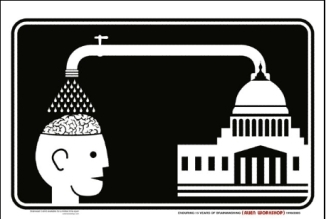
brainwashingAs Americans, we pride ourselves on being the exact opposite of Communists.  In America, we have a democracy.  To live in a democracy, means that you are “free” to think for yourself.  No one living in a democracy can possibly be brainwashed.  In America, “the land of the free and the home of the brave” you will only find people who believe in the truth.  The truth is that democracy is the holy grail of political systems.  It supports everything that is good about life.  In a democracy, all men and women are created equal.  In a democracy, everyone can succeed if they only have the right desire.  Americans will fight and die for this dream.

“We hold these truths to be self-evident, that all men are created equal, that they are endowed by their Creator with certain unalienable Rights, that among these are Life, Liberty and the pursuit of Happiness.”  –  The Declaration of Independence 

It never occurred to me that Americans could be brainwashed until I started teaching MBA students both at St. Thomas College and Metro State University in Minnesota.  Enrollment in MBA programs soared during the nineties as more and more students gravitated to business occupations and away from such occupations as teaching and social work.  Many of my students had obtained non-business undergraduate degrees and become tired of the lack of money associated with such career fields.  With an MBA degree, you could easily make three or four times per year what you could with a Masters degree in Education.

I really enjoyed teaching in the business field because my students were smart, motivated and challenging.  Most of them had been working for several years and brought considerable life experience to their classes.  Very few of my students had simply finished an undergraduate program right out of high school and then gone on to get an MBA degree.

Since I had spent many years as a management consultant, I brought industry experience to my classes.  I had learned along the way that critical thinking and the ability to question the status quo were essential to continuous improvement and systems change.  I tried to incorporate these insights into my curriculum and classroom instruction.  I soon found that this task was easier said then done.

An eye opener for me was when I tried to use the documentary film called: “The Corporation (2003)” in some of my business ethics classes.  The Corporation is a Canadian documentary film critical of the modern-day corporation.  It was directed by Mark Achbar and Jennifer Abbott and written by Joel Bakan.  The film has numerous examples of corporate behavior that walk a fine line between criminal and immoral behavior.  The film shows that many of the behaviors of modern corporations are immoral although not illegal.  However, there are numerous examples in the paper every day wherein executives and corporate leaders have crossed the line.

“Again and again we have the problem that whether you obey the law or not is a matter of whether it’s cost effective. If the chance of getting caught and the penalties are less than it costs to comply, people think of it as just a business decision.” – Robert Monks.

Much to my surprise, many of my students did not see anything wrong with such immoral behavior.  Their standards were set on what was expedient and legal rather than what was moral and ethical.  Repeatedly, I found that modern business students believe in an amoral system of ethics rather than a moral system.  In an amoral system, right and wrong is defined by what works and what does not work.  If you are within the law, you may conduct your business with little concern for the residual effects on either society or citizens.  The first law of business trumps all other concerns.  That law is to make a profit.

No amount of persuasion or argument could sway my students from their steadfast believe in the value of capitalism and its sanctity as an economic system.  Students were not persuaded by the iniquities in the system, by the inherent racism in the system, by the inherent sexism in the system or by the unequal distribution of wealth in a system that has become increasingly dysfunctional.

What we should admit to begin with, if we can, is that good socialism is better than bad capitalism. The logic of the statement is really inescapable. It is only when capitalism fails that people and nations resort to alternative forms of political economy.”  – Jude Wanniski

How can anyone as bright and experienced as these MBA students not see the obvious flaws in America’s belief system?  An excellent book (The Structure of Scientific Revolutions) by Thomas Kuhn talks about the nature of scientific and paradigmatic change.  Kuhn found that even scientists could not see the truth behind a new theory because their old paradigms blinded them to the new reality.

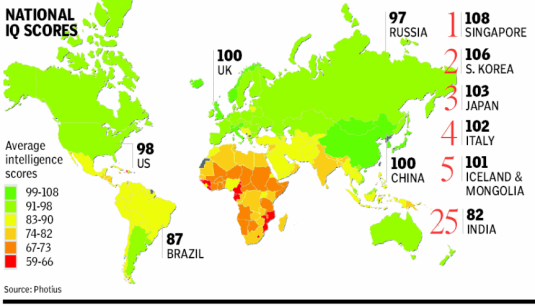
In the same way, it has been gospel for many years now that America is an “exceptional” nation.  Americans are smarter, tougher, harder workers, more courageous, more creative and more ambitious then workers from any other country in the world.  Since it is believed that America is built on Capitalism and Democracy, these two ideologies have become sacred tenets of American life.  To cast doubt or aspersions on the value and efficacy of these systems is to suggest that America and hence Americans are not exceptional.  Trying to talk students into seeing the flaws in either of these systems is about as effective as asking them to describe a Martian.  If you have no foundation for seeing a new reality, you can only describe familiar objects in your current reality.
P4h7lko

Business students today are not critical thinkers nor or they creative thinkers when it comes to politics or economics.  Most of them have been brainwashed.  When I use this term, I mean it to signify someone who cannot think out of a box of concepts that has become their dominant world view.  Just as I suppose a die hard Communist would find compelling reasons to defend communism, die hard Americans can always find compelling reasons to defend America.  A brainwashed person cannot see another reality or even begin to envision what might be wrong with their weltanschauung.

“This is what economics now does. It tells the young and susceptible (and also the old and vulnerable) that economic life has no content of power and politics because the firm is safely subordinate to the market and the state and for this reason it is safely at the command of the consumer and citizen. Such an economics is not neutral. It is the influential and invaluable ally of those whose exercise of power depends on an acquiescent public.”  John K. Galbraith, (Power and the Useful Economist, 1973)
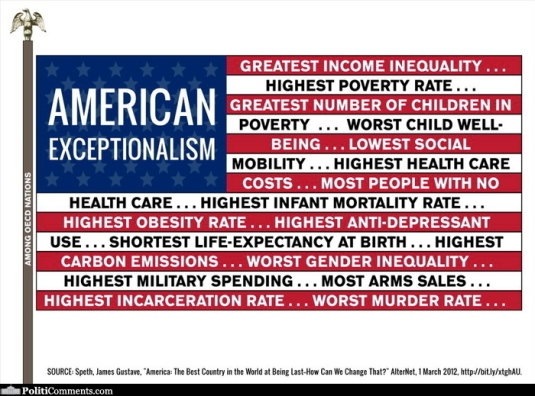
american flag of exceptionalisn

So, what am I getting at?  What is my point?  To find it, we need to return to the thesis of this article:  Are Americans brainwashed?  If we define what it means to be brainwashed as: “One who persists in the belief of something despite apparent evidence and facts to the contrary,” then I would suggest that the evidence points beyond a doubt to the fact that Americans are some of the most brainwashed people on the face of the earth.  It has little to do with experience in business, innate intelligence or amount of degrees accumulated.
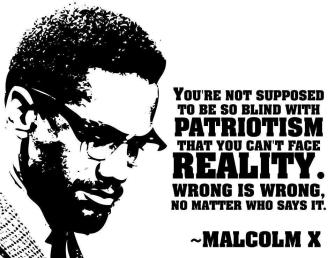
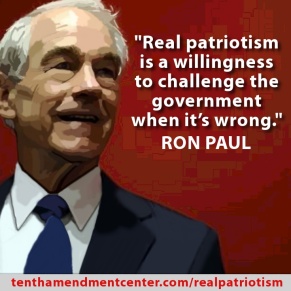
malcomxron paul

A red herring in our acceptance of my conclusion is the common belief that brainwashing is forced.  Too often, we have the picture of an individual strapped to a chair being made to listen to propaganda or watch propaganda films.  The fact of the matter is that brainwashing can be covert and subdued.  I suggest another picture for brainwashing that is just as effective as “forced” brainwashing.  Picture the average American watching four or five hours or television every day.

Television Statistics.  According to the A.C. Nielsen Co., the average American watches more than 4 hours of TV each day (or 28 hours/week, or 2 months of nonstop TV-watching per year). In a 65-year life, that person will have spent 9 years glued to the tube.

During the average day, an American will have seen or heard between 300-700 marketing messages per day, including messages from the Internet and video gaming. – (Source: Phil Barden, “Decoded: The Science Behind Why We Buy”, 2013).  Much of the research on the role that advertising plays in consumer purchases suggests that it is mostly informative rather than persuasive.  In other words, it appears that consumers use the information to choose between products but are not necessarily persuaded by the advertising to buy any particular product.
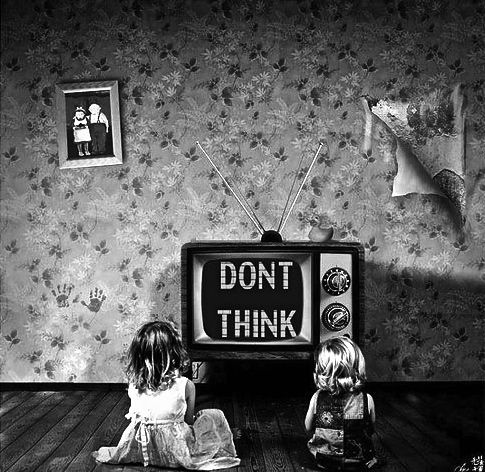
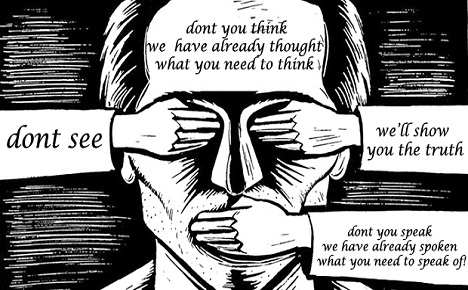
dont-think

As a business instructor and former retail store manager, I am skeptical of the consumer research.  My firsthand experience in regard to the power of these marketing messages does not agree with the research findings.  Students and customers will repeatedly deny that advertising messages play any overt role in their purchasing decisions.  However, any observation of the buying habits of Americans will easily demonstrate a disconnect between what people spend their money on and rational economic sense.

Furthermore, when we look for the messages that “brainwash” many Americans we must look beyond Madison Avenue.  We have a cornucopia of messages bombarding Americans every day that serve to instill mythical beliefs in American exceptionalism, American patriotism, American heroism and American capitalism.  Let us look briefly at some of the beliefs that I noted earlier.

Americans are the hardest working people in the world:

The U.S. ranks 17 out of 38 countries in terms of average hours worked each year, according to the OECD, while Mexico, where labor laws cap the work week at 48 hours, ranks no. 1.  Workers in Costa Rica and South Korea work the second and third longest hours, respectively – Sept 2, 2016

Americans are the most creative and innovative people in the world:

In this area Americans do rank exceptionally high.  The Martin Prosperity Institute ranks 82 countries on a scale for creativity based on technology, talent and tolerance for new ideas.   Overall, America ranks second behind Sweden.  Note however that we are not number one in any category.

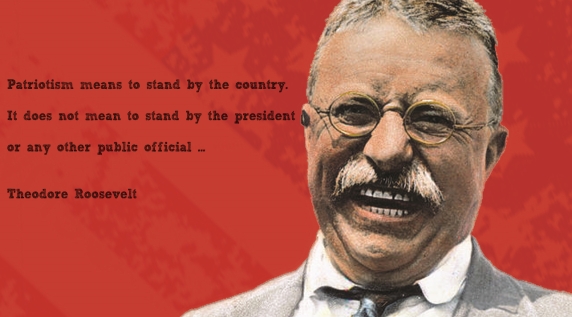
  1. Theodore-Roosevelt-PatriotismUNITED STATES

Technology Rank: 3

Talent Rank: 8

Tolerance Rank: 8

Global Creativity Index: 0.902

Americans are the toughest people in the world:

This is a very ambiguous category and an allegation that is difficult to attack or defend.  How do we define tough?  Is our military the most powerful in the world?  The answer would be yes.  Are our athletes the best in the world?  An all-time medal table for all Olympic Games from 1896 to 2016, including Summer Olympic GamesWinter Olympic Games, and a combined total of both shows that America has clearly dominated the Olympic games.  The top three countries in medal totals are:

America:  Total Medals:  2,804

Russia:  Total Medals – 1,204

Great Britain:  Total Medals – 875

American-exceptionalism

But if we define tough as a measure of resilience to strife and turmoil, we find that Americans are not in first place.  The FM Global Resilience Index ranks and scores countries across nine factors, illuminating their supply chain resilience and resilience in general.  Across political risk, exposure to natural hazards, and infrastructure quality, the index quantifies a nation’s ability to withstand a disruption and bounce back, so products can get to where they need to go.

“The latest version of the ranking, which comes from a Rhode Island-based insurance company, has Switzerland in first place, followed by Norway, with Ireland, Germany, Luxembourg, the Netherlands, the central United States, Canada, Australia, and Denmark counting out the top 10 places.” – Fast Company 

Conclusions:

If Americans belief in the above ideas is false but we continue as a nation to keep repeating them ad nausea, does that mean we are brainwashed?  Or are we simply delusional?  I submit that the causality behind these beliefs is less important than the arrogance and hubris that they demonstrate to the rest of the world.  How can we expect to be respected and admired when we waltz around treating the rest of the world as though they are second class citizens?

“This unchallenged faith in American exceptionalism makes it harder for Americans to understand why others are less enthusiastic about U.S. dominance, often alarmed by U.S. policies, and frequently irritated by what they see as U.S. hypocrisy, whether the subject is possession of nuclear weapons, conformity with international law, or America’s tendency to condemn the conduct of others while ignoring its own failings. Ironically, U.S. foreign policy would probably be more effective if Americans were less convinced of their own unique virtues and less eager to proclaim them.” – Foreign Affairs: The Myth of American Exceptionalism, Stephen M. Walt, 2011

Time for Questions:

Do you think many Americans are brainwashed?  Why or why not?  Do you think there are many beliefs that we as Americans hold that are false?  If so, where do you think they come from?  What do we need to do to see the truth?  How do we overcome mythologies that are constantly reinforced by special interest groups?

Life is just beginning.

The conservative version of American exceptionalism has become a password of sorts for candidates who want to prove their credentials to a right-wing America.” – Russ Feingold


Bully in Chief and Liar in Chief!

‘He is a bully’: Gillibrand hits back at Trump over demeaning tweet

Senator Gillibrand

Trump is not only THE Bully in Chief, he also is THE Liar in Chief. I am still waiting for one journalist to be honest and call this guy a Liar.  At least Senator Gillibrand has the guts to label this lowlife for what he really is. We have a President with NO integrity and a Senate full of politicians with not much more integrity. Do you think this poor excuse for a human being would still be president if even 1/4 of the Senate had the guts to speak out and call him for what he really is?  He no more deserves to be president than Benedict Arnold.  Time for more calls to impeach him.  Time for more Americans to speak out.  Let the waves of indignation and moral outrage roll down and sweep him out of office.

No bigger mistake has been made in the history of this country than the election of Donald Trump to the Presidency of the United States of America.

Time for Questions:

When will we impeach this lowlife?  What about the people who helped to put him into office?  Have they any regrets?  Are you speaking out?  If not, when will you add your voice to the chorus of people who have the courage and integrity to speak their piece?

f61cf2a6b0a0dfac39792e1d5998c996

Life is just beginning.

Trump is not the end but the beginning.  We are going to see more rights for people in the world, more justice, more compassion, more of what will make American’s proud just as soon as we dump trump.


Towards a Policy of Diplomacy – Not War!

War-and-Diplomacy_3x2I was going to call this blog “how to get along with other countries?”  But the above title seemed more erudite and impressive.    As I start to write this blog, I wonder if anyone has a “policy” of diplomacy.  I will soon Google it to find out but first allow me to say a few words on the subject.  I would like to start out with no preconceived bias on the issue.  Of course, this could also subject you to my gross stupidity.  I may at best reinvent the wheel.

For the past two years, I have been reading the journal Foreign Affairs.  I am and continue to be surprised by what I perceive as the impressive understanding that the writers in this journal have concerning a broad array of subjects.  In each issue you may find articles dealing with war, politics, globalization, economics, environment and many other topics.  The articles often are juxtaposed with dissenting positions and many times there are follow-ups to previous articles with critiques and rebuttals.   The level of scholarship and experience of the typical author is almost always impressive.   If I sound like an advertisement for the journal, I am not ashamed to recommend it.

Reading this journal, I am relieved to find that many other people have seen the stupidity and arrogance that I often see in our foreign policy.  Let me state clearly though, that while the USA is guilty of many sins, I have been to thirty three other countries and I have seen the same stupidity and arrogance in every other country as well.

So on the one hand, it seems there are experts out there who have some really good advice and answers on what or how certain international affairs and problems should or could be handled.  On the other hand, it seems no one listens to the experts and instead foreign policy is based largely on emotions, machismo, avarice and stupidity.  I read recently that in 1928, a pact was passed condemning war as an instrument of foreign policy.

“The Kellogg–Briand Pact (or Pact of Paris, officially General Treaty for Renunciation of War as an Instrument of National Policy was a 1928 international agreement in which signatory states promised not to use war to resolve “disputes or conflicts of whatever nature or of whatever origin they may be, which may arise among them.” Parties failing to abide by this promise “should be denied of the benefits furnished by this treaty.” It was signed by Germany, France and the United States on August 27, 1928, and by most other nations soon after.”  — Wikipedia

A total of sixty two countries signed the Pact.  In the USA, the Senate approved the pact by a vote of 85-1 with only one dissenting opinion.  Well, something most have been forgotten along the way.  How many wars have we had since 1928?  If my counting is correct, we have had 102 wars in the world since the pact was signed.   The web site Wars and Casualties of the 20th and 21st Centuries lists all the wars and deaths since 1900 throughout the world.

quote-a-congress-of-the-powers-is-deceit-agreed-on-between-diplomats-it-is-the-pen-of-machiavelli-napoleon-bonaparte-212040Thus, what seems like a very good idea (abolishing war as an instrument of foreign policy) is almost totally ignored.  Millions of people have been and still are being killed as the USA and other nations pursue war as an instrument of policy.  In some cases, it is advocated without any deference to reason as an immediate and primary instrument of policy.  First strikes and preemptive attacks are vastly more popular these days as the world deals with a host of international problems.  When Obama’s aide Marie Harf discussed other options than bombing terrorists as a solution to some of the strife in the Mideast she was trounced in the press and by many politicians as dumb and naïve.  However, when the war hawks in the USA Congress or any other nation are quick to cry War, nary a voice can be heard that challenges the sanity or even efficacy of war as an instrument of policy.  The world seems to believe that if we bomb the village, kill all the people and destroy any and all infrastructure, peace can then be resumed and we can all sleep safely and soundly tonight and forevermore.

“A country which proposes to make use of modern war as an instrument of policy must possess a highly centralized, all-powerful executive, hence the absurdity of talking about the defense of democracy by force of arms. A democracy which makes or effectively prepares for modern scientific war must necessarily cease to be democratic.”Aldous Huxley

Well, now that you have heard some of my thoughts and opinions on the subject of war and foreign policy, let us see what Google turns up when I type in the phrase “Policy of diplomacy.”  I am going to enter it in brackets so it regards the term as one concept.

Here is the first page from our search:

About 213,000 results (0.38 seconds)

Top of Form

Search Results

A Progressive Foreign Policy—and a Whole Lot of Work …  https://www.americanprogress.org/…/a-pro… Center for American Progress  Oct 28, 2015 – Then as now, CAP supported a policy of diplomacy as the first option for preventing Iran from obtaining a nuclear weapon—and military force …

Bush Aides Speak of New Policy Of Diplomacy in Central …  www.nytimes.com/…/bush-aides-speak-of-new-policy… The New York Times Nov 20, 1988 – LEAD: Aides to President-elect Bush said today that they were preparing a new strategy for Central America that would place less emphasis on …

Peace – Permanent Mission of Colombia to the United Nations  www.colombiaun…. Permanent Representative of Colombia to the United…  In furtherance of the policy of Diplomacy for Peace, the Colombian government has received expressions of support from the international community and …  Obama’s foreign policy goes from war to diplomacy in State …

http://www.examiner.com/…/obama-s-foreign-policy-goes-from-war-to-diplo…Jan 29, 2014 – 28, 2014; Obama defended the new foreign policy of diplomacy over military might. AP Photo/Charles Dharapak. While the core President …

[PDF]Atomic Bomb: Ultimate Failure of Diplomacy – Library  library.uoregon.edu/ec/e-asia/readb/93s25.pdf  University of Oregon by S Frank – ‎Cited by 1 – ‎Related articles  conceived policy of diplomacy with both Japan and the Soviet Union. Before I present my case, however, it is important to step back and revisit the Anglo-.

Obama: Be War-Weary, Not World-Weary – FPIF  fpif.org/obama-war-weary-world-weary/ Foreign Policy in Focus  Jul 9, 2014 – Pursuing the current policy of diplomacy over intervention, Obama can achieve concrete results in several areas. In the post-Arab Awakening …

WomenCrossDMZ on Twitter: “Congressional briefing for … https://twitter.com/womencrossdmz/status/623392574636748800  Jul 21, 2015 – Congressional briefing for new U.S. foreign policy of diplomacy over war 4 P.M. today, July 21 2015, Washington D.C. pic.twitter.com/ …

The CNN Effect: The Myth of News, Foreign Policy and … https://books.google.com/books?isbn=1134513135 Piers Robinson – 2005 – ‎Performing Arts The administration had been moving toward a new policy of diplomacy that could have used military force, but this hadn’t involved setting up the special …

diplomatic-insecurityLooking at these results, I find that from 1988 in the first Bush administration through the Obama administration there is talk of a “new” policy of diplomacy.  It seems as though both Bush and Obama decided that maybe war was not as good an idea as diplomacy.  However, I do not find a specific written and described “Policy of Diplomacy.”  What is this new diplomacy that they are or have brought to the world?  Just for the sake of semantics, I went back to Google and tried typing in “Policy for Diplomacy.”  Hits went down from 213,000 to 17,800.  I perused several of the links and I still could not find any specific policy either for or of diplomacy.   So let us try to formulate our own policy.  Here are some key policy points that I think should make up such a policy.

  1. Under no circumstances can another nation be attacked or threatened with an attack
  2. Diplomats must be trained in cultural sensitivity, win-win negotiating and the language of the country they are stationed in
  3. Diplomats should be publicly vetted for their ability to respect other cultures
  4. Bilateral diplomatic discussions should always precede multi-lateral discussions
  5. Multi-lateral parties brought in to discuss a problem should be selected by an objective third party or a selected UN committee established for this purpose
  6. Mediation can and should be used as necessary by third party negotiators
  7. Arbitration should follow failed mediation efforts and may be followed by binding arbitration
  8. Disputes with any binding decisions may be appealed to the World Court
  9. Nations refusing to submit to the agreement of the World Court will be fined an amount determined by the court
  10. Economic sanctions may be used to collect fines
  11. All nations signing this policy will be protected by the United Nations Peacekeeping Force

These policy statements seem self-explanatory and are only meant as a start towards an International Policy of Diplomacy.  Some will argue that they are naïve and that is probably true.  It is undoubtedly “optimistic” to presume that war will cease to be a policy of diplomacy.  There is a saying that I like though.  It goes:  “Hope springs eternal in the human breast.”  We need to start thinking about peace as a normal state of the world.  All too often, it appears that war is the normal state and peace only an interlude between wars.

Time for Questions: 

What can we do to help stop war?  Can you support a policy of NO WAR FOR ANY REASON?  Why or why not?  What if we are attacked first?  Can we stop war from being an instrument of policy?  What ideas do you suggest?  What policies do you think we should have in our new Policy of Diplomacy?

Life is just beginning.

A constructive approach to diplomacy doesn’t mean relinquishing one’s rights. It means engaging with one’s counterparts, on the basis of equal footing and mutual respect, to address shared concerns and achieve shared objectives.”  — Hassan Rouhani

What the Hell Do We Need Morality For?

morals and ethics

This blog is about the subject of morality.  Once upon a time, they taught morality in school and in church.   The first system of morality that many older Americans were exposed to was probably the “Ten Commandments.”   This was a code of rules given to the Israelites by Moses on Mount Sinai.  I have always thought it ironic that a set of morals from the “Old Testament” was supposed to be the foundation for a Christian America.  Even today, advocates of this code of morality want to hang it in town halls, schools, courts and government centers.  This is a part of the Bible that promoted an “eye for an eye” and stoning adulterers.

Jesus did say “Think not that I am come to destroy the law, or the prophets: I am not come to destroy, but to fulfill” (Matthew 5:17).  Jesus added at least one commandment to all others that was even more valuable than the ten TenCommandmentsMoses gave.   Jesus said, “A new commandment I give to you, that you love one another; as I have loved you, that you also love one another” (John: 13:34).  I would be much more in favor of seeing this posted in my neighborhood than the Ten Commandments.

Perhaps even more importantly in terms of a system of morality, Jesus gave a sermon where he proposed what has been called:  The Eight Beatitudes:   (Click here to hear the The Beatitudes Song

Blessed are the poor in spirit, for theirs is the kingdom of heaven.

Blessed are they who mourn, for they shall be comforted.

Blessed are the meek, for they shall inherit the earth.

Blessed are they who hunger and thirst for righteousness, for they shall be satisfied.

Blessed are the merciful, for they shall obtain mercy.

Blessed are the pure of heart, for they shall see God.

Blessed are the peacemakers, for they shall be called children of God.

Blessed are they who are persecuted for the sake of righteousness, for theirs is the kingdom of heaven.  —- Gospel of St. Matthew 5:3-10

It is my opinion that the Eight Beatitudes constitute one of the greatest systems of morality to come out of the Bible.  I would rather see these taught (if we are going to teach a system of morality) than the Ten Commandments.  I would also not mind these being posted in schools and other public places whereas I am sick and tired of those who want to post the Ten Commandments.

I noted that once upon a time, we taught morality in schools and churches.   Actually, we not only taught morality but morality was also imbued in our social fabric by many traditional stories and the media.  Children from an early age were exposed to Fairy tales, Uncle Remus stories, Aesop Fables, and Tales of the Arabian Nights.  These stories were full of morals on how to live and behave properly.  Early TV was also full of morality tales.  Shows like Father Knows Best, Leave It to Beaver and Andy Griffith each week clearly conveyed stories of morality and what was right and what was not right in terms of behavior.

sin-guilt-causes-body-pain-sicknessSomeplace along the way, we started losing our sense of morality.  Some have blamed it on becoming a multi-cultural environment.  Some have blamed it on the decline of religion and church going.  Some have blamed education while still others have blamed progress and a business culture that has no room for strict morality.  I am not sure what the actual cause was.  I am more concerned that it did happen.  Studies have shown that our culture has become more amoral than moral and that narcissism now plays an increasing role in our society.  People are less moral and more self-centered than ever before in the history of this country.  A book by Joel Marks (Ethics without Morals: In Defense of Amorality -Routledge Studies in Ethics and Moral Theory, 2012) is one of several that makes an argument for amorality:

“In clear, plainspoken, engaging prose, Joel Marks presents the case for abandoning belief in morality. Anyone who wants to defend the practice of making moral judgments will have to confront the issues Marks raises, and the alternative to morality he proposes.” – Mitchell Silver, University of Massachusetts, Boston, USA 

In the book “The Moral Fool: A Case for Amorality (2009)” the author Hans-George Moeller advances the following case for amorality:

“Justice, equality, and righteousness—these are some of our greatest moral convictions. Yet in times of social conflict, morals can become rigid, making religious war, ethnic cleansing, and political purges possible.  Morality, therefore, can be viewed as a pathology—a rhetorical, psychological, and social tool that is used and abused like a weapon.”

In an article “Why Is Narcissism Increasing Among Young Americans?”  by Peter Gray in Freedom to Learn (2014), Gray notes the following:

“For the past three decades or a little more, researchers have been assessing both narcissism and empathy using questionnaires developed in the late 1970s.  Many research studies have shown that scores on these questionnaires correlate reliably with real-world behavior and with other people’s ratings of the individuals.  For example, those who score high in narcissism have been found to overrate their own abilities, to lash out angrily in response to criticism, and to commit white-collar crimes at higher rates than the general population.[1]  Those who score low in empathy are more likely than the average person to engage in bullying and less likely to volunteer to help people in need.[2.]

Over the years, these questionnaires have been administered to many samples of college students, and analyses that bring all of the data together reveal that the average narcissism score has been steadily increasing and the average empathy score has been steadily decreasing ever since the questionnaires were developed [3.]  The changes are highly significant statistically and sufficiently large that approximately 70 percent of students today score higher on narcissism and lower on empathy than did the average student thirty years ago.

What accounts for this historical rise in narcissism and decline in empathy?  There is no way to know for sure, based on the data, but there are lots of grounds for speculation.”

I think we have thrown the proverbial baby out with the bath water.  I agree we need to keep the State separate from the Church.  I also agree that we don’t need the Ten Commandments as the foundation for moral thought in America.  Nevertheless, I do believe that we all need a code of morality to live by.  Whether it be Christian, Buddhist, Confucian, Agnostic, Atheist, Islamic, Jewish, Hindu, Baha’i, or other, we need a set of morals as a template and foundation for our behavior.  We need a baseline that each of us can start from so that we can assess what is good and what is right.  We need to have some system of ideas about what is correct behavior and how we should live in a socially interconnected world.

When I was a kid, (somewhere along the way) I was taught the Seven Deadly Sins.  Sometimes they were called the Seven Deadly Vices or the Seven Cardinal Sins.  I assume that since I attended a Catholic school, it went along with the teaching.  The Seven Deadly Sins included the following:

  • Lust
  • Gluttony
  • Greed
  • Sloth
  • Wrath
  • Envy
  • Pride

7 deadly sins

Some of you might think that this list is old fashioned or out of date.  How could this set of implicit moral values make a difference in our society?  They are so old; do they really have any relevance anymore?

Take a close look around you at the world.  You have only to look for a few minutes to persuade yourself that these “sins” are at the top of the list of major problems.  Greed, envy, gluttony and lust appear pervasive in our culture.  (See my series on Gandhi’s Seven Social Sins) TV shows, movies, magazines, radio, supermarkets, superstars, sports, credit services, escort services, pornography, Las Vegas all portray an American brand of materialism that is nothing short of sick.  Get it now, get it fast, and get more and moreMore is better!  Bigger is better!  Shop till you drop!  He who has the most toys wins!

“If necessity is the mother of invention, then surely greed must be the father. Children of this odd couple are named: Laziness, Envy, Greed, Jr., Gluttony, Lust, Anger and Pride.”  ― John R Dallas  Jr.

Black Friday ( The day after Thanksgiving in the USA) is only a small manifestation of the greed, lust and sloth that has infected our society.  How many Americans have a regular exercise schedule?  How many obese citizens can you count on the street each day?  How many Americans spend more each week then they earn?  How many Americans will go in debt this Holiday Season to spend money that they don’t have on gifts and toys?  Where is the self-restraint that is necessary to push oneself away from the table or shut the TV off and say “Enough.”  It barely seems to exist.  Is it any wonder that so many countries have a very negative stereotype of the “average” American?  We appear to be a group of people who have lost our moral compass.

ARTICLE 29 —  The Universal Declaration of Human Rights

  • You have a responsibility to the place you live and the people around you-we all do. Only by watching out for each other can we each become our individual best.

At this point, you well may be asking “What right does he have to be so damn moralistic?”  Didn’t Jesus say “Let he who is without sin cast the first stone?”  “Are you so perfect that you have a right to look down on other people?”  “Who does he think he is, Jonathan Edwards?”  “I don’t need anyone telling me my faults.”  “I get enough negativity from work without having to get it from you.”

Please allow me to clarify a few misconceptions.  In some religious circles we are all sinners.  Since I am agnostic, I don’t subscribe to a religious view of sin.  My use of the terminology is borrowed from the religious sphere since I think that the concept of sin has a very useful connotation if we can free it from some of the pejorative and negative associations with which it is fettered.  First of all, I do not believe that you will go to hell for committing these Seven Sins.  Second, you will not be a bad or evil person because of them.  Third and accentuating the positive, you may be happier and healthier if you are more aware of these “sins” and can do a better job of examining the role that they play in your life.  My bringing these “sins” out is to help us all become more aware of the morality that we have allowed to become obscured in our daily lives.

There are only two mistakes one can make along the road to truth; not going all the way, and not starting.  —-Buddha

We have had a decline in morality that started over one hundred years ago and it still seems to be declining.  More people are worried about their taxes increasing then the poverty facing many people in this country.  More people are worried about their security then the number of people going to jail every day for victimless crimes.  More people are worried about the price of gasoline then the pollution we send into the atmosphere every day.  Self-centeredness has become a dominant fixture of the American landscape.  “Greed is Good” says Ivan Boesky and everyone applauds.

If you look for truth, you may find comfort in the end; if you look for comfort you will not get either comfort or truth only soft soap and wishful thinking to begin, and in the end, despair.   — C. S. Lewis

Why do I think we should care about morality? 

goodevilWithout morality, we are not even as good as animals.  Animals eat, drink, sleep, procreate and fight when they have to.  They do not do it simply to hurt other animals or to wage war against groups or individuals that they cannot tolerate.  Animals care for their young and exhibit many characteristics of moral behavior.  In captivity, animals may display much more aggressive behavior.  For instance, Orcas in the wild have never been observed to kill other Orcas.  This is not the case for Orcas in captivity.  There is no such thing as civilization without a commitment to moral and ethical behavior.  Even animal societies are proof of this.

“I am Envy, begotten of a chimney-sweeper and an oyster-wife. I cannot read, and therefore wish all books were burnt; I am lean with seeing others eat – O that there would come a famine through all the world, that all might die, and I live alone; then thou should’st see how fat I would be! But must thou sit and I stand? Come down, with a vengeance!”  ― Christopher MarloweDoctor Faustus

Without morality, we have no compass to define what is good behavior and what is bad behavior.  We are reduced to the level of opportunists willing to take advantage of anyone and anything that suits our ends.  Listen to the current debate on the use of torture and the recent CIA report and you will find numerous “experts” advocating that the “ends justify the means.”  One man on NPR noted that he thought we should ask the victims of the Twin Trade Towers what they thought about the use of torture to capture Osama Bin Laden.   John McCain (May he Rest in Peace) once said it best when he opined in Congress (12-9-14) that “”Our enemies act without conscience. We must not.”  Nevertheless, he was opposed by his own party in his opposition to torture and in fact to even releasing the CIA Tortmoralityure Report. 

Many Republicans argued against releasing the report, especially as the threat of the Islamic State in Iraq and Syria grew and U.S. intelligence officials had warned that its release could cause backlash from nations and groups hostile towards the nation.   American embassies in the Middle East had been put on heightened security alert for its release.

McCain replied that “This report strengthens self-government and, ultimately, I believe, America’s security and stature in the world.”  (CNN 12-9-14)

Finally, without morality, there is no way to transmit values from one generation to another.  A lack of morality has led to the increase in amorality that is now symptomatic of our society.  Amorality is a set of beliefs which deny the value of morality or at best are indifferent to morality.  A rock is amoral.  It is neither good (moral) or bad (immoral) but may be used for either purpose.  Anything or anyone without a conscience is amoral.  It is a fine line and one that is very easy to trespass between amoral and immoral.  Many people today may think their behaviors are amoral when actually they could better be described as immoral.  Harken back to the Seven Deadly Sins and ask yourself, how many of these vices are amoral?  Are greed, gluttony, lust and wrath amoral?   Can anyone with a good conscience say it is okay to partake in these vices?

“Seven deadly sins,
seven ways to win,
seven holy paths to hell,
and your trip begins

Seven downward slopes
seven bloodied hopes
seven are your burning fires,
seven your desires…”
― Iron Maiden

Time for Questions:

What is your moral code? What are the three most important morals in your life?  Do you think everyone should have an explicit moral code?  Why or why not?  Do you know many amoral people?  What do you think about amorality?  When is it justified?  What do you think the world would be like if everyone was amoral?  Would it be a better world or worse? Why?

Life is just beginning.

“Remember tonight… for it is the beginning of always”  ― Dante Alighieri

Social Legacy Systems: How They Block Change and Prevent Progress: Part 2- The Legal Correctional System

Responsible_Prison_Reform-e1373996928213No set of institutions in America are more in need of reform than our legal correctional systems. No systems in America cost the taxpayer more money with less return or value to the taxpayer than our prisons and correctional related systems. No institutions in American cause more misery and heartache than our courts, legal system and correctional institutions. Together, our courts, legal systems and correctional systems cost the American taxpayer well over $100 billion dollars a year. The Economics of the American Prison System”  (Listen to Wake Up Dead Man) as you read my blog today. 

And what do we get for this “investment?”

  • Within three years of being released, 67% of ex-prisoners re-offend.
  • Within three years of being released 52% are re-incarcerated
  • The rate of recidivism is so high in the United States that most inmates who enter the system are likely to reenter within a year of their release.
  • In 2008, one of every 48 working-age men (2.1 percent of all working-age men) was in prison or jail.
  • In 2008, the U.S. correctional system held over 2.3 million inmates, about two-thirds in prison and about one-third in jail. 450px-Incarceration_rates_worldwide
  • Non-violent offenders make up over 60 percent of the prison and jail population. Non-violent drug offenders now account for about one-fourth of all offenders behind bars, up from less than 10 percent in 1980.
  • The total number of violent crimes was only about three percent higher in 2008 than it was in 1980, while the total number of property crimes was about 20 percent lower. Over the same period, the U.S. population increased about 33 percent and the prison and jail population increased by more than 350 percent.
  • Crime can explain only a small portion of the rise in incarceration between 1980 and the early 1990s, and none of the increase in incarceration since then. If incarceration rates had tracked violent crime rates, for example, the incarceration rate would have peaked at 317 per 100,000 in 1992, and fallen to 227 per 100,000 by 2008 – less than one third of the actual 2008 level and about the same level as in 1980.

These facts are from “The High Budgetary Cost of Incarceration” by Schmidt, Warner and Gupta, 2010

US_criminal_justice_cost_timeline

These facts have not gone unnoticed by state legislatures and politicians.

“In 2013, 35 states passed at least 85 bills to change some aspect of how their criminal justice systems address sentencing and corrections. In reviewing this legislative activity, the Vera Institute of Justice found that policy changes have focused mainly on the following five areas: reducing prison populations and costs; expanding or strengthening community-based corrections; implementing risk and needs assessments; supporting offender reentry into the community; and making better informed criminal justice policy through data-driven research and analysis. By providing concise summaries of representative legislation in each area, this report aims to be a practical guide for policymakers in other states and the federal government looking to enact similar changes in criminal justice policy.” Vera Institute of Justice     US_incarceration_timeline-clean.svg

I have written about this problem before. See my blogs (The Law Enforcement Legal-Judicial Correctional Complex and Lucy in the Sky with Diamonds or “How did our drug laws get so crazy?” It is not a new problem and in the years since I published my first article on it, it has only gotten worse. I published my first article on this issue back in 1995. In it, I applied the concepts of process and quality improvement to the criminal justice System. My article was published in a journal of pro’s and con’s on the justice system. Subsequently, I was asked to speak at a correctional conference in Minnesota and to explain the concepts that I had outlined in my paper.

The conference was attended by hard Right and hard Left people: Correctional Officers, Wardens, Prison Reform Advocates, and Relatives of both victims and prisoners. The Right wanted stronger sentencing guidelines and tougher police policies. The Left wanted more humane treatment for prisoners and more focus on rehabilitation. Each group had read my paper and each group thought I was “on their side.” The fact of the matter was, each side was wrong. I was not on either side. Tougher sentencing (which seems to have won out) has only resulted in prison reasonshigher levels of incarceration, less feeling of safety in society, higher costs and no appreciable decrease in drug usage or correctional costs. The Left may have lost in terms of policy but their solutions would not have fixed the system either. You do not get a better system by fixing defects after they are created. Process improvement focuses on going upstream and preventing defects, not warehousing and reworking them. It became clear as I tried to explain concepts of process control, six sigma system capability, rework, redesign and systems analysis, that I was speaking Greek to the participants, both Left and Right. Neither side had a clue as to what I was talking about. I suspect each side was disappointed that they had not found a new advocate.

“A new scientific truth does not triumph by convincing its opponents and making them see the light, but rather because its opponents eventually die, and a new generation grows up that is familiar with it.” ― Max Planck,

People in the old paradigm cannot see the new paradigm. Both sides might as well have been deaf and mute while I was speaking since the concepts I introduced were so foreign to them. I noted that the Correctional System needs reform. This was an understatement. The Correctional and Legal systems in America need nothing less than a major paradigm shift. Or to put it another way, we need a revolution in thinking about crime, incarceration and justice. Einstein noted that: “We cannot solve problems by using the same kind of thinking we used when we created them.” We need new thinking and new ideas. We need creative inspired leaders who are willing to break with conventions and boldly go “Where no one has gone before.” This kind of courage is sadly lacking in our political leaders today.

If I had to give my talk over again today, I would not talk about process control or process improvement. I would simply talk about the need for a paradigm shift. I would try with all my might to get the fish to see the water, to get the birds to smell the air and to get the people there to see the failure of the present paradigm. I do not need to recite the facts again. They have been repeated ad nausea. The problem is getting people to open their eyes. More prisons do not mean more safety. Longer sentences do not mean less crime. Tougher policing does not mean less violence on the streets. Witness the wave of protests rocking America today following the Eric Garner, Michael Brown, Akai Gurley, Tamir Rice and John Crawford III shootings by police. Every one of these names represents a killing by a police officer of an unarmed Black man or Black child. To date, not one killing has resulted in the indictment of a single police officer. The apparent message this sends is that: “Black men are guilty until proven innocent and that that they are so dangerous that they need to be shot first and asked questions of later.”

Bill James in his book “Popular Crime” provides the following observation:

“What we are doing, in a sense, is making ourselves constantly more aware of the threats and dangers around us, and then erecting security walls as if these threats were closing in on us, when in reality, we are pushing them further and further away.” P-96

James consistently provides evidence that we are safer and crime is lower than it has ever been in the history of this country. A point I made in my blog Are We Living in More Dangerous Times?  , see Part 1 and Part 2 with numerous statistics from the FBI and other agencies. Nevertheless, as the media treats us to a steady crescendo of violence and terror on the news, radio and TV, it is hard for anyone to feel like they are really safer or that they are less likely to be murdered in their sleep. Gun sales, concealed carry weapons and ammunitions sales have increased dramatically in the US in the past ten years. Smith and Wesson’s stock price has gone from 1.65 per share in 2004 to over $9 per share in 2014.

“The “Concealed Carry Permit Holders Across the United States” report from the Crime Prevention Research Center released Wednesday (July 10, 2014) analyzed parallels between a 22 percent drop in the overall violent crime rate in the same time period in which the percentage of the adult population with concealed carry permits soared by 130 percent.

The report finds that 11.1 million Americans now have permits to carry concealed weapons, which are up from 4.5 million in 2007. This 146 percent increase parallels a nearly one-quarter (22 percent) drop in both murder and violent crime rates during the same time period.” —  Number of Permits Surges as Crime Rate Drops

Citizens, police, homeowners, retired people, elderly, minorities and even children are walking the streets with their weapons in Condition O. That is cocked and ready to fire. Only the slightest provocation is needed to shoot. A dark figure lurking in a hallway, a man running towards us down the street, someone knocking on our front door late at night and the response is “shoot, shoot and shoot.” The reaction is even more rapid when the “allegorical” assailant is a minority or a stranger.

We need a paradigm shift. We are going in the wrong direction. We are safer and more secure than ever before, but we are walling everyone away who pose even the most minimal threat to our security. We are walling ourselves away behind security fences, gated communities, threat detection systems, private police forces, concealed weapons and reduction of liberty and spontaneity. We don’t feel safer and we are more suspicious of outsiders and strangers. We resent immigrants and foreigners and anyone who is different from us. Send them all back. The hell with sanctuary or diversity! America for people that look like me, act like me and think like me.

Build more prisons!  Invoke the three strike rule!  Make it a two strike rule!  Get tough on crime!  Platitudes like these get voters on the side of security and restraint. No new taxes does not apply to building new prisons. The contradiction between liberty and safety is ignored. Fear drives irrational behavior. Everyone develops blinders as the police go about harassing would be criminals or even suspected criminals or anyone who even looks suspicious.  “Thank God, once we lock them away, we can throw away the key and not have to deal with them anymore!  If only we could put all the “suspects” away, we good people could go about our lives feeling safe and free from the possibility of crime and violence.”

“By age 23, almost a third of Americans have been arrested for a crime, according to a new study that researchers say is a measure of growing exposure to the criminal justice system in everyday life.” — http://www.nytimes.com/2011/12/19/us/nearly-a-third-of-americans-are-arrested-by-23-study-says.html?_r=0

Time for Questions:

How safe do you feel: On the street, in your home, late at night, at a movie concert? What makes you feel safe? Have you ever been arrested? Do you know anyone in jail? Can you think of a way that prisons could be eliminated? Do you know how many people are in prison for non-violent crimes? What if they were doing public service instead? What can you do to help bring about prison reform? Are you happy with the present system?

Life is just beginning.

“A moment’s beginning ends in a moment” ― Munia Khan


The Land of the Free and the Home of the Brave?

Repeat the words in the title anywhere in the world and they are immediately recognizable as referring to the United States of America.  As Michael Medved loudly proclaims on each of his shows:  “And another great day in this, the greatest country on God’s green earth.”  It is my guess that you have never thought about where the phrase “land of the free and home of the brave” comes from.  Of course, it comes from our national anthem but where did the words originally come from?  Were they from some patriot during the Revolutionary War or from the War of 1812?  Actually they came from a lawyer and amateur poet, Francis Scott Key.  He penned them as part of a poem he wrote in 1814 which was originally titled:  “Defense of Fort McHenry.” 

The poem was set to the tune of a popular British song written by John Stafford Smith for the Anacreontic Society, a men’s social club in London. “The Anacreontic Song” (or “To Anacreon in Heaven“), with various lyrics, was already popular in the United States. Set to Key’s poem and renamed “The Star-Spangled Banner”, it would soon become a well-known American patriotic song.”  — http://en.wikipedia.org/wiki/The_Star-Spangled_Banner

Today, we naturally assume that the words refer to our penchant for American independence and heroism.  Our unique ability to save the world from itself and to right injustices wherever they are found.  Our vaunted American exceptionalism that gives us the moral right and categorical imperative to influence and insert ourselves in events and places the world over.  No one dares to question (or at least few in this country) the right of America to influence politics throughout the world.  No one questions the assumption that we are only in it for the greater good of humanity.  How could anyone from the “land of the free and the home of the brave” do otherwise?  Where our boots tread, soon follows democracy and prosperity, right?

But what if the “land of the free and the home of the brave” was not the reality anymore?  What if it was more accurate to say that today America has become the “land of the guarded and the home of the fearful.”  Since 911, Americans have seemed to retreat behind a cloak of ongoing surveillance and security measures that could become the greatest detriment to freedom, this country has ever faced.  As Benjamin Franklin so wisely noted; “Those who would give up essential liberty, to purchase a little temporary safety, deserve neither liberty nor safety”. 

So I have decided to do some first-hand research and go visit a few “average” Americans.  I took a little road trip across Wisconsin to find some true patriots and to see what they think about our country.  Are we really scared and fearful?  Are we willing to give up our freedom for security?  Have we become more xenophobic?  To answer these questions, I stopped at diners, coffee shops, rest areas, truck stops, libraries and Denny’s Restaurants to visit with real Americans.  Not the 1 percent who make their money from stocks and bonds, but the hardworking “Joes and Janes” who make their money the old fashioned way, by the sweat of their brows.  I will briefly post a few excerpts here from some of my interviews.

Roxanne:  The Full-Time-Part-Time Worker:

I met 36 year old Roxanne in a booth in Mc Donald’s where we talked over a Big Mac, fries and a shake.  Roxanne is a divorced mother of two school aged children whom she is raising with the help of some grandparents.   She works both a part-time day job at Benny’s Cleaners and a part-time night job at Wal-Marts.

John:  Let’s cut to the chase Roxanne. What do you think about America today?

Roxanne:  Well, John, its dam hard to make a living, I can tell you that. Without my grandparents helping me, I don’t know how I would get by.

John:  Do you think we have too much security and not enough freedom?

Roxanne:  I don’t know, seems like there is never a cop around when you need one.  I had a fight with my boyfriend the other day and called the cops, but it took them over 30 minutes to get to my place.

John:  What do you think about the Russians, Iraqis, Mexican Cartels and Obama?

Roxanne:  I think they should all go back to the countries they came from and leave us alone.

John:  Did you vote in the last elections?

Roxanne:  Who was running?

John:  Thanks Roxanne – got to go now.

Patriot: the person who can holler the loudest without knowing what he is hollering about.”  — Mark Twain

 Pete:  The Carpenter

I met Pete while stopping to fill up my gas at a Pilot Station.  I noticed the painted sign on his pick-up truck which read “Carpenters keep it up longer: Call Pete for a good job.”  I offered to buy him a coffee if he would answer a few questions.  Pete was 54 years old, married with four kids. One daughter was still living home with him.  She had been married and was now divorced.  Pete’s wife worked part-time as a church secretary.

John:  So Pete, what do your kids do?

Pete:  Well, one boy works with me when I need extra help. One daughter is married and lives out of state.  One daughter lives with us and the other son works nearby at a local manufacturing plant as a night supervisor.

John:  Do you think this country has provided enough opportunity for them?

Pete:  Yeah, I guess so

John:  What do you think about the economy Pete?

Pete:   Sucks.

John:  I guess a lot of people would agree with you there.  What are your biggest worries for the future?

Pete:  Paying my mortgage and taxes.

John:  Are you worried about freedom and security.

Pete:  Nope, got a concealed carry permit and a good stockpile of ammunition.

John: What do you think we should do about immigration?

Pete:  Send them all home.

John:  Well, thanks for your time Pete.

True patriotism hates injustice in its own land more than anywhere else.” — Clarence Darrow

 Bob:  The Tea Party Member

Bob is a 47 year old accountant. He is married with wife and no kids.  I met Bob at a local café that I had stopped at on my journeys.  He was wearing a t-shirt that read: TEA: Taxed Enough Already.   I sat down at the counter next to Bob and struck up a conversation.

John:  So you belong to the Tea Party?

Bob:  Yeah, joined about five years ago.  I am fed up with big government, taxes and the present no ethics politicians running this country.

John:  So how is the Tea Party going to change things?

Bob:  Well, for a start we are going to only elect politicians that support our views and are not going to compromise away what we stand for.

John:  So what do you stand for?  I know you hate taxes but is that all?

Bob:  Well, here look at this card.  It says it all.

John:  The card Bob gave me read as follows:

Our Core Principles

Tea Party Patriots stands for every American, and is home to millions who have come together to pursue the American Dream and to keep that Dream alive for their children and grandchildren.

What unites the Tea Party movement is the same set of core principles that brought America together at its founding, that kindled the American Dream in the hearts of those who struggled to build our nation, and made the United States of America the greatest, most successful country in world history.

At its root the American Dream is about freedom. Freedom to work hard and the freedom to keep the fruits of your labor to use as you see fit without harming others and without hindering their freedom. Very simply, three guiding principles give rise to the freedom necessary to pursue and live the American Dream:

John:  That sounds very good Bob, but I don’t see a lot of progressive thinking coming from the Tea Party.  Seems like you guys are more against things then for things?

Bob:  That’s because we want to go back to the way this country used to be run before the bureaucrats, illegal aliens, liberals and socialists took over this country.

John:  What about health care and education and social services for the needy?

Bob:  This country is full of free loaders who sponge off the hard working Americans who work for a living.

John:  So you don’t believe that there are truly needy people out there in this country?  What about new immigrants?

Bob:  No one gave me anything or my grandparents.  They came over to this country with just the shirts on their backs.  People used to believe in hard work and honesty.

John:  What about education?  It is barely affordable anymore.

Bob:  That’s because we give all of these free scholarships to students from other countries and the high salaries that those lazy professors make.  Do you realize most of them work less than ten hours a week?

John:  Well, thanks for the opinions Bob.  Time to go!  You have a great day.

 “Let us take a patriot, where we can meet him; and, that we may not flatter ourselves by false appearances, distinguish those marks which are certain, from those which may deceive; for a man may have the external appearance of a patriot, without the constituent qualities; as false coins have often lustre, though they want weight.”  — Samuel Johnson

Cassie Jean:  The NRA Member

Cassie Jean is a 33 year old single woman who works as an Assistant Manager in a small bakery.  I talked to Cassie Jean while she was on a break over coffee and a cigarette.  I had stopped for donuts and a rest break.  Cassie Jean rides a 2002 Honda Shadow 600 motorcycle.  She is an avid hunter and a card carrying member of the National Rifle Association.

John:  So Cassie, what was the last thing you killed?

Cassie Jean:  Well, got me a good sized buck this past fall and a nice turkey this spring.

John:  How long have you been shooting?

Cassie Jean:  Ever since I was a little girl.

John:  Why do you belong to the NRA?

Cassie Jean:  They protect our rights.  You know the Second Amendment.

John:  Isn’t that about militias?

Cassie Jean:  People have the right to arm themselves.   If we let them take our guns away, we will have no protection.

John:  Protection from what.

Cassie Jean:  The wackos and socialists.

John:  What about our army, National Guard and the police department.  Isn’t their job to protect us?

Cassie Jean:  They work for the liberal socialists that are destroying this country.  The only thing that stands between them and us is our guns.

John:  But what about all the gun violence in this country?

Cassie Jean:  If more people were armed, there would be less violence.

John:  How do you figure?

Cassie Jean:  Well, would you screw with someone who had a gun?

John:  But what if no one had a gun?

Cassie Jean:  Over my dead body.

John:  Well, you sure make good donuts.  Take care and happy hunting.

Our government has kept us in a perpetual state of fear – kept us in a continuous stampede of patriotic fervor – with the cry of grave national emergency.”  — General Douglas MacArthur

 Dick:  The Mechanic

Dick is a retired Ford mechanic who worked for a small Ford garage in upstate Wisconsin for over 30 years.  A bad back and a desire to enjoy more of life convinced Dick to retire early.  Dick is a strange sort of man as he does not like hunting or sports but enjoys literature and particularly good poetry.  He is a connoisseur of fine wines and good music and never misses an opportunity to travel with his wife Paula to see new places.  Dick belongs to a group of retired men who hang out at a local library where they can get free coffee and an occasional donut.  Despite his lack of a formal education, Dick is knowledgeable and well versed on many subjects.  His views would surprise many.

John:  What’s new Dick?

Dick:  I am going to Russia!

John:  For real?

Dick:  Yep, I like the way Putin is running things.  No BS in that country.

John:  What about freedom of speech and freedom of religion?

Dick:  Religion is a farce, just a bunch of know nothing do-gooders trying to live off the backs of hardworking people.

John:  What about freedom of speech?

Dick:  No one listens to you here anyway unless you are a billionaire.

John:  I don’t think Putin would tolerate unions and I thought you were a union man?

Dick:  Unions used to help people now most of them are just parasites as well.

John:  You sound like a libertarian.

Dick:  I don’t belong to any party.  They are all useless.

John:  When are you leaving for Russia?

Dick:  Soon

John:  How soon?

Dick:  Not soon enough.

John:  Well, I imagine many of your friends would hate to see you leave.

Dick:  Yeah, well I can send them a postcard.

John:  Do you think the libraries in Russia would have a men’s group and free coffee?

Dick:  I don’t know.  I will talk to Putin about it when I get there.

John:  Well, if I don’t see you before you leave Dick, have a good flight.

Conclusions:

I arrived back to my starting point in Frederic Wisconsin after several days on the road.  Truly, I cannot say I had any great insights into the subject of freedom and liberty.  My “random” sample of “average” Americans would not satisfy even a lazy graduate student much less a hard core researcher.  Nevertheless, my total observations have literally been based on hundreds of such conversations over the past ten years.  My interviewees are a composite of dozens of people whom I have met and talked to from the shores of Coon Lake in Wisconsin to the rocky Casa Grande Mountains in Arizona.

Numerous books attest to major changes taking place in our country.  Are we going backwards, forwards or perhaps sideways?  Are things getting better or worse?  Are we still the place that everyone wants to immigrate to?  If not, what has changed?  We are surrounded by apocalyptic visions.  The USA will be overrun by illegal immigrants.  Socialists will take over the country.  Fascism will become the norm.  The end days are near and the Messiah will return to judge the good and the evil.  The poor will rise up and destroy America.   The country will become one vast prison with drug addicts and drug dealers on every corner.  No one will be able to afford health care or education.  Terrorists will infiltrate and bomb our most prized establishments.  The country will give in to Sharia Law.

With such gloomy visions of the future, is it any wonder that many people are fearful and ready to sacrifice their freedom for security.  More and more Americans live behind walls either in a prison or in a gated community.   Neither prison walls nor community walls seem to protect us from our worst enemies which may be ourselves.

Beck – It’s All In Your Mind, music video         (Love this Song, click on here to listen)

Time for Questions:

Have you felt things are getting better or worse in this country?  Do you think we need more or less patriots?  Do you think most people professing patriotism are really patriots?  What do you think makes a good patriot?  What do you think makes a “bad” patriot?  Where do you stand on patriotism?

Life is just beginning.


Next Newer Entries