One’s life might be viewed as a series of episodes. Each episode is an animated picture or story with a beginning, middle and conclusion. Most of the episodes in our lives follow this pattern. However, there are some that do not. The ones that do not generally lack a conclusion. These are the “incomplete” episodes that I referred to in the title to this blog. Things that we started but never finished. Places we wanted to go but never did. People we wanted to meet but did not. Perhaps even more importantly, who we wanted to become but never did.
Before giving my somewhat prosaic opinions of this topic, I decided to query ChatGPT to see what it would say about the subject. I used the following query:
How does one deal with the incomplete episodes in our lives?
Here is the entire response that ChatGPT gave. Some good food for thought which I would like to later elaborate on. It (I don’t know whether to say he or she), and It seems too impersonal. Anyway, ChatGPT gave the following ten answers. I list these just as he/she gave them. Any typos belong to ChatGPT. 😊
ChatGPT
Dealing with incomplete episodes in our lives can be challenging, as it often involves facing uncertainty, unmet expectations, or unresolved issues. Here are some strategies to help you navigate through such situations:
- Acceptance:
- Acknowledge that life is full of incomplete episodes, and not everything can be neatly resolved or concluded.
- Embrace the uncertainty and imperfection inherent in the human experience.
- Mindfulness:
- Practice mindfulness to stay present in the moment rather than dwelling on the past or worrying about the future.
- Focus on what you can control and let go of things beyond your control.
- Learn from the Experience:
- Reflect on the incomplete episode and identify any lessons or insights it may offer.
- Consider how you can grow and develop as a person through the experiences, even if they are not fully resolved.
- Gratitude:
- Cultivate a sense of gratitude for the positive aspects of the experience, even if it didn’t unfold as expected.
- Recognize the value in the journey itself, rather than solely focusing on the destination.
- Seek Closure if Possible:
- If the incomplete episode involves relationships or unresolved issues, consider whether seeking closure is feasible and healthy.
- This might involve open communication, forgiveness, or finding a resolution that allows you to move forward.
- Adaptability:
- Develop adaptability and resilience to cope with life’s uncertainties.
- Understand that flexibility and the ability to adjust your expectations can contribute to a more fulfilling life.
- Self-Compassion:
- Be kind to yourself. Understand that not everything will have a clear resolution, and that’s okay.
- Avoid self-blame or excessive criticism, and recognize that everyone faces incomplete episodes in their lives.
- Future Orientation:
- Focus on the opportunities and possibilities that lie ahead rather than dwelling on what didn’t work out.
- Set new goals and aspirations that align with your values and contribute to your overall well-being.
- Connect with Others:
- Share your thoughts and feelings with trusted friends, family, or a therapist.
- Connecting with others can provide support, different perspectives, and a sense of community.
- Creative Expression:
- Use creative outlets such as writing, art, or music to express your emotions and make sense of the incomplete episode.
- Creative expression can be a powerful tool for self-discovery and healing.
Remember, the process of dealing with incomplete episodes is unique to each individual, and there is no one-size-fits-all solution. It’s essential to be patient with yourself and allow time for healing and growth.
John Persico: Back to my thoughts now.
 Suffice it to say, I am awestruck by the reply from ChatGPT. She/he might just eliminate the need for many experts including pundits like me, psychiatrists, doctors, lawyers, professors, sociologists, psychologists and even you. I am scratching my head as to what I can add about the subject that ChatGPT did not provide you. I can tell you a story though that ChatGPT cannot concerning a major non-closure in my own life. One episode among many that has left me with regrets. I can also tell you that it is not always easy to get closure on incomplete episodes. Many things can get in the way. Perhaps the primary barriers either being the unwillingness of one party to try or to reciprocate an effort and of course our own egos.
My incomplete episode in a nutshell concerns a friend who I left behind. As much as I admired this friend, I found that talking with him became more and more difficult. It appeared to me that he was always looking to pick a fight or to insult me. We drifted more and more apart in our politics and our views on life. I did not want to engage in frequent arguments with him and to use the common vernacular I “ghosted” him. I just avoided his calls and did not reach out to him anymore. When I had a going away party, I did not invite him.
A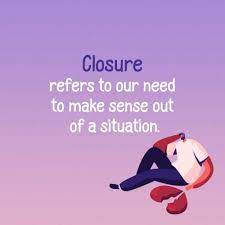 few years later, I decided to reach out to him again. You can guess his reaction. He was angry and insulting. I decided to drop my effort. Over the years, we have had some interactions by phone or email but nothing that has substantially reinvigorated our former friendship. I am not sure whether he feels any loss, but I can honestly say that I miss him. He had many good qualities and there were many times that we spent together that I fondly remember. I have been the one over the past few years to try to reach out, but my efforts have gone nowhere. At this point, I have decided that “people change” and that he is not the person that he once was. This is a good excuse or rationale for my letting go and forgetting him. You can no doubt pick many holes in my logic.
I tell you this story because advice such as ChatGPT has given is very good, but advice can only go so far to heal hurts and pains that we inflect on others. ChatGPT does have one reference to forgiveness, but it really says very little about how we forgive others or forgive ourselves. I know from personal experience that it is not an easy task.
So, what are our options? To paraphrase Hamlet, Act III, Scene 1, Shakespeare:
“To seek closure or not? Whether tis nobler in the mind to suffer the slings and arrows of outrageous fortune, or to take arms against a sea of troubles, and by opposing end them? To die: to sleep; no more; and by a sleep to say we end the heartache and the thousand natural shocks that flesh is heir to, ’tis a consummation devoutly to be wished.”
 I could point out that few things worth having ever come easy. The problem is that too many of us grow up today with the fantasy that as the song in My Fair Lady goes, “With a little bit of luck, you can have it all.” I grew up with a phrase that was popular in my neighborhood that went “He got the breaks.” This meant basically that he/she got what they got cause they got lucky. They did not have to work hard. They did not have to practice. They did not have to study. They simply had to get the “Breaks.” It took me years to realize the fallacy in thinking that luck has much to do with what one gets in life. Two of my now favorites quotes are:
- “The harder I work, the luckier I get.” — Thomas Jefferson
- “Luck is where preparation meets opportunity.” — Samuel Goldwyn
 A life without closures will be a life not really lived well. The more closures we can accomplish, the more satisfying our lives will be. Perhaps only a life lived with closures can be a life lived without regrets. We will all have regrets in our lives. Our incomplete episodes are links in a chain that we forge as we go through life. A key question is “how long do we want our chain to be?” The more effort we make to complete these episodes, the shorter our chain will be, and I think the happier our lives will be. Look at the incomplete episodes in your life today. Which ones still cause you heartache and regrets. Is it too late to do anything about them? Would it be worth the effort? What would it cost you to try?
A Different Point of View:

Many experts think looking for closure is a waste of time. One comment I found was:
“The best closure is ridding yourself of whoever interferes with your happiness and focusing on the people and activities that bring happiness into your life. So, is closure important? Well, you have to decide that for yourself and on your own terms. Maybe letting go is all the closure you really need.”
For more on the above point of view, see “How Important Is It to Find Closure?”
Keep in mind that the closure mostly referred to in this article deals with people and relationships. There are many other types of incomplete episodes in our lives where closure will need a different strategy. For instance, if you feel inadequate because you never went to college. Maybe it is not too late to go to college. Or maybe you always wanted to learn scuba diving. Maybe it is not too late to learn to dive. Here are ten people who started things late in life and are now honored for their efforts:
- Laura Ingalls Wilder Publishes “Little House in the Big Woods” — 65 years old
- Benjamin Franklin Signs the “Declaration of Independence” — 70 years old
- Nelson Mandela Becomes President of South Africa — 77 years old
- Shigemi Hirata Obtains a BA Degree from Kyoto University —96 years old
- Gandhi and Granny D Walk for a Cause — 60 years old
- Grandma Moses Picks Up a Paintbrush — 78 years old
- Fauja Singh is still running marathons — 100 years old.
- John Goodenough wins a Nobel Prize in Chemistry — 97 years old
- Yuichiro Miura climbs Mount Everest — 80 years old
- Adriane Stewart a Professional Opera Singer — 92 years old
As we begin to enter a New Year of 2024. I wish you all the best in the closures or completeness of episodes in your life that cause you regrets and pain. Life is seldom easy.


 Aging Capriciously