
Goal setting is as American as mom, God and apple pie. Every exercise book, life improvement book and management book has a section on goal setting and accolades for the process. I also once subscribed to the philosophy that those who did not set goals for their life were losers, losers and bigger losers. Winners set goals. When winners reach their goals, they up the bar and set them even higher. That is the American Way. Set unreachable goals and if you should meet those goals, then move the bar up, ever up, ever higher.
Well, I am going to tell you that everything in the above paragraph is STUPID advice. Most of the wisdom around goal setting is simply dumb. Unfortunately, when it comes to your health, it is not only dumb, it is dangerous. It was not until 1986 that I met the man who would change my mind and my attitudes towards setting goals. This man was the renowned quality expert and statistician Dr. W. E. Deming.
 I had just finished my PhD program in Training and Organization Development and joined the consulting firm of Process Management International. One of the founders Lou Schultz was a follower and friend of Dr. Deming and I was soon introduced to Dr. Deming and his world. It was a world based on 14 Principles of Management which defied everything I had been taught in my business classes at the University of Minnesota. Dr. Deming, upon meeting me, challenged me with the comment that “Everything they taught you in your business classes is wrong.” I was stunned and somewhat chagrined by his comment. It struck me as rude and extremely arrogant. In six months, I learned that Dr. Deming was more than fifty percent right. Inside of three years, I learned that he was at least ninety nine percent right. Do not think I was brain washed. I have always verified new knowledge by theory and personal experience. Considering the hypothesis that Deming threw out, I was provided a new theory. I became religious about testing his ideas to see if he was wrong. Time and time again, Deming proved correct.
Deming’s 14 Points for Management are as follows:
- Create constancy of purpose for improving products and services.
- Adopt the new philosophy.
- Cease dependence on inspection to achieve quality.
- End the practice of awarding business on price alone; instead, minimize total cost by working with a single supplier.
- Improve constantly and forever every process for planning, production and service.
- Institute training on the job.
- Adopt and institute leadership.
- Drive out fear.
- Break down barriers between staff areas.
- Eliminate slogans, exhortations and targets for the workforce.
- Eliminate numerical quotas for the workforce and numerical goals for management.
- Remove barriers that rob people of pride of workmanship, and eliminate the annual rating or merit system.
- Institute a vigorous program of education and self-improvement for everyone.
- Put everybody in the company to work accomplishing the transformation.
Note number eleven above, where he says to eliminate quotas and numerical goals. How can he advocate this when every single expert in the world says to do the opposite? Setting goals and establish quotas and targets is the refrain most often heard in business. Dr. Deming says that following the traditional rules on goal setting is counterproductive.
“Management by numerical goal is an attempt to manage without knowledge of what to do, and in fact is usually management by fear.” — W. E. Deming
Problems with Goal Setting:

There are several problems with goal setting which I would like to discuss. You need to understand these problems to understand why goal setting my hurt your health. If you have some knowledge of the statistical concepts that Dr. Deming puts forth so much the better. However, I will try to explain Deming’s opposition to goal setting for the reader that has no statistical background. The four major problems are:
- Where did your goals come from and how realistic are they?
- Is your system/body capable?
- What is your apex?
- Are your goals sustainable?
I will try to explain how each of these four problems impacts the goal setting process. I hope you will have a better idea of the pros and cons of goal setting after reading this blog.
- Where did your goals come from and how realistic are they?
Dr. Deming always said that if you do not know what a process is capable of (measured by standard deviation and CPK) than any attempt to set a goal would be foolish. Under these conditions, it would just constitute wishful thinking. For instance, organizations will often set sales goals by simply decrying that they want a 10 percent increase in sales over the previous year. The first question I would have is why 10 percent? Why not 1,000 percent? Ridiculous you might say to a 1,000 percent increase but it is no more ridiculous than 10 percent if I do not have a system that can handle or produce that kind of an increase. Any goal is ridiculous if you do not have a system and a process capable of achieving that goal. Unfortunately, too many goals are simply pulled out of thin air and have no roots in reality.
- Is your system/body capable?
 Let me illustrate the problem addressed by this question with an example from my own life. Several years ago, I had just turned sixty years of age and I thought it would be cool to be able to do twenty pullups. I could usually do about ten or so and so I thought it would be a snap to increase my routine and get to the goal of twenty. At first, I simply increased the number of pull-ups I did each week but this did not work very well as I soon plateaued. I then decided to find some “established” routines. These established routines generally involved doing at least three sets three times per week and having the number of repetitions in each set increasing each week. The formula upon which these increases were based was never disclosed.

I tried several different routines including the Marine program, a program called Recon Ron and several online programs that outlined a systematic way to reach twenty pull-ups. In each case, I followed the program but after six or so weeks, I would reach a point at which I could not advance to the next level. Sometimes the number of reps required for the next level was down right ridiculous. For instance, one day my total repetitions might be five sets of 10- 13 pull-ups each set. The next day, they would have five sets of between 13-16 pull-ups. The jump between 13 and 16 was like trying to jump across a mile-wide chasm. No way could I make the transition.
 In hopes of salvaging the program, I would often drop back to the previous level and try to continue my progress. However, every time I started to progress again, I would reach a point where my body could not obtain the increases dictated by the regime I had selected. I once reached as high as sixteen pull-ups before I crashed. The crashes would usually take the form of having an acute muscle pain or sometimes getting sick and not feeling like I had the energy to continue. Laying off for two weeks or so to recover, I would find that when I tried to start the program again, I had now dropped down to a much lower level than I had previously attained. It was like starting all over again. Over the years, trying to reach my twenty pull up goal, I have felt like Sisyphus pushing the rock up the hill and nearly reaching the top only to have the rock roll all the way down again.

I am now of the belief that first, at my age, I may not have the system or body capability to achieve twenty pull-ups and second, (more importantly) that I am not doing my body any good by trying to push it to some arbitrary goal. What is magic about twenty pull-ups? Am I going to be any healthier or fitter? Furthermore, trying to achieve some arbitrary goal, I could end up doing real damage to my shoulders or back.
- What is your apex?

An apex is the top or highest part of anything. Most athletes reach their physical peak at about twenty-nine years of age. This is true for many but not all sports. I did my best 10K run of 38:48 when I was thirty years old. Since then, my running times have become slower and slower. Some athletes, particularly swimmers may maintain their peaks for many years past their apex. This is not the general rule. It is more likely that whatever sport you excel in your apex performance will deteriorate with age.
The importance of one’s apex performance lies in the recognition that it will be impossible to maintain this performance over time. Moreover, it is foolish and unproductive to try to use such prior performance measures as goals for one’s fitness. The outcome will likely be pulled muscles or worse. What makes more sense is to set “maintenance goals” that are well within your reach and work towards or with them.
A maintenance goal is much different than a stretch goal. Most books on physical fitness emphasize stretch goals. This concept of stretch goals represents a state wherein you are constantly setting lofty goals and moving them forward as you accomplish them. This is very dangerous and frustrating. The first problem with the stretch goal strategy is that they are arbitrary and have no empirical relationship to how fit you are or want to be. The second is the danger of hurting yourself as you constantly try to increase the number, weight or time involved with each goal.
In a maintenance goal, you decide first on the level of fitness that you think makes sense. For instance, do I want to be able to bench press 150 lbs. or do I want to be able to bench press 50 lbs. three or more times? If I am working to become a champion weight lifter than lifting large weights is a must. If I am working to have good muscle tone, flexibility and a relative level of arm strength necessary for normal every day lifting, then being able to life 25 lbs. ten or twenty times will make much more sense than being able to bench press 300 lbs. once. Furthermore, with maintenance goals, I am much less likely to injure myself by tearing or pulling a muscle.
Perhaps you have never had an apex performance in any sport. This is not important. An apex performance simply gives you a relative benchmark based on your best ability at a certain age. If you have never worked out a day in your life, then simply start with what I call a 1-1-1 program. I developed this concept when I was being discharged from the Air Force after serving four years. I had to go in for a discharge physical with 12 other men. After the physical, the doctor called us all together and told us we were all overweight and fat. I was so embarrassed, I determined to start exercising the next day.
The following day after my physical, I had my wife drive the car about a mile down a dirt road and drop me off. I told her to drive down to the end of the road and wait for me. I started to jog down the road. I did not even make it half way down the road before I became sick to my stomach. I walked the rest of the way to the car and asked my wife to take me home. Once home, I went to bed and stayed there until the next morning.
I knew right then and there that I had to start off small and work up. I decided to walk about a block each day. Do one push up each day and attempt one pull up each day. Eventually, I shed my excess weight and got back into the best shape I had seen in three years. I labeled my program, the 1-1-1 program after my three goals or starting points. I allowed myself to progress naturally and not to adopt any outlandish and wishful stretch goals. Later, I started competing regularly in running, biking, swimming, canoeing and skiing events. I continued this competing until I burnt out on the extra load that competing places on one’s body. As the years went by, I could clearly see I was not going to win any gold medals. Based on a knowledge of my body and the realization that my goals needed to adapt over time, I set a series of basic maintenance goals which over the past ten years I still try to follow. My goals are:
- 4 or 5 runs per week with an average run of 30 minutes for the month. Average 60 percent “days run per month” based on 30 days in the month.
- 10 Pullups 3x per week
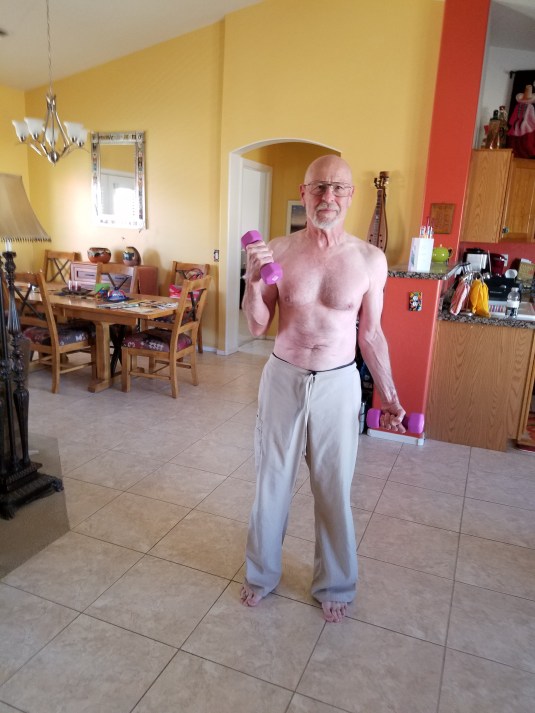
- 200 bicep curls with five lb. weights, 3x per week
- 45 Triceps presses, 3x per week
- Calf stretch and knee bends, 3x per week, 3 minutes stretches with 1 minute for knee bends
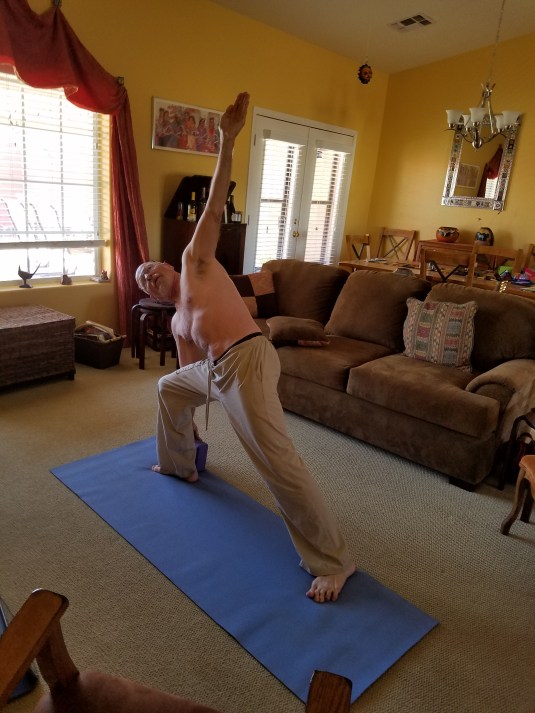
- Yoga 25 minutes, 3x per week
- Ab exercises 8 minutes, 3x per week
The above routine is my basic routine which I do each week. I do not increase my goals. I do not try to stretch myself. I measure and monitor my routines each week to accomplish what I consider to be my maintenance goals. I call them maintenance goals because I am focused on simply maintaining my present state of fitness. This is a level of fitness that enables me to do the activities I enjoy and not feel exhausted or overly worn out. I can hike, bike, canoe or do a relative amount of physical labor without my body protesting too much. Just a few weeks ago, I helped my stepdaughter move into her new home. Her boyfriend and I rented a U-Haul truck and did all the furniture moving ourselves. I had no unusual aches or pains the next day.
Some experts would say that I am going to decline in fitness since my body will acclimate to these goals and then my level of fitness will deteriorate. My reply would be to have them wait until they are 70 years old and see if they still believe this. The truth of the matter is, I occasionally must adjust my goals downward some months. If I have been sick, been traveling or had company and not able to exercise, I may not be able to make my maintenance goals. I will set my sights lower for a while and then work towards getting back to my maintenance level of activity.
- Are your goals sustainable?
 The fourth question you will want to address concerns the sustainability of your goals. I raise this question since the Second Law of Thermodynamics says that all systems will deteriorate unless energy is put into them. Our bodies are simply physical and biological systems interacting with our environment. Over time the energy that we can put into our systems will inevitably decrease with age.
The effects of this decline will mean that any goals, maintenance or otherwise that you have set for your body will be that much harder to attain. Just like a clock runs down when the battery gets weak, your body is going to run down as your energy level declines. This decline will be caused by a combination of age, physical condition, life style, motivation and illness. There is no escaping this. However, this does not mean that you need to give up. The goal you need to have for your body is to be in the best physical condition possible given the exigencies facing you each day. This is going to be different for each of us. My goals, your best friend’s goals, the goals in some exercise book are not going to be the right goals for you or anyone else.
Conclusions:
Don’t let me tell you what your goals should be. Don’t let anyone else tell you either. Decide what your priorities are in life and set your goals or exercise program to match your priorities. Keep in mind that if good health is your priority, you will need to spend some time in physical activities that promote good health. How long and how hard your time and activities will need to be will depend on how you feel and how you want to feel. Start small and remember that progress is not always upwards.
Time for Questions:
Do you exercise? Do you have a written exercise program? Do you have goals? What has been your experience with goals? Have you ever had any bad experiences with goal setting? Can you share them in the comments section? As you age, how have your goals changed?
Life is just beginning.
“An individual will of course have his own goals. A man may set his heart on a college education. He may resolve to finish this chapter by morning: I give myself a deadline. Goals are necessary for you and me, but numerical goals set for other people, without a road map to reach the goal, have effects opposite to the effects sought.” — Dr. W. E. Deming
“A goal such as “improve throughput by 20%” or “reduce lead time from 10 days to 5 days” is incomplete or worse, unachievable or irrelevant, because it doesn’t relate to the process capability. The danger of setting goals without understanding the process capability is twofold.
- If the goal was set beyond the process/system’s capability (or expected range of performance), the only way to achieve the goal is to change the process. However, in many cases, the critical variables in the process are outside the control/scope of the people who are tasked with achieving the goal.
For example, you are getting 25 miles per gallon from your car in the last 3 fill-ups. If you don’t know the capability of 20-30 MPG fuel efficiency, it doesn’t matter if your goal is set at 35MPG (because of your desire or economic need). You might try to change driving habits, keep tires properly inflated, use some additives, or perform more routine maintenance. You might even get rid of some stuff in the car or pick a route with less stop and go traffic. What you will find is that despite great effort, your MPGis still below 30. In some rare occasions, you might achieve 35 MPG or greater because it’s mostly downhill. But you know you would give up the gain when coming back uphill.
- If the goal was set within the process capability, there is always a finite probability of achieving it without any effort or change in the process. The goal without an associated probability target is pointless.” —- Goals and Process Capability — Fang Zhou

 The point of this story is that if we had not been siting vigil at my sister’s deathbed, we would not have been able to prevent a premature death. This is merely one example of the value of an “advocate” when you must go to a hospital. I am sure everyone reading this blog has at least one example that highlights how important it is to have someone as an advocate when you are in the hospital.
 An alarm might go off in an intensive care room but not be noticed for quite some time. I have personally observed many times when a patient needed to call someone for assistance but no one came. Unable to get out of bed, a patient may have to wait a long time before someone is finally able to help them. In many cases, an advocate in the room can help a patient with minor personal needs. If more severe needs exist, the advocate can be of assistance if finding someone to help and making sure that the patient needs are not overlooked or even forgotten.
 Another function an advocate can provide is to stand up for the patient when needed. Most of the time when we are feeling sick or hurting, we are in no position to stand up for what we need or want. In such instances, a patient only wants the pain to go away. Hospitals and health care providers often have needs that transcend the needs of the patient. The patient that must play second fiddle to a variety of administrative and financial procedures. Another example might clarify this.


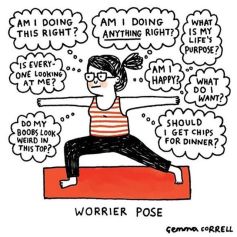 Being overly competitive might be a good formula in exercise programs where you attempt to outdo other participants, but this can be another recipe for disaster when it comes to Yoga. Each participant in Yoga needs to pay attention only to their own body; not to the other participants or even the instructor. If the instructor has his/her legs at a 180 degree angle to their torso and you can only make 30 degrees, you are best advised not try to imitate your instructor or other participants. A good instructor will repeatedly advise you to only go as far as you can with any Yoga posture. Pushing the envelope may lead to torn muscles or dislocated joints.
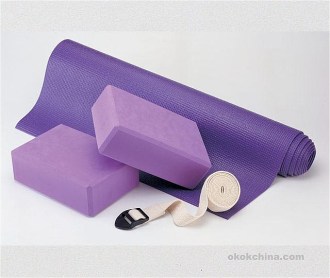 Start doing Yoga once or twice a week. You can get a Yoga mat, strap, blocks and some used Yoga DVD’s for less than $30 dollars. With some Yoga tapes and a DVD player, you will be able to do Yoga in the privacy of your home and as often as you want. I have found Rodney Yee, Patricia Walden and Susan Deason to be great instructors. Gaiam Yoga tapes can often be found in Goodwill or other thrift stores for a few dollars each. On frigid days, it is a real pleasure not to have to get dressed and go to a gym. It is also great to have an instructor on DVD that I do not have to keep paying weekly fees to.
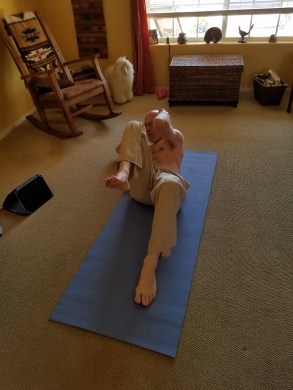 There is a difference between pain and hurt. When I tried to continue my ab exercises after my prostate surgery and then after my hernia surgery, I experienced pain. I wanted to get back into shape too quickly both times. I stopped the exercises and worked on other routines that did not cause pain. Mind you, the ab exercises still hurt and I have been doing them for six years. I am making a big distinction here between pain and hurt. Perhaps, I should say they “burn.” Burn is the athletic euphemism for hurt. Most people don’t like hurt. However, if you expect that you can get in shape without some discomfort, you are destined for life as a couch potato or in a surgery ward.
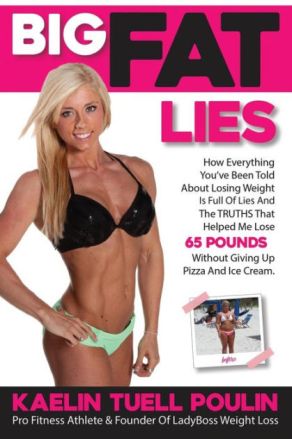 Americans are enamored with diets and each new diet best seller promises fantastic results in a short amount of time. The Amazon number 1 best seller in the health and exercise category was a book titled “Big Fat Lies.” The author promises you the “truths” that helped her to lose 65 lbs. “without giving up pizza or ice cream.” The author is Kaelin Tuell Poulin and the book has a very high rating in the customer reviews section. Ninety-eight percent of the 235 reviewers gave it a 5-star rating. However, while I often put a great deal of store in ratings, you must be careful about inflated ratings. The one negative rater had this to say about the book: (typos in the review were not changed)
 Two years ago, I started developing a pain in my right shoulder. I was not sure where it came from but after several months of it getting worse, I went to see an orthopedic doctor. He asked what if anything I might be doing to aggravate the shoulder. I mentioned that I swim frequently and am aggressive with my laps. His simple answer was “Well then, stop swimming.” I decided to follow his advice and for the next year, I stopped swimming. However, my shoulder pain did not get any better.
 Some people are not so lucky. However, I hesitate to call all of my good health “Luck.” There is a saying by Thomas Jefferson that “The harder I work the luckier I get.” I have worked hard to stay in shape. I exercise regularly. I watch what I eat. I try to avoid excesses. No doubt, I have had some luck that goes beyond hard work and discipline. Nevertheless, I believe that hard work and discipline has played a large role in my ability to be healthy and still active at my age.

 Aging Capriciously