When Healthcare Became a Business: Why America Can’t Find Enough Doctors?  — Part 1 of 2 Parts by Metis with some assistance from Dr. Persico

No matter where you live in American today, you will encounter the problem that there is a physician shortage.  It is easy to blame people.  We can ask why more people are not interested in becoming doctors.  The truth is that America does not suffer from a shortage of people who want to become doctors.  It suffers from a healthcare system that systematically limits physician supply, burns out existing doctors, redirects resources toward profit-generating activities, and increasingly treats healthcare as a business rather than a public service.

This issue became more personal for me recently when my wife had three emergency room trips and three overnight stays in the hospital.  One for six days, and two for two days each.  Despite the fact that no definitive prognosis was found, we could not get an appointment with her pulmonologist for over thirty days after her third emergency visit.  My wife was a BA/RN with a master’s degree in public health nursing for over 55 years full time before she retired.  I have an undergraduate degree in Health Education.  None of our credentials mattered.  We were mostly treated like mushrooms.  Kept in the dark and fed manure.  The reasons we were given “Not enough specialty doctors in our area.” 

I have written before about the problems in the American medical system.  The problems have only grown worse.  Here is a brief summary of where the American Medical System ranks on the five statistics that patients care most about in comparison to other countries.

1. Life Expectancy

This is perhaps the single best measure of whether a healthcare system is helping people live long lives.

  • U.S. life expectancy reached about 79 years in 2024.
  • That is roughly two years below the OECD average and among the lowest of developed nations.

Why patients should care:

If a nation spends the most on healthcare but its citizens die younger than those in comparable countries, something is wrong with the system.


2. Preventable and Treatable Deaths

These are deaths that should not occur if people receive timely and effective healthcare.

The U.S. has among the highest rates of avoidable deaths among wealthy countries.

Why patients should care:

This measures not whether doctors are talented, but whether the system gets patients the right care at the right time.

This statistic directly relates to physician shortages and delayed access.


3. Access to Primary Care

Primary care physicians are the “front door” to healthcare.

The U.S. has fewer primary care physicians per capita than many peer nations and faces projected shortages of tens of thousands of doctors in coming years.

Why patients should care:

  • Longer waits for appointments.
  • Delayed diagnosis.
  • Greater use of emergency rooms for routine care.

This may be the statistic most directly connected to your physician-shortage article.


4. Infant Mortality

Infant mortality is often considered one of the most sensitive indicators of a nation’s health system.

The United States continues to have a higher infant mortality rate than many other developed countries.

Why patients should care:

If a healthcare system struggles to keep infants alive during their first year of life, it raises questions about access, prenatal care, and healthcare equity.


5. Healthcare Cost

This is where the United States is number one.

  • The U.S. spends more per person on healthcare than any other nation.
  • Recent estimates place spending at nearly $15,000 per person annually, roughly double many peer countries.

Why patients should care:

Americans are paying luxury-car prices for a healthcare system that often produces middle-of-the-pack—or even worse—results than comparable medical systems in other countries.  The following table shows where the USA ranks against the list of OECD countries.  The OECD currently consists of thirty-eight member nations most of them high-income democracies.

MeasureUnited States
Healthcare SpendingHighest
Life ExpectancyNear Bottom
Preventable DeathsNear Bottom
Primary Care AccessNear Bottom
Infant MortalityNear Bottom
Overall Ranking Among Peer NationsLast

To verify this data – Go to the Organization for Economic Cooperation and Development site at https://www.oecd.org/en.html

In the blog that follows, I am going to identify some of the major factors that are contributing to the dismal performance of our health care system. 

Factor 1:  The Doctor Shortage

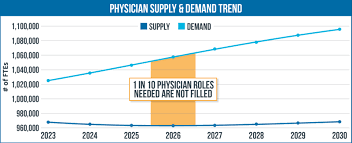
The U.S.  is projected to face a shortage of tens of thousands of physicians over the next decade.  Rural communities are especially affected, but shortages are increasingly appearing in urban areas as well.

  • The Association of American Medical Colleges projects the United States could face a shortage of up to 86,000 physicians by 2036
  • The projected shortage of primary care physicians alone is estimated at 20,200 to 40,400 doctors by 2036. 
  • Only about 24% of U.S.  physicians practice primary care, even though primary care is often the front line for prevention and early diagnosis. 

Factor 2:   Medical School and Residency Bottlenecks

Most people assume the problem is that too few students want to become doctors.

The reality is more complicated.

Every year thousands of qualified students are rejected from medical schools.

Even after graduation, physicians must complete residency training.

The number of residency positions has not kept pace with population growth because Medicare largely funds residency programs and funding has historically been capped.

Result:

  • Fewer physicians enter practice than society needs. 
  • Existing doctors must see more patients. 
  • Wait times increase. 

Healthcare Outcomes

Patients wait longer for:

  • Primary care appointments
  • Specialists
  • Mental health services

Research consistently shows that delayed care leads to:

  • Worse disease outcomes
  • More emergency room visits
  • Higher mortality rates

Factor 3:  Physician Burnout

This may be the most important factor.

  • Nearly half of all physicians reported burnout in 2024.  One major survey found a burnout rate of 49%
  • Although burnout has improved somewhat, 43.2% of physicians still reported symptoms of burnout in 2024, and 41.9% in 2025
  • Primary care physicians consistently report some of the highest burnout rates in medicine.

Many physicians report spending nearly as much time on:

  • Documentation
  • Electronic medical records
  • Insurance approvals
  • Billing requirements

as they spend caring for patients.

Doctors often describe themselves as data-entry clerks with medical degrees.

The Commercialization of the Medical System plays a key role in Doctor Burnout.  While it does not directly reduce the number of medical graduates.  Instead, it can make physicians less willing to remain in practice.

Think of it as a retention problem.

Doctors often cite:

  • Loss of autonomy
  • Productivity quotas
  • Administrative burden
  • Corporate oversight

as reasons for burnout.

When experienced physicians retire early, the effective shortage grows.

Healthcare Outcomes

Burnout contributes to:

  • Earlier retirement
  • Reduced patient access
  • Medical errors
  • Lower patient satisfaction

The average patient often experiences this as:

  • Rushed appointments
  • Less physician attention
  • Difficulty obtaining follow-up care

Factor 4:  Aging Population

America’s population is getting older.

Older adults consume significantly more healthcare resources.

The Baby Boom generation is moving into years where:

  • Cancer rates rise
  • Heart disease increases
  • Joint replacements become common
  • Chronic illnesses multiply

Demand is increasing faster than physician supply.

Healthcare Outcomes

More patients compete for the same physicians.

Wait times lengthen.

Primary care becomes increasingly difficult to access.

Factor 5:  Geographic Maldistribution

The United States may not have a pure national shortage as much as a distribution problem.

Doctors tend to locate in:

  • Wealthier communities
  • Urban areas
  • Regions with better reimbursement

Rural America often struggles to attract physicians.

Arizona experiences this challenge in many communities outside Phoenix and Tucson.  We live in Arizona City, and the selection of specialists is poor to non-existent here.  We are fifty miles from Phoenix and fifty miles from Tucson.  Depending on the time of day, it can take two to three hours to get to some areas of Phoenix and two hours to get to some areas of Tucson. 

Healthcare Outcomes

Rural patients experience:

  • Longer travel times
  • Delayed diagnosis
  • Higher mortality rates for many conditions

Factor 6:  Commercialization of Healthcare

This is where the story becomes particularly interesting.

Many Americans still imagine hospitals as community institutions.

Increasingly they are large corporate enterprises.

Over the past forty years:

  • Independent physician practices declined. 
  • Corporate healthcare systems expanded. 
  • Investor-owned hospital chains grew. 
  • Private equity entered healthcare. 

Healthcare increasingly became a business sector rather than a public service sector.

Hospital mergers and physician acquisitions frequently increase prices without corresponding improvements in quality.

Factor 7:  Hospital Consolidations

  • The percentage of physicians employed by or affiliated with hospital systems increased from less than 30% in 2012 to at least 47% in 2024.
    • More than three-quarters of U.S.  doctors are now employed by health systems or corporations rather than practicing independently. 

Thousands of hospitals merged into large regional systems.

Proponents argued consolidation would:

  • Reduce costs
  • Improve efficiency
  • Improve quality

The evidence is mixed.

Many studies suggest consolidation often results in:

  • Higher prices
  • Greater market power
  • Increased administrative costs

Studies reviewed by the Government Accountability Office found that physician and hospital consolidation is generally associated with higher prices and spending, with limited evidence of corresponding quality improvements.  Read my blog called, “When Bigger is Not Better.”

Factor 8:  Administrative Growth vs Physician Growth

One of the most striking trends is that administrative staffing has grown much faster than physician staffing.

Hospitals employ:

  • Compliance officers
  • Revenue cycle managers
  • Coders
  • Contract specialists
  • Marketing personnel
  • Financial analysts

Many are necessary. 

But the growth rate has greatly exceeded physician growth.  According to one statistic administrators now outnumber physicians by roughly 10 to 1 in some healthcare systems.

Critics argue the system increasingly rewards administration rather than caregiving.

Healthcare Outcomes

More money flows toward administration.

Less is available for:

  • Physician recruitment
  • Nursing support
  • Patient services
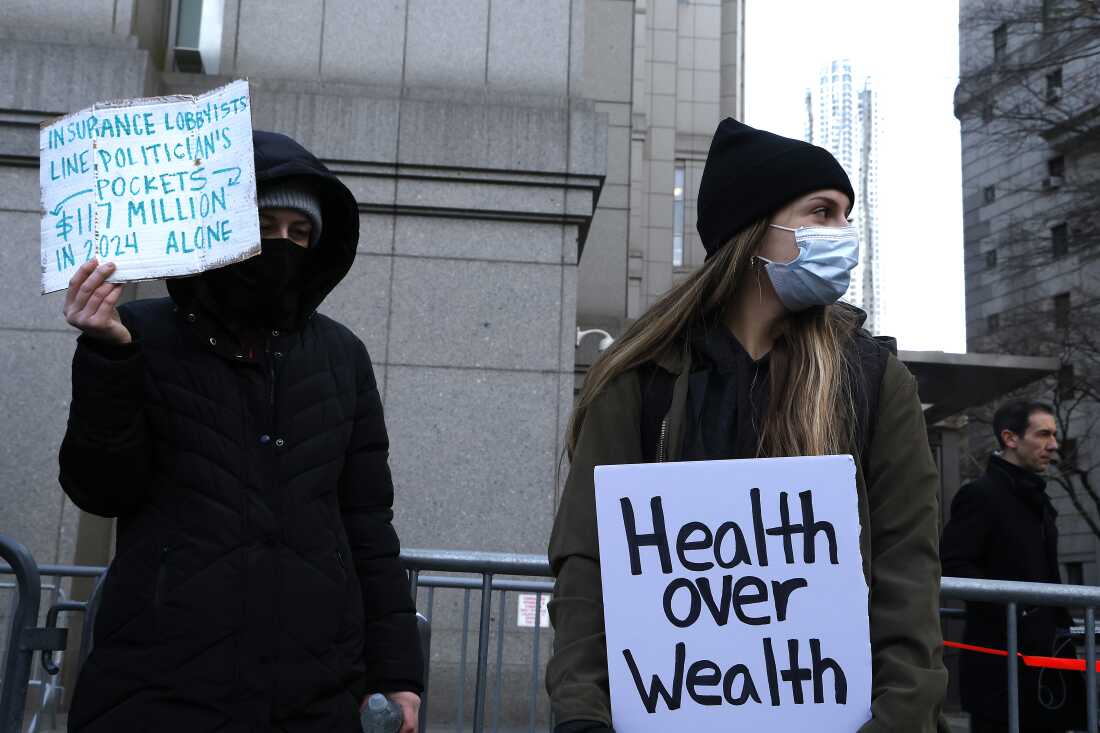
NEW YORK, NEW YORK – DECEMBER 19: People demonstrating against the healthcare industry

Factor 9:  Private Equity and Physician Practices

This is a newer development and one that many people do not know about.

  • Approximately 6.5% of physicians worked in private-equity-owned practices in 2024, up from 4.5% in 2022. 

While still a minority of practices, the trend is moving rapidly.

Private equity firms increasingly purchase:

  • Physician groups
  • Emergency departments
  • Specialty practices

Their objective is generally to increase profitability and eventually sell the practice.

Critics argue this creates pressure for:

  • Higher patient volumes
  • More procedures
  • Cost cutting

Before concluding Part 1, lets summarize the human cost of the physician shortage in the USA and the attendant commercialism health care in America.

The Human Cost

The physician shortage ultimately affects patients through:

Longer Wait Times

Patients may wait months for specialists.

Reduced Preventive Care

Diseases are detected later.

Overcrowded Emergency Rooms

ERs become substitutes for primary care.

Physician Fatigue

Burned-out physicians are more likely to leave practice.

Health Disparities

Rural and low-income populations suffer most.

Treatment Outcomes

You may die from something that could have been treated with earlier diagnosis.

So Where Do the Profits Go:

Consider this paradox.  The United States spends nearly twice as much per person on healthcare as many other high-income countries.  Yet Americans generally do not live longer, have better access to doctors, or enjoy better health outcomes.  If the additional money is not producing better results, where is it going?

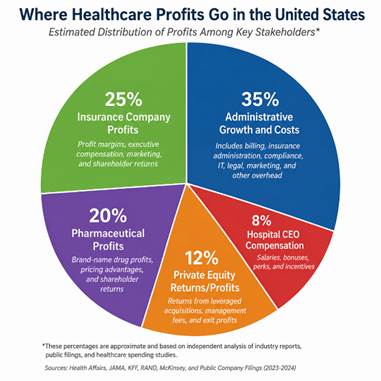
After all this discussion about Health Care becoming a business instead of a human service, the obvious question is “Where do the profits go?”  There are five main actors in this picture.  I would like to call them “villains’ but Metis who is the main author of this piece refuses to let me use this terminology.  Hence, here are the five major actors who share in the money pie. 

  • Hospital CEO Compensation
  • Administrative Growth and Costs
  • Insurance Company Profits
  • Pharmaceutical Profits
  • Private Equity Returns/Profits

The easiest way to view the answer to the distribution of profits is to look at a pie chart:
Who Is the Villain?  Or is there a Villain?

Whenever Americans discuss healthcare, there is a tendency to look for a villain.  Some blame insurance companies.  Others blame pharmaceutical firms, hospital executives, private equity investors, politicians, or even doctors themselves.  While each of these groups deserves scrutiny, focusing on any single villain misses the larger truth.

The real problem is not one person, one company, or even one industry.  The real problem is the system.

Edwards Deming, the quality management expert, often argued that most organizational failures are caused by systems rather than individuals.  If Deming were alive today, he would tell us to stop looking for villains and start looking at incentives.  Why does the American healthcare system produce higher costs, physician shortages, burnout, and poorer outcomes than many comparable nations despite spending more money than any other country on Earth?

The answer lies in the way the system is structured.

Every major participant in healthcare—hospitals, insurance companies, pharmaceutical firms, physician groups, investors, and government agencies—is responding to incentives that reward revenue growth, complexity, and market power.  Over time, these incentives have created a healthcare system that increasingly behaves like a business rather than a public service.

Where does the money go?  The largest portion of it disappears into administrative complexity.  The United States has built one of the most complicated healthcare financing systems in the world.  Hospitals and physician practices employ armies of billers, coders, compliance officers, contract specialists, lawyers, and administrators simply to navigate the rules.  Physicians spend countless hours on documentation, insurance approvals, and billing requirements instead of patient care. This complexity contributes directly to physician burnout and rising costs.

Other high-income nations are not perfect, but many have simpler systems, stronger primary care networks, and greater control over prices.  As a result, they often achieve comparable or better outcomes while spending far less.

My wife once had a visiting nurse from Sweden come to North Memorial Medical Center where my wife was a nurse manager.  Karen was asked to take the visiting nurse and show her around the hospital for the day.  She enjoyed the day with the nurse.  When Karen came home that evening, she told me about the visit and some of the things that surprised her.  This was back in 2005 before Karen retired the first time. 

Karen took the nurse to the business center where the people were working on billing and insurance issues.  North Memorial was then a 4500 employee hospital and the visiting nurse came from one of comparable size in Sweden.  In North Memorial over 200 people were employed in billing and medical coding processes.  Karen was shocked to find that in the visiting nurse’s hospital (ALMOST THE SAME SIZE) only three people were employed.  Why?  Because they had a single payer system with only one place to bill.  In the United States, hospital billing can be bewilderingly complex.

A large American hospital may deal with dozens or even hundreds of insurance plans, each with its own reimbursement rules, approval requirements, referral procedures, and appeals processes. What appears to be fifty insurance companies may actually represent hundreds or even thousands of distinct billing arrangements.  The result is a healthcare system that requires armies of administrators simply to get paid.

A small rural hospital might have:

  • 20–50 major payer contracts

A medium-sized regional hospital might have:

  • 50–100 payer contracts

A large urban hospital system may have:

  • 100–300 payer contracts

So who is the villain?

The villain is a system that rewards complexity over simplicity, treatment over prevention, administration over caregiving, and financial performance over patient outcomes. Most of the people working within the system are trying to do their jobs well. The problem is that the system often pushes them in the wrong direction.

Until we address those underlying incentives, physician shortages, rising costs, and patient frustration will remain symptoms of a deeper disease.  The challenge before us is not to find someone to blame.  It is to build a healthcare system that rewards the outcomes patients actually care about: timely access to care, affordable treatment, healthier lives, and better results.

Conclusion

America spends more on healthcare than any nation in history, yet millions struggle to find timely access to a physician.  The problem is not a lack of talent or technology.  The problem is a system that prioritizes financial performance over system performance.  As hospitals consolidate, private equity expands, and administrative complexity grows, physicians increasingly find themselves serving the business of healthcare rather than the practice of medicine.  Until we address these systemic issues, doctor shortages will remain a symptom of a deeper disease within American healthcare itself.

If the United States spends more on healthcare than any nation in the world, why do so many patients struggle to find a doctor, wait months for appointments, and feel lost in the system? 

If you want more data or resources on any of the subjects I have discussed above, you can find substantial data and references on the following sites.  These organizations provide some of the most widely cited and respected data on healthcare spending, physician workforce trends, access to care, and international healthcare outcomes.

1. OECD (Organization for Economic Co-operation and Development)

Best source for:

  • International healthcare spending
  • Life expectancy
  • Physician supply
  • Infant mortality
  • Cross-country comparisons

OECD Health Statistics

General OECD site:

OECD Official Website


2. Commonwealth Fund

Best source for:

  • International healthcare rankings
  • “Mirror, Mirror” reports
  • Comparisons of U.S. healthcare to other wealthy nations
  • Access, equity, and outcomes

The Commonwealth Fund


3. AAMC (Association of American Medical Colleges)

Best source for:

  • Physician shortages
  • Residency bottlenecks
  • Medical school enrollment
  • Workforce projections

Association of American Medical Colleges (AAMC)


4. KFF (formerly Kaiser Family Foundation)

Best source for:

  • Healthcare costs
  • Insurance statistics
  • Medicare and Medicaid
  • Hospital consolidation
  • Easy-to-understand charts and graphs

KFF (Kaiser Family Foundation)

KFF Health System Tracker

_____________________________________________________________________________

In Part 2, we will look at what is driving the commercialization of hospitals and why they have become places of profit rather than service.  We will also look at some possible antidotes to the commercialization infecting the American Medical System.  Some of these solutions will address:

  • Expanding residency funding. 
  • Reducing administrative burden. 
  • Increasing primary care reimbursement. 
  • Encouraging independent physician practices. 
  • Scrutinizing hospital mergers more aggressively. 
  • Increasing transparency in healthcare pricing. 
  • Developing rural physician incentives. 
  • Measuring healthcare success by patient outcomes rather than revenue generation. 

Why a Health Advocate Is Your Most Important Health Care Plan!

Advocacy_Graphic

This is the final article in my series on health care.  This article has been preceded by nine other articles.  There is no need to read them in order but if you have not read the other nine, you will be missing a good deal of information that just might help you live longer, healthier and happier.  As I finish this series on health care, I am gratified that over the ten weeks I have been writing about the subject, I have found only more evidence that confirms the advice and opinions I have given in this series.  In this final article, I want to talk about how important it is to have someone as an advocate when you enter the health care system in this country.  Let me tell you a personal story that illustrates this point very well.

Several years ago, my sister lay dying in hospice care.  Hospice care is a gentle humane way of helping ease out a person who is at deaths door.  By gradually increasing their doses of morphine, the patients’ bodily functions will eventually slow down and finally cease.  If a patient is accepted into hospice care, it is assumed that they are terminally ill.  What might be a slow lingering painful death without hospice, becomes a respectful and hopefully painless termination of vital processes and death.

My mother went into hospice care in 1994 and died in three days.  She had a terminal infection which was beyond treatment.  We (sisters and brother) sat with her until she expired.  My sister Sheri was also accepted into hospice care in 1999.  She was only fifty-one years old.  She was considered terminal due to her advanced cancer.  As a family, we began another vigil waiting for my sister to succumb to the cancer and morphine.  However, things did not go the same path with my sister.

We noticed that she would seem to come in and out of consciousness.  Often, when she came out she would seem quite rationale and even energetic.  The nurses did not seem to pay much attention to these episodes.  One day, the morphine drip somehow came unplugged.  My sister became quite lucid and wanted to know if it was time for her to do taxes.  She did not seem like a patient near death.  We demanded that they take her off the morphine.  This met with much resistance as I assume they thought my sister would be in great pain and that we would be the instigators of a now painful as well as inevitable death.  Such was not the case.  My sister revived and seemed very healthy.  In a day or so she was out of the hospital.  She moved in with my sister and lived another three years before she passed away in 2002.  The next three years were not always good ones for my sister but we never regretted the decision to take her out of hospice.

Advocacy-bannerThe point of this story is that if we had not been siting vigil at my sister’s deathbed, we would not have been able to prevent a premature death.  This is merely one example of the value of an “advocate” when you must go to a hospital.  I am sure everyone reading this blog has at least one example that highlights how important it is to have someone as an advocate when you are in the hospital.
A health advocate is a family member, friend, trusted coworker, or a hired professional who can ask questions, write down information, and speak up for you so you can better understand your illness and get the care and resources you need – giving you a peace of mind so you can focus on your recovery.

Nurses, doctors and staff all want to do a good job and provide wonderful healthcare.  However, our health care system is under tremendous pressure to cut costs and reduce expenses.  This translates to less time available to care for each patient.  Less time that a nurse or doctor can spend with each patient.

advocateAn alarm might go off in an intensive care room but not be noticed for quite some time.  I have personally observed many times when a patient needed to call someone for assistance but no one came.  Unable to get out of bed, a patient may have to wait a long time before someone is finally able to help them.  In many cases, an advocate in the room can help a patient with minor personal needs.  If more severe needs exist, the advocate can be of assistance if finding someone to help and making sure that the patient needs are not overlooked or even forgotten.

Advocates assist people with making sure their rights are respected. They help consumers to resolve complaints about health or disability services. They operate independently of government agencies, the Health and Disability Commissioner, and the funders of health and disability services.

70b2adaac53bf082bb116c279362275c_advocacy-clip-art-clipart-download-advocacy-clipart_1822-1415Another function an advocate can provide is to stand up for the patient when needed.  Most of the time when we are feeling sick or hurting, we are in no position to stand up for what we need or want.  In such instances, a patient only wants the pain to go away.  Hospitals and health care providers often have needs that transcend the needs of the patient.  The patient that must play second fiddle to a variety of administrative and financial procedures.  Another example might clarify this.

Three years ago, I went to the Mayo Clinic for prostate surgery.  The surgery went fine and I was sent to a room for recovery.  The night passed as most do in a hospital.  Interminable interruptions for pills, blood tests and getting up to walk the surgery unit for exercise.  The night nurse was polite and helpful.  She left sometime after 7 AM and a new nurse came on shift.  She immediately informed me that I had to be out of the room by 12 PM and I should try to do more walking.

I had thought that I was doing a great job of getting mobile but I had not met my new nurse’s standard.  I started to try to walk more and meantime I became fixated on the clock in my room.  I still felt like shit as I watched the hands on the clock move inexorably towards 12 PM.  I am sure that Cinderella did not feel as bad as I felt since she would only be outed as a pauper while I be would be viewed as weak, wimpy and unable to meet standards that every other male prostate victim in America had met.

Fortunately, when the witching hour arrived, I had my advocate intercede on my behalf.  My wife Karen who had kept vigil with me this whole time told them in no uncertain terms that I was not going anywhere until I felt better.  It was now 12 PM but with her assurance, I fell into a deep sleep.  I awoke two hours later and immediately saw that the clock hands were on 2 PM.  Somehow, this extra sleep time was all I needed.  I practically jumped out of bed and started grabbing my clothes.  Karen who had been napping in a chair beside my bed woke up.  I said, “Lets go, we are getting out of here.” She replied, “but we are not packed.”  I replied, “I don’t care, I want to get out of here now.”  Karen grabbled whatever we could and we made the 2-hour drive back to Arizona City from Scottsdale.  I was not sure how I was going to handle two hours in the car post-surgery but I did not care.  I wanted out of the Mayo Clinic and back in my own bed.  To this day, I wonder how much stock my second nurse had in the Mayo Clinic.

Preserver wNew Shadow-logo tagline

My rule now is this.  I will never let a friend or relative go to a hospital for treatment (regardless of how minor) by themselves.  If I have a friend who has no one to go with them, I will be their advocate.  If Karen needs to go to a doctor, clinic or hospital for any reason, even a hangnail, I will go with her.  Hospitals can be places of healing but they can also unexpectedly be places of death.  No one should assume or take for granted what might or might not happen at a hospital.  I could provide many more examples of unintended consequences that happened to friends and people we knew when they went into a hospital.  Better to be safe than sorry.

Patient advocates can work to help patients and their families by providing a variety of services, depending on the patient’s needs and the advocate’s area of expertise. They may help them to secure health care, manage insurance, or make treatment plan decisions.

Your advocate is your best health care plan.  Your advocate can have your back when you are under the weather or unable to defend yourself.  Your advocate can help make sure that the hospital and its providers live up to their own expectations.  Your advocate can help watch over you when everyone else is busy with other patients or administrative tasks.

Pity the poor person who goes into a hospital without a personal advocate.

This now concludes my series on health care.  I hope my blogs on health care have been useful and that you have found some ideas that will help you to lead a healthier, happier and more robust life.

Time for Questions:

Can you think of a time when you wished you had an advocate?  Were you ever an advocate for someone else?  What role do you think an advocate should play in healthcare?  Do you agree that everyone needs an advocate?  Why or why not?

Life is just beginning.

“For he who has health has hope; and he who has hope, has everything.”  — Owen Arthur


Is the War on Drugs Real? — Drugs, Medicine and Pharmaceuticals

pills

Introduction:

Perhaps few subjects are more complex than the relationship between drugs and medicine.  While the word drug often denotes something “illegal”, medicine comes across with very benign connotations.  Drugs are bad for you.  Medicine is good for you.  However, what is the difference between a drug and a medicine?  Do you have to be sick before it is medicine?  Does everyone occasionally need medicine but no one ever needs drugs?  Why are some drugs legal and others illegal?  Why is it that some legal drugs are illegal unless we have a prescription?  In this blog, I will try to provide you some “divergent” views on drugs and medicines and the Pharmaceutical industry.

Pharmaceuticals:

First, we need to define the term pharmaceutical.  We can find the following definition online:

Adjective:  1.  relating to medicinal drugs, or their preparation, use, or sale.

Noun:  1. a compound manufactured for use as a medicinal drug.

It is important to understand the distinction between the medicinal use and the non-medicinal use of drugs.  Obviously, any drug can be used for either purpose.  However, the “moral” authorities which include the government, your neighbors, various religions and others who believe they have a right to dictate human behavior have used this distinction to decide when it is a crime to use drugs and when it is perfectly okay.  Thus, in many states I may now use marijuana but only if it is for a bona fide medicinal purpose.  If I want to simply use it like I use alcohol or caffeine or nicotine for recreational purposes, it is illegal and I will find myself in jail if I get caught.

three colors of pills

This distinction between drugs and medicine is further complicated by the fact that some drugs are simply considered “bad” drugs whether they have a medicinal use or not.  This category of “bad” drugs once included alcohol when (as many of you are aware) the 18th amendment to the US Constitution was passed to ban its legal use.  Prohibition was perhaps one of the most misguided episodes in American history.  However, it does have the unique distinction of being perhaps the only time in our history when a substance was banned strictly on moral terms.  The prohibition against alcohol was primarily based on the idea that drunkenness was a threat to the moral fiber of the nation.   Since then, our “War on Drugs” has been based on several reasons but morality is no longer a major reason.

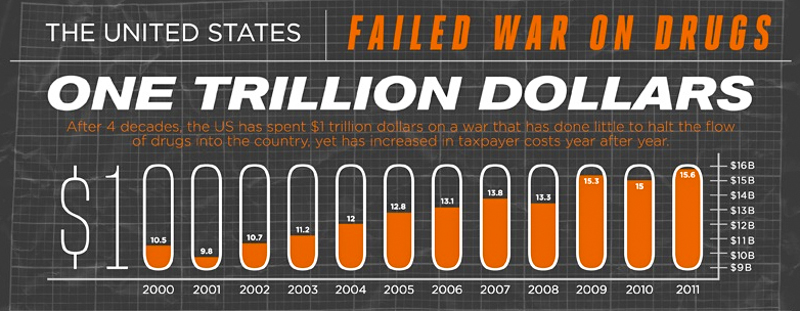
Let’s get one thing clear from the start.  There is no “War on Drugs” in the USA.  If there were a war on drugs, then bars, cigarette shops, coffee shops, liquor stores, drug stores and doctors’ offices would be raided and closed.  Doctors, baristas, druggists and Pharmaceutical CEO’s would be arrested along with the rest of the drug pushers on the street.  We would need to build an entire prison system to house all the pharmaceutical executives, managers and workers who routinely make and sell drugs.

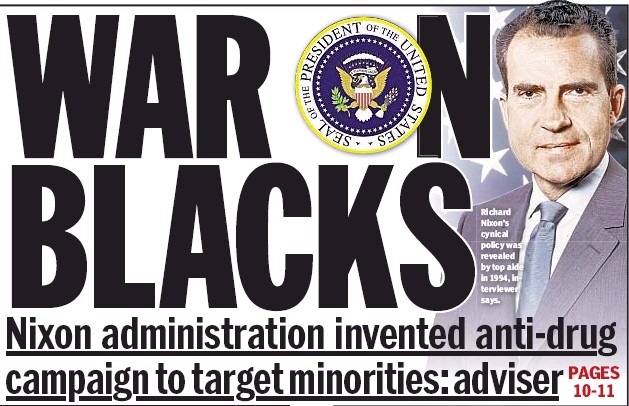
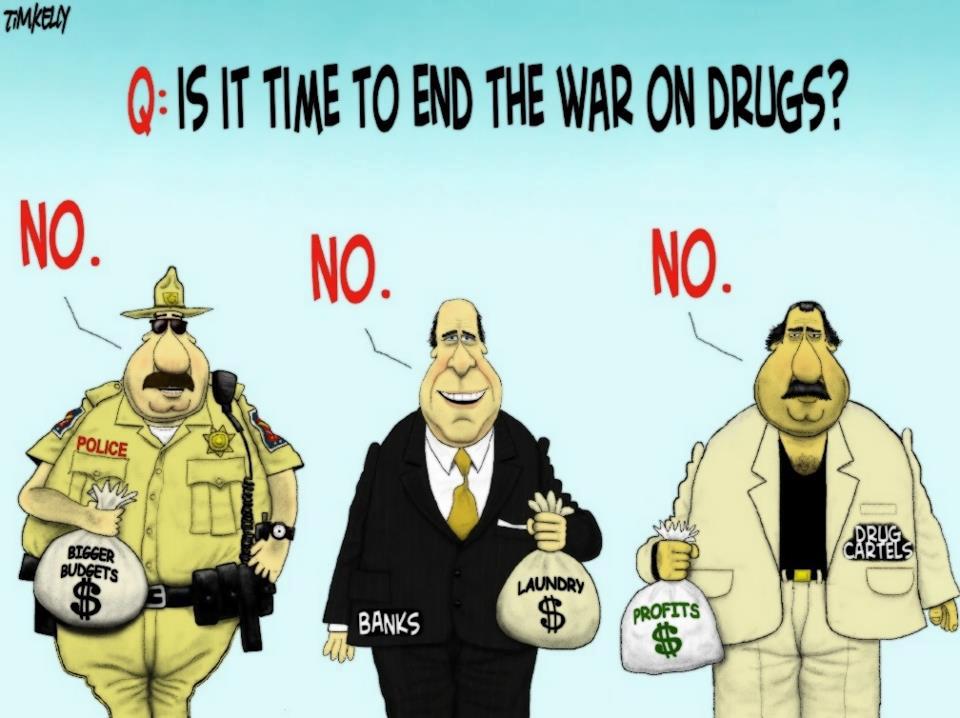
The “War on Drugs” is a sham, a myth and a hypocrisy of epic proportions.  There are two reasons for this so-called war.  The first is prejudice and the second is monetary.  These two reasons are curiously intertwined.

Docs and Big Pharma

Prejudice as a Factor in the Drug Wars:

Our prisons today are overflowing with people who have used or sold illegal street drugs.  Drugs like heroin, cocaine, marijuana and methamphetamines make up the bulk of illegal drugs sold on the street.  The majority of people selling these drugs are poor.  Minorities make up a disproportionate number of the poor in America.   Consider the following facts:

war on blacks

Poverty rates for blacks and Hispanics greatly exceed the national average. In 2014, 26.2 percent of blacks and 23.6 percent of Hispanics were poor, compared to 10.1 percent of non-Hispanic whites and 12 percent of Asians.National Poverty Center

Of course, if minorities are a large percentage of the poor and if the drug war is really an attack on the poor, then it should follow that minorities will make up a larger percentage of those convicted of drug crimes and sent to prison.  The facts support this:

  • African Americans now constitute nearly 1 million of the total 2.3 million incarcerated population
  • African American and Hispanics comprised 58% of all prisoners in 2008, even though African Americans and Hispanics make up approximately 25% of the US population
  • About 14 million Whites and 2.6 million African Americans report using an illicit drug
  • 5 times as many Whites are using drugs as African Americans, yet African Americans are sent to prison for drug offenses at 10 times the rate of Whites

The facts support that the so-called “War on Drugs” is really a war on the poor.  Why war on the poor?  Because they are regarded as a threat to the lifestyle of the wealthy.  The wealthy in America are of course predominately White.

2_war-on-drugs

“96.1 percent of the 1.2 million households in the top one percent by income were White, a total of about 1,150,000 households. In addition, these families were found to have a median net asset worth of $8.3 million dollars.”  — America’s Financial Divide: The Racial Breakdown of U.S. Wealth in Black and White, Huffington Post, 2015

It is seldom mentioned but wealthy people are fully aware of the fact that healthy non-drug addicted citizens make better workers.  Furthermore, non-drug addicted people who are addicted to hard work are less likely to break into your house in the middle of the night and steal your Gucci purse and your Rolex watch.

On the other hand, if you are poor and uneducated, drugs might seem like a decent way to spend a day rather than knocking on closed doors for a job.  I spent four years in the military from 1964 to 1968.   Any war is an ideal breeding ground for drug use.  Consider the daily effects of stress, confusion, attacks, wounds, death and uncertainty.  The military was rife with drugs when I was in.  Would anyone like to guess how much illegal drug use there was during the Vietnam War?

colors arrested more

“In 1971, a report by the House Select Committee on Crime revealed that from 1966 to 1969, the armed forces had used 225 million tablets of stimulants, mostly Dexedrine (dextroamphetamine), an amphetamine derivative that is nearly twice as strong as the Benzedrine used in the Second World War. The annual consumption of Dexedrine per person was 21.1 pills in the navy, 17.5 in the air force, and 13.8 in the army.”  — The Drugs That Built a Super Soldier, The Atlantic, 2016

 The above article concerns speed only and does not deal with marijuanaMy own personal experience was spending many weekends high on pot mixed with copious amount of whatever liquor we could get our hands on.  Beer would do if liquor was not available.  There were also many who simply sniffed glue and destroyed their brains.  To the best of my knowledge, I knew of no one who was ever busted for drug use on any base I was stationed at.  The moral is that it is okay to use drugs if they help you kill people but not simply to feel good about yourself.

The sanctimonious politicians who make drug laws in this country should be shot.  Am I being too “divergent” in my condemnation of these hypocrites?  Believe me, I could not be too hard on them.  Consider the damage that their greedy misguided policies have done to our nation and our citizens.  Millions of people have languished in jail only to serve their sentence and find that when they come out, they are even worse off than when they went in.

lead_large

Consider the effects of a felony record for drugs in America:  A convicted felon in Connecticut faces the following array of restrictions and constraints:

  1. Loses the right to become an elector and cannot vote, hold public office, or run for office, although he can have these rights restored
  2. Is disqualified from jury service for seven years, or while he is a defendant in a pending felony case (CGS § 51-217)
  3. Loses the ability to have firearms
  4. Could lose a professional license or permit,
  5. Employers can ask job applicants whether they have been convicted of a crime although federal anti-discrimination laws place some restrictions on the use of criminal histories.
  6. The State Board of Education (SBE) cannot issue or renew, and must revoke, a certificate, authorization, or permit to someone convicted of certain crimes. The SBE can also take one of these actions if the person is convicted of a crime of moral turpitude or of such a nature that the board feels that allowing the holder to have the credential would impair the credential’s standing.
  7. The Department of Children and Families must deny a license or approval for a foster family or prospective adoptive family if any member of the family’s household was convicted of a crime that falls within certain categories, which can include felonies.
  8. Landlords can evict a tenant who was convicted of a violation of federal, state, or local law that is detrimental to the health, safety, and welfare of other residents. Federal and state law for public housing allows eviction based on conviction of certain felonies. Different rules apply to elderly people.
  9. Someone convicted under federal or state law of a crime involving possession or sale of a controlled substance is not eligible for federal assistance for higher education expenses for certain periods.
  10. State law bars anyone convicted of a drug possession or use felony under federal or state law from receiving benefits under the temporary assistance for needy families or food stamp programs unless the person (1) has completed his court imposed sentence, (2) is satisfactorily serving probation, or (3) completed or will complete a court imposed mandatory substance abuse treatment or testing program (CGS § 17b-112d).

You have served your sentence for possession of a marijuana joint.  You might have served between one and five years.  You are now ready to return to society and be a hard-working honest citizen.  Regard the above list!  No one will hire you. You cannot get a student loan.  You cannot get certain licenses and even some landlords will be legally able to not rent you a place to live.  What would you do?  What would Jesus do?  Well, unfortunately, many of these people are not you and they are not Jesus.  Thus, a life of crime on the street seems to offer more preferences for some than begging for money with a cup.  Besides, every business endeavor has certain risks and the gains from drug dealing may seem to far outweigh the risks, particularly when you consider the alternatives.

drug-war-cartoon

What Role Does Greed Play in the So-Called War on Drugs?

Pharmaceutical companies are huge and make huge profits.  They are consistently listed among the top most profitable companies in America.  Here are the top ten most profitable drug companies by market value:

  • Johnson & Johnson: $276 billion (market value)
  • Novartis: $273 billion
  • Roche: $248 billion
  • Pfizer: $212 billion
  • Merck: $164 billion
  • Sanofi: $134 billion
  • Bayer: $123 billion
  • Novo-Nordisk: $118 billion
  • Bristol-Myers Squibb: $115 billion
  • AbbVie: $110 billion

In 2016, the Pharmaceutical Industry was at the top of the list for most profitable industries.  Forbes, citing data from Factset, recently released its list of the 10 most profitable industries of 2016. “Pharma: Generic” led the way as the most profitable industry with a 30 percent net profit margin”

  1. Pharma: Generic: 30%
  2. Investment managers: 29.1 percent
  3. Tobacco: 27.2 percent
  4. Pharma: major: 25.5 percent
  5. Internet Software and Services: 25 percent
  6. Biotechnology: 24.6 percent
  7. Savings Banks: 24 percent
  8. IT Services: 23 percent
  9. Regional Banks: 23 percent
  10. Major Banks: 22.9 percent

https://www.surepayroll.com/resources/blog/the-10-most-profitable-industries#sthash.rVW6a7fs.dpuf

big-pharma-mafia

Please note where the tobacco industry is on this list.  Now ask yourself this question.  Do you think either big Pharma or Big Tobacco wants competition in the form of legalized drugs?  I hope you answered NO! to this question because there is ample evidence that both industries spend a great deal of money lobbying against drugs that would pose competition to their industries.

“Both pharmaceutical companies and alcohol brands are spending money to keep prohibition around, too.  As we reported last year, certain anti-cannabis academics are funded by big pharma.  Alcohol companies are also lobbying against legalization.  In one example, the California Beer & Beverage Distributors made campaign contributions to a committee dedicated to preventing marijuana legalization and taxation. 

 To summarize, police unions, prison guard unions, for-profit prisons, and drug and alcohol companies spend huge sums of money each year to keep cannabis illegal, and why?  Because it ensures job security and profits.”  — The Top 5 Industries Lobbying Against Cannabis Legalization Will Infuriate You by Sara Lilley in Leafly

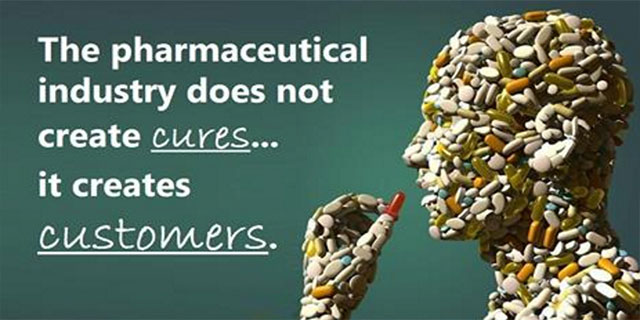
Perhaps you are inclined to think that the prejudice and greed fueling the drug industry is not that bad.  Perhaps you do not mind that America has one of the highest rates of incarceration of any developed country.  Perhaps you do not mind that millions of your citizens are in jail for smoking or selling a joint.  Perhaps you are happy smoking and drinking and do not want any other drugs.  Maybe you feel that “Big Pharma” is on your side and helps you with all the new medicines they have coming down the pipeline.  If so, you are living in a fools’ paradise.  Big Pharma is more likely to steal from you and or kill you than the drug pusher on your street corner.  In fact, they do so every single day.

ethical-criteria-for-medicinal-drug-promotion-schedule-g-17-638

They steal from you with exorbitant profits.  Who do you think pays for all their advertising and research?  They actually spend more money on advertising than they do on research.

“Prescription drug companies aren’t putting a lot of resources toward new, groundbreaking medication, according to a recent report in BMJ, a medical journal based in London. Instead, it’s more profitable for them to simply to create a bunch of products that are only slightly different from drugs already on the market, the reports authors said.  The authors go on to say that for every dollar pharmaceutical companies spend on “basic research,” $19 goes toward promotion and marketing.” — Pharmaceutical Companies Spent 19 Times More On Self-Promotion Than Basic Research: by Alexander Eichler

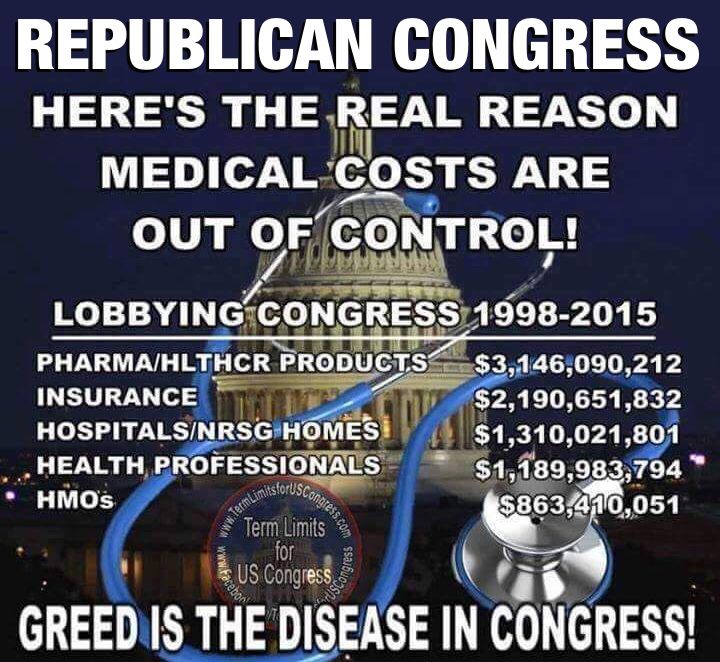
Big Pharma also leads all industries in spending your money on lobbying.  From 1998 to 2016, they spent over 3.5 billion dollars on lobbying.  This was more than a billion dollars higher than for the next highest industry which was insurance.  — Top Industries.

ee545df3eb331cc722ed7088791e9a5eAre you still wondering why drug costs are so high? Did you really think it was all research and development costs?  The three major factors are:  Profits, lobbying and Marketing.  How much do you think these all add to the costs of your prescription drugs?

Well, perhaps you still do not care.  After all, if the drugs do their job, what do you care if they cost a lot.  Perhaps your insurance pays it all anyway.  Well friend, what if you knew some of these drugs were going to kill you?  Do you think I am exaggerating?

Here are some examples of potentially lethal side effects:

“Baycol, which lowers cholesterol, was strongly linked to a potentially fatal breakdown of muscle tissue.  Approved in 1997, it was voluntarily withdrawn four years later.  The anti-inflammatory drug Duract spent just one year on the market. Approved as a strictly short-term use product, the FDA found serious liver problems with people taking the drug for longer than what was recommended.

In 1985, employees of two drug companies were fined and/or sentenced to community service for not reporting adverse events involving the blood pressure drug Selacryn and arthritis drug Oraflex.” — Drug Side Effects Explained

Of course, drug companies do not want to kill you because that could result in costly litigation and even worse, bad publicity.  Thus, most drugs come with a lengthy disclaimer and long list of potential side effects.  These are more designed to protect the drug company than you or your health.  You will probably not be able to read the small print on the label and even if you are able, you will probably not have a clue what they are talking about.  On the odd chance that you do know what it all means, it would not matter anyway, since what is your recourse?  If you are in pain and have gone through the process of obtaining your prescription how likely are you to decide that you will not take the risks associated with the drug?  But, and here is the important “but”, all drugs, even over the counter drugs have potential side effects.

viagra

And this brings us to another major factor affecting the cost of drugs.  This is the cost for Big Pharma to cover its butt when caught doing something wrong.  A report by Pubic Citizen noted the following information:

In December 2010, Public Citizen published a report that, for the first time, documented all major financial settlements and court judgments between pharmaceutical manufacturers and the federal and state governments since 1991.  At the time of the report’s publication, almost $20 billion had been paid out by the pharmaceutical industry to settle allegations of numerous violations, including illegal, off-label marketing and the deliberate overcharging of taxpayer-funded health programs, such as Medicare and Medicaid.  Three-fourths of the settlements and accompanying financial penalties had occurred in just the five-year period prior to 2010.  At the time of the report’s publication, there was no indication that this upward trend was subsiding.

adhdThere are many other egregious practices that go on in Big Pharma and which are beyond the scope of this blog.  My point in writing this was first to help alert you to the hypocrisy of the so-called drug wars and second to bring to your attention the inordinate amount of effort and money that Big Pharma spends in trying to get you to buy their drugs.  If you watch TV or read any mainstream magazines, you cannot help but become inundated with ads for drugs to cure any problem you can think of.

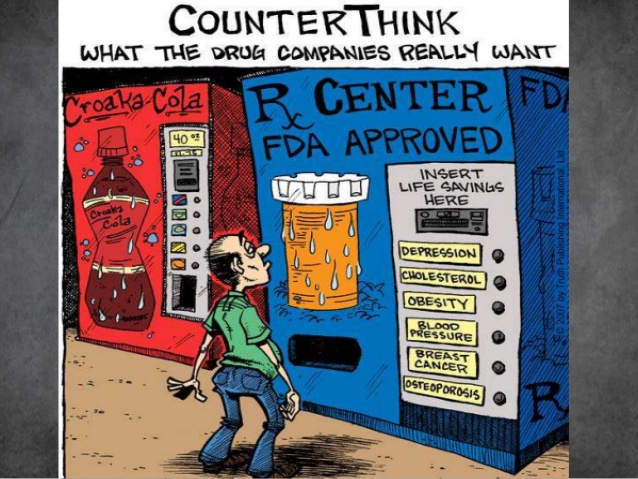
larrythecableguyprilosecThe drug companies are the biggest pushers of drugs in the world today and all for a profit.  The fact that these drugs may help your condition is very secondary to Big Pharma’s primary goal which is profits.  The fact that many drugs should not be taken long-term and may have life threatening side effects is also not particularly important to the drug industry.  Between the ignorance of many medical doctors anxious to provide a fast treatment and the greed of the drug industry, you had best become a very informed and cautious consumer of any drugs you are going to take.  You should also be skeptical of any information provided by the drug industry.

Time for Questions:

What medications do you take?  Why?  What has been your history with drugs?  How informative has the drug information you have received been?  What do you think about all the drug advertising on TV and in magazines?  Do you think we live in an addicted society? Do you think the Drug War is real?

Life is just beginning.

 “People use drugs, legal and illegal, because their lives are intolerably painful or dull. They hate their work and find no rest in their leisure. They are estranged from their families and their neighbors. It should tell us something that in healthy societies drug use is celebrative, convivial, and occasional, whereas among us it is lonely, shameful, and addictive. We need drugs, apparently, because we have lost each other.”  ― Wendell BerryThe Art of the Commonplace: The Agrarian Essays


Should We Be Cautious When Seeing Our Family Doctor?

can you trust your doctor

This is the first of the ten perspectives I am going to discuss about medical care in the United States in the 21st Century.  Before I begin, I have already warned you that if you regard physicians as gods or if you love your MD for saving your life and cannot bear to hear anything wrong about the medical profession, you should probably not read what I am going to say.  One of my friends on Facebook sent me this message or caveat:

“I practiced medicine for 30 years. Be careful about generalizing. I got burned out, I cared. I saw the whole person. I’m not unusual. Medicine is hard. You are always looking over your shoulder. Afraid to be sued. We go into this not for money but to help. Really. Believe it.”

I am quite sure that what she says is true.  True for some.  Not true for others.  Is it the majority?  I don’t know.  But there are a lot for whom the medical system is not working and even more importantly for whom it is dangerous and harmful.  Let’s start with some specifics.

After writing and publishing this blog, a good friend of mine reviewed it.  He had a very different perspective on things than I present.  Together, we are like the Yin and Yang. I see the negative side of things and he sees the positive side of things in the medical profession.  It is my belief that we need to see more of the problems with our medical practices and bring them out so that they are more transparent.  Nevertheless, I realize that there are thousands of medical people who work hard and try to do their best to help their patients.  Thus, I am going to print Fred’s letter to me following my comments.  I hope this will “balance” out my negativity somewhat and create a more balanced view of American medical practice in the 21st century.  (Thank You Fred for taking the time to send us your thoughts.)

  1. Number of Needless Surgeries that are Done

There are many people who are enamored with surgery.  There are an equal number of doctors who are enamored with surgery.  When anyone in the first group goes to anyone in the second group, you can bet that surgery will be the answer to all their problems.  AbracadabraAnd like magic, their hip pains, knee pains and back pains will go away.  The patients are joyous, (unless they die on the operating table like my friend did last summer after going in for a hip replacement).  The doctors are joyous since they are thousands of dollars richer and of course the hospitals are also joyous since they too are also thousands of dollars richer.

signs-that-you-should-see-a-doctor-physical-therapyHave you ever heard of a doctor turning anyone down for back surgery, knee surgery or hip surgery by telling them that they are overweight and would be better served by an exercise program or by physical therapy?  If so, I can guarantee they are not typical of most medical practitioners.  How many doctors look at the major cause of back, knee and hip problems and try to deal with that?  Impossible, because doctors do not treat you over a lifetime.  You don’t see a doctor until you have a problem and by then it may be too late.  Surgery is the fastest solution because exercise, dieting and physical therapy take discipline and time.  Doctors do not want to tell you the truth because it is an inconvenient truth but many problems should not be treated by surgery until it is a last resort.  Too often, it is the first resort.
  • Data show that 10% to 20% of some common surgeries are done unnecessarily – USA Today – June 20th, 2013
  • “I think there’s a higher percentage who are not well trained or not competent to determine when surgery is necessary, Santa says. ‘Then you have a big group who are more businessmen than medical professionals — doctors who look at those gray cases and say, ‘Well, I have enough here to justify surgery, so I’m going to do it.” — USA Today

Here per the study reported by USA Today are the six leading surgeries that often performed and just as often not needed:

  • Cardiac Angioplasty, Stents
  • Cardiac Pacemakers

Pacemakers are used to correct heartbeat irregularities, but research shows that more than 22 percent of these implants may be unnecessary.

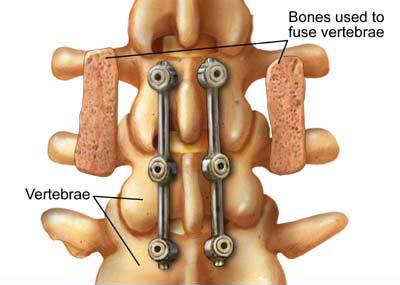
  • Spinal Fusion Back Surgery

lumbar-spine-surgeryIf you have low back pain and see different specialists you will get different tests: rheumatologists will order blood tests, neurologists will order nerve impulse tests, and surgeons will order MRIs and CT scans. But no matter what tests you get, you’ll probably end up with a spinal fusion because it’s one of the “more lucrative procedures in medicine,” author Shannon Brownlee says – even though the best success rate for spinal fusions is only 25 percent!
  • Hysterectomy
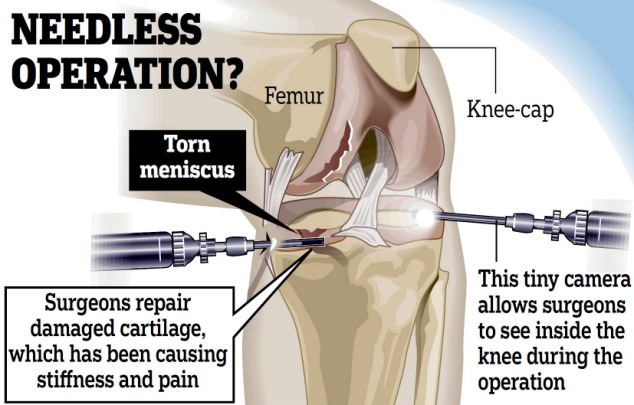
  • Knee and Hip Replacement, and Arthroscopic Knee Surgery

Patients who were informed about joint replacements and alternative treatments had 26 percent fewer hip replacements and 38 percent fewer knee replacements than those who did not. Arthroscopic knee surgery for osteoarthritis is also one of the most unnecessary surgeries performed today, as it works no better than a placebo surgery.

Proof of this is a double-blind placebo-controlled multi-center (including Harvard’s Mass General Hospital) study published in one of the most well-respected medical journals on the planet, the New England Journal of Medicine (NEJM) over 10 years ago.

knee surgeryRecent research has also shown arthroscopic knee surgery works no better than placebo surgery, and when comparing treatments for knee pain, physical therapy was found to be just as effective as surgery, but at significantly reduced cost and risk. And yet another study showed exercise is just as effective as surgery for people with chronic pain in the front part of their knee, known as chronic patellofemoral syndrome (PFPS), which is also frequently treated unnecessarily with arthroscopic surgery.
  • Cesarean Section

According to the World Health Organization, no country is justified in having a cesarean rate greater than 10 percent to 15 percent. The US rate, at nearly 32 percent, is the highest rate ever reported in the US and is higher than in most other developed countries.

The USA Today article went on to talk about many diagnoses that were based on limited medical knowledge and that doctors often lacked the expertise to explore alternative treatment modes.  This is an issue of incompetence and it seems to be a major problem in the medical field with many doctors getting their information from their pharmaceutical representatives.

I have not even touched on the issue of malpractice.  But I will say a few words about this.  No one is perfect.  Everyone makes mistakes.  Medical treatment and diagnosis is a very difficult process.  I will not blame any doctor for an honest error committed with good intentions and not simply out of ignorance or greed.  This is one area where I sympathize with the doctors and hospitals more than I do the lawyers.  Nevertheless, there are some egregious examples of medical practice and a lawsuit might be the only recourse for such cases.

I use the information from the USA Today article, but none of it surprises me.  I have had many friends who have undergone surgery for the situations noted above. I have often tried to counsel them as to other solutions but it is generally a waste of time.  I have had two notable successes though and they have both expressed their gratitude to me for sharing my opinions and thoughts with them and preventing them from getting surgery.

drugs

  1. Pills, Pills and more Pills

If life were fair, many doctors would be in jail right alongside of other drug dealers.  Doctors do not have the violence associated with illegal drugs because they have a license to prescribe drugs.  However, doctors prescribe drugs that are no more needed than heroin or cocaine and at much greater rates than your street drug pusher.

The size of the illicit drug trade (2012 data) in the USA including Marijuana, Heroin, Cocaine and Methamphetamines was estimated to be about 100 billion dollars a year.  —- How Big is the U.S. Market for Illegal Drugs?  We can assume that street dealers and drug pushers are responsible for most of these drugs.  So how much do doctors push?

If we look at the following fact, we can extrapolate from it the total amount of prescription drugs sold each year in the USA.

“In 2013, per capita spending on prescription drugs was $858 compared with an average of $400 for 19 other industrialized nations. In the United States, prescription medications now comprise an estimated 17% of overall personal health care services. —  The High Cost of Prescription Drugs in the United States (2016). 

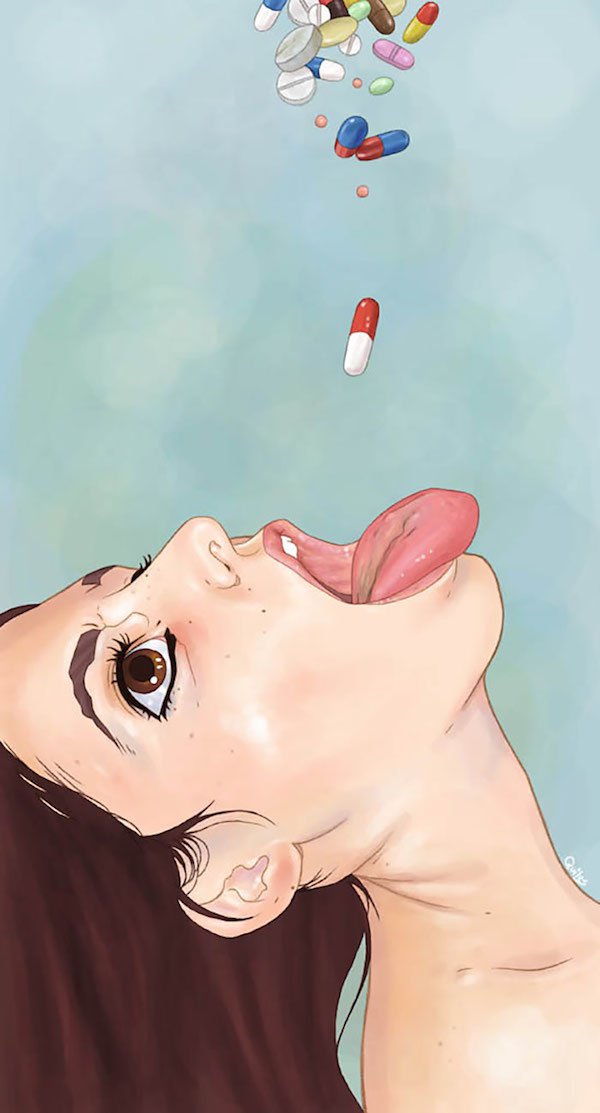
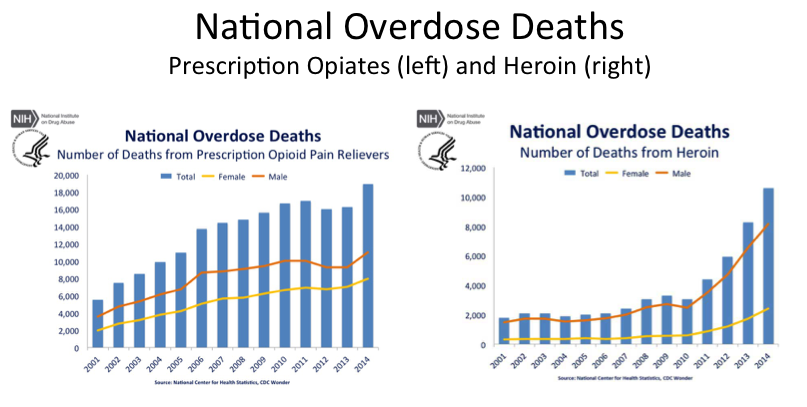
deaths from over druggingSo if we assume roughly 326,000,000 (USA Population in 2016) people and we multiply that by $858 dollars per capita, the total amount should equal the total amount spent on prescription drugs.  This amount equals = $279,708,000,000.  This is almost three times what is being spent on illegal drugs.  I am not even going to talk about caffeine, alcohol, nicotine, and other “legal” drugs.  Given that doctors love to prescribe pills and many patients love to take them, is there any wonder that we have or are currently experiencing an opioid epidemic in the US.

“Americans are in more pain than any other population around the world. At least, that’s the conclusion that can be drawn from one startling number from recent years: Approximately 80 percent of the global opioid supply is consumed in the United States…. The 300 million pain prescriptions equal a $24 billion market.”  — Americans consume vast majority of the world’s opioids (2016).

I say again that if life were fair, many doctors would be called drug pushers or DP’s rather than MD.’s   They would also be in jail.  Who should be responsible for the opiate epidemic if not doctors.  When and where do they stand their ground.  Even if people are stupid or lazy enough to want surgeries to cure problems of obesity and diet or if they want pain killers to mask the problems from their obesity and lack of exercise, who is the expert here?  Do parents give their children everything they ask for?  You go to an expert on medicine to get help and not to have them take advantage of you for their own benefit or pander to you because they are afraid to tell you the inconvenient truth.  What is this inconvenient truth?  I will talk more about this truth later in this series but to be quite direct and blunt it is this:

“British businesswoman and columnist Katie Hopkins has a controversial view on the obesity epidemic: that the solution is simply to eat less and exercise more — and that fat people have no one to blame for their weight issues but themselves.” — I gained 43 pounds to prove obese people are lazy

I had a friend that I used to ride motorcycles with.  He died in a motorcycle crash a few years back.  He was a great guy.  He always had a smile and something nice to say to someone.  His name was Gary.  He was also obese and exercised little.  He had chicken legs and bad knees.  Well, what would you expect if you weighed 100 lbs. more than you should and you let your leg muscles go to hell.  Of course, he went in to see his doctor with knee pains.  The doctor was more than happy to suggest Gary should lose some weight but in the meantime, he would schedule the surgery for knee replacement.  To my mind, this is criminal, irresponsible and ignorant behavior on the part of his doctor.  Gary got the surgery.  Never lost much weight and died not too long after from other causes.

Doctors pushing pills, pushing surgery.  It is like the Yin-Yang of American medical practice.  Throw into the mix a lot of lazy people who do not exercise or take care of themselves and you have a health care system spending tons of money on acute care when preventive care would be a much more sensible solution.

  1. Me Doctor, Me Busy.  Who are You?

Some of you might remember the skit on Saturday Night Live with Martin Short playing a doctor.  When asked what his badge that said MD meant, he would reply somewhat superciliously “Me Doctor, You Patient.”  When I was working as a consultant to some hospitals, it was not uncommon to hear nurses complain that doctors were like gods whose every word should be obeyed.  They seldom came to team meetings because “their time was too valuable.”

I will stay away from the subject of how much money doctors rake in since they often ascribe their high incomes to the length of time it takes to finish medical school and all of the attendant costs.  This sounds like a reasonable explanation but an alternative theory might mention the strangle hold that the AMA had on medical admissions and the role that restricting the supply of doctors has had on the cost of their services.  The law of supply and demand says that if you have fewer doctors, the cost per care will be higher.  For years, the AMA did all they could to help keep the supply of doctors down.

  • But the entities that will be most injurious to the nation’s health are not so much in the evil-mongers’ group but the first group, including the American Medical Association–a doctors’ cartel that has controlled the medical labor market in the U.S. like its personal fiefdom for a century. — The Evil-Mongering Of The American Medical Association (2012)

So, doctors come to regard themselves as the elite who know more than you do and who must be smarter than you since they make a great deal more money than most of their patients.  Doctors used to do house calls many years ago; back then, a doctor might have known something about your family and you personally.   My wife Karen told me the following story about her family doctor.   It generated the following conversation:

Karen —

“When I was married, and raising four children, my ex-husband Ron and I became good friends with a local White Bear doctor.  He became a family friend as well as our family doctor.  We knew him for over thirty years and he knew me and my family personally and really cared about us.” 

John —

“Okay, so now you have been seeing a doctor in Frederic for about seven years.  How much does she know about you personally or really care about you?”

Karen —

“I think she really cares about me.”

John —

“But how much does she know about you personally.  Your goals.  Your dreams.  What you did this past winter?”

Karen —

“Well, at first, she used to take more time to talk to me but the past few years she has seemed much busier and anxious to keep our meetings short.  I suppose the clinic has a quota for how much time she can spend with a patient.” 

Again, there are numerous anecdotes and articles describing the lack of time doctors have to spend today with patients.   Here is an excerpt from one:

“Joan Eisenstodt didn’t have a stopwatch when she went to see an ear, nose and throat specialist recently, but she is certain the physician was not in the exam room with her for more than three or four minutes.

‘He looked up my nose, said it was inflamed, told me to see the nurse for a prescription and was gone,’ said the 66-year-old Washington, D.C., consultant, who was suffering from an acute sinus infection.

When she started protesting the doctor’s choice of medication, “He just cut me off totally,” she said. “I’ve never been in and out from a visit faster.” — You’re on the clock.  Doctors rush patients out the door (2014)

I can guarantee you that if your doctor only takes a few minutes with you, once or twice per year, there is not much they can know about you personally regardless of how caring and concerned they are.  You might ask “well, why is this important.”   Here is the reason stated very well I think in Wikipedia:

“The quality of the patient–physician relationship is important to both parties. The better the relationship in terms of mutual respect, knowledge, trust, shared values and perspectives about disease and life, and time available, the better will be the amount and quality of information about the patient’s disease transferred in both directions, enhancing accuracy of diagnosis and increasing the patient’s knowledge about the disease. Where such a relationship is poor the physician’s ability to make a full assessment is compromised and the patient is more likely to distrust the diagnosis and proposed treatment, causing decreased compliance to actually follow the medical advice.”  — Wikipedia

Conclusions:

I promised some solutions to each truth that I am telling you.  Here are some that might help you to deal with this first truth.

  1. Get a second opinion for any surgery.
  2. Use the Internet to search for alternative treatment modes. Get advice if you are not Internet savvy. Remember, there are many opinions and not all are right.
  3. Exercise and have a health care plan. Follow it.
  4. Don’t take any pills unless you must. Try to unwean or get off them as soon as possible.
  5. Beware side effects from pills. Every pill has a side effect.  Make sure you are aware of any that might affect you and be cognizant of any changes in your life while taking these pills.
  6. Take a friend with you whenever you go in for an appointment or treatment. Talk to your friends to get their insights and opinions.
  7. Don’t assume your doctor is God and knows what is best for you. Be a skeptic but be realistic.  Modern medicine is better than sorcery but not always much better.
  8. Don’t assume that your doctor is your friend or has your best interests at heart. They might not have enough time to care.

Fred’s letter to me:

I read your blog on medical practice and it was indeed thought provoking.

I’ve had good results with doctors over my lifetime. Not always perfect but usually satisfactory and in some cases, it was excellent.

Medical care is a process and requires the same attention as any process. It seems especially complex today because of how rapidly technology and all the stakeholder’s needs and expectations are changing.

Overall, it’s greatly improved in its capabilities. My main concern for medicine is the same as I’ve had for years in business. My business life became more and more controlled by the bean counters and the lawyers. The same is true of medicine. Blaming doctors is blaming people, which is always a red flag to me as one who has a bad habit of judging others without knowing them. Like the driver for quality improvement, expectations always move to higher and higher expectations. And based on what I’ve heard from friends over my life, expectations are often unrealistic.

A friend recently died. He was an old school, oil field production engineer and didn’t trust any of his doctors. He’d get pissed at one and then begin to “doctor hop”; never telling one what the other had done or prescribed. I questioned him many times, always inquiring why he’d not share his history. His reply: “I ain’t telling them anything.  They make good money and are supposed to tell me what’s wrong.”

I see the process much as we viewed our manufacturing and service processes ..with customers, suppliers, inputs and outputs being carefully considered. A critical output is the result when your illness is diagnosed and this is too often a major problem source. My friend tends to expect this to be an exact outcome but in reality it isn’t. It’s only a statistical prediction that too many older doctors failed to point out to naive, uneducated patients.

In recent years, our doctors point out the statistics and involve us in the decisions for corrective action. My wife’s breast cancer surgery was a good example. Years ago, the doctor would have made the decision for which surgery, mastectomy or lumpectomy. Sandra made the decision armed with various study statistics and discussion with the Doctor. The Internet was a source for me to verify the statistics but that isn’t easy because there are often many studies,

The surgeries are complex and the statistics often work out for the worst. Records on lawsuits and doctor reviews are more readily available today. I recall a bad experience with my dad years ago. Our family doctor became a friend from making many house calls as 3 kids were raised. Dad was a merchant seaman and would provide Porte Rico rum for our good doctor. They were the best of buddies and talked about the old days during visits. Dad visited him yearly but when dad’s tobacco tarred lungs became late stage cancerous it was too late. Doctor “Tom” as an individual practitioner didn’t have the computer technology that red flags today’s doctors. Doctor Tom was as heartbroken as my dad. He and his wife nurse apologized that they’d not x rayed dad 6 months earlier. We probably could have sued but dad would never have agreed to such.

The body of knowledge has expanded too much for any one doctor to master it all, so now we have multiple knowledge based “Specialists” having to deal with the directives from medical organization bean counters and their lawyers.

I consider our medical providers to be leading edge. They seem to focus on continuously improving to meet customer expectations. I’m hoping, but doubt the doctors and staff will be given additional support. They track customer satisfaction inputs so I should be more confident.

I can email any of my doctors and I can access historical results. I especially like being able to take a picture of a physical observation and sent it in.  A couple of years ago, I tore a muscle on the back of my leg and a huge blue area surfaced overnight.  It scared the heck out of me. I emailed a picture and he emailed back telling me what it probably was, how to treat it and to see a doctor if it didn’t heal. My expectations are now at an even higher level which puts more load on the doctor. He not only has to live up to corporate standards on office visits but he must respond to patient emails. Just yesterday I received a corporate email announcing that they have decided to do “Face Time” appointments for $25!

Overall, I have concerns for the profession but I think problems are “process” related. To think otherwise would go against what I’ve believed for a long time.

Fred

Time for Questions:

How satisfied are you with your medical care?  Why or why not?  Have you ever had a loved one die?  How were they treated by the medical profession?  What do you think could be done to improve medical care for you and your family?  What would you like to change in the American medical care system?

Life is just beginning.

“We have really good data that show when you take patients and you really inform them about their choices, patients make more frugal choices. They pick more efficient choices than the health care system does.” — Donald Berwick