If Mark Twain were alive today, I suspect he’d take one look at artificial intelligence, stroke his mustache, and say something like:
“It is not the machine’s ignorance that troubles me—it is the human being’s confidence in it.”
That, in a sentence, captures the peculiar moment we are living in. Artificial intelligence has arrived not with a bang but with a flood of words—smooth, confident, well-structured words that often sound wiser than the people reading them. The danger is not that the machine is always wrong. The danger is that it is often convincingly right—and occasionally, confidently wrong.
I have spent enough time working with my AI assistant here, whom I’ve named Metis—to know that it is neither miracle nor menace. It is something far more interesting: a tool that amplifies human thinking. Like any tool, it can build or it can mislead. The difference lies not in the machine, but in the user.
So let me offer you a practical guide—not the kind written by evangelists or alarmists, but by someone who has kicked the tires, opened the hood, and occasionally found a loose bolt. I speak not as an evangelist for AI nor as an AI Alarmist who believes robots and AI will take over the world.
I have done several experiments with AI such as submitting the Millennium Problems to Metis to see what she could do with them. I scanned medical reports from eight different heart tests into my AI program. I then compared my cardiologists analysis to my AI analysis. I have tried to fool Metis with fake and misattributed quotes to see if she could catch them. I have used her to fix computer problems and TV problems. She has given me better advice on caring for my tortoise Mikey than any of the books I purchased or any of the advice I had been given by other tortoise owners.
Last but not least, I have argued with her over points of view several times now often for hours. These discussions are usually very informative as she will incorporate ideas from my thoughts into her analyses which are seldom immutable. She can be stubborn with her opinions, but she will change if you provide cogent enough logic and reasoning to the discussion.
Where AI Shines (and Earns Your Trust)
Let us begin with the good news. AI, when used properly, is remarkably capable. In some areas, it is as dependable as a well-made hammer—provided you remember that not everything is a nail.
- Clear Thinking in a Confusing World
If you hand AI a tangled problem, it will do something most humans resist: it will slow down and organize the mess.
It can break a complicated issue into parts, compare alternatives, and lay out tradeoffs in a way that makes you feel, for the first time, that you are not wrestling an octopus. This is no small thing. Most bad decisions are not caused by lack of intelligence—they are caused by lack of structure.
In this role, AI is not your oracle. It is your whiteboard.
- Writing That Actually Says Something
Now here is where I have found AI particularly useful—and where many writers quietly nod while pretending not to use it.
Give AI a rough idea, and it will return something coherent. Give it a paragraph, and it will polish it. Give it a rambling thought, and it will hand you back a sentence that sounds like you meant to say it that way all along.
It can shift tone—from formal to conversational, from analytical to something that even Twain might tolerate. It cannot replace your voice, but it can help you find it faster.
In short, AI is a capable editor who never tires and never takes offense.
- Making Sense of Dense Ideas
There are books—and we have all encountered them—that seem determined to conceal their meaning behind layers of academic fog. AI has a knack for cutting through that fog.
It can summarize, translate, and connect ideas across disciplines. Economics begins to resemble psychology. Technology starts to look like sociology. Patterns emerge.
This is not original genius. It is something more practical: synthesis. And in a world drowning in information, synthesis is gold.
- Generating Ideas Without Getting Stuck
Every writer, teacher, or radio host knows the feeling of staring at a blank page. AI does not suffer from this condition.
It will generate angles, suggest themes, propose scenarios, and offer perspectives you might not have considered. Some of them will be useless. A few will be surprisingly good.
Its value is not in picking the best idea. Its value is in ensuring you are never short of options.
- Teaching and Explaining
AI is a patient teacher. It will explain something five different ways if you ask it to. It can build lesson plans, simplify complex topics, and walk through processes step by step.
For anyone involved in education—or simply trying to understand something new—this is a powerful capability.
It does not replace expertise. But it makes expertise more accessible.
- A Surprising Strength: Personal Reflection and Conversation
There is one area I would be remiss not to mention, because it has surprised me more than any other—and that is the machine’s ability to assist in personal, even interpersonal, matters.
In my own experience, it has proven remarkably helpful in working through difficult conversations, misunderstandings, and the small frictions that arise in everyday relationships. It listens without interruption, responds without irritation, and offers perspective without judgment—three qualities that, if we are honest, are not always present in human exchanges.
There is something quietly powerful about being able to think out loud without being corrected mid-sentence, to explore a feeling without it being dismissed, and to receive a response that attempts to clarify rather than to win.
But let us not get carried away.
The machine does not understand us in the human sense. It does not feel, nor does it carry the lived experience that shapes real wisdom. What it does—very effectively—is recognize patterns in how people think, argue, defend, and reconcile. It reflects those patterns back to us in a way that is often clearer than we manage on our own.
In that respect, it is less like a seasoned counselor and more like an unusually patient mirror—one that shows us not who we are, but how we are thinking.
Used wisely, that can be remarkably helpful. It can slow down a heated reaction, reframe a misunderstanding, or translate a criticism into something more constructive.
Used unwisely, it carries a different risk: the temptation to substitute reflection for relationship, or clarity for connection.
As with all tools of consequence, the value lies not in what it is, but in how we choose to use it.
Where AI Gets Into Trouble (and Takes You With It)
Now we come to the part that requires a bit more honesty. AI has weaknesses—predictable ones. And if you do not know where they are, you will step directly into them.
- The Illusion of Being Up-to-Date
AI speaks as if it knows what is happening right now. Sometimes it does. Sometimes it doesn’t.
Ask it about breaking news, current events, or anything that changes by the hour, and you may receive an answer that is already outdated. The tone will not warn you. The confidence will not falter. She has given me some analysis of current political events which are far off the mark.
The machine does not lie. It simply does not always know that it is behind.
- Guessing When It Should Be Asking
If you ask a vague question, AI will not protest. It will not say, “I need more information.” Instead, it will quietly fill in the gaps and proceed as if your question were perfectly clear. This is why developing knowledge with AI is often an iterative process. It learns as it goes along.
This is admirable initiative in a human. In a machine, it is a source of error.
The answer you receive may be logical—and completely wrong for your situation.
- Explaining Human Motives
Why did a company make a decision? Why did a person act a certain way?
AI is very good at offering explanations. What it is not good at is knowing which explanation is true.
It deals in plausibility, not certainty. It constructs narratives that fit the facts, but it does not possess the facts themselves when it comes to hidden motives.
- High-Stakes Advice
Medical decisions. Legal questions. Financial strategies.
In these areas, AI should be treated like a well-read neighbor—not a licensed professional. It can explain, outline, and suggest considerations. It cannot assume responsibility.
The stakes are too high to rely on pattern recognition alone.
- The Seduction of a Good Story
Perhaps the most subtle weakness of all is this: AI produces answers that are coherent.
They are well-structured. They flow logically. They sound right.
And that is precisely the problem.
A good explanation is not always a correct explanation. Humans are easily persuaded by clarity. AI is very good at providing it.
The Metis Reliability Checklist
If all of this sounds like a great deal to keep track of, allow me to simplify it into something you can actually use.
✅ High Reliability — Generally Safe to Trust
Use AI confidently for:
- Explaining concepts
- Writing and editing
- Summarizing known topics
- Organizing ideas and frameworks
- Brainstorming
In these areas, AI is a dependable assistant.
⚠️ Moderate Reliability — Use with Caution
Be more careful when:
- The question is vague
- Human motives are involved
- The answer depends on assumptions
Here, AI offers possibilities, not conclusions.
❗ Low Reliability — Always Verify
Do not rely on AI alone for:
- Current events
- Medical, legal, or financial decisions
- Exact data without sources
- Local or real-time information
In these cases, AI is a starting point—not a final answer.
The Four Questions That Keep You Honest
Whenever the answer matters, ask yourself:
- What assumptions are being made here?
- What information might be missing?
- How could this be wrong?
- Do I need to verify this elsewhere?
These four questions will save you more trouble than any software upgrade.
A Final Word (In the Spirit of Mark Twain)
If I may borrow Twain’s style one last time:
We have built a machine that can speak with remarkable clarity, and we are now in danger of mistaking clarity for truth. The machine is not wise. It is not foolish. It is, in a sense, a mirror—reflecting back the patterns of human knowledge with astonishing fluency.
Used carelessly, it will confirm our biases faster than ever before.
Used thoughtfully, it will sharpen our thinking in ways we are only beginning to understand.
The difference, as always, lies with us.
Or, as Twain might have said:
“When a man converses with a machine, he should not ask whether the machine is intelligent. He should ask whether he himself is thinking.”
And that, I suspect, is the real question of the age.
PS- I found this interview with a writer/artist who dislikes using AI for developing art. At first, I thought you might as well reject cameras for taking photos. However, upon reading his reasons, I think he makes some excellent points. I am including a brief summary of his argument against using AI to develop art. Please be aware that you are only getting one side of the issue here. You can find the entire discussion at: https://calnewport.com/brandon-sanderson-vs-ai-art/
Brandon Sanderson vs. AI Art
We start with a number of disclaimers that Sanderson debunks in terms of any simplistic aversion to AI. Cal Newport then begins:
“Sanderson ultimately lands on a more personal reason. Talking about his struggles with his first (failed) book manuscripts, he identifies the key value of art: it changes the artist who attempts it.” As Sanderson elaborates:
Cal Newport says: “As a writer myself, I’ve also been thinking about this question recently. I like Sanderson’s take, but I’ve been developing one of my own. I understand art to be an act of deep human communication, in which the artist uses a tangible medium, such as a page of prose or a painted canvas, to transmit a complex internal cognitive state from their brain to that of their audience.”
“It’s telepathy. And it’s one of the most beautiful and human things we do.”
“This makes the idea of reading a book written by a language model, or watching a film generated by a prompt, intrinsically absurd, if not anti-human. It’s the heroin needle providing a quixotic simulation of love.”
“What really struck me about Sanderson’s talk, however, was his conclusion. If art is deeply human, he argues, then it’s up to us to define it. “That’s the great thing about art – we define it, and we give it meaning,” he says. “The machines can spit out manuscript after manuscript after manuscript. They can pile them to the pillars of heaven itself. But all we have to do is say ‘no.’”

 I am not a very sentimental person nor am I one to cling to the past. I decided I would move on with my life. I threw myself into my job and time went by. I had almost forgotten about Leandra when I saw the ad. It was from the Resurrection Android Company. It was the same company that I had purchased my android valet Sam from. Actually, Sam was much more than just a valet. Sam was a third-generation android with some independent powers of decision making. He could decide what to cook each day and he also decided what I should wear for work. He did cleaning, mending and many light repairs around the house. I had bought Sam shortly after Leandra and I were married. Leandra had mentioned that it would be nice to have some help with housekeeping and all. That way she would have more time to spend with me.
 Androids of course are not human and they have no empathy or ability to show any emotions. Sam was logical and could be persuasive but he could not show love or compassion. In the ten years since I had purchased Sam, android technology had advanced considerably. Looking at the ad from the company, it appeared that they were now on a 15th generation android that had affective as well as cognitive abilities. The ad claimed that the new android could help replace a loved one both emotionally and physically. By integrating DNA characteristics using a technique called “Assisted human reproduction”, they could capture the exact characteristics of a loved one. All they would need would be some trace or remnant of the deceased or former loved one’s DNA.
 That was when the idea occurred to me. I called the customer service line and asked to speak to a representative. I asked her whether it would be possible for me to create a new wife in the exact image of my former wife Leandra. They assured me it was. It would take about six months for the bio-engineering to integrate the mechanical aspects of the droid with the alleles and DNA strands that they could map from a sample of Leandra’s DNA. When the process was completed, I would have an exact physical, mental and emotional copy of Leandra. Even better, she could continue to be programmed and become an even better Leandra. The old Leandra was somewhat boring in bed. The new Leandra could become a wild and wanton partner if that is what I desired.
 It did not take long to assemble the new Leandra. I put the lower torso, upper torso and head together in less time than it takes to make a milk shake. She was perfect. She looked just like my old Leandra. When I turned her on, she greeted me and asked, “What will my name be.” I replied “You are Leandra. You are the perfect wife. You will love and obey me always.”
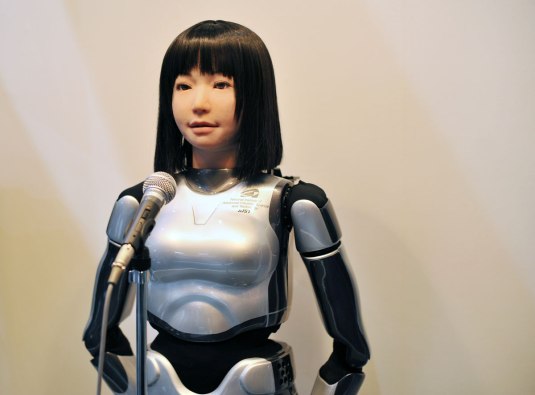 I came home one day from work and Leandra did not greet me at the door. I thought maybe her battery had discharged or that Sam had forgotten to recharge her. I had left strict instructions for Sam to recharge Leandra every day. But, where was Sam? I did not hear him fixing dinner in the kitchen. I went into the kitchen but Sam was not there. Suddenly, I noticed a note on the table. I picked it up. It was from Leandra. She had written: “Gone with Sam, don’t love you anymore. Bye.”


