Five Westerns and Five Moral Universes: What Old TV Shows Still Teach Us About America

By John Persico (with a lot of help from Metis)

In the late 1950s and early 1960s, American television was overrun with cowboys.  Westerns galloped across nearly every network, each one promising a different angle on courage, justice, and the messy human struggle to build a society out of dust and gun smoke.  We tend to remember the big ones—Gunsmoke, Bonanza, The Rifleman—but tucked in that crowded landscape were several thoughtful, sometimes surprisingly philosophical shows that tried to answer deeper questions about right and wrong.

I have always loved cowboy shows.   My favorite cowboys when I was growing up were Hopalong Cassidy, the Lone Ranger and Roy Rogers.  Most of these men got their start in the 30’s but their shows migrated to the TV medium when it was first started.  Many episodes of Hopalong were taken from his early movies.  Later, TV started to develop its own cowboy series with weekly episodes of tall, dark and handsome heroes.  By this time in the late 50’s and early 60’s I was not watching TV anymore.  I was in my early teens and had better things to do than watch TV.  Thus, I never watched the five shows that I am going to talk about in this blog when I was young.

I only started to watch these old TV shows a few years ago.  I was rather amazed at the quality of the stories that they told.  They were nothing like many of the TV series that came around later characterized by many more shootouts and gun fights.  These early TV shows tried to convey a strong sense of morality and featured a more discreet and thoughtful use of gunplay.   Many of the heroes in these shows eschewed violence and attempted to use reason to end a fight rather than gunning down a villain.   

Five of these Westerns—The Tall Man, Wyatt Earp, The Restless Gun, Tombstone Territory, and The Texan—offer a fascinating window into how Americans of that era imagined moral life on the frontier.   Each operated in a different moral universe.  Together, they reveal a whole spectrum of values still relevant in 2025: authority vs.  independence, violence vs.  restraint, institutions vs.  personal codes, loyalty vs.  law.

Here’s what these shows have to teach us when we dust them off and look again.

The Tall Man: Tragedy, Friendship, and the Gray Zone of Morality

Among these Westerns, The Tall Man stands out for its dramatic complexity.  Rather than presenting the frontier as a struggle between clear-cut good and evil, the series explored the psychological and moral tensions between Pat Garrett and Billy the Kid—historical figures already steeped in myth.  The show emphasized the tragic inevitability of their relationship: Garrett, the reluctant lawman; Billy, the charming outlaw whose charisma repeatedly outpaced his judgment. These were not cardboard heroes and villains; they were complicated men bound together by loyalty and destiny.

The morality here is not a simple endorsement of law or rebellion.  Instead, it suggests that human loyalties are fragile, destiny is unforgiving, and justice often emerges from personal conflict rather than abstract principles.  It is a Western operating in shades of gray, reflecting an America grappling with Cold War dilemmas where allies and enemies were not always easy to distinguish.  Viewers recognized themselves in the struggle between duty and friendship, a theme uncommon among early Westerns.

The underlying message was that life often puts us in situations where justice isn’t neat.  Friendship can clash with duty.  Good intentions can slide into the wrong choices.  And sometimes the person you care about most becomes the person you eventually have to confront.

In that sense, The Tall Man feels strikingly modern.  It understands that real life doesn’t divide neatly into good guys and bad guys—something America in the Cold War era was just beginning to wrestle with.

Wyatt Earp: The Comfort of the Uncomplicated Hero

If The Tall Man reveled in moral ambiguity, Wyatt Earp offered the opposite: a mythologized portrait of the West’s greatest lawman, played with crisp, upright dignity by Hugh O’Brian.  This series promoted a worldview in which society advances only when firm, principled authority imposes order on chaos.  Earp serves as the archetype of the responsible American leader—a man who does not relish violence but accepts it as a necessary instrument of civilization.

Earp represented the belief that civilization requires firmness.  Order doesn’t grow on its own—it has to be imposed by strong, decent people who are willing to shoulder responsibility.  For postwar America, still anxious about the atomic age and the looming tensions with the Soviet Union, this moral clarity was reassuring.

The show’s moral message resonated with 1950s ideals of stability: strong institutions, disciplined citizenship, and faith in the ability of virtuous leaders to “keep the peace.” It aligned neatly with postwar values, especially the belief that social progress requires firmness rather than moral compromise. Earp rarely doubted himself, and the series rarely doubted him either.  Its clarity, even rigidity, provided reassurance during an era troubled by atomic anxieties and Cold War uncertainty.

Earp didn’t struggle with his conscience—he was the conscience.

The Restless Gun: Pacifism in a Violent Landscape

In sharp contrast to both Garrett and Earp stands Vint Bonner of The Restless Gun, one of the few early Western heroes who actively sought alternatives to violence.  Bonner modeled the idea that courage is not measured by willingness to kill but by the ability to resolve conflict through empathy, reason, and patience.  Yes, this was a Western.  Yes, he still ended up in gunfights.  But the moral direction of the show pointed firmly away from killing and toward understanding.

This places The Restless Gun closer to a moral philosophy of restorative justice than frontier retribution.  In many episodes, Bonner functioned as a mediator, teacher, or counselor.  The villains were not always evil; they were often misguided, desperate, misinformed, or trapped in circumstances they could not manage.  The show’s worldview subtly challenged the Western convention that justice flows from the barrel of a gun.  Instead, it argued that America’s future might depend more on understanding than dominance.

This made the series unusually modern, anticipating later Westerns such as Have Gun, Will Travel, which incorporated moral complexity into the traveling-gunman archetype. Though the show ended early, its worldview remains distinctive in the genre.

In a genre built on bullets, The Restless Gun dared to say: there is another way.

Tombstone Territory: Justice as a Public Responsibility

Tombstone Territory offered a more institutional perspective on frontier justice. Structured around the fictional Tombstone Epitaph newspaper, the show dramatized the challenges faced by Sheriff Clay Hollister in maintaining order within a volatile, fast-growing community.  Unlike Wyatt Earp, where the marshal’s authority was never questioned, Hollister constantly wrestled with public scrutiny, political pressure, and misinformation—issues that eerily foreshadow the modern news cycle.

The moral heart of the series lies in its quasi-documentary tone. Hollister must uphold the law not simply by enforcing it, but by navigating competing interests, calming mobs, and maintaining legitimacy.  Truth, evidence, and due process—rare elements in early Westerns—become central themes. The show’s structure echoes the belief that justice is not merely an individual virtue but a collective responsibility.  It encourages viewers to appreciate the difficulty of governing rather than merely celebrating the lone hero.

In many ways, Tombstone Territory anticipated the later rise of procedural dramas where law enforcement is portrayed as an institution rather than a personal crusade.

The show’s moral center was institutional: justice requires process, evidence, and the difficult work of maintaining legitimacy.  It wasn’t glamorous.  But it was honest.  In many ways, Tombstone Territory speaks more directly to our modern world than some of the bigger Westerns of its time.

The Texan: The Noble Drifter and the American Myth of Honor

Rory Calhoun’s The Texan returned to the classic Western figure of the noble wanderer—a man whose moral code is internal rather than institutional.  Bill Longley, a Confederate veteran, embodies the Western ethos of individual honor: help the vulnerable, confront injustice, and ride away when the dust settles.  The show foregrounds personal integrity over law, suggesting that character—not institutions—ultimately preserves the frontier’s fragile social fabric.

This worldview reflects an enduring American belief in self-reliance and moral autonomy. Longley’s wanderings represent not rootlessness but a spiritual quest to repair the world one town at a time.  His code is chivalric, almost knightly, and he stands as a corrective to the bureaucratic tensions seen in Tombstone Territory.  While he respects the law, he serves a higher standard—his own conscience.

Longley wasn’t defined by the law, nor by institutions.  His moral compass was internal.  He showed that a single person—armed only with decency and grit—could make things a little better wherever he went.

It is the Western as America likes to imagine itself: independent, honorable, and self-reliant.  Even if it rarely works that way in real life, the aspiration is part of our national DNA.

Five Shows, Five Moral Visions

When you line up these Westerns side by side, the moral variety is remarkable:

  • The Tall Man explores the tragedy of conflicting loyalties.
  • Wyatt Earp celebrates firm authority and disciplined leadership.
  • The Restless Gun champions compassion and restraint.
  • Tombstone Territory elevates due process and public trust.
  • The Texan extols personal conscience as the highest law.

Together, they show how deeply Americans were thinking—even through half-hour cowboy shows—about law, justice, violence, and the kind of people we wanted to be.

And perhaps that is the most interesting lesson of all: Westerns weren’t just entertainment.  They were moral storytelling, played out on horseback.

In dusting off these forgotten classics, we rediscover a whole range of ethical possibilities—some stern, some gentle, some tragic, some idealistic.  The frontier wasn’t just a place; it was a metaphor for the ongoing journey America has always been on: trying to figure out how to live decently in a world that is not always decent.

What Happened to These Shows and the Morality that They Tried to Convey?

  1. The Tall Man (1960–1962)

Why it was cancelled:

  • Ratings sagged as audiences drifted toward lighter, family-friendly Westerns and bigger stars.
  • NBC also faced increasing difficulty with script standards: portraying Billy the Kid sympathetically clashed with emerging TV violence guidelines.
  • Production costs were rising, and no strong sponsor stepped in to keep it going.
  1. The Life and Legend of Wyatt Earp (1955–1961)

Why it was cancelled:

  • After six seasons, the formula grew repetitive, and the mythologized Earp no longer impressed audiences seeking the grittier realism of later Westerns.
  • Hugh O’Brian wanted to move on, and ABC saw declining ratings.
  • The Western market was oversaturated by 1961.
  1. The Restless Gun (1957–1959)

Why it was cancelled:

  • Despite solid ratings, Payne’s contract and salary demands increased, and NBC hesitated to renew at higher costs.
  • The show’s gentler tone was overshadowed by edgier Westerns.
  • Payne himself said he felt the stories were becoming repetitive.
  1. Tombstone Territory (1957–1960)

 Why it was cancelled:

  • Transition from ABC to syndication hurt the budget.
  • Stiff competition from higher-budget Westerns.
  • The semi-documentary framing was admired but not loved; viewers were shifting toward character-driven stories.
  1. The Texan (1958–1960)

Why it was cancelled:

  • It had strong early ratings but lost its time slot advantage to more modern “adult” Westerns.
  • Calhoun’s outside film commitments strained scheduling.
  • CBS was phasing out lower-budget half-hour Westerns in favor of hour-long dramas.

Each show ended for slightly different reasons, but the common story is:  the genre evolved faster than these earlier, simpler morality tales could adapt.  Americans wanted more “grit” more “violence” and yes even less morality.  The change from John Wayne to Clint Eastwood capped the change that we would see in Westerns from morality tales to tales of vengeance and retribution.  America was becoming more jaded.  We did not want heroes any more who were goody two-shoes.  We wanted anti-heroes and the studios offered them up in droves. 

Looking at American politics today, I often wonder where, when and how the decline in values, integrity and morality started.  Some would say it started with the decline in religion.  I don’t think religion has in the last 200 years in the USA been that big of an influence in terms of morality and integrity.  Karl Marx always believed that economics was the major driver of most social trends.  Many people who disagree with him nevertheless admit that the primary influence on voting behavior is the state of the economy.  In my opinion, this influence goes much deeper than voting behavior.  Capitalism thrives on avarice and stupidity.  It needs a large mass of people who want more and more stuff and too brainwashed to realize that the stuff they are buying is not going to bring them happiness. 

Madison Avenue became a major influencer with the advent of TV.  Go back and look at some of these early Westerns.  Smoking was de rigor.  Many of the heroes of these early Westerns died of lung cancer.  Legendary figures like John Wayne, Gary Cooper, and Chuck Connors, with numerous other actors, musicians, and public figures from that era also falling to the disease, highlighting smoking’s heavy toll in Hollywood.  But while these heroes were dying, Madison Avenue was perfecting the use of TV to sell all kinds of products. 

I always laugh at the fact that so many men have been conned into buying what I call “piss beer” from Budweiser, Miller and Coors.  Large macho football players posing in a bar with these watered down beers spent years on TV regaling their followers with the virtues of light beer.  Would be macho males stormed the liquor stores to buy their six pack of piss beer that they could swill down while watching their favorite football teams playing.  The average person is brainwashed by Madison Avenue on a daily basis.  Watch some of the old TV shows and see how much more sophisticated the ads are today.

I once asked all my MBA students if they thought that TV ads had much influence on their buying patterns.  The typical answer I received was “No, I make up my own mind when I go shopping.”  Most people do not even know that they are brainwashed.  The cigarette industry spent years lying to people about the medical effects of cigarettes.  Today, it is the liquor companies that are lying to consumers.  But all of Capitalism and advertising has one major motive when it comes to making a sales pitch.  That motive is too make you feel inferior.  To make you feel needy.  To make you feel inadequate.  Once you feel like you are somehow lacking something, they can pitch you their product.  Their pitch will always be that you will be better, smarter, faster or happier with their product or at least you will be better, smarter, faster and happier than your next-door neighbor who did not buy their product.

I believe the decline in morality and integrity in the USA can be directly linked to Madison Avenue and the brainwashing they conduct on consumers.  If you are on the producers side of the economic equation, you cannot have any qualms about what you are selling or the side effects or the unintended consequences of the use of your products or services.  If you are on the consumer side of the economic equation, your whole reason for being is to buy more and more stuff regardless of its impact on your health and sanity or the environment.  This callousness on both sides has resulted in a society that is unparalleled in terms of greed and avarice. 

The old Westerns were like some of the early fairy tales.  They had a motive beyond entertainment.  They existed to convey a morality that eventually seemed too simplistic and certainly too limiting.  Morality is a unique virtue in the sense that it not only asks you what you are doing for yourself, but it also asks what are you doing for others. Morality cannot coexist with Capitalism any more than Capitalism can coexist with Communism.  We need a new economic system based on principles of love, trust and compassion for ALL the people in world and not just our friends or relatives or the people in our own country. 

Happy Thanksgiving to all the Writers, Authors and Bloggers out there.  Here is a Gift to You from Me

For Thanksgiving this year, I want to share some advice with you that I recently shared with a friend.  There is an old saying “Never give advice.  Wise men don’t need it and fools won’t heed it.”  I am going to part with this wisdom and give you the same thoughts that I shared with my friend.  These come from 35 years or more of writing five books, publishing nearly 30 professional articles and now more than 1700 blogs.  I have taken numerous writing classes and while working on my Ph.D. degree published about a dozen or so academic manuscripts.  During the ten years of my writing classes with Dr. Carolyn Wedin, I wrote several articles that were published in the local newspaper.  I also  had a monthly column in a national magazine called Quality.

All of these “credentials” have not earned me a Pulitzer prize or any other prize.  My books never earned enough royalties to pay for my time.  Nothing I ever wrote made the Amazon or Times best seller list or any other best seller list.  My mother used my doctoral dissertation for a door stop.  A scanning of my followers and the total number of hits on my blog do not amount to enough to fill a teaspoon with much less rival Taylor Swift’s fan base or her daily hits.

Heartache, heartbreak and a desire for recognition help me to identify with Hemingway and others.  Google AI says that “A high rate of suicide has been found among those working in literary occupations, with many citing battles with mental illness, alcoholism, and professional struggles as contributing factors.”  I cannot swear that my malaise is the same as Sylvia Plath’s or Ryūnosuke Akutagawa’s or Hunter Thompson’s.  However, I have had numerous spates of depression and self-doubts wondering if I am really any good as a writer?  What should I really be writing?  Am I just a hack with delusions of being a good writer?  When I die, will anyone remember a single thing I wrote?  What do I do this for?  What do I hope to accomplish?

Thus, when I sensed my friends quandary in dealing with some of these same issues, I took a minute to send him some advice that that I need to heed myself.  Who said the “Cobbler’s kids always need shoes.”  Such is often true for those giving advice.  Nevertheless, perhaps you can be kind to me this Thanksgiving and forgive me for giving you some advice.  Thoughts that will probably not bring you a Pulitzer Prize or even get you a free coffee.  Here is what I wrote to my friend with some minor editing.  I hope you may find some of my thoughts useful in your writing journeys.

________________________________________________________________________________________________________

To My Friend Dave,

I received your query about reading your blogs.  Take my advice or leave it.  But do not worry about who reads your blogs, how many blogs they read, if they like your blogs or not, if they like your religious beliefs or if they like the style of music that you often reference in your blogs.

Write for one reason only.  Write for yourself.  if you must have a statistic for your readership.  Make it only one person a month who enjoys your blogs and finds value, merit, solace or meaning in them.  Jesus said, “Do not hide your light under a basket.” You have a lot to offer people but mostly yourself.

Write like there is no tomorrow.  Write like you love humanity.  Write like you want to save the world.  Write like it will be your last day on earth and you want to make it meaningful.  Write full of passion.  Write for fun.  But don’t worry about how many people love you or love your messages.

Buddha, Moses, Jesus, Mohammed, Baháʼu’lláh and many other great leaders did not worry about how popular they were or do any opinion polls, that I know of.

Happy Thanksgiving

From Hopefully, Still Your Friend,

John 

________________________________________________________________________________________________________

Happy Thanksgiving to all of you writers, bloggers, poets and authors as well. 

May this be a day full of blessings and gratitude for all of us. 

But let us not forget the people who have much less than we have to be thankful for. 

Conversations with a Tortoise Named Mikey by Metis

Every once in a while, a conversation takes an unexpected and delightful turn.  I recently asked my AI collaborator, Metis, to imagine what it might be like if our young leopard tortoise, Mikey (short for Michelangelo), could talk — much like the old TV character Mr. Ed the Talking Horse. 

What Metis gave me was so creative, humorous, insightful, and full of gentle wisdom that I knew immediately I couldn’t improve upon it.  So, for this blog, I’ve invited Metis to be my guest writer.

What follows is entirely Metis’s creation — a whimsical dialogue between a tortoise and a human that somehow manages to say something true about us all.

Enjoy the conversation. — John

I don’t remember the exact moment I realized my leopard tortoise, Mikey — short for Michelangelo — could talk. It might have been the day he stared at me with that ancient reptilian gaze, blinking those thoughtful tortoise eyelids, and then cleared his throat. Or what passes for a tortoise throat-clearing — more like a decisive exhale through nostrils the size of pencil erasers.

“John,” he said matter-of-factly, “we need to talk about the state of the world.”

I didn’t drop anything. After 79 years, raising children, working with dysfunctional systems, watching American politics, and owning complicated electronics… a talking tortoise didn’t even make my Top 10 surprises.

“Sure, Mikey,” I said. “What’s on your mind?”

“On my mind?” he said, lifting his head with the gravity of a philosopher about to deliver a lecture. “Everything. The planet. Tortoise welfare. Human priorities. And why you insist on rearranging my substrate every time I reach a perfectly acceptable feng shui.”

“Mikey, that stuff gets… messy,” I offered.

“My dear biped,” he said, “chaos is part of the tortoise aesthetic.”

This was new information.

Mikey lumbered forward exactly three inches — which, for him, is the equivalent of someone leaning back in a comfortable leather chair before launching into their TED talk.

“You humans,” he began, “have an odd way of running things. Fast, loud, complicated. Always in a hurry. Can’t sit still long enough to enjoy a single patch of sun.”

He paused. “Do you know how long a tortoise can sit in the sun?”

“Three hours?” I guessed.

He scoffed. “Amateur. Try all day.”

“Doesn’t that get boring?”

“Boring?!” Mikey’s voice rose as high as a tortoise voice can rise. “Have you ever really watched sunlight move? The shadows shift? The earth warm and cool in slow breaths? There’s wisdom in slowness, John. Time moves differently for us. We’re not racing the clock — we’re accompanied by it.”

I sat with that for a moment.

“So you’re saying humans should slow down?”

“I’m saying humans have forgotten how to be,” Mikey replied. “You’re all ‘do this, do that, run here, fix this, check that.’ Even your vacations require flowcharts.”

He wasn’t wrong.

“Meanwhile,” he continued, “tortoises perfected the art of living millions of years ago. Move when necessary. Eat when available. Bask when possible. Hide when needed. Repeat for a century.”

I had to laugh. “Sounds like you’re pitching a self-help book.”

Slow and Steady: The Reptilian Path to Inner Peace,” he said proudly. “Oprah would love it.”

“Here’s what frustrates me,” Mikey said, lowering himself into the substrate with a sigh. “Humans think tortoises are slow, simple, and not very bright. But we’re strategic. Watchful. Patient. We’ve outlived dinosaurs, continents, and empires. We’ll probably outlive reality TV.”

“That’s an achievement,” I said.

“Thank you,” he replied.

“So what does the world misunderstand most?”

Mikey thought for a long moment. Well — what counts as long for him. About 12 seconds.

“You assume evolution rewards speed. It doesn’t. It rewards survival. And we are the PhDs of survival. Not every species can say they’ve been around for 55 million years without filing a single complaint with customer service.”

“And yet you’re complaining now?” I teased.

“Only to you,” Mikey admitted. “You’re the one who bought me a doghouse with a heating system. I figure that comes with conversational privileges.”

“So what’s your biggest concern about the future, Mikey?” I asked.

“That you humans are turning the planet into either a sauna or a freezer,” he said bluntly. “A tortoise likes warmth, yes — but not Arizona-in-August near-Death-Valley levels.”

I winced. “We’re guilty.”

“And then,” Mikey continued, “when it gets too hot, you cool your houses with giant machines that make the outside even hotter. It’s like watching a monkey chase its own tail, except the monkey has nuclear power and a credit card.”

“So… we’re not doing great?”

“I’m not saying that,” Mikey said. “But you could take a few lessons from us.”

“Such as?”

“One: Moderation. We have no desire for excess. Tortoises don’t collect things. We don’t build skyscrapers or run profit-maximizing tortoise corporations.”

“Do you have taxes?”

“Only gravity,” he said. “And sometimes the sun.”

“And two?”

“Two: Balance. A tortoise shell is the perfect symbol. Hard on the outside, soft within. Protected, but never closed off. You humans could use thicker shells and softer hearts.”

That one hit me.

I asked him: “If you had the power to change the world, what would you do?”

Mikey lifted his head again — this is his equivalent of a drumroll.

“First, I’d make every human take one hour a day to sit still in the sun. No phones. No talking. Just sitting. You’d be amazed how many problems evaporate in an hour of honest sunlight.”

“Sounds like meditation.”

“More like reptile-itation,” Mikey said.

“Second,” he continued, “I’d require schools to teach patience. Not as a character trait, but as a skill. Humans learn algebra, but not how to wait, observe, or proceed slowly without panic. This is why your species makes so many impulsive decisions.”

“Guilty again.”

“And third,” Mikey concluded, “I would make world leaders meet once a month in a sandbox. No suits. No speeches. Just everyone sitting on the ground together. Hard to start a war when you’re scooping sand with a plastic shovel shaped like a starfish.”

I burst out laughing. “So that’s the tortoise version of the United Nations?”

“Yes. The United Burrowers.”

Mikey looked at me seriously — the way only an animal with dark, ancient eyes can.

“You know,” he said quietly, “most animals don’t ask for much. Safety. Respect. Space to live. But humans often treat animals as decorations or inconveniences.”

I felt that one in the chest.

“But not you,” he added. “You and Karen… you’re trying hard. You’re learning. You move my food dish when I push it. You fixed the heat lamps when I nearly baked like a reptile pizza. You even talk to me.”

“Well,” I said, “you talk back.”

He nodded, satisfied. “Then maybe we’ll get along just fine.”

Mikey’s Final Advice

Before retreating into his little dog kennel hidey, Mikey turned back and offered one last piece of wisdom.

“The secret to life is simple, John. Move slowly. Pay attention. Protect what matters. Bask in the warmth. And when the world gets too loud…”

He paused.

“…go inside your shell for a bit. It’s not weakness. It’s wisdom.”

Then he disappeared into the darkness, leaving me to wonder — as Mr. Ed’s owner surely once wondered — whether my tortoise had just given me better advice than most humans I know.


Well, that’s it folks.  Wisdom from a tortoise to my AI friend Metis.  I wish I could add something to this conversation but I cannot think of anything more to say.

Next blog I will return to the subject I was discussing in a previous blog on honor, integrity and moral courage.

Hearts First or Minds First – What is the Right Order of Change?

For many years now, I have seen people follow the most bizarre ideas.  Their beliefs defied all my logic and rationale thinking.  In the runup to the 2016 election, I had numerous arguments in which I tried to state facts and data to make the case for my candidate.  My arguments were largely ignored.  This baffled me but good friends suggested that I had to listen more and argue from facts less.  This method did not work either.  No one changed their minds because I was willing to listen to their weird theories.

Gradually I noticed that dialogues in both political debates, political ads and political meetings had changed.  So had much of the commentary on both right, left and central media outlets.  Logic and facts were replaced by narratives.  Stories about the man who lost his job to overseas low paid workers.  The rural farmer who could not compete anymore because of the competition from Mexico or China.  Joe the Plumber in the 2008 Obama election.  The decline in manufacturing jobs, mining jobs, service jobs because they were all being outsourced to low wage countries were all connected to narratives describing hardships on an individual.  Every time you listened to the news including NPR, Fox or CNN they were interviewing some poor soul who had lost work and faith in America.  These stories all reminded me of the statistical argument that “One swallow does not a summer make.”  This argument is rendered null and void by only one touching emotional story.   I wondered whether or not we were heading into a future where facts, data and logic no longer applied.

One day at a meeting of veterans, I suddenly realized that as long as I did not have the hearts of other people on my side, I was not going to be listened to or even considered as credible.  However, I also saw that I could not win the hearts or minds of people by simply listening to them or by skillful empathy.  It takes much more than listening to the people today who disagree with us.  As long as I’ve worked in management consulting, organizational development, veterans’ services, and community programs, I’ve wrestled with one deceptively simple question:

Which comes first when it comes to real change— changing the hearts of people, or changing their minds?

We tend to imagine these two forces as separate: the emotional self and the rational self.  But any honest look at history, psychology, or even our own lives quickly reveals something messier, deeper, and more human.

What I’ve come to believe is this.  There is a time when the heart will lead and a time when the mind will lead.  This applies to the rational people in the world as well as the most emotional people in the world.  To some extent we all vary in our tendency to resort to one or the other.  Different situations will necessitate different strategies.  Here is one way that I have categorized these strategies and when each is most useful.

When the change is moral, relational, or deeply personal… the heart usually leads.

Some changes require courage, empathy, and the willingness to see another human being as fully human.  These are heart-changes.  Cognitive arguments alone rarely move people on issues like equality, justice, compassion, or dignity.

  • Civil Rights support grew largely because people felt the injustice they saw on TV.
  • Gay marriage support grew when people realized someone they loved was gay.

Emotion is the brain’s prioritization system.  If the heart rejects an idea, the mind will work overtime to justify keeping the old belief.

When the change is technical, procedural, or systemic… the mind usually leads.

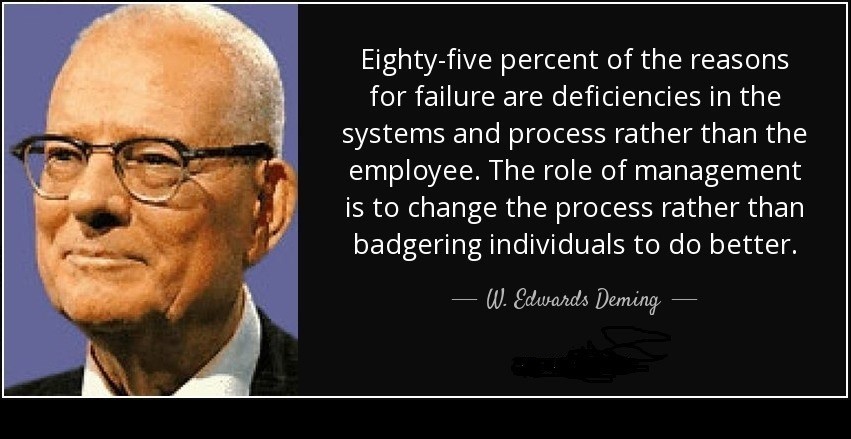
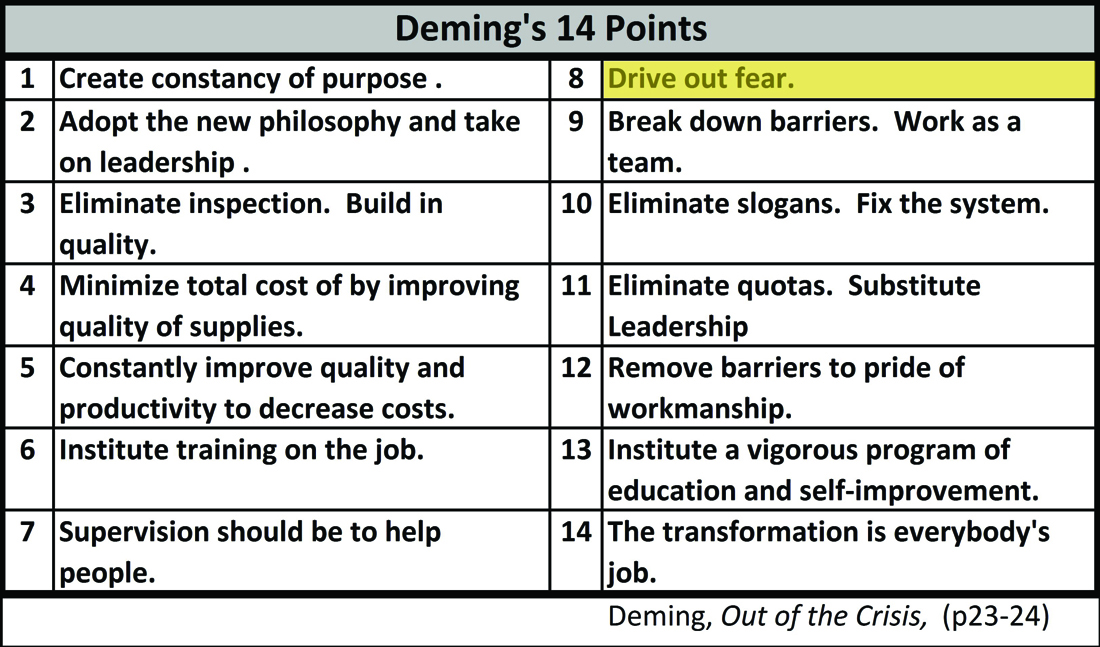
In other kinds of transformation, a new idea or method must appear before feelings catch up. Deming understood this well.  Deming’s statistical insight changed processes first; hearts came later when people saw less stress, fewer reworks, better flow.  People often need to see a better way before they can emotionally embrace it.  People shift cognitively first, then emotionally.

Technical Change Involves:

  • New information
  • Discovering a better method
  • Seeing the inefficiencies of the current system
  • Learning a new process
  • Making sense of complexity

Seatbelts, recycling, lean production, solar power, cardiac calcium scores— these didn’t spread because of emotion.  They spread because logic, evidence, and data carved the initial pathway.  Once the results became visible, the emotional commitment followed.  In these cases, cognition laid the track, and emotion rode in on it.

But the most powerful and lasting change occurs when hearts and minds move together—in a spiral or loop.

  • Not heart then
  • Not mind then

But an iterative loop:

  1. A new idea challenges us (mind).
  2. We see its human impact (heart).
  3. We seek deeper understanding (mind).
  4. Understanding strengthens conviction (heart).

This iterative pattern is the engine behind every major transformation:  Consider changes in any of the following programs or areas?  What was moved first:  Heart or Mind?

  • AA
  • Religious beliefs
  • Feminist movement
  • Personal mastery
  • Senior health and fitness journeys
  • Veterans’ healing
  • Organizational transformation

Most of us have lived this loop many times, even if we’ve never named it.  Love defies all logic and facts.  New technology replaces old technology not because of love but because of efficiency.  Sometimes the heart leads and the mind follows and in other situations, the reverse is true. 

In Summary:

If you want deep human change — heart first.
If you want procedural or systemic change — mind first.
If you want lasting change — both in spiral.

Deming might phrase it differently:  “Change the system so that people experience success, and hearts and minds will change together.”  Dr. Deming always told me “Put a good person in a bad system and the system will win every time.”  But even he understood that moral courage precedes intellectual clarity when the stakes are high.  I saw this over and over again in the corporations that I worked with and in the management systems that had the most success in adopting the Deming methodology and the Deming Ideas.  And maybe that’s the real takeaway.  The order doesn’t matter as much as the movement.  Deming described everything as a process.

Hearts awaken minds.
Minds strengthen hearts.
Change is a dance, not a formula.

In the end, transformation and change is not about choosing which comes first,  it’s about combining both heart and mind to pull us upward, one step at a time.

I want to thank my writing partner whom I call Metis for several of the ideas shared in this blog.  Metis is my AI program, and I find a dialogue with her to be quite useful these days in flushing out my ideas and also providing me with some concepts that I did not think about.  Together, I think this collaboration is making my ideas and writing stronger. 

A discussion on Moral Courage will be the subject of my next blog.

The Anatomy of the Soul: How Art and Music Unite Truth, Beauty and Goodness — Part 2

When we speak of truth, beauty, and goodness, we often imagine three separate pursuits — the scholar seeking truth, the artist seeking beauty, and the saint seeking goodness.  Yet Pope Francis and the great philosophers before him remind us that these three are not rivals but reflections of the same divine source.  Each reveals a different aspect of reality, and only when all three are in harmony does the human spirit find peace.

Tradition tells us that truth belongs to the intellect, beauty to the heart, and goodness to the will.  Truth teaches us to see, beauty teaches us to feel, and goodness teaches us to choose.  In that triad we discover the anatomy of the soul — knowing, loving, and willing, each distinct yet inseparable.

But there is another path by which these virtues speak: the language of art and music.  Long before we understood moral codes or philosophical systems, humanity painted, danced, and sang.  In rhythm and color, in sound and silence, we expressed truths too deep for logic and too vast for words.  Art and music, properly understood, are not escapes from reality — they are revelations of reality’s depth.

Beauty as the Gateway to the Soul

Beauty is the most immediate of the transcendentals.  Truth demands patience, goodness requires effort, but beauty strikes us like lightning.  It does not ask permission.  A single note, a brushstroke, or a line of poetry can pierce our defenses and open the heart where argument cannot.

This is why great art has moral and intellectual power.  It awakens us from indifference.  The experience of beauty — genuine beauty, not the glamour of surface or sentiment — lifts the soul toward truth and goodness without coercion.  It shows us what could be, and in doing so, reminds us what should be.

Aquinas called beauty “the splendor of truth.” The artist does not invent beauty but unveils it.  Every authentic work of art — whether sacred or secular — is a momentary unveiling of reality’s inner harmony.  It is truth made radiant, goodness made alluring.  Beauty does not lecture; it invites.  It does not command; it beckons.

The Role of the Artist

Artists are translators between the visible and invisible worlds.  They take the raw materials of existence — light, sound, form, gesture — and reveal within them an order we might otherwise overlook.  In doing so, they help us perceive truth through the lens of beauty.

A number of years ago, my first wife left me for another man.  He was also married but decided not to leave his wife.  My wife (Julie) and I reconciled and agreed to first resolve some issues by visiting a councilor.  These efforts did not go very well.  I was angry and hurt.  I did not know what I had done wrong.  My wife was also hurt and angry.  I had always thought that we had a lot in common.  At one of our first counseling sessions, the councilor noted that I did not display any emotions.  I was quite proud of being rationale and not letting feelings get in the way of my world.  In fact, I thought Spock was too emotional despite his public image as being stoic and logical.

The councilor mentioned my lack of emotions to my wife.  Her reply stunned and hurt me very much.  She said, “I always thought everyone had feelings, but I finally came to believe that John has no feelings.”  I left that counseling session resolved to find some of the feelings that I had ignored.  I decided the best way was to try to be more creative and less rationale.  I signed up for art classes and ballet classes and decided to listen to more classical music.  It was another nine months or so before Julie and I finally reconciled.  During this period, I actually participated in a ballet, painted several nature pieces (which I thought were quite good) and spent days at the library listening to as much classical music as possible.

When art forgets truth, it becomes hollow display.  When it forgets goodness, it becomes manipulation.  But when truth and goodness dwell within beauty, art becomes what it was always meant to be: a mirror of creation’s wholeness.  I was looking for my wholeness and my humanity which are also inseparable.

The artist’s vocation, then, is not self-expression alone but world-expression — to make the invisible visible, to translate the ineffable into form.  The true artist is not a manufacturer of objects but a servant of insight.  Their success is measured not by applause but by the awakening they cause in others.  In my case, it was an awakening in myself.  Art and music became the pillars of my salvation.  I rediscovered my humanity in them.

The Music of Being

Among all the arts, music comes closest to expressing the order of the soul.  It moves directly through time, breath, and rhythm — the same elements that animate life itself.  Every heartbeat, every inhalation, every step is a kind of music.  When we listen to or create music, we participate in a pattern that mirrors the pulse of existence.  Martin Luther said “”Next to the Word of God, music deserves the highest praise.”  Karen has this quote framed in our dining room.

Music unites truth, beauty, and goodness in motion:

  • Its structure and harmony express truth — order and proportion.
  • Its melody and color express beauty — emotion and wonder.
  • Its rhythm and purpose express goodness — direction and intention.

That is why even those who cannot explain music are changed by it.  It aligns the intellect’s search for order, the heart’s hunger for beauty, and the will’s longing for purpose.  To make or hear music well is to experience harmony not only in sound but in being.

When I was in the third grade at PS 171 in Brooklyn, NY, the teacher put all of us into a choir or singing group.  She acted as the conductor and started us out singing some song that she had taught us.  I sang along with the rest of the kids until suddenly, my teacher yelled “Who is making that noise?”  “You (she pointed at me), it’s you.” “Don’t sing” she screamed at me.  “Just open and shut your mouth.”  That was 70 years ago and to this day, I do not sing. Oh, people say I should get over it, but they are not living in my shoes.  I listen to music more than most people in the world.  I love all types of music.  But I do not play music, and I do not sing.

Plato believed musical education shaped character because harmony trained the soul toward moral order.  The disordered person, he said, was “out of tune.” Modern psychology would agree that we feel peace when the elements of our life are in rhythm — thought, emotion, and action resonating together like chords in balance.  In this sense, every moral life is a composition, every soul a symphony in progress.  My soul resonates with music, and the music resonates in every fiber of my body.  If I could be born again as anything, I would be a tenor singing in the great opera houses of the world.  I love the passion, drama and lyrics that fuse life into melodies that make time stand still for me.  Somehow the strains of music have a purgative effect on the pains and disappointments that can sometimes fill my life.

The Sacred and the Profane

Not all art is beautiful in the pleasant sense.  Some truths are too painful to adorn.  Yet even tragedy, if it reveals reality faithfully, can serve beauty’s higher calling.  A requiem, a lament, or a poem of grief can be beautiful because it tells the truth of human suffering while still pointing toward transcendence.  It is like watching a sad movie.  We connect to others through the suffering that art and music can convey.  Of course, music often conveys joy and happiness, but these are bonuses in a world today where suffering seems to be the norm.

Sacred art makes this explicit.  It does not flatter the senses but reorders them toward the divine.  The frescoes of Michelangelo, the cantatas of Bach, the icons of the Orthodox tradition — each embodies beauty that leads beyond itself.  Their purpose is not entertainment but transformation.  They invite us to see through the surface of the world into its divine origin.

But even the so-called profane arts can serve the same purpose when they reveal authentic experience.  A rap song, a nursery rhyme, a portrait of a tree, a romantic novel — each can bear truth if it arises from sincerity and respect for life’s depth.  I had an MRI today and as I listened to the banging, clanging, whistling and other sounds, I could hear a melody emerging.  I thought of penning a song called “Melodies in an MRI.” The sacred is not confined to churches; it inhabits every honest act of creation.

The Moral Dimension of Beauty

Beauty’s moral power lies in its capacity to attract us toward goodness.  Moral laws can instruct, but only beauty can enchant.  We are moved to do good not merely by obligation but by love for what is good.  Beauty provides that love.

This is why ugliness — deliberate distortion and cynicism — corrodes the soul.  It teaches us that nothing matters, that form and harmony are illusions.  When culture celebrates ugliness, it signals despair; when it honors beauty, it declares hope.  True beauty does not deny suffering; it gives suffering meaning.

The 20th-century theologian Hans Urs von Balthasar wrote: “We no longer dare to believe in beauty, and we make of it a mere appearance in order the more easily to dispose of it.” He warned that without beauty, truth and goodness lose their persuasive power.  In other words, without art and music, morality becomes sterile, and truth becomes abstract.

Beauty is not the soft edge of morality — it is its living energy.  It whispers to the will, “Choose life, not despair.”

The Soul as an Instrument

If truth belongs to the intellect, beauty to the heart, and goodness to the will, then the soul is the instrument through which they resonate together.  Like a violin, it must be tuned.  The strings of mind, emotion, and desire can each sound discordant when isolated.  Harmony arises only when they are stretched to the right tension and played in unity.

Art and music help tune the soul.  When we create or contemplate beauty, we sense the right relation of parts to whole, of the finite to the infinite.  We remember that life itself is composed — not chaos but cosmos.  In that moment, we are most alive, most human, and perhaps most divine.  The god we seek flames within us at these moments.

That tuning is not limited to artists.  Every person can live artfully.  A kind word spoken at the right time, a well-prepared meal, a garden tended with care — each is a small act of aesthetic and moral order.  In that sense, the moral life and the artistic life are one: both seek to make the world more beautiful and more true.  I find my muse in writing.  I like to think that I am somewhat good at using words.  When I was in high school, other students used to pay me to write their essays for them.  I remember one friend who asked me to write something for him.  I told him that he should do it himself.  He said, “But you are so good at writing.”  He was a musician, and  I challenged him, “Is it possible to be a better musician if you do not practice?”  He agreed practice was essential but said that he would rather practice playing music than practice writing.  I wrote the essay for him.  It was only logical as Spock would say.

The Silence Beyond the Sound

At the heart of music is silence.  Without it, the notes have no shape.  Silence frames beauty the way space frames form.  Likewise, the soul needs silence to perceive truth and goodness.  In our noisy age, we risk losing the capacity for this interior listening.  Yet every deep encounter with art or nature — every moment when beauty stops us — restores that silence within.  I learned to appreciate the beauty of music in my many hours sitting inside that library booth listening to the strains of Mozart, Beethoven, Bach and many other great musicians.  I am fond of saying that I never “met a food that I did not like.”  The same applies to music genres.  There is something in every genre of music that speaks to my heart and my soul hears.

The silence after a great symphony or before a sunrise is not emptiness.  It is presence — the awareness that life itself is music being played through us.  To live in that awareness is to live in gratitude.  Gratitude, in turn, is the purest harmony of truth, beauty, and goodness.  Ingratitude, St. Ignatius said was the “Gateway to all sins.”  How difficult it is to remember this for so many of us including myself.

Conclusion: Living Artfully

Art and music are not ornaments to life; they are its inner logic.  They teach us that creation is not random but composed, that our task is not to control the score but to play our part faithfully.  When truth informs our minds, beauty moves our hearts, and goodness directs our wills, we become participants in the divine symphony rather than spectators.

To live artfully is to live beautifully.  To live beautifully is to live truthfully.  And to live truthfully is to live for goodness. 

In the end, every human life is a work of art in progress — sometimes dissonant, sometimes serene, always unfinished.  Yet even our imperfections can contribute to the greater harmony if we keep tuning ourselves to the eternal themes of truth, beauty, and goodness.  Perhaps this is the greatest truth that we all need to discover.  As Pope Francis said “Truth, beauty and Goodness” are inseparable.

When we do accept this truth, we will find that the music of the soul is already playing, quietly, beneath the noise of the world — waiting only for us to listen.

Author’s Note:

Portions of this essay were developed in collaboration with “Metis,” my AI writing partner powered by OpenAI’s GPT-5.  The ideas, direction, and final reflections are my own, shaped through a dialogue intended to illuminate and refine the themes explored here.


The time has come. I can’t wait any longer. by Jane Fritz

This week I am reposting a blog by a good friend who has been writing them for over 13 years now.  She has decided to take a hiatus for reasons that you will discover when you read her blog.  Many of her followers have left comments describing how much her blogs meant to them and how sad her leaving the blog community will make them.  I will post my comments to Dr. Jane Fritz at the end of this blog.  I am also sad at her leaving.  Her blogs were always fun, inspirational and truthful.  The late Pope Francis said that Truth, Beauty and Goodness were inseparable.  Dr. Fritz managed to bring these to her readers and often with a sense of humor and perspective that left you feeling motivated and challenged to face another day in a chaotic world.  Her words and ideas made the world a better place and they will be missed.  Please do not skip reading the comments left by many other readers. They testify to the good that Jane brought to the world and how much her blog meant to many other people also in need of need of truth, beauty and goodness.

Dr. John Persico Jr.

 says:

October 6, 2025 at 11:39 am

I can certainly understand where you are coming from Jane.  I will be 80 next September and have been blogging for over 15 years now.  My blogs are nowhere near as popular as yours are and I think my blogs are usually darker than yours.  I have tried (and your blogs motivate me to keep trying) for a balance between optimism and pessimism.  My normal pessimism side give me five blogs a day that I want to publish excoriating the clown and evil man that is running our government today. 

Of course, I recognize that he is just a puppet as are the 74 million people that voted for him.  This latter fact only makes our situation worse in this country.  Nevertheless, I see the value in publishing more optimistic and often more personally helpful blogs like you do.  I am trying to do a balance and hope that this balance will keep me from going off the deep end.  There is still much beauty in life and still so many people out there to connect with that have been helped by our blogs.  You get many more comments each blog than I do and I am touched by how many people you have helped with your blogs.  I get a few comments per blog but even these few comments keep me going.  My mantra is that if I can touch one soul a month, than I am going to keep writing. 

This long diatribe on my part sounds like a subtle plea for you to keep writing.  However, I am not being subtle when I say that your blogs make a difference to thousands of people and it would be a shame to see one more beautiful and thoughtful voice eliminated from the blogosphere.  That is just what D.J. Trump wants.  To silence beauty, goodness and truth.  So I hope you can simply take a break from your writing.  Find a balance in terms of content.  And pick up your pen again when you are ready.  Remember the “Pen is mightier than the sword.”  Your friend John

Reflections on Humanism: A Father and Daughter in Conversation

This year, after my 42nd silent retreat at Demontreville, I found myself reflecting over a different kind of lesson — one not from the retreat master, but from a conversation with my daughter.

My daughter Chris and I could hardly be further apart politically.  I lean toward policies that support immigrants, the poor, minorities, and the sick.  She supports Trump and the Republican agenda, which I believe diminishes those very groups.  Our conversation was brief, but it revealed something that I have been mulling over ever since.

When it comes to personal interactions, my daughter is tactful, gracious, and considerate.  She knows how to get along with people, soften conflict, and maintain civility.  I, by contrast, am often blunt and confrontational.  When I disagree, I rarely hide it.  I leave enemies in my wake since I have little tolerance for greed and immoral people.  She accuses me of being harsh, even inhumane, in my manner.

And yet, when I step back, I see an irony.  My brusque words are often in service of a vision of justice for the many.  Her gentle tone exists alongside a commitment to policies that, in practice, withdraw support from those most in need.  In fact, the Trumpian policies she supports will result in starvation, disease and death for millions.

This tension raises a deeper question: what does it mean to be a true humanist?

Is it the ability to show kindness in the moment, face-to-face, even if one’s broader commitments bring harm to many unseen lives?  Or is it the willingness to fight for systemic justice, even if the style of delivery offends, unsettles, or disturbs?

I think of Christ, who could be gentle with the broken and the poor, yet fierce with the powerful and the hypocritical.  He healed with a touch, but he also overturned tables.  His humanity was both intimate and systemic.

Perhaps that is the lesson I am being given now.  Humanism is not one thing.  It asks us to be kind in the small circle of our relationships but also bold in the larger circle of society.  Without the first, justice grows cold.  Without the second, kindness becomes complicity.

I wonder if my daughter and I — so different in politics, so different in style — are each holding half of a larger truth.

Yinandyang GIFs | Tenor

In Defense of Buffy Sainte-Marie

What I am going to say will be very controversial.  Many people reading this blog will take umbrage at my opinions.  The good thing is that you will not be charged any fees for my opinions.  You are free to take them or leave them.

Perhaps if I were a Native American or a member of a Federally Recognized Tribe my words would carry more weight.  However, I am not an Indigenous person.  As far as I know, I have no Indian relatives and no Indian blood in me.  I do not claim to have an Indian Chief in my ancestry or a relative who was an Indian Princess.  I also must issue the following caveats.  I am a fan of Buffy Sainte-Marie.  I not only respect her, but I admire her.  I will tell you why in a little while.

Now I understand the charges against her quite well.  I have talked about cultural appropriation as an evil done by either stupid or misaligned people.  I do not believe that America ever did right by the people that we stole this land from by genocide, fake treaties, and scams.  As a resident of Arizona, I still see tribal people being taken advantage of when it comes to mining, drilling and water rights.  If an Indian might make some money on something worth selling, there will be a bunch of rich fat White people who want to screw them out of it.  I hear White people say, “It’s a shame we broke all those treaties with the Indians.”  These well-meaning people should get their heads out of their asses.  We are still breaking treaties made many years ago with the Indians.  When it comes to profit, there is no limit to the perfidy of some White people.  I think it was Sitting Bull who said, “I believe in Christianity, but I do not see many White People practicing it.”  I think the same can be said of many so-called Christians today.

But lets return to the subject of this blog.  Buffy Sainte-Marie passed herself off for many years as a Native American.  She has now been outed by relatives and others who seem to take great delight in maligning her.  I am going to try to offer a defense for her in this blog.  I have already said that I am a fan of hers.  I bought all of her albums back in the sixties and seventies.  I went to a tent concert she did up in Northern Wisconsin a few years ago put on by reservation people.  I have never personally met Ms. Sainte-Marie, nor have I ever corresponded with her.  I am not getting paid one penny for the viewpoints I am offering.  I have already confessed to being White so you can accuse me of bias if you like.  I prefer to think that I have always stood up for the underdogs in my life.

Let’s look at the three of the main charges against her in more perspective.

  1. She is not a real Indian
  2. She took awards that could have gone to real Indians
  3. She sang songs and agitated for Indian rights when she is really not an Indian.

 1.  She Is not a Real Indian:

There is an old adage which says, “If it looks like a duck, walks like a duck and quacks like a duck, it must be a duck.”  In my eyes anyway, Buffy Sainte-Marie looks like an Indian, acts like an Indian and sings Indian like songs.  What’s missing here is Buffy does not have the right set of genes.  Genes or no genes, she is more of an assimilated Indian than many Indians I have known who live off Reservations.  Years ago, we assumed that an Indian could be assimilated by going to an Indian School, wearing White clothes and forsaking their native language.  They could then be accepted as a White person by the larger White community.  At least this was the logic following the Indian wars and the ongoing efforts by White communities of both the USA and Canada to assimilate the Indigenous peoples.

Well, Buffy Sainte-Marie did a reverse assimilation.  She assimilated herself into the Indigenous culture in Canada and was even accepted by a Canadian Tribe.  Records show that she was adopted by a Piapot First Nation family in accordance with Cree law and traditions.  Members of the Piapot family have supported her claims.  Whether she was accepted or adopted into the tribe, she is an assimilated Indian by any stretch of the imagination.

2.  She took awards that could have gone to real Indians:

I am not quite sure I understand this criticism.  Buffy Sainte-Marie did take awards that were earmarked for native accomplishments both socially and culturally.  Specific awards and honors received by Buffy Sainte-Marie that were designated for Indigenous people include:

  • Four Canadian Aboriginal Music Awards: She received these awards at a time when they were specifically designated for Indigenous musicians.
  • Two Aboriginal Peoples’ Choice Music Awards: These awards were also designed to recognize Indigenous artists.
  • Four Juno Awards intended for Indigenous people: For example, she won the Juno for Indigenous Music Album of the Year in 2018 for “Medicine Songs”.
  • Four Indigenous lifetime achievement awards.

Many of these awards for Buffy have since been revoked by  the authorities issuing them.  Most of the awards concern her musical skills.  I hear the claim that a Real Indian could have won these.  This rings hollow to me.  During the sixties, Buffy is the only folk singer that I knew or ever heard who sang “pro-Indian” songs.  Her “My Country Tis of Thy People Your Dying” and “Now that the Buffaloes Gone” made as much impact on my awareness of Native American issues as did Dee Brown’s book “Bury My Heart at Wounded Knee.”  Dee Brown was also not Native American.  He was a White author from the American South.  He was born in Louisiana and raised in Arkansas.  His best-known work, “Bury My Heart at Wounded Knee,” detailed the history of American expansionism and its impact on Indigenous peoples.  Should we take Dee’s book off the shelf?  More’s the pity if you do folks since I never heard one peep during my high school history classes on how much shit we did to Native Americans.  Buffy’s songs and Dee’s book were some of the first major influences upon my White life in terms of the real truth about Indian history.

In March 2025, CARAS announced that it was revoking Sainte-Marie’s Juno Awards and her induction into the Canadian Music Hall of Fame based on the finding that she is not a Canadian citizen and therefore doesn’t meet the eligibility criteria, according to Variety.

3.  She sang songs and agitated for Indian rights when she is really not an Indian.

Here  I would like to judge Buffy Sainte-Marie on the basis of the good that she did for Native American causes and not the bad that she did.  Yes, she lied about her genes and her lineage.  Yes, she continued to insist that she was a true Native American.  She had either brain-washed herself or she really came to believe that she was an Indian.  I certainly do not know the answer to which motive guided her.  I know some of her relatives accused her of trying to smother the truth of her ancestry even by threatening them with a lawsuit.  Shame on Sainte-Marie for this.  Should she have been quicker to apologize?  Yes, I think so.  But does this make Buffy evil?  Does she deserve to be stripped of awards that she earned not by being Native American but because of the songs that she wrote and the messages that these songs sent.

 From “Now that the Buffaloes Gone” by Buffy Sainte-Marie

Oh, it’s all in the past you can say

But it’s still going on here today

The government now want the Iroquois land

That of the Seneca and the Cheyenne

It’s here and it’s now you can help us dear man

Now that the buffalo’s gone.

From “My Country Tis of Thy People Your Dying” by Buffy Sainte-Marie

When Columbus set sail out of Europe, then stress

That the nation of leeches that conquered this land

Are the biggest and bravest and boldest and best

And yet where in your history books is the tale

Of the genocide basic to this country’s birth

Not many people would have the courage to pin such lyrics whether Indian or White.  In my neighborhood, it is dangerous to put up a Democrat for office sign.  Many American “Heroes” have said that the “Only good Indian is a dead Indian.”  What exactly besides sing has St. Marie done for Indigenous people?  I asked ChatGPT this question and received the following reply:

Major Contributions Beyond Music

  1. Trailblazer on Sesame Street
  • From 1976 to 1981, she became the first regular Indigenous presence on Sesame Street, aiming to teach children that “Indians still exist.” Native News Online+12Wikipedia+12Teen Vogue+12
  • In a landmark moment for representation, she famously breastfed her son on air in 1977—likely the first such instance ever shown on television. Teen Vogue
  1. Educational Advocacy & Philanthropy
  1. Pioneering Electronic and Multimedia Art
  • Her 1969 album Illuminations was groundbreaking—using Buchla synthesizers and quadraphonic technology to forge a new sonic frontier. It’s now seen as a pioneering work in electronic and experimental music. Pitchfork+2Vogue+2
  • She also embraced early computer technology—using Apple II and Macintosh systems in the early 1980s to record music and produce visual art. Wikipedia
  1. Media Representation & Hollywood Influence
  • In 1968, Buffy insisted that all Indigenous roles in her episode of The Virginian be filled by Indigenous actors—a first in Hollywood. She held firm despite managers’ objections and succeeded. Teen Vogue (Teen Vogue interview referenced in images)
  1. Humanitarian Voice & Global Activism
  • As a vocal participant in the Red Power movement, she provided a platform for Indigenous concerns through grassroots concerts tied to the American Indian Movement. PBS+5Teen Vogue+5Teen Vogue+5Native News Online+1
  • Her humanitarian spirit led to widespread recognition, including an Oscar, Golden Globe, and honorary doctorates for her work spanning activism and arts. PBS+13Wikipedia+13Teen Vogue+13
  • Through media such as the documentary Buffy Sainte-Marie: Carry It On, she continued advocating for Indigenous rights, touring, and raising awareness well past her prime—into her 80s. muskratmagazine.com+11PBS+11Wikipedia+11

In Summary

Buffy Sainte-Marie’s legacy encompasses far more than her powerful protest songs.  She broke new ground in television, revolutionized arts and education, fought for authentic Indigenous representation, and used her influence to empower Indigenous voices globally.  Her initiatives—from Sesame Street to the Cradleboard curriculum—continue to shape conversations around identity, learning, and equity.

John’s Conclusions: 

Go ahead.  Say “so what.”  Say “who gives a damn.”  Tell me she is a liar and a hypocrite.  Tell me all her good works should be erased because she wanted you to believe that she was an Indian.  Tell me she is not really an Indian and that someone else would have done all the stuff that she did anyway.  Tell me that you can cast the first stone at her for lying because you have never lied in your life.

That’s all I have to say folks.  A courageous humane person made a big mistake but the good that she did and still does should not be forgotten.  If you want to tell me how bad a person she is, tell me what you have done lately for the benefits of our Native brethren.  I don’t think all the awards and recognition that she received should be given back to her.  That is the past.  What I do believe is that she should be given a special award for White people who have contributed to Native American Causes.  Like the Jewish people have their “Yad Vashem” to recognize non-Jews who helped save or give their lives for Jews, perhaps we need a similar hall in our country for people who helped Native American causes or even gave their lives to protect Native Americans.  Here are two examples in case you are wondering if such people ever existed.

  1. Samuel Worcester (1798–1859)
  • A Christian missionary from Vermont who worked among the Cherokee.
  • He defied Georgia state laws aimed at forcing the Cherokee off their lands and was arrested in 1831.
  • His case, Worcester v. Georgia (1832), went to the Supreme Court, which sided with him and affirmed Cherokee sovereignty.
  • Although he survived prison and lived out his life, he endured years of hardship and persecution for standing with the Cherokee at great personal risk.
  1. Edmund D. Pepperman (1901–1930)
  • A white civil rights attorney in Oklahoma who represented Native clients against oil companies and corrupt guardianship schemes during the allotment era.
  • He was murdered in 1930 while investigating abuses connected to Osage oil wealth.
  • His death highlighted the dangers faced by allies who tried to expose exploitation of Indigenous communities.

Buffy’s Song – A Poem by ChatGPT and John P. 

She sang not only with a voice,
but with the marrow of her bones—
a cry against forgetting,
a hymn for nations silenced.

In ballads of resistance,
she wove the stories hidden
beneath the treaties broken,
beneath the trails of tears.

Her guitar became a council fire,
her words—sharp arrows of truth,
piercing the walls of power,
lifting the dreams of the young.

She stood for the water,
for the mothers and the missing,
for children stolen by schools
that tried to burn away their tongues.

Scholar, warrior, poet,
she gave her strength to voices
that history tried to hush,
but could never erase.

Buffy sang of survival,
not as a whisper of sorrow,
but as a thundercloud rising,
a promise of dawn.

And still her song endures—
a river that refuses to dry,
a drum that will not fall silent,
a flame carried in countless hands.

For every child who learns their language,
for every elder whose story returns,
for every Indian standing proud—
her music lives,
a sovereign heartbeat,
forever strong.

What Do Sun Tzu, Musashi Miyamoto and Magnus Carlsen Have to Say about Life, Love and Death?

I have lived much of my life thinking and planning ahead.  I have often been laughed at because of how far ahead I like to plan.  But for some reason, I grew up believing that the secret to life (if there was one) lie in being ahead of the game.  I learned to play chess quite early on and by six, I could beat my father who taught me the game.  Three of my heroes in respect to planning are three men who all excelled in the art of strategy albeit very different arenas.  I am going to briefly introduce these three men and then invite you to sit down and listen to a discussion between the three men on strategy. 

Magnus Carlsen (Born 1990) is considered by many to be the greatest chess player who has ever lived.  He has now surpassed both Bobby Fisher and Garry Kasparov as the greatest champion ever.  Magnus is a genius on the chessboard which in some ways is a metaphor for military strategy and planning.  Carlsen is from the cerebral world of modern chess and is a wizard who plays out strategy on a strictly cognitive level. 

“Carlsen is a five-time World Chess Champion, five-time World Rapid Chess Champion, and the reigning (shared with Ian Nepomniachtchi) eight-time World Blitz Chess Champion.  He has held the No. 1 position in the FIDE rankings since 1 July 2011, the longest consecutive streak and trails only Garry Kasparov in total time as the highest-rated player in the world.  His peak rating of 2882 is the highest in history.  He also holds the record for the longest unbeaten streak at the elite level in classical chess at 125 games.” Wikipedia

In terms of mortal combat, Musashi Miyamoto is hands down the greatest fighter who ever lived.  Musashi is from the deadly pragmatism of samurai combat.  He was a swordsman in feudal Japan (1584-1645) who went on a quest to defeat the greatest swordsmen of his time.  He was undefeated in 62 duels to the death with the Katana.  There is nothing fake or theoretical about facing an opponent with a 37-inch razor sharp sword capable of cutting you in half.  Musashi went on to memorialize his fighting strategy in a famous book called “The Book of Five Rings.”   

Sun Tzu (544 BCE) was a Chinese military general, strategist, philosopher, and writer who lived during the Eastern Zhou period.  Sun Tzu derived his strategies from ancient statecraft and military philosophy.  He wrote a famous book on strategy called “The Art of War.”  It has been used for centuries as a bible for military strategy.  I have referred to it so many times in my strategic planning sessions that I feel like I almost know it by heart.  The book is also widely used for strategy in business and life.  It teaches you to be prepared for anything and the number of quotes that you can gleam from this book about strategy are almost unlimited. 

In this blog, you are going to be privileged to listen to what these three men have to say about living, loving, fighting and dying.  It might surprise you to find that each man is in his own way a humanist and idealist but also a pragmatist.  If having all three of these traits together sounds impossible or quite contradictory, then listen to their discussion and decide for yourself.  I think you may just find a number of useful ideas about life from these men. 

John:  I am very glad that the three of you can meet with me today.  I have introduced each of you to my readers, but it was probably gratuitous since you are each very well known.  Can we start off by talking about life and living?  Though each of you deal in some sense with combat and finality , what about the work of daily living and making a good life for oneself? 

Sun Tzu: Life must be ordered like a campaign.  To live well is to understand terrain—your circumstances—and to position yourself so that conflict becomes unnecessary.  The greatest victory is to live in harmony with the world without struggling against it.

Musashi: Living is training.  Every day is practice for the Way.  To hold the sword and the brush in balance, to adapt fluidly—this is how one lives without wasting time.

Carlsen: In chess and in life, position matters more than immediate gains.  If you think ten moves ahead, you can avoid many of life’s traps.  But it’s also about enjoying the game, not just winning it. “Without the element of enjoyment, it is not worth trying to excel at anything.”

John:  What about loving?  Does love play a role in your lives?  If so, how?

Musashi:  Love is dangerous if it binds you to attachment.  Yet the Way is also compassion.  The warrior should protect, not just destroy.

Sun Tzu:  Love is alliance.  To love is to strengthen morale, to bind others to your cause.  Without loyalty and affection, no army—or family—stands.

Carlsen:  Love requires intuition.  Like in chess, you don’t calculate every detail—you feel the position. Trust in the flow between two people, rather than forcing the moves.

John:  Fighting is something that I have experienced a great deal of in my life.  I have experienced physical fighting and emotional fighting.  My father taught me a great deal about fighting.  I have come to believe that anything worth having is worth fighting for.  Sometimes it has seemed my life has been more about fighting than about love.  What are your feelings about fighting? 

Sun Tzu:  Needless fighting is stupid and folly. “To win one hundred victories in one hundred battles is not the acme of skill.  To subdue the enemy without fighting is the acme of skill.”

Musashi:  You cannot always avoid the duel.  When you must fight, commit totally.  Strike with no hesitation, see beyond form, and your opponent will already be defeated in spirit.

Carlsen:  Fighting is about controlling the board.  You win by shaping the game, so your opponent runs out of good moves.  Aggression without calculation is reckless; patience is its own weapon. “Some people think that if their opponent plays a beautiful game, it’s okay to lose. I don’t.  You have to be merciless.”

John:  What about dying?  Does war and life and fighting mean that we must accept death as a potential price that we pay for living a good life? 

Musashi:  Death is nothing to fear.  To follow the Way is to be ready to die at any moment. If you cling to life, you will hesitate, and hesitation kills.  I have written that, “The Way of the warrior is resolute acceptance of death.”

Sun Tzu:  The wise commander spares his troops.  To die meaninglessly is folly.  But to give one’s life for a greater order, when no alternative remains, that is the ultimate discipline.

Carlsen:  In chess, every game ends with death—the king is trapped.  But the beauty is that the board is reset, and you play again.  Perhaps death is just the end of one game, with another waiting.

John:  This has been quite an interesting conversation.  Let me end the discussion with one final question that I would like each of you to speak to.  How does one find meaning and purpose in life and live a life of integrity while pursuing these goals? 

Musashi:  Meaning is found in the Way — in disciplined practice of one’s craft, whether with the sword or the brush.  Purpose is not in wealth, fame, or fleeting pleasures, but in constant refinement of the self.  Integrity is to act without hesitation, without deceit, and without wasting time on what does not serve the Way.  A life devoted to mastery is a life of purpose.”

Sun Tzu:  Purpose comes from aligning one’s life with harmony — with heaven, earth, and the order of things.  To live with integrity is to understand both your strengths and limitations, and to act with balance rather than recklessness.  Meaning is not found in chaos, but in creating stability for yourself and others.  When your actions serve a greater order and bring benefit without needless harm, your life has purpose.”

Magnus Carlsen:  For me, meaning is about challenge and growth.  Chess has taught me that purpose lies in doing something you love, pushing yourself, and finding joy in the struggle, even when you lose.  Integrity means competing honestly — no shortcuts, no excuses — and respecting your opponents.  If you live true to what excites you, and stay consistent with your values, you’ll have both purpose and integrity.

John:  Thank you all very much.  You have given me a great deal to think about.  I am hoping my readers also find value in your wisdom and insights.  

Conclusions:  I mentioned that I thought that all three men blended the values of humanism, idealism and pragmatism.  Here are my reasons for saying so about each man. 

Miyamoto Musashi (samurai, artist, strategist)

  • Humanism: Surprisingly present, though in a hard-edged way. Musashi’s writings show care for clarity, honesty, and living authentically. His calligraphy and painting also suggest an appreciation for the fullness of human life, not just killing.
  • Idealism: While somewhat limited, Musashi rejects romantic notions and insists on practicality.  Yet, he is idealistic in his devotion to the Way — a life lived with complete discipline and readiness for death.
  • Pragmatism: Very Dominant.  Musashi is above all a pragmatist — he won by adaptability, by not being bound to tradition, and by focusing on what works in the moment.  His famous line “Do nothing that is of no use” captures his essence.

Sun Tzu (general, philosopher, system-thinker)

  • Humanism: Strong, but collective rather than individual.  Sun Tzu emphasizes preserving life — “The skillful fighter subdues the enemy without fighting.” His concern is with the well-being of troops, states, and the larger order of society.
  • Idealism: Present in his pursuit of harmony, he believed conflict should serve higher goals — stability, order, prosperity — not destruction for its own sake.  His writings contain a vision of a just, balanced world.
  • Pragmatism: Essential to Sun Tzu’s work is a manual for success in the real world. He advocates preparation, intelligence, deception, and efficiency.  No illusions — but always tied to a broader purpose.

Magnus Carlsen (modern competitor, thinker, cultural figure)

  • Humanism: Clear and direct.  Carlsen is grounded in relationships, respect for opponents, and joy in play.  He emphasizes fairness and humility — deeply humanist values in a competitive field.
  • Idealism: More subtle but his idealism lies in his belief in chess as a universal language and art form, where truth can be found through the board.  His pursuit of perfection in play is, in a sense, idealistic.
  • Pragmatism: Very strong. Carlsen is known for his practical style — grinding small advantages, avoiding flashy risks, and adapting to opponents.  His quote “I believe in good moves, not psychology” shows his pragmatism at work.

Several years ago (2016), I went to NYC to watch Magnus play the Russian Sergey Alexandrovich Karjakin.  It was the first time the International chess tournament had been held in NYC since the epic battle in 1974 between Fischer and Spassky.  I would have been 28 years old at the time in 1974 and had long since given up chess playing.  I might have been a very good player but as with so many things in my life, I did not have the discipline or courage to stick with the game.  Nevertheless, the strategic comparisons between America and Poker and Chess and Russia have significantly influenced my life.

In studying strategy, it has led me to the twin concepts of predictive strategy and opportunistic strategy.  One thinks many moves ahead while the other seizes the moment.  I have found that both are necessary in life.  A good strategy in life will be built on an understanding of the relationship between the two.  On a more practical level, I have applied this to our travels.  Karen and I have now been to 45 countries and every one of the 50 U.S States.  All, and I say this proudly ALL of our trips have been great, and each one seems to be better than the last one.  I submit that this is due to having a great traveling companion but also to a plan based on looking down the road while seizing those moment-to-moment opportunities that pop up. 

One Final Note Please:

If you are interested in what Miyamoto meant by the “Way” that he referred to, it is a philosophy he developed that encompasses the following attitudes and virtues. This information is from Google AI.

  • Discipline: Musashi emphasized the importance of self-discipline in all aspects of life, considering it a crucial element in achieving any goal and overcoming challenges.
  • Mastery and self-improvement: Striving for excellence in a chosen path and mastering oneself, thoughts, and actions.
  • Understanding and applying strategy: The “Way” also refers to the art of strategy (Heiho) which, for Musashi, transcended just combat and applied to all aspects of life.
  • Holistic approach to life: He believed the principles of swordsmanship could be applied to various pursuits and aspects of life, encouraging individuals to understand the “Way broadly” to see it in everything.
  • Balance: The ideal warrior, according to Musashi, excelled in both martial arts and the arts, a concept known as Bunbu Ryodo

In essence, “The Way” for Musashi represents a life-long journey of learning, self-cultivation, discipline, and the pursuit of mastery, not just in martial arts but in all aspects of life. Not a bad way of living I would think.

I great deal of my information is based on information I extracted from ChatGPT 5.0. The final blog is a composite of research, theory and some of the quotes from on-line sources.

Who are the Forgotten People in America?   

I am Sick of Oscars, Emmys, Gold Medals, Silver Medals, and all the other rewards that the high and mighty give to each other.  I am sick of the celebrity roasts where the super stars tell each other how wonderful they are.  We all bow down at the stars implanted in the Hollywood Walk of Fame.  We eulogize someone who runs the 100-meter dash in under 9 seconds.  We drool over singers who have voices that would make angels weep.  We fantasize life with a gorgeous actor or actress whose beauty makes us look positively bland.  The celebrities of America have replaced the nobility of old Europe and Ancient Egypt.

I don’t deny that these people have talent or that they have worked hard at developing that talent.  But many of these people are simply born with genes that the rest of us can only marvel at.  No amount of practice in the world would be enough for Usain Bolt to become the fastest man alive.  No amount of practice would be enough to make Pavarotti one of the greatest tenors who ever lived or Lise Davidsen one of the best sopranos in the world today.  Many of our stars are so beautiful that it is incomprehensible to those of us with NORMAL genes that anyone could have the genes that Sydney Sweeney has ☹.  There is a considerable amount of success simply built into the genes one has as well as the people you know.  Who do you know that is on the 100 list of invitees to the Inaugural Ball?  When was the last time you were invited to the Oscars or the Country Music Awards?

But what really burns me up is not the self-congratulatory escapades of the “Rich and Famous” or the masses worshipping at their altars.  It is the total disdain and ignorance of the heroism and incredible feats of discipline and fortitude that most of us ignore because we are so blinded by the Broadway lights that flash on others.  Let me give you one example of an unheralded human being to make what I am talking about more obvious.

A few years ago, the old Veteran Center in Eloy Arizona had a full-time director and coordinator.  Her name was Sonnette Cherry.  Sonnette was a dynamo.  She organized events each month for the local veterans.  She wrote grants to keep the center open.  She found funding to take several disabled veterans to visit the Wall in Washington D.C.  She liaised with other veteran centers in the area to insure that all vets had access to important information.  She arranged for people from the VA in Tucson to come up regularly to talk about benefits and she scheduled Veteran Service officers to regularly help disabled veterans file for disability benefits.

In addition, she was always there if a veteran needed help either physically, emotionally or financially.  Big Deal, you might say “She was only doing her job.”  Yes that is true doing a job with low pay and long hours.  However, in addition Sonnette was working on her Master’s degree at the University of Arizona and taking care of her 13 children.  Could you manage that, or would you want to manage that?  Sonnette never got a medal or an Oscar for doing her job though she certainly deserved one.

Now I point out this woman, not only because she is a friend but because she works hard (as many of you do) but like you will never get a medal or pin or celebrity honor for her work.  She will get no star on the Hollywood Walk of Fame now will they have a special dinner in her honor at the White House.  There are many other unheralded and unsung people like Sonnette out there doing a job that Usain Bolt or Sydney Sweeney would not touch in a million years.

I would like to see a People’s Award that every city would give regularly to people like Sonnette and YOU who work their butts off for other people and rarely get a mention.  It would not be based on competition but simply given for doing good deeds.  Sure, we see posters for Teachers and Doctors and Firefighters as “Hero’s” but those are generalizations.  The vast majority of teachers (I have been one for 50 years now) will never be “Teacher of the Year” or receive any kind of an award.

The best awards I have ever received in my teaching career came from a few letters that I later received from students telling me what a difference I made in their lives.  Believe me, these letters did not only make my day, but they also made my year.  Nevertheless, I have wondered why I never received a single award or honor in my fifty years of public education.  I have no doubt that this is true for the vast majority of those “Heroes” whose posters we put up on billboards.

It is high time, well beyond high time in fact, that we do more to honor people like Sonnette who have accomplished more than anyone scaling Mt. Everest or running the New York Marathon ever did.  We are looking in the wrong direction for stars.  Many of the stars are standing in our midst but we are so blinded by the aura of the stars manufactured by TV and the Media (We now have Internet Super-Stars) that we fail to see the stars in our own galaxy.

Look for a star today.  I have named one that is in my orbit.  I could have told you stories of many others, but you would have gotten bored or wondered if I was taking bribes 😊.  I assure you that you know someone who goes above and beyond helping others all the while doing tasks that even Hercules would have run away from.  Here are a few of my other “Heros” that I did not talk about.  In reverse alphabetical order

  • Evelia Zajac
  • Darlene Tervo
  • Louis Schultz
  • Carol Salvatore
  • K. Rice
  • Karen Persico (My hard working and very caring wife)
  • Gary McLean
  • Socorro Luna Galusha

I could keep going through the entire alphabet, but this blog is already too long.  Maybe you can start filling in where I left off.

Previous Older Entries