
We are all born with four baskets of life. We are born with these baskets, and we will die with these baskets. Our happiness and success will depend on how we fill these baskets and what we fill them with. It might seem unfair, but no two people are born with the same size baskets. Some of us have bigger baskets and some of us have smaller baskets. Ironically, bigger baskets can be more of a burden than smaller baskets.
The four baskets are known as, mental, physical, socio-emotional, and spiritual. When we are born, our baskets are almost empty. We have rudimentary materials that are put in each basket at birth. However, no human can grow to maturity without adding more into each basket. Given the size limitations of our baskets, our challenge is to fill each basket with the appropriate goods that we need for a happy successful life.

Mental/Cognitive Basket
Some of us are smarter than others. However, smartness or intelligence is not merely related to IQ. Each of us can be smart at different things. Some people are good cooks. Some people are good mathematicians and others are good carpenters. Regardless of what skill sets you may have; your mental basket needs some basic knowledge to help you navigate in life. Many of the skills needed are gained in schools or by teachers who help fill your basket. Many of the skills we need are gained by experience. Regardless of whether you add to your basket by experience or formal learning in a school, the goods you put in your basket need to match your knowledge, skills, and abilities. Your interests are the motivation for what you desire to find and add to your basket. One should go through life adding stuff to their basket and occasionally removing stuff. Knowledge is not static. It changes with the times as well as with your own needs. I used to tell my business students, that the only value they had to their company was between their ears.

Physical Basket
Clearly we are all born with different physical assets and abilities. Nike says everyone is an athlete. Unfortunately, too many people do not see any reason to add goods to their physical basket. They admire people like Michael Jordan, Mikaela Pauline Shiffrin, Usain Bolt, Michael Phelps, Misty Copeland, Anna Netrebko and Tom Brady. If you asked most people, they would readily admit that they do not have the physical skill sets that these champions have. However, too many people grow old with the nearly same basket that they were born with. I know too many people who stopped exercising or practicing after they left high school or college. “Oh, I used to run but I gave it up.” “I used to play the clarinet, but I lost interest.”
If any of the people I noted above had not practiced and practiced and never given up, they would not have achieved the greatness that they did. We all have different size baskets particularly when it comes to physical attributes but without practice and more practice filling up our baskets, we can never know what we are capable of. At the very least in terms of increasing our physical attributes, we might live to an older age still able to walk, run, hike, play, and sing. Instead too many people can only dream about the days gone by when they still could do these things.
Socio-Emotional Basket
Covid 19 devastated many people who depend on emotional connections to help manage their lives. It is true that some of us are less dependent than others when it comes to emotional attachments. Some of us are introverts and some are extraverts. Nevertheless, I know of no one who can go through life without a desire for love and friendship. The socio-emotional basket may vary in size for many of us but it is still a basket that we must try to fill to meet our needs or we remain isolated and lonely.
A number of years ago, the idea of EQ or Emotional Quotient to measure how well people do at managing their interpersonal relationships entered the mainstream of social science. “The term first appeared in 1964. It gained popularity in the 1995 best-selling book ‘Emotional Intelligence’, written by science journalist Daniel Goleman.” — Wikipedia The basic idea is that we all need to cope with our emotions and learn skills and techniques to help us better deal with the stresses of life. Everyone has days of being up and down. We all suffer from mild to strong depression at some time in our lives. Thoughts of suicide are more prevalent than most people realize. However, the goods that we put in our socio-emotional basket can determine how well we cope with these stresses. Even the “greatest” of lives have succumbed to a weak basket and gone to drugs or drink to try to deal with the ups and downs of life. History is littered with the deaths of good people who just did not have the socio-emotional coping skills to handle what life was throwing at them. I have had two cousins who committed suicide and a best friend who also took his life. Most people thought they had a lot to live for but apparently they disagreed.
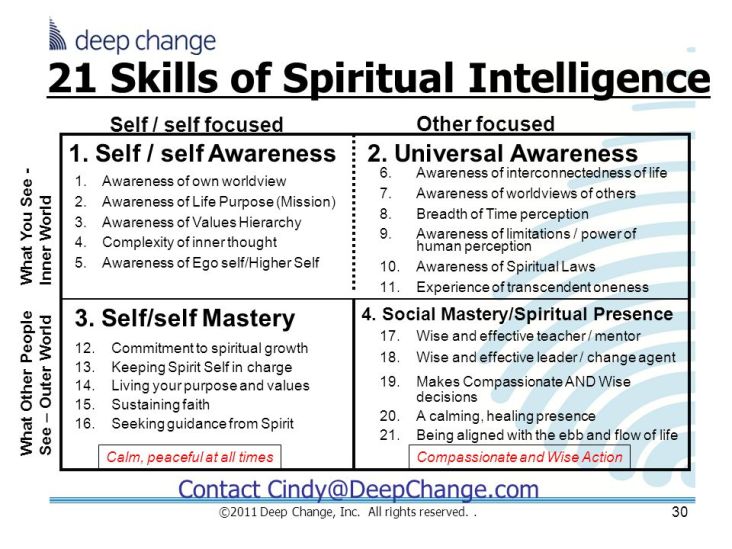
Spiritual Basket
The spiritual basket is the most difficult to fill and the most problematic. Unless we fill the spiritual basket we will never find peace and happiness. It is the basket of fulfillment. It is the basket of true love. Without the right ingredients in this basket, we remain lonely and unloved. It does not matter how much we put in the other baskets, we must put the right stuff and enough of the right stuff in this basket or we will lead a life of “quiet despair.” There are two paths typically taken to fill this basket. One path is secular. The other path is sectarian. There are problems with each path.
 The secular path is the path of the world. It is the path that says you need to have more of the things of the world to put in your basket. Getting more of the world’s stuff is heralded as the secret to filling your basket and achieving success and happiness. Some of the things people try to get more of include: Food, drugs, alcohol, fame, fortune, money, medals, accomplishments, status, power, knowledge, youth, health and titles. While some of these things might be useful in your other baskets, in this basket they simply do not work. The spiritual basket is immune to the things of the world. It is a truism that all of the great prophets and philosophers and thinkers have extolled. Sadly, it is a path that is promoted by too much of the world because it is driven by greed and financial profits. Buy that new truck and you will be happy. Buy that giant house and you will be happy. Read the latest diet book and you will be happy. How many times do people have to go down this path before they will realize that it only takes them in the wrong direction?
The other path to fill the spiritual basket is the sectarian path. This is the sacred path or the path of religion and sects. It is a path of meaning and purpose. It is a path of prayer and meditation. It is a path of Gods, prophets, and spiritual leaders. These leaders tell their followers that the path to happiness and success comes from following their teachings. Often they include meaning and purpose as tools necessary for your spiritual basket. Some believe in the power of meditation and prayer for your spiritual basket.
 The great spiritual leaders like Mohammed, Jesus, Buddha and Baháʼu’lláh all had followers and tried to teach their followers by various means. It seems that the goal of enlightenment, samadhi or nirvana was achieved by each of the great leaders and even by some of their followers. Unfortunately for humanity and for most organized religions, these gurus and religious teachers all missed one important truth. “You cannot teach enlightenment.” Enlightenment can only be learned by example. We learn from our parents by the example they set for us. We learn by observing how they treat other people. We learn by what they do rather than what they say. The followers of the great prophets and gurus were learning their spirituality from what their teachers were doing and now what they were saying.
The words that were left by some religious teachers like Thomas Merton, Mother Teresa, OSHO, Krishnamurti and the writers of the Old Testament and New Testament have no doubt inspired many people to try to reach heaven or nirvana. For the most part, I doubt that many followers have ever achieved much enlightenment. If they did, it was not by the reading of words but by the life that they led.
I think having had 39 silent Jesuit Retreats that prayer, mediation, solitude, and contemplation have a role in finding peace and happiness. I do not think that they will lead anyone to nirvana or enlightenment. Unless I am an extreme outlier, after 39 years of a three-day silent retreat full of prayer and meditation, I am still pretty much just your normal unsaintly unholy guy. I am still waiting for most of my prayers to be answered and I am still waiting to sit peacefully in my car full of good will and cheerfulness when some jerk is tailgating me on the freeway. I am much more likely to wish that I had an invisible ray gun that could make the impatient driver and his/her auto just disappear.
You can not teach how heat feels. Description is futile. You must feel it. You cannot teach fulfillment or enlightenment you must experience it. Words are useless. The most important ingredient in a spiritual basket is love. Love for yourself and love for others. Love for all others and not just people who are like you. Not just people who think like you. If you do not feel love for yourself, you cannot feel love for others. But there is a paradox here. It is that love from others can help you feel loved. Love for others, love for yourself, love for yourself and love for others are the Yin/Yang of a spiritual basket. Purpose and meaning are good things, but they are transient. They will come and go and change with the times. Love never changes. Jesus said:
“A new commandment I give unto you, that ye love one another; as I have loved you, that ye also love one another. By this shall all men know that ye are my disciples, if ye have love one to another. By this shall all men know that ye are my disciples, if ye have love one to another.” – John 13:34-35 (KJV)
If you want enlightenment, follow a good person, do good deeds, be kind to all people and love yourself. Being a person of integrity and honor leads to self-love. Self-love leads to love for others. We are all born with an empty spiritual basket. In order to become complete, we must fill this basket with as much love as we can.

 Karen grew up with two sets of grandparents. On one side the Misselts were Norwegian and on her dad’s side the grandparents were Swedish. Karen was baptized at Pilgrim Lutheran Church in Frederic, Wisconsin where we now reside. Karen went to public schools and was an average student. She dreamed of becoming a nurse. However, her guidance counselor had different ideas. She advised Karen that she would never make it as a nurse because her math scores were too low. Karen showed what I have since realized was a streak of determination or stubbornness (if you will) to get what she wants. She ignored the counselor’s advice, went to nursing school at the University of Minnesota and a few years ago retired with fifty plus years of nursing experience.
 Karen and I were married in 1989 but started dating in 1983. Both of us were coming off of recent divorces. We were on again and off again as I did not want to make any commitment. After six years of dating, Karen finally said that she was tired of this off again and on-again business and either it was permanently on or permanently off. I yielded to her logic, and we were married by my good friend Bill Cox at a Methodist Church in Taylor Falls, Minnesota. The marriage of a good Lutheran and a quixotic Atheist.
 From the start, we had a rather rocky relationship. I was often temperamental. Easy to anger and resort to verbal and emotional abuse. I lost count of how many times I said that I was going to leave, and that divorce was the only answer. Karen would ask me not to yell at her and I would say I was not yelling. It seemed to me that any slight rise in my tone of voice was yelling to Karen. Our discussions often made matters worse. However, Karen never gave up on our relationship. We went to counselling together to save it. We have been to three Marriage Encounter weekends to improve various aspects of our lives. Sometimes the improvements are more obvious than other times. I still tend to be the pessimist and see the half-empty glass and Karen is the optimist who keeps assuring me that the glass is half-full and getting fuller.
 Karen was a single mom who raised four children after her first husband left. She tried to be mom and dad to these kids. She cooked, cleaned, sewed, and went to work each day and came home at night to help them with their homework or whatever they needed. She took them on camping trips and vacations. By the time we were married, three of her children had left the nest and we had one child left to raise. Karen’s relationship with her children was never smooth. Some of the kids seemed to blame her for their dad leaving. I was the evil stepparent and I never fit in. Her youngest daughter after many years of Karen and I together once asked me when their real father was coming back.

 Karen is one of the most caring, honest, ethical, and thoughtful persons in the world. She is patient, kind and compassionate with everyone that she deals with. Not just me, and not just people she knows or people in our “tribe.” Karen is always willing to go out of her way to help others in need. Karen has a wonderful talent for crafts and music and uses these to give back to the world.
 Karen wanted to study music when she was younger. Her parents had a piano in their house and Karen learned to play it. However, she realized that she did not have the talent to be a professional musician and so she took it up as a hobby. She started singing in a church choir when she was eight years old and still sings in a choir. A piano is a rather cumbersome instrument to carry around, so Karen discovered the Mountain Dulcimer about fifteen years ago and learned to play it. She takes it with us when we travel, and she plays with a group in Arizona called the Tucson Dulcimer Ensemble. They practice weekly and play at nursing homes, churches, and special events. About five years ago, she purchased a Ukulele and started learning to play it. She now plays with a group in Centuria, Wisconsin and they also do free gigs for nursing homes, county fairs and churches.
 fools, greedy people, and bullies. I find it hard to turn the other cheek. I lack compassion, kindness and patience for racists, white supremacists, KKK, Neo-Nazi and many other groups. Through it all, Karen stands by me. I complain that she is too nice. Minnesota Nice bothers me because I see it as wimpy and avoidance behavior. Karen says it is caring and compassion. I wonder what Jesus would say. Regardless, I know I live a better happier life because I have one very special person that I admire, and love more than I can ever say. She may look like an average old lady, but she is not average to me. No average person could live with me for more than a week.

 The ukulele is a four-stringed instrument that has its origins in Portugal but was adapted by Hawaiians in the 19th Century. Its size can vary, with the larger instruments producing deeper tones. Elvis Presley played a ukulele and so did Tiny Tim. The ukulele became most popular in Hawaii but more recently with a player named Jake Shimabukuro its popularity has skyrocketed. Karen and I have been to two of Jake’s concerts and it is beyond amazing what he can play and do on his ukulele. He has done for the ukulele what the movie “O Brother, Where Are Thou” did for old time music. He has created a renaissance for the ukulele with millions of people all over the world now taking up the instrument.
 They play a variety of ukes from soprano to tenor to concert to bass ukuleles. In addition to playing, they also sing. They are quite innovative and creative in their adaptations of the various pieces of music that they play. They often invite ticket holders to bring their ukuleles to the concert and play along with them. You can find out more about this group at their site


 Aging Capriciously