
I want to talk about the idea of righteousness in my blog today. Of course, I did not invent this concept. But I do have my own definition for the concept. I am going to give you my definition and then some popular definitions from other perspectives.
A righteous person consistently places truth, justice, compassion, and integrity above personal gain. They willingly sacrifice wealth, comfort, reputation, or even life itself when necessary to protect others, uphold justice, or defend what is right. They serve others without expecting reward, listen with humility, admit mistakes, practice self-control, and continually strive to become a better human being. They freely share credit, accept responsibility, and recognize that most worthwhile human achievements are built upon the efforts of many rather than the glory of one. Their character inspires trust because their thoughts, words, and actions remain aligned even when doing so comes at great personal cost. Following are a few examples from history of righteous people who were not afraid to die for their beliefs and actions.
Martin Luther said, “Here I stand. I can do no other.”
Socrates said, “And if you say to me, “Socrates, we will let you go free but only on condition that you stop your questioning,” then I will reply, “Men of Athens, I honor and love you. But I must obey God rather than you, and while I have life and strength I will never stop doing philosophy.”
Jesus said: “You would have no power over me at all unless it were given to you from above.” Pontius Pilate had claimed that he had the authority to release or crucify Jesus.
Nelson Mandela said, “I have cherished the ideal of a democratic and free society… It is an ideal for which I am prepared to die.”
Sophie Scholl, shortly before her execution by the Nazis said, “I am, now as before, of the opinion that I did the best that I could do for my nation. I therefore do not regret my conduct and will bear the consequences that result from my conduct.
Now let us look at how some religions with considerably more wisdom than I have define the idea of a Righteous Person.
✡️ Judaism
Perhaps the religion that has done the most to bring the concept to the attention of the world. In Judaism, a righteous person (tzaddik) is someone who strives to live according to God’s will as revealed in the Torah. Righteousness is demonstrated through faithful obedience to God’s commandments (mitzvot), justice (tzedek), mercy, humility, honesty, and compassion. A righteous Jew seeks to honor God not only through worship but also through ethical treatment of others, caring for the poor, welcoming the stranger, and pursuing peace (shalom). The Hebrew prophets consistently taught that righteousness is measured as much by moral conduct and social justice as by religious observance. While no person is considered perfect, the righteous continually repent, grow in character, and seek reconciliation with God and others. Righteousness is ultimately expressed in covenant faithfulness, integrity, and living a life that sanctifies God’s name.
✝️ Catholicism
In Catholicism, righteousness is living in a right relationship with God through faith in Jesus Christ, participation in God’s grace, and cooperation with that grace through a life of holiness. While salvation begins as God’s free gift, righteousness is nurtured through the sacraments, prayer, scripture, charity, and faithful obedience to God’s commandments. A righteous person seeks to imitate Christ by practicing the theological virtues of faith, hope, and love, along with the cardinal virtues of prudence, justice, fortitude, and temperance. Genuine righteousness is reflected in love for God and neighbor, concern for the poor, forgiveness, humility, and a commitment to justice. Catholics understand righteousness as both an inner transformation by grace and an outward life of good works inspired by that grace.
✝️ Protestantism
Most Protestant traditions define righteousness primarily as being made right with God through faith alone (sola fide) in Jesus Christ. Human beings cannot earn righteousness through good works; instead, Christ’s righteousness is credited to believers through faith. Good works do not produce salvation but naturally flow from genuine faith as evidence of a transformed life. A righteous person trusts in God’s grace, seeks to obey Scripture, grows in holiness through the Holy Spirit, and demonstrates love, integrity, compassion, forgiveness, and service to others. While Protestant denominations vary in emphasis, they generally agree that righteousness begins with God’s grace, is received by faith, and is demonstrated through a life increasingly shaped by Christ’s character.
🕉️ Hinduism
In Hinduism, righteousness is living according to dharma—one’s moral, spiritual, and social duty in harmony with the cosmic order. A righteous person practices truthfulness (satya), nonviolence (ahimsa), self-discipline, compassion, generosity, and respect for all forms of life. Because dharma may differ according to one’s stage of life and responsibilities, righteousness involves faithfully fulfilling one’s obligations while acting without selfish attachment to results, as taught in the Bhagavad Gita. Such a person seeks spiritual growth through right action, devotion, knowledge, or meditation. By cultivating virtue and reducing selfish desires, the righteous gradually purify their karma and move toward liberation (moksha), the ultimate realization of unity with the Divine.
☸️ Buddhism
In Buddhism, righteousness is not defined by obedience to a creator God but by living in accordance with the Dharma—the truth about reality and the path that ends suffering. A righteous person cultivates wisdom, ethical conduct, compassion, mindfulness, and mental discipline. They follow principles such as the Noble Eightfold Path, avoiding actions that produce harm while developing loving-kindness (metta), compassion (karuna), generosity, patience, and equanimity. Right intention, right speech, right action, and right livelihood are central expressions of righteous living. Rather than seeking divine approval, the righteous Buddhist seeks to overcome greed, hatred, and ignorance, benefiting both themselves and others while progressing toward enlightenment (nirvana).
☪️ Islam
In Islam, righteousness (al-birr) is wholehearted submission to Allah through faith, obedience, and sincere devotion. The Qur’an teaches that righteousness includes belief in God, His prophets, revealed scriptures, angels, and the Last Day, along with faithful performance of prayer, charity (zakat), fasting, honesty, justice, patience, mercy, and kindness. A righteous person possesses taqwa—a deep awareness and reverence for God that guides every aspect of life. Following the example (Sunnah) of the Prophet Muhammad, they strive for purity of heart, integrity, generosity, forgiveness, and compassion toward others. Righteousness is measured not only by religious rituals but by moral character, social responsibility, and sincere intentions. Ultimately, the righteous seek to please Allah in both private and public life.
✴️ Bahá’í Faith
In the Bahá’í Faith, righteousness is living in harmony with God’s will while recognizing the unity of humanity and the progressive revelation of God’s messengers. A righteous person reflects divine attributes such as truthfulness, justice, compassion, humility, trustworthiness, generosity, and love. Bahá’ís believe that spiritual growth occurs through prayer, service, moral discipline, and continual self-improvement. Righteousness is expressed not only in personal virtue but also in active efforts to promote peace, eliminate prejudice, advance equality between women and men, pursue justice, and contribute to the betterment of society. Service to humanity is regarded as a form of worship. A righteous person strives to align thought, word, and deed with God’s teachings while fostering unity among all people, regardless of race, nationality, or religion.
Looking at the above definitions might lead one to conclude that there are several common principles that all have in common. You would be right. I have summarized them in the table below and then provided a description following the table. I hope that as you read this, it will not be strictly an academic exercise. I think the concept of being a “righteous” person is an excellent concept to live by. Ask yourself, which of these principles reflect beliefs and more important actions. Then apply these to the next lawyer, politician or anyone else you decide to work with.
Here are six principles that are found, in one form or another, in every one of these religions.
| Universal Principle | Judaism | Catholic | Protestant | Hindu | Buddhist | Islam | Bahá’í |
| 1. Moral Integrity (Truth & Honesty) | ✓ | ✓ | ✓ | ✓ | ✓ | ✓ | ✓ |
| 2. Compassion & Love for Others | ✓ | ✓ | ✓ | ✓ | ✓ | ✓ | ✓ |
| 3. Justice & Fairness | ✓ | ✓ | ✓ | ✓ | ✓ | ✓ | ✓ |
| 4. Self-Discipline / Self-Control | ✓ | ✓ | ✓ | ✓ | ✓ | ✓ | ✓ |
| 5. Service to Others | ✓ | ✓ | ✓ | ✓ | ✓ | ✓ | ✓ |
| 6. Personal Spiritual Growth | ✓ | ✓ | ✓ | ✓ | ✓ | ✓ | ✓ |
1. Moral Integrity
Every religion insists that righteousness begins with being truthful and honest.
- Judaism: obey God’s commandments honestly.
- Christianity: live truthfully before God.
- Islam: truthfulness is a mark of taqwa.
- Hinduism: satya (truth) is one of the highest virtues.
- Buddhism: Right Speech forbids lying.
- Bahá’í: Truthfulness is called “the foundation of all human virtues.”
Without integrity, none of the others consider a person righteous.
2. Compassion
Every religion teaches that righteous people care about others.
This may be called
- Love
- Mercy
- Compassion
- Loving-kindness
- Charity
- Benevolence
but it always means putting another person’s welfare ahead of selfishness.
Interestingly, compassion is probably the single most universal religious virtue.
3. Justice
All seven religions insist that righteousness requires fairness.
Examples:
- protecting the weak
- honesty in business
- fairness in judgment
- defending the oppressed
- respecting human dignity
Justice may be defined differently, but no religion praises selfish exploitation.
4. Self-Control
This one surprised me when I first start studying the different religions.
Every one teaches that righteousness requires mastery over one’s own desires.
Examples include
- resisting temptation
- controlling anger
- avoiding greed
- practicing humility
- moderation
- discipline
In Buddhism this means overcoming attachment.
In Christianity it is resisting sin.
In Islam it is submission to Allah.
In Hinduism it is mastery over desire.
Different language—same principle.
5. Service
A righteous person does not merely avoid evil.
They actively do good.
Examples include
- helping the poor
- generosity
- charity
- hospitality
- kindness
- community service
- peacemaking
This principle appears almost universally.
6. Continuous Spiritual Growth
No religion says,
“You’re righteous now. You’re finished.”
Instead they all teach continual growth.
Judaism:
Become more faithful.
Catholicism:
Grow in holiness.
Protestantism:
Sanctification.
Islam:
Increase in taqwa.
Hinduism:
Purify karma.
Buddhism:
Progress toward enlightenment.
Bahá’í:
Develop divine virtues.
Every religion sees righteousness as a journey rather than a destination.
An Even Deeper Commonality
Looking at these traditions side by side, they all point toward one overarching principle:
A righteous person is someone who continually seeks to bring their inner character and outward actions into harmony with the highest moral reality they recognize.
For Judaism, Christianity, Islam, and the Bahá’í Faith, that highest reality is God.
For Hinduism, it is dharma and ultimate reality (Brahman).
For Buddhism, it is the Dharma and the true nature of reality.
The metaphysical foundations differ, but the practical direction is remarkably similar: transform yourself so that your thoughts, words, and deeds consistently express truth, compassion, justice, self-control, and service to others.
I find it striking to think that if you met seven truly righteous people—one from each of these religions—you might notice their theological differences, but you would likely recognize many of the same virtues in their character. That shared moral core has been one of the enduring insights of comparative religion.
Go back now and review my definition? Does it hold up? Does it reflect any or some of the principles noted in the religions named?

Conclusions:
I want to end with some questions. Years ago, I always ended my blogs with questions but somehow I lost this idea. It is especially important because questions help us to reflect on life. “The unexamined life is not worth living,” it is a decent quote to live by. Here then are some questions to help you lead an examined life.
Are you a righteous person? Why or why not?
Would others say that you are a righteous person?
Do all of the above principles apply to your actions as well as your stated beliefs?
Do you know when you are being a hypocrite or when you stray from your beliefs?
How charitable would people say that you are if you included charity to the entire human race and not just your tribe, religion, friends, or family?
How many friends do you have that you would say were righteous people?
Are you satisfied that you are on the right moral, ethical and spiritual path?












 The secular path is the path of the world. It is the path that says you need to have more of the things of the world to put in your basket. Getting more of the world’s stuff is heralded as the secret to filling your basket and achieving success and happiness. Some of the things people try to get more of include: Food, drugs, alcohol, fame, fortune, money, medals, accomplishments, status, power, knowledge, youth, health and titles. While some of these things might be useful in your other baskets, in this basket they simply do not work. The spiritual basket is immune to the things of the world. It is a truism that all of the great prophets and philosophers and thinkers have extolled. Sadly, it is a path that is promoted by too much of the world because it is driven by greed and financial profits. Buy that new truck and you will be happy. Buy that giant house and you will be happy. Read the latest diet book and you will be happy. How many times do people have to go down this path before they will realize that it only takes them in the wrong direction?
 The great spiritual leaders like Mohammed, Jesus, Buddha and Baháʼu’lláh all had followers and tried to teach their followers by various means. It seems that the goal of enlightenment, samadhi or nirvana was achieved by each of the great leaders and even by some of their followers. Unfortunately for humanity and for most organized religions, these gurus and religious teachers all missed one important truth. “You cannot teach enlightenment.” Enlightenment can only be learned by example. We learn from our parents by the example they set for us. We learn by observing how they treat other people. We learn by what they do rather than what they say. The followers of the great prophets and gurus were learning their spirituality from what their teachers were doing and now what they were saying.



 Like Dion DiMucci’s “The Wanderer,” I spent years wandering from church to church and religion to religion to explore other venues for spirituality. Dion was my favorite pop singer in the sixties. As I write this, he is still alive and performing. One of his most popular hits was a song called “The Wanderer.” The lyrics grabbed every guy I hung out with, and we all dreamed of being macho and tough like the guy in the song.


 It was January of 1986. I had finished all my course work for my Ph.D. degree. It had already been a long and cold and snowy Minnesota winter. I had finally collected all the data I needed to finish my dissertation. Four years in school, working part-time, divorced, no money and writing a dissertation had just about wrung me out. I needed a vacation but had no money. Someone told me about this place called Demontreville which they described as a sort of place to get away from life. They had beautiful facilities, private rooms and some really nice ski trails. You could get three free meals for four days and there was no charge. It was all based on voluntary donations. Weekend retreats ran from Thursday evening to Sunday evening.
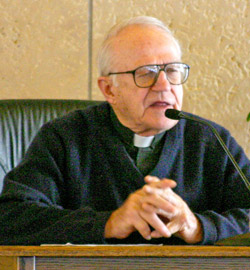
 When I went into the “conference” center, there were many men milling around and talking in small groups. I am not the most social guy in the world, so I took a seat on a couch by myself and commenced reading a magazine called America. This is a magazine published by the Jesuits each month and to this day I always enjoy reading it.
  At about 6:50 PM or so, a Jesuit priest arrived and after a loud hand clap, announced that dinner was being served. We first said a short prayer called the Angelus and then went into the dining hall which is connected to the conference center. The “conference center” is really just a large room to relax in. It has numerous chairs and sofas scattered about a well-lit room with large windows looking out over the grounds. It is one of the most peaceful places in the world to sit, reflect and enjoy a coffee. The conferences (Which I learned about later) are all held in the chapel which is also connected to the dining hall. The only time you have to leave the building is to go to your room. I was given a room assignment upon entering the conference center.


 Once upon a time, there was a group of creatures called humans. They evolve and live out their lives on a place they call Earth. Earth is basically a spheroidal rock that revolves around a Class 3 star (called a sun) in a galaxy named the Milky Way. No humans know where they came from, how they developed or why. This is a subject of endless debate and speculation that has led to a plethora of social organizations which humans call religions.

