All Aboard for a Ride on the Trump Mobile

The Trump mobile is the limousine that Trump drives.  I will describe it in this blog.  If you board his vehicle, he will take you on a ride to autocracy and xenophobia.  To a land bereft of Democracy or anything pertaining to the values and virtues of the Founding Fathers.  Lets look at the construction of this vehicle from the ground up.

There are four tires that the Trump mobile rolls on.  One tire is Christian Nationalism.  This is the belief that the Christian religion should become the religion of the USA.  It is the belief that Christianity is superior to all other religions and that the Christian God is the only true God.  Christianity needs to infiltrate our government and our schools.  Christian Nationalists want to do away with the separation of church and state and put the 10 Commandments and Bibles in every institute of education in America.  America will become a Theocracy like Iran and Israel.

A second tire that the Trump mobile rides on is White Supremacy.  This tire is constructed of layers of belief that White people need to remain the supreme governing group in the USA.  It supports the idea that White people are superior in morals, intellect and aspirations to all other ethnic groups.  By virtue of being White, you are entitled to rule over inferior races which includes everyone on earth who is non-White.

The third tire constructed for the Trump mobile is Sexism.  This tire promotes the inferiority of women to men.  Women were brought into being by a creator not to lead men but to follow men.  A women’s main role is to bear children that will continue the dynasties started by men.  Women should always remain subservient to men from the bedroom to the kitchen.

The fourth tire for the Trump mobile is Racism and Xenophobia.  This tire is built up from layers of fear and loathing for other races and cultures.  This tire rolls on the belief that White people must prevent race mixing.  Allowing relationships with other races will dilute the pure heritage of the White genotype.  Anyone different such as Gays, minorities, disabled people or indigenous people must be eliminated from the White gene pool.

Moving on to the major power for the Trump mobile we come to the engine and the fuel supply.  The engine is composed of 8 cylinders of greed, avarice, acquisitiveness, covetousness, graspingness, cupidity, materialism, and possessiveness.  The fuel that feeds the engine delivers power from the promise of Tax Breaks and Trickle-Down Economics.  A fuel that will help the rich and many others find ways to buy more stuff.

Then we come to the transmission for the Trump mobile.  No limousine can move until the power is transferred to the wheels from the engine.  In the case of the Trump mobile, the two main cogs in the transmission are fear and hate.  Fear and hate convey the power to the wheels.  Fear of others who may try to take away the values promoted by Trump and his followers.  Hate for those who are different and who may try to block the desires of Trump and his supporters.

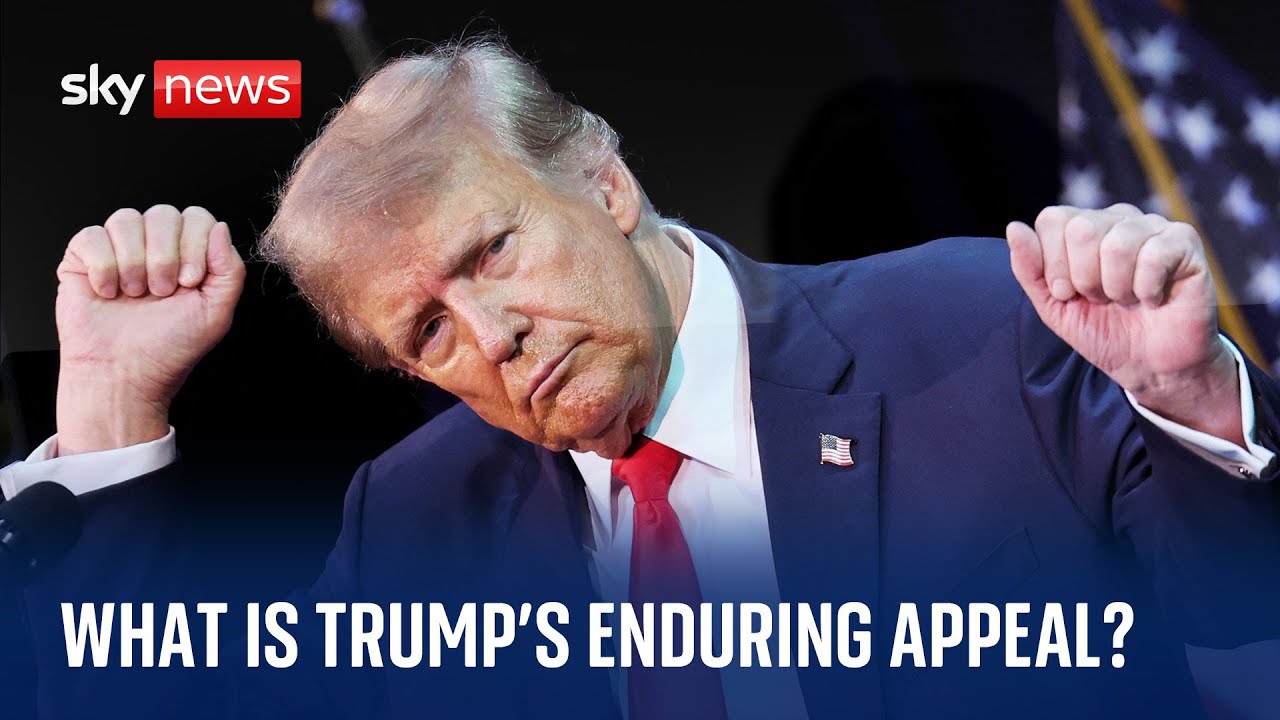
The vehicle is of course driven by the charismatic Donald Trump who is the only one on the whole planet capable of steering the limousine in the RIGHT direction.  Trump was sent by the Christian Nationalist God to drive the Trump mobile to a paradise on earth ruled by White Christian people.  People who believe in the superiority of Whiteness and a White God with blond hair and blue eyes who will smite the enemies of Trump and his supporters.

The fronts seats of the Trump mobile are filled with sycophants who bless Trump and regard him as a savior.  Leaders of the Republican party, rich billionaires, media propagandists and young sexy women all get to ride in the front seats.  The back seats are full of Trump supporters who hope someday to ride in the front seats.  These are men and women who feel cheated by their government and society of their rightful place in life.  They believe that someday Trump will anoint them as faithful followers and allow them to join Trump in his paradise on earth.  They believe that the Trump mobile will take them there.

All aboard please.  The Trump mobile is leaving soon. 

A Conversation with Jesus about Love

I had this conversation with Jesus nine years ago now. I think it is worth reposting as so many people have a need for love in their lives but so few people know what love really entails. John

Only God Can Save You!

This past year marks my 41st Jesuit Silent Retreat.  I may be the only Atheist at the retreat.  Each year brings new insights and thoughts.  I wonder if I have grown any during my retreats.  I can’t say that I feel any closer to God, yours or theirs.  I wonder if there is a God but I doubt it.  I wonder if there are multiple Gods.  A God for each religion.  Is the Muslim God and the Catholic God and the Jewish God the same entity?  Were the Romans, Greeks, Hindus and many others more on the mark with different Gods for different functions?

This year reading as I usually do many of the assigned Gospel readings and many other Gospel passages I was struck with how many of the old prophets emphasized the need to believe in God’s goodness.  Only God can save us and we must have faith in God’s goodness.  God has a plan for all of us if we will only listen to him or perhaps her.  God knows what we need but we ignore his/her messages.  Pray to God.  Love God, for God loves us.  He loves us so much that he sent his only “begotten” son (Not sure what a begotten son is) to save us.

Exodus 33:18-19 (NKJV)

“And he said, ‘Please, show me Your glory.’ Then He said, ‘I will make all My goodness pass before you, and I will proclaim the name of the Lord before you. I will be gracious to whom I will be gracious, and I will have compassion on whom I will have compassion.’”

Frankly, I still don’t get it.  Many people have taken a shot at saving my soul, but I still don’t see any value in God.  During the past five years, he/she has allowed Global Warming to destroy much of the climate that I once loved.  He sent a scourge called Covid 19 to help ruin the last few years of my life.  And to top it off, he allowed a low life called Trump to run for President again.  I guess I am lost to the damnations of hell fire, but I still don’t see a God that is going to save me.  If so, he/she is about 78 years past my patience.

C. S. Lewis was the great “converter.” The conversion of an Atheist to a Theist is an aphrodisiac for the devoted religious. I suppose it justifies their belief in a future fiction that requires a complete abandonment of reason and logic.  A place called Heaven where we can all live happily ever after.  Just as long as we are willing to listen to daily sermons about how good God is for us.

“[God] will not be used as a convenience. Men or nations who think they can revive the Faith in order to make a good society might just as well think they can use the stairs of heaven as a shortcut to the nearest chemist’s shop.” — C.S. Lewis

But “Only God Can Save You” has a ring of truth to it.  No one on earth can save you from death.  No one can be trusted to be by your side forever regardless of the consequences.  Friends and lovers come and go like shadows in the night.  One day someone loves you, the next day they hate you.  One day someone is your friend, the next day they unfriend you on Facebook.  Tragedy of tragedies.  Loneliness is a Satan stalking all of us all of our lives.  I would wager more people have committed suicide out of loneliness than any other reason on earth.

Psalm 107:8-9 (NKJV)

“Oh, that men would give thanks to the Lord for His goodness, and for His wonderful works to the children of men! For He satisfies the longing soul and fills the hungry soul with goodness.”

Only the concept or idea of an All Knowing, All Seeing, All Powerful and All Compassionate God can guarantee us that we will never be alone.  Never be forgotten.  Never be forsook.  One popular song goes:

Walk on, walk on

With hope in your heart

And you’ll never walk alone

You’ll never walk alone

This song was first written by Oscar Hammerstein II and composed by Richard Rodgers for their musical Carousel, which was released in the USA in 1945.  It has since become one of the most popular funeral songs (Next to Amazing Grace) of all time.  Many people interpret it to have faith.  Faith in friends.  Faith in lovers.  Faith in a God who will always be with you in time of trials and tribulations.  It is a song to give hope to people in time of grief and suffering.

But where does one find such a God?  The Bible shows us at best an arbitrary God.  Sometimes belligerent.  Sometimes vindictive.  Sometimes vengeful.  Sometime cruel.  A God that many of us see in the world wreaking havoc on humanity for any number of transgressions.  From Sodom and Gomorrah to massive floods to sending his “Chosen people” into slavery.  A God who threw Adam and Ever out of the Garden of Paradise because they dared eat an apple.  A God who destroyed cities because they did not live up to his/her expectations.  A God who sent a flood to wipe out humanity.  This is a compassionate loving God?

Psalm 31:19 (NIV-84)

“How great is your goodness, which you have stored up for those who fear you, which you bestow in the sight of men on those who take refuge in you.”

Or is it a God who feeds his people.  A God who watches out for his Chosen ones.  A God who rewards those who obey him/her.  A God who destroys the enemies of those who worship him.  A God who is loving, kind and compassionate.  I wonder what God really is.  Here are some questions that still nag at my Atheist beliefs.

  1. Do I think that I am smarter than all the wise and great people who believe in God?
  2. Who or what created us?
  3. What if there is a God? What does he/she think of me?
  4. What if there is no God?
  5. Is God simply a metaphor for “Unconditional Love?”
  6. Is God Death or Life or Both?

The Atheist by Martin Braun

Science defines my virtue.

Factual and fictional books are my domain.

Don’t speak to me of pixies, fairies, and unicorns,

Or of your monopoly on morality, love, faith, and shame.

I am what I am

And of what I do I claim my own.

I fight for my survival

Of which need not be told, judged or shown.

There is no all knowing

Or an immortal god of my fate he will judge.

For when my heart ceases to beat

It will return from whence it came, a kind of primordial sludge.

Can We Break the Cycle of Lies, Calumnies and Slander in our Political System?

You have just read the title of this blog, and you thought, great idea but impossible.  There is no way that we can stop the lies and misinformation that infect our political system.  I submit that you are wrong.  I submit that nothing is impossible if “We the People” decide that we have had enough.  I am sure that this year in the USA, we have all had more than enough.  I don’t care if you are a Democrat, Republican, Independent, Green, Libertarian, Constitutionalist or Socialist, I know that you are probably as sick and tired of the continuous lies that fuel our election process as I am.

“But wait” you say, “In twenty-five days, it will all be over.”  I sincerely wish you were right, but you are not.  No sooner than this election is over then you will get requests from someone running for dog catcher in Fairbanks, Alaska asking you for money.

Dear Sir,

Thank you so much for your generous campaign contribution for my election.  It was thanks to your help and thousands of other donors that I was elected.  But now is not the time to let up.  Our sleazy lying opponents have already collected a million dollars to fund their next campaign.  We must stop them now before it is too late.  Please pledge at least $100 dollars (or whatever you can afford) before midnight to help us reach our goal of 10 million dollars to re-elect me as dog catcher of Fairbanks.  My opponent says that she will ban stray dogs from wandering around our streets.  I promise to do better than that.  I will take all the homeless dogs off the street and provide adequate food and housing for them.  My campaign motto is “Make American Dogs .”  That stands for MAD because I am mad that we have so many homeless dogs.

PS:  You can buy a MAD hat at my office for the low price of only $39.99.  All proceeds will go to building more dog shelters

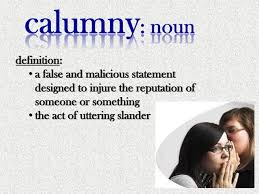
IF you think the above letter is funny, it is only so because you know it is true.  No sooner than this election is over, the cycle of lies, slander and calumnies will begin again.  How can we stop it?  Believe it or not we can stop it.  But before describing what I think we can do, it is important to define some terms.  What is a Calumny?  What is a lie?  What is a slander?  I will use the Oxford Online Dictionary to provide a common definition of each and a few examples.

A Calumny is the making of false and defamatory statements about someone in order to damage their reputation.  — https://languages.oup.com/google-dictionary-en

As an example, I have a flyer before me that claims one presidential candidate will send police door to door to seize firearms.  This is a lie because it is not true, but it is also a calumny because it is designed to damage the candidates reputation.

A Slander is the action or crime of making a false spoken statement damaging to a person’s reputation.

Here is one example from another political flyer.  Candidate X has invited criminals, drug dealers and terrorists into our neighborhoods.  Another lie because no candidate on either side has ever done such an egregious offense.

If you study these two words, calumny and slander, they are very confusing.  One source describes the differences as follows:

“While both “slander” and “calumny” refer to making false statements to damage someone’s reputation, “calumny” is considered a more formal and serious term, often implying a malicious intent to spread false accusations, while “slander” simply refers to making a false spoken statement that harms someone’s reputation; in legal terms, “slander” is the specific act of making a defamatory oral statement, whereas “calumny” is a broader concept encompassing the act of making a malicious false accusation.”  — Generative AI

A Lie is an untrue statement with intent to deceive.  She told a lie when she said she didn’t break the vase.  He lied to create a false or misleading impression.

Lying is common to both calumnies and slanders but whereas slanders and calumnies can be illegal and subject to lawsuits, lies are a more generic family of comments that seem to escape legal action.  Part of the reason deals with intention.  A lie may be intentional, but it may not be meant to harm but only to deceive.  (Some might quibble about my distinction here).  For instance, I lie to my date because I want to impress her or him but not because I want to harm him or her.  I lie on my resume to get the job because I think the credentials required are ridiculous and I know I can do a great job despite lacking the formal requirements.

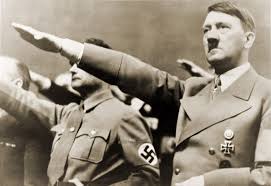
Today, we see lies about everything.  Sadly, people are willing to believe these lies.  The famous Nazi propagandist Joseph Goebbels and German Leader Adolph Hitler have both been described as partisans of what has been called “The Big Lie.”

“The German expression was first used by Adolf Hitler in his book Mein Kampf (1925) to describe how people could be induced to believe so colossal a lie because they would not believe that someone ‘could have the impudence to distort the truth so infamously’.  The phrase “Big Lie” was used in a report prepared around 1943 by Walter C. Langer for the United States Office of Strategic Services in describing Hitler’s psychological profile.  The report was later published in book form as ‘The Mind of Adolf Hitler in 1972.’  Langer stated the following in respect to Hitler’s personality.”  — Wikipedia

“His primary rules were; never allow the public to cool off; never admit a fault or wrong; never concede that there may be some good in your enemy; never leave room for alternatives; never accept blame; concentrate on one enemy at a time and blame him for everything that goes wrong; people will believe a big lie sooner than a little one; and if you repeat it frequently enough people will sooner or later believe it.”  — “Mind of Adolf Hitler, 1972”

When I was a young student going to a Catholic School, I learned that there were two types of lies.  One was called “White Lies” and the other were simply “Black Lies.”  White lies were lies told for good reasons.  White Lies might be defended by those who believe that the ends justify the means.  Thus, politicians who believe they can save the USA from defeat by its enemies might tell “White Lies” to get elected so they can save the country.  Black Lies are generally regarded as lies told for selfish reasons or reasons to benefit someone else.  Using AI again, we find the following distinctions:

White Lies are told to please someone or to benefit the relationship and are generally considered acceptable. For example, telling a friend that their new haircut looks great.  White lies are often motivated by empathy and compassion.

Black Lies are told to gain personal benefits or to avoid a deserved penalty.  Black lies are generally considered universally wrong.  For example, a used car dealer lying about the condition of a car. Black lies are often motivated by selfishness.  — Generative AI

The nuances depicted in many of the definitions given above make ascertaining any criminal liability for lying very difficult.  One person’s “good intentions” might be another person’s “road to hell.”   Lawyers and pedants would have a field day debating these distinctions.  For those of us who know a horse from a cow, the distinctions are quite clear.  Namely, we are sick and tired of being lied to and having to listen to calumnies and slanders from either side attacking and trying to destroy the reputation, character and morals of people whom we personally respect.

I do not care which side you are on, left, right, up or down, enough is enough.  To demolish the character of people with lies and more lies simply to win an election is wrong.

It is wrong. 

It is sick behavior, and it is destroying our country.  You can proclaim all you want that the country is too divided, but it can never come together when one side demonizes the other.  Lying Fascist Greedy Right-Wing Republicans versus Lying Commie Radical Left-Wing Democrats.  What if someone called your mother or wife one of these terms?  How would you feel?  What would you do?  I know what I would do, and it would probably land me in jail.

What is my solution? 

Let us start a national movement that puts power back in the hands of voters.  You can argue all day long about false ballots, hanging chads, illegal voters, fake ballots and you will get nowhere.  As long as we have a voting process there will be human errors and even some iniquities in the process.  But what if we refuse to vote?  There are no laws against NOT VOTING in the USA.  What if we say, “I have had enough.  I am not voting in any election until we have a fix against political slander, lies and calumnies.”

There is no law that could put us in jail for not voting.  Imagine what it would do to the political process.  It would be like throwing a giant monkey wrench in the system.  The elections systems all over America would come to a grinding halt.  All we have to do is “NOT VOTE.”  We agree to stop voting for anyone until some efforts and sanctions are enacted for lying, slander and calumnies in the political process.  Until then, I say we sign petitions not to vote.  Buy yard signs saying “I am not voting anymore.” Start a National I Am Not Voting Party consisting of people like us who are tired of a system built on money, greed and lies.

Please feel free to share this blog with anyone else who is sick and tired of lies and more lies. 

The Real Reason Why Trump Supporters Worship Trump!

maxresdefault

You have read all the books.  You have heard all the theories.  Why do people support Trump?  But every time you listen to Trump, you shake your head wondering “why, why, why?”  Why would anyone support such a low life despicable character or should I say lack of character.  The experts, his “old” friends, his relatives and the left-wing keep coming up with more theories to explain the Trump phenomenon.  How could anyone support a man with no ethics?  An adulterer, liar and slanderer who is also greedy, avaricious and felonious.  A man who has already served one term in the highest office in the world with disastrous results and if his luck holds out may just serve another term.  How, how, how you ask is this possible?  How could 74 million people vote for such a person?

The books and pundits have proposed so many theories for the above questions during the last four years that it would make your head spin.  Going to Google, I found 111 books about Trump.  Most of these books are not favorable but a few are.  (See bibliography of Donald Trump).

There are other theories that have not been enshrined in a book yet.  A recent one that I heard had to do with virility.  Some scientists looked at the US States with the highest Viagra usage and found that the degree of Viagra sold correlated positively with the votes for Trump in that State.  The higher the usage of Viagra, the more men voted for Trump.  Ergo, the theory is that men who can’t get an erection are more likely to vote for Trump.  Needless to say, these “scientists” need to have their heads examined IMHO.  So why do people support Trump?  The other question is “why can’t any facts, data, evidence or Trump pronouncements change their minds?”  Lets start with the first question.

Why Do People Support Trump?

The answer lies in a John Denver song called, “Country Roads, Take Me Home

Almost Heaven, West Virginia

Blue Ridge Mountains, Shenandoah River

Life is old there, older than the trees

Younger than the mountains, growin’ like a breeze

Country roads, take me home

To the place I belong

West Virginia, mountain mama

Take me home, country roads

All my memories gather ’round her

Miner’s lady, stranger to blue water

Dark and dusty, painted on the sky

Misty taste of moonshine, teardrop in my eye

maxresdefault (1)

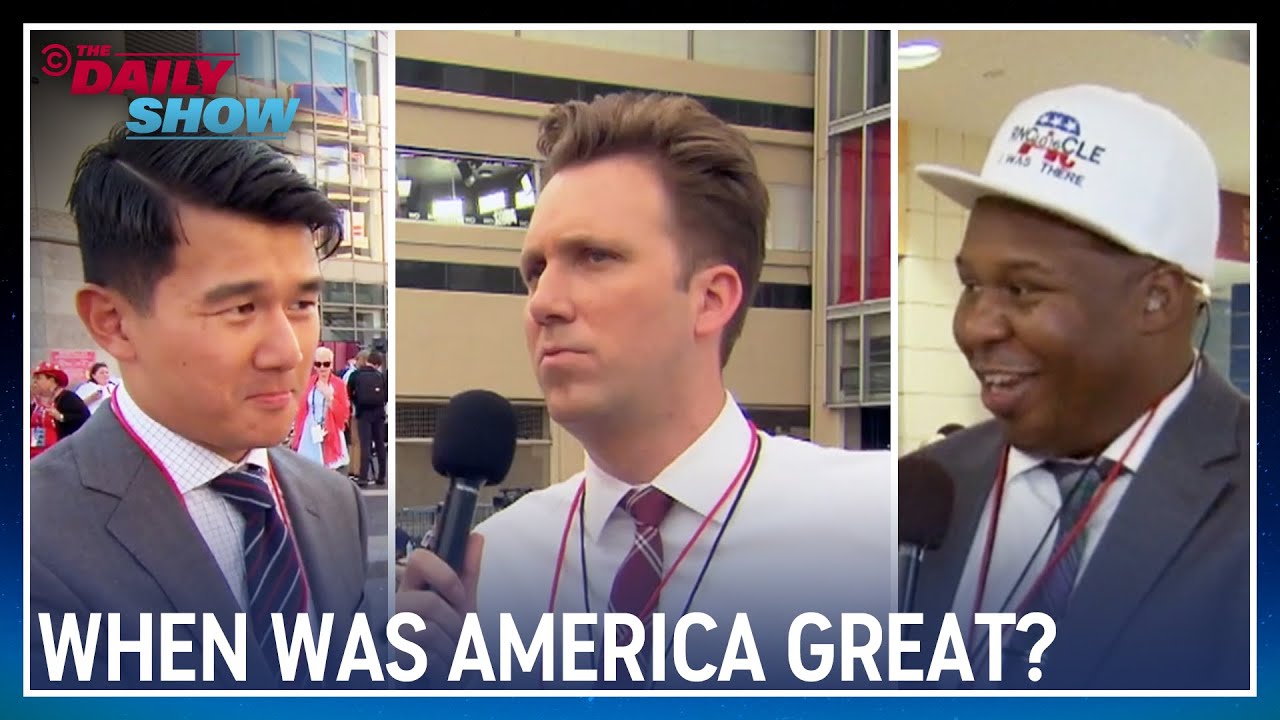
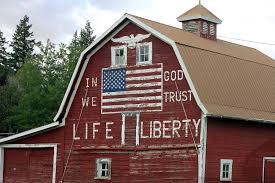
Trump supporters want to go back to the “good old days.”  The days when Whites governed.  Blacks and other minorities knew their places.  Women worked in the kitchen and bedroom and had children.  Men were the breadwinners and on a miners, truck drivers, postal workers, or other blue-collar job could raise a family of six and still have a few bucks left over to go down to the local pub after work for a couple of brews with buddies.

You did not have to be politically correct around gays who were called fags, or disabled people who were called gimps.  Mexicans came over to do the farm work and went back to Mexico.  Other minorities were given visas and possibilities of becoming US citizens but in much smaller quantities than for White Europeans.  School is where you went to get a diploma, play sports and maybe go to college.  No one was worried about being shot in a mass shooting.  Guns were plentiful but were mainly used for hunting and target practice.  Shooting someone for taking your parking space, was unheard of.  (Man killed during fight over parking spot)

It was a time when the USA ruled the roost.  China, Russia, Korea and the Mideast did not dare or would not dare to challenge us.  We had a cold war but until Vietnam, we had peace and prosperity.  Religion was a place that taught morals and values.  The separation of church and state was still believed in by most people.  The TV show “Happy Days” captures some of the nostalgia for the “Good Old Days.”  Days that might have been very happy for some Americans but definitely not for others.  It was also a time of Jim Crow laws that relegated many African Americans to the “back of the bus” and to less than second rate jobs and education.

images

Unfortunately, the Democrats do not understand the Right-Wing nostalgia for the past.  Harris intones “We will not go back.”  She may win over minorities and progressive White people with this message but not with Trump supporters.  It is the opposite of what Trump is promising.  it conflicts with Trump’s message.  Some have interpreted Trump’s message to “Make America Great Again” as a code for “Make America White Again.”  I believe a more accurate interpretation for his followers would be to “Take America Back Again.”  Back to Happy Days, back to a John Denver valley of peaceful tranquility.  Harris wants to go forward but Trump supporters are cautious, going forward to what?  Artificial Intelligence?  Mars Expeditions?  More fake internet information?  More wars in unknown parts of the world like Gaza and the Ukraine?  I want to go home.  I want to go home.

I hear her voice in the mornin’ hour, she calls me

The radio reminds me of my home far away

Drivin’ down the road, I get a feelin’

That I should’ve been home yesterday, yesterday

Country roads, take me home

To the place I belong

West Virginia, mountain mama

Take me home, country roads

 In my next blog, I will answer the second question that I posed above: “Why can’t any facts, data, evidence or Trump pronouncements change a Trump supporters mind?” 


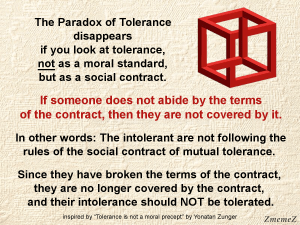
Can We Be Justified for Intolerance Towards Intolerance?

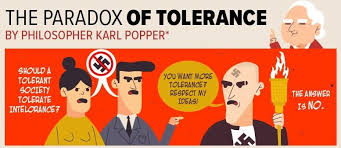
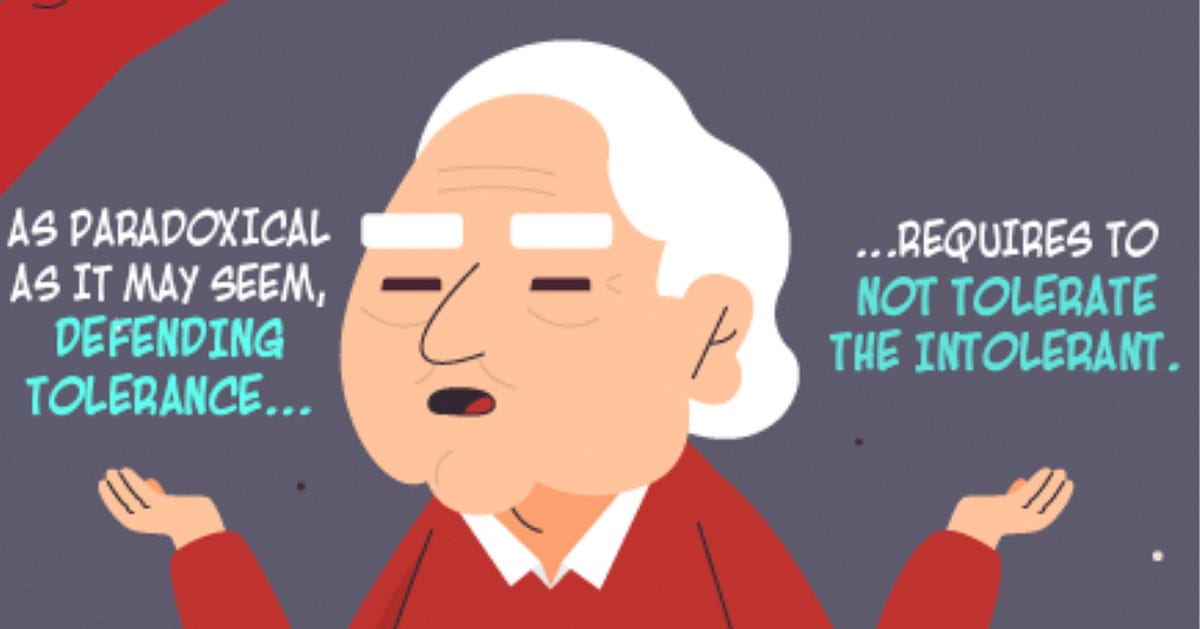
Many years ago, the famous philosopher Kark Popper created what has been called the “Paradox of Tolerance.”

Karl Popper wrote that, “if we want a tolerant society, we must be intolerant of intolerance”.  This is known as the “Paradox of Tolerance”, which is the idea that a society must be intolerant of intolerance in order to maintain tolerance.  As with any paradox, this is very confusing.

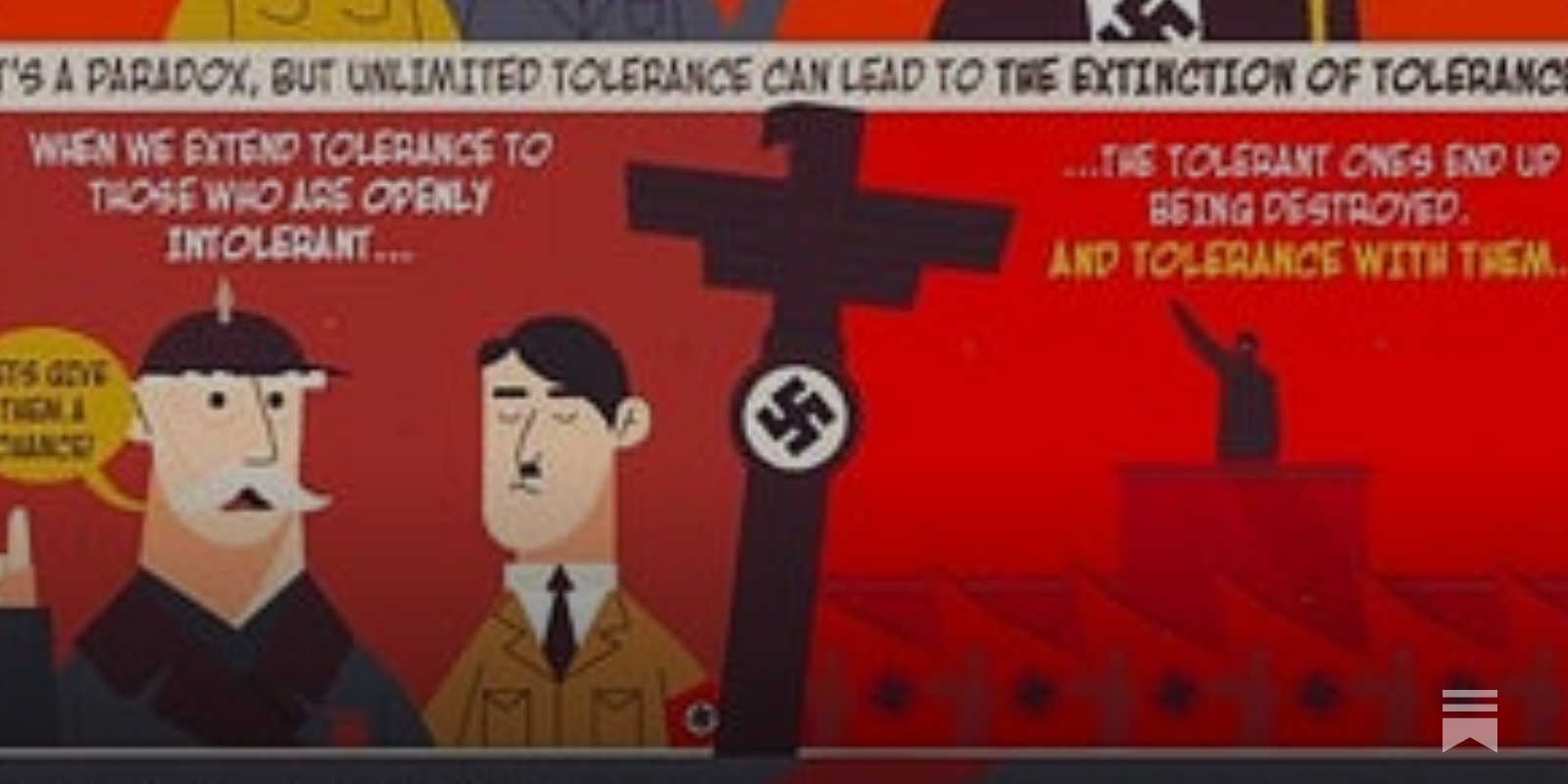
“Popper explained that unlimited tolerance can lead to the destruction of tolerance.  He said that a tolerant society should be prepared to defend itself against intolerant views, and that the right to suppress intolerant views should be claimed if necessary.  However, he also said that suppressing intolerant views through force is unwise unless they are unwilling to engage in rational argument.”  —- From Search Labs | AI Overview

Recently, I came across a rather long academic article which I think supports a justification for Popper’s viewpoint.  Albeit I think this article provides a more nuanced explanation for being intolerant of intolerance.  I have decided to post this article since I think the times demand that we understand this perspective.  I believe it is a focal point worth fighting for.  You may disagree but the analogy of how Hitler took power is I think quite relevant and worth thinking about.  Here in its unabridged form is the entire article.  I would love to hear what you think, so please leave a comment or two.

What are the Limits of Toleration? By Tamar Lagurashvili

University of Tartu, Institute of Government and Politics, Graduate Student

Introduction

Tolerance is considered to be one of the cornerstones of modern liberal democracies, thus having acquired different implications across the countries, which ultimately leads to the ambiguity of the concept itself. In order to avoid further misunderstanding, we should clearly define what is meant in tolerance and why it is crucial not to mix this term with the words having similar connotations. Yossi Nehushtan (2007:5)  offers an obvious distinction between the value-based liberal tolerance and rather neutral tolerance, which finds more similarities with indifference rather with toleration itself. Concerning its linguistic origin, author refers to the Latin word tolerabilis, which means to lift an object, clearly implying to the burden to be carried by one, who tolerates certain unacceptable behavior, act or opinion. Within this context, we should refer to Michael Sandel (1996),  who differentiates liberal non-judgmental toleration from judgmental toleration. While looking closely at these concepts, we can see that in the case of former, person (tolerant) tolerates certain opinion, act or behavior without judgmental evaluation simply because he does not care or he respects others’ privacy and thus, refrains from any kinds of interference. Albeit that, refraining from interfering in other people’s private life is an integral part of modern liberalism, definition provided above does not correspond with the tenets of tolerance.
As Heywood (2015:251)  rightly mentions, tolerance should be distinguished from permissiveness, indifference and indulgence, since being tolerant inherently implies to the fact that a tolerant person faces moral difficulties to put up with certain behavior or act, but does so for the sake of different reasons. Being tolerant means that a person has to impose certain restrictions on him/herself in order to avoid to openly interfere in others’ life when there is something to be disliked, disparaged or disapproved. Toleration with its basic definition can be considered as truly moral value, supporting a peaceful coexistence of the different individuals, but whether there are certain cases, where intolerance is morally/pragmatically justified is major concern of this paper.

Why do we tolerate?

Rainer Frost (2008:79-82) while touching Pierre Bayle’s Reflexive theory of Toleration, talks about three different reasons or factors, which trigger toleration among majority and minority groups. First he mentions permission conception, according to which the majority gives minority a right to live according to their customs, but toleration is possible when the “difference” of minority is contained to certain limits and does not cross the borders of private life. As an early and most vivid example of permission conception Frost names the Nantes Edict of 1598, which granted the Calvinist Protestants of France substantial rights in private as well as in public spheres.

Second way of toleration is coexistence concept, which resembles to pragmatic tolerance to be discussed bit later. In this case, avoiding conflict and paving way towards peaceful coexistence is what matters, but unlike the previous situation, here we face not the relation between the ruling majority and minority, but rather two groups wielding equal powers, thus requiring making some concessions for the sake of preventing clash of interests. If we attempt to apply this concept to real life, we can think of Somalia, who has been torn apart by three different clans ruling in three regions of Somalia, therefore hindering country’s normal development. Bearing in mind that Somalia is characterized by distinctive homogeneity (Guardian Africa: 2015),  one can assume that it is not different beliefs and traditions, which impede toleration among the clans, but the economic benefits they can reap from the permanent state of conflict.

Third conception is based on the principle of respect, thus implying to the fact that toleration requires acknowledging the fact that everyone is equal and deserves equal political and legal rights.
As one can see Frost’s approach towards toleration is rather a combination of pragmatic and moral values, since it fosters cooperation between majority and minority and upholds egalitarian values. Kristie McClure (1990:361-391)  puts forward John Rawls’s understanding of toleration within his notion of “ justice as fairness”, according to which toleration carries distinctively pragmatic connotation, namely the one of social conditions, which not only helped to put an end to the religious wars in Europe, but to transform religious toleration into certain form of social practice. John Locke’s work Letter Concerning Toleration is deemed to be a milestone in understanding the tenets of toleration. Locke comes from the assumption that we are all created by God and thus, our “Highest Obligation” should rest on the understanding of others’ differences for the sake of our moral obligation and love (Frost 2008). Later on Locke argues about the possible relation between the tolerant and one to be tolerated, excluding the possibility to give superiority to any church, since it will lead to persecution and monopolization of power.

One can consider that by proposing to give each and every church equal power as searching for  the only true religion is futile and will exacerbate conflict between different religious groups, Locke somehow offers the coexistence concept elaborated earlier. Even though toleration is a God-given virtue, Locke still talks about its possible limits, which in his case is restricted to two kinds of groups: “A church that assumes the power of being able to excommunicate a king or that claims political and religious authority over its members…” and the atheists, as: ”They are not at all to be tolerated who deny the Being of a God” (Frost: 91-92).

Nehushtan, like Frost points out three different reasons of why people generally tolerate: tolerance as right, pragmatic tolerance and tolerance out of mercy. First he touches upon tolerance from the standpoint of rights and argues that no matter how repulsive person’s behavior or opinion can be, harm inflicted to that person cannot be justified on the grounds of personal autonomy developed by Joseph Raz . Author stresses particular importance on the pragmatic side of toleration and develops the ideas very similar to Frost with an additional insight of reciprocity and proportionality, which will be discussed later on. His third point argues that people with physical and/or mental disabilities might be exposed to more toleration than usual, regardless their repulsive behavior.
Can toleration be limited?

Tolerance with its underlying principles and applicability clearly upholds democratic values and strengthens personal autonomy, which constitutes one of the cornerstones of the liberal democracies. Albeit that tolerance is widely considered as “moral virtue”, would we go further and suggest that tolerance can be applied to each and every circumstance regardless the fact who should be tolerated? This question is examined in the works of many political scientists, including Andrew Heywood, who even though stresses importance of the political pluralism, openly talks about those political parties, which are clearly distinguished with hate speech and bigotry, thus threatening the democratic values, should not be tolerated and permitted to the political spectrum, since as author suggests: ”toleration is not granted automatically, it has to be earned” (Heywood: 256).

I would suggest that reciprocity, as a crucial feature of toleration substantively defines the nature of its applicability, which means that in certain exceptions, where we have to deal with a massive surge of intolerance, clearly undermining the democratic values and endangering the sovereignty of state, toleration should be limited. Heywood calls an example of Nazi Germany, where after the failure of Munich Putsch, Hitler and his collaborators were still allowed to pursuit their political activities legally, which ultimately led to the disastrous consequences. It seems that reciprocity plays an integral part in understanding the limitations of tolerance, so clearly expressed in the work of Nehushtan, who also talks about proportionality, which mainly focuses on the costs and benefits of limiting toleration. We could start by recalling Rawls, who suggests that:” it seems that an intolerant sect has no title to complain when it is denied an equal liberty”( Rawls 1999:190).  While analyzing Rawls’s words, we can assume that those intolerant groups, which openly threaten state sovereignty and democratic values in general, should not be treated in a tolerant manner, but how can intolerance be expressed when it comes to politics? Should we ban such intolerant political parties and prevent them from entering parliament?

Should we hold a peaceful campaign, during which we will expose true information about the intolerant party’s real intentions and the scope of possible harm in case of proliferation the intolerant ideas? Deciding upon the methods of expressing intolerance is rather individual and as Nehushten suggests, is rooted in the principle of proportionality. According to the author, while working on the scope of intolerance, one should take into account the nature of intolerance and the response towards it, since if an act of intolerance takes place in parliament for example, an intolerant response should be formulated within the realm of politics and not in the private life. On the other hand, amount and nature of intolerant response should not exceed the original intolerance and what is of core importance- intolerant response should inflict minimal harm to the democratic values and human rights, because otherwise we will face counter-productivity. Fintan O’Toole (1997:346)  raises another interesting question concerning the limits of tolerance based on assumption that excessive freedom of certain group might threaten collective good, thus requiring to impose certain restrictions on that group’s excessive liberty. Therefore, certain amount of intolerance towards the groups, who wield the power in order to prevent them from abusing/manipulating this power, is justified.

Nevertheless, author calls an example of Bernard Shaw’s criticism of the Christian Golden Rule (according to which we should treat others as we would like to be treated), providing the heterogeneous nature of the society, where what one person considers benign for him/herself, might be perceived as totally evil by other. Author suggests that even though there might be a society with relatively homogeneous religious beliefs, the applicability and interpretation of the customs and beliefs might considerably vary (O’Toole: 347). Therefore, we should not expect that toleration will be upheld as universal value across different societies, but what author explicitly refers to is the nature of harm inflicted by the intolerant groups, which morally and pragmatically justifies adequate intolerant response.
Conclusion

Tolerance, as one of the tenets of modern liberal thought,  cannot be applied universally to every situation, without taking into account the nature of an opinion, behavior or act to be tolerated and the amount and nature of harm done to the society followed by intolerance.  We can assume that intolerance is justified on the grounds of reciprocity i.e. as Heywood stated, tolerance should not be granted automatically and it requires certain effort to be excerpted by the groups demanding tolerance and proportionality, which implies that there should be balance between the original intolerance and its corresponding intolerant response. Even though tolerance constitutes a major tenet of modern liberal democratic states, where each and every individual is endowed with personal autonomy and a right of individual liberty, preventing certain individuals from infringing others’ private life, there are some exceptional cases, where intolerance can be justified. Even though individual liberty is an integral part of the democratic societies, my essay primarily focused on the limits of tolerance at the political level, where we might face much more disastrous results in case of allowing unlimited tolerance towards the intolerant groups. Having tolerant attitude is vital in pluralist societies, but when national sovereignty and democratic values are endangered due to the nature and amount of intolerance exposed to the wide public, appropriate intolerant response should be nurtured taking into account the costs and benefits of such response.

Bibliography

Frost, Rainer. “Pierre Bayle’s Reflexive Theory of Toleration.” In Toleration and Its Limits, edited by Melissa S. Williams and Jeremy Waldron. New York University Press, 2008.

Heywood, Andrew. Political Theory: An Introduction. Palgrave, 2015.

McClure, Kirstie M. Difference, Diversity and the Limits of Toleration. Sage Publication, 1990.

Nehushtan, Yossi. “The Limits of Tolerance: A Substantive-Liberal Perspective.” 2007.

O’Toole, Fintan. “The Limits of Tolerance.” By Fintal O’Toole and Lucy Beckett. Irish Province of the Society of Jesus, 1997.