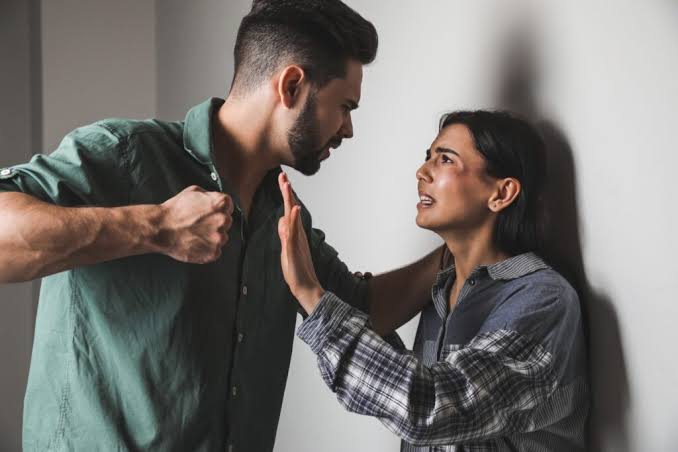
For many years, I had an anger management problem. I never saw the problem even when Julie left me the first time. We reconciled a few months later. We missed each other. However, I still had not realized that my anger was affecting our marriage. I was told by the marriage counselor that we saw that I had an anger problem. However, since I never hit or physically hurt Julie or my daughter Chris, I did not accept his assessment. Not until years later did I realize how much my behaviors scared them and the fear that they lived with on a daily basis.
I would throw things. I would smash things. I would punch the walls. I once bragged that every wall in our house had a hole in it where I punched it. I did not get any help for my anger problem or even realize that I needed help until 1984 when Julie and I decided to call it quits for good.
I decided to go back to school to get a Ph.D. degree. Although I had gone to a few other shrinks over the years, the issue of my anger problem with these other counselors never came up. I would go to see them for reasons more related to my OCD and depression. I also had recurring nightmares that someone was trying to kill me. Since counseling was free for students, I decided to see a counselor who was at the University of Minnesota.
We met several times. Then one day, she looked me in the eyes and said, “You have an anger management problem.” To me that meant I could not control my temper and assaulted people. I still could not see that anger and my behaviors with my wife and daughter had been abusive. I denied it. She insisted. She said that she wanted me to go to the Domestic Violence Program Center at the Wilder Center in St. Paul for an anger assessment. We argued over this “waste” of my time, but I finally relented.
She set up an appointment with a counselor there for me to see. I was expecting a woman and instead a younger man sat across a table from me looking quite smug and self-assured. I immediately disliked him and his attitude.
He started asking me more and more personal questions. I was getting more and more pissed at his questions. He then asked the question that really set me off. “Did you ever molest your daughter sexually?” At that point, I stood up and said, “How would you like me to knock your teeth down your throat?” To my surprise, he merely laughed and said, “You have an anger management problem.” Suddenly, like a bolt out of the sky, I knew he was right.
I joined the Domestic Abuse Program, someplace, I never thought I belonged. Yes, I had many fights, but they were always with other guys who back then I labeled as assholes.
I did the 12-week program and then spent three years coming back to a weekly support group for men who had gone through the program. We had doctors, lawyers, teachers, plumbers, carpenters, truck drivers and men from many other walks of life. One guy “a lawyer” had thrown a beer can at his wife and knocked her eye out. Most of the men initially blamed their wives for causing their anger. Over time and being caringly confronted by men in the group who had gone before them, they finally saw what I had learned. It was my fault. Not my wife’s fault, or anyone else’s fault. My anger was my responsibility and no one else’s.
The program forced me to look at who I was and what I did and how I was responsible for my actions. Men in the support groups would not allow any of the new people in the group to try and bullshit their way out of responsibility. Over time, I became one of those who would challenge others when they tried the “she made me do it” line.
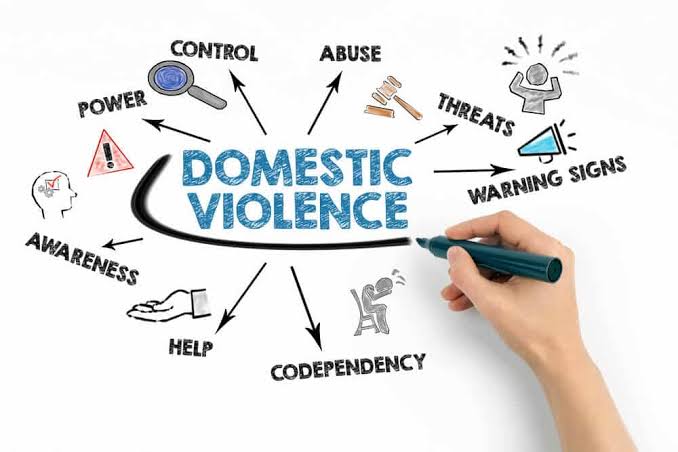
No one except me was to be blamed because I threw something, smashed the lights on my car, beat up a guy I thought was messing with my wife or any number of other things I did for one simple reason. I would not control my anger.
I can see now with the value of hindsight that it must have been hell living with me. Julie was a very kind and compassionate person. My daughter Chris always seemed to be afraid of something. I realize now that what she was afraid of was me. Julie did the best she could to protect me from the excesses of my own anger. Without her I know I would have ended up in jail.
My daughter was sixteen when Julie and I separated. She did not want anything to do with me for twenty years or more. I would like to have more of a father daughter relationship. I miss a relationship with her that I never had. I also recognize why she would want to keep her distance.
It hurts but the forgiveness that I long for may never come. It is the price that I pay for the anger and psychological abuse I caused both Chris and Julie.

I started off with “MY” story, because I am sure you have heard all the statistics and the warnings about domestic violence. I wanted to make this blog personal because domestic abuse and domestic violence are personal. In my case, it was a function or outcome of my anger. In many cases, domestic abuse stems from other sources like entitlement, power, jealousy or machismo.
I was going to start this blog off with statistics showing the extent of domestic violence in our nation. The people we say that we love most in the world are among the most abused and mistreated people in the country. The amount of abuse is staggering.
General domestic violence statistics
- More than 1 in 3 women and 1 in 6 men in the United States have experienced physical violence, sexual violence involving contact, or stalking by an intimate partner during their lifetimes.
- An estimated 6.7 million women and 2.8 million men experienced those forms of intimate partner violence in the twelve months preceding the survey.
- Nearly 1 in 3 women and more than 1 in 5 men have experienced psychological aggression by an intimate partner, including humiliation, threats, or controlling behavior, during their lifetimes.
- About 18% of women and 9% of men have experienced severe physical violence by an intimate partner during their lifetimes, such as being beaten, kicked, or subjected to choking or suffocation attempts.
- The above data is from “The National Intimate Partner and Sexual Violence Survey 2023/2024” — Intimate Partner Violence Data Brief
https://www.cdc.gov/nisvs/media/pdfs/intimatepartnerviolence-brief.pdf
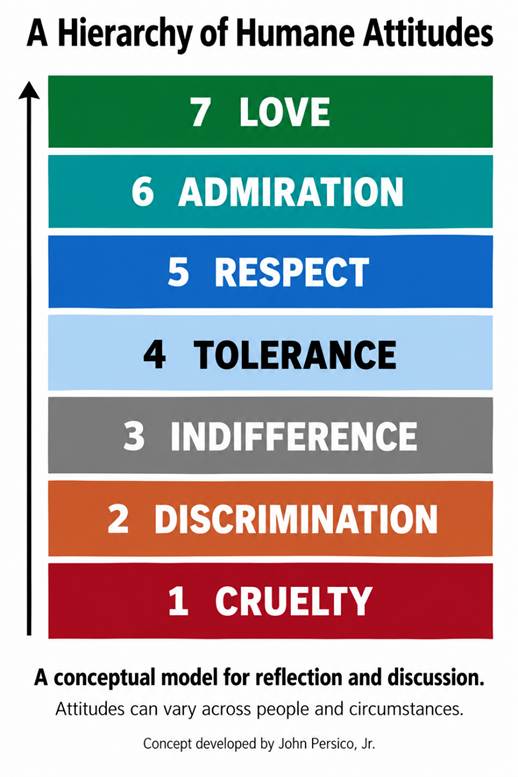
I cannot help but think that given the amount of domestic violence, many of us lack a scale of humane values and attitudes. Too many of us say we want one thing, but our actions and attitudes get us the opposite. I am not in a position to lecture anyone on anger management, but I wanted to create a scale of tolerance which I thought we might use in dealing with not only our loved ones but everyone else. I started this idea ten years ago. Over time, I realized that tolerance was only a stop on a journey to full love for others. The love that Jesus said all people should have for others as well as strangers and people not like themselves. Working with my AI Assistant I created the following scale.
The vertical dimension indicates an increase in compassion, and merciful attitudes towards others. Each level includes examples of how that attitude can be expressed. This scale is meant to help you reflect on your actions. It is not a validated measurement tool. My belief is that attitudes without appropriate behaviors are meaningless. Years ago, I would have said that I loved my wife and daughter. My behaviors painted a different picture.
“A Hierarchy of Humane Attitudes”
| Love | Affection • Care • Commitment • Generosity |
| Admiration | Appreciation of character • Abilities • Contributions |
| Respect | Dignity • Rights • Boundaries • Fair treatment |
| Tolerance | Acceptance of differences • Peaceful coexistence |
| Indifference | Ignoring suffering • Neglect • Disengagement |
| Discrimination | Exclusion • Unequal treatment • Denial of opportunities |
| Cruelty | Psychological • Physical • Sexual • Combinations |
| Attitude ↑ | Examples of its expression ↔ |
One essential qualification: respect and safety are obligations; admiration and affection cannot be demanded. Someone experiencing abuse does not owe their abuser greater love or continued access to their life.
Conclusions:
Where do you put yourself on this scale? Can anyone who spends most of their time down in the cruelty and discrimination areas of this scale say they have a good relationship with others?
The damage that we do to others in words and deeds cannot always be undone. We can do our best to apologize and to ask for forgiveness, but the hurts we inflict on others may never be erased. Healing and changed behavior may make a difference for you but forgiveness and reconciliation are never guaranteed.
Speaking for myself, the realization of what I was and how I behaved can never be forgotten. Many have told me, you have to forgive yourself. It might be possible, but it has not happened yet.
If I have said anything in this blog that helps you to see that you may have an anger management problem or if you feel that you are a victim of abuse, I encourage you to call the following number.
National Domestic Violence Hotline, 800-799-7233; text START to 88788


Oct 04, 2026 @ 14:06:52
Now that you bring it up — I would say that Trump has a severe anger management problem. Perhaps MAGA is mainly people with anger management problems.
LikeLiked by 2 people
Oct 04, 2026 @ 18:34:13
I have not heard that theory yet on Chump and his sycophantic supporters but I think it is a good one.
LikeLiked by 3 people
Oct 04, 2026 @ 18:34:13
I have not heard that theory yet on Chump and his sycophantic supporters but I think it is a good one.
LikeLike
Oct 04, 2026 @ 18:25:02
Thanks for sharing your story so candidly John. Your journey really got me thinking. It’s a good thing to keep remembering that we are responsible for our own actions. Your story also shows me hope.
LikeLiked by 2 people
Oct 04, 2026 @ 18:33:07
Thank you for your kind remarks. I wonder what Julie and Chris would think about my memories? It seems so many years ago now and I am not sure I got everything right but I wanted to be honest. John
LikeLiked by 2 people
Oct 04, 2026 @ 21:23:04
Wow … thank you for sharing your story, John … doing so can’t have been easy for you. I’ve been very lucky that neither I nor anyone close to me have had anger management issues, but I once had a friend whose husband did and I well remember the trauma she went through. Thanks again … take care, my friend.
LikeLiked by 2 people
Oct 04, 2026 @ 22:34:42
Well, I can’t say it was easy Jill. But living with the past is even harder. I seldom have a day go by when I don’t wish I had been a different person. I can’t write without telling the truth as I remember it. I suppose my exwife and daughter might have different memories. I realize that the painful memories far eclipse any good times we might have had as a family. Thanks for taking the time to comment. I am going to work tomorrow night on a phone bank to try to flip the Congress for the mid-terms so we can hamstring the AIC we have in office.
LikeLiked by 2 people
Oct 05, 2026 @ 22:51:32
Indeed, living with the past, facing our mistakes, gets harder as we get older, John. We … none of us … are without flaws and all of us have done things in our past that we are ashamed of today. But … you can’t change the past, you can only resolve to “do better” … and you have. You’re a good man, John. And you’re doing good things in many ways, not the least of which is trying to wake people up in the next 28 days to make this election COUNT! Thanks for doing that, my friend! We each do what we can as best we can.
LikeLiked by 1 person
Oct 06, 2026 @ 07:27:56
Thank you Jill for the thoughtful and kind comment. John
LikeLiked by 1 person
Oct 06, 2026 @ 08:27:24
I admire your ability to have realized that you had a problem, and the good sense to take the necessary steps to get the help you needed. The first step is admitting you have a problem, and that goes for a wide range of issues.
Anyone who says they do not get angry should have a good long talk with themselves in a mirror. I am a relatively passive person, but a close family member of mine said that although I was slow to anger, I was scary when I did lose my temper. I cannot say that any display of emotion when it comes to losing one’s temper is warranted. It is best to stay in control, which is much easier said than done in some cases.
Very informative blog, and your suggestion to those who may have a problem to call that hotline was a very good idea. There are many people who would profit if they could just admit that they have a problem.
LikeLiked by 1 person
Oct 06, 2026 @ 10:01:36
Thanks Jeanine.
LikeLike
Oct 09, 2026 @ 19:26:30
It is interesting to hear about your experience with the support group. I’ve heard a lot of positive things about support groups for men in general. I like to hear about men holding other men accountable in this way, it seems like something society benefits from. Speaking truthfully about painful subjects can lead to healing individually and collectively.
LikeLike
Oct 10, 2026 @ 09:30:23
Thank you for the comment Deermoonflower. I am a big believer in support groups but some mens groups I am afraid foster beliefs in male supremacy and machismo which is the opposite of what I want to see men doing.
LikeLiked by 1 person