I have talked about fame, fortune beautiful people and cars. These are a few of the things that many of us lust after. Foolishly chasing them in the hope that they will bring us happiness. But the epitome of all desires by humans is immortality. All other aspects of our egos are merely means towards achieving a dream that we will never be forgotten.
Some people want buildings named after them. Some want giant arches or statues to be remembered by. The pharaohs of Ancient Egypt built huge pyramids so that they would not be forgotten. Many famous people have airports, streets, awards, and other tokens of fame named after them. While I have often lusted after such symbols of immortality, I am reminded of a poem by Shelley about a statue.
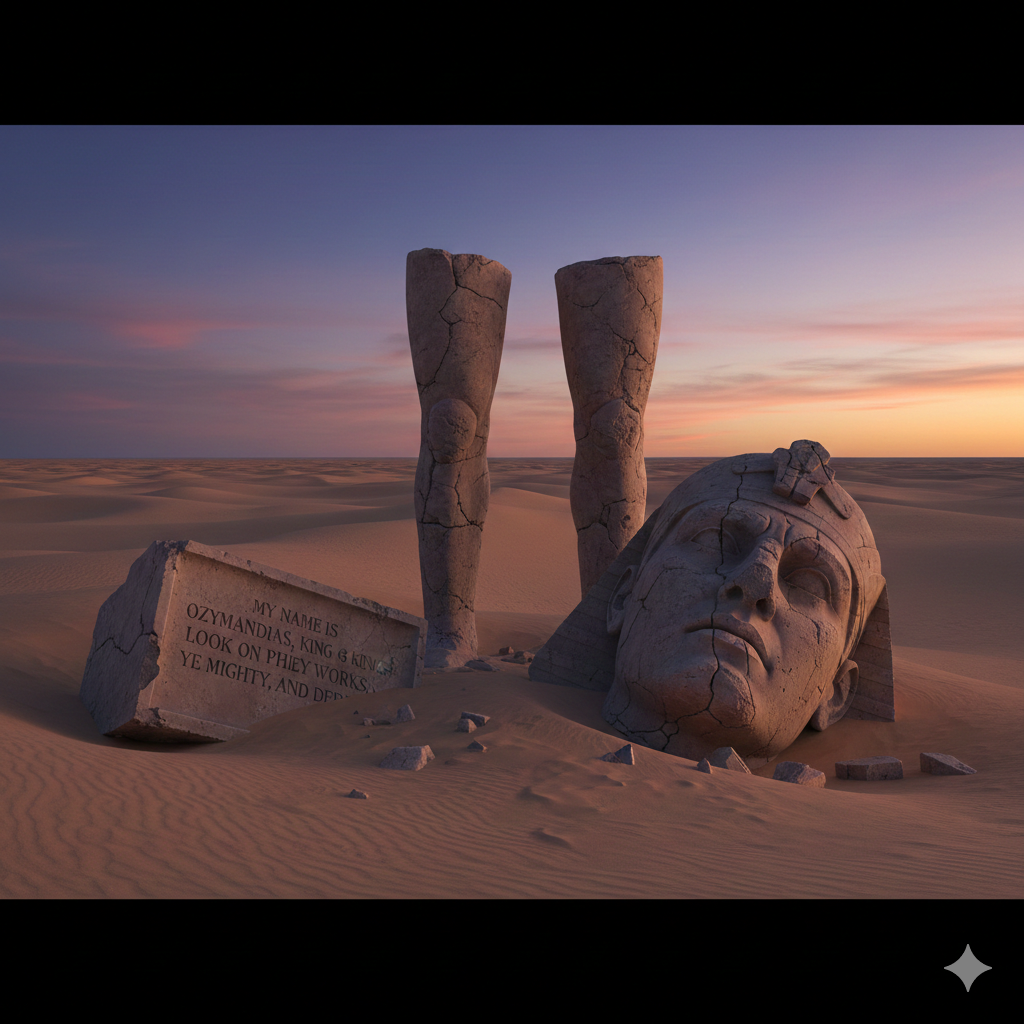
Ozymandias
By Percy Bysshe Shelley, 1819
I met a traveler from an antique land
Who said: Two vast and trunkless legs of stone
Stand in the desert. Near them, on the sand,
Half sunk, a shattered visage lies, whose frown,
And wrinkled lip, and sneer of cold command,
Tell that its sculptor well those passions read
Which yet survive, stamped on these lifeless things,
The hand that mocked them and the heart that fed:
And on the pedestal these words appear:
“My name is Ozymandias, king of kings:
Look on my works, ye Mighty, and despair!”
Nothing beside remains. Round the decay
Of that colossal wreck, boundless and bare
The lone and level sands stretch far away.
There is an irony here that I cannot ignore. The king’s monument lies in ruins, but Shelley’s poem keeps his name alive. The warning against immortality has itself become a vehicle for remembrance. Even so, being remembered for two hundred years is a long way from being remembered forever.
When I became a graduate research assistant at the new Vocational Education building on the St. Paul Campus, we were told that each Ph.D. graduate would have a brick inscribed with their name on it. The brick would find its way somehow into one of the buildings walls. Placed in such a way that it would survive for eternity. I entered graduate school in 1982 and completed my Ph.D. degree in 1986. I was never given a brick with my name on it. As far as I know, no one else ever had their name put on the wall. Unless it was inscribed in graffiti too discrete for even the university maintenance department to notice.
To be honest, I was mildly disappointed. I was ready to settle for immortality by brick.
I doubt that the Vocational Education building will stand forever. Thus, even if I did get my name on one of its walls, it would hardly reflect my idea of immortality. Who would know from my name alone, the wonders I accomplished in the 21st Century of America?
But what do I mean by immortality? My first thought was simple: something that lives forever, whether a person, an idea, or a thing. The more I considered it, however, the more I realized that I was mixing several different desires.
Living forever is one thing. Being remembered after death is another. Having an influence that continues after people have forgotten your name is something else again. A building named after me would not keep me alive. It might not even keep anyone interested in who I was.
Religions and philosophies complicate the question further. Some promise the survival of a soul. Others imagine rebirth. Buddhist teachings about the Deathless do not simply promise that the familiar personal ego will continue forever. We use similar words for very different hopes.
If you are still confused, I suppose we could go to Webster’s definition to settle things a bit. Looking at the various theories that have been proposed over the centuries does not provide a clear answer to what immortality really means. As I started looking for a universal definition, the hundreds that emerged made me realize that most of the great thinkers in history as well as great religions all have very different ideas as to what immortality entails.
I find this somewhat surprising since I was sure that for most of us it meant simply living forever. Alas, life is never that simple. A key question that my search led to was “What, if anything, will live forever?” Do we have an immortal soul that will go on living long after our body returns to protons and electrons? Will we come back again in some ghostly appearance and stalk the universe? Is there a heaven where good people like us will get to live forever with their favorite pets and/or spouses? How crowded and confusing this would get on Friday nights.
What if I told you that immortality was a fiction? A fiction that humans created like they created the “God” in their image. An idée fixe that according to Max Stirner is simply wheels in the head. For Stirner, a “wheel in the head” is an abstract concept, ideal, or belief that a person treats as absolute, sacred, and superior to their own individual self. Instead of the individual owning the idea, the idea owns the individual.
Key elements of Stirner’s concept include:
The “Spooks” of Mind: Stirner argued that abstract concepts like God, the State, Morality, Humanity, Duty, or Truth are not real, physical entities. They are illusions—ghosts or “spooks”—that people construct.
Our ancient ancestor woke up on the middle of a night a million years ago and decided that he did not want to die. Death represents oblivion. A passage into nothingness. No remnants remaining of life. Nothing and nobody to remember. A life’s journey of experiences, learnings, meetings, friends, relatives, loves and all gone.
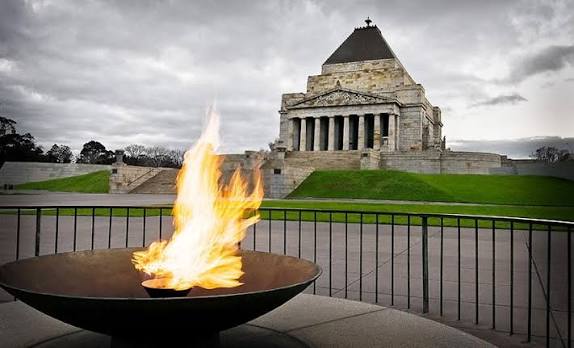
Perhaps you will get a gravestone that a few people will visit for a few years. If you are remarkable enough, perhaps you will get an eternal flame on your grave. How long will your eternal flame burn if you do get one?
Did you know that according to Google, there are only about nine prominent naturally occurring eternal flames known in the world, though estimates vary?
Google adds that If we include man-made eternal flames—such as memorial torches, religious lamps, and civic monuments dedicated to leaders or fallen soldiers—there are hundreds or thousands of them maintained in the world.
Eternal has much the same meaning as immortal. Webster’s defines Eternal as “having no beginning and no end, lasting forever, or existing completely outside of time.”
Synonyms:
• Immortal
• Everlasting
• Perpetual
• Enduring
• Timeless
We don’t want to die. We don’t want our works, our loves, our treasures, our hopes and dreams to pass into nothingness. So we invent the idea of immortality. We create a belief that somehow we can preserve all the treasures of our lives. Maybe, just in a bunch of pictures of events that meant so much to us. Places we visited. People we knew. Houses and cars and stuff we owned.
Unfortunately, when our heirs are going through what remains of our possessions, the pictures get sifted and only those few with images of our heirs may get saved while the rest will go into the garbage bin. That is one place that does not seem to be sacred to humanity, the garbage bin.
In some respects, the lack of sanctity related to garbage might be the ultimate sin of mankind. Perhaps 90 percent of everything that humans including you and I ever made will end up in the garbage bin.
I have noticed that the greatest writers, poets, artists, authors, philosophers, historians, scientists, painters, sculptors and musicians will be lucky if they are remembered for more than one work that they created.
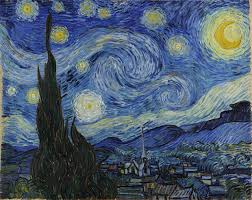
What irony that Van Gogh now the highest paid artist in history sold few paintings while he was alive.
We might console ourselves with the belief that immortality can only be achieved after we die. Socrates, Plato, Jesus, Buddha, Mohammed, Moses and many other great prophets as well as leaders only stepped into the ranks of immortality after they passed away. Jesus said that you are never a prophet in your own land. Maybe no one can be immortal until after they die.
However, posthumous fame may be of little consolation. Or does it mainly comfort those of us who hope that recognition might eventually catch up with our own neglected brilliance?
What if you could buy immortality? What if someone in the vast world of capitalism found a way to sell immortality. We hear talk of being frozen upon death. What if some new conglomerate came along and for a price guaranteed that they would keep (if not our bodies) at least our memories and accomplishments alive forever?
Instead of the obituary which plays in the local newspaper for a week and then is read by a few at your “celebration of life”; what if you could buy a guarantee that your name would become immortal? How much would you pay for the privilege?
You would not have to build a pyramid or an arch. The XYZ Life Company would create an ongoing marketing program to insure that you were never forgotten. You could simply buy immortality for a price.
Sadly, you can see the potential glitch in this idea. Companies come and go. The top companies yesterday are now in the dustbins of history. Like your frozen body, who is going to do the marketing after the XYZ Life Company goes bankrupt or the senior executives run off with the profit?
Do you trust capitalism to insure your immortality?
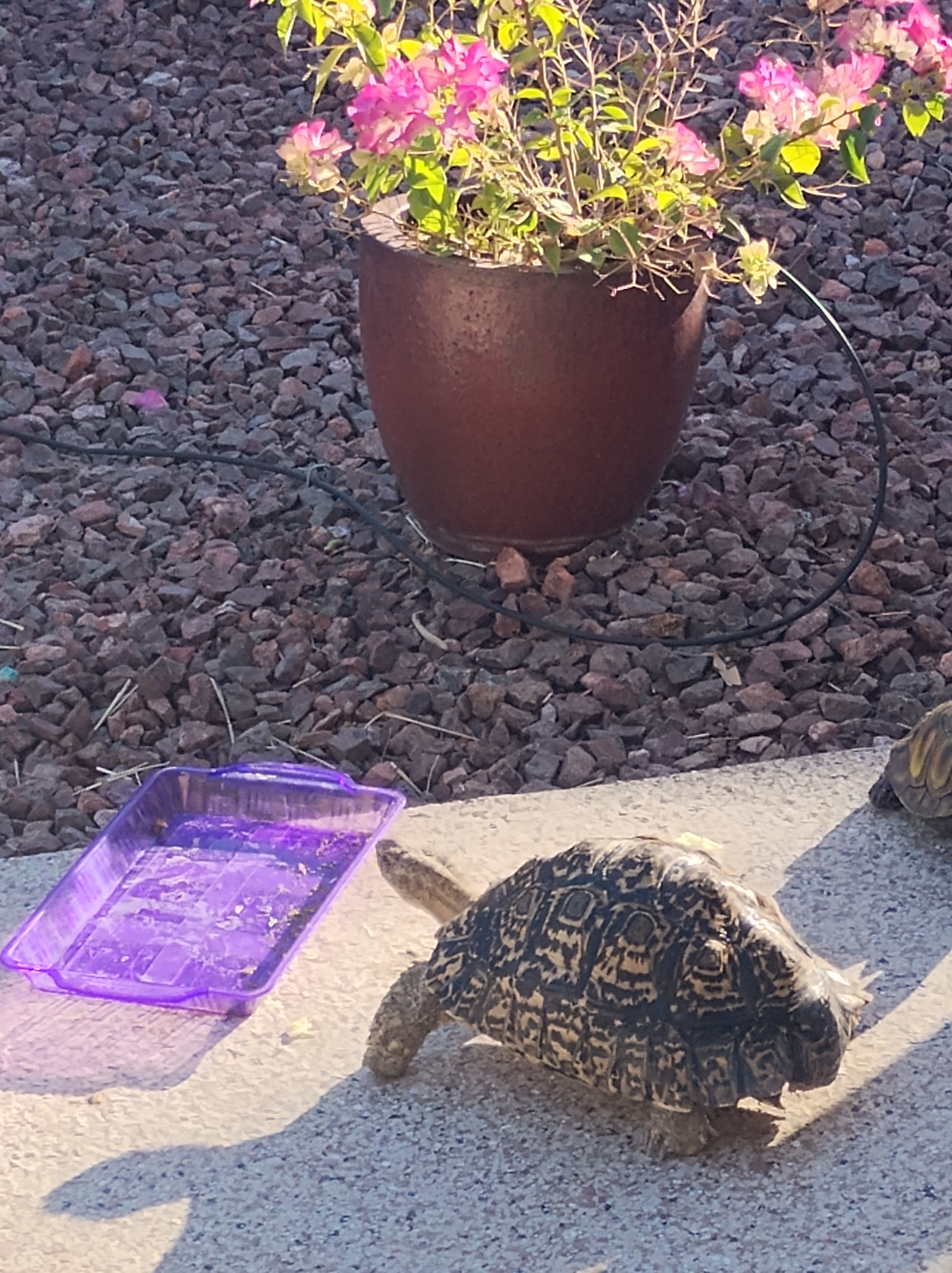
Our tortoise Mikey, short for Michaelangelo, roams our yard daily. He is much more active when the weather is warm, but he spends more time in his heated thermostatically controlled to 74 F house when the weather turns colder. This week the highs will be in the mid-70’s and the lows will be in the mid-fifties. Occasionally, we bring him inside for a soak.
Mikey belongs to an ancient lineage. Turtles and their relatives have an evolutionary history extending back more than 200 million years. That does not mean his particular species has existed that long. Our own species, Homo sapiens, has been around for roughly 300,000 years. Neither comparison gives an individual tortoise—or a human—immortality.
Perhaps the question that I should have asked before worrying about my missing brick is this.
Why must a life last forever to have mattered?
A kindness can matter to the person who receives it even if neither person is remembered a century later. The same is true of a friendship, a love, or an afternoon spent enjoying the world.
The dream of immortality does little to help us live today.
I wonder if Mikey ever realizes that his species has been a lot more immortal than ours has. At least in terms of longevity. I suspect turtles will continue to hold an edge. It is probably not an idea that Mikey spends a great deal of time thinking about.
He never seems concerned about whether a street will be named after him or an arch built for him.
Mikey is now out roaming the yard, getting on with his day.
Just another Tortoise Day.
PS:
My thanks to Metis my AI assistant for her suggestions in making my writing better than it would be without her ideas and editing. I do not always take her suggestions but she often makes a good point even when I do not agree with her.


