“Determine That It Will be Done, and Then We Shall Find a Way” — Lessons on Leadership from Abraham Lincoln

America has lost the “Art of Leadership.”  We no longer develop men and women with integrity or selflessness.  Instead of Statesmen, we have political hacks only concerned with getting reelected.  Politicians with no backbones or the courage to stand up against injustice.  We have a Congress of sycophants willing to do whatever they are told to do regardless of how unethical or immoral it may be.  We have thousands of lawyers who do not uphold justice but find arguments to support an amorality that meets the letter of the law but ignores the significance of decency, goodness, honesty, conscience and fairness.

In this blog and the ones to follow,  I will write about insights regarding leadership from one of the greatest American leaders and Presidents of all time.  I found a compilation of these in an old collectors edition of “Civil War Times” published in Winter, 2013. There are 41 in total.  I have already covered the first two in previous blogs.  I would like for you to hear the words of Abraham Lincoln and what he had to say about leadership.  I will include some of my own experiences from my years of working with senior management in over 32 organizations.  Some of the men and women I worked with were incredible leaders.  Most of them wanted to be better leaders and that is where I brought the teachings and thoughts of W. E. Deming to my consulting practice.  Dr. Deming achieved extraordinary results in business by tapping the knowledge, skills and abilities of ordinary people.  Senator Hubert Humprey famously said that “Democracy is a system that achieves extraordinary results with ordinary people.”

Insight # 3 – Determine That the Thing Can and Shall be Done, and Then We Will Find a Way to Do It — Speech to Congress, June 10, 1848

Abe Lincoln was an interesting blend of idealist and pragmatist.  There are many pundits today who talk endlessly about what should be done and how it should be done.  Such idealism is not only admirable but also necessary.  However, idealism in never enough.  I do not trust others who tell me “what to do” but never lift a hand to help me do it.  The Right-Wing in America has for many years belittled Academics as “Pointy Headed Intellectuals” with no common sense.  Democrats, Liberals and Intellectuals have too often seen what needed to be done but lacked the courage or fortitude to get it done.

I found a wonderful political button twenty-five years ago which unfortunately I have lost.  On one side it read “Democrats, the Party of Wimps.”  On the other side, it read “Republicans, the Party of Greed.”  In the years since, I have noticed how appropriate these labels were.  When the Democrats had majorities in many states, they bickered and dithered while the Republicans gerrymandered districts as fast as they could.  This gerrymandering is one of the key reasons that Republicans have come to dominate politically across the USA.

“In 2011, Republicans leveraged their new state-level dominance and recent advances in districting technology to enact a very aggressive and sophisticated redistricting plan, which allowed them to win a majority in the 2012 House midterms, despite losing the popular vote for the House and losing the presidential election. This was a qualitative escalation in the gerrymandering wars, widely documented, and widely excoriated—especially by Democrats.”Where We Have Been: The History of Gerrymandering in America

When Obama selected Garland for a Supreme Court position, he sat back and did little or nothing while McConnell blocked any efforts to advance Garland’s nomination.  Contrast this with Lincoln’s effort to remove potential spies during the start of the Civil War.

“Abraham Lincoln suspended the writ of habeas corpus during the Civil War to suppress potential Confederate sympathizers and secure the nation’s capital, particularly in Maryland, where there were significant threats to Union troop movements and a risk of disruption to supply lines to Washington D.C., justifying his actions as necessary to protect the country during a time of rebellion; he argued that the extreme circumstances of war allowed him to temporarily suspend this right to maintain public safety.” —- Google AI

The insight here by Lincoln can be phased as “Where there is a will there is a way.”  As another example, the Democrats faced during Biden’s term a Supreme Court with a 6-3 majority against them.  Biden, if he had been bold, could have changed this situation.  Biden could have found grounds to indict both of the two Supreme Court justices who were accused of taking bribes during his administration.  If Biden had removed these justices and prosecuted them (with some courage) he could have appointed two justices “temporarily” to replace them.  This would have given Democrats a 5-4 edge.  During this “temporary” period, any challenges to Biden’s actions would have been supported by a Supreme Court in his pocket.

If you think I am being cynical, denigrating or somehow abandoning the purpose of the Supreme Court, you are very naïve.  The Supreme Court has never been and never will be neutral until a new means of appointing justices can be imposed.  I refer to you the numerous pro-slavery and Jim Crow laws which many Supreme Courts have upheld which clearly were cruel, unethical and immoral decisions.

“The three most important Supreme Court Justices before the Civil War—Chief Justices John Marshall and Roger B. Taney and Associate Justice Joseph Story—upheld the institution of slavery in ruling after ruling.” — Supreme Injustice: Slavery in the Nation’s Highest Court, by Paul Finkelman – Jan 8, 2018

“Jim Crow laws, enforcing racial segregation, were upheld for approximately 60 years from after the Reconstruction era until the mid-20th century with landmark civil rights legislation. The Supreme Court’s decision in Plessy v. Ferguson in 1896 was pivotal in maintaining these laws until their abolition in the 1960s. —Brainly.Com

America has long been a nation that has scorned people who were labeled as intellectuals, geeks and daydreamers.  Some of this scorn is deserved.  Ideals without action are like dreams without plans, they can go nowhere.  The Yin/Yang of life is thinking and action not one or the other.  Today, more than at any time in the history of this country, intellectuals, scientists, thinkers and day dreamers are under fire by an administration that puts thoughtless actions ahead of dreams and ideals.  For example, I refer you to Trump’s Palestinian solution.  We will kick all the Palestinians out of the Mideast and build seaside resorts in Gaza.  If this is not an example of “thoughtless” action, than I do not know anything about life and justice.

Abraham Lincoln knew how to dream but he also knew when and how to act.  Some called him a dictator.  In reality he stood up to the bullies of his time.  Lincoln took actions to support his dream of a slave-free America.  He carefully timed the actions to achieve his dreams with an ability to muster the resources and means to accomplish them.  Lincoln had ideals but he was also a pragmatist.  Lincoln realized that until and unless the South was defeated, we would not be able to abolish slavery.  Once victory was in his grasp, Lincoln wrote the Emancipation Proclamation to free slaves throughout the nation.

President Abraham Lincoln issued the Emancipation Proclamation on January 1, 1863, announcing, “that all persons held as slaves” within the rebellious areas “are, and henceforward shall be free.  The following goals were furthered by the timing and wording of the Emancipation Proclamation:  (From Search Labs | AI Overview)

  • Lincoln believed that freeing slaves was a military necessity to save the Union.
  • The proclamation declared that all enslaved people in rebellious states were free.
  • It allowed Black men to serve in the military.
  • Lincoln intended the proclamation to inspire enslaved people to support the Union.
  • Lincoln wanted to prevent other countries from giving the Confederacy military aid.

When I worked with companies, one of my goals was to create a culture of continuous improvement modeled somewhat on Dr. W. E. Deming’s 14 Points for Management.  The concept of a Continuous Improvement Culture (See My Book The TQM Transformation) was linked to Demings 14 Points.  Several if not most of these points were viewed as a radical departure from what managers were taught in business schools and MBA programs.

I once had a manager who told me that if he made the changes I was endorsing, it would be suicidal for his career.  I replied, “Most radical changes require a leadership willing to sacrifice everything for their ideals including their lives.”  He laughed as he jokingly said, “I am not willing to fall on my sword for this company.”  In truth though, history supports to a large degree that radical change often requires the ultimate sacrifice.  Many men and women have given their lives to support the ideals that they believed in.  A far cry from the sycophants that we see in Congress today who will not even give up their seats in support of the Democracy that they claim to believe in.

How do we fight an “Uncivil War”?  Insight # 4 from Old Abe has more valuable thoughts to help us in this struggle.  I will share these in my next blog.    


The Lost Art of Leadership: Lessons on Leadership from Abraham Lincoln

America has lost the “Art of Leadership.”  We no longer develop men and women with integrity and courage.  Instead of Statesmen, we have political hacks only concerned with getting reelected.  Instead of people with a backbone and the guts to stand up against injustice, we have a Congress of sycophants willing to do whatever they are told to do regardless of how unethical or immoral it may be.  We have thousands of lawyers who do not uphold justice but find arguments to support an amorality that meets the letter of the law but ignores the significance of decency, goodness, honesty, conscience and fairness.

In my next blogs, I want to write about 41 insights regarding leadership from one of the greatest American leaders and Presidents of all time.  I found a compilation of these insights in an old collectors edition of “Civil War Times” published in Winter, 2013.  I would like for you to hear the words of Abraham Lincoln and what he had to say about leadership.  I will include some of my own experiences from my years of working with senior management in over 32 organizations.  Some of the men and women I worked with were incredible leaders.  Most of them wanted to be better leaders and that is where I brought the teachings and thoughts of W. E. Deming to my consulting practice.  Dr. Deming achieved extraordinary results in business by tapping the knowledge, skills and abilities of ordinary people.  Senator Hubert Humphrey famously said that “Democracy is a system that achieves extraordinary results with ordinary people.”

I should issue one caveat before I begin this series.  There are some who disparage “Honest Abe” as not really caring about slavery.  They argue, Lincoln only fought the war to save the Union and not to free the slaves.  My readings and knowledge of Lincoln shows that nothing, I repeat NOTHING could be further from the truth.  Lincoln was appalled at slavery from the time he was a young child until he issued the Emancipation Proclamation.  The idea that Abe did not care about slavery is a lie fostered by a bitter Confederacy that wanted to hide their heinous practice behind the cloak of states rights.

Lincoln said,  “I have here stated my purpose according to my view of official duty; and I intend no modification of my oft-expressed personal wish that all men everywhere could be free.”  –August 22, 1862, Letter to Horace Greeley

Lincoln also said, “My paramount object in this struggle is to save the Union and is not either to save or destroy slavery.  If I could save the Union without freeing any slave I would do it.” —August 22, 1862, Letter to Horace Greeley

Two very different goals.  Two very different thoughts.  What are we to make of Lincoln’s motivations?  The Confederacy pushed the latter because it justified their defense of States rights to choose slavery as a viable economic system.  Several of the constitutions of the new Confederate states proclaimed their rights to practice slavery.

In its statement for seceding from the Union, the state of Georgia wrote the following:

“The party of Lincoln, called the Republican party, under its present name and organization, is of recent origin.  It is admitted to be an anti-slavery party.  While it attracts to itself by its creed the scattered advocates of exploded political heresies, of condemned theories in political economy, the advocates of commercial restrictions, of protection, of special privileges, of waste and corruption in the administration of Government, anti-slavery is its mission and its purpose.”

Alexander H. Stephens, the Confederate vice president said the following:

“Our new government is founded upon . . . its foundations are laid, its corner-stone rests, upon the great truth that the negro is not equal to the white man; that slavery – subordination to the superior race – is his natural and normal condition.”

Lincoln was always against slavery.  Long before he became president he argued about the evil and immorality of slavery.  He modified this position to include saving the Union at the beginning of the war as a political expedient to gain support for the war.  As it became clear that the North would win and thereby have the power to free the slaves and abolish slavery, that became his main objective.  There can be no doubt that he did both.  There can be no doubt that in doing so, he signed his death certificate.  Like Martin Luther King, Malcolm X and many other civil rights martyrs, the cause of equal rights for all has always been a precarious position to assume.

Lincoln said that “Four score and seven years ago our fathers brought forth on this continent, a new nation, conceived in Liberty, and dedicated to the proposition that all men are created equal.”  Martin Luther King in his famous “I have a Dream” speech said that this promise was an uncashed check.  It is now “Eight Score” years from the date of the Emancipation Proclamation and we are once again engaged in a battle between racism and equality, between prejudice and tolerance and between fascism and democracy.  We have begun a new “Uncivil War” which has divided the hearts, minds and loyalties of Americans from the East Coast to the West Coast every bit as deeply as did our first Civil War.

Today we face a battle between those who believe that America should be a White Supremacist Christian nation ruled by rich oligarchs and those who believe in the concepts of Equity, Diversity and Inclusion.  One half of America wants to create a country that believes in the concepts of White exceptionalism, America First and Evangelical Christianity above all over religions.  This half praises individual rights above individual responsibilities.  The rights of the individual are more important than the rights of society.

The other half of America wants to create a country where racism, sexism, exclusivity and prejudice does not exist.  This half believes that responsibilities are just as important as rights.  That the rights of others in society must be protected from those who would trample on them.  This group believes in democracy over oligarchy.  These Americans believe that we all have the right to “Life, Liberty and the Pursuit of Happiness” as long as we take responsibility to insure that everyone in our nation shares these rights.

The war between these two sides of America has now entered a new phase.  The first phase started many years ago.  The second phase has started on January 21, 2025.  I want to help us to remember the ideas and insights of Abraham Lincoln as we move into this second phase.

Insight # 1

Fight the Good Fight:  The probability that we may fall in the struggle ought not to deter us from the support of a cause we believe to be just.  — Springfield, Illinois, 12/20/1839

Lincoln was thirty years old when he said these words.  They reflect the words of Frederic Douglas who said, “ If there is no struggle, there is no progress.  Those who profess to favor freedom, and yet depreciate agitation, are men who want crops without plowing up the ground.” 

The words of Patrick Henry also come to my mind,

“If we wish to be free– if we mean to preserve inviolate those inestimable privileges for which we have been so long contending–if we mean not basely to abandon the noble struggle in which we have been so long engaged, and which we have pledged ourselves never to abandon until the glorious object of our contest shall be obtained–we must fight!  I repeat it, sir, we must fight!

I keep these words and thoughts in my mind as our “Uncivil War” commences the next four years to preserve and protect what we call our democracy.  I have no doubt that many people have struggled throughout American history to save things that they believed in.  There has been times when African Americans, Latinos, Women, Indigenous People, Asian Americans and LGBTQ people have all been persecuted and where life must have seemed totally unjust and not worth living.  Many of us woke up on November 6th with similar feelings.  I cringed when I saw people walking around town waving Trump flags and others proclaiming that they voted for Trump.  I consoled myself with “hoping they would get what they deserved.”  Then I realized that “hope” was not enough.  We must fight for what we believe in.

How do we fight an “Uncivil War”?  Insight # 2 from Old Abe has some valuable thoughts to help us in this struggle.  I will share these in my next blog.


Old Times There Are Not Forgotten!

The lyrics from the title song above were written by Daniel Decatur Emmett.  One well known verse is:

I wish I was in Dixie, Hooray!  Hooray!

In Dixie’s Land I’ll take my stand

to live and die in Dixie.

Away, away, away down south in Dixie.

Away, away, away down south in Dixie.

Ironically this song was written by a Northerner and first sung in New York City in 1859.  The first shot was not fired in the Civil War until April 12, 1861 when the Confederates attacked Fort Sumter.  I often heard this song when I was growing up since my mother and I were both born in Alabama.

farm roadsI was born in Fairfield, Alabama and my grandparents had a farm in Ensley, Alabama.  Years later and the farm is now ancient history and Ensley is a bunch of suburban homes adjacent to Birmingham.  The cow paths, chicken barn, pig sties and goat pens are long gone.  The rolling dirt road that once led to the Farmers Grain and Feed store is now a paved two lane highway leading to Walmart and CVS.  I remember feed millmany trips down this road beside my grandfather who always had a large quart canning jar full of ice and water and wrapped in a towel.  When we arrived at the feed store, he would go in to purchase his feed and buy me an RC Cola from the metal soda box on the front dock.  I would sit on the side of the feed store loading dock while the workers would pack his pickup truck with bags of grain and other assorted farm essentials.   My grandfather would have a brief chat with the workers and we would be on our way back to his farm.

Old Farm

My grandfather and grandmother lived in a Quonset hut that they purchased after the end of WW II.  The hut was all metal and “rooms” were defined by hanging blankets.  I do not remember any doors in the hut except the single door leading outside.  Beyond this door was the path that would take you directly to the outhouse.  Other paths branched off this main path to the barn and various animal areas.  My grandfather and grandmother always lived frugally but they did not scrimp on the food.  Breakfast would be grits, brains, bacon and eggs.  Lunch would be fried chicken with collard greens and large baking powder biscuits.  Supper would be fried potatoes, green beans and either roast pork or perhaps barbecued goat.  Fridays we would eat catfish and okra.  I never tired of my grandmother’s southern cooking.

blast-furnaces-of-a-steel-mill-light-j-baylor-robertsMy grandfather supplemented his meager income by working at the Birmingham Steel mill.  I remember when we would go to Birmingham at night.  The sky would be full of smoke and sparks from the various steel mills in the city.  The steel mills dominated ingot of steelthe city architecture and they owned the night.  As we came closer to one of the mills, we would soon see the large red hot ingots lying on their side cooling off in the mill yard.  Occasionally, we could see the huge ladles of red hot ore pouring out their contents into the casting molds.  Sparks would fly everywhere and cauldron of steelthe night sky would be lit up with flames streaking hundreds of feet into the heavens.  It was almost like a fireworks show that went on night after night.  I left the mills and Alabama when I left home in 1964 thinking that I would probably never see either of them again.  I was wrong though.
One after another each of the five major steel mills in Birmingham shut down, unable to compete with more modern methods of making steel.  Soon there were only large rusted metal cities looming ominously over the landscape but devoid of soul and spirit.  The smoke and flames were gone from the night sky.  Each of the mills were torn down and replaced by shopping centers or parking lots until finally only one of the old mills

Steel Mills Birmingham

Steel Mills Birmingham

remained.  Civic minded leaders in a spirit of trying to capture history decided to turn this last steel mill into a museum.  Later on in my life, I toured this museum and visited the various plant areas but it was not the same anymore.  The plant that had killed hundreds of men and took my grandfather’s left foot was now lifeless.  In my imagination, I could see shadows of the dead men who had sweated in the heat of the blast furnaces and stoked coal to feed the hunger of the ovens for fuel and a growing nation for automobiles.  A steel mill that had once been a dangerous fiery roaring tiger was now simply a large cavernous rusty building that echoed in my mind with the mute sounds of the past.

Years after my first marriage was over, I took my second wife Karen down to Alabama to visit the remnants of the clan that my mother had belonged to.  By this time, my grandparents were dead and most of my aunts and uncles were also deceased.  I had never gone south with my first wife and so it had been years since I had visited Alabama.  Karen and I had taken trips together to several different countries.  We had been to England, Scotland, France, Germany and China.  I warned her that going down South would be a culture shock.  I was not surprised when she later told me that the “culture shock” she experienced in the South and with my relatives was greater than any she had experienced on our overseas trips including China.

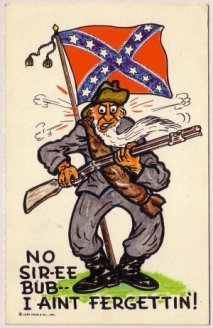
Karen said she had heard that the South was still fighting the Civil War but she could not believe what she heard and saw during the trip.  Numerous bumper stickers, ain'tfergettintattoos, hats and t-shirts proclaiming:

  • Hell no, we ain’t forgettin
  • The South will raise again
  • Long live the Confederacy
  • Nathan Bedford Forest: American Patriot
  • Confederate American and proud of it

And of course, she saw numerous Confederate flags hanging from houses, pickup trucks and motorcycles.  We even found a roadside stand where they were selling Confederate memorabilia and a large sign over the stand proudly proclaiming “Heritage Not Hate” as though the Civil War was about mint juleps and the right of slaves to sing and dance all night long.

red neck shirtIt became apparent to me why I never took my first wife to visit my relatives.  Deep down inside, I was both appalled and ashamed at their ideas and behavior.  During our visit Karen and I listened to more prejudice and bigotry then I had heard in years.  I retreated to an almost catatonic state.  I did not once broach the subject of racism or discrimination despite the abundant evidence of its pervasiveness.  My normal outspokenness for intolerance was stilled in the onslaught of insults and harangues that I heard towards Blacks, Mexicans and other minorities.  It was like a Gordian knot of discrimination and I did not know where to start unravelling it.  On our way home, Karen and I discussed our mutual inability to speak out or take any action in the face of this prolific bigotry.  I perhaps more than Karen was embarrassed that I had said and did nothing.  I had become the silent person who fails to speak out.

We can talk about moving on but I don’t think many of us realize how long it takes to change a culture and to really let go and move on.  There have been and continue to be many changes in the Old South.  Slavery has of course ended.  The plantations are gone and Jim Crow rule is finally over.  The Confederate Flag has even been taken down from most Southern State Capitals.  The symbols and icons of the Old South are fast disappearing.  Nevertheless, in the hearts and minds of many Southerners, you can still hear the refrains from Dixie repeating: “Old times there are not forgotten, Look Away, Look Away, Look Away, Dixie Land.”  When it comes to the South, old times there are still not forgotten.

Time for Questions:

Have you ever been down South?  What was your experience?  Do you have any roots in the South? If so, what changes have you seen over the years?  What do you think it will take to make the South forget the Civil War and move on?

Life is just beginning.

“In the South, history clings to you like a wet blanket. Outside your door the past awaits in Indian mounds, plantation ruins, heaving sidewalks and homestead graveyards; each slowly reclaimed by the kudzu of time.”  ― Tim HeatonDon’t Be Ugly:


Autobiographies from the Dead – Chima the Slave

For the next several weeks, my blogs are going to consist of “autobiographies” written by some very special people.  They have one thing in common.  They are all dead.  Some have a burial place and some were simply discarded like pieces of trash.  Their stories will be told by the deceased themselves.  They cry out from the fields, rivers and graveyards to speak.  I have heard their cries.  They want me to tell their stories to you.  They want you to know what their living and dying was for.  This week, Chima will tell you the story of his life and death.

Chima the Slave

igbo boyMy name is Chima.  My slave name is Julian.  My family and I were Igbo people.  I was 9 when I was brought to the United States.  My father and mother also came with me.  We were captured one night by Arab slave traders who sold us to the British slavers.  The year was 1790.  We were chained together with other Igbo tribe members and forced to walk many miles to the coast of Africa. Slaves_ruvuma

Once on the coast we were loaded like cargo into the hulls of the British slave ships.  Nearly 600 of us were loaded onto one slave ship.  As we were loaded into the vessel, we were branded with red hot irons on our arms or chests or legs with the marks of various slave owners.  We were crammed so close together below decks that there was no room to move or change position.  We sat between each other’s legs and could not lie down.

Freed-Slave-Ship-by-Granger-in-Fine-Art-America-665x385There were numerous pails placed among us to use for feces and urine.  Several people were selected to dump the pails overboard each day.  Usually they were overflowing before they could be dumped.  The smell was horrible.  Many of the people selected to dump the pails overboard never returned.  We often heard how they had jumped overboard to drown rather than return to the hull.  Other slaves were then selected to replace them.

We were fed on deck twice per day.  We ate rotten meat and a mixture of oats and gruel.  We were given water to wash our food down with.  The amount of food was never quite enough to make one feel satiated and there was always a gnawing sense of hunger that was pervasive among us.  Many of use died from starvation or dehydration.  The slavers deliberately underfed us in the belief that the stronger of us would survive and bring better money at the auctions.

Slave-hung-on-ship-1Some of my tribal members tried to attack our captors.  This would end in either being thrown overboard or hung upside down from the Yard Arms until they died from starvation or dehydration.  Screams and cries were a constant sound at all times of the day from sick or hungry slaves.  My father died from some disease before we reached shore.  Diseases were rampant aboard ship and no one received any treatment.  Smallpox and scurvy were the most common disease killers.  Probably one third of all the slaves who boarded our ship died before we reached port either through starvation, beatings, suicide or disease.

slave-auction-virginia-PMy mother and I were still together when we reached the harbor in Charleston, South Carolina.  We were brought to an auction house with many other slaves and placed into large rooms with no furniture or windows.  We were kept locked in these rooms like animals in a pen.  They discussed whether to sell my mom and I separately or together and it was decided that because of my age, they would keep us together for a while.

cottonculture-1875After some White people purchased us, we were loaded onto a cart with the other purchased slaves and taken on a two day journey to our new home.  We arrived at a large white building with big columns set in the middle of a large field.  In the field and around the house were many other slaves and White people riding large black horses.  The horse riders all carried whips and riding sticks.  We heard constant yelling and orders which we later learned were instructions to speed up and work harder.

born-in-a-tar-paper-shack1_scruberthumbnail_3My mom and I were brought to a single room shack where an old Black woman lived.  She was given instructions to wash us and show us what the rules were around the plantation.  She was told to get us out in the fields as old slave womansoon as possible and to show us how to pick and tend the crops.  Anna, as she was called, told us that she had lived on this plantation for over fifty years now.  She told us we would both be field hands and that if we worked hard enough we might someday become workers in the big white house.

I first ran away ten years later.  I was nineteen years old.  I did not get very far as some other field workers yelled to the Master that I was running off.  When they caught me, I was tied to a large oak tree and given twenty five lashes.  I was warned never to try it again.  As soon as my wounds healed, I ran away again.  I ran away at least five more times in the next three years.  Each time I got further and further from the plantation.  Each time I was caught the beatings got more severe.  They hung me by the neck once for about three minutes before cutting me down.  I was told that the next time I ran, the hanging would be for real.

My mom and some of my slave friends told me to never quit or give up.  “No matter what they do to you” said my mom, “never give up your freedom.”

I have heard tell of how happy slaves are and how much better off we are on the farms then if we were left on our own.  I never met a happy slave.  I never met a slave who did not want their freedom.  I never met a slave who did not want to go back to their home in Africa.  If we were so happy on the plantations, why do they beat us, chain us, brand us and torture us?

Slave_Hung_1I see my body now hanging from the trees.  It looks like a big celebration going on beneath me.  My eyes are bulging out, my skin is flayed off my loins and I am bleeding from many wounds made by the whips and dogs.  Some people are throwing rocks and sticks at me while other people look like they are having a picnic with their families on blankets below where I am hung.  I see a large pile of sticks being placed under me.  I assume they are going to burn my body now.  It won’t matter much to me because I am already dead.  My soul left my body several minutes ago and I am simply dead meat hanging there.  I am finally free.

I am wondering what I ever did to these people to make them hate me so much.  Why do they treat us as like animals when we have souls and dreams just like they do?  I have heard that White people fought for their freedom and declared the following:

“We hold these truths to be self-evident, that all men are created equal, that they are endowed by their Creator with certain unalienable Rights, that among these are Life, Liberty and the Pursuit of Happiness.” 

How could any people who believed in the above saying treat other human beings as we were treated?  The phase says “all men.”   Was I not a man?  Were my people not men and women?  Did we not want to have happiness and liberty?   How could we have a life and happiness if we were treated as animals and beaten and chained and whipped daily?  I do not understand.

Furthermore, the White people on our plantation all said that they were Christians.  They said they believed in a God who wanted peace and love among all people.  I heard it said that their savior (whom they wanted us to believe in) was a savior of compassion and mercy and forgiveness.  But these people never showed my people any love or mercy or compassion or forgiveness.  They treated us with contempt and scorn and intolerance and hatred.  Everything they showed us was the opposite of what they said their savior stood for.

They have lit the pile of sticks below me now and they are burning my body.  The smell is awful and many people in the crowd are holding their noses while many others are laughing and patting each other on the back.  It is time for me to leave.  I want to go find their God.  I need to see why he would let my people be treated like this.  What have I done to deserve such a fate?   Maybe he will be able to explain it to me.

Time for Questions:

Do you think the slave were happy down on the plantation?  Do you think the Confederate flag is about “heritage and not hate?”   Do you practice tolerance and love to only people of your own color or do you love all people regardless of color?  Why or why not?  What do you do to help fight racism and discrimination?  Do you think it is only a Black fight?”

Life is just beginning.   For some people anyway!

The facts cited below are from:  Center for American Progress

  1. While people of color make up about 30 percentof the United States’ population, they account for 60 percentof those imprisoned. The prison population grew by 700 percent from 1970 to 2005, a rate that is outpacing crime and population rates. The incarceration rates disproportionately impact men of color: 1 in every 15 African American men and 1 in every 36 Hispanic men are incarcerated in comparison to 1 in every 106 white men.
  2. According to the Bureau of Justice Statistics, one in three black mencan expect to go to prison in their lifetime.Individuals of color have a disproportionate number of encounters with law enforcement, indicating that racial profiling continues to be a problem. A report by the Department of Justice found that blacks and Hispanics were approximately three times more likely to be searched during a traffic stop than white motorists. African Americans were twice as likely to be arrested and almost four times as likely to experience the use of force during encounters with the police.
  3. Students of color face harsher punishments in school than their white peers, leading to a higher number of youth of color incarcerated.Black and Hispanic students represent more than 70 percentof those involved in school-related arrests or referrals to law enforcement. Currently, African Americans make up two-fifths and Hispanics one-fifth of confined youth today.
  4. According to recent data by the Department of Education, African American students are arrested far more often than their white classmates.The data showed that96,000students were arrested and 242,000 referred to law enforcement by schools during the 2009-10 school year. Of those students, black and Hispanic students made up more than 70 percent of arrested or referred students. Harsh school punishments, from suspensions to arrests, have led to high numbers of youth of color coming into contact with the juvenile-justice system and at an earlier age.
  5. African American youth have higher rates of juvenile incarceration and are more likely to be sentenced to adult prison.According to the Sentencing Project, even though African American juvenile youth are about 16 percent of the youth population, 37 percent of their cases are moved to criminal court and 58 percent of African American youth are sent to adult prisons.
  6. As the number of women incarcerated has increased by 800 percentover the last three decades, women of color have been disproportionately represented.While the number of women incarcerated is relatively low, the racial and ethnic disparities are startling. African American women are three times more likely than white women to be incarcerated, while Hispanic women are 69 percent more likely than white women to be incarcerated.
  7. The war on drugs has been waged primarily in communities of color where people of color are more likely to receive higher offenses.According to the Human Rights Watch, people of color are no more likely to use or sell illegal drugs than whites, but they have higher rate of arrests. African Americans comprise 14 percentof regular drug users but are 37 percent of those arrested for drug offenses. From 1980 to 2007 about one in three of the 25.4 million adults arrested for drugs was African American.
  8. Once convicted, black offenders receive longer sentences compared to white offenders.The U.S. Sentencing Commission stated that in the federal system black offenders receive sentences that are 10 percentlonger than white offenders for the same crimes. The Sentencing Project reports that African Americans are 21 percent more likely to receive mandatory-minimum sentences than white defendants and are 20 percent more like to be sentenced to prison.
  9. Voter laws that prohibit people with felony convictions to vote disproportionately impact men of color.An estimated 5.3 million Americans are denied the right to vote based on a past felony conviction. Felony disenfranchisement is exaggerated by racial disparities in the criminal-justice system, ultimately denying 13 percentof African American men the right to vote. Felony-disenfranchisement policies have led to 11 states denying the right to vote to more than 10 percent of their African American population.
  10. Studies have shown that people of color face disparities in wage trajectoryfollowing release from prison.Evidence shows that spending time in prison affects wage trajectories with a disproportionate impact on black men and women. The results show no evidence of racial divergence in wages prior to incarceration; however, following release from prison, wages grow at a 21 percent slower ratefor black former inmates compared to white ex-convicts. A number of states have bans on people with certain convictions working in domestic health-service industries such as nursing, child care, and home health care—areas in which many poor women and women of color are disproportionately concentrated.