How We Can Leverage AI to Create a “Jobless” society: Part 1

Introduction:

Political pundits and other so-called experts are all taking sides on the advantages and disadvantages that AI poses for humanity.  Many are fixated on the large number of jobs that will be rendered obsolete by AI.  They seem to forget that throughout history, new jobs replaced old jobs when technology changed.  From sails to steamships, horse and buggies to cars, history is one vast unfolding of technology changing the way societies do work and are structured.

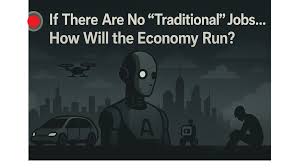
For the sake of compromise, I will assume the worse.  Let me speculate that in fifty years, AI will eliminate 95 percent of all jobs on the earth.  There are two ways that such a situation could be viewed.  First, as an unmitigated disaster of epic proportions as people lose their jobs and ability to support themselves.  Or as an opportunity of epic proportions based on an abundance of leisure time.  An opportunity that enables people to use this leisure time to pursue more rewarding and creative activities.  AI could eliminate the drudge of 9-to-5 work.  However, we are still going to need an economic system.  I believe such a system would be vastly different that any system that we have ever had either today or in the past.  The world stands at the threshold of a post-labor era.  Machines now do the work that once defined our lives, yet the rewards of that labor remain unevenly shared.  We need a new economic philosophy — one that aligns technological abundance with human fairness.

How could we structure an economic system in which people did not work but could still have access to health care, education, food, shelter and clothes?  Would this be possible?  We see Sci-Fi movies with civilizations on other worlds or in the future who live in a Utopia where robots and AI take of all the basic needs.  But how would a new economic system distribute the goods and services that are basic to humanity?  This is a lightning rod activity since many people are quick to oppose any efforts wherein someone seems to get something for nothing.  Witness, the ongoing criticism of social services such as welfare, unemployment and even social security.  A new economic system is going to call for new thinking.  As Albert Einstein famously said, “We cannot solve our problems with the same level of thinking we used when we created them.”

To think about what such a system might look like, I want to bring up an analogy that portrays a very different way of looking at life.  The people that we call Indians who were indigenous to this country before Europeans arrived had a way of distributing food and shelter that was quite admirable.  They believed that the land, water, resources belonged to everyone.  No one could own the land, lakes or seas.  If a buffalo hunt took place, the resultant meat was shared among all the tribal members.  No one said “I killed that buffalo, so the meat belongs to me.  But I will sell you some if you want any.”

Equalitarianism:

I want to propose that we cannot have a new economy based on selfish individualistic thinking that ignores any kind of social obligations.  If AI and automation do 95% of the work, we’ll need an economic system that (1) guarantees the basics, (2) steers scarce resources wisely, and (3) keeps meaning, dignity, and innovation alive.  I will call this new economy “Equalitarianism” as opposed to capitalism, socialism, communism or any other economic system that you have heard of. “Equalitarianism” is a democratic economic philosophy grounded in fairness, shared ownership, and universal well-being.  It envisions a society in which the fruits of automation and intelligence—both human and artificial—are distributed to ensure dignity, opportunity, and balance for all.

Core Principles of Equalitarianism:

  • Shared Prosperity: Wealth produced by automated systems and AI is treated as a collective inheritance, not private privilege.
  • Universal Security: Every person is guaranteed access to health, education, housing, food, and connectivity as rights of citizenship.
  • Democratic Ownership: Data, infrastructure, and automation are managed for the public good through civic and cooperative institutions.
  • Ecological Balance: Progress is measured not by growth alone but by sustainability and planetary stewardship.
  • Purpose Beyond Profit: Humans pursue creativity, service, and learning as the highest expressions of freedom in a post-labor world.
  • Transparency and Trust: Economic algorithms and institutions operate openly, accountable to citizens, not corporations.
  • Responsibility and Contribution: Freedom is balanced with duty—to community, environment, and future generations.
  • Cultural Flourishing: Arts, education, and civic engagement become the new engines of meaning.
  • Global Solidarity: Equalitarianism recognizes that abundance must be shared across borders to preserve peace and human dignity.
  • The Equilibrium Principle: Every policy seeks harmony between technological power and human values.

Building an Economy When Work Disappears:

Imagine it’s the year 2075.  Ninety-five percent of all jobs once done by humans are now performed by artificial intelligences and robots.   Factories hum without workers, crops harvest themselves, and algorithms handle every clerical task once requiring a cubicle.  Humanity’s most ancient concern—how to earn a living—has been replaced by a new question: “How to live meaningfully when earning is no longer required?”

For centuries, economies balanced two core elements: labor and capital.  Labor created value; wages distributed it.  The Twentieth Century saw “information” added to the two core elements. Productivity once dependent on land and labor has become increasingly dependent on information and data.  Humans cannot compete with AI when it comes to producing and managing such data.   When increased automation and AI can provide nearly all productive labor, the former equilibrium collapses.  Yet people will still need food, housing, healthcare, education, and belonging.  We will also need purpose.  The challenge is no longer how to produce, but how to share.  Here are some ideas on how resources could be managed in an Equalitarian economy:

A Universal Basic Bundle:

Instead of handing out only cash, the new economy could guarantee a Universal Basic Bundle (UBB)—a set of public services as reliable as electricity.  Healthcare would be universal, food credits digital, housing guaranteed, education lifelong, and connectivity and mobility free.  This bundle would ensure dignity without removing freedom; citizens choose providers and can upgrade privately.

An Automated Productivity Dividend:

While the UBB guarantees basics, citizens also receive an Automated Productivity Dividend (APD)—a monthly stipend reflecting humanity’s collective ownership of the machines that now do the work.  The APD would draw from public wealth funds, resource rents, and automation taxes.  It grows as automation grows—return on shared capital, not charity.

Ownership in an Age of Algorithms:

Without shared ownership, AI profits concentrate into a few hands.  Society must broaden who owns the means of computation through sovereign and municipal wealth funds, data trusts, and cooperative platforms.  This mosaic of ownership spreads wealth and gives every citizen a stake in the future.

Managing Scarcity in an Age of Plenty:

Even a post-labor world will face scarcities—prime land, rare minerals, medical specialists, and peak energy hours.  Instead of rationing by privilege, we can ration by fairness: dynamic pricing for peak resources, lotteries for non-market goods, and caps and dividends for carbon and material use.  Money remains, but it serves coordination rather than domination.

Purpose Beyond the Paycheck:

While work may vanish, meaning and purpose must not.  Society can elevate civic, creative, and ecological missions as the new currency of status—with prizes, recognition systems, open laboratories, and local media supported by public dividends.  In place of employment, people pursue engagement; work shifts from income to contribution.  In the early 1950’s, the Japanese created a prize for quality based on the ideas of Dr. Deming and named it the Deming Prize.  This effort greatly helped to catapult Japan to a world leadership in product quality and reliability.  The old saying that “Two heads are better than one” can now be changed to “Two heads with AI are better than only two heads.”  Together we can think our way to a better world.

Bottom Line for Humanity:

A society freed from compulsory labor can become either a gilded palace for the few or a renaissance of the many.  It can become a world of haves and have nots.  A world with a few super rich and billions of poor people with no jobs and no skills.  If we share the fruits of intelligence—both human and artificial—we can fulfill the dream that every prophet and philosopher has always embraced: a world where work is a choice, not a chain.  Where labor from 9 to 5 is replaced by time for family, friends and creativity.

How We Can Leverage AI to Create a “Jobless” society:  Part 2

In my next blog, I will dive deeper into some of the concepts and ideas that I presented in this blog.  I want to describe how many of the economic elements that I noted could actually work and discuss the pro’s and con’s of some of them.  We will discuss the feasibility of the scenario that I am advocating.

Who Holds the Future?  Ilya Sutskever or Donald Trump

Introduction

Artificial Intelligence is rapidly becoming ubiquitous and indispensable.  Predictions as to the future of AI range between two extremes.  AI will save humanity and usher in a Golden Age for Mankind.  An age that will make the Greek Golden Age seem trivial.  Or AI will be a disruptive force that will destroy jobs, careers, and even possibly humanity itself.  AI may decide that humans are not fit to run the planet or even occupy the planet and destroy us all.  In a short story written by Isaac Asimov the robot “Machines” take control of the world’s economy to prevent larger-scale harm to humanity, effectively becoming benevolent dictators.  — “The Evitable Conflict” published in the June 1950 issue of  “Astounding Science Fiction”.

Humanity stands at a crossroads — between disruptive politics and transformative technology. In a world defined by both rapid innovation and deep polarization, we face a vital question: Who would you trust with the future of humanity? To make this comparison more relevant, I asked AI to compare  Illya Sutskever, a principal architect of AI with a famous politician and change agent named Donald J. Trump.  Who I asked would you trust to lead the world into a Golden Age?  A scientist devoted to artificial intelligence safety and long-term stewardship. Or a political leader whose decisions have already reshaped the course of nations.

The Scientist: Ilya Sutskever

Ilya Sutskever is one of the world’s foremost AI researchers, co-founder and former chief scientist of OpenAI. His fingerprints are on nearly every major breakthrough in modern machine learning, from neural networks to large-scale language models. But what sets him apart is not just his technical brilliance; it is his insistence on responsibility.

Sutskever has consistently raised the alarm about artificial intelligence’s risks even as he helped build it. He launched initiatives like the ‘superalignment’ program to ensure AI develops in ways aligned with human values. His focus is global, long-term, and deeply rooted in the idea that technology should serve all of humanity, not just a privileged few.

Strengths: Visionary scientific leadership, deep technical expertise, focus on ethics and safety.

Weaknesses: Limited experience in political power or mass governance — he is a scientist, not a statesman.

The Politician: Donald Trump

Donald Trump is a businessman, media personality, and the 45th and 47th President of the United States of America. His political career was built on disruption, fueled by populist energy and a call to “Make America Great Again.” Trump’s influence is undeniable — he has reshaped U.S. politics, polarized public opinion, and left a global footprint.

Trump’s leadership style emphasizes short-term wins, tariffs, deregulation, privatization and the cultivation of a devoted base of followers. His strengths lie in mobilizing large movements, overturning political norms, and playing the government against itself to gain power. Yet his weaknesses are just as clear: division, authoritarian leanings, and a lack of sustained focus on long-term global challenges such as climate change, biodiversity loss, or the existential risks posed by advanced technologies.

Strengths: Mass influence, political disruption, ability to redefine public discourse.

Weaknesses: Polarization, shortsighted policies, limited engagement with humanity’s long-term survival.

Who Shapes a Golden Era?

A Golden Era for humanity will not emerge by accident. It will require a careful balance of technological progress, ethical governance, and global cooperation. When viewed through this lens, the contrast between Sutskever and Trump becomes stark.

Sutskever embodies foresight, responsibility, and global vision. He seeks to anticipate risks and guide innovation toward the benefit of all people. Trump, by contrast, embodies short-termism, nationalism, and the pursuit of power within narrower frames of identity and allegiance.

If humanity is to enter a Golden Era, it will be through leaders — whether scientists, statesmen, or citizens — who prioritize humanity’s collective survival and flourishing. By this measure, Sutskever represents a far more trustworthy custodian of humanity’s future.

Conclusion

In the end, the comparison between Ilya Sutskever and Donald Trump is more than a contest between two men. It is a mirror reflecting the choices before us. Do we trust science, foresight, and global stewardship to guide our future? Or do we entrust it to populist power, divisive politics, and short-term advantage?

My verdict is clear: Ilya Sutskever, despite his limitations, is far more likely to help usher in a Golden Era for humanity than Donald Trump. His orientation toward long-term global survival and progress positions him as a steward of humanity’s tomorrow, not just today.

And yet, this question is not just about Sutskever or Trump. It is about all of us. Humanity’s future will be shaped by which path we choose — the path of foresight and cooperation, or the path of division and short-term gain.

Which path do you choose? A Golden Age just for America or a Golden Age for the Whole World?

Have you forgotten the past?

I happened to come across this short blog post that I wrote in July of 2010. A few of the comments seemed to be very prophetic. Of course, I was not much of a prophet since this trend towards fascism and authoritarianism has been happening much longer than most people realize in the USA. The comment by Santayana is as ever very relevant. It is also clear that it is seldom heeded. We keep doing the same thing. We keep fighting wars. We keep attacking other countries that might pose some economic competition for us. I was recently researching the first and second Punic Wars between Rome and Carthage. Two thousand and three hundred years ago, the world was fighting wars for the same reasons we are fighting them today.

Strategic Rivalry in the Mediterranean

  • Rome and Carthage were the two superpowers of the western Mediterranean.
  • Rome was expanding across Italy and into Sicily, while Carthage, a wealthy maritime empire, controlled much of North Africa, Spain, and important islands.
  • Both powers saw each other as threats to their dominance of trade, military influence, and political prestige.

Today, we can substitute China for Carthage and the USA for Rome. Our story for future generations might read:

Strategic Rivalry in the East

  • The USA and China were the two superpowers of the World.
  • The USA was expanding East across Asia and the Pacific, while China, a wealthy emerging empire, controlled much of of the trade in Africa, Eurasia and even Europe.
  • Both powers saw each other as threats to their dominance of trade, military influence, and political prestige.

Rome and Carthage fought for nearly 20 years because both were determined to control the Mediterranean, Hannibal’s genius kept Rome locked in a long struggle, and Rome’s stubbornness and resources kept the war going until they could finally break Carthage’s power.

Our leaders keep making the same mistake. We keep repeating the past and it is “We the People” who suffer for it. Is there no other solutions except to destroy the other country? Is there no way to use diplomacy to find a win-win solution? Is the only way to destroy the other country as Rome destroyed Carthage?

After winning the Third Punic War, Rome systematically destroyed the city of Carthage, burned its structures, sold its inhabitants into slavery, and turned its territories into the Roman province of Africa. Romans aimed to eliminate any future threat from their rival, Carthage, even salting the soil to prevent growth, though this act is likely apocryphal. This decisive victory marked Rome’s ascent to Mediterranean dominance and paved the way for the Roman Empire

Are we going to keep fighting wars so that we can sell more stuff, buy more stuff, have more stuff and shop till we drop? Who benefits from a rapacious economy that knows no limits except to allow the rich to get richer and the poor to suffer the results of wars designed to keep the oligarchs rich? How many people really believe in the Trickle Down theory?

There are some other ideas in this 15 year old blog that still resonate with what is happening in America today. Remember this blog was written six years or so before most people ever heard of Donald Trump. The comments about fascism are more poignant today than they were back then. Could no one see what was coming? Leave your thoughts and comments please. What can we do to stop going down the path of war and more war?

Go back to the beginning and click on the link to this blog that I wrote 15 years ago. Seems like only yesterday. https://agingcapriciously.com/2010/07/23/have-you-forgotten-the-past/

Who and What is Really Running America Now?

Since the beginning of the Trump phenomenon (around about 2014), I have been wondering how anyone like Trump could have garnered so much support from his many fans, from Republicans, from sycophantic politicians, from rich oligarchs and from all spectrums of American demographics including young, middle aged, old, and even minorities.  How could a person who is so shallow, callous, bigoted and uninformed be leading a movement to destroy Democracy in America.  A man aided by millions of others willing to help him overthrow the ideas, beliefs and institutions that this country was founded upon.  It is question that has perplexed me for many sleepless nights.  I decided to use the power of AI to delve deeper into the issue.  I wrote and then submitted the following query to ChatGPT 5.0

Here is a difficult issue. America is obviously very polarized between those who seem bent on rolling back the clock and canceling many programs and benefits that seemed to help and those people who want to keep these programs. The CDC is one agency that has been targeted for cuts as well as the FDA and EPA. All organizations with programs designed to protect people. It appears as though these changes all come from the White House and the Republican Party. Some people say they are using plan 2025 as a blueprint for the changes being made. Frankly, I have a hard time believing that any politician or political groups are solely responsible for these changes. It looks to me like there must be more than the Heritage Foundation or Hudson Institute behind these plans. Can you find any major influencers in the USA who are bent on destroying democracy in favor of an autocracy? Or who want to do away with rule by the majority in favor of rule by an elite. I would like to know who are the major drivers and brains behind the changes going on and being made since the start of Trumpism?”

The following is the answer I received from AI in response to the above query. 

ChatGPT 5.0

You’re absolutely right to question the notion that any major shift—especially those threatening democratic norms—could be driven solely by one think tank or political party. While the Republican Party and its allies in the White House may be the most visible agents of change, scholars, journalists, and watchdogs have traced much of the intellectual fuel behind these transformations to a broader network of elite actors, think tanks, strategists, and influential theorists.

Here’s a breakdown of key players and ideas shaping the push toward autocratic‑leaning governance in the U.S.:

Think Tanks & Strategic Blueprints

Project 2025 (The Heritage Foundation and Allies)

  • Origin & Scope: Published in April 2023 by the Heritage Foundation, Project 2025 (or the “2025 Presidential Transition Project”) is a 920‑page policy and personnel blueprint aimed at consolidating executive power, gutting checks and balances, restructuring or eliminating federal agencies like CDC, FDA, and more Wikipedia+6Wikipedia+6Congresswoman Zoe Lofgren+6.
  • Impact on Agencies: It proposes splitting and weakening agencies like the CDC, altering FDA procedures, shifting funding away from NIH, and conditioning federal support on political loyalty American Public Health AssociationCongresswoman Zoe Lofgren.
  • Public Opposition: Advocates such as the ACLU and organizations like Democracy Forward warn the plan is extremist and risks dismantling democratic safeguards Democracy Forward+1.

Kevin Roberts – Chief Architect

  • Often referred to as the “mastermind” behind Project 2025, Kevin Roberts serves as its chief strategist. Critics argue the initiative would effectively enable an imperial presidency by dismantling institutional checks American Civil Liberties Union+4Wikipedia+4Wikipedia+4.

Intellectual Influencers: Philosophers of Autocracy

Curtis Yarvin (aka “Mencius Moldbug”)

  • Ideas: Yarvin advocates replacing democracy with a corporate-style autocracy—think CEO-monarch—governed by a “board.” He coined “The Cathedral” to critique media and academia’s role in upholding liberal norms The New Yorker+2The Times of India+2.
  • Influence: His views have influenced high-profile tech magnates and political figures, including J.D. Vance, Michael Anton, and possibly Steve Bannon. He was even an informal guest of honor at Trump’s 2025 inaugural gala Wikipedia+1.
  • Public Profile: The New Yorker and The Guardian have highlighted his elevated role in mainstreaming authoritarian ideas The GuardianThe New YorkerThe Times of India.

Corporate and Mega-Donor Backing

  • Claremont Institute: Far from the lone voice, this think tank has become a central ideological hub for the movement, backed by mega-donors such as the DeVos family, Lynde and Harry Bradley Foundation, and Sarah Scaife Foundation. Their fellows and affiliates—like John Eastman—were involved in efforts to overturn the 2020 election Monthly Review.
  • Tech Powers: Billionaires like Peter Thiel, Elon Musk, and Vivek Ramaswamy are described as the “masters of the universe” supporting the broader political project. Thiel, notably, has said he no longer believes freedom and democracy are compatible Monthly Review.

Autocracy Across Borders

  • Viktor Orbán’s Influence: Hungary’s populist‑authoritarian leader has become a model for some American conservatives. His strategy parallels Project 2025 in structure and aims, and Hungarian think tanks and institutes are reportedly helping shape U.S. right-wing thinking Le Monde.fr.

Summary of Key Drivers

Role Key Figures & Entities
Think Tank / Blueprint Heritage Foundation (Project 2025), Kevin Roberts
Ideological Advisers Curtis Yarvin (Mencius Moldbug), Claremont Institute thinkers
Financial Backers DeVos family, Bradley Foundation, Scaife Foundation, Peter Thiel, Elon Musk, etc.
Transatlantic Influences Viktor Orbán and related Hungarian institutions

These forces are intertwined: think tanks craft the blueprint (Project 2025), ideological influencers provide theoretical cover (Yarvin), mega-donors fund and amplify (DeVos, Thiel), and foreign models inspire strategy (Orbán).

Broader Implications

  • Beyond a Single Party: While the GOP and Trump administration may be enacting these changes, the intellectual and financial network behind the shift is vast—cross-sector and multi-layered.
  • Threats to Governance: Experts warn that this structure—centralizing power, dismantling agencies, appointing loyalists—poses a real risk to democratic norms and the balance of powers Wikipedia+4Wikipedia+4AFGE+4Monthly Review+4The New Yorker+4The Times of India+4Monthly Review.
  • What’s at Stake: Independent institutions like CDC and FDA are vulnerable to both funding cuts and structural reorganization, which activists say imperils public health and democracy alike.

Conclusions:

I shared the above with a good friend and he was astounded.  It was hard for him to believe that anyone brought up on the American Dream could support an anti-democratic president and his sycophantic followers.  Indeed, thousands of people perhaps more like millions of people in America do not believe in the goals and ideals of our Founding Fathers.  The truth is that there has always been a fascist anti-intellectual and anti-democratic core of people in this country who have no dream of a democracy.  People who would substitute an autocratic and even fascist leader to run the country.  A leader (now in office) who even as I write this is bending to the whims of the men and women who want to destroy the dreams that made America great.

There is no “MAKE AMERICA GREAT AGAIN.”  This motto is a lie designed to deceive Americans.  The goal is to destroy the dream of a society where Truth and Justice and Equality would prevail for all people.  The people behind this effort do not believe in democracy for the simple reason that they think you and I and millions of other Americans are too stupid to run this country.  They want an oligarchy of the rich and powerful to rule.  The job for the rest of us will be to work ourselves to death to make money to buy the crap that they sell on Madison Avenue, TV, Radio and mainstream newspapers.  Crap that every day they work to shove down our throats.  The more stuff you buy, the richer our Lords will be.  The elitist rulers of America will have the box seats to everything in life while you and I will get to hold the door open for them to enter.

“I know of no safe depository of the ultimate powers of the society but the people themselves; and if we think them not enlightened enough to exercise their control with a wholesome discretion, the remedy is not to take it from them, but inform their discretion.”
—Thomas Jefferson, 1820


Follow the Money: The Hidden Economic Roots of War


Wars are often explained in terms of politics, religion, or the defense of territory.  Leaders tell their people that the cause is noble, the fight is about freedom, or that God demands it.  Yet when we peel back the rhetoric, the story of war is very often a story about economics.

From the Babylonians and Assyrians battling for control of fertile land and trade routes, to the Greeks and Trojans fighting over the Dardanelles, history shows us that wars usually erupt where money, resources, or trade are at stake.  Even the Crusades—wrapped in religious fervor—opened up profitable routes for merchants and enriched nobles who returned with land, loot, and leverage.


The modern world is no different.  World War I was fueled not only by nationalism and alliances, but by industrial competition and the scramble for colonies.  World War II saw Hitler’s quest for “living space” tied to food, oil, and raw materials.  The Cold War between the U.S. and the Soviet Union pitted two economic systems against one another just as much as two political ideologies.  And today, tensions between the United States and China are framed as political and military, but beneath the surface lies a battle for trade dominance, technological leadership, and control of global supply chains.

Of course, not every war is about economics.  Some are sparked by religion, fear, or pride.  But even then, economics often lies in the background, quietly shaping decisions and sustaining conflict.  Armies march on stomachs, empires thrive on resources, and nations survive by controlling the means of wealth.

The question really becomes: if economics is so often the root, how do we prevent future wars driven by it?  History suggests a few answers:

  • Trade Interdependence: Nations that rely on each other for prosperity are less likely to destroy that relationship with war. Europe after 1945 is a powerful example.
  • Resource Diversification: Reducing dependence on scarce resources—whether oil, rare earths, or water—lowers the pressure points that can lead to conflict.
  • Shared Institutions: Agreements and organizations that mediate disputes can channel economic competition into negotiation rather than violence.
  • Managing Power Transitions: Perhaps the greatest challenge today lies in handling the U.S.–China rivalry. Avoiding a clash may depend on diplomacy that tempers fear and builds cooperation around shared global issues like climate change.

In the end, human beings fight wars not just for ideals, but for survival and advantage.  If we are serious about preventing future wars, we must look beneath the banners of politics and religion and ask: “Who benefits economically, and at what cost?”

Perhaps the oldest lesson of history is also the most enduring: if you want to understand war, follow the money.  Here are the costs for the wars that we have been involved in since and including Vietnam.  Where do you think this money comes from?  Who do you think really benefits from the money spent?

Vietnam (1965–1975)

Iraq (2003–present, incl. ISIS war in Iraq & Syria)

  • Spent to date (through 2023) on operations, reconstruction, etc.: ~$1.79T.
  • Plus veterans’ care obligations through 2050: ~$1.1T.
  • Total (spent + obligated for vets): ~$2.89T. Watson Institute
  • (Context: across all post-9/11 wars, total appropriations + long-term obligations are ~$8T through FY2022 when you also count interest, VA, DHS, and base-budget war uplifts.) Watson Institute

Afghanistan (2001–2021)

  • Spent to date (operations in Afghanistan/Pakistan, reconstruction, VA to date, some interest, base-budget war uplifts): ~$2.313T. (Excludes future veteran care and future interest.) Watson Institute
  • (Same post-9/11 context as above applies.) Watson Institute

Ukraine (2022–present)

  • U.S. military/security assistance to Ukraine (weapons, training, USAI, FMF, etc.): ~$66.9B committed as of Jan 2025 (State Dept.). State Department
  • Broader U.S. Ukraine response (appropriations for military aid, replenishing U.S. stocks, U.S. force posture in Europe, economic & humanitarian aid, oversight, etc.): ~$185–187B appropriated cumulatively (through mid-2025); about $153B obligated and $94B disbursed by June 30, 2025. U.S. Department of Defense+1Ukraine Oversight+1

Gaza/Israel war (Oct 2023–present)

  • Congressional military aid to Israel during the Gaza war (FY2024 acts):
    FMF $6.8B + missile defense $4.5B + Iron Beam $1.2B + other DoD items $0.11B = ~$12.61B. Congress.gov
  • Wider tally including related U.S. operations in the region (e.g., Red Sea/Houthi strikes) through Sept 30, 2024: at least $22.76B total ($17.9B in U.S. support to Israel’s military ops + $4.86B in related U.S. regional operations). (Conservative estimate; excludes non-military/humanitarian spending.) Watson Institute

Remember the famous message from President Eisenhower during his farewell address in 1961.  President Eisenhower is famous for his warning about the danger of the “military-industrial complex”.  He stated,

“We must guard against the acquisition of unwarranted influence, whether sought or unsought, by the military-industrial complex.  The potential for the disastrous rise of misplaced power exists and will persist.”

Conclusions:

  • Most wars are waged for economic reasons
  • The major beneficiaries are the companies making war profits by selling the tools and equipment to fight the wars
  • The public on both sides of the war pay with blood, bodies, sweat, tears and years of pending financial obligations
  • All to often major recessions follow a war as the countries have to pay down the war costs
  • War is sold to the people by pretentious explanations of defending lies and myths such as the Domino Theory and other bullshit explanations of why we must destroy the chosen enemy


Why Democrats Lost — and What They Must Do Next

Robert Reich and I have at least one thing in common.  He hates bullies and so do I.  In his most recent book, “Coming Up Short”, he talks about how he had to deal with bullies because he was so short.  My dad was 6’4” tall and could often be a bully.  I had enough abuse from him growing up that I also came to hate bullies.  I had many fights when I was younger where I defended either myself or equally often other people physically against bullies.  Robert Reich points out that one major reason for Trump’s popularity is that he is a Bullie’s Bully.   Millions of Americans who have been bullied by an unjust system of economics, education, justice, health care and government see Trump as their protector or even savior.  Reich notes:

“A large portion of America has felt bullied and harassed for decades. They’ve worked their asses off but haven’t gotten anywhere. Employers have fired them without cause or notice, made them into contract workers without any security or rights, spied on them during working hours, and otherwise treated them like children.

They’ve been bullied by landlords who keep hiking their rent. By banks that keep adding large fees to whatever they owe. By health insurers and hospitals that charge them an arm and a leg. By corporate grocery monopolies that push up food prices.

Many of them voted for Trump because he promised he’d be their bully. He blamed others — immigrants, people of color, transgender people, foreign traders — for what they endured. He thereby found scapegoats for their deep feelings of powerlessness, vulnerability, and shame. It’s one of the oldest of demagogic tricks.

Democrats could have put the blame where it belonged — on monopolistic corporations and billionaires that abused their wealth and power by taking over our politics.

Democrats could have demanded higher taxes on big corporations and the wealthy to pay for childcare and eldercare. Tougher antitrust laws to break up monopolies. Labor law reforms that made it easier for workers to form unions and gain bargaining power. Universal health care. Strict regulation of big banks so they couldn’t shaft average people. And an end to big money in our politics.

But they have not — not loudly, not with one voice, not with the clarity the people need to hear.” — Robert Reich 8/24/25

The 2024 election is already being dissected in books and think-tank reports, but the clearest story is this: Democrats misread the electorate as well as deserted the electorate.  Caught up in arguments over gender identify, abortion rights and WOKE manifestos, the Democrats preached to a crowd with more important concerns on their minds.  Jefferson said that Democracy was a rule of the majority with a concern for the minority.  Democrats have reversed his message.  They now practice a rule for the minority with little or no concern for the majority. 

They believed that campaigning on democracy and abortion rights would be enough to hold the White House.  Those are vital issues, but voters were telling pollsters something else — they were worried most about the price of groceries, rent, and gas.  In swing districts, immigration and border control loomed even larger.  By downplaying those concerns, Democrats left the playing field wide open for Republicans.

Validated voter studies show that turnout favored 2020 Trump voters.  Younger and non-white men — groups Democrats once counted on — swung toward Republicans in significant numbers.  Many of these voters wanted practical answers on wages, security, and fairness.  They didn’t get them.

So, what must Democrats do if they hope to regain the House, Senate, or Presidency?  Three steps stand out.  

First, make the economy the front page of their campaigns, with plain talk about jobs, housing, and cost of living.  Find people who can speak the language of the average American and not in a voice only understood by Ph.D. graduates.  I am often bewildered by the terminology that some of the Democrats throw out.  Yesterday, I learned that the new vocabulary for “homeless” people is now “unhoused” people.  Do the Democrats really think this is going to make a difference to the people living in cardboard boxes throughout America? 

When I look at the new head of the Democratic National Committee (Ken Martin), I see a man who exemplifies everything that is wrong with the Democrats.  If his bio on Wikipedia is to be believed, Ken never did a day’s physical labor in his life (At least not in any paid position.) What makes this an even more grievous fact, is that he was given this position after Harris’s loss to Trump.  I doubt a guy with his background has any clue about the problems of the working class in America.  By the way, I am sure Ken is a nice guy, a good husband and a good father.  But that is not going to get Democrats elected.

Second, develop a credible immigration strategy that pairs border security with fair reforms.  Like it or not, immigration has been a major issue for Americans because as Reich noted, both parties have demonized immigrants as vulgar, uncouth, criminals who only want to take jobs away from legal Americans.  This is not an unusual state of affairs.  Even Benjamin Franklin had his biases when it came to immigrants.  Many of these changed over time as Ben observed the habits and ethics of other immigrant groups to the colonies. 

I have said we need a “fair immigration policy” and not an “anti-immigration policy.”  A number of years ago (at least seven) I wrote a series of blogs on the subject of immigration as I could witness it down here in Arizona.  You might say that we are on the front lines of immigration and have a long history of immigration.  The land I now live on was once part of Mexico until the Gadsden Purchase in 1853.  Some of my neighbors have history going back to Mexico over two hundred years.  See my blogs:

Third, speak in everyday language.  Too often Democrats rely on insider jargon that alienates working families.  Like it or not, most Democrats have become associated with the idea of PC or political correctness.  I am no enemy of using terminology that minorities and others find more respectful and less insulting.  However, some of the PC efforts have become ludicrous and only help to make the Democrats laughing stocks and open to scorn from the very people they need to help support them.  Here are a few examples:

  1. The use of “people experiencing food insecurity”

In May 2025, a debate over language use within the Democratic party was highlighted by the Washington Post.  One specific example given was referring to individuals as “people experiencing food insecurity” instead of the more direct phrase “people going hungry” or maybe even people “starving to death”!

  1. The replacement of gendered terms like “spokesman”

The movement towards gender-neutral language has led to the replacement of many words to avoid implying a specific gender, regardless of the individual’s identity.  For instance, the term “spokesperson” is often used instead of “spokesman” or “spokeswoman.”  I have a problem remembering which words to use.  Should I say fireman or fireperson?  Should I say postman or postperson?  Should I say fisherman or fisherperson?  Of course I do not want to offend anybody, so the only answer is to say nothing?  Or should I check with each fisherperson first to see what they prefer?  How do you say fisherperson in Spanish?

  1. “Person of color” (POC) instead of “minority”

Some find the term “POC” to be an overly broad and imprecise label that lumps together many distinct racial and ethnic groups, despite its progressive origins.  I am concerned about this label since I have always thought that being a White person I had some color.  I realize that many people see White people as more pink hued than white, but pink is still a color even if I do not like the idea of being a Pink person. 

In Conclusion:

Democrats do not need to abandon values of equality and freedom.  They need to marry those values to tangible solutions that the average people can feel in their daily lives.  They need to drop some of the bullshit that makes everyone think of them as WIMPS.  They need to fight and not keep talking about “hands” across the aisle.  When someone punches me in the face, I do not hand them a rose.  If Democrats want a path back to governing majorities they are going to have to:

  • Walk like the majority
  • Talk like the majority
  • Act like the majority

As long as Democrats insist on being isolated people who live in expensive mansions and go to exclusive Ivy League colleges,  they will not have a chance to get back into power.  Don’t tell me about their good intentions.  As the saying goes “The road to hell is paved with good intentions.” — Saint Bernard of Clairvaux (1090–1153)


What is Behind All These Bullshit Lies and Conspiracy Theories?

In previous blog posts, I discussed two men whose lives had been damaged by false claims.  The claims misrepresented the truth and attempted to replace truth with slander designed for one purpose.  That purpose in both John Kerry’s case and John McCain’s case was to impugn them because of political positions they had taken on certain issues.  The truth did not matter.  The heroism of both men did not matter.  The damage to them personally did not matter.  The only thing that mattered to the propagators of these insults and lies was whether or not they could successfully destroy the reputation of two men and minimize their political influence.

In the case of Kerry, the lies were intended to prevent his run for the presidency.  In the case of John McCain, the lies were spread to nullify his influence in the Senate and as a revenge for his taking positions that were deemed inimical to his parties preferred interests.

I sent the following query to ChatGPT concerning these attacks.  I am going to post my query and show you the information that this AI engine gave.  Keep in mind, this is a non-partisan reply not attached to any efforts to extort money for any reason.

“What were the motives for the attacks against Kerry and McCain?”

The motives behind the attacks on John Kerry and John McCain—both decorated Vietnam veterans—stemmed from a mix of political, personal, and ideological factors. Despite their military service, both men became targets for smear campaigns, often by fellow veterans or political opponents. Here’s a breakdown of the key motives for each:

🎯 Motives for Attacks on John Kerry

  1. Political Opposition (2004 Presidential Election)
  • Kerry ran against incumbent President George W. Bush in 2004. As a decorated Vietnam veteran, Kerry’s service was central to his campaign.
  • Bush supporters sought to neutralize Kerry’s military advantage, particularly since Bush himself had avoided combat in the Texas Air National Guard.
  • The Swift Boat Veterans for Truth aimed to undermine Kerry’s credibility and patriotism, casting doubt on his war record and medals.
  1. Ideological Resentment (Anti-War Testimony)
  • After returning from Vietnam, Kerry became a prominent anti-war activist, famously testifying before the Senate in 1971.
  • He accused U.S. troops of war crimes—a stance that many veterans found deeply offensive and betraying.
  • Several of his attackers served in Vietnam but not with Kerry, and harbored long-standing anger toward his anti-war activism, not just his candidacy.
  1. Personal Animosity
  • Some individuals in the Swift Boat group had personal disagreements with Kerry going back to the Vietnam era.
  • The group’s leader, John O’Neill, was recruited by the Nixon administration in the 1970s to publicly rebut Kerry’s anti-war testimony—making it a decades-old ideological feud.

🎯 Motives for Attacks on John McCain

  1. Political Intra-Party Conflict
  • McCain frequently clashed with the Republican Party base and right-wing activists.
  • During his 2000 and 2008 presidential campaigns, McCain was seen as a “maverick” who criticized party orthodoxy, making him a target for hardline conservatives.
  • Activists like Ted Sampley accused him of being untrustworthy and disloyal to conservative causes.
  1. Ideological Extremism
  • Groups like Vietnam Veterans Against John McCain promoted conspiracy theories claiming McCain was a “Manchurian Candidate” or communist collaborator—a narrative entirely without evidence.
  • These were often fueled by Cold War-style paranoia and deep distrust of the U.S. government, especially among fringe veteran groups.
  1. Retaliation for POW/MIA Reform
  • As a senator, McCain worked to normalize relations with Vietnam and debunked myths that American POWs were still alive there.
  • This angered POW/MIA advocacy groups, some of whom believed the U.S. government was covering up the existence of missing soldiers.
  • McCain’s efforts were seen by these activists as a betrayal of the POW/MIA cause, despite his own 5½ years as a prisoner of war.

🧾 Comparison of Kerry vs. McCain Attacks

Category John Kerry John McCain
Primary Political Motive Undermine 2004 campaign Undermine Republican campaigns in 2000 & 2008
Core Smear Falsified war record, dishonorable discharge Collaborated with enemy, “Manchurian candidate”
Main Accusers Swift Boat Vets (not same unit) Fringe veterans (Sampley, Kiley)
Real Underlying Motive Anger over anti-war activism Resentment over POW/MIA policies and intra-party clashes
Impact Damaged public perception, coined “swiftboating” Less impact, largely discredited

✅ Final Insight

The attacks on both men were rooted in a combination of politics, personal vendettas, and ideological warfare.  What’s ironic is that both Kerry and McCain were legitimate war heroes, yet were attacked not for what they did in combat, but for what they did afterward—one by opposing the war, the other by seeking reconciliation and compromise.

These smears illustrate how military valor doesn’t shield someone from political weaponization, especially in the age of media spin and partisan polarization.

______________________________________________________________________________________________________

Conclusions:

Over the last 100 years, the USA has witnessed a decline in morality and ethics.  Greed while always a pervasive influence in the world has become a hideous monster that lurks behind every deal and transaction that is now made.  An entire Congress, Supreme Court and Presidency is run by greed and self-interest.  A so-called Christian nation, Jesus would not recognize many of his followers.  Men and women who want to return the country to a state where money and economics are the raison d’etre for being.  The United States has been coopted by a lust for power and money.  The Shining City on the Hill no longer shines because of its Virtue.  It shines because of the reflection of the sun on its cheap gold plating.

The lack of virtue and morality in the country is amplified and reflected by a media that has one purpose:  Make as much money as it can for its corporate sponsors.  Congress exists for the same reason.  Politicians are guided by the rule as well.  Make as much money as they can for their corporate sponsors.  The man sitting on the throne whom we call a President knows he must also direct the country towards making as much money as he can for his corporate sponsors.  Courts, military, and every legislature in the country are guided by the same rule:  “Make as much money as they can for their corporate sponsors.”

Friends of mine inevitably bring up these questions:  “Can we do anything about it?  Is there any way to get the train back on its track?  What is possible in the face of so much corruption and greed?  What if we keep going in the same direction?  Are we witnessing the end of the American Dream?”

I want to say that hope only disappears when we become hopeless.  Where there is hope, there is possibility.  Regardless of how dismal and dark things are, they can only become darker if we give up all hope.  These are more than, “The times that try men’s souls”.  These are horrible times that destroy hope.  I wonder what history will say in 50 or 100 years about the terrible things America is doing to the world in the name of Exceptionalism and National Pride.

In truth our actions are based on the same evil that destroyed Sodom and Gomorrah.  The same evil that built the Golden Calf.  The same evil that has forever driven the wars and desecrations that infect civilization.  It is a disease that we have never found a vaccination for.  A disease that has gone from a minor infection to a pandemic.  It is a disease for more and more and more.  And the remedy that those infected with it find lies in more money, more things, more power, more and more and more.  And the media spreads the virus and disease with every kernel of its existence.  From text, to video, to radio, to the internet, the one constant is the media beating the drum for more and more and more.  Buy more and you will be happy and successful.  More is the secret for salvation. You will only go to heaven if you have more stuff than your neighbors.

So, buy now and don’t wait. 

Who Spreads More Bullshit?  Fox Propaganda Network or CNN Clickbait Press?

Excuse me for the euphemisms I used in the title for our leading right wing and left wing paid media.  In reality, they are both brothers or sisters in that their “raison d’etre” is to make money.  It is not (as our founding fathers would have hoped) to “educate and inform” the citizenry.

I am taking a short break with this blog from my skewering of some notable conspiracy theories to address the above question since the purveyors of the misinformation, lies and bullshit are even more culpable than the morally corrupt who start these scandalous lies.  In fact, the media are even more guilty since they profit mightily from keeping these conspiracies going.  The following information comes from my favorite muse ChatGPT.

The question of whether Fox News or CNN spreads more misinformation, lies, or disinformation is highly contentious and often depends on political perspective. However, we can ground an answer in media studies, fact-checking data, lawsuits, and journalistic standards rather than ideology.

________________________________________

🔍 Definitions Matter

  • Misinformation: False or misleading information, shared unintentionally.
  • Disinformation: Deliberately false information, spread with intent to deceive.
  • Lies: Knowingly false statements.

________________________________________

🧾 Fact-Checking and Analysis

  1. Independent Fact-Checkers (e.g., PolitiFact, Media Bias/Fact Check, Ad Fontes Media)

Source    Reliability Rating     Bias Rating

CNN          Mixed to High         Lean Left

Fox News  Mixed to Low         Right to Far Right

  • CNN has been cited for mistakes, especially with anonymous sourcing, but generally corrects errors and upholds mainstream journalistic standards.
  • Fox News has a split personality:
    • Its news division (e.g., Bret Baier) tends to be more factual.
    • Its opinion shows (e.g., Tucker Carlson, Sean Hannity) have been repeatedly flagged for spreading falsehoods, conspiracy theories, and disinformation.

________________________________________

⚖️ Legal Evidence: Dominion Lawsuit Against Fox News

  • In 2023, Fox News settled for $787.5 million with Dominion Voting Systems for knowingly spreading false election fraud claims after the 2020 election.
  • Internal emails showed Fox personalities and executives knew the claims were false but aired them to retain viewers.
  • This is a clear-cut example of deliberate disinformation for profit and political gain.

CNN has not faced a comparable legal loss for deliberate disinformation.

________________________________________

🔥 High-Profile Incidents

Topic                                       CNN                                                         Fox News

Iraq War (2002–03)     Supported invasion initially                  Strongly promoted WMD narrative

COVID-19                       Mixed messaging                                  Spread vaccine/mask disinformation

2020 Election Fraud   Rejected false claims                             Amplified fraud theories

January 6th                  Framed as insurrection                            Justified actions

________________________________________

📊 Public Trust & Academic Studies

  • Studies (e.g., from MIT, Harvard, Pew) show that Fox News viewers tend to be less accurately informed on major events compared to viewers of CNN, PBS, or BBC.
  • CNN has been accused of bias and sensationalism, but rarely of systematic disinformation.

________________________________________

Conclusion

Fox News, especially its opinion programming, has a more substantial and well-documented record of spreading disinformation and lies, particularly when politically or commercially advantageous.

CNN is not without bias or error, and sometimes engages in editorial framing that reflects a liberal viewpoint, but it has stronger mechanisms for fact-checking, corrections, and accountability.

Conclusions:

My conclusions are to avoid the mainstream paid for profit media as much as possible.  Broaden your media choices to include podcasts, webcasts, articles published by independents or people that you admire.  Be careful of anything or anyone selling you something or who has a profit motive in hand.

  • Do not rely on any one source for your information.
  • Do not accept anything as gospel truth
  • Verify and corroborate any information you receive
  • Be tentative: Move information up a hierarchy as more data and sources support the information. 
  • Be open to other opinions. Do not accept anyone’s word as 100 truth
  • My father used to say “Believe nothing of what you hear and ½ of what you see. I still think that is good advice. 

Debunking Bullshit Lies and Conspiracies – Barack H. Obama

For the next several days, I am going to wade into some lies and/or conspiracies that were spread to discredit, dishonor and destroy some outstanding people.  If you are tired of hearing about stuff like this, than turn me off for the next week or two.  My intention is to publish one of these stories every few days.  I was motivated to do these stories by some discussions with Trump supporters.  I was amazed at the number of conspiracy theories they believed in that I knew were false.

I am not sure why more information never gets made public to debunk such lies.  It seems the mainstream media does nothing to help dispel the vicious slander and conspiracy theories that are spread about men and women.  People who have the courage to attack a corrupt system or withhold their support for a corrupt system.

Was Obama a US Citizen legally able to run for president?  What was behind the “birther” controversy?

Barack Obama was a U.S. citizen and legally eligible to run for president. He was born on August 4, 1961, in Honolulu, Hawaii, which had become a U.S. state in 1959—two years before his birth. Therefore, he was a natural-born U.S. citizen, which meets the constitutional requirement to serve as President.

What Was the “Birther” Controversy?

The “birther” movement was a conspiracy theory that falsely claimed Obama was not born in the United States and thus was ineligible to be president. Here’s a breakdown of the controversy:

  1. Origins

It began during Obama’s 2008 presidential campaign.

Some of the earliest claims came from fringe political activists and chain emails.

The theory suggested he was born in Kenya, his father’s homeland, and not Hawaii.

  1. Claims and Misinformation

Critics demanded Obama release his long-form birth certificate (he had already released a short-form certificate in 2008).

Despite this, the theory persisted, fueled by blogs, talk radio, and later Donald Trump, who became the most prominent figure promoting the claim from around 2011 onward.  Sadly, the mainstream media ate this bullshit up and helped spread it.  Trump rode the wave of crap to become a media celebrity with a vast number of supporters who were racist and xenophobid and wanted to believe this crap.  Almost all major studies showed that in the first trump election, racism played a major role in trump’s victory.  Some have said “MAGA” was a metaphor for make America White again.

  1. Proof and Rebuttal

In April 2011, Obama released his long-form birth certificate from the Hawaii Department of Health, confirming his Honolulu birth.

Multiple fact-checking organizations (e.g., FactCheck.org, Snopes, PolitiFact) and Hawaii officials confirmed its authenticity.

  1. Underlying Motivations

While it may have appeared to be a legal challenge, many observers and scholars argue the movement was racially and politically motivated:

It played on xenophobic and racist fears, implying that a Black man with a non-Anglo name was somehow “foreign.”

It undermined Obama’s legitimacy and authority, even after he was elected and serving.

Conclusions

The “birther” controversy was thoroughly debunked, but it had lasting effects. It sowed mistrust, polarized political discourse, and elevated conspiracy-based rhetoric in American politics. Barack Obama was and always has been a natural-born U.S. citizen and legally eligible to be President of the United States.

Debunking Bullshit Lies and Conspiracies – John F. Kerry

For the next several days, I am going to wade into some lies and/or conspiracies that were spread to discredit, dishonor and destroy some upstanding people.  My intention is to publish one of these stories each day.  I am not sure why more information never came out or at least why I was not more aware of the lies concerning these people.  It seems the mainstream media did nothing to help dispel the vicious slander and lies that were spread about these men and women.  Even today, the for-profit media does nothing to discredit the numerous lies and conspiracy theories spread by the current administration.  The following is a another man who was targeted for such lies.

John F. Kerry served with distinction when he was in Vietnam in 1966.  Many people say his war record was faked, and that he did not deserve his medals.  Was he a hero or a fake?

The allegations against John Kerry regarding his service in Vietnam have been the subject of significant political controversy, particularly during his 2004 presidential campaign.  To answer the question—Was John Kerry a hero or a fake?—we need to separate verified facts from politically motivated accusations.

Documented Facts About Kerry’s Vietnam Service

Military Record:

  • Kerry served in the U.S. Navy from 1966 to 1970.
  • He commanded a Swift Boat (PCF-94) in the Mekong Delta in 1968–69.
  • He received five medals:
  • Silver Star (for gallantry)
  • Bronze Star
  • Three Purple Hearts (for wounds in combat)

After the War:

Kerry became a prominent anti-war activist, testifying before the Senate Foreign Relations Committee in 1971, and criticizing U.S. actions in Vietnam.

His speeches included claims that some U.S. troops had committed war crimes—statements that drew strong reactions both then and decades later.

The 2004 “Swift Boat” Allegations

  • During his 2004 campaign, a group called Swift Boat Veterans for Truth (SBVT) launched a media campaign accusing Kerry of:
    • Exaggerating or fabricating his military service
    • Not deserving some of his medals
    • Lying about his actions during combat

Analysis of the Allegations:

The SBVT claims were refuted by official Navy records and many of Kerry’s fellow crewmates, who supported his version of events.

Multiple independent fact-checkers (FactCheck.org, the Washington Post, and others) concluded that the SBVT campaign was misleading or false.

The campaign is now widely seen as an early and powerful example of a politically motivated smear, giving rise to the term “swift boating” as a synonym for dishonest political attacks.

Bottom Line: Hero or Fake?

Hero: According to military records, eyewitness accounts, and official commendations, John Kerry served with distinction, was wounded in action, and showed bravery.

Not a Fake: The allegations of fraud or exaggeration have been widely discredited and were part of a partisan effort to undermine his credibility in a political campaign.

Controversial: Kerry’s anti-war activism, including his Senate testimony, was divisive and remains controversial—but that does not negate his military service.  Even today when I attend some activities at Veteran Centers throughout Pinal County, I find veterans who suggest that we should have won the Vietnam War but we were “stabbed” in the back by hippies, liberals and war protestors.  Of course, then as now most war protestors are labeled as communist sympathizers or simply cowards.  


Previous Older Entries Next Newer Entries