Autobiographies from the Dead – Chima the Slave

For the next several weeks, my blogs are going to consist of “autobiographies” written by some very special people.  They have one thing in common.  They are all dead.  Some have a burial place and some were simply discarded like pieces of trash.  Their stories will be told by the deceased themselves.  They cry out from the fields, rivers and graveyards to speak.  I have heard their cries.  They want me to tell their stories to you.  They want you to know what their living and dying was for.  This week, Chima will tell you the story of his life and death.

Chima the Slave

igbo boyMy name is Chima.  My slave name is Julian.  My family and I were Igbo people.  I was 9 when I was brought to the United States.  My father and mother also came with me.  We were captured one night by Arab slave traders who sold us to the British slavers.  The year was 1790.  We were chained together with other Igbo tribe members and forced to walk many miles to the coast of Africa. Slaves_ruvuma

Once on the coast we were loaded like cargo into the hulls of the British slave ships.  Nearly 600 of us were loaded onto one slave ship.  As we were loaded into the vessel, we were branded with red hot irons on our arms or chests or legs with the marks of various slave owners.  We were crammed so close together below decks that there was no room to move or change position.  We sat between each other’s legs and could not lie down.

Freed-Slave-Ship-by-Granger-in-Fine-Art-America-665x385There were numerous pails placed among us to use for feces and urine.  Several people were selected to dump the pails overboard each day.  Usually they were overflowing before they could be dumped.  The smell was horrible.  Many of the people selected to dump the pails overboard never returned.  We often heard how they had jumped overboard to drown rather than return to the hull.  Other slaves were then selected to replace them.

We were fed on deck twice per day.  We ate rotten meat and a mixture of oats and gruel.  We were given water to wash our food down with.  The amount of food was never quite enough to make one feel satiated and there was always a gnawing sense of hunger that was pervasive among us.  Many of use died from starvation or dehydration.  The slavers deliberately underfed us in the belief that the stronger of us would survive and bring better money at the auctions.

Slave-hung-on-ship-1Some of my tribal members tried to attack our captors.  This would end in either being thrown overboard or hung upside down from the Yard Arms until they died from starvation or dehydration.  Screams and cries were a constant sound at all times of the day from sick or hungry slaves.  My father died from some disease before we reached shore.  Diseases were rampant aboard ship and no one received any treatment.  Smallpox and scurvy were the most common disease killers.  Probably one third of all the slaves who boarded our ship died before we reached port either through starvation, beatings, suicide or disease.

slave-auction-virginia-PMy mother and I were still together when we reached the harbor in Charleston, South Carolina.  We were brought to an auction house with many other slaves and placed into large rooms with no furniture or windows.  We were kept locked in these rooms like animals in a pen.  They discussed whether to sell my mom and I separately or together and it was decided that because of my age, they would keep us together for a while.

cottonculture-1875After some White people purchased us, we were loaded onto a cart with the other purchased slaves and taken on a two day journey to our new home.  We arrived at a large white building with big columns set in the middle of a large field.  In the field and around the house were many other slaves and White people riding large black horses.  The horse riders all carried whips and riding sticks.  We heard constant yelling and orders which we later learned were instructions to speed up and work harder.

born-in-a-tar-paper-shack1_scruberthumbnail_3My mom and I were brought to a single room shack where an old Black woman lived.  She was given instructions to wash us and show us what the rules were around the plantation.  She was told to get us out in the fields as old slave womansoon as possible and to show us how to pick and tend the crops.  Anna, as she was called, told us that she had lived on this plantation for over fifty years now.  She told us we would both be field hands and that if we worked hard enough we might someday become workers in the big white house.

I first ran away ten years later.  I was nineteen years old.  I did not get very far as some other field workers yelled to the Master that I was running off.  When they caught me, I was tied to a large oak tree and given twenty five lashes.  I was warned never to try it again.  As soon as my wounds healed, I ran away again.  I ran away at least five more times in the next three years.  Each time I got further and further from the plantation.  Each time I was caught the beatings got more severe.  They hung me by the neck once for about three minutes before cutting me down.  I was told that the next time I ran, the hanging would be for real.

My mom and some of my slave friends told me to never quit or give up.  “No matter what they do to you” said my mom, “never give up your freedom.”

I have heard tell of how happy slaves are and how much better off we are on the farms then if we were left on our own.  I never met a happy slave.  I never met a slave who did not want their freedom.  I never met a slave who did not want to go back to their home in Africa.  If we were so happy on the plantations, why do they beat us, chain us, brand us and torture us?

Slave_Hung_1I see my body now hanging from the trees.  It looks like a big celebration going on beneath me.  My eyes are bulging out, my skin is flayed off my loins and I am bleeding from many wounds made by the whips and dogs.  Some people are throwing rocks and sticks at me while other people look like they are having a picnic with their families on blankets below where I am hung.  I see a large pile of sticks being placed under me.  I assume they are going to burn my body now.  It won’t matter much to me because I am already dead.  My soul left my body several minutes ago and I am simply dead meat hanging there.  I am finally free.

I am wondering what I ever did to these people to make them hate me so much.  Why do they treat us as like animals when we have souls and dreams just like they do?  I have heard that White people fought for their freedom and declared the following:

“We hold these truths to be self-evident, that all men are created equal, that they are endowed by their Creator with certain unalienable Rights, that among these are Life, Liberty and the Pursuit of Happiness.” 

How could any people who believed in the above saying treat other human beings as we were treated?  The phase says “all men.”   Was I not a man?  Were my people not men and women?  Did we not want to have happiness and liberty?   How could we have a life and happiness if we were treated as animals and beaten and chained and whipped daily?  I do not understand.

Furthermore, the White people on our plantation all said that they were Christians.  They said they believed in a God who wanted peace and love among all people.  I heard it said that their savior (whom they wanted us to believe in) was a savior of compassion and mercy and forgiveness.  But these people never showed my people any love or mercy or compassion or forgiveness.  They treated us with contempt and scorn and intolerance and hatred.  Everything they showed us was the opposite of what they said their savior stood for.

They have lit the pile of sticks below me now and they are burning my body.  The smell is awful and many people in the crowd are holding their noses while many others are laughing and patting each other on the back.  It is time for me to leave.  I want to go find their God.  I need to see why he would let my people be treated like this.  What have I done to deserve such a fate?   Maybe he will be able to explain it to me.

Time for Questions:

Do you think the slave were happy down on the plantation?  Do you think the Confederate flag is about “heritage and not hate?”   Do you practice tolerance and love to only people of your own color or do you love all people regardless of color?  Why or why not?  What do you do to help fight racism and discrimination?  Do you think it is only a Black fight?”

Life is just beginning.   For some people anyway!

The facts cited below are from:  Center for American Progress

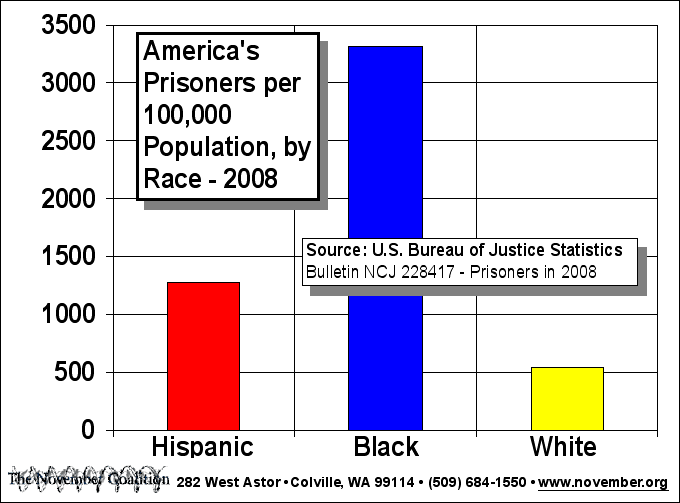
  1. While people of color make up about 30 percentof the United States’ population, they account for 60 percentof those imprisoned. The prison population grew by 700 percent from 1970 to 2005, a rate that is outpacing crime and population rates. The incarceration rates disproportionately impact men of color: 1 in every 15 African American men and 1 in every 36 Hispanic men are incarcerated in comparison to 1 in every 106 white men.
  2. According to the Bureau of Justice Statistics, one in three black mencan expect to go to prison in their lifetime.Individuals of color have a disproportionate number of encounters with law enforcement, indicating that racial profiling continues to be a problem. A report by the Department of Justice found that blacks and Hispanics were approximately three times more likely to be searched during a traffic stop than white motorists. African Americans were twice as likely to be arrested and almost four times as likely to experience the use of force during encounters with the police.
  3. Students of color face harsher punishments in school than their white peers, leading to a higher number of youth of color incarcerated.Black and Hispanic students represent more than 70 percentof those involved in school-related arrests or referrals to law enforcement. Currently, African Americans make up two-fifths and Hispanics one-fifth of confined youth today.
  4. According to recent data by the Department of Education, African American students are arrested far more often than their white classmates.The data showed that96,000students were arrested and 242,000 referred to law enforcement by schools during the 2009-10 school year. Of those students, black and Hispanic students made up more than 70 percent of arrested or referred students. Harsh school punishments, from suspensions to arrests, have led to high numbers of youth of color coming into contact with the juvenile-justice system and at an earlier age.
  5. African American youth have higher rates of juvenile incarceration and are more likely to be sentenced to adult prison.According to the Sentencing Project, even though African American juvenile youth are about 16 percent of the youth population, 37 percent of their cases are moved to criminal court and 58 percent of African American youth are sent to adult prisons.
  6. As the number of women incarcerated has increased by 800 percentover the last three decades, women of color have been disproportionately represented.While the number of women incarcerated is relatively low, the racial and ethnic disparities are startling. African American women are three times more likely than white women to be incarcerated, while Hispanic women are 69 percent more likely than white women to be incarcerated.
  7. The war on drugs has been waged primarily in communities of color where people of color are more likely to receive higher offenses.According to the Human Rights Watch, people of color are no more likely to use or sell illegal drugs than whites, but they have higher rate of arrests. African Americans comprise 14 percentof regular drug users but are 37 percent of those arrested for drug offenses. From 1980 to 2007 about one in three of the 25.4 million adults arrested for drugs was African American.
  8. Once convicted, black offenders receive longer sentences compared to white offenders.The U.S. Sentencing Commission stated that in the federal system black offenders receive sentences that are 10 percentlonger than white offenders for the same crimes. The Sentencing Project reports that African Americans are 21 percent more likely to receive mandatory-minimum sentences than white defendants and are 20 percent more like to be sentenced to prison.
  9. Voter laws that prohibit people with felony convictions to vote disproportionately impact men of color.An estimated 5.3 million Americans are denied the right to vote based on a past felony conviction. Felony disenfranchisement is exaggerated by racial disparities in the criminal-justice system, ultimately denying 13 percentof African American men the right to vote. Felony-disenfranchisement policies have led to 11 states denying the right to vote to more than 10 percent of their African American population.
  10. Studies have shown that people of color face disparities in wage trajectoryfollowing release from prison.Evidence shows that spending time in prison affects wage trajectories with a disproportionate impact on black men and women. The results show no evidence of racial divergence in wages prior to incarceration; however, following release from prison, wages grow at a 21 percent slower ratefor black former inmates compared to white ex-convicts. A number of states have bans on people with certain convictions working in domestic health-service industries such as nursing, child care, and home health care—areas in which many poor women and women of color are disproportionately concentrated.
Autobiographies from the Dead – Ephraim the Jew  

For the next several weeks, my blogs are going to consist of “autobiographies” written by some very special people.  They have one thing in common.  They are all dead.  Some have a burial place and some were simply discarded like pieces of trash.  Their stories will be told by the deceased themselves.  They cry out from the fields, rivers and graveyards to speak.  I have heard their cries.  They want to tell their stories to you.  They want you to know what their living and dying was for.  They chose me to be the medium for their voices to be conveyed to you.  I do not know why or how I was chosen.  I do nothing but repeat in 12 pt. font the stories that they tell me.  There are many more dead who want to be heard, but for now I have only agreed to share eight of their tales.  Each of the dead will give you a brief vision of their lives but much more importantly to them, they will give you a vision of their deaths.

Ephraim the Jew

jewish shadowMy name is Ephraim. I was born to a Jewish mother and a Jewish father in Germany.  My parents and great grandparents were all born in Germany.  We were not rich but we made a living over the years in various trades.  My family was all hard workers and I was taught the value of hard work and an education at an early age.  We were proud to be Germans.  My father had served with distinction in WW I and my great grandfather had served in the earlier Franco Prussian war.  We had many musicians and writers in our family and were proud that we could contribute to the rich German cultural heritage of our homeland.

HumiliationOne day, some young men started throwing stones at my father and me as we came home from work.  We arrived home with bruises and cuts but no broken bones.  My mother said that things were getting worse for Jews in Germany and that she had heard of many such incidents from other friends.  My father said she was being an old woman and should not worry so much.  This was just the result of a bunch of hoodlums and the government would soon arrest such bullies so that the streets would be safe again.

Weeks and months went by.  More assaults!  More bullying!  Everywhere we turned it seemed that people hated us.  The government passed Pro-German Laws to protect “Pure” Germans.  Somehow this seemed to mean that we Jews were now the enemies.  We were no longer Germans.  Our businesses were taken away from us.  Our jobs were taken away from us.  Then they took our freedom away from us.

trainsThey took us in trains to these large detention centers.  Smoke and flames were visible from numerous chimneys when we arrived.  Some people whispered that these were Jews who had been cremated.  It was too horrible to conceive.  It could not be true.  We were whipped, kicked and herded off the rail cars.  An angry looking German soldier in a black uniform with skulls and lightning bolts directed each person either to the right or to the left when we fled the cars.  Women and young children went one direction.  Men and young boys went the other direction.  My mother and sister went to the right.  They waved and said good bye.  “We will see you soon.”  “We must go to the showers first.”  We never saw them again.

The-last-Jew-in-Vinnitsa-1941My dad and I were assigned to work details.  Food was meager and work was hard.  We labored with very little rations from before sunrise to well after sunset.  My father died a year later.  He was nothing but skin and bones.  He said: “I am sorry.”  Another year later and I could not get up and go to work.  The guards came for me one day and said, “You are garbage and you are no longer useful.”  Two other Jews were forced to pick me up.  They carried me to a large pit.  I noticed many other bodies in the pit.  They threw me in the pit with the other bodies.  A holocaust-bodies-mass-graveguard shot me three times.  “Like shooting fish in a barrel he said.”  I was shot once in the head and twice in the chest.  He laughed as I twitched and as the blood oozed out of my veins.  I was surprised that it did not hurt as much as I thought it would.  I could feel my soul leaving my body.

Finally, I was looking down at my distorted figure and it was no longer twitching.  Even the blood had stopped oozing out.  The guard who shot me had lit a cigarette and was enjoying a quick smoke before returning to another work detail.  I watched for a while as other men and boys were carried to the pit and murdered.  I could no longer bear to look.  I decided to go find God and talk to him.  I was confused and angry but I thought that perhaps a talk with God might straighten things out.  My spirit left this hell on earth.

I am dead looking for godmany years now and I am still searching for God.  I want to know what we did to deserve such a fate.  We worked hard.  We paid our taxes.  We treated our fellow Germans with respect.  We worshipped on the Sabbath.  We upheld all of the commandments.  We were good people.  We were good Germans.  Why did they hate us so?  What did we do to cause this suffering?  Was this some kind of a test?

I think God is hiding from me.  He is nowhere to be found.  I have wandered now for years and still I find no God.  I know he exists.  I believe in God but I think he is avoiding me.  I think he may be ashamed for letting this happen.  I swear my soul will never rest until I find God and ask him this question:  “Why?”  But what if he doesn’t know the answer?

Time for Questions:

What is an Anti-Semite? Why do people still hate Jews? What did any Jews ever do to deserve such a fate?  Are you an Anti-Semite?  What can you do to help fight Anti-Semitism?  Do you try? Why not?

Life is just beginning.

“I swore never to be silent whenever and wherever human beings endure suffering and humiliation. We must take sides. Neutrality helps the oppressor, never the victim. Silence encourages the tormentor, never the tormented.”  ― Elie Wiesel

What do those Black People Want Anyway?

Two White men overheard talking at a coffee shop (Read while listening to Glory from Selma)

Ron:  You know it seems all we hear about are Black problems these days.   What do they want?  Christ’s sake, we abolished slavery over 150 years ago now.

Jack:  Yeah, then they got to join the military in WWI and even fight in WW II.

Black-unemploymentRon:  Yep, then all they did was complain even more.  Selma and Bama marches!

Jack:  Right, so we gave them the Civil Rights amendment.  Thought that would make them happy!

Ron:  Nope, they just complained even more.  Watts riots and all.  So what did we do?

Jack:  Created Martin Luther King Day.

Ron:  Just so.  Did that make them happy?

Jack:  Course not.  They just whined even more.  Especially after that white guy shot MLK.

Ron:  So what next?  Did we quite trying to make them happy?

Jack:  No, you must be thinking about Obama.

Ron:  Right.  We even elected one of them as President of the United States of America.

Jack:  Does this make them happy?

black RacePrisonRon:  Course not.  Then we get the Ferguson riots.  Nothing ever makes them happy.

Jack:  I wonder why they all don’t go back to Africa?

Jack:  They think it’s bad here. I would like to see how they like Africa.

Ron:  Maybe we could get the Republican Tea Party or the NRA to sponsor a bill that would allow them to go back and give them some kind of stipend to leave?

Jack:  Not a bad idea.  I don’ think the NRA or Tea Party likes Obama so much.

Joan:  (A bystander on a nearby coffee seat.)   Are you guys prejudiced?

Ron and Jack altogether:  Course not!  Some of our best friends are Black.

Joan:   You sound like you are pissed off about Black people in this country.

Ron:  Well, they got Affirmative Action, Obama Care, Gun Control, Drugs, but they still are not happy.  Now they got this new movie Selma bringing up all that old crap about prejudice and discrimination in the South.  Why can’t they just move on?

Jack:  I have heard they want financial reparations for their years in slavery.

Ron:  None of them living today were slaves.

discrimination_image_1Jack:  My family did not own any slaves.

Ron:  Neither did mine

Ron:  The problem is they just don’t have the same values as White folks.

Joan:  Like what would those be?

Jack:  Well like Christian Values for one.

Joan:  Did you know that most Black people belong to a Christian Church?

Ron:  Well, they don’t seem to value education.  Look at the dropout rate of Black students.

Joan:  Have you ever looked at the relationship between poverty and educational attainment?  It is hard to concentrate on school when you are hungry or cannot afford housing.

Jack:  Hey, whose fault is that?  They can work hard like the rest of us and get ahead.

Ron:  I don’t see no ball or chain on their legs.

Jack:  They got Affirmative Action and they still can’t finish school.

Ron:  Maybe they should concentrate less on sports and more on education.

Joan:  Funny you should say that, did you know that the Super Bowl this year was the most watched TV event in history.  Lots of White people concentrating on sports as well.  Sports is one area where you can make big money if you stand out.

black educationRon:  What about NASCAR racing.  You don’t see too many Blacks in that.

Jack:  Look lady, this isn’t about prejudice.  It’s about fitting in.

Ron:  Yeah, we would just like them to fit in like the rest of the immigrants did.  My grandparents came over and learned the language, got jobs and eventually fit right in.

Jack:  Mine too.

Joan:  Did your grandparents come over voluntarily or where they chained in a ships hold without adequate food for water for days and then sold to a plantation owner?

Jack:  Very funny.  That’s the past lady.  What’s that got to do with today?

Joan:  Have you ever heard the comment, “Those who forget the past are condemned to repeat it.”

Ron:  What does that mean?

Joan:  It means that we must remember our culture and ancestors and learn from the mistakes of the past.

Ron:  Well, what are Black people learning from the past?

unemployement ratesJoan:  You say you have some Black friends.  Do you ever talk to them about their racial history?

Ron:   I don’t bring up such stuff.

Jack:  What’s the point in bringing back the past?  Why can’t we all just live together in peace and harmony?

Ron:  I got nothing against Black people that want to work hard and get ahead.

Jack:  Same for me Lady.

The End:

[This blog was provoked by a conversation I was listening to this morning on Public Radio describing the Selma marches and discrimination.]

I would like to send this blog to a Facebook website I belong to and get reactions to it.  I will post reactions in the section below from African Americans who belong to –  Real TAUK:  African American Issues.

Comments from Black Folks regarding this blog: 

Time for Questions:

Do you think prejudice still exists against Black people in this country?  Do you think White folks have a right to be prejudiced against Black folks?  Why or why not?   What do you think White people’s role should be in helping to overcome prejudice?

Life is just beginning:

Life is too short to hate.  When you hate, you kill your soul.  What good has hate ever done the world?


Why America Needs Latino Immigrants or Lets Stop Dissing Mexican Americans!

Chicanos, Mexicans, Latinos, Hispanics, Mexican Americans, Spanish Americans, it’s all so confusing, what do I call them anyway?  Why can’t they just take a simple name like we do: Gringos?  You don’t see White people making it hard for others to call us names.

mexican american familyWhen I grew up in an Italian American neighborhood, we were wops, dagos, greasers, and guineas.  As in:

“You think im some goombah housewife with big hair and big jewelry??”
“You dirty wop, go back to Naples”
“You stupid Guinea, go back to Africa”
“What’s up dago?” 
by mikey ambrosio February 07, 2005

When I grew up, it was the age of cowboy shows.  The early shows were collected from old movies and brought to TV and featured such notable characters as Hopalong Cassidy, Lash Larue, Gene Autry, Tom Nix, Zorro and many others.  Early TV had two roles for Latinos:  Sidekick or villain.  Mexicans got to play the bad guy if the script wanted to use someone other than Indians.  I can still remember my first image of a Mexican.  It was a guy with a long black mustache, bandoliers crossing his chest, carrying two or more side arms.   He was adept at hiding behind rocks and ambushing my heroes.  Of course, he always wore a large black sombrero and spoke like:

“You tink you get away from Pancho?  Pancho no fool?  Pancho keel you now, you stupid gringo!”

mexican banditoThe cavalry never had to rescue my hero from the Mexican bad guys as needed to happen when he was captured by the Indians.  The Mexican bad guys were easy to outsmart:

“No, I would never try to get away from Pancho.  Would Pancho mind loaning me his gun for a minute, I would like to see what a nice gun he has close up?”

“Oh sure, gringo like to see my gun?  Here take it and see the nice ivory handle.”

“Hands up Pancho, or I’ll blow your brains out. Come to think of it, I’ll blow your brains out anyway, cause your just a wetback from over the border. You probably don’t even have any legal immigration papers.  Blam, blam, blam, take that you dirty Latino.”

The other role for any male south of the border (Latino women were always cooks and stirring a large pot.   Later on they got to play tavern whores when the shows got more risqué.) was as a sidekick.  One of the most famous Mexican sidekicks was Pancho (What else?) who was Duncan Renaldo’s sidekick on the Cisco Kid.”  Renaldo was not born in Mexico but was born in Romania but he played the Cisco Kid who apparently was of Hispanic lineage.  The Kid spoke fluent English while of course Pancho (Leo Carrillo) said things like:

The Cisco Kid: There is something Pancho and I can do.
Pancho: Yes, there is something we can do. We could – we – what is it?
The Cisco Kid: Investigate, Pancho.
Pancho: I don’t have a mind to invest in a gate. What good would that do, anyhow?

“The Cisco Kid: School Marm (#6.8)” (1955)

“Although he played stereotypical Mexican Americans, Leo Carrillo (a college graduate) was part ofcisco and pancho an old and respected California family. His great-great grandfather, José Raimundo Carrillo (1749–1809), was an early settler of San DiegoCalifornia. His great-grandfather Carlos Antonio Carrillo (1783–1852) was Governor of Alta California (1837–38), his great-uncle, José Antonio Carrillo, was a three-time mayor of Los Angeles, and his paternal grandfather, Pedro Carrillo, who was educated in Boston, was a writer.”  http://en.wikipedia.org/wiki/Leo_Carrillo

Of course, it would not do to have a Mexican play a hero or anything more than a bumbling half-witted but well intentioned sidekick.

Time for some musicMexican Americans Cheech and Chong full song (Click on Link)

I live in Arizona which has a large amount of undocumented immigrants attempting to pass through.   Many people in this state have developed a higher than average intolerance of our Latino friends.  A short while ago I was sitting in the local coffee shop and the woman on the stool next to me said rather loudly “I wish those damn Mexicans would all go home.”  I said “Well, many of them are home.  In fact, many if not most of them were here before you were.”  She looked at me rather meanly and said, “What, do you mean by that?”  I said, “Well until the Gadsden Purchase, the land you are sitting on was owned by Mexico.  Mexicans living here were given the chance to become American citizens and since many of their families had been living here since about 100 years before the Mayflower came over, they decided to stay.”  She did not say another word to me.

sign for serving whites onlyMy actual first encounter with Latinos was way back in 1967.  I was doing migrant farm work for Abrahamson’s Tree Farm in Scandia Minnesota for $1 dollar an hour.  It was hard physical labor from about 7 AM to 9 or even 10 PM at night.  Many of the field workers were from South of the Border.  I was warned never to discuss wages with any of them.  This warning was given despite the fact that none of them spoke English and I did not speak Spanish.  One day, while I was sitting in the fields with some of the other workers eating lunch. one of them looked at me and said “Bull-OVA, Bull-OVA.”  I had not the slightest idea what he was trying to say and looked rather quizzically back at him.  He finally reached over and took my arm. He pointed to his wrist and my wrist.  I suddenly realized we were both wearing Bulova watches.  It was a small thing but it was a rather poignant connection that we shared despite our lack of language.  That was my last contact with any Latinos until about 1979 when I was hired by Sister Giovanni to teach at Guadalupe Area Project in Westside St. Paul.

Nearly fifty years later and I am still discovering interesting things about our Latino neighbors and friends.  I was substitute teaching in one of the Casa Grande High Schools about a year ago when the phone rang in my classroom.  I picked it up and heard a Spanish speaking voice on the other end.  I looked at my class which is about 40 percent Hispanic and I picked out one suitably Mexican looking young girl and said to her:  “Maria, would you take this call for me, they are speaking Spanish.”  She looked back at me and said “I don’t speak Spanish.”  So much for getting over stereotypes!

In 2000, Arizona voters approved a law that effectively banned bilingual education in public schools.

Proposition 203, which passed with 63 percent of the vote, prohibits native-language instruction for most limited-English-proficient children in public schools. Using the electoral process to micromanage the schools, the new law imposes a statewide English-only mandate, overruling the

  • Choices of Hispanic and Native American parents,
  • Judgment and experience of professional educators,
  • Decisions of local school boards, and
  • Sovereignty of Indian nations trying to save their languages from extinction.

This mentality reminds me of the efforts by the Bureau of Indian Affairs (BIA) in the early 20th century to eradicate the Native American cultures in this country by prohibiting Indian students from speaking their native language.  Many Americans now look back on the history of Indians and say how unfair our treatment of them was.  We say that we wish we could do it over.  But we are trying to do the same thing to the Latino speaking cultures in this country TODAY.  This is not happening 100 years ago.  In 2010, Arizona passed a law banning Ethnic and Multi-Cultural Studies in schools.  The ostensible reason was to insure that the government of the United States was not overthrown by these multi-cultural radicals.

But Mexicans are good for one thing.  Many of my compatriots in Arizona love to go to the border towns in Mexico to get their dental work done or their prescriptions filled.  The town of Algodones is on the Mexican border of California and Arizona.  It is filled each day with people from the USA who cross over to take advantage of the lower prices for both dental and eye work.  The prices can be as much as a third lower than in the USA. The popularity of both inexpensive prescriptions and medical care catering to Canadian and US senior citizens has prompted a virtual explosion of pharmacies and dental offices.  We may not want these Mexicans to live near us but we don’t mind if they will fix our eyes and teeth at discount rates.

stereotypesSo what drives this antipathy and sometimes out right hatred towards our Latino neighbors?  Why after 300 years of sharing our border have we reached this sorry state of anti-immigration and intolerance towards the Latino culture?  Some would say fear.  Others would say it is a reflection of hard times in the USA and the difficult economy.  Who needs more competition for jobs and work when millions of United States citizens are suffering with unemployment and a high cost of living?   But is this any reason to take it out on the poor of other countries who want a chance to escape their poverty?  Why can’t we look for a win-win in this scenario?

What further exacerbates this problem is the sorry state of leadership in this country.  Instead of looking for solutions that would appeal to the best in human nature, too many of our political leaders seem intent to stoke the fires of race hatred and cultural intolerance.

Resistance to a sweeping immigration overhaul is moving from conservative talk shows to the corridors of power.  The Republican-controlled House of Representatives on rejected President Obama’s policy to stop deporting young people brought to this country illegally as children. With all but six Republicans voting against funding a policy that lets hundreds of thousands of law-abiding but undocumented youth enrolled in high school or the military to stay in this country, the vote spotlighted the long odds facing the much broader Senate bill to allow 11 million illegal immigrants to earn citizenship.

 The House vote came two days after Republican Gov. Rick Scott of Florida vetoed a bill that would help young people whose deportations were halted by the Obama administration get driver’s licenses. And on Wednesday, a key immigration leader in the House, Republican Raul Labrador of Idaho, defected from bi-partisan talks.  http://www.nationaljournal.com/politics/mounting-signs-of-gop-rebellion-against-immigration-reform-20130607

 We seem to have forgotten that this country was settled by people from many other countries.  Perhaps our greatest strength has come from our diversity and our ability to assimilate people from diverse cultures. The assimilation was not accomplished and has never been accomplished by laws or politicians. The assimilation happened because we were all able to share in the mexican_march_californiaAmerican dream of “Life, Liberty and the Pursuit of Happiness.”  This vision of what could be has been the fuel for the vast melting pot that this country has always represented.  Without this fuel, we have no ability to assimilate diverse cultures.  People are not assimilated because of anti-language or anti multi-cultural study laws.  People are assimilated by a common dream and a common vision.  We have always pointed our country out as a beacon for the forlorn and hopeless of other lands.  Are we going to give up on this role and the dreams that millions of people have for freedom, justice and prosperity?  Will we diminish ourselves by denying this dream to others?  What happens to such a dream if we do not share it with others?

 “Cruelty is all out of ignorance. If you knew what was in store for you, you wouldn’t hurt anybody, because whatever you do comes back much more forceful than you send it out.”  — Willie Nelson

 Time for Questions:

When did your grandparents come over? How were they treated? What if they were trying to come over today, how do you think they would be treated? What if you lived in a poor poverty ridden country, what would you do to escape or make your life better?  Documented or undocumented immigrants, should we have more opportunities for immigration to this country or less?  Why?  How much charity should we extend to people from other countries?  Can we extend too much?

 Life is just beginning.


Next Newer Entries