Courage is number seven of my seven essential virtues for leading a happy and successful life. Every Sunday I start my day with the following prayer:
- Give me the ability and courage to make a difference today, no matter how small.
I have been thinking about courage now for quite some time. One of my favorite quotes is as follows:
“The test of courage comes when we are in the minority. The test of tolerance comes when we are in the majority.” — Ralph W. Sockman
Courage has been one of the most salient virtues in my life. I think about it often. I am afraid to be a coward but wonder if I am brave. Is it courage to do things because you are afraid of how you will think about yourself if you do not? I have tried to test myself often to prevent feeling like a coward. Caesar said “Cowards die many times before their deaths, but heroes only die once.” Perhaps, it was Shakespeare who really said this, but the point remains the same. My father hated cowards and more than once chastised me for being afraid of something. I can think of too many times in my life when my father would have been sorely disappointed in me.
When I was young, I always took the side of the underdog. I would defend anyone against a bully. I hated bullies with a passion. I still prefer the underdog. This might explain to some degree why I care about the poor, the sick and the homeless. Psychologists would say I was overcompensating to try to win my father’s approval. It really does not matter to me what they say. There is something poignant and sad about people who have less or are needier than I am. There is something despicable about people that only care about themselves and are too ready to say “I did it myself.” One of my favorite poems is:
No man is an island,
Entire of itself,
Every man is a piece of the continent,
A part of the main.
If a clod be washed away by the sea,
Europe is the less.
As well as if a promontory were.
As well as if a manor of thy friend’s
Or of thine own were:
Any man’s death diminishes me,
Because I am involved in mankind,
And therefore never send to know for whom the bell tolls;
It tolls for thee. — John Donne
In thinking about courage, I have found that the subject is more complex than it would appear. I believe that there are five kinds of courage. Some of us may be stronger in one while others are stronger in another kind of courage. I would like to list each kind of courage, give you my definition and then say a little about each one. The five types of courage I have found are:
- Physical courage
- Intellectual courage
- Emotional courage
- Moral courage
- Spiritual courage
Physical Courage:
 This type of courage is the most obvious and perhaps least subtle. The mountain climber, the motorcycle racer, the football player, the sky diver all display what to some of us would seem to be a reckless disregard for life. Each of these individuals risk life and limb for either fame, fortune, fun or to achieve some goal. Often money is the least of their motivations for risking their lives. These people do things that leave most of us awestruck but also inspired. We watch their events on TV, in the movies and at live shows. We never fail to be impressed by the exploits and daring do that such individuals undertake. Risk is the hallmark of their efforts and we note that many of them pay for their risky behaviors. Death is an ever present companion for these people. Somehow though, they rise above the fears that chain the rest of us to the TV and they are out there doing what many of us only do in our dreams.
There is another group though that exhibit raw physical courage and they do it for a different set of reasons. Soldiers, police officers, emergency medical people and fire fighters all risk their lives on a daily basis. Most of these individuals do it for altruistic motives. There is not enough money in the world to convince the rest of us to risk our lives like these people do. No one can say they only do it for the money, since sadly these occupations are not very well paid. We pay accountants, Wall Street brokers and MBA’s many times more than we pay the people who risk their lives every day to protect the rest of us.
Intellectual Courage:
 What do you do when someone tells you that your ideas are stupid and that you will never amount to anything? If you are like most of us, you give up and go on to something else. The person with intellectual courage though is different from the rest of us. They don’t give up on their ideas. They plod forward in the face of distain, insults and criticism. Many times they are dead and buried before the value of their ideas are recognized. Darwin, Mendel, Pasteur and Copernicus were all ridiculed and ostracized for many years before their ideas were accepted. Socrates was executed for his ideas. Indeed, here is what Socrates said at his trial:
“But some of you will ask, ‘Don’t you regret what you did since now it might mean your death?’ To these I answer, ‘You are mistaken. A good man should not calculate his chances of living or dying. He should only ask himself whether he is doing right or wrong—whether his inner self is that of a good man or of an evil one.’ — From Plato’s Apology.
Now I ask you, was Socrates a brave and courageous man? Would you have the conviction to die for your ideas?
Emotional Courage:
 I have a good friend of mine who will not go to funerals. They make him feel very sad and he tries to avoid such feelings. No one of us likes to feel sad. It takes a kind of courage to go to a funeral. What do you say at a funeral to the friends and relatives of the departed one? How do you act? What if you did not know the person very well? There are many ways to feel embarrassed or like a fish out of water at a funeral. Easier to stay home then go. But it takes a certain kind of courage to deal with emotional risk. Any courage is difficult because of the risk. Emotional risk entails looking stupid, feeling stupid or having to deal with difficult feelings. A person with emotional courage confronts these situations with a degree of bravery and élan that escapes many of us.
“I learned that courage was not the absence of fear, but the triumph over it. The brave man is not he who does not feel afraid, but he who conquers that fear.” — Nelson Mandela
 One of the greatest fears that many people have is called “stage fright” or fear of public speaking. Many professional speakers and actors/actresses feel significant stage fright. Actress Carol Burnett was so nervous that she threw up before many of her performances. Most of us would never think of getting up on a stage. I know that people call it stage fright, but it is not really about the stage, it is really about us. Who wants to look stupid and particularly in front of hundreds or people? It takes emotional courage to deal with life. All of us have it, but we often choose not to exercise it. We simply spend our lives trying to avoid situations that might make us look dumb or embarrass ourselves. The people with emotional courage deal with these situations and take the risk that the rest of us hide from.
Moral Courage:
 The world is full of examples of moral courage. However, to my way of thinking, the amount of moral cowardice far outweighs the shining examples of moral courage. The number of Martin Luther Kings, Gandhis, Mandelas, Parks, Kellers and Kyis are dwarfed by the number of moral cowards who turn the quote I noted above around. These are the people who when in the majority would tyrannize the minorities. They are the moral cowards who use their positions to foster hatred and bigotry and intolerance towards the disadvantaged and weak. They prey on the sick and
  hungry and would deny benefits or help to anyone who is not a member of their tribe or affiliation. They go through life pretending to be good people and deluding themselves that they are.
Conversely, we have those cowards who when in the minority are afraid to risk. They are afraid to speak out when they are surrounded by racists and bigots. They are afraid of what their friends and neighbors might think if they stand up for their beliefs. So they say and do nothing. They find it easy to ignore the admonition that:
“The only thing necessary for the triumph of evil is for good people to do nothing.” — Edmund Burke
This group of moral cowards also includes the pious so-called Christians who feel that all they need to do to guarantee their ascent into heaven is to spout religious slogans from the bible. They conveniently forget what Jesus himself did and what the apostle James noted:
“So you see, faith by itself isn’t enough. Unless it produces good deeds, it is dead and useless.” — James 2:17
Jesus said:
“So then, you will know them by their fruits. Not everyone who says to Me, ‘Lord, Lord,’ will enter the kingdom of heaven, but he who does the will of My Father who is in heaven will enter.” — Matthew 7:21
I understand both of these passages to mean that a good person must do good deeds. It is not enough to have good thoughts or to say “I believe, I believe.” You must also be able to say “I do good.” “I do good.” And what good do you do? Do you stand up for those who are being persecuted or do you join in their persecution? Moral courage is standing up for your beliefs. It is standing up for other people. It is not just thinking about “What would Jesus do?” It is doing what Jesus would do. Jesus would not be silent in the face of persecution of others.
Spiritual Courage:
Spiritual is the ability to face the uncertainly of life and to greet each day with a sense of awe and hope that in the world I can be a better person and that I can help make the world a better place. If we look at the word spirit, we find the following definition:
“The inner character of a person, thought of as different from the material person we can see and touch.” — Cambridge Dictionary
The world greets us each day with new possibilities. Many of these possibilities entail risk. Risk of dying in a car accident. Risk of dying in a shooting. Risk of being raped. Risk of losing a loved one. Risk of disease. Risk of unhappiness. The list of risks we face each day is endless. We are sensitized to these risks by the onslaught of news and media that bombards us minute by minute and second by second with ghastly deeds that journalists love to print.
Fear is ever present in our society today and is it any wonder? The media exalt in horror stories that should have most of us seeking sanctuary in a deep dark cave. We long to be hidden from the persecution that seems to engulf our daily lives. Catholics fighting Protestants. Jews fighting Muslims. Shia fighting Sunnis. Tea Party people hating liberals. People of different cultures and ethnic groups inflicting insults and defamations on each other. Women and children subjected to abuse every second of the day. Wars raging in one country or another. The wealthy despising the poor and the poor envying the wealthy. Life is portrayed as nothing but an unmitigated disaster waiting for a tragedy to befall us or so the media would seem to have us believe. The news becomes a drug whose side effects are to convince each of us to drop out of life and to give up on the world.
“During my 2009 service as an Air Force chaplain in Iraq, I saw countless examples of heroism. However, the most spiritually heroic act I witnessed was the prayer of a soldier who asked God to forgive the insurgents who had killed his battle buddy.” —
Hero’s Highway: A Chaplain’s Journey Toward Forgiveness Inside a Combat Hospital
I wonder that anyone has the courage to get out of bed each day. It is astonishing to me that any of us has the desire to do good for the world or to make a difference. It hardly seems possible to roll back the evil and injustices that pour forth each day from every corner of the globe. So why bother? One atrocity surpasses and begets the next atrocity.
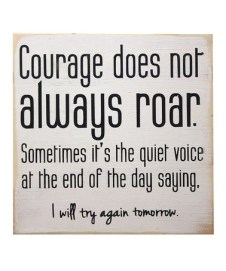 Nevertheless, in the face of all this iniquity, the majority of humankind has a spiritual courage that defies logic. The majority of people want to do good for the world. The majority of people are good and most people try to leave the world a better place then they found it. This is truly an amazing observation. More people are spiritual heroes than not. Every day those who have the courage and strength to get out of bed and to start a new day show a sense of spiritual courage. It would be easier to hide and to do nothing then to face the daily rigors of life on our planet. Yet, that is what the majority of people do each day. They get out of bed. They go to work. They volunteer. They innovate and create. They campaign for their ideals. They build. They love. They pay taxes. They die. And the cycle starts all over again for the next generation.
“I long to accomplish a great and noble task, but it is my chief duty to accomplish humble tasks as though they were great and noble. The world is moved along, not only by the mighty shoves of its heroes, but also by the aggregate of the tiny pushes of each honest worker.” — Helen Keller
Time for Questions:
What kinds of courage do you have? What kind of courage do you wish you had more of? Why? What could you do to find more courage in your life? Do you think it would make a difference? Why?
Life is just beginning.
“One isn’t necessarily born with courage, but one is born with potential. Without courage, we cannot practice any other virtue with consistency. We can’t be kind, true, merciful, generous, or honest.” — Maya Angelou

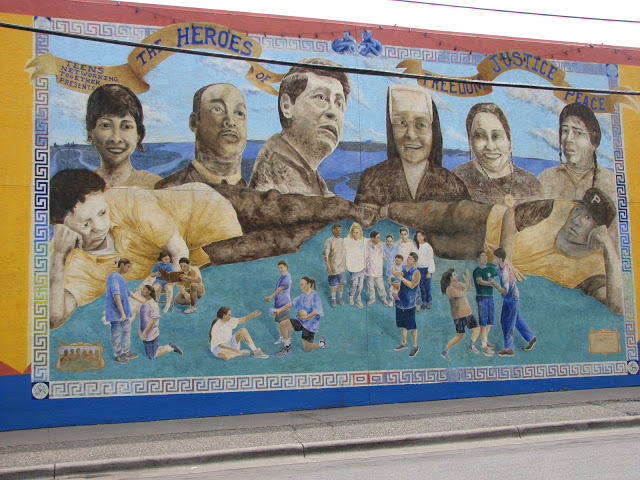
 One day a young student came to me and complained that he felt that his rights had been violated. At the time, I took any students complaints very seriously particularly when it concerned rights. I listened to his problem and asked him what he wanted me to do about it. He asked if I would intercede on his behalf with Sister Giovanni, who was our principal. I wanted to show the young man that I was concerned and caring and so I agreed to carry his problem to Sister G as she was known. She was feared and loved by almost all students so it did not surprise me that he thought I might have more luck with Sister G than he would have.
 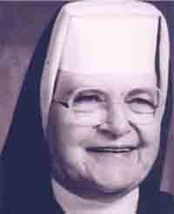 I went to Sister G’s office and knocked on her door. She opened it and welcomed me in. We exchanged some pleasantries and she asked me what I needed. I began to explain the issue that the student had brought to me. Sister G listened attentively. When I was done, she smiled and nodded reassuringly. I thought “Great, I have been successful.” She then spoke, “This is your first year teaching right John?” “Yes, it is,” I answered. “Well, I have heard the issue and I may address it later, but I want to give you an important piece of advice now. Students just like the majority of people will always demand their rights, but they seldom demand their responsibilities.” Then, she gave me the philosophy that I have never forgotten. “John,” she continued, “for every right there is always a responsibility.” That was the end of our discussion.

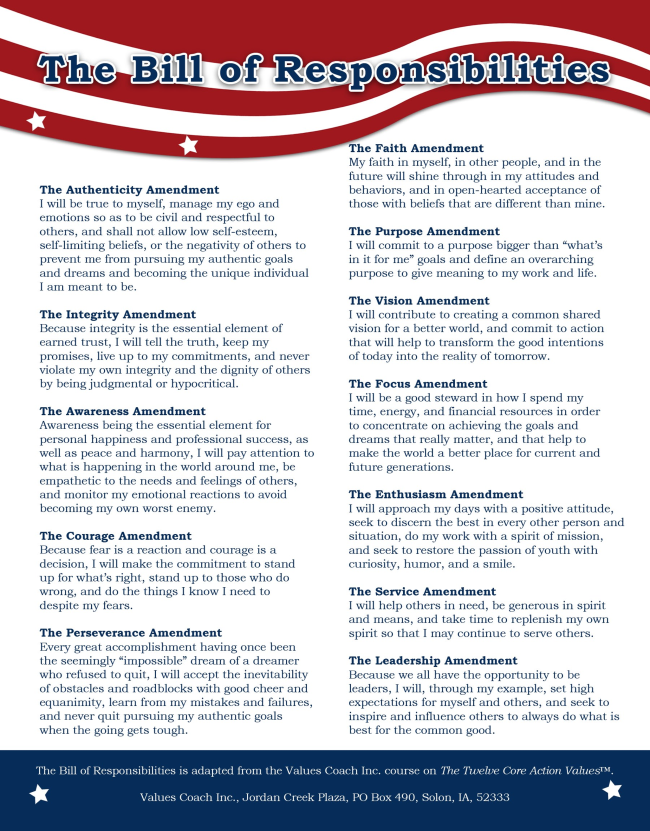
 What is the solution to the problem that we are facing today? A poisonous cultural stew of narcissism and entitlement driven by a rights only oriented mentality that thinks they are above responsibilities. I have reached the point in this essay where it would be easy to say, “Sorry, I don’t have the answer.” Or else, I could now list several bromides which may or may not have much effect. I have the following solution which I believe in 100 percent. I doubt that it would be acceptable to Americans as too many people have grown privileged, lazy, and indulgent in this country.
  My solution is for a National Required Service (NRS) that starts at the age of 18 for every man and woman in America. Upon finishing high school and before starting college, every American would need to attend the National Required Service. They would have two options. The first option would be to choose between a two-year service or a four-year service. A two-year service would be the minimum. The advantage of a longer service would lie in the educational benefits that would accrue. Serve two years and you would receive two years of financial credit towards any public education institution of your choice in the country including vocational education as well as liberal arts. Choose a four-year tour of service and you would receive four years of financial credit towards the public institution of your desire.
 Faith is number five of my seven essential virtues for leading a happy and successful life. Every Friday I start my day with the following prayer:
 I decided that I must first understand what Faith really means. To do this, it is helpful to deconstruct how we think about Faith and how we use the word. I thought about how we use both Trust and Faith in common language. For instance we use trust in English as follows:
 I think you can readily see that there is a certain degree of overlap between the two concepts. However, Faith generally seems to convey a more sectarian or theological concept of belief whereas Trust is generally used in more secular terms. Thus, we don’t “trust” God but we have Faith in her. Faith seems to be a term that is not contingent upon any kind of physical or logical proof. We might not trust a person with our money without proof that they are “bonded” or trustworthy, but we would not expect such displays of material evidence when it comes to having Faith in God. So what is the relevance to this in our lives? What good is Faith if we can substitute trust for faith and have more security in the long run?
 The answer seems to be (IMHO) that sometimes we can trust without evidence but generally we are better off trusting with some element of surety that can mitigate the risk of our trust being unfounded or mistaken. Whereas, there is little or no evidence that can prove your need or desire to have Faith. You must have Faith like a parent has love for a child. It is unconditional. You have Faith simply because you want to believe. You have Faith because you accept something without conditions. You need no proof or evidence to support your Faith. Is this a good thing or a bad thing? Should you have Faith without proof? What would a life without Faith be like? Would we be safer or happier with less Faith?
 Fortunately, the 3.4 percent of respondents have been more than enough to help me keep my Faith. (Should I really need such sustenance if I have Faith?) Yes, I have Faith that my writing is making a difference to the world but alas, I have no proof for the empiricists, the materialists or the skeptics. I have to ask you as well as myself to believe that I am. It is Faith that keeps me motivated. Without Faith, life would appear to be a futile waste of time. Faith helps us to carry on when everything and everyone is saying to quit. The woman in the life raft, the athlete with a severe injury, the parents with a disabled child, the poor fighting hunger, the righteous fighting injustice are all sustained by the power of Faith.
 Faith can believe everything


 Kindness is number four of my seven essential virtues for leading a happy and successful life. Every Thursday I start my day with the following prayer:
 There were few heroes when I was growing up who could measure up to my standards for clear and unemotional thinking. I grew up with a father who demanded toughness. My father’s motto was not to “get even” but to “get one up.” If someone hit me, he taught me to make sure that they would never think of hitting me again. My father was 6’ 4” tall and had been a professional boxer with a 21 and 3 record. He taught me fighting skills at a very young age. My neighborhood taught me to disregard the “rules of boxing” and to fight with whatever I had to win. I could easily protect myself and few people would bother me. Somehow, I became a protector for those kids who were less aggressive and who were picked on by the ever pervasive bullies. I kicked more bullies asses then I can count. I was always proud to help the underdog. Paradoxically, these traits did not make me more compassionate but made me harder and tougher.
 Through hardness and toughness I began to forge a wall that nothing could get through. Sentiments, compassion and empathy were increasingly blocked out by my need to be tough and to not take any shit from anyone in the world. Each episode where toughness prevailed was another brick that helped to build my wall higher and higher. I never thought I would get married but after getting my first wife pregnant, I “did the right thing” and married her. It was the manly thing to do. My dad had always taught me to take responsibility for my actions and my baby Chris was a direct result of my actions.
 One day we were in a grocery store just before Christmas. An apparently legless man pushing himself along on some kind of a wheeled board was inside the grocery looking for some money. I walked by him with Julie (my first wife) and ignored him. My wife turned back and started to give him some money and I said: “Shit, don’t give him any money, he can probably outrun me. I will bet he is just a fakir.” She gave him the money anyway and replied “What if he is not?” I never forgot that comment. I am not sure why my first wife married me. She once said that she thought all people had feelings and emotions until she married me. We subsequently divorced but I have to say that I probably owe my life to my first wife. She cared for me when I was suicidal and she always looked after me when I was hurt or needed help. Through her, I began to see what compassion and kindness were. This journey has continued with my second wife Karen who is one of the most considerate and most compassionate spouses anyone could have. Every day I learn something about kindness from her.
 I disagree with Shaw. I am getting older and I still respect and uphold the values of our Founding Fathers, but I refuse to live in a gated community or allow a homeowner’s association to tell me what color holiday lights to put up. I am not a believer in mincing words but I respect the rights of minorities and anyone else to be referred to as they want to be referred to. I respect the rights of Indians to have their ancestor’s graveyards not dug up for commercial or even academic reasons and I respect their rights not to be depicted as silly mascots for some college team. Trump and his supporters believe the US has become too PC. They blame minorities for this. They would like to live in a land where it is ok to call a Black person a nigger since we call Italians wops and French frogs. A Black person they argue has a double standard or they apply a double standard for Blacks and Whites. The bottom line of all this double talk is not too much PC but a lack of empathy and compassion and kindness towards others.
 Yes, there are extremists who want to take Huckleberry Finn out of the library just like there were Popes that knocked the genitals off of statues in Rome. But if you have any empathy or even the slightest understanding of culture and history, you will be less apt to say “My father didn’t own any slaves.” That is a little like replying to a woman who was raped “Well, I did not do it.” To which I can now hear someone replying, “Yes, but no Black people alive today were slaves, so why should they be so upset?” Yes indeed, why should they be so upset? If you are serious about looking at a reason, please regard the following article:
 The people that we will remember in our lives and who make the most impact on our lives are not the rich and famous. They are the people who most cared about us and looked after us. They were kind and loving towards us and somehow showed that we meant something to them and to the world. They may have been our fathers or mothers or an aunt or teacher or perhaps a close friend. How much money they had or how successful they were did not make a difference to us. Indeed, what they gave us could not have been purchased by money. Money doesn’t touch us but kindness does.
 Aging Capriciously