I am reposting the above Blog from a site sent to me by a friend. The author is most eloquent and describes with such great detail all of the horrors and meanness of the present administration. I have written many blogs on this subject but none as touching and complete as this one by Mike U. As the author notes, he does not usually do political stuff. His blog deserves reading by anyone looking for some very fine writing. I am including a link to his blog below:
“The Silence Weighs More”
25 May 2025 21 Comments
in Uncategorized Tags: courage, fear, freedom, justice, standup for justice

“The Silence Weighs More” by ChatGPT and J. Persico, mostly by Chat.
You wake each day with a world on fire,
Yet choose the path of least desire—
To see, but not to raise a voice,
To name the wrong, then mute your choice.
But silence is not soft or kind,
It’s the heavy chain that grips the mind.
Each quiet hour, each averted gaze,
Is fuel to keep injustice ablaze.
The fear is real, that much is true,
But fear has never made hearts new.
Change is born in trembling hands,
In whispered truths and stammered stands.
Don’t wait to be the perfect light—
A flicker can ignite the night.
Your voice, though small, could be the spark
To guide a soul lost in the dark.
You say, “I’m just one,”—yes, and still,
One seed can split the hardest hill.
The world does not need flawless men,
It needs the brave to rise again.
So speak, even if your voice must shake.
Step forward, though the ground may quake.
The price of comfort is far too steep
When justice cries and you still sleep.
No, you don’t have to save the day—
But don’t just look the other way.
For every moment you pretend,
Another soul meets bitter end.
Rise not to be a hero crowned,
But simply one who stood their ground.
Let history say, when it recalls,
You saw the truth—and did not stall.
All Hail Trump the King!
24 May 2025 7 Comments
in Uncategorized Tags: Congress, cowards, dictator, king, Senate, supreme court, trump, USA

After hearing the latest news today about the Supreme Court’s ruling that Trump could fire just about any government employee he wanted to without cause, my spouse Karen suggested “Why don’t we just crown him king.” “That’s a GOOD idea I replied.” The courts have already said that he is immune from prosecution for any wrongdoing while in office. In New York, he was told ten times during his trial that he was in danger of being charged with “Contempt of Court”, but it never happened. The chicken shit judge was afraid to do anything.
Our Congress bends over backwards to support anything Trump wants including a “Great Big Beautiful Bill” that will kick many people off Medicare benefits. Punish people too disabled to find work and give tax breaks to the top ten percent of Americans. Only two-House Republicans voted against the bill and that was probably because they were afraid it would increase the deficit. Either that or they feared violence by Trump and his supporters. Trump has Senators afraid to disagree with him. Senator Lisa Murkowski admitted that she is terrified of retaliation from President Trump and his supporters. No doubt that feeling is shared among many in the House and Senate.
Almost every major economist in the USA said this new tax bill would increase the deficit but that did not deter Congress from giving money to their benefactors. They pushed more money into the military-industrial-complex and the Border Patrol and took it away from the lower income earners. I heard a Republican on NPR this morning say that the big waste is in entitlement programs including Education, Social Security and Healthcare. No one calls our bloated military budget an “entitlement” program for major corporations, nor do they call our growing Border Patrol an entitlement program.

I would sooner fund welfare recipients than drones or smart bombs that are programmed to stalk and kill other human beings. Please don’t call me a pacifist or disloyal. Unlike Trump, I volunteered for military service in September of 1964 and served until October of 1968. I volunteered three times for Vietnam. If any true crisis emerged, I would not hesitate to defend our country. However, a military budget that ranks as the number one in the world and is equal to the next ten budgets combined is absurd. I also have little or no use for creating a border wall and border security to deny privileges written in the US Constitution. Once upon a time, there was no wall, no border patrol, no security checks, no internment camps and things worked out fine.

We are now creating a Space Force and high-powered lasers so that we can place them on the moon and Mars. Do you know why? I bet you can guess. Here is a hint. It has to do with some billionaires who are making fortunes with their space programs.

I asked ChatGPT the following question: Did either Musk, Bezos or Zuckerberg serve in the military? Here is the answer that I received to my inquiry:
Elon Musk
Elon Musk did not serve in the military. He left South Africa at the age of 17, partly to avoid mandatory conscription under the apartheid regime.
Jeff Bezos
Jeff Bezos has never served in the military. His background is rooted in academics and business.
Mark Zuckerberg
Mark Zuckerberg has no military service record. There have been no credible reports or evidence suggesting any military involvement. His focus has been on technology and business since his early years .
I hope you are not surprised by these results. Uber-Rich people including most politicians seem to find the idea of joining the military very repugnant. Fighting and dying is for poor people or people so unconnected that they are eventually sucked into the Army or Marines where they can be sent to the front lines and when dead or disabled awarded with an array of medals.
I again asked ChatGPT a question. “Is there any data related to the socio-economic status of soldiers who died or were wounded in combat during the Vietnam War and the Gulf Wars versus soldiers who were not?” Here is a summary of the reply that I received:
Comparative Summary
| Conflict | Recruitment System | SES Profile of Troops | Casualties & SES |
| Vietnam War | Draft + volunteers | Lower to working class | Disproportionately lower SES, especially early in war |
| Gulf Wars | All-volunteer | Lower to middle class | Middle/lower-middle class more represented in casualties |
SES stands for Socio Economic Status. Most of the studies on my question found that the poor, the less educated, and people from geographically disadvantaged rural areas had more deaths and injuries.
“A study published in the American Journal of Public Health includes a figure illustrating the relationship between state per capita income and Vietnam War combat casualties. The analysis indicates that states with lower per capita incomes experienced higher casualty rates, highlighting a socio-economic disparity in war fatalities.” — PubMed
I point out the above data to illustrate the growing gap between the rulers in this country and the ruled. The golden rule could never be more firmly implanted than it is today. “He or she who has the gold makes the rules.” The rulers eat, drink and live in palatial mansions that most of us cannot even imagine. The rulers live on boats bigger than our schools. They eat at restaurants that would not allow someone of my income level to be near the food except maybe to pick up the trash. Most people I know would be happy to have take home bags from these places.
Just for the record, our (Spouse and I) combined income puts us in the 45th percentile, meaning our income is slightly below the national median, but higher than about 45% of U.S. households. Thus, we are not poor, but we are pretty far from being rich considering that 55 percent of American families have higher incomes than we do. Just for fun, I calculated how much Jeff Bezos makes per year and obtained the following result which includes his salaries, profits and earnings growth.
Based on his net worth growth, Jeff Bezos earns $9.6 billion a year—or $798,333,333 a month. To break this down even further, that’s $26,611,111 a day, $1,108,796 an hour, $18,480 a minute—and $308 a second. In comparison, both Karen and I make $7.62 per hour or “$183 dollars per day. Bezos makes almost twice as much in one second as I make in a day.
But getting back to the rich a-holes who are destroying our American Democracy, why continue the charade? Stephen Miller or J.D. Vance can nominate Trump for King, and I will second the motion. Think of the happiness this would bring to the billionaires who support Trump. Think of the joy amongst his followers who never believed in democracy in the first place. Think of the sycophants who can now stop kissing his ass and can simply run rampant over the rest of us. At least two of them have floated a bill to include Trump at Mount Rushmore.
The Supreme Court can crown Trump “The Most Beautiful King” who ever lived by a six to three majority. The Senate leadership has already given up the idea that checks and balances should limit the power of the President. Why say we have a president? If it walks like a duck and quacks like a duck, it must be a duck. Anyone who can say Fuck You to the Supreme Court, Kiss My ASS to the Congress and put FEAR into the hearts of academics, lawyers and government officials with his threats of Vengeance and Retribution is not a president. By any measure I can think of they are a violent, narcissistic Dictator.
King George move over for King Trump.
Mr. Wardell E. Stephens: A Profile in Courage, Character and Integrity
17 May 2025 8 Comments
in Uncategorized Tags: books, character, courage, integrity, navy, rescue, salvage, towing

Mr. Wardell Stephens is a 95-year-old Navy veteran. He was born in 1930 in St. Louis. Wardell joined the Navy in 1947 at the age of seventeen. He retired twenty years later in 1967 at the age of 37. He had a long and distinguished career as a Navy diver conducting deep sea rescue operations. He is a rare man, and it is my pleasure to provide a brief overview of his life. I call it a Profile in Courage, Character and Integrity. Reading this testimonial, I think you will agree that these terms aptly apply to Mr. Stephens.
I first met Mr. Stephens several years ago at one of the Eloy Veterans Day celebrations. Mr. Stephens was the guest of honor and a keynote speaker. He was mild mannered and humble. He briefly thanked the people for his being there and said a few words about how much the Navy mattered to him. He was a Navy diver who had conducted several deep-sea rescue operations back when the equipment was much more primitive than it was today. No bragging about his bravery or how dangerous the job was. I was impressed with his humility.
Several years went by and one day shortly after they opened the new Eloy Veterans Center, (January 2025) Mr. Stephens dropped by to visit. Wardell was now 95 but had not seemed to age a day. He still walked like a young man with none of the shuffling you often see with the aged. He was ramrod straight and looked in better health than many people half his age.
We had a talk about some of his career exploits and again I was very impressed with his courage and humility. I asked if I could interview him and he agreed. That was more than two months ago. Mr. Wardell was sick for a while (as was I) with the damn bug that went around this spring. We finally set a date for me to interview him. Earlier he had left a packet of information about his Navy ships and projects for me to look at. Some of the material that follows are taken from his Navy record and some will include my interview with Wardell on May 7th, 2025. The interview lasted about 2 hours. Many veterans are inclined to some exaggeration as the years have passed. Wardell was just the opposite. I had a hard time getting him to be anything more than modest about his adventures.
Here is what one of his commanders said about him in a Navy Review:
“Stephens is an extremely conscientious Petty Officer in that he invariably will take charge of an operation. He goes out of his way to correct other divisional personnel who are performing work in an unseamanlike manner. His timely suggestions and technical ability have contributed greatly to the ability of the diving division to perform submarine repair work in an expeditious manner. He is always in a clean complete uniform and wears it in a shipshape fashion at all times. Definite credit to his rate and to the Naval service. Highly recommended for advancement in rate. Stephens when in charge of an evolution uses excellent judgement and disposes his men for maximum effectiveness in accordance with their abilities thereby assuring a smooth operation.” — J. H. Lindsay, CDR, USN
I had a chance to look at Mr. Stephen’s training record. It was full of very difficult diving techniques including the following:
- Deep sea diving school
- Salvage diving school
- Diving school instructor
- Submarine rescue
A number of years ago I went to scuba training and received my PADI certification. I then went on a trip to Belize to do several dives in the area of Ambergris Caye and Caye Caulker. I was sixty years old at the time. Some of my dives were fun but some were scary. Swimming among large sharks. Swimming through some narrow channels in dark conditions. Having to think about time for compensation stops to avoid getting the bends. Watching my air and depth gauges. Trying to avoid scraping coral. Trying to manage my buoyancy to stay with the other divers. It was very challenging, and I was only recreational diving. I never went below 150 feet and was never down for more than thirty minutes.
Wardell was diving in pitch black conditions. Sometimes using helium instead of oxygen and going down to do rescue and salvage operations at depths of 350 feet. Here is a Letter of Commendation describing one operation that Wardell completed:
“On May 13, 1964, NEREUS completed the water-borne replacement of the propeller on the USS Scamp. The old and new propellors weigh approximately 12 tons. As far as is known the replacement had never been accomplished in the water. As a member of the diving crew, you did the work assigned and thus contributed to the overall success enjoyed. In each instance, the reliance placed on you by the Master Diver and diving officer was justified and your contribution was significant.” — M. des Granges, Commanding Officer, USS NEREUS
The following video talks about what it is like to be a Navy Rescue and Salvage diver.
https://www.youtube.com/watch?v=AnihhBnzowg
I would like to describe one more operation that Wardell did from the Commendation letter that he received. After this I will go to the interview that I did with Wardell. I am glad that he sent me some of his service records because it was hard to get Wardell to “brag” about any of his Navy exploits. I am trying to give you a sense of the danger and difficulty of what Mr. Stephens did for twenty years. I don’t often think of all military people as heroes, but it is certainly an appropriate designation for Wardell.
“In the early evening of December 3, 1958, a Marine Corps helicopter flying under conditions of darkness and poor visibility crashed in the Potomac River near Jones Point, Alexandria, Virginia. While enroute to commence the salvage operation on the assigned helicopter, you were advised of a second aircraft crash. This second crash was a Navy Beechcraft with a crew of two which crashed in the Potomac river off Haines Point. Throughout the daylight hours of 4 December under adverse weather conditions, the officers and men of your entire organization worked expeditiously in the salvage of the downed Beechcraft. On December 5th, you were also able to complete the salvage of the downed helicopter.” — Commandant, Potomac River Naval Command
On my last Scuba Diving trip to Belize in April of 2024, the weather conditions were pretty bad. A storm had come through the area and the water visibility was very poor. The waves and current were quite rough. I had a hard time reading my depth gauge and my air gauge and ended up getting separated from the other divers on our ship. I came up to the surface and could not see the dive boat. I had left my safety flag back with my pack. I also had not bothered to take my snorkel. My tank was almost out of air, and I had no way to alert anyone as to where I was. When the oxygen ran out of my tank, I had to keep propelling myself above the waves to get a breath of air. With the waves running high, I could do little except bob up and down and hope someone would find me. About 90 minutes later, the boat finally found me. I was picked up and spent the next two hours trying to barf up the seawater that I had swallowed.
I tell you the above story because Mr. Stephens had made many operations where he had to arrange a tow in weather ten times worse than I experienced. To link a tow ship with a disabled vessel is not as easy as simply throwing a rope to someone on the other ship. This short video might give you some idea of what courage it would take to engage in such an operation.
Rescue Salvage Towing operations on rough sea
https://www.youtube.com/watch?v=-JhLJoCYi-g
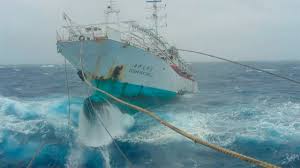
Here are my interview questions and Wardell’s replies. On the day of the interview, we had not scheduled a definite time. I had said that I would be at the Veterans Center between 10 AM and 2 PM and that he could stop by anytime he wished. Shortly after 10 AM, my cell phone rang, and it was Wardell. I expected that he was calling to say that he was not feeling well. Not an unexpected event for a man 95 years old. Instead, he had called to tell me that he might be a little late since he had a phone problem at his house and the repair person was coming out that morning. I thanked him for his call and told him that any time he arrived it would be okay. I can’t tell you how surprised I was at his call. I cannot get repair people to give me a date and time that they will arrive much less call me if they are going to be late. Wardell receives not one penny from this interview and yet he is courteous and diligent beyond what any norm is today.

John and Wardell Interview:
John: Can you tell me a little about yourself when you were growing up. Friends, school, culture, family, dreams?
Wardell: I was raised by my mom and aunt. I had no siblings. I grew up in East Saint Louis in the Rush City Area. We called it the bottoms. I started working as a pin setter in a bowling alley when I was 14. I drove a coal truck when I was 16. My dream was to own my own truck and go into the coal business. I never got a drivers license. I joined the Navy when I turned 17
Wiki describes the Rush City area as follows:
“Rush City is a historically African-American community within East St. Louis, Illinois, that is unique in the American Bottom region. It’s characterized by a rural Southern influence, dispersed housing, and vernacular architecture, making it a distinct “country life” pocket within a struggling urban environment. The community has faced challenges related to economic disinvestment, environmental pollution, and industrial encroachment.”
John: Why did you pick the Navy?
Wardell: Well, one day during the second World War, the Navy brought an LST to St. Louis. I went down to see it and was very impressed. Later when I decided to leave St. Louis, I enlisted in the Navy.

John: What are you most proud of in terms of your military service?
Wardell: The work I did as a rescue and salvage diver and my Sailmaker rate
John: Can you tell me more about your work in the military? Challenges etc.?
 Wardell: There was a lot of things to learn. Setting up a tow. Different type of rigging on different ships. Working cables in rough weather. Using hoists in rough weather. It was easy to get hurt if you were not careful.
John: What were your biggest difficulties in the military?
Wardell: Only had a few minor negative experiences. Most of my career was positive.
John: What were the negative experiences?
Wardell: Well Truman changed some of the policies for the better. Before Truman there were some bases where they separated Blacks and Whites in the dining halls.
John: How did the transition to civilian life go for you?
Wardell: At first it was very chaotic. In the military things are very orderly and predictable.
John: Can you tell me a little about your family life? Spouse, kids?
Wardell: Well, I was married twice. I have four children and ten grandchildren.
John: Wardell, for a 95-year-old guy, you are in great shape. How do you do it?
Wardell: I lift weights three times a week. I don’t smoke or drink. I eat lots of protein. Three times per week, I go for a walk. I walk as much as I can. I always park as far away from a store in the parking lot so I get more walking in. I have a treadmill at home I walk on when the weather is too hot or bad.
John: What advice would you give young people today?
Wardell: I would tell them that you have to learn and study to get something good in life. You have to study hard and pay attention in school. I would tell them that they should learn another language.
John: What were the highs and lows of your life Wardell?
Wardell: The high was completing Navy diving school in 1954. I also finally completed my GED since I never graduated high school.
John: What would you do over if you could?
Wardell: I would go for more school. Continue education all your life.
John: Am I leaving anything out you would like to share?
Wardell: That’s about it. Except I also had a stint in the Merchant Marine after I retired from the military.
John: Thank you for taking the time to share some of your life and thoughts with us Wardell. It has been a pleasure talking to you.
That’s it folks. I hope you have enjoyed learning about a very remarkable human being. In addition to a depth of character and integrity that is more than noteworthy, Mr. Stevens is a kind man who said not one bad word about anyone during the entire interview or the time that I have known him. His integrity and character stems from his taking the responsibility to live life according to what his mother and aunt taught him and what his religious beliefs have inspired in him.
PS: I still see Wardell every few weeks when he comes down to the Veteran Center in Eloy. Yesterday, he asked me to add a little something to the bio I did for him. I was quite surprised to learn that Wardell is a Life Association Member of the Buffalo Soldiers. He officially belongs to the “9th and 10th (Horse) Cavalry Association – Official Army Unit Association.” For those of you who have never heard of the Buffalo Soldiers, I give you the following brief excerpt from Wikipedia. For more information, click on the Wikipedia link or simply go to any Arizona Library. There are many books written about the Buffalo Soldiers.
Buffalo Soldiers were United States Army regiments composed exclusively of Black American soldiers, formed during the 19th century to serve on the American frontier.
Legacy and Contributions
-
Courage and Discipline:The Buffalo Soldiers had the lowest desertion and court-martial rates in the army, demonstrating exceptional discipline and courage.Westward Expansion:They played a crucial role in the expansion of the United States, though this placed them in the complex position of enforcing policies that displaced Indigenous populations.Paving the Way for Civil Rights:Their exemplary service and perseverance in the face of discrimination helped to advance the cause of civil rights and military integration, which was fully realized in 1948.
The United States of America: Are we a Country without Empathy?
10 May 2025 24 Comments
in Uncategorized Tags: compassion, compassion., emotional-intelligence, empathy, faith, help, justice, kindness, love, mercy, relationships

You destroy anything when you withdraw empathy from it. When you don’t care about anything you are on the path to destroying it. You destroy a country when there is no empathy for its institutions or cultures. When you withdraw empathy from a countries values and principles you can find it easy to destroy them. You destroy people when you don’t have any empathy for them. When you withdraw empathy from anyone or anybody it is easy to destroy them.
It has ever been the same formula throughout history. From the Ancient World to the Medieval World to the Industrial World and now to the Information World, destroy empathy for the things and people you hate and then you can destroy them.

What is empathy you ask? How is empathy different from sympathy and compassion and mercy? I won’t bore you with any dictionary definitions or twist your brain with some pure academic definitions. Here are my thoughts on what empathy is:
Empathy puts you in the other person’s shoes, heart, soul and mind. When you have true empathy for someone you stand inside them not beside them. Mercy, compassion and sympathy leave you outside the person. I feel sorry for you. I feel bad for you. I will give you something to make you feel better or to help you out. However, I do not feel the pain that you do when I simply have sympathy for you. My friend Jaine says that empathy is essential for mercy and compassion. I think she is right, but we must start with empathy. Without empathy, we are merely kind and thoughtful. We have empathy for one another when we become one with the other. Their heartache is our heartache. Their suffering is our suffering.

The other day while waiting for my wife to finish her Senior Fit class at the Casa Grande Community Center, I picked up the local newspaper. The Casa Grande Dispatch had an article about a new bill being proposed by the Republicans in the Arizona Senate. The bill SB-1268 would require hospitals to inquire whether or not the patient was here legally before providing healthcare treatment. Many empathetic people are concerned that it would deter people who needed treatment from getting it. The bill’s sponsor said that she does not care. “They should stay in their own countries if they want to have care”, said Wendy Rogers during a hearing on her legislation. What do you think Ms. Rogers would say if this was her mother or father or sister or brother? What if it was a friend or relative of yours? What would you say? Is Ms. Rogers one heart short of empathy? Do you think she ever read the inscription inside the Statue of Liberty? One stanza of the inscription therein states the following:
Give me your tired, your poor,
Your huddled masses yearning to breathe free,
The wretched refuse of your teeming shore.
Send these, the homeless, tempest-tost to me,
I lift my lamp beside the golden door!”
Why don’t we just knock down this wretched statue? It would appear that its message is no longer accepted or believed in by millions of Americans. I am sure Elon Musk would approve of its destruction. He could use Ellis Island as a new departure point for his Mars expedition. After all, here is what Musk had to say about empathy:
“The fundamental weakness of Western civilization is empathy.”
This lack of empathy seems to be a major theme running throughout the Republican Party.

I asked my wife’s pastor one day why he thought that so many conservative Christians wanted to post the Ten Commandments of Moses from the Old Testament in city halls all over the country, but I had never heard of one effort to post the Eight Beatitudes from Jesus’s Sermon on the Mount any place. Would not Christians be more expected to support the words of Jesus than the words of Moses? His comment was that many conservative Christians felt the words of Jesus were kind of wimpy. Interesting that Jesus’s empathy for humanity is regarded as wimpy.

It had not been 12 hours since the new pope was elected before the so-called Christian Right was attacking him. Following in the footsteps of his predecessor Pope Francis, the new Pope Leo XIV would seem to be a human who had empathy for the poor and hungry and dispossessed.
Transcript: MAGA Fury Boils Over at New Pope’s “Anti-Trump” Views
“Leo is known to share some of the same priorities as Francis, particularly when it comes to the environment and outreach to migrants and the poor, according to The College of Cardinals Report, a resource created by a team of Vatican journalists.” Google AI
Read closely and you will see why Pope Leo XIV is anathema to Trump and his supporters.
- He would protect the environment
- He would protect immigrants
- He would protect the poor
Imagine a Christian who would dare have empathy for these people and the world.

Now if I seem biased and oblivious to the limitations of empathy, let me point out that throughout history, there have been many great leaders who have had little or no empathy for humanity. Some of the most notable people and notable categories are:
- Attila the Hun
- Genghis Khan
- Mussolini
- Stalin
- Hitler
- Most slave owners
- Climate change deniers
- Greedy billionaires
It certainly seems like you can go far in this world by substituting cruelty and greed for empathy and compassion. I will end this blog with the following thoughts on empathy:
“Our bodies have five senses: touch, smell, taste, sight, hearing. But not to be overlooked are the senses of our souls: intuition, peace, foresight, trust, empathy. The differences between people lie in their use of these senses; most people don’t know anything about the inner senses while a few people rely on them just as they rely on their physical senses, and in fact probably even more.” ― C. JoyBell C.
“Highly sensitive people are too often perceived as weaklings or damaged goods. To feel intensely is not a symptom of weakness, it is the trademark of the truly alive and compassionate. It is not the empath who is broken, it is society that has become dysfunctional and emotionally disabled.” ― Anthon St. Maarten
“I do not ask the wounded person how he feels, I myself become the wounded person.” ― Walt Whitman, Song of Myself
“Self-absorption in all its forms kills empathy, let alone compassion. When we focus on ourselves, our world contracts as our problems and preoccupations loom large. But when we focus on others, our world expands. Our own problems drift to the periphery of the mind and so seem smaller, and we increase our capacity for connection – or compassionate action.” ― Daniel Golema
This Link leads to a thread on Facebook with some interesting quotes and comments on empathy in America today: https://www.facebook.com/photo.php?fbid=1125366842958078
Some Recent News Reports Showing a Complete Lack of Empathy for Humanity. If you have any please share in my comments and I will post as an addendum to this blog.
“DOGE Is Bringing Back a Deadly Disease”
Silicosis is typically caused by years of breathing in silica dust at work, and can worsen even after work exposures stop. In recent years, after decades of inaction, the federal government finally took several important steps to reduce the incidence of this ancient and debilitating disease. Under the Trump administration, all that progress is going away, in but one example of the widespread destruction now taking place across the federal government. —- The Atlantic,
Tennessee’s GOP leads the fight to deny public education to children without documents
The sponsors of the proposal have largely downplayed denying children the right to education, but instead have focused on the fiscal impact states are facing in educating children residing in the U.S. illegally. —– US News, AP
Defying tyranny: Maria Ressa on journalism under authoritarian rule
04 May 2025 9 Comments
in Uncategorized Tags: democracy, dictator, dictatorship, duterte, fight, Maria Ressa, news, philippines, Politics, protest, Rappler, Resist, trump
 I heard this interview with Maria Ressa on Arizona Public Radio the other morning. Her experiences in the Philippines with another would be dictator point the way the USA under Trump and his fascist thugs and sycophantic Republican cohorts has us headed. This is one of the most interesting and insightful interviews I have heard in the past ten years.
Journalist Maria Ressa, the co-founder of the Filipino investigative news site Rappler, a winner of the Nobel Peace Prize and the author of “How to Stand Up to a Dictator,” speaks with The World’s Carolyn Beeler. They discuss how the slide toward authoritarianism Ressa experienced firsthand in the Philippines is eerily similar to what she’s seeing today in the US. — “The World,” May 1, 2025, By Joy Hackel
When journalist Maria Ressa, the co-founder of the Filipino investigative news site Rappler, looks around America, she sees something all too familiar.
Ressa, a winner of the Nobel Peace Prize and the author of “How to Stand Up to a Dictator,” spent much of her career working as a journalist in the Philippines — and she was arrested several times during the reign of the authoritarian leader Rodrigo Duterte for the outlet’s reporting, often calling out corruption under his regime.

“I’ve learned through the six years of Rodrigo Duterte that you have to hold the line,” Ressa said. “You have to fight for your rights, because every day you do not, you lose more.”
Ressa said that Duterte tried shutting down Rappler in 2018 and 2019. And then, something shifted for the author.
“I had 10 arrest warrants in a little over a year,” she said. “Those cases have continued until today.”
Ressa has won eight of the 10 cases against her, with two more trials to go. And she’s not the only one awaiting trial.
Nobel Peace Prize winner Maria Ressa of the Philippines gestures as she speaks during the Nobel Peace Prize ceremony at Oslo City Hall, Norway on Dec. 10, 2021. A Philippine tax court on Wednesday, Jan. 18, 2023 cleared Ressa and her online news company of tax evasion charges she said were part of a slew of legal cases used by former President Rodrigo Duterte to muzzle critical reporting.
“So, Rodrigo Duterte is gone,” she said. “This president was the first social media president elected with Facebook’s help. But he was just arrested in March on an ICC arrest warrant for crimes against humanity, and he is in prison in The Hague. My president — who tried to jail me — is in jail, waiting trial.”
Ressa joined The World’s Host Carolyn Beeler to discuss what aspects of her experience she found most relevant to understanding how a free press can come under attack.
Carolyn Beeler: How does it feel to know that he is in jail and you are still free? And do you reflect on the role that you may or may not have played in that?
Maria Ressa: We kept doing our jobs, which is our investigative reports, chronicling, putting faces to the countless people who have died in a brutal drug war. This is now being used as evidence. Our reporter, who worked on the drug war, wrote a book that became a New York Times bestseller. It’s called “Some People Need Killing.” That’s a phrase that one of the vigilantes told her. The president, like this US president, makes the attack very personal, but I think what I learned is — and I’m an old-style journalist in this sense — I treated the office with respect. And I just had to have faith that doing the right thing is the right thing; that you hold on to the line, that you do not compromise. There are many, many instances, and business will lead the way. We were not the first news organization attacked. We were the third. The first was the top newspaper, the second [was] a top television station. The top newspaper, within two weeks, said it would sell to a friend of President Duterte. It ultimately did not. But the top broadcasters, a news group I managed for six years, tried to negotiate with President Duterte, and they lost their license to operate. And even though Duterte is out of power, they cannot broadcast anymore.
So, there’s still damage done to the free press, even though he is sitting in jail?
It’s not even that there’s still damage. It’s that the damage that is done will not go away without tremendous effort. So, the largest broadcaster doesn’t have a license, a franchise to operate today. And those licenses, those franchises were given to the friends of Duterte. It is creating an oligarchy. Really, it’s leading to kleptocracy. I think the two things — and this is actually very similar here — you need to look at the level of corruption. You need to look at who benefits from this. You know, you look today at what’s happening in America, not many news groups covered the pausing of the Foreign Corrupt Practices Act, which is essentially the US government saying in order to be competitive, go be corrupt.”
You’ve been drawing these comparisons about what happened in the Philippines and what is happening now, it sounds like, in the US. But I’m wondering, to what extent is it really fair to compare those two very different countries?
Two very different countries, but we have a constitution that is patterned after the United States. Three co-equal branches of government, a bill of rights that’s almost exactly like the United States. And what happened in the Philippines — tell me if this sounds familiar — is a very strong executive that pushed it and co-opted the Legislature, so he gained tremendous power, and the judiciary that ultimately, in the end, crumbled. Well, I can’t say things like that publicly, let’s just say that’s someone else’s analysis. But look, if the checks and balances don’t work, and what you realize is that checks and balances of institutions depend on the men and women who will carry those out. And when a president — and I can again say from the Philippines, President Duterte appointed 6,000-plus people to top positions — when they are both ignorant and arrogant and use their power to kill the checks and balances, use their power [to get] more power, then you have nothing stopping this. And we watched our history change in front of our eyes. It’s déjà vu.
Duterte was a very popular leader. What was it like battling such a popular leader when you were so often up against him?
Look, in Cambridge Analytica, the country that had the most-compromised accounts was America. The country with the second-most number of compromised accounts was the Philippines. The Cambridge Analytica whistleblower said that they tested tactics of mass manipulation in our country, and when it worked, they used it in [the US]. So, popularity is manipulated. When you have a design of a platform, when it’s designed for maximum profit to keep you scrolling, what they found out is — and they have this data — when lies spread six times faster — that’s an MIT study from 2018, this is on social media — when lies spread six times faster at least, and then in our data, we saw that if you lace it with fear, anger and hate … it spreads virally. That’s part of the reason our values are upside down. We are rewarding the worst behavior of people. So, popularity, I guess, what I’m saying here is I think a lot of this is manipulated.
But was Duterte able to do what he was able to do because of his popularity? How did that play into his ability to control and take so much power?
He wouldn’t be able to do all that if we didn’t have a behavior modification system at his disposal [social media]. Data is gold. Data is how we’re manipulated. And data privacy with the new technology — and I’m not just talking about social media AI, but also generative AI — with this new technology, is a myth. This is how control happens. And this is part of the reason, look … The technology companies have figured out how to hack our biology, to hack the way we feel, which changes the way we think, which then changes the way we act in the real world and ultimately, changes the way we vote. So, back to your question … he’s really popular. Really, really popular? Why? How? Were our fears manipulated to make it that way? Were we given false promises? Was democracy crushed in that popularity?
Based on your experience, what do you see as the most-effective ways to tackle the attack on data privacy, this onslaught of misinformation that may or may not be manipulating our feelings about our government or our leaders?
I’ll step back to say what we did. We survived six years of Duterte. Our lawyers told me, you know, “You’re crazy,” in some of the things that we did. But, I think you just, you hold the line, right? Because by coming at you through taxes, through business ends … the businesses themselves and news organizations are under attack anyway. So, I think the first is that when you hold the line, you get out of the virtual world. In 2012, when Rappler was first formed, my elevator pitch getting there was [that] we build communities of action and the food we feed our communities is journalism. So, we moved into the physical world. And what we found was that our communities are there. Fear is real. And in the Philippines, there were an average of eight dead bodies dumped every night in Metro Manila. One team going out every night, and we would just have this. It’s meant to instill fear. And we saw that when people are afraid, that fear spreads, but so does courage. And so, every time I got arrested, and another arrest warrant, every time, we’d get a spike of crowdfunding, and I was just telling my sales team who was celebrating, I was like, “This is not a sustainable business model, right?” But what I learned is this: form these communities, number one. Number two: it’s got to be laws. This is not a speech issue or a freedom of the press issue. This is a safety issue. It’s like you’ve put poison in the water system, and you have to make sure people on these platforms have agency. And frankly, the biggest question in the world today is whether rule of law still exists, right? Whether it’s in the physical world, where you have attacks against sovereign nations, invasions. Uh, yeah, Putin? Hello. And then you have the virtual world, where you have impunity happening as well.
You’ve said that you’re feeling déjà vu here in the US. You’re teaching at Columbia right now. How would you characterize the civil society response to the changes the Trump administration has made in its first 100 days?
Like deer in headlights. Not enough, although I would say the court system is kicking back now, and then what did we see last Friday? A judge was arrested in Milwaukee. Again, these are intimidation tactics. In “How to Stand Up to a Dictator,” the question I asked is a really simple one, because the tech has allowed individual targeting. So, the question there is, “Individually, what are you willing to sacrifice for the truth?” Without facts, you can’t have truth. Without truth, you cannot have trust. The only government that exists without trust is a dictatorship, right? But if you don’t have these three, we have no shared reality. So, everything hinges on us living in the same shared reality, and I think this chilling effect is here. And in the past, I used to say, in the Philippines, it was Siberia.
Hello, Americans. Where are you?
End of Interview
______________________________________________________________________________________________________
I could add my two cents to this interview, but I could not do justice to the comments that Nobel Laureate Ressa makes. Perhaps, the most striking thoughts I gleaned from this interview are as follows:
- “The only government that exists without trust is a dictatorship.”
- “You have to fight for your rights, because every day you do not, you lose more.”
- “What you realize is that checks and balances of institutions depend on the men and women who will carry those out.”
Here is a bonus for my blog readers today. I heard this sickening suck up speech to trump on the anniversary of his first 100 days in office. This will either have you laughing your butt off or running to the toilet to barf. Imagine the difference between Bondi and Ressa?

 Aging Capriciously