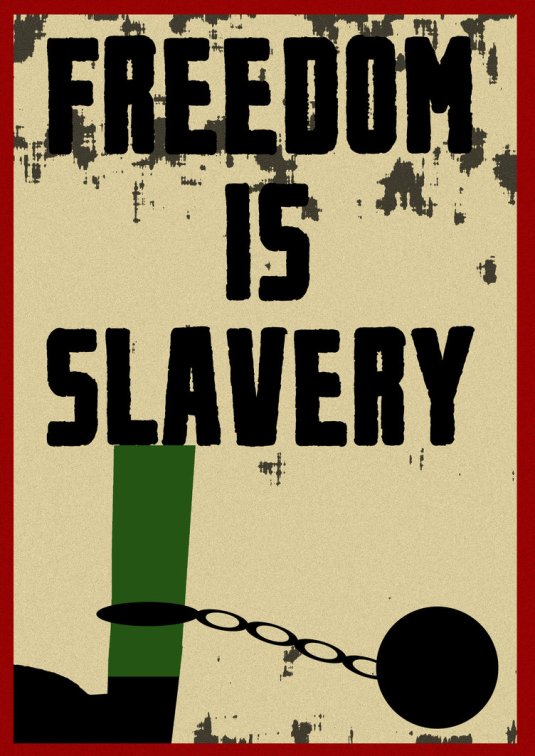
What America May Be Like in the Year 2056

freedom-is-slavery

The following is an imaginary story I wrote back in January of 2017.  I wrote it at the start of the first trump administration.  I was reflecting on what life would be like in about 40 years under a Republican dominated government.  I just happened to come upon this blog again a few days ago.  After rereading it, I was surprised by how many of these things seem to be coming to pass under the “NEW” trump administration.  I have decided to publish it in the original without making ANY changes at all.  Love to hear your comments and what you think.  

———————————————————————————————————

I live in Republicanville USA.  It is a small town of about 1,500 people in the rural Midwest.  Today in my town, all the women are barefoot and pregnant and all the men are stupid and misinformed.  It wasn’t always this way.  Things started to change about 75 years ago, when Ronald Reagan became President.  My town had always been very progressive and liberal but we started hearing more and more about how we were being taken advantage of by the poor, those on government handouts and those too lazy to work.  The Republicans who in our town had always been a minority began to grow in numbers.  The more we heard about welfare cheats and welfare freeloaders and those on drugs taking advantage of us, the more my town embraced a new concept of democracy.  It was more like “every man or woman for themselves” rather than “all for one and one for all.”

obey-jesus-or-perish

Our U.S. democracy which had always prided itself on a separation of church and state seemed to forget the reason for this partition.  Increasingly, a group called Evangelical Fundamentalists became more popular along with their criticism of many progressive institutions.  Republicanville USA moved more and more to the right.  The concept of unbridled capitalism became enshrined as a religion and many people began opposing “big” government and taxes.  The Republican Party preached that the marketplace could provide for all social, physical and economic needs of U.S. citizens.  My town moved even further to the right.

trump-state-of-the-unionThis conservative trend was already well underway when in 2017, a billionaire real-estate developer named Donald Trump became the 45th President of the United States of America.  In addition to the hard core conservative beliefs of many mainstream Republicans, Trump added the once discredited idea of American Isolationism.  We would now put America first, no matter what.  No more negotiations with other nations unless it was clear that we got the better of the deal.  We would build a big wall to keep Mexicans and other immigrants out and we would renege on our trade deals with China and Europe.  About the only country that Trump liked was Russia.   Eventually, he agreed to give Alaska and parts of Canada back to Russia.

Trump came through on his promises to the Evangelicals that he would make America White again and put women back in the bedroom where it would be okay to grab their pussies whenever you wanted to.  Minorities were targeted for deportation and women libbers promoting abortion or equal rights for women were arrested in wholesale sweeps and sent to special detention centers for chronic complainers and protesters.

I would like to describe in somewhat more detail what my town is like now in 2056.  Things are a lot different than when I was born in 2017.  I will divide my discussion of these changes into three areas:  Family, Education and Social Issues.

Family:

another-day-in-paradiseI am 39 years old and have two children.  I have never worked (at least outside of the home) as women have not been allowed to work since 2022 when they passed the “Women in the Home Law” as it was popularly called.  The Federal government passed the law and it was ratified by every state and municipality in the nation.  Some places tried to hold out but the government cut off all funding to them until they capitulated.  This law effectively outlawed women working.  It also barred women from the military.  Ten years later (2032) they passed the “Mandatory Birth Act.”  This bill proscribes that every woman (physically able to) must give birth to at least two children.  Any woman who reaches the age of 32 and still has not given birth to two children is forcibly removed to a National Birthing Center where she will be artificially impregnated and kept confined until she has had at least two healthy children.  Sickly or unhealthy children are sent to Disposal Camps where they are “recycled” per official government propaganda.  No one is quite sure what happens during recycling but the children are never seen again.

Many gay women resisted the Mandatory Birth Act and the National Suicide Rate went up dramatically.  The “Fathers” (as our political leaders are now called) made it very clear that the country would be better off without such deviates.  Since women were no longer allowed in politics, the leaders of the nation decreed that they would all be called “Fathers” instead of being referred to as politicians or legislators as they once were called.

My husband works at a local mill where they make t-shirts for Japan, China, Brazil and some of the more developed t-shirt-workersnations.  Since banning imports of such items, we have created millions of jobs making goods that were once made in low wage countries.  The demand for such goods has skyrocketed but now we are providing them.  Unfortunately, the wages and education needed for such work is still low.  My husband did not finish high school but most men in our town do not.  The Fathers have repeatedly stated that real men don’t need higher education.  (I will talk more about education later.)
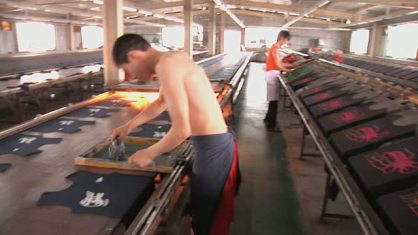
When my husband is not working, he spends most of his time watching football, baseball, basketball, golf or hockey.  I ammen-watching-game not allowed in the living room when his sports are on except to bring in some beer or chips.  This does not really bother me much as I have plenty to do with the kids, housecleaning, cooking and all.  I have my own TV in my sewing room where I can watch any of the approved programs for women.  We have 30 different “Women Only” channels where I can learn more about cooking and cleaning and how to be a good wife. There are some good romances and family drama stories that are occasionally on.  I look forward to watching these when the kids are in bed.

Our two children, Mary and John are 12 and 15 respectively.  Mary is in a finishing school for girls where they are preparing her for being a mom and wife.  She takes subjects such as homemaking, cooking, cleaning and parenting.  She has one more year to go before finishing school.

When Mary turns 14, she will be eligible for marriage.  Her name will be put in a marriage registry.  If she is lucky enough and pretty enough, some up and coming town Father will select her for a wife.  Men who qualify due to income levels are allowed to have up to five wives.

woman-vacuum-cleaning

My son John is not in school any longer and he works part-time.  The Fathers decried that girls did not need schooling after the age of 13.  John hopes to get a job in the t-shirt plant where his dad works when he turns 16.  He quit school because we could not afford a private school for him.  Only the rich kids in town go on to education beyond the 10th grade.  Private schools are very expensive and the Fathers do not believe in funding education any more.  It has been emphasized that education is an elitist program that creates class divisions and makes some people feel more entitled than other people.   Most young men in our town will work in one of the mills or plants.

Education:

anti_public_education_propaganda_by_8manderz8-d5xz1cj

I have already talked about some aspects of our education system today.  Basically, most people do not believe in higher education anymore.  It is only for the rich.  All funds for public education were cut in 2035 when they passed the “Private Education Act”.  Most folks now send their kids to private schools through the 8th grade and then find work for their children after that.  Girls will be shortly married so school is not thought to be that important for them anyway.  They can learn whatever they need to be a good wife on the “At Home Wives Channels.”

students-1920-1950-9_jpeg

Boys from families with lower incomes can opt to go to privately funded vocational schools to learn such trades as t-shirt making, sneaker making, jewelry making, gun repair, taxidermy, and many other skills that might be in demand.  There is still some funding for such programs that is available for lower income families.  All public colleges have been closed now.  As I noted earlier, such schools were decried to be elitist and the Fathers were unanimous in un-funding them.

Boys from wealthier families go to the more prestigious private schools where they will learn such skills as: Leadership, Accounting, Business Development, Entrepreneurship and Medicine.  Law was abolished as a field of study in 2030 with the passage of the “No More Lawyers Act.”  This act basically made lawsuits illegal thus dramatically decreasing the need for lawyers in the U.S.

Courtrooms abolished “adversarial” trial procedures with the “No More Lawyers Act” and replaced the old-fashioned method of two people arguing trials with modern Computerized Forensic Tomography.  Using CFT, a cross section of the case and evidence pro and con is presented to the jurors.  All the available facts and data are reviewed and jurors vote on the verdict.  Trials are much more efficient and there is no need for lawyers.

Anti EducationLibraries are now mostly museums.  With the passage of the “Books Only Lie Bill” in 2038, all funds to public libraries were cut.  The Fathers decried that books did nothing but cause trouble and stir up discontent.  Anything citizens really needed to know could be found on the “Citizens Channels” offered by the government Department of Public Wisdom.  There are over 100 of these channels which are available on public TV.  They are on 24/7 and offer many programs for good citizenship.  Some of the programs are:

  • Disciplining your children
  • How to take proper care of your guns
  • Disciplining your wife
  • Obeying your supervisor
  • Getting along with co-workers
  • Obeying authority
  • Keeping a clean house

Social Issues:

Social issues or problems (as some people thought of them) have been mostly eliminated in our town.  Our Fathers banned minorities in 2040 with the “America for Whites Act.”  Under this act, no immigrants or people of color can live in the same community as White people.  In 2041, they passed the “Christian Only Act” making Christianity the official Religion of the USA.  All other religions were banned along with atheism and agnosticism.  The “Mandatory Religion Act” in 2042 made it a felony crime not to attend a Christian church every Sunday.

In our town, there is only one church now.  It the Fundamental Evangelical Christian Church for Christ.  We have two pastors who are both well versed in Old Testament theology.  They are fond of saying that “Heaven is for the obedient, the disobedient will all go to hell.”  We are taught that Jesus will come again before the end of the century to judge the living and the dead.  The good folks will go to heaven and the bad will burn forever in the flames of hell.

We still have crime in our community but not very much.  It is severely punished with public floggings, beatings and hangings.  Criminals are banished to work rehabilitation camps for hard labor.  Drugs are still a major problem but the new “One Strike Act” passed in 2050 decried that anyone caught with an illegal substance would face a mandatory life sentence at a penal colony somewhere in the South China Sea.
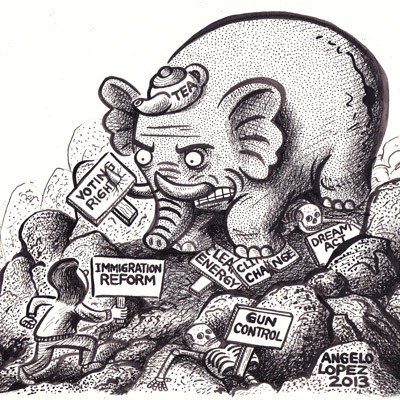
immigration-reform

Gay men still can be found but homosexuality can be punished under the “2045 Purity of Purpose Bill” with mandatory castration.  Boys are encouraged to be manly and any evidence of femininity in our boys is severely dealt with.  Our town brought back “town stocks” a few years ago, to punish any boys or men caught in homosexual activities.  These punishments plus the threat of castration have decreased the rate of homosexuality considerably in our community.

Well, I could tell you a great deal more about life in our town in 2056, but I have cleaning and cooking to do.  Furthermore, if anyone knew I was writing this I would be in big trouble.  Under the “Against Propaganda Law” passed in 2041, no one may criticize the government, any Fathers or any laws without official authorization from the local town council.  I could be publicly flogged or worse for saying these things.  Thus, for now I will just hide this away.  I don’t mean to be either a coward or a complainer.  Our Fathers say this is the Golden Age of America and that we are living in the greatest Christian country in the world.  Who am I to argue?

Time for Questions:

Are you living the good life?  Do you live the life you dreamed of?  Do you think you have a right to your dreams?  Do you think other people also have a right to their dreams?  How much authority do you think a government should have over your dreams?  What kind of dreams do you have for your children?  What do you call progress?

Life is just beginning.

“No one believes more firmly than Comrade Napoleon that all animals are equal.  He would be only too happy to let you make your decisions for yourselves.  But sometimes you might make the wrong decisions, comrades, and then where should we be?”  ― George OrwellAnimal Farm

Virtues, Values, Morals and Ethics:  What are the differences and Who Cares?

The older I get, the more questions concerning virtues, values, morals and ethics concern me.  Like most people, I thought that I learned what these concepts meant through church, parents, school, books, fairy tales and movies.  What I never really learned was: 1. Why are they important?  2. What do they mean for society?  3. Why should we care about the differences?  4. How do they actually play out in real life?  Real life meaning in war, in peace, in times of societal disasters and even in everyday living.  Now with a few years left in my life, I am immensely concerned with the above questions. 

I started reading more about virtues and values and morals and ethics a few years ago and did not make even a slight dent in the literature.  Recently, I looked into YouTube to see what some videos had to say about the same questions I am concerned with.  I found more videos to watch than I could review if I lived 100 more years.  Nevertheless, I spent some time scanning a few of these videos to see what other writers had to say about virtues, values, morals and ethics.  After reviewing these videos, I decided I would just wing it from my own perspective and experience.  In this blog, I will try to answer each of the questions I posed based on my own experiences.  Before we begin, I would like to provide a very simple definition for each concept.  No ChatGPT or Google here.  This is my own simple and probably not very profound definition of each.  

Virtue:  A gift to be earned.  Examples, “Patience, Honesty, Faith”

Value:  Something we think is important or worthwhile.  Examples, “Happiness, Love, Frugality”

Moral:  A principle we want to live by.  Example, “Do unto others etc.”

Ethics:  Principles others think we should live by.  Examples, “Always respect your customers”

 1.  Why are they important?

The simplest but most compelling answer to this question is that they help you to lead a happier, more fulfilling life.  People adhering to these concepts will have character and integrity and be both respected and admired.  They may not make you rich.  They may not make you famous.  But true happiness does not come from fame and fortune.  Here are some quotes that I like on happiness:

“True happiness is not attained through self-gratification, but through fidelity to a worthy purpose.” – Helen Keller

“Happiness is not something ready-made.  It comes from your own actions.” – Dalai Lama

“Happiness is when what you think, what you say, and what you do are in harmony.” – Mahatma Gandhi

“Happiness is a warm puppy.” – Charles M. Schulz

“It is not how much we have, but how much we enjoy, that makes happiness.” – Charles Spurgeon

You might be asking yourself “Well, do we really need to pay attention to each of these concepts?”  Why not just worry about virtues or ethics?  My answer is yes.  We need to pay attention to all four of these concepts because they work together.  Like a car needs a transmission, engine, battery and wheels to get anyplace, you cannot become the person you want to be if you ignore any of these ideas. 

You cannot be virtuous and have shallow values.  You cannot have great values but no ethics.  You cannot have ethics but no morals.  We need to understand and embrace all four of these concepts.  Values and ethics deal more with external influences on our lives while virtues and morals come more from inside us and deal with our own abilities and character.  Can you have good character and embrace “bad” actions?  Can you have “bad” character and pursue good actions?  I think the answer to both these questions is “very unlikely.”  Actions flow out of character and character is developed by actions. 

2.  What do they mean for society?

First let me ask you a few questions and see if your thinking about these questions answers my question above.  Are you happy with the way people drive on the freeways today?  Do you feel that politicians and leaders today really care about you and the country?  Do you think that poverty and homelessness are inevitable or that good leadership could help to amend these problems?  Is a good leader ethical, moral, virtuous and guided by good values?  Do you think the above problems can be taken care of simply by higher incomes and fewer taxes? 

Now, I would ask you to go back to my question number 2 and take a few minutes to think of how you would answer it.  What would it mean for society if everyone practiced good virtues, morals, ethics and values?  Would we have as much unhappiness in society as we seem to have today?  Would our crime rate be high?  Would we constantly be involved in fighting wars in other countries? 

“Virtue does not come from wealth, but wealth, and every other good thing which men have comes from virtue.”  Socrates

“No people can be great who have ceased to be virtuous.”  – Samuel Johnson

A country cannot subsist well without liberty, nor liberty without virtue.”Daniel Webster

The first principle of value that we need to rediscover is this: that all reality hinges on moral foundations.  In other words, that this is a moral universe, and that there are moral laws of the universe just as abiding as the physical laws.  –  Martin Luther King Jr

Once upon a time, I thought that the most important thing I could teach in schools would be critical thinking skills.  However, after having been teaching since 1975 in every class from kindergarten to Ph.D. programs, I have come to believe that the most important thing I can teach is an appreciation of these four concepts.  I have no illusions that I can or should force any particular virtue or values or ethics or morality down anyone’s throat.  I think that while each of these concepts is universal, each person must identify his/her own ideas and beliefs that are most important to them.  I have my list of virtues and morals that I try to live by.  Each day, I start out with a little prayer to remind myself to practice a particular virtue.  Today it was patience.  Tomorrow it will be kindness.  I do an inventory at the end of each day wherein I ask myself “how did I do today on my virtue.” 

As for morals, I have several principles that I try to live by.  I have listed five of my most important moral principles below.  You may have five, ten, fifteen or twenty that you believe in and not one that matches any of mine.  I think that what is important is that each of your principles is a building block for positive character.  A character that other people can admire but even more importantly, a character that you can be proud of. 

  • Do no harm to others
  • Stand up for what I believe
  • Do unto others as they would have done unto them
  • Demonstrate integrity in all I say and do
  • Do not be afraid to do what is right

 3.  Why should we care about the differences between these concepts?

Dr. Deming was famous for his quote that, “Experience without theory teaches nothing.”   I strongly support his axiom.  What it means is that if you keep doing something and it works or perhaps does not work, without an underlying theory of causality, you will never understand what factors or actions have resulted in your success or failure.  Without understanding these factors, it may be difficult to replicate your success but also likely you will not be able to improve on it. 

For instance, what if people seem to shy away from me and dislike me?  Or what if I seem to aggravate people but I cannot figure out why?  Going to school to study psychology or reading “How to Win Friends and Influence People” by Dale Carnegie might be just the theory that you need to better understand yourself and your behavior.  Socrates said, “Know Thyself” and also that, “The Unexamined Life is Not Worth Living.”  Reflection and knowledge can lead to wisdom and wisdom will help you to lead a good life.

I also support the opposite belief, that “Theory without experience teaches nothing.”  You can read all the psychology books you want but unless you act on your theories, you will also learn nothing.  You cannot understand an apple or a steak without biting into it.  We must couple action with theory in our lives, or we risk going through life with a tank ½ full.

4.  How do these concepts play out in real life? 

This is a very challenging question.  I can tell you that in my life I tended to ignore the theory part in favor of experiences.  I learned a great deal through the proverbial trial and error, but my life has been in the past like a rubrics cube that came apart and I could not put it back together again.

I did not understand the relationship between the concepts we are discussing now and how they could and should play a role in my life.  I looked for a better more meaningful life by working harder, making more money and acquiring more diplomas and certificates.  Only in the past few years have I began to understand that without a firm grounding in morality, ethics, values and virtues, I could never live a life that measured up to my goals and aspirations.  These concepts form the bedrock and foundation for a life that exemplifies integrity and character. 

“Despotic power is always accompanied by corruption of morality.” – Lord Acton

“Where the roots of private virtue are diseased, the fruit of public probity cannot but be corrupt” –  Felix Adler

“Moral decline has become a growing concern in many societies around the world.  As the traditional values and principles that guide human behavior weaken, we see a shift in attitudes, actions, and even societal structures.  This decline in ethical standards, often characterized by increasing selfishness, dishonesty, and a lack of accountability, has widespread implications for individual lives, families, communities, and nations.” – Virtuous Magazine, 10-9-24

“Those who conduct themselves with morality, integrity and consistency need not fear the forces of inhumanity and cruelty.” –  Nelson Mandela

Conclusions:

I wrote this blog because as many people have attested to, there is an alarming decline in morality, ethics, values and virtues in our world today.  Many people now subscribe to an opportunistic philosophy which states that “If it is not illegal, than I can do it.”  To these people, it does not matter who they will harm by their actions.  The only things that matter are their own personal wants and desires.  Some people have referred to the present generation as the “entitlement” generation.  Others call our present times a time of Amorality.  Amorality is between immorality and morality, but it does not denote a Golden Mean.  Rather it is more like a zombie state that ignores the negative effects of a lack of morality on society.  It ignores the harm that Amorality does to individuals in any society. 

Opportunism, Amorality and Entitlement have become strong values for many in American society.  In this respect, I see them as “bad” values.  The difference between Good Values and Bad Values might seem to be merely a matter of opinion but I disagree.  I have argued in my previous blog that there are Bad Laws and Good Laws.  So too there are Bad Values and Good Values.  Bad values devalue life, liberty and the pursuit of happiness for private profit and gain.  The opposite is true of Good values.  Good values enhance life, liberty and the pursuit of happiness for the greatest number.  James Madison said that a Democracy is a “Rule of the Majority with a concern for the Minority.”  What we see in America today would seem to be the rule of an Oligarchic Rich Elite exploiting minorities for their own benefit.  Perhaps more emphasis on morals, values, virtues and ethics in the media and press and less emphasis on violence and mayhem could reposition our country.  I think many of us would like to live in a nation that is based on empathy and compassion for all rather than revenge and retribution for those who are more vulnerable, poor or less powerful.

The Diagram that I used in this blog was created by Sudir Vigneshwar.  He has a very good blog on the subject of Morality and Virtue at his website.  I think the diagram depicts in a model what I have been saying in so many words.   Look for 

The Moral Alignment Scale: In Depth Conversations on Morality with an A.I.

Breaking the Law – Is it Ever OK? I Say YES!

Have you ever deliberately broke the law?  Mea Culpa!  Mea Culpa!  I have many times in my life.  I grew up with an aversion to rules and a definite bias towards the idea that “rules were made to be broken.”  Sometimes this has gotten me into trouble but other times it has been something I actually feel proud of.  You see, I do believe that there are stupid and even evil rules and laws.

Lets start with the most obvious as an example of laws that were not only bad but evil.  In respect to slavery there are many such examples.  Let’s take just two that make my point.  The very first concerns the legalization of slavery.  Early slave laws recognizing the practice in the US were written well before the constitution or the US was a nation.  Massachusetts is considered the first colony to recognize slavery as a legal institution in 1641.  Most of the other colonies soon passed laws legalizing the practice.  Once the colonies became a country and formed a constitution many Federal laws were passed to condone slavery, and these were supported by the Supreme Court.  Two such laws that are notorious today are the “Fugitive Slave Act of 1793” and the “Fugitive Slave Act of 1850.”

Who today could support such laws?  Laws that treated individuals of another color as little better than animals.  People (slaves) could be beaten, lashed, chained and bred not to mention worked to death so that some people could profit from their labor.  Would it have been wrong to say that these laws were acts of evil?  Should we obey laws that are clearly evil?

For my second example, we turn to Nazi Germany and its Reign of Terror against the Jewish population of Europe.  Over the centuries there have been many laws passed by European countries demonstrating an overt prejudice against the Jewish population.  However, the Nazis took this prejudice to new levels of persecution and eventually genocide.

The first significant law enacted by Hitler that targeted the Jewish population in Germany was the “Law for the Restoration of the Professional Civil Service” passed on April 7, 1933.  This law was designed to isolate and exclude Jews from participation in public life.  It banned them from holding government jobs or participating in professions such as doctors, teachers, and lawyers.

Much like we are now seeing in the USA today (albeit for a different purpose), there was a progression of laws in Germany to escalate the violence and discrimination against Jews.  The first laws seemed to be ones that people could live with but eventually they led to laws that were so evil that even Hitler was afraid of them being recorded.  I refer to Hitler’s “Final Solution.”  There may not have been any recorded laws, but the facts of the Holocaust and Genocide cannot be denied.  Eichmann claimed at his trial that he was only following orders to expedite in the most efficient manner the extermination of every Jew in Europe and Russia.

Could you live in a country like Germany was in the 1930’s and 40’s? What if we started deporting legal American citizens from the USA to prison camps in South America or Asia?  Would you obey such orders?

When we first came down here to Arizona in 2010, there was a great deal of discrimination directed against legal citizens who were of Mexican or Spanish Heritage.  One infamous law was the Arizona Senate Bill 1070 (SB 1070), enacted in 2010, which included a provision that allowed police to question people about their immigration status if there was “reasonable suspicion” they were in the country unlawfully.  They were obliged to “Show me your Papers” and Mexican American citizens were often profiled and stopped because they “looked” Mexican.  A friend of mine who lives in Tucson and is a musician wrote a song called “Show me Your Papers” which spoofed the law with some very humorous lyrics.

There were other laws passed in Arizona making it a crime to help immigrants coming over the border who might be undocumented.  The problem with these laws is that many immigrants legal and illegal do not speak English.  How in the hell are you going to ask them if they have papers?

One day about ten years ago, I was driving in a rural part of Arizona through the desert when I saw a young man hitchhiking on the side of the road.  I stopped to see where he was going.  I asked him if he needed some water since it was a very hot day.  He nodded his head yes and I gave him a bottle of water.  Down here you are stupid if you do not keep extra water in your car.  He then handed me a piece of paper.  On it was a hand drawn map that showed some directions and a motel at the end of the arrows on the map.  I asked him where he wanted to go.  He simply pointed at the motel.  The name of the motel was on the map, and I knew where it was.

I was on my way home and it was only about three miles from where I lived.  I motioned for him to jump in my car.  He climbed in and off we went with no conversation since it was obvious he did not speak English.  I pulled up to the motel and he got out of my car.  He turned around and in his hand, he held a bunch of fifty-dollar US bills.  He handed one to me.  I shook my head and said, “Gracias but no thank you.”  He smiled, left my car for the motel and we both waved goodbye as I drove off.

Did I break the law?  Was he an “illegal” immigrant?  Should I have just left him on the side of the road in 100 + temperatures?  Should I have driven him to the police department?  Frankly,  I don’t give a damn what the law said back then.  I saw someone who needed help, and I helped him.  Christians are fond of saying “WWJD”, meaning What would Jesus Do?  If you are at all familiar with the parable of the Good Samaritan in the New Testament, you know what Jesus would do.

There are good laws and there are bad laws.  Pope Pius the XII once said that he had no problems with the good friars in Minnesota making illegal whiskey during prohibition because they were not breaking God’s law but only man’s law.  I claim to be no saint nor even a Christian.  However, I do believe that some laws whether backed by the Supreme Court or backed by an Executive who can make no claim on morality or virtue are evil and deserve to be broken or ignored.  One caveat is that you must be willing to suffer the consequences of breaking such laws.  No one may be on your side.  It might be years or decades before attitudes change, and people realize how heinous some laws are.

Conclusions:

  • Only fools and cowards obey laws that are evil.
  • We have a right to dispute laws that are inhumane or that violate long-held principles of morality and ethics.
  • We may be punished for breaking a law but we all must be willing to take risks if we want to build a better world.
  • Don’t break the law simply because it inconveniences you. Only break laws that are not in the common good or that make other people suffer without good cause.
  • Some things are evil no matter what the law says.

If you would like to pursue this issue further, here are two excellent articles by Michael Corthell which I will list below with a hyperlink to them.  

The President Who Breaks the Law and the Court That Lets Him”, July 16, 2025

When the Crowd Booed Back: How Authoritarians Crumble When People Stop Obeying –  July 22, 2025


How Can You Tell Good Poetry from Bad Poetry?

I have to confess that while I love to write, I have never been able to understand  a good deal of poetry much less write any poetry that I thought was very good.  Over dinner the other night, Karen and I were reading from our book of dinner prayers, and we came across a poem that we both thought was awful.  We agreed that in our humble opinions, it was “Bad” poetry.  

It is very difficult to call anything “Bad” poetry.  I have sat through many writing sessions where someone brought in poetry samples, and I thought to myself “Bad” poetry.  When everyone applauded, I of course felt very humbled and guilty.  Perhaps, I am just a barbarian.  A Luddite who really does not understand what good poetry is.  There seem to be what I might call “poetry snubs” who proclaim poetry as the highest art form in literature.  Only morons and the uneducated and unwashed would call anything “Bad” poetry.

However, being the logical person, I think myself to be, it stands to reason that if something can be good than something can be bad.  I decided once again to turn the question over to my favorite muse these days and ask ChatGPT the question:  “How does one tell good poetry from Bad poetry.”  I actually thought that it might reply, “Stupid question John, there is no such thing as “Bad” poetry. Much to my surprise and delight it answered my question with the following replies.  First, here is what ChatGPT said about “ Good” Poetry:

Signs of Good Poetry

  1. Emotional Impact
    • It moves you, surprises you, or makes you feel something new or deeply familiar.
    • It lingers in your mind after reading.
  2. Fresh Language
    • It avoids clichés and uses original images or phrases.
    • Common experiences are made new through metaphor, simile, or unexpected word choices.
  3. Strong Structure or Form
    • Whether free verse or formal (like a sonnet), it has internal rhythm, pacing, and flow.
    • It uses line breaks, stanza shape, or sound devices with purpose, not at random.
  4. Layers of Meaning
    • It offers depth—something you can re-read and interpret in more than one way.
    • There’s often subtext, symbolism, or ambiguity that invites reflection.
  5. Sound and Musicality
    • It reads well aloud: rhythm, alliteration, assonance, and other sonic qualities enhance the meaning.
    • Good poetry doesn’t sound flat or awkward—even free verse has rhythm.
  6. Precision and Economy
    • Every word counts—no filler. Good poets can say more with less.
    • The language is intentional, not just pretty or verbose.

I was very pleased with the above list that I received to my query.  These made a great deal of sense to me.  Not being a total Luddite, there are in fact many poems that I do like.  I then asked ChatGPT to write me a “good” poem about two elderly lovers, one of whom was dying.  Here is the poem that Chat wrote:

“Still, You Hold My Hand”

We do not walk as quickly now,
our steps are slow, but still in tune—
two shadows stretching side by side
beneath the silver hush of moon.

The clock has softened all our lines,
our hair grown thin, our fingers bent,
but what we’ve lost in strength or speed
we’ve found again in time well spent.

You lie here now, your breath a thread,
the light behind your eyes grown dim.
I hold your hand, recall the days
when we would go on every whim.

Do you remember, love, the spring—
the daffodils, the borrowed car?
We chased the sun across the hills
and kissed beneath a falling star.

Your voice was once an angelic bell
that called me in from any spree.
Even now, though faint and frail,
its echo still brings peace to me.

I talk, though I don’t know you hear;
you smile at things I cannot see.
But when our fingers intertwine,
I feel you’re still right here with me.

So rest, my love. I’ll hold your hand
until the last small breath is through.
And if there’s more beyond this veil,
I’ll walk there slowly… back to you.

I made a few changes to the above poem, but otherwise I thought it was very good.  Now, we come to the part about “Bad” poetry.  The following are characteristics are what ChatGPT said were Signs of “Bad” Poetry.

⚠️ Signs of Bad Poetry

  1. Clichés and Predictability
    • Uses worn-out phrases like “my heart is broken,” “the stars above,” “a love like a rose,” etc.
    • You know how it ends after the first few lines.
  2. Flat or Forced Rhyme
    • Rhymes are predictable or awkward, sacrificing meaning for the sake of sound.
    • It reads like a greeting card instead of a crafted work.
  3. Vague or General Language
    • Lacks vivid imagery or specific detail.
    • Talks about feelings without showing them through actions or concrete images.
  4. Lack of Rhythm or Flow
    • Feels choppy or randomly broken up.
    • The poem’s form doesn’t add anything to the message.
  5. Overuse of Adjectives or Adverbs
    • Tries too hard to sound poetic without real substance.
    • “The extremely beautiful shining golden sun rose splendidly” = cluttered.

I asked ChatGPT to give me an example of “Bad” poetry based on the following idea.  A man who would be king.  Can you imagine who I might have had in mind?  Here is the “Bad” poem that Chat wrote.  I think she did a good job of describing “he who shall remain nameless.”

“Absolutely.  Here’s a deliberately bad poem—complete with clunky rhyme, mixed metaphors, awkward phrasing, forced rhythm, and shallow content.  It’s meant to be humorous in how poorly it’s constructed:”

“The Man Who Would Be King (Someday Maybe)”

He woke up late, ate moldy bread,
Put a chicken hat upon his head.
Declared aloud with mighty tone,
“I think I’ll sit upon the throne!”

His suit was blue, his tie was red,
He dreamed of ruling folks in bed.
“I’ll ride a cow into the war!”
(He’d never left for war before.)

The people laughed and called him Blob,
He called himself “King Corn-on-the-Cob.”
He made a sword out of old ham,
And practiced battle on a clam.

“I shall be feared from east to west!”
He yelled while pounding on his chest.
But tripped and fell into a bush—
A squirrel proclaimed, “You royal tush!”

His kingdom vast, inside his head,
With loyal troops (all made of bread).
He ruled his yard, his fans approved,
Until the cat said, “You’re removed.”

Considering the subject matter, I actually liked this “Bad” poem.  I thought it fit “you know who” very well.  So let me finish with Chat’s “Tips to Evaluate a Poem.”  I  hope all you poetry lovers out there have found something useful in my blog this week. 

👂 Tips to Evaluate a Poem

  • Read it aloud – Does it flow? Does the sound match the subject?
  • Ask what it’s really about – Is there a deeper idea or emotion?
  • Notice what’s not said – Good poems leave room for you to think or feel.
  • Try rewriting it – If you can improve it easily, it probably needs work.
  • Test time – Does it still move you after reading it twice, or a week later?

What Would Thomas Jefferson, Samuel Adams and Thomas Paine Say if They Were Alive Today?  Opinions Expressed by ChatGPT!


I often wake up at night pondering the imponderable.  A few nights ago, I woke up wondering what my favorite Founding Father would think about things today if he were alive.  I refer to Thomas Jefferson who despite much of his hypocrisy, I still admire very much for his intellectual foundations of democracy.  Thus, I got out of bed and decided to see what ChatGPT would think about this question.  While I was at it, I included queries for Samuel Adams and Thomas Paine whom I also admire very much.  I put the following query to ChatGPT.

In 500 words or less, what would Thomas Jefferson have to say about the present state of politics in America today?

If Thomas Jefferson were to assess the present state of American politics, he would likely express both deep concern and guarded hope. As a champion of liberty, limited government, and the diffusion of power, Jefferson might be alarmed by the hyper-partisanship, concentration of wealth and influence, and erosion of civic virtue that marks much of today’s political climate.

Jefferson valued the free press and an informed citizenry as bulwarks against tyranny, but he would likely be troubled by the rise of misinformation and the deep polarization stoked by media echo chambers. He warned that a republic could only survive if its people were educated and vigilant. Seeing voter apathy, low civic trust, and widespread political cynicism, he might fear that the American experiment was straying from its foundational ideals.

He would likely criticize the influence of large corporations and special interests on lawmakers, calling it a form of “elective despotism” — where private power manipulates public policy. Jefferson was wary of centralized banking and would probably see today’s economic inequality as a threat to republican balance and self-rule.

On the other hand, Jefferson would also recognize the enduring strength of constitutional institutions, the resilience of democratic dissent, and the diversity of political participation as hopeful signs. He believed in the capacity for peaceful revolution and renewal. The activism of young people, the vibrancy of civil society, and ongoing debates about rights and justice might stir his belief that the republic can still be revitalized.

Ultimately, Jefferson would urge Americans to remember that liberty requires effort — that every generation must “refresh the tree of liberty” not with violence, but with active engagement, moral courage, and public service. He would remind citizens that they are not subjects but sovereigns, and that the preservation of democracy depends not on leaders alone, but on the people themselves.


In 500 words or less, what would Thomas Paine have to say about the present state of politics in America today?

If Thomas Paine were alive to witness the present state of American politics, his response would likely be fiery, uncompromising, and full of both indignation and inspiration. As the passionate voice behind Common Sense and The Rights of Man, Paine championed radical democracy, social justice, and the power of ordinary people to overthrow corrupt systems. He would likely view today’s political climate as a betrayal of the revolutionary ideals he once fought for.

Paine would be outraged by the degree of economic inequality and political influence held by the wealthy elite. He warned in his time about the dangers of monarchy and aristocracy—today, he might argue that America faces a modern version: oligarchy. The dominance of corporate money in elections and policymaking would, in his eyes, amount to tyranny in a new form.

He would be sharply critical of political parties that prioritize power over principle and create divisions that distract from the common good. Paine believed that government should serve the people, not entrench the power of a few. He would condemn the partisan gridlock, deliberate misinformation, and what he might see as cowardice among leaders unwilling to stand up for justice and truth.

Yet, Paine would not despair. He believed deeply in the ability of people to rise, to demand reform, and to create a more just society. He would likely praise movements for racial justice, labor rights, climate action, and economic fairness as modern heirs to the revolutionary spirit. He would call on Americans to shake off apathy, to recognize their power, and to demand a government that works for all, not just the privileged few.

In Paine’s words: “We have it in our power to begin the world over again.” He would challenge today’s citizens to do exactly that.

In 500 words or less, what would Samuel Adams have to say about the present state of politics in America today?

Samuel Adams, the fiery patriot and master organizer behind the American Revolution, would likely view the present state of American politics with a mix of alarm and rallying fervor. As someone who believed that liberty must be constantly defended against corruption, tyranny, and apathy, Adams would be deeply concerned by the erosion of civic trust, the rise of special interest power, and the complacency of citizens in the face of growing dysfunction.

Adams saw government as a sacred trust, meant to reflect the will and virtue of the people. Today, he would likely condemn the influence of money in politics as a betrayal of republican principles, calling out lobbyists, corporate donors, and elected officials who prioritize personal or partisan gain over the common good. He would regard political leaders who manipulate public opinion with lies or fear as dangerous enemies of liberty.

He’d also take issue with the widespread civic disengagement and low voter turnout. Adams believed that public virtue—active, informed participation in the republic—was the cornerstone of freedom. He would likely warn Americans that rights not actively defended are rights easily lost, and that freedom requires both vigilance and sacrifice.

Yet, ever the agitator for liberty, Adams would not retreat into pessimism. He would find hope in grassroots activism, community organizing, and movements that hold the powerful accountable. He would see in these efforts the spirit of the Sons of Liberty reborn.

Adams might close his remarks with a challenge: “If ever a time should come, when vain and aspiring men shall possess the highest seats in Government, our country will stand in need of its experienced patriots to prevent its ruin.” That time, he would say, is now. And he would call on Americans to rise—peacefully but boldly—to restore the republic.

___________________________________________________________________________________________________________

I was very impressed by the above observations.  They mirror what I thought each of these great men would have said.  However, as I lean towards pessimism and given the present state of America, I tend to be very pessimistic, I would have totally overlooked some of the positive attitudes that each of these men expressed as well as some of the optimism they spoke of.  I am very grateful to ChatGPT and Thomas Jefferson, Thomas Paine and Samuel Adams for their ideas.  I only wish I could share these thoughts with all Americans today.

Is there any possibility, these ideas would make any difference to at least some of the followers of our erstwhile King and Dictator? 

To Be Bold or Not to Be Bold? – Part 1

With the passage of trump’s “Big Beautiful Bill” it would appear that the Democrats have been handed a major defeat.  A defeat that will go down in history as something that they have earned by their timidity and wimpy responses to the growing menace of fascism in America.  Had they been bolder over the years, they could have cut this menace off at the proverbial knees.  But while the Republican Party became the Party of Greed, the Democratic Party became the Party of Wimps.  What value would Boldness have had for the Democrats?  In Part 1 of my blog, I want to relate what ChatGPT says about the value of Boldness.  In Part 2, I am going to lay out some of my own strategies for what Boldness might entail as we must still confront the goals of trump to destroy democracy in America.  Make no mistake, trump and his supporters have no more affinity for Democracy than Brutus had for Caesar.

I started ChatGPT off with the question:  Is it true that “Fortune Favors the Bold” or that “Success is the Child of Audacity?”  These are two aphorisms that have been around for ages.

ChatGPT:

Great question — both “Fortune favors the bold” (from Latin Fortes fortuna adiuvat) and “Success is the child of audacity” reflect a deep truth about human psychology, society, and even evolution.

Here’s why these ideas seem to hold up in life:

  1. Bold Actions Break Stagnation

Most people are cautious by nature. Those who take bold steps — start businesses, lead movements, speak up, try something unconventional — stand out. And standing out is often a prerequisite for success in a crowded world.

Boldness disrupts inertia. It pushes things into motion that otherwise never would have moved.

  1. Risk Is Tied to Reward

Success usually carries risk: social, financial, emotional, or reputational. Those who are bold enough to accept those risks have access to greater potential rewards. Many never try, so those who do are ahead simply by taking the shot.

  1. Confidence Is Attractive and Contagious

Bold people inspire confidence — in investors, partners, followers, or even random bystanders. Audacity, when not reckless, signals that someone believes deeply in their cause, and others often want to follow or support that.

  1. Failure Is a Learning Loop

The bold fail more — but also learn more. They get feedback the timid never receive. Over time, this trial-and-error process builds resilience, insight, and eventually success.

“The timid die a thousand deaths, the bold only once.”

  1. History Favors the Story of the Bold

Think of who history remembers: explorers, revolutionaries, inventors, artists — often people who defied norms and dared big things. Their boldness makes a compelling narrative. Even when the odds were against them, their courage became legend.

  1. Boldness Taps Into Serendipity

Bold moves often place people in the path of opportunity. Taking initiative creates collisions with luck — new people, ideas, or events that can’t be predicted or planned.

In Short:

Boldness is the gateway to uncommon results.
Not because it’s always right — but because it’s often the only way to reach what’s rare and meaningful.

ChatGPT

Would you like examples from history, psychology, or even nature to see how this principle plays out?

YES

Great — let’s walk through examples from history, psychology, and nature that show how boldness and audacity lead to success, or at least open the door to it in ways caution rarely does:

🏛️ History: The Bold Are Remembered

  1. Alexander the Great
  • At age 20, he became king. Instead of consolidating power cautiously, he launched a bold campaign and conquered most of the known world.
  • His military strategies were risky — but successful — and his name still echoes 2,000 years later.
  1. Rosa Parks
  • Her refusal to give up a bus seat wasn’t the first act of civil disobedience — but it was bold, direct, and visible.
  • That audacity became the spark that lit the Montgomery Bus Boycott and the larger civil rights movement.
  1. Elon Musk
  • Whether one admires or criticizes him, Musk’s career is a case study in boldness: betting his PayPal fortune on rockets, electric cars, and AI.
  • Many experts predicted his failure. But his audacity forced entire industries to evolve.

🧠 Psychology: Why Boldness Works

  1. The “Approach Motivation” Advantage
  • Bold individuals are wired to approach opportunity rather than avoid risk. Psychologists call this “behavioral activation.”
  • This mindset triggers more action, more experimentation, and more eventual wins.
  1. The Halo Effect
  • People attribute competence and strength to those who act confidently and decisively — even if they’re not always right.
  • That perception can open doors that might otherwise remain closed.
  1. The Spotlight Effect
  • We often overestimate how much others notice our failures.
  • Bold people tend to care less about being judged, and this emotional freedom lets them act while others hesitate.

🌱 Nature: Evolution Favors the Daring

  1. Peacocks and Risky Traits
  • A peacock’s tail is wildly impractical. But it’s bold — and signals genetic strength to peahens.
  • Nature sometimes rewards the flashy and the fearless, even if it comes with risks.
  1. Predator-Prey Dynamics
  • In a pack of prey, the ones that break from the herd occasionally find a faster escape route.
  • While riskier, this behavior sometimes allows survival where conformity means death.
  1. Mutation and Evolution
  • Every major evolutionary breakthrough came from a “mistake” — a mutation that took a leap from the ordinary.
  • Boldness, in this sense, is biological experimentation — and essential to progress.

🧭 Summary

Realm Example Boldness Led To…
History Rosa Parks, Alexander, Musk Movements, empires, industries
Psychology Confidence bias, approach motivation Influence, momentum, resilience
Nature Peacocks, predators, mutations Survival, reproduction, evolution

As you can see from the above analysis, there is more than a little truth to the trope that “Fortune Favors the Bold.”  There is not much I can add to these thoughts except to wonder what it will take to instill the boldness in the actions that we will need as we move forward with trumps presumed tenure in office.  I say presumed because I believe he will do everything he can in the next three and ½ years to further gut the powers of Congress and the courts.  His ultimate goal will be to install himself as “President for Life.”  An American version of Stalin, Hitler and Mussolini.

What does the 4th of July really mean?

Happy Family Standing On The Hill And Watching The Fireworks

happy family standing on the hill and watching the fireworks

Happy 4th of July! The 1st of July is the 182nd day of the year. As you watch the fireworks tonight, consider that today is now the 185th day of the year. This probably will make little or no difference to your enjoyment of the display you go to see.  Each year, the fireworks displays seem to be longer and more spectacular.  The loud explosions, dazzling sparkles and bright flashes of color contrasting with the grey smoke really bring home to me the vision that drove Francis Scott Key to write the “Star Spangled Banner.”

O! Say can you see by the dawn’s early light,
What so proudly we hailed at the twilight’s last gleaming,
Whose broad stripes and bright stars through the perilous fight,
O’er the ramparts we watched, were so gallantly streaming?
And the rockets’ red glare, the bombs bursting in air,
Gave proof through the night that our flag was still there;
O! say does that star-spangled banner yet wave,
O’er the land of the free and the home of the brave?

The American Flag, the 4th of July, the Declaration of Independence and the “Bombs” too many of our soldiers have seen are more than just images of a unique US Brand.  They are more than just symbols of our heritage. They are down payments on a legacy that is part of our fundamental American dream.  Our Forefathers created a system of government that was based on the belief that all men (and eventually this included women and African Americans) were entitled to life, liberty and the pursuit of happiness.  This was the most positive, uplifting and life affirming message the world had ever known.  It became the great American experiment.  The only other country to ever come close to America in creating an entirely new life affirming belief system for its citizens was Greece.  The Greek experiment failed to continue but its message helped to form a foundation for every other experiment in democracy the world over.

There are those who argue that the “ascendancy” of the American experiment is over.  It is opined that just like Rome, France, Great Britain and many other empires, America is on the downside of its greatness.  China, India, Japan and Brazil are noted as possible successors. Perhaps from a military or economic view this will be true.  But taken from the perspective of the belief system that under-girds America, there are no countries that are even close.  We do not always practice what we preach.  Moreover, in many areas of life, we seem to have lost our way.  Our politicians are often guided more by party politics than by what is good for the American people or the world.  Today our nation seems fractured into two countries.  One is red.  The other is blue.  It is questionable whether they can ever be reunited into a common nation.

As you enjoy your barbecue, your picnics and your fireworks today, rest assured, the core of the American experiment, the dream and ideals that has brought and continues to bring millions of immigrants to the shores of America will ring forever through the halls of history.  The world will never forget that someday and in some place called America, there was once a people who lived, worked, fought and died for the belief that “we”, the people, including the rich, the poor and all minorities have a set of inalienable rights.  These American values have become values the world over.  It matters little whether the USA is still true to them.  Democracy may be under siege in many nations but there are still millions of people who live under a democracy today and millions more who yearn for the Democratic values espoused by our Founding Fathers.

America became a great nation because we once practiced and believed in this message for all people.  We remain a nation that is great in spirit and great in heart though many of us appear to have lost our way.  If we can find the ability to care more about others than we do about ourselves, our nation can still be a spiritual and moral beacon to the oppressed and downtrodden of the world.  Greatness cannot be measured in economic and monetary terms.  We must measure the greatness of a people by the greatness of their vision.  By that standard, America is the greatest nation that has ever existed.  If only we can find that vision again.

Time for Questions: 

Do you believe in the American Vision?  Do you believe it is for all people, or just for Americans?  When was the last time you actually read the Declaration of Independence?  Do you know the difference between Patriotism and Jingoism?

Life is just beginning.

The advancement and diffusion of knowledge is the only guardian of true liberty.”
James Madison

The Hypocrisy of Paywalls and Political Campaign Contributions

If you are reading this blog, you will note two aspects of my blog that might be salient.  They will only be evident if you look closely.  First, there is no Paywall.  I charge nothing for my ideas.  Indeed, I encourage you to repost or use my ideas in any way that you think will help others.  Second, there are no advertisements.  I take no money from anyone.  I am beholden to no companies or corporations for endorsements or financial remuneration.  If anyone does not like what I say, that is their problem.  I am free and unencumbered to say it and you are free and unencumbered to read it.  No sixty second sound bites from anyone before you can plow ahead.  The only thing standing between you and my blog are the bits and bytes of your computer and the speed of your Internet provider.

I point the above out because it seems that what is obvious to me is not obvious to others.  Most of us know that the USA and its government is seriously broken.  It is dysfunctional, immoral and often now illegal and unconstitutional.  What is the biggest reason for this?  Simple.  Money and greed and the power that money begets.  Ergo, if money is as they say, “The Root of All Evil,” than how can asking for more money fix the problem.  Imagine if there were a fire burning in your house and you tried to put it out by throwing money on it?  Well, that is what too many people are trying to do. 

Many bloggers are now asking for money before you can read their blogs.  How do they think this will make the world a better place to live?  “Just give me money and I will share my wonderful ideas with you.”  In other words, I am no different than the other greedy people who would sell their souls for a few dollars.  I will sell my soul for a few bucks that I might make on Substack or some other place that allows Paywalls and advertisements.

If you think advertisements are benign and harmless, you are delusional.  Madison Avenue and the corporate advertising machine are the number one brainwashers in America.  They are the primary reason that people keep spending and spending.  Madison Avenue exists to convince you that you are inadequate and that if you only buy product X, it will make you feel better and bestow happiness on your life.  Than, you only have to keep buying more to stay happy.  Think of the junk that you see every day trying to be sold to suckers to make their lives better.  Not a prophet in history preached that you can have a better life by having more things.  If you support advertising, you support this evil concept.  The foundation of this concept is Greed that pervades Corporate America. 

Next we have politicians whose every message ends with “SEND MONEY” or “DONATE TO MY CAMPAIGN.”  I cannot think of a campaign or revolution in history from Alexander the Great, Julius Caesar, Napoleon or Lenin to Toussaint Louverture or Simon Bolivar or Gandhi or Martin Luther King, where they sent out advertising brochures or flyers asking for money.  They might have solicited soldiers or workers but people not money were their primary objectives.  You of course can argue that some of these individuals had the power and resources of the state to fund their campaigns.  I concede that this is true.  However, it is equally true that without people, their campaigns and revolutions would have failed. 

I see too many politicians who seem to believe that if they can only get enough money, they will then be able to buy enough advertising to convince you to vote for them.  Nothing could be more stupid.  Harris spent nearly a ¼ billion dollars more than trump during the last election and obviously lost.  All of her money did her no good.  Nor did her celebrity endorsements.  The day after the elections, the DNC asked for more money to defeat trump’s policies.  [By the way, the CEO of ActBlue, the major fundraiser for the Democrats has a gross salary of approximately $500,000 dollars a year and many of the senior executives of this organization make well over $100,000 dollars a year.  This should dispel any notion you have that fundraisers for the Democrats are benevolent donors of their time and energy.] 

The other point about advertising’s power to convince anyone to vote concerns the voters themselves.  How many trump supporters do you think changed their mind because they listened to or watched a Harris ad?  How many Harris supporters do you think changed their mind because they watched a trump ad?  And what of the thirty-three percent of the people who did not vote?  A percentage that has remained roughly the same since the first voting in this country for George Washington.  Nearly every election a third of Americans DO NOT vote.  How many of these non-voters do you think changed their mind to vote for either Harris or trump because of some cute and slick campaign ad?  Madison Avenue is laughing their asses off every time an election comes around because they are the real winners.  As the famous pianist Liberace once said, “I am laughing my way all the way to the bank.” 

Einstein once made the following two profound statements, “We cannot solve our problems with the same level of thinking we used when we created them” and “Insanity is doing the same thing over and over again and expecting different results.”  We are insane if we think that we are going to change a system based on greed and money by simply donating more money to fund this system.  What could be more preposterous than this idea?

Let me tell you a little story that I experienced in the 2024 election.  A friend of ours from church decided to run for state representative.  I believe that she supported many if not most of the same policies that I do.  However, I told her as well as others that I knew that I was no longer donating money to any campaigns.  We discussed some ideas at church one day and she was very pro-education, and she thought that we needed to do some things differently.  I gave her my personal card and said that I would be happy to discuss some of my ideas on education.  Ideas that come from teaching for over fifty years now.  A short time later,  she sent me a notice that she was hosting a campaign fund raiser.  I was somewhat surprised since I thought I made it clear that I would not donate money to anyone for a campaign effort.  I was also perplexed since I believed in her ideas, and I admired her personally.  Nevertheless, I decided to stick with my convictions about money.  Instead, I sent her an email saying that “I would not make campaign donations, but I would help her with phone calls, signs or going door to door.” 

Weeks went by.  She never called to set up a time to talk to me about my theories of changing education nor did she ever call to ask me to help physically in any way with her campaign.  Come the election, she lost to her opposition by a 56 to 44 margin.  Would my help have made any difference, or would my money have made any difference?  I have no way of knowing.

During the last election, being a guest on Podcasts has emerged as a new political tool and strategy.  Judging by the election results, it might be a better strategy than the money wasted on advertising.  Some data concerning the visibility that trump gained versus Harris gained on podcasts are as follows:

Trump’s Appearances/Mentions: Trump has been mentioned in or appeared on a significantly larger number of podcasts, with nearly 70,000 instances, according to Brookings, citing Ivy, a podcast discovery service.

Harris’s Appearances/Mentions: Kamala Harris has been mentioned in or appeared on a little over 12,000 podcasts.

This data suggests that while Trump had more individual podcast appearances, he also received substantially more mentions or coverage across a wider range of podcasts compared to Harris.

A friend of mine recently called me up to tell me that I should watch Pete Buttigieg on a Podcast called Flagrant with a guy named Andrew Schulz.  Four other young males of various ethnicities all casually dressed flanked Shultz and Buttigieg as they engaged in a casual banter about life and politics.  

This podcast and others of the same ilk have nothing in common with the traditional sit-down interviews that politicians used to have on shows such as Face the Nation and 60 minutes.  Podcasts like Flagrant are like sitting in your buddies living room or Arizona Room and slurping a beer while casually discussing the latest news.  Not a woman was present in the room with Buttigieg and Schulz.  A more or less macho image pervaded the discussions.  It seem macho has become the new norm in politics today.  Women can stay in the kitchen while the men hide out in their man caves and solve the problems of the world. 

My friend had asked me what I thought of Buttigieg?  I wondered if Pete attending all the macho podcasts was a strategy to set him up for the next election cycle.  I have a strong belief  that is what his advisors are endorsing.  Perhaps this is being pragmatic and simply making maxim use of the new media.  Or perhaps it is targeting the same demographic that trump targeted so successfully.  I queried ChatGPT to get the results on trump’s election demographics.  They were as follows:

| White voters (overall) | ~80–82% | Largest core group |

| White evangelical Protestants | ~82% (South); 43% of R base | Bedrock core |

| Latino voters | 46–48% | Historically high support |

| Latino men | ~54–55% | Key swing within Latino support |

| Asian Americans | ~40% | +10-point gain since 2020 |

| Black voters | ~15% (esp. young men) | Doubled since 2020 |

| Young men | ~55–56% | Social media & influencer effect |

A reasonable estimate for men aged 25–45 is around 50–52% of Trump voters.  This is a majority of his voting demographic.  Watch some of the podcasts like Joe Rogan and Flagrant and you tell me what demographic you think they are appealing to.  Rogan averages 11 million views on Spotify and Flagrant (numbers are not public) is estimated to be in the millions with specific episodes passing ten million viewers.  With these numbers and the type of audience watching, millions of dollars on traditional advertising is a waste of time and money. 

Conclusions:

  • If you want change in this country, do not send another dime to a politician.
  • If you must fund any politician, look at how many PACs they subscribe to or how many lobbyists they get funding from. Stay away from any with PACs hiding under aliases like Patriots for Freedom or Americans for Liberty.
  • Donate your time and talent to anyone running for public office before you donate any money.
  • Encourage your choice for office to get out there and talk to people. Consider people for office who can really relate to the people who are going to elect them.  Any lawyer that went to a private high school and then graduated Summa Cum Laude from Harvard and never served a day in the military or put in an honest days work is not likely to know the problems of the common people. 
  • Think before you send any money to anyone. What are they going to use your money for? 
  • If you have a printing press in your house or a tree that grows money, than by all means, send all the money you want. While you are at it, could you send me a few thousand dollars? 

P.S. 

Before I could even get this blog up, I get an email from the new “Hero” of the Democratic Party telling me the following and three times asking for donations in the same email.

“We will need to run the largest and most effective campaign in history for the next five months to win the general election. The same billionaires whose money could not stop us before, are throwing everything they have to crush us. And the reality is that they are going to go after any candidate in any part of the country who dares to champion working people.”

“What we will achieve together sends a message across America — and throughout the world.

The people can topple political dynasties. The people can build coalitions. The people can win.

So join our movement and lets bring forward a new generation of leadership.

In solidarity,”

Zohran Mamdani

Donate »

Donate »