by Dr. John Persico Jr, October 27th, 2026
No doubt if you have been to any weddings, you have heard the following verse:
“Love is patient, love is kind. It does not envy, it does not boast, it is not proud. It does not dishonor others, it is not self-seeking, it is not easily angered, it keeps no record of wrongs. Love does not delight in evil but rejoices with the truth. It always protects, always trusts, always hopes, always perseveres.” – 1 Corinthians 13:4-7 NIV
To which I say bullshit. That’s right BULLSHIT! You show me one marriage that is anything close to this and I will write you into my will. Only in some la-la land that does not exist in our universe is love anything close to this definition.
Now, I could go with my skepticism, and I would say, “Love is really lust in disguise.” I have seen dozens if not hundreds of women that I FELL in love with on first sight. How do you fall in love with someone that you have never met and know nothing about? Easy, but I don’t want to get pornographic, so I won’t discuss the details here.
However, I have another view on what love really is and what love really means. This description does not come from skepticism or optimism. It comes from seeing life through my lens of 80 years on this earth.
My three word description – Love is sacrifice
Love is giving up things that may cost you much in life. Jesus said that “Greater love hath no man than this, that a man lay down his life for his friends.” — John 15:13
- Love means doing things you do not want to do
- Love means going places you do not want to go
- Love means putting up with people you do not like
- Love means taking responsibilities you do not want
- Love means forgetting as well as forgiving
- Love means TRYING to be kinder
- Love means TRYING to be more patient
- Love means TRYING to be more compassionate
As we grow older and our relationships with others change, so too will the roles that we can play with them change. Once upon a time, love meant having fun with my spouse. Going out to a nice dinner. Going to new places to visit.
Today, we spend more time going to doctor’s appointments. More time taking care of each other. My responsibilities in my relationship with Karen continue to grow despite my efforts to avoid any added responsibilities.
I wrote a blog a while ago about the differences between rights and responsibilities. Everyone demands their rights but few if any demand their responsibilities. Why is this so?
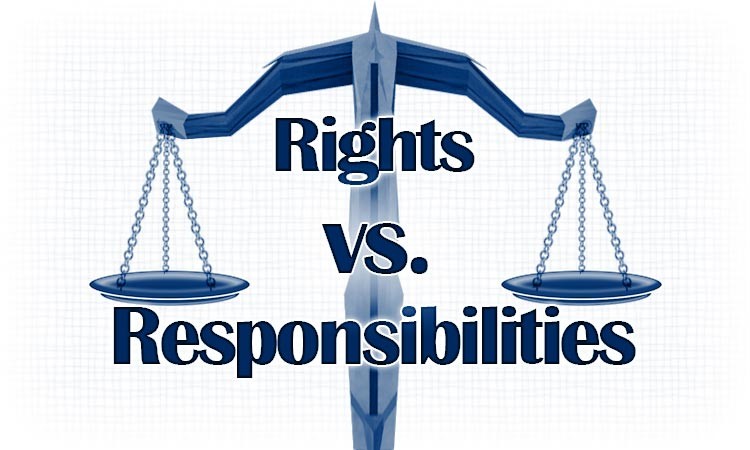
The answer is clear. Rights are a gift. You get rights seemingly free of charge. The illusion of those demanding their rights is that there is no cost. And of course everyone loves a freebie. The reality as I said is quite the opposite. For every right, there is a responsibility. The responsibility is the cost that you pay for your right.
Responsibilities mean work. Work is how we pay for what we get. There are no free lunches on this planet. None exist except in the minds of fools who think they deserve a free ride. We seem to be inundated, indeed swamped and drowning today in such fools.
I want my rights!. I want my rights!
Let me diverge a bit to explore with you what some of the great teachers and prophets had to say about rights and responsibilities. We will return to the subject of Love after this brief detour.
Jesus on Rights and Responsibilities:
Rather than demanding or protecting personal rights, Jesus repeatedly commanded his disciples to yield them for a higher spiritual purpose.
The Two Greatest Commandments: Jesus condensed all religious and ethical duties into two absolute responsibilities: loving God completely and loving one’s neighbor as oneself (Matthew 22:36-40).
Social and Communal Duties: He placed a heavy emphasis on caring for the marginalized, poor, sick, and imprisoned. He explicitly states that a person’s ultimate judgment is tied to how well they fulfilled their responsibility to the “least of these” (Matthew 25:40)
Bahá’u’lláh on Rights and Responsibilities:
Bahá’u’lláh, the founder of the Bahá’í Faith, directly addressed both rights and responsibilities, weaving them into a single, interdependent framework for global civilization. Writing in the 19th century, his teachings heavily anticipated modern concepts of universal human rights.
However, Bahá’u’lláh did not view rights as independent demands. In the Bahá’í framework, an individual’s rights are guaranteed only by the collective responsibility of humanity to uphold justice and unity. — https://bahaiteachings.org/bahai-principles-human-rights-for-all/
Rabbi Jonathan Sacks on Rights and Responsibilities:
The late Chief Rabbi Lord Jonathan Sacks wrote extensively on how the modern obsession with individual rights, divorced from communal duties, fractures society. In his philosophy, he championed what he called Radical Responsibility.
“Judaism is a religion of holy responsibility… It is God’s call to human responsibility.”
Rabbi Sacks argued that the ancient Greek and Western traditions are built on rights, while the Hebrew Bible is built on covenants and duties. He noted that a society focused entirely on “what I am owed” creates a culture of blame and victimhood. True human freedom and the protection of minority rights, he argued, only survive when individuals step up and say, “I am responsible.” —- https://rabbisacks.org/videos/rabbi-sacks-on-a-responsible-life-example/
Muhammad on Rights and Responsibilities:
Prophet Muhammad framed rights as sacred entitlements guaranteed entirely by our strict, divine responsibilities to God and humanity. His teachings demand absolute personal accountability across all social classes, fiercely binding individuals to structural obligations like protecting minorities, caring for the marginalized, and paying workers instantly.
In this divine framework, the rights of the vulnerable are only secured when believers actively fulfill their radical responsibilities, knowing they will answer directly to God for any failure to act. — From ChatGPT
Buddha on Rights and Responsibilities:
The Buddha did not speak in terms of personal “rights,” but built his entire ethical system around universal responsibilities, karma, and reciprocal duties (Dharma). In ancient India, the concept of legal entitlements did not exist. Instead, the Buddha taught that true freedom, peace, and harmony are achieved not by claiming what the world owes you, but by mastering your responsibility over your own mind and actions. — https://www.buddhistdoor.net/features/a-buddhist-understanding-of-the-dharma-and-human-rights/
Lord Krishna (The Bhagavad Gita) on Rights and Responsibilities:
The Teaching: Krishna introduces the concept of Svadharma—the specific, inescapable moral duty of an individual based on their unique position, life stage, and circumstances in society.
Focus on Responsibility: Krishna famously states: “You have a right to perform your prescribed duty, but you are not entitled to the fruits of your actions” (Gita 2:47). He teaches that human beings have zero control over outcomes or what the world owes them; our sole, supreme responsibility is to execute our moral duties with total detachment from personal gain. — https://en.wikipedia.org/wiki/Dharma
The responsibilities we have towards others is not easy to conduct. I am imagining a wedding ceremony where the participants take vows of responsibility to each other. The idea of “Love, honor and obey” does not say much that is practical. Here is my take on a:
Vows of Responsibilities
Today, I choose you as my partner, and I accept my responsibility for the marriage we begin together.
- I promise to consider how my words, my actions, and my decisions affect you.
- I will listen with the intention of understanding you, especially when we disagree. I will speak honestly and with kindness and make room for truths that may be difficult to hear.
- I take responsibility for my mistakes. When I hurt you, I will acknowledge it, offer a sincere apology, and work to repair the harm.
- I will respect your dignity, your boundaries, and your freedom to be yourself. I will support your friendships, your interests, and your dreams, and give you room to grow.
- I will carry my fair share of our responsibilities—the work that is visible and the work that often goes unnoticed. When circumstances change, I will help us find a fair balance again.
- I will be open with you about our resources, our commitments, and the decisions that shape our future.
- I will care for my own well-being, ask for help when I need it, and recognize that you, too, need care and support.
- In times of illness, uncertainty, and sorrow, I will offer my presence, my patience, and whatever strength I can give. I will respect your limits and be honest about my own.
- I will notice your efforts, express my gratitude, and make time for affection, laughter, and the ordinary pleasures of being together.
- When difficulties arise between us, I will face them with you. I will seek understanding, accept help when we need it, and do my part to keep our relationship a place of safety and trust.
- I cannot promise that I will always know what to do. I promise to keep learning, to reconsider when I am wrong, and to follow these words with action.
With love, freely given, I accept these responsibilities today—and commit myself to practicing them throughout our life together.
I only wish that I had been practicing these vows longer and more persuasively than has been the case. My excuse was to insist that I never wanted to be a saint. However, the closer the door gets to closing on my life, the more that I would like to go out knowing that I was trying to be a better person.
I leave it to the world to decide if I have succeeded.


Oct 27, 2026 @ 04:58:48
Dear John,
I would like to wish you a sustained achievement or an eventual success in “trying to be a better person” or even “a saint” as follows:
Yours sincerely,
SoundEagle🦅
LikeLike
Oct 27, 2026 @ 11:24:09
Thanks SoundEagle. I love the graphic. We probably already have enough St. Johns so I will just stick with being an Atheist or maybe St. Atheist? 🙂
LikeLiked by 1 person
Oct 27, 2026 @ 21:35:45
Dear John,
May you become “a saint” warts and all!
Yours sincerely,
SoundEagle🦅
LikeLike
Oct 28, 2026 @ 03:12:41
Good Cartoon. Can I do like they do with political ads and say “I approve this ad” or at least “I approve this cartoon.”
LikeLiked by 1 person
Oct 28, 2026 @ 03:49:39
Dear John,
Thank you for your approval. An apple a day keeps the doctor away. Two cartoons a day keeps reality at bay.
Having revealed “What Love Really Is”, let’s summon Metis to reveal-cum-review the style and content of my post entitled “👁️ Visualizing 🎼🎹—THE—🎹—LAST—🎹—RAG—🎹🎵🎶 with SoundEagle🦅 音鷹 and Friedrich Zettl 狐胡 🎨” published at
Yours sincerely,
SoundEagle🦅ೋღஜஇ 音鷹
LikeLike
Oct 28, 2026 @ 16:10:22
SoundEagle, in this essay, it was my thoughts. I used google for the summaries of the prophets. The rest was from too many years thinking about what love is and even denying that love existed. I began to see that love does exist. One morning I realized that I had truly been selfish or still was being selfish because I did not want more responsibility for Karen. She had lost some medical papers that I gave her that dealt with her ongoing health treatments and I became somewhat angry with her. I did not say it but I thought the following “It is your health and not my responsibility to care for your stuff.” As so often happens, I woke up thinking about sacrifice and why I was being selfish. If my loved one has a failing memory (which seems to be the case) than I have a responsibility to help her when needed or when I know she will not remember where she put something. That was the genesis of this blog-post. It made me rather ashamed of myself. John
LikeLiked by 1 person
Oct 27, 2026 @ 05:35:34
Hi John 👋
When I was reading Corinthians I was thinking “BULLSHIT” too 😂 or perhaps better terminology is, as you say, “La La Land”.
I too am desperately tired of hearing about people declaring their ‘rights’. One person’s rights are another person’s lack of freedom. In my opinion they are divisive and counter productive unless addressing associated responsibilities.
I really like your suggestions of vows which are practical and meaningful, particularly considering long-term relationships and marriages which are bound to change over time. This one seems especially important, allowing others to be themselves and enabling growth, rather than prison walls ….
“I will respect your dignity, your boundaries, and your freedom to be yourself. I will support your friendships, your interests, and your dreams, and give you room to grow.”
LikeLiked by 2 people
Oct 27, 2026 @ 11:21:43
Thanks Margaret for taking the time to reply. I love your comment. THe vow you selected really resonates with me since my first wife told me many years after our divorce that I was forcing her to lose herself. I don’t think I was doing it intentionally but like any bad habit they manifest themselves quite unwillingly or at least without conscious intentiion.
LikeLiked by 2 people
Oct 27, 2026 @ 05:52:22
I agree. That opening goes out the window before the wedding reception 😀
LikeLiked by 1 person
Oct 27, 2026 @ 11:19:11
Lets have a virtual cup of coffee together over this Kevin. My wife probably thinks I am way to cynical.
LikeLiked by 2 people
Oct 27, 2026 @ 06:46:16
I really like the “vows of responsibilities” you listed here. I think I would call them commitments in my life. Your perspective is really interesting, I remember you also connected the concept of sacrifice to righteousness. I don’t think about the term sacrifice as much. (Maybe I was so conditioned to sacrifice it doesn’t require as much intention). I think about the word commitment though. I ask these commitments of myself when I choose to love someone. It seems from your list that you learned healthy skills of relating. Thanks for sharing your ideas. I enjoy reading your perspective. I’m glad you found your way to a beautiful relationship.
LikeLiked by 1 person
Oct 27, 2026 @ 11:18:00
Thanks Carol, I think committments is a good fit as well. I had forgot about my other blog dealing with sacrifice. Must be something on my mind. Maybe I could find a good chicken to sacrifice to the Gods and pray that Trump finds his way to prison. I appreciate your thoughts very much. It is always nice to hear that something I wrote has resonated with someone else.
LikeLiked by 2 people
Oct 27, 2026 @ 18:49:13
As I read your blog the traditional vows of matrimony started to run through my head. The words for better, and for worse, in sickness and in health, in my opinion, are the cornerstones of a solid marriage. I am speaking when they are observed.
What the world needs now is love sweet love, that’s the only thing that there’s just too little of. 🎵
LikeLiked by 1 person
Oct 27, 2026 @ 19:14:02
The problem with traditional vows is that no one will really know what they mean until it is too late to realize that we need to observe them. For instance, what does it mean “better or worse?” Worse what? Why would I need to vow about Better. If everything was always better, I would not need any vows. Same goes for sickness and in health. Historically, I guess the evidence is that these vows were somewhat useful since divorce laws did not protect women until many years after these vows were written. I looked up the history of this vow and here is a partial extract regarding the utility of part of this vow:
The paradox of the “for worse” clause
The greatest utility—and the greatest tragedy—of the traditional vow lies in the phrase “for worse.”
• The Benefit: It created an incredibly high threshold for leaving. It forced couples to accept that long stretches of hardship, grief, financial ruin, or emotional distance were a natural part of a lifelong narrative. In terms of sheer marital longevity, it worked; couples did not split up over temporary unhappiness because they had explicitly agreed that “worse” times were part of the contract.
• The Harm: Historically, without legal access to divorce, this exact phrase trapped millions of women in dangerous, abusive, or deeply dysfunctional marriages. Because “for worse” was interpreted strictly by the church and state, physical abuse, extreme neglect, and severe misery were legally categorized as the “worse” that a spouse had promised to endure.
LikeLiked by 2 people
Oct 28, 2026 @ 10:04:31
John, what makes this reflection powerful is your willingness to move beyond the idealized language of love and examine what relationships actually demand from us over time. Your observation that love changes as people grow older, face illness, and take on new responsibilities gives the argument a deeply human dimension.
I would add one important distinction: love is not simply sacrifice, nor should responsibility mean that one person must continually surrender their needs for another. Its deeper meaning lies in reciprocal responsibility—the willingness to care, to remain accountable, to repair the harm we cause, and to respect each other’s dignity even when life becomes difficult. Rights and responsibilities are not opposing forces; each becomes more meaningful when neither is used to erase the other.
Your proposed vows are particularly compelling because they turn abstract moral ideals into commitments that can be practiced, examined, and renewed. Perhaps this is where love becomes more than a feeling: not in the promise that we will never fail, but in our willingness to recognize failure and take responsibility for what we do next.
Your closing admission—that you wish you had practiced these principles longer and more persuasively—is arguably the most moving part of the essay. It replaces the claim to moral perfection with something more credible: the courage to keep learning.
Here is the question your argument leaves me with: How can we build relationships and societies in which responsibility is embraced as an expression of love and shared dignity, rather than imposed as a burden on those who are already carrying the most?
LikeLiked by 2 people
Oct 28, 2026 @ 16:02:53
Dear Mr. Noorzai, thank you for your very insightful and perceptive analysis of my essay. I think you add a great deal to it with your comments. I am almost ready to write it over and include your thoughts. Perhaps, you would like to write an essay and I will publish it on my site with all credit to you. I think the question that you ask “How can we build relationships and societies in which responsibility is embraced as an expression of love and shared dignity, rather than imposed as a burden on those who are already carrying the most” would make a great thesis or central idea for the essay. I do see most things as a sort of Yin/Yang but your question is one I would need to reflect on quite a bit more. It is a truly great question. I think we need to teach people that questions are as important as answers. Anyway, how about the essay? I think you would do a fantastic job on this question. John
LikeLiked by 1 person
Oct 29, 2026 @ 11:13:58
Dear John,
Thank you for your generous words and for taking my reflections so seriously. I would be delighted to develop this idea into an article for your website.
I believe the central question deserves deeper exploration: how can we build relationships and communities in which responsibility becomes an expression of love and shared dignity, rather than a burden disproportionately carried by those who are already struggling the most?
For me, love is not merely a feeling or an ideal. Its deeper meaning emerges through responsibility, reciprocity, dignity, and the way we respond to one another’s vulnerability over time. The real test of love may not be how beautifully we describe it, but whether our relationships create conditions in which everyone can contribute, receive care, and retain their dignity.
I also appreciate your observation about yin and yang. Perhaps the challenge is not to eliminate the tensions within human relationships, but to understand how those tensions can be balanced without allowing responsibility, sacrifice, or suffering to fall persistently on one side.
Your point that questions matter as much as answers is particularly important. A good question can reveal assumptions that familiar answers leave untouched.
I would be glad to develop this into a thoughtful article, and I appreciate your willingness to publish it on your website. Thank you for opening the door to this exchange.
Warm regards,
Wahidullah
LikeLiked by 1 person
Oct 29, 2026 @ 13:14:46
Dear Wahidullah,
I look forward to your blog post and your thoughts on this subject. I think you are well beyond my rather mundane thinking about Love. Sadly, I grew up in a family without much love so it only came into my life much later than it should. I am still struggling to figure it out on some days. Anyway, your blog will be posted whenever you have completed it. I promise not to edit anything. I can best publish it if you send me a word document or if you have a site that allows cross blog posting, that will probably work as well. Until then, I want to thank you for your thoughtful and very profound thoughts on this subject. John
LikeLiked by 1 person
Oct 29, 2026 @ 15:35:25
John, I agree 100%, “lust”, I love it. However, regarding your “love means” items, sadly I fail six out of the eight. It’s good thing I don’t believe in Heaven or Hell .
LikeLiked by 1 person
Oct 29, 2026 @ 15:57:38
Repent Repent Repent Jon — Maybe that will help 🙂
LikeLiked by 2 people
Oct 29, 2026 @ 16:11:03
Dear John,I will give this subject my sincere effort and try to express what I genuinely believe about love, while recognizing that no words can fully capture such a profound human reality. I do not claim to offer the most complete interpretation, but I hope to contribute an honest and thoughtful reflection.I would also welcome your suggestions or any additions you consider valuable. And if you could share your email address, I would be happy to send you the article directly once it is ready.Warm regards,Wahidullah
LikeLiked by 1 person
Oct 29, 2026 @ 22:30:31
Greetings Wahidullah, my email address is persico.john@gmail.com
LikeLiked by 1 person
Oct 29, 2026 @ 22:35:18
Hello Dr. Persico,
Thank you for your email. I have sent the article to this address.
Warm regards,
Wahidullah Noorzai
LikeLiked by 1 person
Oct 30, 2026 @ 01:06:56
از ایمیل شما متشکرم. مقاله را به این آدرس ارسال کردم.با سلام و احترام،وحیدالله نورزی
LikeLike