 I woke up this morning thinking about the upcoming Oscars on March 10. Like many people, I love movies. I have watched almost every best movie Oscar winner since the silent movie Wings won the first award in 1929. I have researched lists by noted critics for movies to watch from the “Greatest Horror Movies of All Time” to the “Greatest Westerns of All Time” and the “Greatest Foreign Films of All Times.” Many foreign made movies have English subtitles which you soon forget are there. I have watched every Foreign Film that won an Oscar for best Foreign Film. Movies can motivate us, educate us, make us laugh and make us cry or just help us enjoy a day with a loved one.
Years ago, I purchased a few of “Leonard Maltin’s Movie Guides” and “The Great Movies by Roger Ebert” to help me find movies that were highly rated to watch. I now use Rotten Tomatoes Online to help me select a movie for what Karen and I call “Friday night at the movies.” We pick a movie on Friday night and instead of eating at the dining room table, we set up a table in the living room and watch a movie while we eat. Sometimes with popcorn and sometimes not. I try to select movies that on Rotten Tomatoes receive a high score by both the critics and the general public. My goal is to find a movie that scores above 90 percent in each category, which is quite rare. Most of the time, we have to settle for one that is maybe a 70 by the audience and a 60 by the critics or vice versa. A lot of our choice depends on the plot, actors and how unique we find the movie to be. We don’t let the critics alone decide on our choices and have often been surprised by the quality in a low rated movie. These days many highly rated movies must appeal to a younger generation since neither Karen nor I enjoy the constant shoot-outs that are ubiquitous in movies. It is rare to see a movie where someone is not being killed.
Over the years, I have watched many movies. Some good, some bad and some ugly. Like most of you, I have my favorites. However, there are many movies that were great movies but over time, have been forgotten. Thus, I want to give you my list of Top Ten Forgotten Great Movies. I will give you an explanation why I think they were great and what I enjoyed about them. Many of them were recognized as great movies “back in the day” but today they have been forgotten or at least Almost Forgotten.
You will not find on my list “The Wizard of Oz”, “Gone with the Wind”, “To Kill a Mockingbird”, or “Citizen Kane”. These are all great movies, but they are hardly forgotten. I wanted my list to include movies that you most likely have not seen. There are some exceptions on my list. The original “King Kong” has been remade at least four times since it was first released in 1937 and Kong has grown from a 25-foot ape to a 200-foot ape. Each remake he gets bigger and bigger. Everything today must be bigger. Witness the size of a MacDonald or Burger King hamburger. Some of the other movies on my list have also been rewarded with modern remakes like “12 Angry Men” and “Moby Dick.” However, I am betting that you have never watched the original. In my opinion, most remakes cannot touch the originals. Do yourself a favor and if you enjoy a good movie seek out the original. I will list the dates of the originals to avoid confusion.
Before you select a great movie, you need to think a little about what goes into the making of a great movie. Of course, great actors are important but what else? One expert said that “All great movies are based on great stories.” I think there are some exceptions to this rule but in general I think the aphorism holds true. But what then makes a great story? One noted writer said that there are three main elements to a great story. They are:
- Compelling and interesting characters
- An exciting and absorbing plot
- A narrative arc that is engaging
If you can take these elements to the big screen and put them into visuals that are dynamic and intriguing, you just may have a hit. I plead that this is not the only pathway to a great movie, but it is certainly one that has led to many big hits. Please follow me as I start on my list and see what I think makes the following movies so great.
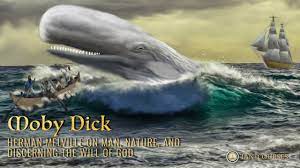
- Moby Dick – 1956
Perhaps the biggest fish story ever told even considering The “Meg” which graced our theaters in 2018. The “Meg” was a story about a prehistoric shark that was 75 feet long. The “Meg” was typical of the “Jaws” like imitators which so often are popular today. More adventure and suspense than human interest or human passion. In the movie version of Melville’s novel, “Moby Dick” was a white Sperm whale who was also 75 feet long. However, in Melville’s novel “Moby Dick” was implied to be over 90 feet long.
Melville’s “Moby Dick” is a brilliant story about obsession, revenge, and passion. Captain Ahab is out to kill the giant white Sperm Whale named Moby Dick who bit off his leg. His pursuit of revenge is nothing short of horrifying. He will do anything to assuage his anger at Moby Dick. He risks his ship, his crew, and his life to get his revenge. The actor who played Captain Ahab was the renowned Gregory Peck who the American Film Institute named the 12th-greatest male star of Classic Hollywood Cinema.
The opening line of the novel and movie “Call Me Ishmael” is among the most famous in American Literature. A book which was initially disparaged and ignored has since been hailed as one of the greatest pieces of literature in American writing. It has been sliced and diced by more pedants and critics than I could describe in twenty books. However, the movie does a good job of following the novel and if one picture is worth a thousand words, then this movie is surely a decent portrayal of the main plot concept. Basically, the final question you are left with is “Where does revenge get you?”
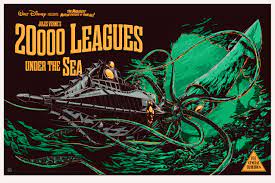
- 20,000 Leagues Under the Sea – 1954
I was eight years old when this movie was released. “Twenty Thousand Leagues Under the Sea” is a classic science fiction adventure based on a novel of the same name by the famous French writer Jules Verne. It was one of the first adventure fantasy movies that I can remember seeing. There is an earlier version of the story made into a silent film that was released in 1916.
I was fascinated by the roles played by Kirk Douglas, James Mason, Peter Lorre, and Paul Lukas. The brilliant inventor and idealist Captain Nemo is played by James Mason. Kirk Douglas played Ned Land, a sailor and master harpooner. Peter Lorre, one of my favorite actors of all time played Conseil, the devoted assistant to the marine scientist Arronax played by Paul Lukas. You could not have assembled a better cast.
The animation in the film was a step forward from previous movies. The vivid ocean adventures take place deep in the ocean depths. The animation makes you feel like you are in the Nautilus and diving with the sub. The film won two Academy Awards for its art direction and special effects. The story plot occurs in the middle 19th Century. The novel by Jules Verne was released as a sequence of stories between 1869 and 1871. This was a good fifty years before submarines were capable of such depths or abilities as depicted in the movie. In his paper “The Design of Jules Verne’s Submarine Nautilus” — 2011, Stuart Weir writes that:
“Only near 1960 did submarines begin to equal the performance of the fictional Nautilus, 90 years after “Twenty Thousand Leagues Under the Seas” was published. Less appreciated is the technical merit of Verne’s submarine design, a concept so detailed that it could be used to build a submarine, one with faults but no worse than submarines made by engineers of his day, and in many ways correctly indicating future developments.”
Jules Verne, Edgar Allen Poe, Edgar Rice Burroughs, Robert Lewis Stevenson, and H.G. Wells all fueled my keen interest in Science Fiction and Science Fantasy. As a young boy, they took me along with their adventures to places that I could only dream of going to someday. To Mars with John Carter, to find buried treasure with Jim Hawkins, to solve the murders of the Rue Morgue with C. Auguste Dupin and to dive deep beneath the sea with Captain Nemo. In my mind, I lived in these stories. I was the hero saving the world, changing wrong to right and finding the riches discarded by others.
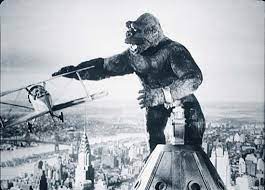
- King Kong – 1933
King Kong is really a version of the Beauty and the Beast story. Beauty and the Beast is a story about a young prince that is cast under a spell. His spell can only be broken by true love. The spell keeps him ensconced in the body of a hideous beast. The story “La Belle et la Bete” was by the French author, Gabrielle-Suzanne Barbot de Villeneuve. It was published in 1740 and was based on a 16th Century romance between a French court servant and a man with incurable hair growth. Disney adopted the story for an animated movie and made it quite popular. It is still one of the most remade movies ever. The story line has been adopted by numerous film makers all over the world and many remakes use a slight variant of the theme with some unique plot twists. I lost track trying to count all of the remakes or variants of this story.
Surprisingly, I did not encounter anyone who identified King Kong as a variant of the Beauty and the Beast theme. This is somewhat surprising since one of the most famous lines from the 1933 movie occurs at the end when the greedy entrepreneur Carl Denham says “Oh no, it wasn’t the airplanes. It was beauty killed the beast.” Perhaps because the idea of love between a giant gorilla and the ravishing beauty Ann Darrow played by Faye Wray is incomprehensible, few people see the resemblance to the Beauty and the Beast theme. Yet it is quite clear in the movie that Kong had some type of attachment to the voluptuous Ann Darrow. And in some ways, Ann showed an affection for Kong. Albeit I would think it was more platonic than romantic. Nevertheless, one of several scenes cut out of the original movie was deemed in violation of the movie industries moral codes concerning sexual activity. Quite clearly some of the producers saw a value in implying some sexual overtones to the movie.
In terms of moral values, the movie is a showcase for greed, avarice, and the human proclivity to turn everything into a profit. The entrepreneur Denham says “”We’ll give him more than chains. He’s always been king of his world, but we’ll teach him fear. We’re millionaires, boys. I’ll share it with all of you.” Yes, he would share it all right. In the financial accounting of Capitalism. “One for you, two for me. One for you, three for me. One for you, four for me.”
This movie is a tragic opera. A tale of love impossible. A story where you know the ending is going to be bad for someone. You care about Kong. He may be violent, but it is because of the way he is treated. He is a victim of exploitation, and you end up rooting for him. From atop the Empire State Building, you cheer for him to knock the planes down that are trying to kill him. At the end of the movie, you are sad. The bad guys walk away, and the good guy is dead.
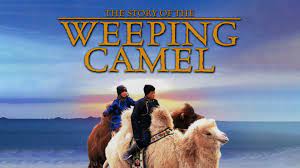
- Story of the Weeping Camel – 2004
I am less amazed that I have this movie on my list then I am that I watched it in the first place. A story about a family of nomadic shepherds in the Gobi Desert and a camel. The list of actors included the following whose names are definitely not household words or even pronounceable in the USA. The cast includes: Ikhbayar Amgaabazar, Zeveljamz Nyam, Amgaabazar Gonson, Chimed Ohin and Janchiv Ayurzana.
You would not expect to find this movie on a list of bestselling movies. The movie is categorized as a docudrama, being part real and part staged. Nevertheless, the Tomato Meter on Rotten Tomatoes had the Critics giving it a 94 percent rating and the Audience giving it an 87 percent rating. The documentary was nominated for an Oscar in the category Best Documentary at the 77th Academy Awards. The plot is about the reconciliation of a mother camel and her initially rejected calf. The story follows the adventures and efforts of the nomads to help reconcile the mother with her calf. The story is very touching, and you get into the lives of the nomads and how devoted they are to their animals. At the end of the movie, you are doing as much weeping as anyone in the show.
I am always moved by movies like this when I think of our American claim to exceptionalism. I have been to over forty countries now and I am embarrassed by such claims. Everywhere on this planet are exceptional people. Many who live very mundane or humdrum lives (at least as many Americas would describe it) but who persist with love and compassion for things that we take for granted or even abuse in the USA. Watch this movie and you will know what I am talking about.
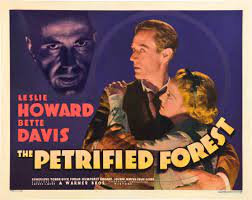
- Petrified Forest – 1936
The Petrified Forest has the Trinity of Archetypes characteristic of some of the greatest movies or stories in history. The Feeler, the Thinker, and the Doer. You will find this Trinity in the Wizard of Oz with the scarecrow wanting to think, the lion wanting the courage to act and the tin woodsman wanting a heart to feel. You will find it in Gone with the Wind. Scarlett O’Hara, the strong independent woman who can’t make up her mind who she loves. Scarlett proclaims emotionally, “I’d cut up my heart for you to wear if you wanted it.” Rhett, the dashing brash fighter who wants to go off to war. Ashley the soldier who does not believe in war and logically proclaims that “Most of the miseries of the world were caused by wars.” You will find this Trinity in Star Trek. Kirk, the impulsive captain who abandons his ship at the drop of a phaser. Spock, the logical thinker who analyses everything in mathematical terms. Bones, the ships surgeon who has the most regrets and remorse when things go wrong. “Compassion. That’s the one thing no machine ever had. Maybe it’s the one thing that keeps men ahead of them,” says Bones with great emotion. It might be a stretch but perhaps it was this Trinity which made Christianity so popular. You have God the Doer who builds the universe and world in seven days and creates everything known to humans. Jesus the Teacher who preaches and speaks in parables and metaphors. And the Holy Ghost who cannot be seen but only felt.
The Petrified Forest is the story of three such archetypes who collide one night in a rickety old café in the middle of nowhere. That nowhere being a fictional town called Black Mesa in Arizona, at the edge of the Petrified Forest. Leslie Howard who played Ashley Wilkes in Gone with the Wind is again a protagonist as Alan Squier. Alan is a failed writer who cannot make a living doing the only thing he knows how to do. Gabrielle played by the great actress Betty Davis plays the diner owners daughter who dreams of leaving Black Mesa and going to France to be a painter. She is entranced by poetry and literature. Whereas Alan looks logically upon words to convey thoughts, Gabrielle is enamored with the mere idea of being an artist or poet. She is fascinated by Alan who manages to portray a sophisticated man of the world aura. And then Humphrey Bogart shows up as Duke Mantee.
In the role that made his bones, Bogart plays a gangster who takes what he wants when he wants it. His character is the “man of action.” He is a cold calculating and unemotional killer. He does not deal in logic or analysis but solves his problems with a gun and bullets. The interaction between these three archetypes is nothing short of mesmerizing.
Alan Squier: The trouble with me, Gabrielle, is I, I belong to a vanishing race. I’m one of the intellectuals.
Gabrielle Maple: That, that means you’ve got brains!
Alan Squier: Hmmm. Yes. Brains without purpose. Noise without sound, shape without substance.
Alan Squier: Tell us, Duke, what kind of a life have you had?
Duke Mantee: What do you think? I spent most of my time since I grew up in jail. And it looks like I’ll spend the rest of my life dead.
The is the end of Part 1. If you have enjoyed my nostalgic trip through some of my favorite movies, stay tuned for Part 2 where I will cover the next five movies on my list.
- Executive Suite – 1954
- Glengarry Glen Ross – 1992
- Captains Courageous – 1937
- 12 Angry Men – 1957
- The Oxbow Incident – 1943

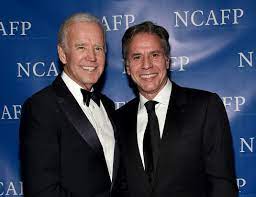 As the slaughter of innocent Palestinian women and children continues by Netanyahu and his IDF forces, there are several constants on the part of the United States in terms of our reactions. The First Constant is for Biden and Blinken to keep sending more ammunition and bombs to Israel even without authorization from the US Congress.

 This is a variant of idea number 2.
 This was suggested during the Vietnam war since many Americans with a monetary bent figured that it cost roughly one million dollars for every Viet Cong soldier that we killed. I thought that if Israel dropped some shekels, stocks or bonds with their bombs, it would help the Palestinians rebuild Gaza or at least move to someplace else like Miami or Houston.
 Perhaps a good Madison Avenue marketing campaign could be developed to show the Palestinians that the IDF really is trying to protect them. As with most such campaigns it would all be smoke and mirrors, but advertising is very effective and would dampen down some of the criticism. Israel needs to do more to show that “They Really Care.” That would make a good campaign slogan, “We Really Care.”
 I realize that this is not one of my best ideas but you know the old saying “Music sooths the savage beast.” When I am worried and upset a bit of good music helps me to relax. Perhaps some good music along with the bombing might help to address Palestinian anxiety and make them feel more cared about.



 Every year since Karen and I were married we have put up a Christmas Tree. Putting up a tree was once something I hated almost as much as I hated the entire Christmas event. I would be more than happy to forget that Christmas ever existed. I made my first wife miserable with my incessant complaints about Christmas and made a promise to myself not to let my hatred of Christmas get in the way of Karen’s love for the holiday. So very dutifully I unload the tree and boxes of ornaments, put on some Christmas songs, and help Karen decorate our tree.


 I saw another shadow ahead. The shadow became more defined as I came closer, and I realized that it was my father. He was standing there shaking his head. He started yelling at me. “You can’t do anything right. You fuck everything up. Leave it alone, I will do it myself.” I stopped to tell him that I was sorry. I always tried but it was never good enough. He just shook his head. The light moved on again and I followed it down the path.
 Soon, I could make out two more figures on the path as I approached their shadows. One was my former wife, Julia. She was sitting on a rock with my daughter Christina. Christy was seven or eight and they were both crying. I remember the scene well. I had taken a picture of them both that day amid that dismal moment. I was oblivious to their pain and heartache. The picture is in a scrapbook that I left with Julia when we divorced. It has often haunted my thoughts. I can see the picture in my mind just as clearly as if I were holding it in my hand. I was the reason; they were both crying and trying to comfort each other. Thinking of the pictures reminds me of the bastard that I once was and how horrible I had often been to Julia and my daughter Christy.


