The Biggest Lie That I Ever Told

download

The other day, we were having a discussion in my writing class and someone suggested we all write a piece on “The biggest lie that we ever told.”  At first, this sounded like a fun exercise.  Before starting it, you quickly realize that it makes one feel very vulnerable.  To open our consciences and share with others something that we may not be proud of.  In fact, something that we may have kept hidden for many years.  This is a very challenging and scary thing to do.  If you don’t think so, than I suggest you try this activity.  Here was my contribution to the effort.

How do I start or even write on this subject when I have never ever told a lie in my entire life.  Some of the things I did, I don’t think count as lying.

There was the time that I chopped the cherry tree down and my dad asked me who did it.  I simply told him that I did not remember.  I think someone must have done it but I could not remember who.

Then there was the time that I blew the three houses down and ate all the juicy fat pigs.  When they took me to court, I plead the 5th Amendment against self-incrimination.

The only other possible time that anyone could accuse me of lying was when I slept in the three bears’ beds and ate their porridge.  I ran so fast that even the bears could not catch me.

Oh, I almost forgot the time that  I stole the goose that laid the golden eggs.  The big old ogre did not need the goose anyway.  I fixed his butt when he tried to climb down the bean stalk after me.

So that’s it folks.  I have lived a life of honesty and would never ever lie, steal, or not tell the truth.  So help me God!

download (1)

The 2nd of Gandhi’s Seven Social Sins: Pleasure without Conscience.

3-2

A number of years ago when I first started graduate school, I was talking to a professor who had just purchased a brand new yacht.  This was nearly 40 years ago and I was pretty judgmental (I am hoping I am somewhat less judgmental today).  I remember saying to him exactly what was on my mind:  “Don’t you feel guilty with all of the poverty and problems we are facing in this world, to spend your money on such an extravagant purchase?”  To this day (Perhaps, my continued naiveté) I remain both shocked and amazed at his reply.  “John, if I can afford it, I deserve it.”  I was shocked because it seemed so insensitive to the world’s problems and I was amazed because I had expected that someone who had earned a Ph.D. would have had a more reflective and thoughtful reply.  Instead, he simply parroted back to me what I had labeled as the “Protestant Ethic.”  According to Wikipedia:

“The Protestant work ethic (or the Puritan work ethic) is a concept in theology, sociology, economics and history which emphasizes hard work, frugality and prosperity as a display of a person’s salvation in the Christian faith. The phrase was initially coined in 1904 by Max Weber in his book The Protestant Ethic and the Spirit of Capitalism.

Somewhere in the course of the development of American Capitalism, guilt or perhaps conscience was replaced by the moral certainty that if you only work hard enough, you can spend your money as frivolously as you want to.  At least, this was the interpretation I drew and continue to draw from my understanding of the Protestant Work Ethic.  Now of course, it has morphed into an abomination called the “Prosperity Gospel.”  In some sense, I can understand this idea.  If you work hard, why should you not be able to harvest the fruits of your labor?  Why should you be expected to share with those who are less fortunate?  After all, how many of the “less” fortunate are “less” because of their own laziness, stupidity, inertia or lack of ambition?  Should I have to pay more taxes to support people who don’t want to work or whose entire goal in life is to eat their way to obesity, drink their way to liver failure or drug their minds to an out of this world zombie state?  Why should I have to put up with the lack of ethics and self-discipline that it would appear in so many of the indigent and poor in this world exhibit?  A study in England in 2009 found that:

Four out of five people see nothing wrong with stealing from their workplace – while more than half think it acceptable for a care giver to persuade an elderly person to rewrite their will, according to a new study.
http://www.dailymail.co.uk/sciencetech/article-1211629/How-80-think-OK-steal-work-study-reveals-wavering-moral-compass.html#ixzz2RU850BbL

In some sense, the Protestant Ethic is a direct refutation of the morals that I had been given in my early Catholic school training.  Perhaps, that is why Catholics and Protestants did not get along in years gone by.  I remember every lunch break being told by one of the nuns or sisters at my Catholic school to be sure to “clean my plate.”  When queried why this was so important I always received the same reply “Because of the starving kids in India.”  Somehow, I was expected to feel guilty for these starving children in some far away country who did not have enough food to eat.  Was it my fault that they did not have enough to eat?  However, it was okay if I cleaned my plate and did not leave any scraps.  Kind of reminds me of when I go to a Chinese Buffet and it says on the sign posted:  “Please do not take more than you can eat.”  I weight 147 lbs. and scrupulously (well, sometimes) obey this admonition.  I watch the 400 lb. plus people with plates that are stacked higher than the Eiffel Tower and I wonder if they saw the sign or is it simply that they are on a diet?  See, there I go again, being judgmental.

Well, here it is nearly 40 years later and the question I posed to my professor colleague still seems quite legitimate to me.  When is it okay to indulge?  When can I binge?  When is it permissible to go buy my brand new Ferrari or brand new yacht?  What would Sister Evangeline say if she knew I was spending $350,000 dollars or more to purchase a new boat that I might only use two or three times per year?  What would Martin Luther say?  I can not imagine Luther saying: “Well, John, don’t worry about it.  You are supporting the economy.  Every boat you buy is a job for some boat builder in India or Pakistan or some other place where the kids don’t have enough to eat.”  “Thank You Martin Luther, now I don’t feel so guilty.”  Hooray for the Protestant Work Ethic!

Here is what the Gandhi Institute has to say about this issue:

Pleasure Without Conscience: This is connected to wealth without work. People find imaginative and dangerous ways of bringing excitement to their otherwise dull lives. Their search for pleasure and excitement often ends up costing society very heavily. Taking drugs and playing dangerous games cause avoidable health problems that cost the world hundreds of billions of dollars in direct and indirect health care facilities. Many of these problems are self-induced or ailments caused by careless attitudes. The United States spends more than $250 billion on leisure activities while 25 million children die each year because of hunger, malnutrition, and lack of medical facilities. Irresponsible and unconscionable acts of sexual pleasure and indulgence also cost the people and the country very heavily. Not only do young people lose their childhood but innocent babies are brought into the world and often left to the care of the society. The emotional, financial, and moral price is heavy on everyone. Gandhi believed pleasure must come from within the soul and excitement from serving the needy, from caring for the family, the children, and relatives. Building sound human relationships can be an exciting and adventurous activity. Unfortunately, we ignore the spiritual pleasures of life and indulge in the physical pleasures which are “pleasure without conscience.”

Fromhttp://www.rabbitadvocacy.com/gandhi_teachings.htm

A person I really admired was the teacher and prophet OSHO.  OSHO also believes that all the violence in the world comes from the need people have to address the boredom and meaninglessness in their daily lives.  People who are bored and who feel that their lives have no meaning turn to violence and or drugs in an effort to fill their lives with something that excites them or makes them feel alive.  The problem with such stimulation is that it never really fills the void and as with any panacea it is only temporary.  The void returns and the need to find new or greater stimulation also returns.  The cycle is not broken by the search for outside stimulation since the only real meaning of our lives must come from within.  No matter how great the wealth we achieve, no matter how many titles we accrue, no matter how famous we become and no matter how many people want our autographs, this kind of stimulation can never fill the void that we have if we do not find real meaning for our existence.

Let us pose the central issue here (Pleasure without Conscience) in the form of series of questions. Each question puts a slightly different slant on the issue:  Here are some ways to reflect on the issue:

  • How much pleasure is it okay to feel before I feel guilty?
  • If I am enjoying my life, should I feel guilty?
  • Do I have to feel guilty if I am feeling great pleasure?
  • Does a sense of conscience have anything to do with my personal pleasure?
  • Do I need to tie the concept of pleasure in with conscience?

Depending on which way we posit the question, we will come up with different answers.  Try the exercise yourself and see what you find as your personal answers.  For me, I would answer some of these questions in the negative and some in the positive.  Nevertheless, such a pedantic method of addressing the issue actually ignores what I think Gandhi was really getting at.  I don’t think this is an issue of us not enjoying our lives or not finding pleasure but it is more of what I have come to think of as a “Happy Days” issue.  Do you remember the sitcom that ran from the mid-seventies to mid-eighties?  It featured Ron Howard as a too good to be true teenager and Henry Winkler as a thuggish type of Greaser.  The term “Happy Days” was associated with how many Americans felt about the period of time between the end of the Korean War and the beginning of the Vietnam War.  Leave it to Beaver, Father Knows Best, I Love Lucy and the Mickey Mouse Club show were only a few of the sitcoms to depict a happy America where all was right with the world and Americans knew only bliss and prosperity.

Those “Happy Days” for middle class White male Americans were not so happy for the rest of the world.  During this period, there were many groups and constituencies in the USA who were denied rights, served excessive prison terms, could not find employment and were often subject to abuse and/or lynching.  I refer here to minority groups and women in the USA during our “Happy Days” period.  One could argue that either stupidity or a lack of conscience was a prerequisite for putting on “Happy Days” blinders.  Kind of like those folks who miss the “Good Old Days” down south.  Those nostalgic summer days when the happy slaves would sing and dance all day long in the cotton fields.  At the end of the day, they would trudge merrily home to their cozy cabins to sit by the fire-place and eat their fill of watermelon, sweet potato pie and Kentucky Fried Chicken.  Before going to bed, the young slaves would all have cute stories read to them by Uncle Remus.  Stories that would prepare the young slaves to get ahead in a world dominated by racism, discrimination and non-citizenship.  No doubt migrant workers, women and many other minorities would have their own version of the “Happy Days” fantasy that dominated American Psyche for so long.  In fact, there are many Americans who still believe in the “Happy Days” fantasy.

The point I am getting at is that no matter how you look at it, it is immoral and unethical to divorce Pleasure from Conscience.  To do so, is to be guilty of at best a form of benign neglect and at worst, a criminal conspiracy to keep other people degraded and denied the same opportunities as we might have.  Christians should all be familiar with many of Jesus’s teachings on this subject:

  • “It is easier for a camel to go through the eye of a needle than for someone who is rich to enter the kingdom of God.”  Mark 10:25
  •  “Jesus, looking at him, loved him and said, You lack one thing; go, sell what you own, and give the money to the poor, and you will have treasure in heaven; then come, follow me.”   Mark 10:21
  •  “For what does it profit a man to gain the whole world, and forfeit his soul?”  Matthew 16:26

Clearly anyone who claims to be a follower of Jesus Christ could not put profit or pleasure above conscience.  Jesus was all about helping others even at the expense of his own life.  His entire mission was to help those who were poor, sick or downtrodden.  Is there anyone who could do this without a conscience?  Perhaps we have focused too much in the past few decades on success and getting ahead.  This intense focus may have allowed many of us to put our consciences aside with the result that they seem to have atrophied or in many cases disappeared.  Too many people now measure success by how much money they have made and not how many people they have helped.  It is time we start focusing on conscience again.  Pleasure without conscience is simply hedonism.

Ok, time for questions:

What pleasures do you have that you may sacrifice your conscience for?  Do you think it is possible to have both conscience and pleasure?  What does it mean to have an “ethical” conscience?  Can we have too much conscience?  Do you think people should have more pleasure or more conscience?  Why?  What about yourself? Where do you fall on this issue?

Life is just beginning.

I wrote this blog more than four years ago.  Many have read it during the past few years.  With hindsight, I can see that we have gone further down the path.  Our political systems are rife with a lack of conscience.  Furthermore, this lack of conscience is justified by a “Prosperity Gospel” which preaches that:  financial blessing and physical well-being are always the will of God and that faith, positive speech, and donations to religious causes will increase one’s material wealth. 

In other words, that God rewards increases in faith with increases in health and/or wealth.  Thus, if you are wealthy, you are a “true believer”, anointed by God and deserving of your wealth.  The poor and sick are not true believers and thus are deserving of their fate and little or no sympathy or help.

Too many of us have given up on conscience and have become more and more Amoral.  We don’t care what we do or the consequences of our actions as long as they are “legal.”  Unfortunately, the law has never been a good barometer for ethics and morality.  The law has too frequently been usurped by the rich and powerful to promote their own self interests.   A history of the Supreme Court decisions in the USA would show this truth as would the Nazi Laws in Germany during the 30’s or the slavery and apartheid laws that existed throughout history in many parts of the world.   Law does not make right.  It never did and it never will.

The 1st of Gandhi’s Seven Social Sins: Wealth without Work.

1

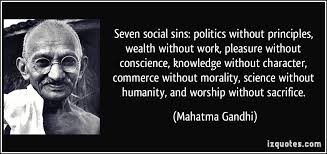
The Seven Social Sins is a list created by Mohandas Karamchand Gandhi in 1925.  He published this list in his weekly newspaper “Young India” on October 22, 1925.  Later he gave this same list to his grandson, Arun Gandhi on their final day together shortly before his assassination.  The Seven Sins are:

  1. Wealth without work.
  2. Pleasure without conscience.
  3. Knowledge without character.
  4. Commerce without morality.
  5. Science without humanity.
  6. Religion without sacrifice.
  7. Politics without principle.

I wrote a blog for each of Gandhi’s “sins” about ten years ago.  The blogs seemed to be quite popular with my readers.  I am going to update and repost each of the Seven Sins for the next few weeks.  Karen and I are making some major changes in our living arrangements and I probably will not find the time to write much new material.  I am reposting these because they still seem to be quite relevant in these challenging and chaotic times.

Wealth Without Work:  The First of Gandhi’s Seven Social Sins

Once upon a time in this great country, a model for attaining wealth and a set of rules to accomplish this objective stemmed from 3 basic beliefs.  These were:

  1. You worked hard, long and industriously.
  2. You attained as much education as you could absorb and afford.
  3. You treated all of your engagements with absolute honesty and scrupulousness.

Somewhere during the later 20th Century these 3 Cardinal beliefs (Above) about attaining great wealth were replaced by the following beliefs:

  1. Wealth can be attained at a gambling casino or by winning a lottery if you are lucky enough.
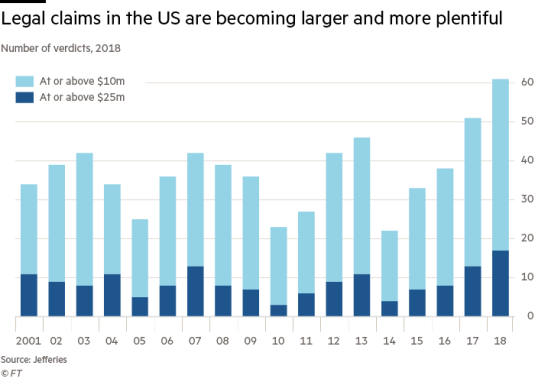
  2. Wealth can be attained by suing someone and with the help of a lawyer who will thereby gain a percentage of your lawsuit.
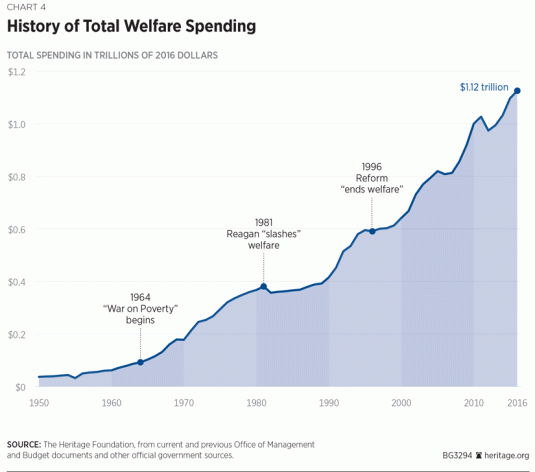
  3. Wealth can be attained by finding some means of acquiring a government handout for the remainder of your life.

Admittedly, not all Americans subscribe to the second set of beliefs and fortunately there are many who still subscribe to the first. Nevertheless, I think you would be hard pressed to argue that gambling, casinos, government handouts and lawsuits have not multiplied exponentially over the past fifty years.  The following are some charts which I think illustrate my points rather graphically.

global-online-gambling-market-by-region

http___com.ft.imagepublish.upp-prod-us.s3.amazonaws

BG-welfare-spending-2018-ALL-CHARTS-page4-825_1

The nature of human beings is to want things fast and with a minimum of effort.  This is normal and not to be thought of as deviant or unusual.  However, as we age and develop more self-control and wisdom over our daily affairs, we learn to temper our desire for instant gratification with a more mature perspective.  Noted quality guru, Dr. W. E. Deming maintained that people wanted “Instant Pudding.”  For Deming this meant, change without effort, quality without work and cost improvements overnight.  Added together, “Instant Pudding” was Dr. Deming’s metaphor for the desire to obtain results with a minimum investment of time and energy.  Dr. Deming continually warned his clients that there was no “Instant Pudding” and change would take years of hard work and could not be accomplished without continued dedication and focus.

Unfortunately, our media and even schools today seem to emphasize the possibility of achieving success and wealth overnight.  Sports stars are depicted as suddenly being offered incredible contracts.  Movie stars are shown as going from unknown to overnight fame and fortune.  Singers and musicians seem to suddenly achieve fame despite being barely out of their teens and in many cases barely into their teens.  It would appear that everywhere we look fame, fortune and success happen overnight.  All it takes is to be discovered. This might happen if you can get on American Idol or be found by the right booking agent or obtain a guest appearance on a celebrity TV show.  In some cases, all it takes is the right YouTube video to accomplish overnight success.  One day PSI was an unknown Korean musician and in a few short weeks, he was celebrating success by a dinner in the White House and appearing at the Times Square New Year’s Eve celebration.  How can anyone dispute that all that is needed for fame and fortune is to be in the right place at the right time?

You may be asking “yes, but what exactly did Gandhi mean by this “sin?”  The M. K. Gandhi Institute for Nonviolence gives the following explanation:

“Wealth Without Work: This includes playing the stock market; gambling; sweat-shop slavery; over-estimating one’s worth, like some heads of corporations drawing exorbitant salaries which are not always commensurate with the work they do.  Gandhi’s idea originates from the ancient Indian practice of Tenant Farmers.  The poor were made to slog on the farms while the rich raked in the profits.  With capitalism and materialism spreading so rampantly around the world the grey area between an honest day’s hard work and sitting back and profiting from other people’s labor is growing wider.  To conserve the resources of the world and share these resources equitably with all so that everyone can aspire to a good standard of living, Gandhi believed people should take only as much as they honestly need.  The United States provides a typical example.  The country spends an estimated $200 billion a year on manufacturing cigarettes, alcohol and allied products which harm people’s health.  What the country spends in terms of providing medical and research facilities to provide and find cures for health hazards caused by over-indulgence in tobacco and alcohol is mind-blowing.” ‘There is enough for everyone’s need but not for everyone’s greed’, Gandhi said.

There is a visual problem here that perhaps underlies much of the current thinking about success.  The media loves to trumpet short success stories that will grab anyone’s attention. We are constantly bombarded with headlines such as:

Each of these sites (click on to hyperlink to the actual site) promises you overnight success or at least success in a much shorter time span than is realistic.  These ads are in the news, checkout stands, on TV and just about anywhere you turn around.  The constant daily bombardment of such ads creates a zeitgeist in which overnight success not only seems to be possible; but it actually seems to be the norm.  If you are not an overnight success, if you cannot become rich in days rather than years, if you contemplate a life of hard work to attain your fame and fortune, than something is wrong with you.  Anyone subscribing to the first 3 sets of beliefs I mentioned in the opening is a peculiar species today.  The most common belief about success in the new millennium can be summed up as:

I don’t have time to wait. I don’t have the patience to wait.  I don’t want to spend my life waiting.  I am entitled to success now.  Why should I have to wait?  I am as good as any of these rich successful people. If only everyone could see how good I really am, I would get the fame and fortune I deserve now.  If you expect me to shut up and work hard, I will leave and go elsewhere.  You need me more than I need you.

I believe that Gandhi and many of my generation would find such ideas very peculiar not to mention that they contradict certain universal principles.  Every time I hear of a new terrorist attack in this country or a new massacre at some workplace, I wonder how much the instigator was influenced by his or her desire for overnight fame and fortune.  In some bizarre out-of-this-world thinking, these maniacs equate their picture on page one of the news with a sort of glory that is accomplished by their bizarre and cruel rampage.  The more they kill or maim, the greater they think their glory will be.  We can look for all the “reasons” why but we will never find any “good” reasons for anyone to take such anti-social actions against others.  The paradox is that often the very people they hate are the ones they wanted attention or recognition from.

Ok, time for questions:

Have you raised your children to believe in hard work?  Are you one of the parents who want to make sure their kids have it easy?  How do you know how much hard work is enough?  Do you think you are entitled to success because you work hard?  What other factors play a role in success?  Is it fair that some people do not seem to have to work hard and yet still reap big rewards?  Do people today have it too easy compared to the immigrants that founded this country?

Life is just beginning.

Oh No! Not Another Environmental Organization

images

It seems like every time I turn around, I find another environmental organization that is on the front lines of the war against something or other.  Some are out to address water shortages, some are fighting the fossil fuels industry, and some are advocating for more clean solar energy.  They are all great causes.  I shake my head though and wonder how come I have never heard of this organization.  I am always amazed to find yet another non-profit fighting the “good” fight for climate change.  No climate deniers at these organizations.

Today, I went to a recently discovered environmental website and lo and behold, they have a staff of at least a forty people.  The staff seems to be divided between what I would call admin type people, lawyers, and some environmental scientists.  This particular site seems to be about fifty percent lawyers.  It is not unusual to find lots of lawyers on these sites.  The cynic in me wonders whether or not they could find a higher paying job in corporate America or at least on the Trump defense team.  The numbers of staff at these organizations can range from as few as two staff members to as many as fifty including interns and part-time volunteers.  Most of these environmental organizations will have a great looking website with tabs like this:

ABOUT   ACTION   PROGRAMS   NEWSROOM   PUBLICATIONS   SUPPORT

Go to the ABOUT tab and you will  probably find a drop-down menu that looks like this:

  • Mission
  • Our Story
  • Meet the Staff
  • Board of Directors
  • Publications
  • Jobs and Internships
  • Contact Us
  • Support Us

What am I griping about you may ask?  Why my obvious cynicism?  The management consultant in me is buzzing with the following questions:

  1. Why are so many organizations trying to do the same thing?
  2. Why so many lawyers on the staff at these organizations?
  3. Great publications and research but how come I never heard of this organization?
  4. With a sound mission and team and so many other organizations fighting for climate change, how come the best we can do is Biden’s latest bill to fight climate change?
  5. How come the climate keeps getting worse?

Please allow me to explain or at least defend my critique of these well-meaning groups in terms of the above questions.  If you do not agree, great.  Send me your reasons and logic and I will post them in my comments section or simply post it yourself.  Lets go through each of my questions one at a time.

Duplication-of-effort-and-information-silos-within-various-sectors-of-Ethiopia-the-case

  1. Why are so many organizations trying to do the same thing?

In business and industry, we have a law of efficiency that abhors needless redundancy and duplication.  This law can lead to greater efficiency through economies of scale but can also lead to lack of innovation and inefficient monopolies.  Proponents of this law advocate for competition as a way of preventing these disadvantages.  However, when we talk about non-profits, we are dealing with the proverbial “horse of a different color.”  In this case, I can see more disadvantages than advantages from having so many organizations attempting to address the same problem.  For instance:

  • Wasted time spent on fund raising
  • Duplication of grants
  • Duplication of effort
  • Lack of leverage due to small size
  • Wasted money spent on equipment, offices, and administrative staff

It would really be interesting for these organizations to publish their financial reports and show a breakdown like many charities do.  I would like to know how much money goes directly to program goals versus support and infrastructure.

images (1)

  1. Why so many lawyers on the staff at these organizations?

I admit a bias here.  We have too many lawyers in this country.  In my work with organizations, lawyers were the most inefficient part of the companies that I worked with.  They blocked change with nitpicking details that were too often ridiculous and superfluous. They drove up costs with their legal fees and contributed not one red cent to the bottom line.  I hated to work for companies that had a large legal staff because I knew they would always try to find reasons “NOT” to do things rather than to change the existing status quo.  Lawyers seem to exist on the premise that it is safer to do nothing than to take calculated risks and do something.  Any time I see an organization with lots of lawyers, I see lots of overhead costs and a tendency to oppose change.

41-SVId5PxL._SX331_BO1,204,203,200_

  1. Great publications and research but how come I never heard of this organization?

Most of the time, I find my way to these environmental organizations via some article that one of their staff has posted.  For instance, the recent article in the Guardian (Landmark US climate bill will do more harm than good, groups say) led me to the following five environmental groups:

  • Taproot Earth Vision
  • Center for Biological Diversity
  • Environmental Justice Coalition
  • Sovereign Iñupiat for a Living Arctic
  • Climate Justice Alliance

I found the article interesting since it supported my belief that the Biden bill made to many concessions to the fossil fuel industry.  In the article, spokespersons for each of these five organizations echoed my concerns about the Biden bill.  In some respects, they are whistling in the wind as much as I am.  Many of my blogs deal with the problems of growth versus development, sustainability, climate change and water shortages.  I am a choir of one impacting maybe 100 or so readers of my blogs who are probably already believers in what I am preaching.  I too am guilty of not reaching the tornado blown, flood inundated, drought ridden, heat exhausted victims of climate change.

Quotefancy-7018857-3840x2160

  1. With a great mission and team and so many organizations fighting for climate change, how come the best we can do is Biden’s latest bill to fight climate change?

Most of these environmental organizations have some great people on their staffs.  Dedicated and wise scientists and volunteers who give their time and effort to help others.  I mentioned earlier that there are probably no climate deniers at these organizations.  What I do not see is the political clout that these organizations need to seriously impact the political process in this country.

Either there are not enough people who support climate change efforts in the world, or these organizations do not have enough political power to reach these people.  It is my opinion that fewer organizations working together would accomplish more than many disparate environmental organizations each staffed with a director, assistant director, administration people, HR people and other people not directly impacting the organization mission.  Of course, some staff people are needed.  The question is how many staff people are needed.  Too many organizations working towards the same mission and goals is inefficient.  Imagine, if Honda had a separate organization for each of its products.  The reason companies become conglomerates is because of scale efficiencies.

What Are Economies of Scale?

“Economies of scale are cost advantages reaped by companies when production becomes efficient. Companies can achieve economies of scale by increasing production and lowering costs. This happens because costs are spread over a larger number of goods. Costs can be both fixed and variable.” — Investopia

Global net anthropogenic emissions have continued to rise across all major groups of greenhouse gases.

A new flagship UN report on climate change out Monday indicating that harmful emissions from 2010-2019 were at their highest levels in human history, is proof that the world is on a “fast track” to disaster, António Guterres has warned. Reacting to the latest findings of the Intergovernmental Panel on Climate Change (IPCC), the UN Secretary-General insisted that unless governments everywhere reassess their energy policies, the world will be uninhabitable.

  1. How come the climate keeps getting worse?

Keep doing the same thing and expect different results and you are crazy.  The results on climate change are all going in the wrong direction.  Things are getting worse every day.  Many scientists say that we are already past the point of no return.  In a recent article by another environmental organization Circle of Blue, the author wrote that Arizona will probably be a wasteland with no water and deserted cities by 2060.

“The state enters an era of relentless decline. By 2060, according to several published projections, extreme heat and water scarcity could make Phoenix one of the continent’s most uninhabitable places.”  “Arizona’s Future Water Shock” by Keith Schneider, Circle of Blue – March 28, 2022

This concerns me greatly, since twelve years ago Karen and I bought a home in Arizona City.  We live half way between Tucson and Phoenix right in the middle of the Sonoran Desert.  We were assured by realtors that there was enough water for one hundred years when we bought our home.  A year later, we realized that realtors are the biggest liars in America.  This excludes politicians whom everyone knows cannot help but be liars.

Getting back on focus, if you were running an organization and everything you were doing was leading to declining sales, declining profits, declining demand for your products or declining success on your major indicators, would you still keep doing the same thing?

We have had twenty or more years of declining climate.  Isn’t it about time for these environmental organizations to change strategies?  Perhaps instead of writing articles, hiring lawyers etc., they should be hiring more marketing and PR people to reach out to the larger public.  Hubert Humphrey once said that “If you give the people the right information, they will make the right decisions.”  We have an SEC Commission which publishes stock reports on an hourly basis.  We have a Consumer Affairs Office which provides us with monthly updates on consumer spending and inflation.  We have a Commerce Department and Labor Department which issue regular updates on labor, monetary policies, gross domestic product, and many other economic indicators.  All of these reports help to insure that people have information about the economy.  But when it comes to the environment, where are the national indicators?  Where are the:

  • Weekly updates on temperature changes by state?
  • Weekly updates on water supplies by state?
  • Weekly updates on ozone levels, methane levels, carbon dioxide levels?
  • Weekly updates on aquifer levels?

mp,840x830,matte,f8f8f8,t-pad,1000x1000,f8f8f8

Maybe if more people had as many facts about the environment as they have about the economy, they could make better decisions.  Maybe, there would be less climate deniers and more people voting for officials willing to change how we deal with the environment.  Maybe, maybe, maybe.  But one thing is certain, if we keep doing what we are doing, we will leave a barren unsustainable world for future generations.

This excerpt is from an article that is worth reading if you are concerned about the environment.  I will put the url after the excerpt:

“There are so many crises occurring simultaneously that we cannot be misled when it comes to the solution. We must not return to ‘normal’ as advocated by governments and corporations: ‘normal’ is part of the problem. It is time to demand strategic changes that represent more radical responses and create conditions for other changes in the future. Major decarbonisation can help us today. However, it will not be easy to demand structural reforms without working-class mobilisation. Here, we see the important role of social movements in Latin America in demanding the impossible, especially when any other perspective could push us even further into the abyss.”

This excerpt if from:  https://thetricontinental.org/notebook-3-green-new-deal

But can we really learn to love again?

Just Give Me A Reason”  Pink with Nate Ruess
Sad-Broken-Heart-Wallpapers-4I love the possibility that Pink raises in her song that a love which has gone cold can somehow be reignited.

But can we really learn to love again? 

How many of us have had a love affair go south.  A love that we thought was like no other.  A love that would last forever!  A love that caused all reason to go out the window and for which we would have sold our souls to the very devil himself.  A love that friends and families said was meant to be and that would still be burning bright in the firmament when all the stars in the sky had long since dimmed.  A match made in heaven itself that would never be seen again.  No reason, no logic, no facts, no data, no statistics, no arguments, no evidence could convince us that we would not be with this person until the very end of time.  But then something happened!

I’m sorry I don’t understand
Where all of this is coming from
I thought that we were fine
(Oh, we had everything)
Your head is running wild again
My dear we still have everythin’
And it’s all in your mind
(Yeah, but this is happenin’)

Suddenly, the impossible becomes possible.  The unthinkable becomes thinkable.  Your worst fears become reality.  Nightmares become day dreams.  You are cheating on the other person.  The other person is cheating on you.  You are drifting apart.  You don’t connect like you used to.  You find yourself wishing you were with someone else. You are hurt.  You are lonely.  You feel abused. You feel neglected.  They don’t care about you anymore.  Things are different but you don’t know why.

You used to lie so close to me, oh, oh
There’s nothing more than empty sheets
Between our love, our love
Oh, our love, our love

But can we really learn to love again? 

You don’t know.  They don’t know.  The impossible is now probable.  You have lost faith in the dream.  “Grow old along with me” has changed to “I can’t go on any longer like this.”  Caring has changed to neglect. Closeness has been replaced with distance.  Love has been replaced with apathy. Everything seems hopeless.  What could have happened to us?

Just give me a reason
Just a little bit’s enough
Just a second we’re not broken just bent
And we can learn to love again
I never stopped
You’re still written in the scars on my heart
You’re not broken just bent
And we can learn to love again

But can we really learn to love again? 

Where do we start?  We forgot what we meant to each other.  We forgot how to care for each other.  We forgot how much we once loved each other.  How do we remember?  Where do we find what we once knew?  broken-heart-pictures-quotes

Life conspires to help us forget.  I told you that I loved you a million times.  Each time I meant it more than the countless times before.  But one day, I stopped saying it.  Something was happening but I did not know what.  Nothing had prepared me for the day that I forgot that I once loved you.  Now, my once and forever love is not even a distant memory.  Where do I find the love that I lost?  Can I find it in your arms or in the arms of someone new?

Somehow it seems easier to look elsewhere for our lost and forgotten love.  Divorce is fast and easy.  I lost something that now I cannot find.  Easier to move on and start over again.  Legions of counselors, psychologists, therapists and ministers could not put our love back together again.  I simply want to escape the pain and the loneliness.  I did not mean for this to happen.  We seemed to be so happy together yesterday and then today, it was all over.  Dreams shattered like a boat in a storm on a rocky shoal.  It all happened so fast, I was overwhelmed.  I am devastated.

Oh, tear ducts and rust
I’ll fix it for us
We’re collecting dust
But our love’s enough
You’re holding it in
You’re pouring a drink
No nothing is as bad as it seems
We’ll come clean

broken-heart-love-quotes-text-1719275-1280x800But can we really learn to love again? 

I wish that it were really possible but I don’t know where to start.  How can we go back when I don’t remember what to go back to?  What is the cause?  How do I solve a problem when I don’t know what the problem is?  Like the boat on the shoals, I feel like I am being battered on all sides.  I can’t go back and I can’t go forward.  I want to escape and I don’t know where or who to escape to.  Somewhere there must be a happy ending.

Oh, we can learn to love again
Oh, oh, that we’re not broken just bent
And we can learn to love again

But can we really learn to love again?

Maybe we can learn to love again but often I think it takes work and more work.  Too many love affairs, marriages, romances etc. are based on a sort of nostalgic love.  We hear of many people who have gone back to high school reunions and married a high school sweetheart.  I think romance might be the start of love but it is only getting out of the gate.  The real work comes, and it is work to keep a relationship together, after the fantasy of love forever starts to fade.  No amount of dreaming, hoping or wishing can replace the effort that a good relationship takes to maintain.  The Law of Entropy says that unless you put energy into something, it will devolve into chaos and randomness.  Too many love affairs have gone this way.  There is something sad about watching this happen, whether to a friend or to ourselves.

Time for Questions:

Why do we fall out of love?  Was it really love in the first place?  Can we bring back the feelings we once had for someone?  Why or why not?  Are you willing to do the work it takes to rekindle an old flame or to keep a flame burning?  Can it really be rekindled?  Is it all about wanting to or is it all about desire?  Do you know anyone who has “learned to love again?”  What did they do?  Could you do this?  Why not?


Stages of Aging

images

For many years now, I have wondered about the way we live life as we get older.  Psychologists and scientists have studied the “growing” process for children and young adults but little or nothing has been done to look at the aging process for older adults.  You can look at developmental stages for infants, children, young adults and to some extent adults through middle age.  These stages describe changes in motor skills, social skills, cognitive skills, and language skills.  The changes in skills are described chronologically.  As one goes from infant to adult our skills in these areas undergo profound changes.  People like Haim Ginott, Jean Piaget, Arnold Gesell, Eric Erikson, Lawrence Kohlberg and many others have all contributed to our understanding of how we develop from infants to adults.

Unfortunately, there are few if any studies that show how people age after they become adults.  It is assumed that adults simply grow old and die.  My wife who worked in home care for many years described three stages that were used by home care people to relate to the aging population.  They were active elderly, pre-frail elderly and frail elderly.  These stages describe differences in physical capacity, cognition, and quality of life.  The problem with these stages is that they are too broad and do little to describe the developmental pattern of many aging adults.

icons0228cm-

Over the years, I have thought about a way to describe the changes that I see many of my aging friends going through.  I can see why it is difficult to find any uniform stages because illness and other problems of the aged impact any linear timelines that can be uniformly ascribed to getting older.  We see people who are still active when they are in their nineties and people who are sick and bedridden in their sixties.  Differences in lifestyle have a major impact on how people age.

However, I have recently thought of one series of changes that I see many aging people going through.  These changes do not center or focus on physical change although they parallel to some extent the changes that are taking place both physically and cognitively.  The changes I refer to are based on domicile.  As we age, we change our living arrangements in terms of scope and scale.  We change the size of the place where we live and we change the amenities that are offered in our living places.

I want to describe one pattern of changes that I have seen happen many times now with friends and relatives and neighbors.  My caution to you is that not all aging people will go through these domicile changes.  For reasons dealing with incomes, social arrangements, ethnicity, culture and health, many aging people may remain in one place for all of their lives.  The ideal way to die is often described as to be in bed with no pain and surrounded by your loved ones in your own home.  I have seen this happen but perhaps not as often as we would hope for.  Thus, the following sequence of “stages” in aging that I describe are centered on changes in residency and are by no means immutable or universal.

Dates are approximate for each of my stages.

GettyImages-170882674-5ada98281f4e1300382fbb0f

Empty Nest:  44-60

Your children are off to college or jobs, and you are still working.  You have this entire house to yourself except for when your kids stop by to drop their laundry off or for a free meal.

23575_btc5255extentryroadoct2018email

Downsizing Home and Snow Birding:  60-70

You have either retiring or are getting ready to retire.  The house that you have lived in for many years now seems much too big.  Your children have moved away to follow their jobs and you hardly see them anymore.  You decide to purchase a new home or condo and simplify your life.  You get rid of much clutter, move to a less crowded location.  You now spend winters going down to Arizona, Florida, Texas, or California.  The old bones do not seem to like the cold weather and the tropical breezes feel great on your arthritis.

Gated Community

No More Snow Birding:  70-75

Going back and forth has gotten to be too much.  You had to make a choice and your chose the tropical weather over the snow and cold of your old home.  You moved down south permanently, and you decide to stick it out through the really hot weather.  You crank the air-conditioning up when needed and stay inside.  It is still easier with no snow or ice to deal with, and the humidity is low and that feels good.  Your new home is small, but it is comfortable and easier to maintain.  Taxes are lower and upkeep is lower as well.

a546f93b2a7048a61cec9c7a2a1ec5fb--small-farmhouse-plans-white-farmhouse

Aches and Pains and Missing the Kids:  75-80

Even a smaller home is hard to manage on your own.  You decide to move back to your roots.  Most of your children also seem to be there now.  You sell your tropical paradise, and you find an apartment or small home close to your kids.  You are back in the cold and blustery winter weather, but you really do not get out much.  You get to see your children more and they are there to help you when you need it.  Much of your time is spent in doctors’ appointments.

730x450#

Assisted Living Home:  80-85

You just can’t do the things that you used to do.  Even a small apartment is too much to manage on your own.  The kids do not feel that you are safe by yourself.  They convince you to move into an assisted living center.  It is a beautiful place with birds and fish tanks and many activities for seniors.  You really did not want to go but you had no choice.

0x0

Nursing Home:  85-90

You can’t get around on your own.  You can no longer prepare your own meals.  You have a hard time even getting dressed.  Your kids felt it was for the best.  Everyone seems sleepy and somnolent.  You don’t like the ambiance at all.  They bring in entertainment once a week and when you are able you participate.  Your children stop by every so often.

What-Is-Hospice

Hospice Care:  Near the End of Life

It just seems like yesterday that you were a little kid.  Your mom and dad would take you to the beach in the summer and you would build castles in the sand.  Your grandmother would take care of you sometimes and tell you stories about life when she was growing up.  You were always getting into a fight with your older brother.  Where are they now you wonder?  It has been so long since you have seen them.

granate_marker

Cemetery:  The End

I never thought it would be like this when I died.  I understand why no one ever came back to tell me.  All my old friends are here along with my mom, dad, brother, and grandparents.  It is like a great big reunion.  I don’t feel old anymore and all my arthritis is gone.  I don’t know why I was so hesitant to come here.  It is a beautiful happy peaceful place.  It is my favorite place of all.

photo-1596510915124-38eaa5517966

PS: 

I realize that the scenarios I am sketching are highly restrictive and do not apply to a large majority of the human race.  I am describing my experiences to date as a middle class, white somewhat educated male with a wife and several children.  The above stages are related to my experiences and while I believe that many people will identify with them, they are far from being a definitive description of the stages that all humans on this planet will experience.

Ingratitude:  How it destroys our minds and hearts and souls. 

I wrote this about 8 years ago. I thought I would reblog it this week. It still seems worth saying and hopefully worth reading.

Dr. John Persico Jr.'s avatarAging Capriciously

One of the things that I think most of us try to do is make sense out of the senseless. To do this, we apply various types of reasoning. From economic to political to psychological explanations, we attempt to fashion a purpose or logic for the senseless that helps us to see some logic to seemingly random and violent actions. Religious people use the term sin to cover many such acts. Some say it is the work of the devil. Psychologists use terms like paranoid schizophrenic or sociopath to convey some idea as to motive and underlying rationale. More practical minded people look to motives like revenge, money, jealousy etc.

I have heard that Bertrand Russell said that fear was the main motive for all evil that is done. This has a great deal of merit to it as an rally5underlying or foundation problem to explain many senseless acts of…


View original post 1,519 more words

The Four Baskets of Life Needed on the Path to Happiness and Success

true happiness

We are all born with four baskets of life.  We are born with these baskets, and we will die with these baskets.  Our happiness and success will depend on how we fill these baskets and what we fill them with.  It might seem unfair, but no two people are born with the same size baskets.  Some of us have bigger baskets and some of us have smaller baskets.  Ironically, bigger baskets can be more of a burden than smaller baskets.

The four baskets are known as, mental, physical, socio-emotional, and spiritual.  When we are born, our baskets are almost empty.  We have rudimentary materials that are put in each basket at birth.  However, no human can grow to maturity without adding more into each basket.  Given the size limitations of our baskets, our challenge is to fill each basket with the appropriate goods that we need for a happy successful life.

download

Mental/Cognitive Basket

Some of us are smarter than others.  However, smartness or intelligence is not merely related to IQ.  Each of us can be smart at different things.  Some people are good cooks.  Some people are good mathematicians and others are good carpenters.  Regardless of what skill sets you may have; your mental basket needs some basic knowledge to help you navigate in life.  Many of the skills needed are gained in schools or by teachers who help fill your basket.  Many of the skills we need are gained by experience.  Regardless of whether you add to your basket by experience or formal learning in a school, the goods you put in your basket need to match your knowledge, skills, and abilities.  Your interests are the motivation for what you desire to find and add to your basket.  One should go through life adding stuff to their basket and occasionally removing stuff.  Knowledge is not static.  It changes with the times as well as with your own needs.  I used to tell my business students, that the only value they had to their company was between their ears.

ability-900x700-01_900x700_acf_cropped

Physical Basket

Clearly we are all born with different physical assets and abilities.  Nike says everyone is an athlete.  Unfortunately, too many people do not see any reason to add goods to their physical basket.  They admire people like Michael Jordan, Mikaela Pauline Shiffrin, Usain Bolt,  Michael Phelps, Misty Copeland, Anna Netrebko and Tom Brady.  If you asked most people, they would readily admit that they do not have the physical skill sets that these champions have.  However, too many people grow old with the nearly same basket that they were born with.  I know too many people who stopped exercising or practicing after they left high school or college. “Oh, I used to run but I gave it up.”  “I used to play the clarinet, but I lost interest.”

If any of the people I noted above had not practiced and practiced and never given up, they would not have achieved the greatness that they did.  We all have different size baskets particularly when it comes to physical attributes but without practice and more practice filling up our baskets, we can never know what we are capable of.  At the very least in terms of increasing our physical attributes, we might live to an older age still able to walk, run, hike, play, and sing.  Instead too many people can only dream about the days gone by when they still could do these things.
maxresdefault

Socio-Emotional Basket

Covid 19 devastated many people who depend on emotional connections to help manage their lives.  It is true that some of us are less dependent than others when it comes to emotional attachments.  Some of us are introverts and some are extraverts.  Nevertheless, I know of no one who can go through life without a desire for love and friendship.  The socio-emotional basket may vary in size for many of us but it is still a basket that we must try to fill to meet our needs or we remain isolated and lonely.

A number of years ago, the idea of EQ or Emotional Quotient to measure how well people do at managing their interpersonal relationships entered the mainstream of social science.  “The term first appeared in 1964.  It gained popularity in the 1995 best-selling book ‘Emotional Intelligence’, written by science journalist Daniel Goleman.” — Wikipedia  The basic idea is that we all need to cope with our emotions and learn skills and techniques to help us better deal with the stresses of life.  Everyone has days of being up and down.  We all suffer from mild to strong depression at some time in our lives.  Thoughts of suicide are more prevalent than most people realize.  However, the goods that we put in our socio-emotional basket can determine how well we cope with these stresses.  Even the “greatest” of lives have succumbed to a weak basket and gone to drugs or drink to try to deal with the ups and downs of life.  History is littered with the deaths of good people who just did not have the socio-emotional coping skills to handle what life was throwing at them.  I have had two cousins who committed suicide and a best friend who also took his life.  Most people thought they had a lot to live for but apparently they disagreed.

slide_30

Spiritual Basket

The spiritual basket is the most difficult to fill and the most problematic.  Unless we fill the spiritual basket we will never find peace and happiness.  It is the basket of fulfillment.  It is the basket of true love.  Without the right ingredients in this basket, we remain lonely and unloved.  It does not matter how much we put in the other baskets, we must put the right stuff and enough of the right stuff in this basket or we will lead a life of “quiet despair.”  There are two paths typically taken to fill this basket.  One path is secular.  The other path is sectarian.  There are problems with each path.

GreedThe secular path is the path of the world.  It is the path that says you need to have more of the things of the world to put in your basket.  Getting more of the world’s stuff is heralded as the secret to filling your basket and achieving success and happiness.  Some of the things people try to get more of include:  Food, drugs, alcohol, fame, fortune, money, medals, accomplishments, status, power, knowledge, youth, health and titles.  While some of these things might be useful in your other baskets, in this basket they simply do not work.  The spiritual basket is immune to the things of the world.  It is a truism that all of the great prophets and philosophers and thinkers have extolled.  Sadly, it is a path that is promoted by too much of the world because it is driven by greed and financial profits.  Buy that new truck and you will be happy.  Buy that giant house and you will be happy.  Read the latest diet book and you will be happy.  How many times do people have to go down this path before they will realize that it only takes them in the wrong direction?

The other path to fill the spiritual basket is the sectarian path.  This is the sacred path or the path of religion and sects.  It is a path of meaning and purpose.  It is a path of prayer and meditation.  It is a path of Gods, prophets, and spiritual leaders.  These leaders tell their followers that the path to happiness and success comes from following their teachings.  Often they include meaning and purpose as tools necessary for your spiritual basket.  Some believe in the power of meditation and prayer for your spiritual basket.

prophetsThe great spiritual leaders like Mohammed, Jesus, Buddha and  Baháʼu’lláh all had followers and tried to teach their followers by various means.  It seems that the goal of enlightenment, samadhi or nirvana was achieved by each of the great leaders and even by some of their followers.  Unfortunately for humanity and for most organized religions, these gurus and religious teachers all missed one important truth.  “You cannot teach enlightenment.”  Enlightenment can only be learned by example.  We learn from our parents by the example they set for us.  We learn by observing how they treat other people.  We learn by what they do rather than what they say.  The followers of the great prophets and gurus were learning their spirituality from what their teachers were doing and now what they were saying.

The words that were left by some religious teachers like Thomas Merton, Mother Teresa, OSHO, Krishnamurti and the writers of the Old Testament and New Testament have no doubt inspired many people to try to reach heaven or nirvana.  For the most part, I doubt that many followers have ever achieved much enlightenment.  If they did, it was not by the reading of words but by the life that they led.

I think having had 39 silent Jesuit Retreats that prayer, mediation, solitude, and contemplation have a role in finding peace and happiness.  I do not think that they will lead anyone to nirvana or enlightenment.  Unless I am an extreme outlier, after 39 years of a three-day silent retreat full of prayer and meditation, I am still pretty much just your normal unsaintly unholy guy.  I am still waiting for most of my prayers to be answered and I am still waiting to sit peacefully in my car full of good will and cheerfulness when some jerk is tailgating me on the freeway.  I am much more likely to wish that I had an invisible ray gun that could make the impatient driver and his/her auto just disappear.

You can not teach how heat feels.  Description is futile.  You must feel it.  You cannot teach fulfillment or enlightenment you must experience it.  Words are useless.  The most important ingredient in a spiritual basket is love.  Love for yourself and love for others.  Love for all others and not just people who are like you.  Not just people who think like you.  If you do not feel love for yourself, you cannot feel love for others.  But there is a paradox here.  It is that love from others can help you feel loved.  Love for others, love for yourself, love for yourself and love for others are the Yin/Yang of a spiritual basket.  Purpose and meaning are good things, but they are transient.  They will come and go and change with the times.  Love never changes.  Jesus said:

“A new commandment I give unto you, that ye love one another; as I have loved you, that ye also love one another.  By this shall all men know that ye are my disciples, if ye have love one to another.  By this shall all men know that ye are my disciples, if ye have love one to another.” – John 13:34-35 (KJV)

KindnessDay-5

If you want enlightenment, follow a good person, do good deeds, be kind to all people and love yourself.  Being a person of integrity and honor leads to self-love.  Self-love leads to love for others.  We are all born with an empty spiritual basket.  In order to become complete, we must fill this basket with as much love as we can.

91om8nQaobL._SL1500_

Karen Yvonne Persico

20220227_153705

My wife is an average looking elderly woman.  If you saw her walking down the street you would not think that there was anything special about her.  But to me, Karen is the most special person in the world.  Perhaps, special most to me but special even without me.  Let me tell you why.  However, a little history and  background might help.

Karen was born in St. Paul, Minnesota on July 5th, 1944, to Myrtle and Raymond Blomgren.  She was an only child.  Her dad wanted five children and her mother wanted zero.  They compromised with Karen.  From the start, she was the most special person in her dad’s eyes since he knew he would not have any more children.

karen at sculpture parkKaren grew up with two sets of grandparents.  On one side the Misselts were Norwegian and on her dad’s side the grandparents were Swedish.  Karen was baptized at Pilgrim Lutheran Church in Frederic, Wisconsin where we now reside.  Karen went to public schools and was an average student.  She dreamed of becoming a nurse.  However, her guidance counselor had different ideas.  She advised Karen that she would never make it as a nurse because her math scores were too low.  Karen showed what I have since realized was a streak of determination or stubbornness (if you will) to get what she wants.  She ignored the counselor’s advice, went to nursing school at the University of Minnesota and a few years ago retired with fifty plus years of nursing experience.

20211002_163733Karen and I were married in 1989 but started dating in 1983.  Both of us were coming off of recent divorces.  We were on again and off again as I did not want to make any commitment.  After six years of dating, Karen finally said that she was tired of this off again and on-again business and either it was permanently on or permanently off.  I yielded to her logic, and we were married by my good friend Bill Cox at a Methodist Church in Taylor Falls, Minnesota.  The marriage of a good Lutheran and a quixotic Atheist.

IMG_4025 (2)From the start, we had a rather rocky relationship.  I was often temperamental.  Easy to anger and resort to verbal and emotional abuse.  I lost count of how many times I said that I was going to leave, and that divorce was the only answer.  Karen would ask me not to yell at her and I would say I was not yelling.  It seemed to me that any slight rise in my tone of voice was yelling to Karen.  Our discussions often made matters worse.  However, Karen never gave up on our relationship.  We went to counselling together to save it.  We have been to three Marriage Encounter weekends to improve various aspects of our lives.  Sometimes the improvements are more obvious than other times.  I still tend to be the pessimist and see the half-empty glass and Karen is the optimist who keeps assuring me that the glass is half-full and getting fuller.

You may have guessed by now why Karen is special to me.  People are always coming up to us and asking her how she manages to put up with me.  I am not an easy person to get along with.  Some might accuse her of enabling me, but Karen is not passive and is very proactive in standing her ground and expecting me to apologize or make things right when I am wrong.  But there is a great deal more to Karen than just putting up with me.

Karen and three childrenKaren was a single mom who raised four children after her first husband left.  She tried to be mom and dad to these kids.  She cooked, cleaned, sewed, and went to work each day and came home at night to help them with their homework or whatever they needed.  She took them on camping trips and vacations.  By the time we were married, three of her children had left the nest and we had one child left to raise.  Karen’s relationship with her children was never smooth.  Some of the kids seemed to blame her for their dad leaving.  I was the evil stepparent and I never fit in.  Her youngest daughter after many years of Karen and I together once asked me when their real father was coming back.

karen at concert

I saw Karen’s children as selfish and narcissistic.  Over the years together, I tried to stay out of the way of Karen’s relationship with her children.  Occasionally I would suggest some efforts to improve these relationships.  I often thought it was a waste of time, but Karen never gave up.  Karen continued to reach out to each of her children particularly when she thought they were in need.  She has treated her adopted daughter Susan with the same compassion as her biological children.

A few years ago, when we did a will together, she opted to divide any of our assets evenly between all four of her children.  I suggested that she pro-rate the assets based on how they have treated her over the years.  It was not always good.  She paid no attention to my suggestion as she said she loved them all equally.

Karen and Susan 3Peg, Karen and JeanineKaren is one of the most caring, honest, ethical, and thoughtful persons in the world.  She is patient, kind and compassionate with everyone that she deals with.  Not just me, and not just people she knows or people in our “tribe.”  Karen is always willing to go out of her way to help others in need. Karen has a wonderful talent for crafts and music and uses these to give back to the world.

20220317_152722Karen wanted to study music when she was younger.  Her parents had a piano in their house and Karen learned to play it.  However, she realized that she did not have the talent to be a professional musician and so she took it up as a hobby.  She started singing in a church choir when she was eight years old and still sings in a choir.  A piano is a rather cumbersome instrument to carry around, so Karen discovered the Mountain Dulcimer about fifteen years ago and learned to play it.  She takes it with us when we travel, and she plays with a group in Arizona called the Tucson Dulcimer Ensemble.  They practice weekly and play at nursing homes, churches, and special events.  About five years ago, she purchased a Ukulele and started learning to play it.  She now plays with a group in Centuria, Wisconsin and they also do free gigs for nursing homes, county fairs and churches.

Message_1640392871369

Karen is very active at her church in Casa Grande, Arizona with the choir and other events and is also very active with her church in Frederic.  It is the same church that she was baptized at.  Karen helps make beautiful quilts and shawls which are donated to various groups and individuals.  She pays for most of the materials herself.  You can see the glow on her face when she finishes a piece and is able to donate it to the church.  Helping others this way is a labor of love for Karen.

As you have probably realized by now, particularly if you have read some of my blogs, I have a tendency for vindictiveness.  I don’t like 20211010_190249fools, greedy people, and bullies.  I find it hard to turn the other cheek.  I lack compassion, kindness and patience for racists, white supremacists, KKK, Neo-Nazi and many other groups.  Through it all, Karen stands by me.  I complain that she is too nice.  Minnesota Nice bothers me because I see it as wimpy and avoidance behavior.  Karen says it is caring and compassion.  I wonder what Jesus would say.  Regardless, I know I live a better happier life because I have one very special person that I admire, and love more than I can ever say.  She may look like an average old lady, but she is not average to me.  No average person could live with me for more than a week.

Why a Ukulele is Better than a Gun

parts-of-the-ukulele

I was sitting down tonight with my spouse Karen watching YouTube videos in our Frederic living room.  After watching our usual batch of eclectic YouTube videos, we generally finish off by watching some news reports and then finally some music videos.  My wife is an avid dulcimer player and has been playing it for more than fifteen years now.  About five years ago, she decided to start playing a ukulele.  She has taken lessons for both the uke and dulcimer and plays with a dulcimer group in Tucson and a ukulele group in Centuria, Wisconsin.

20220710_100117

The two music groups that Karen plays in have a lot in common.  They are primarily older women players but there are some men in each group.  They practice weekly and occasionally do performances for various venues such as nursing homes, churches, county fairs and festivals.  They do not usually get paid for their performances, but the people who attend at these venues are very happy and grateful to hear the music and songs they play.  The music they perform in both the dulcimer and ukulele groups include a lot of wonderful old gospel tunes, Irish tunes, and country songs.  I have attended many of these performances with Karen.  I do not play but I help with carrying her instruments, amplifiers, and music stands.  Some of the other members call me her “roadie.”

Jake-Shimabukuro-Press-Photo-2185-1570-DPI-4267x6400-1-1080x720The ukulele is a four-stringed instrument that has its origins in Portugal but was adapted by Hawaiians in the 19th Century.  Its size can vary, with the larger instruments producing deeper tones.  Elvis Presley played a ukulele and so did Tiny Tim.  The ukulele became most popular in Hawaii but more recently with a player named Jake Shimabukuro its popularity has skyrocketed.  Karen and I have been to two of Jake’s concerts and it is beyond amazing what he can play and do on his ukulele.  He has done for the ukulele what the movie “O Brother, Where Are Thou” did for old time music.  He has created a renaissance for the ukulele with millions of people all over the world now taking up the instrument.

download

Tonight, we watched some of the videos for a ukulele group that we have watched many times before.  They are called the Ukulele Orchestra of Great Britain.  They have nearly two dozen music videos on YouTube.  There are eight members in the group.  Two women and six men.

soprano-concert-tenor-baritone-ukulele-sizes They play a variety of ukes from soprano to tenor to concert to bass ukuleles.  In addition to playing, they also sing.  They are quite innovative and creative in their adaptations of the various pieces of music that they play.  They often invite ticket holders to bring their ukuleles to the concert and play along with them.  You can find out more about this group at their site Ukulele Orchestra.  Their website includes information on where they are playing next.  They tour all over the world and will be in various parts of Europe and America over the next two years.  By the way, National Ukulele Day takes place on February 2 each year when ukulele players from around the country will strum their favorite tunes to celebrate.  But I started this blog with the admonition that ukuleles were better than guns.  Following are my ten reasons why a ukulele is better than a gun.

  1. You do not need a Concealed Carry Permit to carry a ukulele in public. 

Most people will not feel at all uncomfortable if you pass them by in a Walmart with a ukulele.  Not so true with a gun.  Few places ban ukulele players from entering.

  1. There have been very few people killed with a ukulele.

Either intentionally or unintentionally, statistics show that ukuleles are relatively safe.  They are very light weight and even if you cracked a person over the head with one, it would probably hurt your ukulele more than the other person.

  1. Ukuleles do not have to be reloaded.

Ukulele strings do not break very often, and they are pretty inexpensive to purchase compared to most bullets.  In addition, stores seldom run out of ukulele strings whereas bullets seem to fly off the shelf every time a Democrat is elected.

  1. The sound of a ukulele playing will not generally make people dash for cover and cower behind closed doors.

Ukuleles are fun to play and fun to listen to.  The music written for ukes as well as much of the music played by ukulele players is heartwarming and upbeat.

  1. Ukuleles are relatively inexpensive.

A good gun (if there is such a thing) will set you back several hundred dollars.  You can buy an excellent carbon fiber ukulele for $100 dollars.  Many people prefer a wood ukulele but carbon fiber ukes are waterproof and humidity resistant.  In addition, they have an excellent tone.  More and more acoustic instruments are being made out of carbon fiber.

  1. You do not have to lock your ukulele up to protect your children.

As a matter of fact, many parents like to encourage their children to play an instrument by leaving it around for them to pick up and experiment with.  (WARNING) You do not want to leave your gun around for your kids to play or experiment with.

  1. Ukuleles do not malfunction and blow up in your face.

Where there might be some “bad” ukes, there are no reports of any ukes blowing up or exploding and killing anyone.  Ukuleles are thus much safer to play than guns.

  1. Ukuleles are bipartisan.

You can be a Republican or a Democrat and still play a ukulele.  There are no official designations limiting who can play a ukulele.  Unlike Covid masks, playing a ukulele will not denote your political affiliation.

  1. Ukuleles can be carried on a plane and stored in the overhead bins.

The small size and light weight of most ukes make them ideal for traveling.  They will easily pass through most metal detectors and unlike guns will not sound alarms and have people scurrying for cover if you forget to mention that you have one in your luggage.

  1. They are more inclusive than guns.

When anyone draws a gun and starts firing it, most people will run away as quickly as possible from the shooter.  The exact opposite is usually true with a ukulele player.  Take out your ukulele and start playing it and people will soon come around and if you are a half-way decent player, you will have a crowd of people listening to you.  If you are really good, open your uke case and you can pick up a few bucks in tips by being a busker.  When was the last time, you saw any gun owners making money by shooting their guns in public?

So there you have it.  10 good reasons to buy a ukulele today and learn to play it.  There are oodles of free lessons on line, and it seems just about every town now has a uke club.  My wife plays weekly with a friend in Canada and her group in Centuria.  Members of uke groups are friendly and hospitable.  To date, none of the mass killers in America have been uke players.

“What the world needs are more ukuleles and fewer guns.”  — Socrates, 457 BCE

“Sir, I have had new thoughts on the Second Amendment.  I believe we should change it as follows:  ‘A well-disciplined ukulele band, being necessary to the peace and harmony of a free State, the right of the people to keep and play ukuleles, shall not be infringed.’”  Thomas Jefferson, 1789 CE

A good uke site if you are interested in getting started:

https://www.beginnerukuleles.com/favorite-ukulele-sites/


Previous Older Entries Next Newer Entries