Black Lives Don’t Matter:  They Never Did

Screenshot_2020-06-06_20.02.17__56119.1591491755

During the time of the slave trade, it is estimated that some 13 million African natives were captured and sent by ship to the Americas to work plantations in both North and South America.  They were sent because they represented cheap labor.  Not free labor because slaves had to be fed, clothed, and bought.  Of these 13 million individuals, somewhere between 2-3 million men, women and children perished on the voyage over.  They died from malnutrition, disease and outright murder by hangings, drownings, and beatings.  Consider if you will the shrinkage rate.  In merchandising shrinkage of a product is the loss of a product through “unavoidable” circumstances.

A good merchandiser does everything they can to avoid shrinkage.  The loss of a product represents loss of profit for a company.  Such was not the case with the slave trade.  Every slave was regarded as property but with a difference.  They were regarded as “expendable.”

“Black lives did not matter.”

A slaver or slave owner could “write” off the loss of a slave as simply a cost of doing business.  The market for slaves was never predicated on a 100 percent transfer of live merchandise.  If only 75 percent of the African natives made it over to the Americas, the cost of slaves would be based on that percentage.  The rest might today be called “collateral damage.”  They never could have been called an “unavoidable” expense since murder and starvation are hardly unavoidable.

Zong_crew_throwing_slaves_overboard_1781

Much has been made of the fact that slaves were regarded as “property” by the plantation owners in the south.  Confederate apologists say that slaves were well cared.  Logically, any property would be regarded as valuable.  Thus, slaves were well fed, well clothed and well housed.  History again is a lie.   The lower the cost of maintaining a slave, the more profit for a slave owner.  Thus, little expense was allocated towards feeding, clothing, or improving the life of a slave.  In any business, the future success of the business, is related to the further development of the workers in that business.  Companies spend billions of dollars a year on Human Resource Development (HRD) activities designed to train, educate, and improve the knowledge, skills, and abilities of their workers.  This was not the case with slavery.  There were no HRD programs for slaves.

Slaves had to clothe, feed, and take care of their own medical problems.  If they died, they were expendable.  Slaves could be replaced by breeding more slaves or by raping slaves and replacing any that died.  Slaves were not educated, and laws prohibited the teaching of reading or writing to slaves.  Knowledge has always meant power and that was one thing that must be denied to slaves.  Some slaveholders would teach select slaves reading or writing skills because they needed someone to run errands for them, but this was the exception in the USA and not the rule.

1819, Missouri: Prohibited assembling or teaching slaves to read or write. 1829, Georgia: Prohibited teaching blacks to read, punished by fine and imprisonment. 1832, Alabama and Virginia: Prohibited whites from teaching blacks to read or write, punished by fines and floggings.  — Anti-literacy laws in the United States

“The United States is unique in that it is the only country known to have prohibited the education of slaves.”  — Wikipedia

“Black lives did not matter.”

Several versions including movies and stories have portrayed the life of a slave as one of happiness and joy.  This version of history shows slaves as well cared for, well treated, and generally satisfied with their station in life.  Happy to be working for their white masters, happy to be caring for the children of their white masters and happy to be singing and dancing for their white masters.   One wonders then why there were over 250 slave rebellions before slavery was abolished in 1865.  This figure does not count the number of slaves who tried to escape by running away.  The famous “underground railroad” is estimated to have helped as many as 70,000 individuals (though estimations vary from 40,000 to 100,000) escape from slavery in the years between 1800 and 1865. — Fugitive slave

See the article “Did African-American Slaves Rebel?” by Henry Louis Gates Jr.

The most famous slave rebellion took place in Virginia in 1831.  The rebellion was led by Nat Turner.  After a considerable number of white people were killed the revolt was finally suppressed.  As an aftermath of the revolt, 56 slaves were officially executed but over 120 other slaves and free blacks were murdered in retaliation.  Valuable black property was not so valuable when it came to revenge.  To prove that black lives were not regarded as compensable property is the fact that after the rebellion at least seven slaveowners sent legislative petitions for compensation for the loss of their slaves. They were all rejected.

“Black lives did not matter.”

Again, one wonders why the happy singing slaves would go to the risk and peril of staging a slave revolt knowing full well that the consequences would mean a terrible death.  The slaves executed were often tortured and put to death with as much pain and suffering as possible.  There was no effort made to provide a humane method of execution.

“Black lives did not matter.”

In 1932, The United States Public Health Service (PHS) conducted the infamous “Tuskegee Study of Untreated Syphilis in the African American Male.”  This so-called study took place between 1932 and 1972.

“Investigators enrolled in the study a total of 600 impoverished, African American sharecroppers from Macon County, Alabama.  Of these men, 399 had latent syphilis, with a control group of 201 men who were not infected.   As an incentive for participation in the study, the men were promised free medical care, but were deceived by the PHS, who disguised placebos, ineffective methods, and diagnostic procedures as treatment.   The men who had syphilis were never informed of their diagnosis, despite the risk of infecting others, and the fact that the disease could lead to blindness, deafness, mental illness, heart disease, bone deterioration, collapse of the central nervous system, and death.” — Tuskegee Syphilis Experiment

“Black lives did not matter.”

The Vietnam war was in full swing from 1964 to 1973 in terms of major US troop involvement.  During this period, many of the men who served in front line combat units were enlisted from the draft rolls.

“By lowering the education standards of the draft, an estimated 40% of the 246,000 draftees of Project 100,000 were Black. Some activists in the US speculated that the uneven application of the draft was a method of Black genocide. Black people were starkly under-represented on draft boards in this era, with none on the draft boards of Louisiana, Mississippi, Alabama, or Arkansas.” — Military History of African Americans During the Vietnam War

image

“African American troops were more likely to be assigned to combat units.  Twenty-three percent of combat troops in Vietnam were Black.  The combination of our selective service policies, our testing of both drafted and volunteers, the need for skilled enlisted men in many areas of the armed forces, all conspired to assign blacks in greater numbers to the combat units of the Army and Marine Corps.  Early in the war, when blacks made up about 11.0% of our Vietnam force, black casualties soared to over 20% of the total.” — Vietnam War Statistics

“Black lives did not matter.”

A recent Harvard Study (2020) found that blacks were up to six times more likely to be killed by police during an encounter than whites.  They analyzed 5,494 police-related fatalities using data from Fatal Encounters a database of people killed in encounters with police.  There was a great deal of variation across the country but on average, blacks were three times more likely to be killed during a police encounter than whites.

The Harvard study did not show how many more times blacks are going to be encountered by police for routine matters.  A Stanford University study of nearly 100 million traffic stops from around the US has concluded that, on average, black drivers are 20% more likely to get pulled over than a white driver.  More likely to get pulled over and then more likely to get killed.  A black man or woman stopped for drunk driving is (on average) up to three times more likely than a white man or woman stopped for drunk driving to be killed during the encounter.

“Black lives still do not matter.”

A few weeks ago, up here in the North woods of Wisconsin in our rural Polk County we had a “Black Lives Matter” protest rally.  Mostly white rural people up here in our county.  About fifty or more people showed up carrying signs supporting the “Black Lives Matter” movement.  Karen and I made two signs and joined the rally.  Looking at the numbers of white people in the country supporting this movement, I can’t help but wonder if white people are finally “woking” up.  If they are “woke” how long will they stay “woke.”

Liberal whites are for many blacks more despicable than conservative racists.  Malcolm X noted in one of his talks that:

“The white liberal differs from the white conservative only in one way: the liberal is more deceitful than the conservative. The liberal is more hypocritical than the conservative. Both want power, but the white liberal is the one who has perfected the art of posing as the Negro’s friend and benefactor; and by winning the friendship, allegiance, and support of the Negro, the white liberal is able to use the Negro as a pawn or tool in this political “football game” that is constantly raging between the white liberals and white conservatives.” — Malcom X Speech 1963.

A recent example of white hypocrisy concerns the Alabama-based Southern Poverty Law Center (SPLC).  A Center long heralded for their attacking racist groups like the Aryan Brotherhood and the KKK, they recently came under attack for racial discrimination within their own ranks.  The liberal champion at this organization was a lawyer named Morris Dees.  Famed for his standing up to the Klan and for the number of threats on his life, he resigned during the turmoil over the charges against him and the SPLC.  Some employees claim that the civil rights nonprofit group suffers from a “systemic culture of racism and sexism within its workplace.”

I have had many arguments with liberal friends over the issue of racism in the USA.  I generally find that they agree with me – up to a point.  We disagree on methods of dealing with racism often with large gaps in our strategies.  There is no way a liberal will ever agree to or countenance violence against oppression.  This is the reason that Martin Luther King was championed over Malcolm X.  Malcolm X did not believe in “turning the other cheek.”  Liberals believe that you can “Reason” with racists and help them to see the error of their ways.  In 1857 Frederic Douglas gave a speech now called “If There is No Struggle, there is No Progress.” (I will “reconstruct” this speech in my next blog)

After I argue with my liberal friends (often I defend some of the violence associated with protests) they will go home to their suburban white gated communities with their security walls and security guards who make routine patrols through their neighborhoods.  Driving through these communities, you will not be surprised to find few if any minorities living within the gated walls.  When Karen and I bought a home in Arizona we had to argue with the realtor because she insisted we buy a home in a gated community where we “would be safer.”  We refused and we have Latino and Black neighbors on our street.  We have children running up and down the street and we have no walls to block our view of reality.

audubon-place

Before the “Black Lives Matter” Rally began in Centuria, a small town in Polk County, an “All Lives Matter” group assembled across from us.  Sporting MAGA hats, Trump Signs and signs promoting “All Lives Matter” they watched us from across the street.  Later during the rally, they “buzzed” us with a pickup truck to harass us.  The police stationed themselves to watch for any potential violence and to keep the two groups apart.  I decided to walk down and talk to some of the guys standing near a pickup truck and ask them a few questions.

I approached two men.  One guy had a long beard, several tattoos and was probably in his sixties.  The other man was tall, muscular, a muscle t-shirt, several tattoos and was probably in his forties.  I told them that I was a member of the “Black Lives Matter” rally.  I then asked them if they supported us (I kept a straight face).  I had my Air Force veterans’ hat on.  They seemed somewhat surprised at my question and replied that “They believed all lives mattered.” They then wanted to know why we singled out only the lives of black people.  I noted the large number of blacks recently killed by police with little or no motivation.  They replied with some statistics concerning the large number of white people who are often killed by police during encounters.

I asked if either of them was a veteran.  The older guy said he was.  He said that he had served in the Army and that he was a Vietnam Veteran.  I asked if he had ever served with any black soldiers and if he thought they covered his ass when needed.  He told me that he had a great deal of respect for the black soldiers he served with.  We talked some military stuff for a few minutes and about the violence associated with some of the recent protest rallies.  I finally decided to ask one last question that I had been thinking about.  I asked “Why did you wait to protest ‘All Lives Matter’ until the ‘Black Lives Matter’ protests started?”  I did not get an answer.

https___cdn.cnn.com_cnnnext_dam_assets_200610095309-franklinville-nj-all-lives-matter-protest-reenactment

I think the “All Lives Matter” slogan is a disingenuous white method of promoting racism.  It is easier to discount the effort to make black lives important by aggregating all lives into one anonymous amorphous coagulation of people who die.  Then we can ignore the black people who are subjected daily to racism and discrimination in American society.  What they are really saying is that:

Black Lives Still Don’t Matter!

AP20161683079400

“For to be free is not merely to cast off one’s chains, but to live in a way that respects and enhances the freedom of others.” —Nelson Mandela

National Academy of Science issues Garbage Report Recommending Schools Reopen in the Fall.

d6e0c71ca3722c71ddd73a242718257f_XL

“This fall, public school districts should prioritize full-time, in-person classes for grades K-5 and for students with special needs.”   So says a new report by the National Academies of Sciences, Engineering and Medicine.  Many are using this report to endorse opening all education institutions FULL-TIME and even decrying distance learning as a failure.  If you want to read the full report, you can download it in PDF for no cost.  Go to:  Reopening K-12 Schools During the COVID-19 Pandemic

This is one of the worst pieces of research I have ever seen in my life.  It is claimed in the report that “The report includes an updated review of the evidence from around the world and a set of recommendations on mitigation strategies for the corona-virus in school settings.”  In actuality, there is little factual data supporting a reopening strategy but a great deal of conjecture.  Some of the so-called findings would seem to support NOT opening.  For instance:

“there is no definitive evidence about what suite of strategies is most effective for limiting transmission within a school setting when students, teachers, and other staff are present.”

(145 Pages of this report is mostly information you could get online about the effects and history of the Covid Pandemic.)

“The existing guidance documents offer an extensive list of potential strategies but little guidance on how districts and schools can or should prioritize them.”

(Little guidance but they are making their recommendations to open the schools anyway).

“Many of the mitigation strategies currently under consideration (such as limiting classes to small cohorts of students or implementing physical distancing between students and staff) require substantial reconfiguring of space, purchase of additional equipment, adjustments to staffing patterns, and upgrades to school buildings.”

(When and how will this happen?  In the next month? Does this seem realistic?)

“The research community should immediately conduct research that will provide the evidence needed to make informed decisions about school reopening and safe operation. The most urgent areas for inquiry are: • children and transmission of COVID-19, • the role of reopening schools in contributing to the spread of COVID-19 in communities, • the role of airborne transmission of COVID-19, and • the effectiveness of different mitigation strategies.”

(This is a so-called research study but it recommends we make more research to find “evidence” about school reopening that they are already recommending to reopen.”

“Second, the committee determined that, given the short timeline for producing this report, an exhaustive, systematic review of all available guidance documents for schools and districts was not feasible.”

“The committee met virtually five times over a 4-week period.”

(The time spent doing “research” is ridiculous.  It is nothing but a cut and paste job that looks like it came from the White House.”

“If children do transmit the disease efficiently, as they do with influenza, for example, physically reopening schools could accelerate the transmission of COVID-19 in a community.  Data needed to answer this and other important questions are unlikely to be available by the time the decision to reopen will have to be made.”

(The Data will not be likely to be available, but we recommend anyway?”)

“Twenty-eight percent of public school teachers are over 50, putting them in the higher risk age category for serious consequences of COVID-19 (Taie and Goldring, 2020). On a survey of teachers, principals, and district leaders administered by the EdWeek Research Center in June, 2020, 62% reported that they were somewhat or very concerned about returning. Any plans for reopening will need to address these concerns.”

(So how do we protect the teachers? Administrators and Parents?)

There are five major reasons this study offers for reopening the schools, but they give little evidence to support a true analysis of the costs/benefits for reopening.  Nor do they offer any alternatives. They are as follows:

  1. Many families rely on schools for daycare.
  2. Schools provide meals
  3. Schools provide mental health counseling and health care
  4. Schools are a center of social life
  5. Minorities and disadvantaged youth will fall behind wealthy children who have better home access to the internet and distance learning. 

My response to the above issues:

  1. We need national daycare as well as national health care for all.  No question.  But are schools the right place for day care services?  Is reopening going to solve our daycare problem?
  • Many schools have already made arrangements to help provide needed meals.  We do not need to reopen the schools to do this.
  • In Wisconsin there is 1 counselor for about every 470 students in the state.  (See data from “https://www.schoolcounselor.org/asca/media/asca/Publications/ratioreport.pdf)  It does not seem very likely to me that much mental health counseling is actually going on.  This ratio is even worse in many other states.
  • Schools may be a center of social life, but kids will not die from a slightly diminished social life.  I doubt many high school kids suffer much during summer months from a lack of social life.
  • Suddenly, they are concerned with minorities and disadvantaged youth? This is a quite disingenuous argument.  Educators have been asking for years for more funds to help address this issue and suddenly it is given as one of the primary reasons for reopening the schools. The report even notes the pervasive systemic racism in the education system.  Now they want to reopen the schools to address the issue of racism?

rural-propublica

After reading this 145 pages piece of garbage, I may never have any respect again for the National Academies of Sciences, Engineering and Medicine.

I can only suspect that the White House threatened to cut off their funding if they did not publish something to support Trump’s determination to open the schools. This is clearly part of Trump’s agenda to get the economy to reopen before the elections. The result of his pressure on states to reopen and his lack of support for efforts such as masks to mitigate the spread of this virus are nothing short of criminal. The administration is willing to sacrifice “old people” for the sake of the economy and now they are willing to sacrifice “young people” as well.

Teachers Say Rush to Reopen Schools Without Covid-19 Safety Plan Shows Trump and DeVos ‘Do Not Care About Students’


Crying

Mother_Earth-scaled-600x396

The mother cries for her dead child

The man cries for the loss of his spouse

The child cries for fear of loneliness

All over the world, there is a blanket of tears.


The soldiers cry for the loss of their comrades

The wounded cry for the loss of their limbs

The Generals cry for their failures

The battlefields ring with the cries of the dead and dying.


The soil cries out as it is poisoned with a stew of rot and pollutants

The air cries out as it is smothered with a brew of fumes and gases

The water cries out as it is fouled with a soup of oil and garbage

The earth shudders and heaves as it cries itself to sleep each night.


God looks down upon the earth and crying says, “What did I do?”


A note on this small bit of prose:

At my retreat this week, one of the exercises given by Father Shea SJ was to imagine that we could look down upon the earth.  Using our senses of sight, sound, smell, taste, and touch, what do we observe?  I closed my eyes and imagined that I was on some distant star.  I looked down upon the earth, but I could not see anyone.  What suddenly came to my attention as the blue ball of earth rotated beneath my gaze was the sound of crying.  All over the earth, I could hear crying.  From every part of the earth I was conscious of the sound of crying.  Hence, I wrote this small bit of prose to capture the lamentations of our planet.


Reconstructing the Great Speeches – Martin Luther: “Here I Stand”

download

I have attended over 35 Jesuit retreats at Demontreville Retreat Center.  Every year at the end of each retreat, I have received a Plenary Indulgence bestowed by the Pope on people who complete a retreat.  Unlike in the day of Martin Luther, I do not have to pay for these indulgences.  My understanding is these indulgences will knock some of the time off that I have to spend in purgatory as reparations for my less than mortal sins.  You still cannot get time off for mortal sins without going to confession.

I am not sure how much time will be knocked off and since I am an atheist or sometimes an agnostic, I am not sure whether or not they will be valid.  I once wondered if I could put them up on eBay and maybe get some money from them.  This would be more in line with the uses that were associated with these plenary indulgences in the time of Martin Luther (1483 to 1546).

Reformation.crop_528x396_2,0.preview (1)There are many who would consider Martin Luther the father of the Protestant Reformation.  Growing up Catholic, we regarded Protestants as heretics.  We all knew that the one true religion was Catholic, and Protestants did not know what they really wanted.  What does the name Protestant even mean?  Taking it at face value, it would seem to mean to protest against.  The dictionary defines a Protestant as someone who has broken from the Roman Catholic church.  If you are a Protestant you practice a form of Christianity in protest to the Catholic form.  There are over 200 major Protestant denominations in the USA and over 35,000 independent or non-denominational Christian churches which are ostensibly Protestant.  During the past few decade, we have seen numerous splits in Protestant churches over such issues as gay marriages, gay clergy, women ministers.  Even though I am a non-Catholic myself, I can’t help but be amazed at the dissension and disunity among Protestants.  I wonder what Martin Luther would have thought if he were alive today.

cc-1509034747-1xk2ppowve-snap-image

In any case, Luther protested against the selling of Indulgences by the Catholic Church and the Pope.  He published his famous 95 Theses (which were polemics primarily against the monetary abuses of the Church) by nailing the theses on the door of All Saints’ Church and other churches in Wittenberg, Germany.  An extremely dramatic way to advance his opposition.  The theses were quickly reprinted and spread like wildfire throughout Europe.  And thus, began what is known as the Protestant Reformation (1517 – 1648).  It actually started even earlier but Luther’s theses were the proverbial straw that broke the camel’s back.

00bayfield

Martin Luther’s position and actions were quite bold, even audacious.  Luther’s ecclesiastical superiors had him tried for heresy, which culminated in his excommunication in 1521.  This retaliation on the part of the Catholic Church was quite serious.  Luther risked life and limb with his attack on the Church.  The following is a list of people executed for challenging Catholicism during the period from 1500-1600 CE.

  • Ipswich Martyrs († 1515–1558)
  • Jean Vallière († 1523)
  • Jan de Bakker († 1525), 1st martyr in the Northern Netherland
  • Wendelmoet Claesdochter († 1527), 1st Dutch woman charged and burned for the accusation of heresy
  • Michael Sattler († 1527), Rottenburg am Neckar, Germany
  • Patrick Hamilton († 1528), St Andrews, Scotland
  • Balthasar Hubmaier (1485–1528), Vienna, Austria
  • George Blaurock (1491–1529), Klausen, Tyrol
  • Thomas Hitton († 1530), Maidstone, England
  • Richard Bayfield († 1531), Smithfield, England
  • Thomas Benet († 1531), Exeter, England
  • Thomas Bilney († 1531), Norwich, England
  • Joan Bocher († 1531), Smithfield, England
  • Solomon Molcho († 1532), Mantua
  • Thomas Harding († 1532), Chesham, England
  • James Bainham († 1532), Smithfield, England
  • John Frith (1503–1533), Smithfield, England
  • William Tyndale (1490–1536), Belgium
  • Jakob Hutter († 1536), Innsbruck, Tyrol
  • Aefgen Listincx († 1538), Münster, Germany
  • John Forest († 1538), Smithfield, England
  • Katarzyna Weiglowa († 1538), Poland
  • Francisco de San Roman († 1540), Spain
  • Étienne Dolet (1509–1546), Paris, France
  • Henry Filmer († 1543), Windsor, England
  • Robert Testwood († 1543), Windsor, England
  • Anthony Pearson († 1543), Windsor, England
  • Maria van Beckum († 1544)
  • Ursula van Beckum († 1544)
  • Colchester Martyrs († 1545 to 1558), 26 people, Colchester, England
  • George Wishart (1513–1546), St Andrews, Scotland
  • John Hooper († 1555), Gloucester, England
  • John Rogers († 1555), London, England
  • Canterbury Martyrs († 1555–1558), c.40 people, Canterbury, England
  • Laurence Saunders, (1519–1555), Coventry, England
  • Rowland Taylor († 1555), Hadleigh, Suffolk, England
  • Cornelius Bongey, († 1555), Coventry, England
  • Dirick Carver, († 1555), Lewes, England
  • Robert Ferrar († 1555), Carmarthen, Wales
  • William Flower († 1555), Westminster, England
  • Patrick Pakingham († 1555), Uxbridge, England
  • Hugh Latimer (1485–1555), Oxford, England
  • Robert Samuel († 1555), Ipswich, England
  • Burning of Latimer and Ridley, Oxford, 1555
  • Nicholas Ridley (1500–1555), Oxford, England
  • John Bradford († 1555), London, England
  • John Cardmaker († 1555), Smithfield, London, England
  • Robert Glover († 1555), Hertford, England
  • Thomas Hawkes († 1555), Coggeshall, England
  • Thomas Tomkins († 1555), Smithfield, London, England
  • Thomas Cranmer (1489–1556), Oxford, England
  • Stratford Martyrs († 1556), 11 men and 2 women, Stratford, London, England
  • Guernsey Martyrs († 1556), 3 women, Guernsey, Channel Islands
  • Joan Waste († 1556), Derby, England
  • Bartlet Green († 1556), Smithfield, London, England
  • John Hullier († 1556), Cambridge, England
  • John Forman († 1556), East Grinstead, England
  • Pomponio Algerio († 1556) Boiled in oil, Rome
  • Alexander Gooch and Alice Driver († 1558), Ipswich, England
  • Augustino de Cazalla († 1559), Valladolid, Spain
  • Carlos de Seso († 1559), Valladolid, Spain
  • María de Bohórquez († 1559)
  • Pietro Carnesecchi († 1567) Florence, Italy
  • Leonor de Cisneros († 1568), Valladolid, Spain
  • Dirk Willems († 1569), Netherlands
  • Giordano Bruno (1548–1600), Rome, Italy

6542cb86e28310d760047cf9591b8929

The famous scientist Galileo was forced to recant his idea that the earth revolved around the sun.  This was widely known among many scientists, but it was opposed by the Catholic Church which held to the view that the sun revolved around the earth.  Thus, in 1521 Galileo was charged with heresy.  After a rather lengthy trial, Galileo retracted his theory preferring to live rather than to be right.  Nevertheless, he spent the rest of his life under house arrest.  Publication of any of his works was forbidden, including any future works.

martin luther

Martin Luther’s Speech at the Imperial Diet in Worms (18 April 1521)

On 18 April 1521 Luther stood before the presiding officer, Johann von Eck at the ongoing Diet in Worms.  Luther was called before the political authorities rather than before the Pope or a council of the Roman Catholic Church.  Eck acting on behalf of the Catholic Church informed Luther that he was acting like a heretic.  Pope Leo X had demanded that Luther retract 41 sentences included in his original 95 Theses.  Luther had been questioned the day before, but he had requested time to think about his response to the charges.  Thus, began Luther’s short but famous speech.   His life depended on his response.

“I this day appear before you in all humility, according to your command, and I implore your majesty and your august highnesses, by the mercies of God, to listen with favor to the defense of a cause which I am well assured is just and right.  I ask pardon, if by reason of my ignorance, I am wanting in the manners that befit a court; for I have not been brought up in king’s palaces, but in the seclusion of a cloister; and I claim no other merit than that of having spoken and written with the simplicity of mind which regards nothing but the glory of God and the pure instruction of the people of Christ.”

Luther begins his speech with humility and with apologies for any lack of etiquette or procedure, but no apologies for his actions.  He is certain that he is right.

“I have composed, secondly, certain works against the papacy, wherein I have attacked such as by false doctrines, irregular lives, and scandalous examples, afflict the Christian world, and ruin the bodies and souls of men. And is not this confirmed by the grief of all who fear God?  Is it not manifest that the laws and human doctrines of the popes entangle, vex, and distress the consciences of the faithful, while the crying and endless extortions of Rome engulf the property and wealth of Christendom, and more particularly of this illustrious nation? Yet it is a perpetual statute that the laws and doctrines of the pope be held erroneous and reprobate when they are contrary to the Gospel and the opinions of the church fathers.”

Luther’s words could not be stronger here.  He accuses the Pope of offense that are scandalous, immoral, and perhaps even criminal.  He softens his words here not one bit.  He is not on the defense but on the offense.  Here is a man not dissembling or hedging his words.  If he is afraid for his life, his words show no fear or caution.  He is doing no political two step or making effort to appease the Pope.  Perhaps Luther knew that he was in little danger of being executed but the fact that he spent the next nine months of his life in hiding would suggest differently.

“In the third and last place, I have written some books against private individuals, who had undertaken to defend the tyranny of Rome by destroying the faith.  I freely confess that I may have attacked such persons with more violence than was consistent with my profession as an ecclesiastic: I do not think of myself as a saint; but neither can I retract these books.  Because I should, by so doing, sanction the impieties of my opponents, and they would thence take occasion to crush God’s people with still more cruelty.”

Luther does not back down one bit.  He confesses to more passion than might have been required but he will not retract anything he has written.  I am no saint he says but I will not be a hypocrite.  Just think of the people surrounding President Trump and contrast their lies, obfuscations, and baffling oratory with the quite clear words of Martin Luther: “What, then, should I be doing if I were now to retract these writings?”  “What if I said my president was lying?  What if I said my president was engaging in double speak?  What if I admitted that my president actually said the words which he claimed that he did not say?  Would I be subject to trial by fire or would I be burned at the stake?”

What makes someone lie on behalf of someone else?

The ending of Luther’s defense was epic.  Perhaps no more forceful words have ever been spoken in history.

“I neither can nor will retract anything; for it cannot be either safe or honest for a Christian to speak against his conscience.  Here I stand; I cannot do otherwise; God help me!  Amen.”

Emperor Charles V passed the Edict of Worms, which banned Luther’s writings and declared him a heretic and an enemy of the state.  Luther fled and although the Edict mandated that Luther should be captured and turned over to the emperor, it was never enforced.  Bear in mind the list of heretics who came after Luther and was executed.

Luther was a German professor of theology a composer and a priest.  He was no warrior or fighter.  In many ways, he was average, except in one especially important way that mattered and would make him a hero for all time.  He was not afraid to stand up to tyranny and to stand up for his beliefs and to speak out on behalf of what he believed.

Martin-Luther-on-Trial-1300x740-81e5a3c51e

Imagine if more citizens were courageous enough to stand up for what they believed and to speak out forcefully and not meekly on behalf of these same beliefs.  It has been said that “Evil triumphs when good people do nothing.”  Doing nothing or saying nothing are one of the same cloth.  If you want to allow a dictator, bully, or tyrant to take power, simply stay quiet and bemoan the fact that you can do nothing.  Or you can write, speak, march, protest and organize against injustice wherever it can be found.  Any less makes us guilty of a conspiracy of silence.

“A conspiracy of silence, or culture of silence, describes the behavior of a group of people of some size, as large as an entire national group or profession or as small as a group of colleagues, that by unspoken consensus does not mention, discuss, or acknowledge a given subject.  The practice may be motivated by positive interest in group solidarity or by such negative impulses as fear of political repercussion or social ostracism.”  —  Wikipedia

Reconstructing the Great Speeches – Socrates: “The Defense Speech”

socrates-now-900x600

It was said that Socrates was the “Wisest Man” in the world.  Actually, Socrates was not that smart.  If he had been smart, he would have realized that teaching people to question authority was not such a good idea.  Socrates was the epitome of Greek philosophy.  He was born in 470 BCE and died in 399 BCE at the age of 71.  He died or rather was executed by taking the poison hemlock after being found guilty of “corrupting” the youth of Athens.  Corrupting should be thought of as a euphemism for actually getting the youth to “think for themselves.”  A characteristic no more desired two thousand and five hundred years ago than it is today.  (See my blog “Are Americans Brainwashed.”)

Hundreds of years later and schools are still not able to teach critical thinking skills to students.  I have been in education for over 45 years and I can testify to fact that rote learning is valued ten times more than critical thinking in any school in America.  True, there are many educators who will tell you how important critical thinking skills are.  However, when push comes to shove standardized tests, SAT tests, ACT tests, GRE tests, GMAT tests, LSAT tests, MCAT tests, diploma requirements and graduation exams all demand facts and data.  The quest for the holy grail of critical thinking goes down the toilet.

Socrates might not have actually been the smartest man or even the smartest philosopher, but he certainly knew the value of critical thinking.  The Socratic Method is still widely revered as perhaps the best method for teaching critical thinking.  Socrates did not leave a large body of writings or principles or admonitions for success and greatness.  Socrates simply left us the art of investigating or discussing the truth of opinions, also known as a dialectic.  The Socratic method accomplished this by questioning everything.  Wikipedia defines the method as follows:

“The Socratic method (also known as method of Elenchus, elenctic method, or Socratic debate), is a form of cooperative argumentative dialogue between individuals, based on asking and answering questions to stimulate critical thinking and to draw out ideas and underlying presuppositions.” —- Wikipedia

If I am sounding critical of Socrates, this is not my intent.  If any man in history was my hero, it would be Socrates.  Not only did Socrates value critical thinking and actually practice it with his pupils, but he had the audacity and courage to stick to his guns right up to the end.  To understand the integrity of the man, you must read and understand his Defense Speech given at his trial.

p01128tw

The Trial of Socrates and His Defense Speech:

The fathers of Athens and the Athenian leaders had finally had enough of Socrates.  Socrates had created many enemies along the way.  Other philosophers resented his methods and his denigration of their supposed wisdom.  Prominent leaders thought he challenged democracy because Socrates believed that democratic decision making did not always result in the best decisions.  When it came to their children questioning them and their authority, this was the final straw.

Socrates was hauled into an Athenian court and charged with two counts.  Corrupting the youth of Athens and impious acts.  His impious acts involved questioning the Greek gods.  The Athenians did not have a strict separation of church and state.  Socrates really pissed them off by failing to respect their gods.  Even today, such disrespect will get you killed in many countries across the globe.

Now of course, no one has an exact transcript of Socrates trial.  It has also been generally acknowledged that despite Socrates being found guilty by five hundred Athenian jurors of both charges and sentenced to death, they were willing to let him escape to another country or face a voluntary exile.  This is where it gets really interesting and where you see the courage and integrity of Socrates.  His speech is a defense of everything Socrates finds important in life including his self-respect.

Most of what we know about Socrates and his Defense Speech is found in the following documents:

download“Primary-source accounts of the trial and execution of Socrates are the Apology of Socrates by Plato and the Apology of Socrates to the Jury by Xenophon of Athens, who had been his student; contemporary interpretations include The Trial of Socrates (1988) by the journalist I. F. Stone, and Why Socrates Died: Dispelling the Myths (2009) by the Classics scholar Robin Waterfield.”  —- Wikipedia

I highly recommend the “Apology of Socrates” by Plato and “The Trial of Socrates” by I.F. Stone.  The following speech excerpts are taken from “The Apology” by Plato.  The Translation is by Benjamin Jowett.

“Someone will say: And are you not ashamed, Socrates, of a course of life which is likely to bring you to an untimely end? To him I may fairly answer: There you are mistaken: a man who is good for anything ought not to calculate the chance of living or dying; he ought only to consider whether in doing anything he is doing right or wrong – acting the part of a good man or of a bad.”

Socrates is declaring that virtue in life comes not from living or dying but from doing what you think is right or wrong.  Virtue does not come from living a long life but from living a good life.  If you suffer ill consequences from doing the right thing, it should not matter.  Your conscience is more important than your body.  Imagine for a second if the US Congress was full of men and women who adhered to this belief.

“They in their fear (of death) apprehend to be the greatest evil, may not be the greatest good. Is there not here conceit of knowledge, which is a disgraceful sort of ignorance? And this is the point in which, as I think, I am superior to men in general, and in which I might perhaps fancy myself wiser than other men, – that whereas I know but little of the world below, I do not suppose that I know: but I do know that injustice and disobedience to a better, whether God or man, is evil and dishonorable, and I will never fear or avoid a possible good rather than a certain evil.”

Years before Caesar noted that “Cowards die many deaths and heroes die only once”, Socrates was admonishing the Athenians to not fear death but to fear ignorance and to fear a hubris that was overly proud of knowledge and wisdom.  Socrates asserted that if he was wise, it was because he did not try to act as though the knew everything.  He was humble in the face of his own ignorance of the world.

download

Consider today the experts that surround us and try to act like they are miniature gods.  Doctors, lawyers, engineers, military planners, intelligence experts and of course academicians all like to parade their wisdom and knowledge that in actuality is far surpassed by what they do not know.  Nevertheless, advice is rendered, fees collected and the sheep among us march passively towards a perhaps ignominious fate buoyed by a firm belief in whatever nostrum has been sold to them.

i-know-everything-5c3124

“O my friend, why do you who are a citizen of the great and mighty and wise city of Athens, care so much about laying up the greatest amount of money and honor and reputation, and so little about wisdom and truth and the greatest improvement of the soul, which you never regard or heed at all? Are you not ashamed of this?”

Socrates knew that money, honor, and fame often had little to do with wisdom and truth and the improvement of the soul.  Several centuries later, and we have a populace that has elected a leader because many of the voters believed that “A rich man was a wise man.”  Socrates knew this was false and so has every major prophet quoted in both the Old Testament and the New Testament and every holy book every written in history from the Hindu Vedas to the writings of   Abdu’l-Bahá.

“He who hath knowledge and power will rather seek out the glory of heaven, and spiritual distinction, and the life that dieth not. And such a one longeth to approach the sacred Threshold of God; for in the tavern of this swiftly-passing world the man of God will not lie drunken, nor will he even for a moment take his ease, nor stain himself with any fondness for this earthly life.”  — Abdu’l-Bahá

It is amazing to me that the greatest works in history all tell us the same thing.  We must seek out the truth.  We must live a virtuous and moral life.  We must take success with a grain of salt.  We must not be seduced by greed and fame.  We must not judge others by how much they own or do not own.  Jesus said we must feed the hungry and take care of the sick.  Major religions all over the world are predicated on these basic ideas.  Yet, everywhere we look, we see adherents to these same religions practicing the very opposite of what their prophets have espoused.

“If this was the condition on which you let me go, I should reply: Men of Athens, I honor and love you; but I shall obey God rather than you, and while I have life and strength I shall never cease from the practice and teaching of philosophy.”

3c322ae00edbe9ae0eb038072a9821c1

Socrates was more afraid of being a hypocrite than he was of dying.  He would not forfeit his integrity for his life.  Contrast that with the cowards and sycophants we see every day in the news, on TV, in the Congress and in the White House willing to forfeit their soul and anything they say they believe in to support lies, misinformation, disinformation and immoral intrigues that surpass anything imaginable.  People with more money than they can ever spend but still willing to accept bribes for power and position and more money rather than look for the truth or support a goal of knowledge driven leadership.

Socrates did not leave Athens even when his supporters offered to spirit him away.  Socrates saw such flight as cowardice and a repudiation of everything he believed in. Socrates was a martyr to integrity.  Fame for Socrates was not a fifteen-minute exercise in tweeting or attacking someone with less power than he had.  Socrates attacked the very heart and soul of all evil.  He attacked ignorance and offered a search for truth instead.

Reconstructing the Great Speeches

51GzgohmOqL

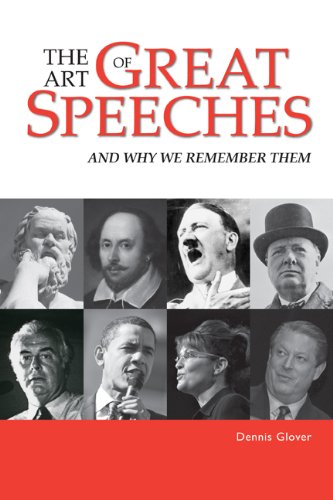
One of my hobbies over the years has been listening to, reading, and collecting the great speeches of history.  From Socrates’s speech at his trial to Pericles’s Funeral Oration speech to Napoleon’s speech to his Old Guard to Martin Luther King’s Dream speech, I have always been fascinated by oratory that mesmerizes, galvanizes and exhorts people to goals and endeavors that they would never have believed possible.  The list of great speeches is exhaustive.  It would take an encyclopedia to catalog all the wonderful speeches of history.  I am sure that there are blogs dedicated to this effort.  For the next few weeks, I am going to present my humble attempt to look at a few of these magnificent oratorical achievements.  Few things in life are more beautiful that a well worded speech.

article-2403311-1660750A000005DC-96_638x433

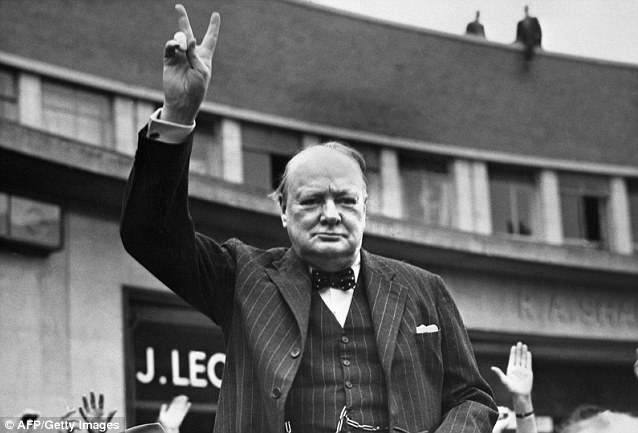
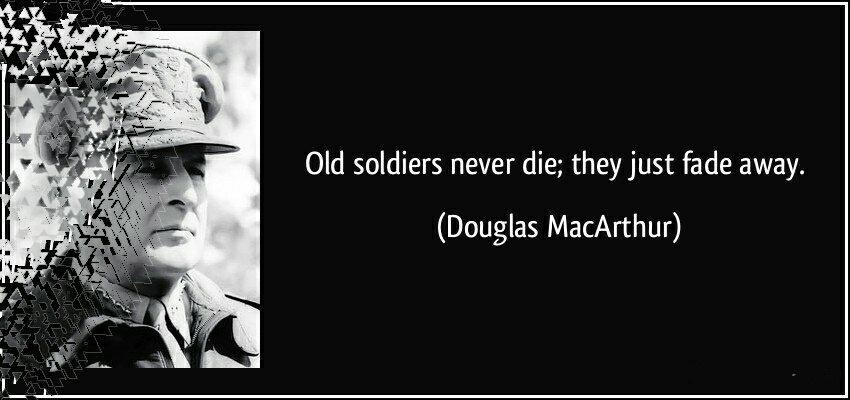
One of the most interesting things about a great speech is that you can find yourself being moved by it even when you disagree with the arguments or premises of the speaker.  For instance, General Douglas MacArthur delivered his “farewell speech” to a joint session of Congress on April 19, 1951.  This speech is sometimes referred to by its most famous line “Old soldiers never die; they just fade away.”  MacArthur spoke to defend his militaristic war policy in Asia after being rebuked by President Truman for his resistance to Truman’s position.

i6nbviy2iwv01

I have listened to MacArthur’s speech dozens of time.  I disagree with everything he says in his speech.  Nevertheless, I find myself oddly moved and thinking “Right On!  Let’s go in and blast those guys.”  I catch myself getting ready to sign up with the Marines and remember that MacArthur would probably have started WW III if not for Truman.  But great speeches are like that.  They move us, they hypnotize us, they motivate us to efforts that were not for the speech, we would never have thought possible.

I have this habit in my blog of doing things or writing about ideas and issues in groups of seven.  I think this is the limit to my attention span on any one topic or issue.  Thus, I wrote about capitalism, medicine, immigration, education, prophets, and several other issues in groups of seven or sometimes less when my focus ran out even sooner than seven.  In respect to talking about great speeches, I could write about one great speech each day and not live enough lives to cover all the great speeches of history.  Thus, in keeping with my limited attention to seven of any particular subject, I will spend the next seven blogs “reconstructing” some of my (perhaps not the greatest) favorite speeches.

Now, I carefully chose the word “reconstruct.”  If I had said that I was going to “deconstruct” several great speeches, then these next blogs would be quite a bit different.  To deconstruct can be defined as:

“A method of critical analysis of philosophical and literary language which emphasizes the internal workings of language and conceptual systems, the relational quality of meaning, and the assumptions implicit in forms of expression.” —Dictionary.Com. 

I have no desire or the skill level to “deconstruct” historic speeches.  Instead, I would like to “reconstruct” several of these speeches by reinterpreting what the original speakers wanted to achieve.  To understand this, we must understand the relationship of the speech to the context that the speech was given in.  Too often you hear a speech, but the context of the speech is often left out of the speech.  This is a major failing of listening to any speech since the context in which the speech occurs is essential to fully understanding and appreciating the speech.  I will also try to reconstruct the meaning that these speakers had by updating and rephrasing some of their vocabulary for a modern audience.  This will probably horrify some purists out there who believe that things once said should never be rephrased.

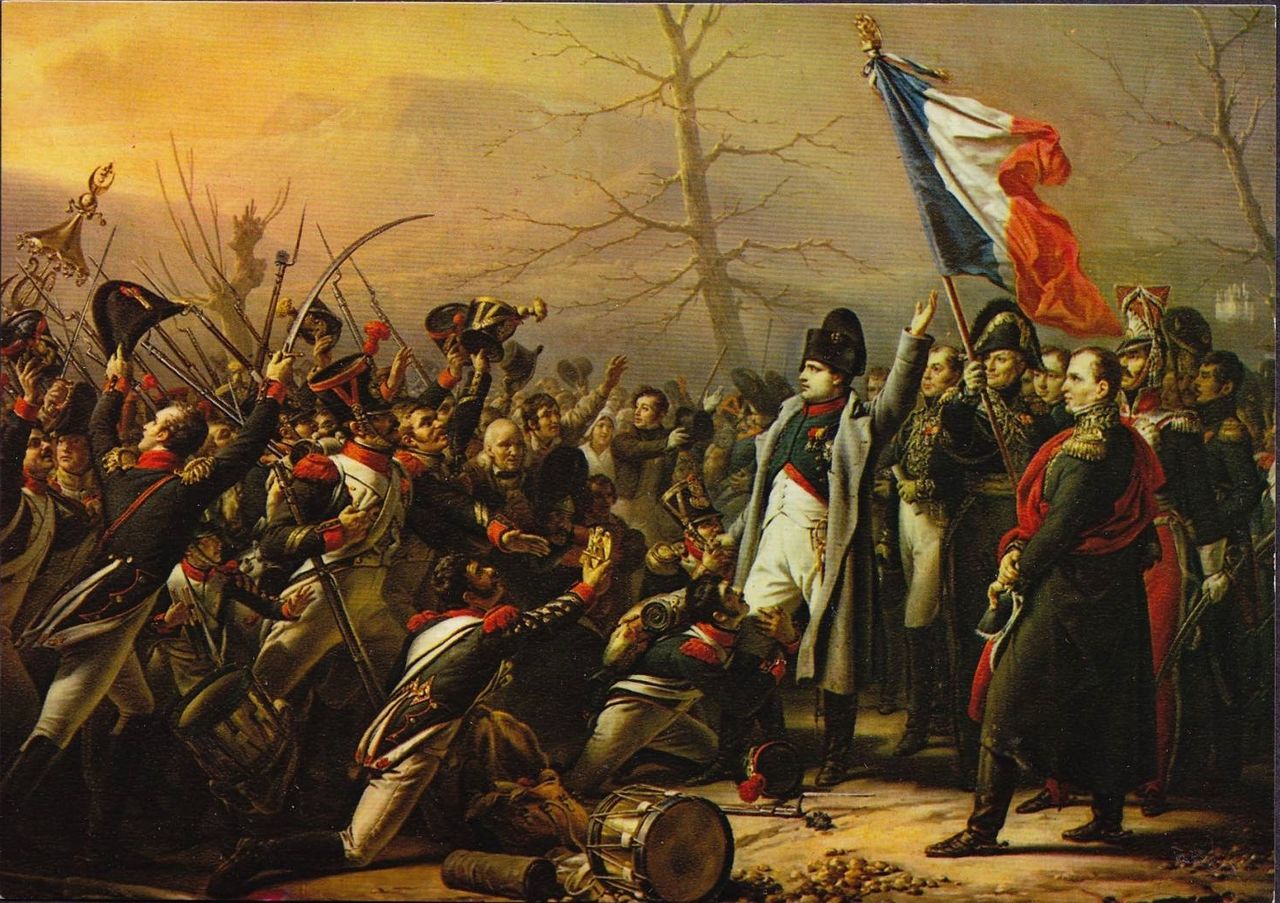
Let me give you an example from one of Napoleon’s famous speeches.  First, though we need to establish the context for his speech.

Napoleon_returned

History teaches us today that either Napoleon was a great military leader or that he was a megalomaniac bent on world domination.  If we journey back to the times right after the French Revolution (1789- 1794) we find Europe in turmoil.  The French people have not only overthrown their King and Queen, they have beheaded them.  Monarchies all over Europe are still in power.  Spain, Italy, Austria, Hungary, Germany, Russia, Norway, Sweden, Belgium, and others all have their reigning rulers ordained by God.  Imagine their horror at seeing the French get rid of their royalty.  Imagine, if we suddenly took all our politicians and drowned them in the Potomac.  Or what if instead of storming the Bastille as the French Peasants did, we would storm Hollywood and throw out all the actors and actresses.  “Off with their lovely gorgeous heads!”

9781640306547_p0_v1_s550x406France is in chaos.  Heads are rolling faster than you can say “jack rabbit.”  No one knows whose head will be on the guillotine next.  In the middle of this pandemonium, the Monarchs surrounding France decide to put a stop to the changes going on in France.  They plan to reestablish the French royalty and bring things back to where they were.  European royalty marshal their armies to attack France.  In steps Napoleon.  A young French solider with extraordinary military skills.  Napoleon galvanizes the French People and singing the Marseillaise they fight back and defeat all of the opposing enemies.  The Following is an excerpt from a speech given by Napoleon to his army in Italy delivered on May 15, 1796:

“SOLDIERS! You have precipitated yourselves like a torrent from the Apennines. You have overwhelmed or swept before you all that opposed your march.  Piedmont, delivered from Austrian oppression, has returned to her natural sentiments of peace and friendship toward France.  Milan is yours, and over all Lombardy floats the flag of the Republic.

Basically, Napoleon is congratulating his army on their spectacular victories over the combined armies that attacked France: “You guys did great.  You really rocked. You kicked some real butt out there today.” 

But, and this is a big BUTT, “Power corrupts, and absolute power corrupts absolutely.”  Napoleon’s victories and the rewards from these victories soon went to his head.  It was not enough to simply defend France; Napoleon then decides that there are more wars to win and more power to obtain.  He plans to establish a Grande Paix Française, wherein France will rule most of Europe with himself as emperor.  From the same speech in Italy:

“Yes, soldiers, you have done much; but much still remains for you to do.  Shall it be said of us that we knew how to conquer, but not to profit by victory?  Shall posterity reproach us with having found a Capfia in Lombardy?  Nay, fellow soldiers!  I see you already eager to cry ‘To arms!’  Inaction fatigues you! and days lost to glory are to you days lost to happiness.”

“Okay Guys, we kicked butt.  Wasn’t it fun?  But look, we can kick more butt and have more fun.  I guarantee glory and fame awaits us.  As we sing the Marseillaise:

To arms, citizens!

Form your battalions,

Let us march, let us march!

That their impure blood

Should water our fields.

Sacred love of the fatherland,

Guide and support our vengeful arms.

Liberty, beloved liberty.

41nEpKQ5+WL._SX338_BO1,204,203,200_

Over the course of my next seven blogs, with interludes as needed, I will “reconstruct” seven of my favorites speeches.  The speeches that I want to look at will include the following:

  • The Defense Speech – Socrates
  • Here I stand – Martin Luther
  • Dare, Dare Again, Always Dare – Danton
  • If There is No Struggle, there is No Progress – Frederick Douglas
  • I Am an Anarchist – Lucy Parsons
  • Give Me Blood and I Will Give You Freedom – Subhas Chandra Bose
  • Police Brutality Speech – Malcolm X

There are thousands of great speeches and dozens of “The Greatest Speeches in History” lists.  For my reconstructions, I wanted to take some of my favorite speeches that are less well known, and which were very controversial at the time.  It is one thing to get up and say something that everyone will agree with (Trump Speech), it is another thing entirely to give a speech that threatens the status quo and which may leave the audience hating you.  Each one of the above speeches is challenging and provocative.  The speakers were not afraid to generate animosity and hostility towards themselves.  I think this fearlessness in the face of adversity is truly one of the characteristics of a great speech.

“Persuasion is achieved by the speaker’s personal character when the speech is so spoken as to make us think him credible. We believe good men more fully and more readily than others: this is true generally whatever the question is, and absolutely true where exact certainty is impossible and opinions are divided.” — Aristotle


A Day in the Life of a Hummingbird

75367911-1200px

I am a hummingbird.  My name is Archilochus Colubris, but you can call me Josh.  I am also known as a Ruby Throated Hummingbird to distinguish me from other members of my family.  We have over 330 different species in my family.  Much like humans have ethnic groups, we hummingbirds have species.  My family has the distinction of being the smallest members of the bird class known as Aves.

I listen to humans all the time talking about how tough their lives are.  Buddy, you don’t know what tough is.  Humans think they live life in the fast lane.   Did you know I flap my wings at 60 times per second?  That is 3600 times per minute.  Speedy Gonzales can run a mile in 4 minutes, in that time I could go nearly 4 miles.  I can fly upwards of 50 miles per hour.  My heart beats at over 1200 beats per minute.

Human beings, even the busiest ones take breaks several times a day.  Not me.  I almost never stop moving.  My life is constantly in motion.  I don’t have time for breaks.  My life span is only about 4 years.  During that time, I have lots to do.  Humans are always in a hurry and multi-task because they think have lots to do.  I can do in one year what it takes a human twenty years to do.  The cycle of life is the same for all of us.  We are born, grow up, age, and die.  Along the way, we make friends, have babies, eat many meals, sleep every day, and see some of the world.

60395581Did you know that if I am in Wisconsin this summer, I will migrate down to southern Mexico and northern Panama each winter?  I go by myself because hummingbirds tend to be loners.  No flocks or “birds of a feather” for us.  I enjoy the trip down each year by myself.  It takes me about a week to reach my final destination area.  The most remarkable part of my voyage is crossing the Gulf of Mexico.  I will fly non-stop up to 500 miles to reach Central America. It takes approximately 18-22 hours to complete my solitary flight.  I do this each year of my life.  I think even Charles Lindbergh would be impressed with my journey.

393c576c25effe36d2d60a0eb3477f25

b44b45903b38d29898c4e956efe12218Now I know you are all wondering about my sex life.  I have observed that this is an especially important part of a human being’s life.  So, you are probably asking how often does a hummingbird have sex and how many kids do we have in our short lives.  I probably find a female about three or four times a year to mate with.  I spend a great deal of time trying to impress a suitable mate.  I make the Blue Angels look like novices with the aerobatics I perform to attract a female of my species.  Compared to the time spent attracting a female, our mating goes pretty rapidly.  In about 4 seconds we are both done.  I have heard that some human males are even faster.

Unlike some humans and much like some others, I do not have a big role in the lives of my progeny.  I do not mate for life and I do not help my mate in any way to build her nest or care for her chicks.  In a human, this would be the height of irresponsibility, but it is just not in our DNA to take a patriarchal role with our off spring.  Of course, some human males will identify with my position.  I have observed many human males who take even less of a role than I do with their kids.

6258550c130c5ce0edb04526038302adNow as far as friends and enemies go, I do not have much of either one.  There is good and bad in this.  Humans have many friends and they tend to come and go like the weather.  I don’t have to deal with “fair weather” friends because I never make any friends.  If I miss out on the companionship, it never bothers me.

As for enemies, many birds fear hawks but I do not.  I tend to worry more about cats and praying mantis.  Both of these predators are surprisingly stealthy and have caught many a hummingbird by surprise.  Sometimes wasps, spiders, frogs, and an occasional snake will get lucky and make a meal of us.  Generally, I am speedy enough to avoid any potential predator who sees me as a tasty snack.  Being as small as I am, I cannot make much of a meal.

RubyThroatedHummerMaleAtFlowersNow we come to the biggest and most important part of my day.  Since I expend so much energy just moving and staying alive, I have an enormous appetite.  I love to eat.  My life is one constant search for food.  My favorite meals are nectar and insects.  Because of my high metabolism, I must eat all day long just to survive.  I consume about half my body weight in bugs and nectar each day.  To do this I must feed about every 10-15 minutes and visit 1,000-2,000 flowers throughout the day.  I will eat a few dozen to several hundred or even a thousand or more insects in one day, depending on the availability of insects, the type of insects, and my dietary needs. Imagine a 200-pound human eating about every 15 minutes a day and consuming 100 lbs. a day of meat.  Judging by some of the humans I see, I think some have this as a goal.  It might work for them if they were as energetic as I am, but this seldom seems to be the case with humans.

Eventually, death comes to us all.  We live fast and we die fast.  In only four years (on an average) I will be equal to an eighty-year-old human.  Like humans, hummingbirds die from many causes.  Predators eat us, we fly into stationary objects (especially windows and buildings), we get hit by vehicles, we encounter problems during migration or bad weather, we succumb to disease or other physical maladies, or we just plain get old and die.

The average heart rate of a human is about 70 beats per minute.  Assuming 80 years as an average age for most humans, than a human can expect to have about 100,800 heart beats per day x 365 days in a year x 80 years for a total of 2,943,360,000 heart beats in a lifetime.  Now my heart beats at about 1200 beats per minute or 1,728,000 per day x 365 days in a year x 4 years.  I can expect to have about 2,522,880,000 heart beats in my lifetime.  Given the range in my average age versus the average age of a human, I find it interesting that I have about the same amount of heart beats as a human does before I die.  I think there is a message here.  Maybe we all have the same amount of time on the earth, but we live it at different speeds.  Maybe we should all live each heart beat to the maximum.

I think I gave you more than a day in my life.  But since things move so fast for me, I could not help but give you a lifetime in a day.  Please watch the following video that some friends of mine made.  I am featured prominently in this film.  My one chance for stardom.

“I always loved those little creatures [hummingbird], always feel blessed when they appear nearby. There’s a magical quality to them. I finally put one in a song.” — Leonard Cohen


Autobiographies from the Dead – George Floyd

george-floyd-mural-scholarship

This series of “Autobiographies” started out as seven stories to commemorate some very special people.  They have one thing in common.  They are all dead.  Some have a burial place, and some were simply discarded like pieces of trash.  Their stories are told by the deceased themselves.  Their voices cry out from the fields, alleys, streets, rivers, and graveyards to speak.  I hear their cries.  They are channeling me to tell their stories to you.  They want you to know what their living and dying was for.  This week, George Floyd will tell you in his own words about his life, loves, dreams and death.  He is deceased now, talking from the great beyond where he has gone to meet his maker.

george-floyd-daughter-gianna-float-rtr-jc-200603_hpMain_16x9_992

George Floyd

My name is George Floyd.  My full name is George Perry Floyd Jr.  The name George is derived from the Greek word γεωργός (georgos) meaning “farmer and earth worker.”  I suppose it means that I am or was the “salt “of the earth.  Many kings, authors and great people have been named George.  The most famous for Americans being George Washington.  My family name was Floyd.  Floyd could have been my first name and people used to kid me and call me Floyd instead of George and tell me that my name was backwards.  Floyd is or was a slave name being derived from English or Irish heritage.

I was proud of my name.  Many Black folk get rid of their slave names and change them to Muhammad or Mustafa or some other Muslim name.  Others simply find a “non” slave name to adopt.  I was not ashamed of my name and I was always proud to be an American.  I was never one to say that all White people are devils or that White people are all the enemy.  I had many White friends as well as Black friends.  You can grow up in America being White and having no Black friends but if you are Black, you will more than likely have many White friends.  I got along with everyone.

Floyd_George3I was born on October 14, 1973 in Fayetteville, North Carolina.  I grew up in Houston Texas.  I was always big for my age and I loved sports where I excelled.  I also loved music and was part of a hip-hop group called “Screwed Up Click”.  My stage name was “Big Floyd.”  I was or thought I was headed for greatness.  Somehow though greatness never came.  I did not make any major league teams and I never got any big breaks on the music scene.  Like many young Black men with no foreseeable future, I stumbled into drugs.

Drugs will do three things for you.  1st. Destroy any will to achieve or drive for excellence.  The drug becomes a substitute for greatness.  2nd.  Destroy your finances.  You can never make enough money to support a drug habit.  3rd.  Lead to crime.  In order to support a drug habit, you must either deal or steal.  I chose to do both.

skynews-george-floyd-washington_5007851

I see the millions of people marching now in my name.  They are marching for peace and justice.  I spent several years in jail and was a criminal five times over.  I was arrested for an armed home invasion and sentenced to prison for five years.  I was a bad guy.  I was no saint.  I had five children out of wedlock, some of whom I abandoned.  If you had killed me back then, it would have been no great loss to humanity or my family.

In 2013, after leaving prison, I started to turn my life around.  I had kicked my drug addiction and I decided to devote my life to helping others.  I wanted to lead a more Christian life and help other young men do the same.  In 2014, I moved to Minneapolis to find work and new opportunities for my new life.  People called me the “Gentle Giant” because I would not hurt a flea.  I could easily have hurt at least two of those cops who grabbed me if I had wanted to.  I went down without a struggle.  I was 46 years old and things were looking up when I died.

8:08 PM – 14 Minutes to Live

It was May 25th, 2020.  It started off much as any day might.  Like many Americans, I had lost my job due to the Covid-19 Virus.  I was thinking about where I might find some other job opportunities.  I spent some time talking to my girlfriend and took some pain killers for a low back ache problem that I had.  I watched some sports on TV.  Later that day, I decided to take a drive with a couple of friends to a nearby market to get some cigarettes.  The weather was clear.  It was around 8 PM and the local temperature was 76 degrees.

I went into the market.  I picked out my favorite brand of cigarettes and paid the store clerk with a twenty-dollar bill.  I walked out to my car, got in and was sitting in the car talking to my friends when the store clerk and another guy comes running up to my car and starts demanding that I give him his cigarettes back.  He is also telling me to give him my phone.  He is hard to understand, and I do not know why he is demanding that the cigarettes be returned.  I decided to just ignore him and hope he will go away.

flyod-site-1-white-box-videoSixteenByNineJumbo1600

The next thing I know is that two cops are banging on my car window and telling me to put my hands on the steering wheel.  One cop has his gun drawn and is pointing it at me. The rest of the events happened so fast that they are hard to describe.  I am trying to ask, “What have I done?”  I do not want to seem resistant and I am trying to comply with the demands that the police are making while I am also trying to find out what I have done.  Next, I am told that I am under arrest.  What is happening?  What did I do?  What am I being arrested for?  I am then handcuffed and pushed to the police car.  I am as compliant as I can be, but the handcuffs hurt and my whole world is one big confusion.

george-floyd-homicide

Then things go from bad to worse.  One officer pushes me to the ground and kneels on my neck.  “I can’t breathe.  I can’t breathe.”  I scream this out several times.  I plead for him to take his knee off of my neck.  “Please don’t kill me.”  My pleas are ignored.  “I can’t breathe.”  I think I am dying.  “Mama.”  I know that I am dying.  “Mama.”

I died at 8:22 PM but the officer did not take his knee off my neck until 8:27 PM.  He had kept his knee on my neck for 8 minutes and 24 seconds.  What did I do?  Why did they murder me?  I was only 46 years old and my life was just beginning to come together.  What did I do to deserve such a fate?  Did God not forgive me for my former transgressions?  Was it because I was a Black man?  Do White people really hate and despise all Black people?

george-floyd-funeral-fountain-praise-church-houston-09-gty-jc-200609_hpEmbed_3x2_992

They buried me on June 9, 2020 in Houston Texas where I grew up.  I am amazed at all the people that attended my funeral.  Life sure is funny.  Thirty years ago, I had a dream.  I was 16 years old and when a friend asked me what I wanted to do with my life, I said “I want to touch the world.”  Now I see that I have touched the world.  I did not think I would have to die to do it though, but in one sense it is a cheap price to pay.

Wright-GlobalProtestsGeorgeFloyd

The life of a Black person in America is never easy.  Institutionalized racism, personal racism, prejudice, and discrimination are woven into the very fabric of our daily lives.  From the economic sphere to the social sphere it is difficult for a Black person to rise above the hatred and bigotry that surrounds them.  Few if any White people understand what it is like to be loathed because of the color of your skin.

I go now to find God.  I want to know if it will ever end.  I want to know why God allows it to happen.  Will there ever be a day in America when a Black person can walk down a street and not be judged by the color of his or her skin?

22454672


What do those Black People Want Anyway?

Wrote this five years ago. More relevant now than ever before.

Dr. John Persico Jr.'s avatarAging Capriciously

Two White men overheard talking at a coffee shop (Read while listening to Glory from Selma)

Ron:  You know it seems all we hear about are Black problems these days.   What do they want?  Christ’s sake, we abolished slavery over 150 years ago now.

Jack:  Yeah, then they got to join the military in WWI and even fight in WW II.

Black-unemploymentRon:  Yep, then all they did was complain even more.  Selma and Bama marches!

Jack:  Right, so we gave them the Civil Rights amendment.  Thought that would make them happy!

Ron:  Nope, they just complained even more.  Watts riots and all.  So what did we do?

Jack:  Created Martin Luther King Day.

Ron:  Just so.  Did that make them happy?

Jack:  Course not.  They just whined even more.  Especially after that white guy shot MLK.

Ron:  So what…

View original post 883 more words

A One Act Play in Memory of Our Good Friend: Dr. Hana Tomasek – D- 05-25-2020  

Dr. Hana Tomasek:  A Most Remarkable Woman

I am reposting this blog in memory of my good friend Dr. Hana Tomasek who died at 10:45 AM this Memorial day morning (May 25, 2020) from the Coronavirus.  Dr. Tomasek led a life that most of us can only dream about.  She was 85 years old.  Every year on July 4th, Hana would have a wonderful Independence Day Party to celebrate the country that she felt gave her everything that she could possibly want.

We would have a band, dancing, lots of good food and a series of roasts to poke good natured fun at Dr. Tomasek.  She had a great sense of humor and enjoyed the gags.  The highlight of the day though was the speech that Hana always gave to remind us all of her love for America and what a great country she lived in.  Five years ago, I wrote this play for our July 4th party in 2015.  Seems like just yesterday, that we were all sitting on her deck overlooking her beloved lake and drinking Becherovka.

Introduction to the Original Blog Written on June 1, 2015

Once upon a time there was a very remarkable young woman and young man who decided to flee communism and come to the United States of America in hopes of finding a better life.  Leaving their families and at great risk to their own lives they managed to elude the authorities in their home country and find their way to America.  With hardly anything except the clothes on their backs and speaking no English Hana and her spouse found asylum in the USA.  With the help of some good spirited people, they began to construct a new life based on their dreams and abilities and not simply by adhering to the “party” line. 

Hana became a good friend of ours in the late 80’s when we met at Process Management Institute, where Hana was now an esteemed consultant as well as educator at the University of Minnesota. Over the years, we shared many thoughts and ideas together.  Hana was one of the most competent consultants I have ever worked with.  She was wonderful at combining both “high tech” and “high touch” in working with her clients.  She was very capable of applying TQM technology but equally capable of compelling the leaders in the organizations she worked with to make the needed psychological changes to adopt a “new philosophy” as Dr. Deming called it.  TQM was ultimately more a change in attitudes then a change in technology.  A point that Hana was quick to recognize. 

Hana will be 80 years old this July and she had a birthday party this past weekend in honor of the occasion.  I was invited to say a few words about Hana at the party.  A picture of her as a young girl inspired my thinking about what I would say.  I thought of how Hana must have been when she was young. With this in mind, I decided to write the following fictional account of an interview with her as a young girl.  I decided to compose it as a short one act play.  At the party, I asked a good friend Nancy Hoy to play the part of Hana, while I narrated and played the part of the young reporter from Prague. 

A One Act-Play:  The Little Girl with Big Dreams.

The Background and Setting:

The 1948 Czechoslovak coup d’état (often simply the Czech coup) –  was an event in February 1948 in which the Communist Party of Czechoslovakia, with Soviet backing, assumed undisputed control over the government of Czechoslovakia, marking the onset of four decades of Communist dictatorship in the country. Czechoslovakia remained as a Communist dictatorship until the Velvet Revolution of 1989.  More immediately, the coup became synonymous with the Cold War. The loss of the last remaining democracy in Eastern Europe came as a profound shock to millions.  For the second time in a decade, Western eyes saw Czechoslovak independence and democracy snuffed out by a totalitarian dictatorship intent on dominating a small country

The play takes place in Prague, 1948.  The Daily Prague newspaper has become a part of the Communist means of controlling the population and is looking for human interest stories.  It has heard of a young precocious girl who is the highest rated student at her school and they have decided to do an interview with her to help show the masses how wonderful life in a communist system can be.

Hana has been notified to expect a reporter from the Daily Prague.  Hana lives in clean 2 bedroom apartment with her mother, father and brother Jan.  Hana sits in a small chair near a larger sofa reading a book and waiting for the reporter to arrive.  It is a small but comfortable and very neat living room with a few pictures of relatives and friends on the mantle.

A One Act-Play:  The Little Girl with Big Dreams.

John:  (Knocking at the door. He is a young man of 25.  Medium height, blond hair. He has been very nervous lately and constantly has the feeling that someone is looking over his shoulder.  He has been warned to stay away from “compromising” subjects.

John:  May I come in?

Hana:  (An attractive looking young girl just turning 13.  Well-proportioned with short brown hair.  Her friends would describe her as elegant and very sophisticated.)

Hana:  Yes, please do.

John:  Hi, I am from the Daily Prague and I am here to conduct the interview with you.

Hana:  Wonderful, let’s get started.  Please sit down.

John:  Thank you. Well, Hana, I will begin by asking you a few questions.

Hana:  It’s Ms. Hana, if you don’t mind.

John:  Sure, Ms Hana.   Well, Ms. Hana, what would you like to be when you grow up?

Hana:  I would like to be President of the United States of America.

John:   (Nervous chuckle noticed by Hana) But you don’t live in the United States of America and even if you did, you could not be president because you were not born there.

Hana:  (Quite composed)  I am going to move to the United States of America and then change the law when I live there.

John:  Well, let’s just say that this might not work out; do you have a backup plan?

Hana:  Of course, I will become a rich and famous management consultant.

John:  But in Czechoslovakia system, only communists can become rich and even they are not allowed to become famous.

Hana:  Then I will go to the United States of America and become a rich and famous management consultant there.

John:  Why do you want to become a management consultant?

Hana:  So I can tell people what to do.

John:  Are there any other reasons?

Hana:  Well, so many companies are so poorly run and they need lots of help.

John:  How are you going to learn about business when you live in a communist system? Wait, I know, you are going to move to the United States of America.

Hana:  Right.  I will learn all about how to become rich and famous when I get to America.

John:  (More nervous now and deciding to change the subject) Could you tell our readers what your hobbies are and what you like to do for fun?

Hana:  I like to study, read and learn about new and interesting things.

John:  Yes, but what do you do for fun?

Hana:  I just answered you.  Maybe I did not understand your question.

John:  Well, like do you jump rope, play doll house or do dress up?

Hana:  What are those things?

John:  (Uncertain where to proceed) Well, I understand you are a very smart young student.  Do you like school?

Hana:    Yes, but recently they changed all the textbooks and they took out all the good stuff about the United States of America

John:  I have not heard about that but maybe it was because they thought it might be lies.

Hana:  Well, I don’t think that people should rewrite history just because they change their minds.  What about facts?

John:  (Quite nervous again)  I think you have a very inquiring mind.  You would make a good management consultant.

Hana:  (Very Serious) Do you know where I could find a good textbook on Management Consulting?

John:  I don’t think we have any of those in the library anymore.

Hana:  Why not?

John:  Well, in a communist system, nobody worries about how the system runs since it is up to the government to decide how things should be run.

Hana:  That does not sound like a very good idea. I don’t think they do it like that in the United States of America.

John:  Well, Ms. Hana, it has been wonderful talking to you.  Our readers will be quite pleased to see how happy and great life in Czechoslovakia is for you.

Hana:  (Very skeptical) May I review your notes?

John:  (Ignoring Hana’s request)  Well,  Ms. Hana, we always like to send our contributors a token of our appreciation.  Would you like a framed picture of General Secretary Joseph Stalin or Defense Minister Ludvík Svoboda?

Hana:  Could you send me a picture of Mickey Mouse?

The END: 

Time for Questions:

What would you do if you lived in a total dictatorship?  Would you risk your lives and those of your family to flee? Would you simply go along as best you could? How would you get started in a strange country where you could not speak the language?  How much courage does it take to start a new life?

Life is just beginning.

Previous Older Entries Next Newer Entries