Special Ed, Special Needs, Special Kids

downloadWe have all heard the words, Special Ed, Special Needs.  We know that these words refer to kids who are “different.”  But do we really know what it means to be different, to be special?  Perhaps some of you have had special needs children.  If so, you do know what it means to be special or to have a special needs child.  For many, like me, it is a somewhat abstract idea.  Once in a while, I see a “different” child in a Walmart or someplace out and about.  My general feeling is sympathy for the child but also gratitude that I have been blessed to date with good health.

Yesterday, I had the opportunity to engage on a deeper level with about 10-15 special needs children.  As some of you know, I still do substitute teaching work at two high schools in Arizona.  Because of the shortage of both teachers and substitutes, I can usually pick which classes I want to sub for.  Years ago, you needed a license in a specific area to substitute in that area.  For instance, if you were substituting as a math teacher, you needed an education license in Math Teaching.  That is not the case here.  I substitute for most subjects from math to history, to band, to choir, to dance, to art, to construction, to automotive and even 4H.

imagesThis past week, I accepted a substitute teacher position in an ESS class or Special Ed class.  I was somewhat reluctant to take this class because I knew that there was no teachers aide in the class.  In many Special Ed classes, the regular teacher has one or two “Paras” who assist with class management.  A few weeks earlier, I had been asked to substitute for only one period in this same class.  I was rather surprised to find out that I was alone with ten special needs students.  Because they are all very different, having someone aboard who understands their various needs is important.  I had no experience with any of these children and have never been trained as a Special Ed teacher.  The forty-five minutes went quickly, and I had no problems.  Thus, when I saw the opportunity to sub for an entire day (which includes five periods of 45 minutes each) in this Special Ed class, I took it.

download (1)As the day drew closer, I had more and more trepidations.  Could I handle these children for five periods by myself?  Would I end up doing some emotional damage to these kids?  Would there be situations I could not handle.  The day of the class, I went in to see the administrative assistant who gives out class keys and class assignments.  I think she noticed my reluctance and she asked if I would want to switch with another class that was missing a teacher.  It would be a PE or Physical Education class.  She knew I have done a great deal of subbing with PE/Health, and I am very comfortable with such an assignment.  My undergraduate degree is a B.S. in Health Education with a K-12 certification.  Meaning I am certified to teach any grade from kindergarten through 12 grade.  In point of fact, I have now taught every grade from pre-school to Ph.D. classes at the University of Minnesota.

I mulled over the offer to switch and decided against it.  I told her I thought I might actually have the opportunity to do some real teaching with the special needs students.  In the regular classes, my offers to help with work or assignments are routinely shot down.  Usually, with polite “No, thank you but we are okay.”  I want to say, “You mean you are not anxious and eager to take advantage of my fifty plus years of education, experience, and knowledge?”  I suspect I would get the same responses.

download (2)So off I went to five periods of Special kids on a Friday which is the worst day to substitute teach.  Friday is the end of the school week and kids are sick of the school regimen and anxious to be free from bells and schedules.  Added to this eagerness to leave the school environment is the fact that there are only about three weeks to go until the end of the school year.  Students are primed for anything but education.

I arrived in the classroom about 30 minutes early which is my usual strategy.  This gives me time to find the regular teachers assignment and to peruse it to be sure that I understand it.  I decided to write the instructions out on the whiteboard as well.  The teacher had five class periods.  Two dealt with reading.  Two dealt with science and one dealt with math.  The assignments seemed straight forward.  Three of the five assignments had physical worksheets.  The assignment for the two science periods was to be done on their computers.  All assignments were to be completed by the end of the class.  Students were allowed to work together.

images (1)The entire day turned out to be very delightful and fulfilling.  Not only did I really enjoy interacting with these kids, but I really learned the meaning of “Special.”  Each child was very unique.  As a group, some had special emotional needs.  Some have special physical needs.  Some had special cognitive needs.  For some the dividing line was difficult to discern.

All of the students interacted very differently with me and their fellow classmates.  Some students were gregarious.  One young girl went around the class to make sure that students were working on their assignments.  She frequently offered me advice on running the class.  She came in for several periods and I enjoyed her extroversion.  The other students seemed to regard her as a De Facto teacher.

images (2)Some students were very solemn and said little.  They did not really interact with others and pretty much kept to themselves.  Some students were more loquacious and liked to laugh and joke with other students.  Another young lady in the class started talking about her pet rabbits.  I put a short video from “YouTube” up on the screen that showed pictures of various rabbits and some of their habits.  The kids all enjoyed the pictures and kept focused on their assignment while they watched the photos of rabbits doing some funny things like sleeping with a cat and sitting on someone’s head.  There is hardly anything cuter than a young fluffy rabbit.

download (4)

Over the course of the day, I actually managed to help several students with their assignments. To my amazement and surprise, these Special Needs students stayed focused on their assignments.  In a regular class, many of the students will do all they can to avoid working on their assignment.  From texting on their cell phones, to playing video games, to social media on their laptops, it is a constant challenge to get students to “focus” on their education and not on some video game.

All of the fifteen or so special needs students that I saw during the day were polite and respectful.  Two of the young men in the class looked like big jumbo teddy bears and acted like one.  They were always smiling and happy and learned my name right away.  I use Dr. John rather than my last name as I try to be somewhat informal with students.  In addition, out here in the Southwest, Persico is not easily pronounced.  I use the Dr. prefix to let them know that I have credentials beyond simply a teaching degree.  I think many regular students as well as regular teachers see substitute teachers as some sort of losers that can’t really teach or do anything else.  For instance, substitute teachers are never included in teacher prep meetings or teacher education activities at either campus.  I have been subbing out here for five years now. During the “Red for Ed” movement, I was told that I could not join because I was only a substitute teacher.  My net pay is $130 per day.  Sure, Karen and I can always use the money, but if you think that I am substitute teaching for the money, you do not know me very well.

If I only wanted money in my life, I would stick to writing this blog.  Since starting it fifteen years ago, I have made millions on endorsements for Trump products.  I have collected hundreds of thousands of dollars for doing keynote speeches at Republican conventions.  Famous Hollywood directors are always importuning me with opportunities to have my life story made into a movie or video game.  Marvel even contacted me about using my persona as a superhero for one of their comic book series.  I turn them all down because truth be told, Karen and I have more money than we know what to do with.  Besides that, I value my anonymity over Fame and Fortune.  Now you know that I am almost as big a liar as Trump.  However, look how far he has got by lying.

In Conclusion:

I ended up the day feeling very good about myself and my students.  I learned why we should think of these children as special.  I do not think that I will see a Special Child again and feel sorry for them.  I will be grateful that the universe has room for all kinds of people including those who are different from the norm.  There is a big difference between difference and deficit.  I hope I made a difference in their lives in some way or at least made the day fun for them.  I see no reason why school and education should not be fun.  Instead, for too many students today, we have turned our schools into prisons.  Did you have security guards in school when you went to high school or teachers carrying concealed weapons?

Facing America’s Real Problems:  Part 2 – The Failure of Education

help

One of my writing goals is to simplify the complexity of the problems facing the USA today.  This effort is like trying to find my way through a very complex maze.  An instructor of mine once told me that “anytime you study a problem, it becomes more complex.”  I agree with his analysis, but I also like the Zen thought that when we start studying a mountain, it first becomes a complex amalgamation of physics, geology, geography, chemistry, and biology.  However, once we really understand it, it becomes a mountain again.  A Zen cycle of simplicity, complexity and then simplicity.

This is the problem facing my analysis of the Education System in America.  It is complex and overwhelming.  I have been working in the system for almost fifty years now.  I have taught every grade from pre-kindergarten to college Ph.D.  classes.  I have written several blogs on this subject already.  However, as each day goes by, what I have said the day before seems less and less adequate.  Many friends have disputed my thoughts on education.  They think that I am wrong, and that the system can be saved by some tweaks here and there.  I disagree.  I have not changed my thoughts on this problem.  We need an entirely new concept and system of Public Education.

The Public Education System in America is like a bomb that has exploded.  You cannot put the bomb back together even if you do manage to find all the pieces of the bomb.  The Public Education System in America is dysfunctional and outdated.  It is rapidly disintegrating as the many outside forces that impact it are ignored or mishandled.  The most important of these forces involve technological and social changes, but they also include a well-funded political effort on the Right to privatize education.

The rich in America understand that Public Education is not serving the needs of students and families.  Those with money and power are cannibalizing the present Public Education System with vouchers and charters to establish elite schools for the wealthy and privileged.  The dream of a Public Education System which would prepare all children with the tools and skills needed to be successful in a Democratic society has been abandoned by many in this country.  We are moving towards a two-tier system of education.  Much like we have one system of justice for the rich and powerful and another for the poor and underprivileged, we are moving towards the same structure in our schools

For the past seven years, I have been working as a substitute teacher in two different high schools in my local area.  While I think many of the same problems plague elementary schools and universities, there are notable differences.  Thus, in this blog, I want to focus on the problems that I have seen over the past few years that high schools are trying to deal with.

The two high schools where I am teaching are comprised of mainly low-income students in an area of low-income families.  The two high schools I substitute for received the following ratings by Public School Review based on a comparison of test scores statewide.

High School 1 -Rating: 2/10 Bottom 50%

High School 2- Rating: 4/10 Bottom 50%

Arizona ranked worst state in America for teachers, study says

Arizona public school system ranked worst in America; study says

The results for Arizona are dismal and put Arizona at the bottom of states in terms of supporting education.  However, I do not believe that these statistics should lead anyone to feel that Arizona is simply a bad state for education.  In the first place, ratings and rankings only tell a portion of the story.  I have seen many schools across this country.  I doubt that the problems in Arizona are much different than for most public schools in America.

We have a systems problem here and my best guess is that most public high schools will be within three standard deviations of a mean around test scores or any other rating scales you can use.  Thus, using the same statistical methods we use for determining the quality of any process, it would be foolish to say that any one school is clearly better than the rest.  The same forces are at play across this country in our public schools.  We are looking at a system and not simply a group of isolated schools.

The following are the major forces causing the deterioration of Public High Schools today.   I will address each of these in more detail.

  1. Technology that replaces traditional skills learned in school. g., AI replacing writing skills
  2. Lock step education methods
  3. Low investment in education by students and parents
  4. Lack of student discipline
  5. Attacks by politicians on the Right who are pandering to voters and parents at the expense of teachers and students
  6. Over emphasis on testing and high school rankings

ai

  1. Technology that replaces traditional skills learned in school.  g., AI replacing writing skills

Years ago, in 1975 when I was doing my student internship for my undergraduate teaching degree, I allowed my students in my classes to use calculators.  The math teachers in the school were appalled but I did not desist.  They went to the principal who ordered me to stop allowing my students to use calculators.  “What, he said if the batteries went bad?  How would they do any math?”  I replied, “What if their pencils ran out of lead?”  He was not amused.

From calculators to computers to cell phones to the internet and now Artificial Intelligence, the world that students live in today bears little or no resemblance to the world that many of us once knew.  However, the fundamental problem here is not technology.  Marshal McLuhan nailed the problem fifty years ago.  The world outside schools is now richer and more dense with knowledge and skills than the world inside schools.  Once upon a time, students went to a dense environment of wise instructors, libraries and books that were unavailable to the wider community.  Today, a child of three holds in their hands more knowledge than in the Library of Congress.  That child is also exposed to ideas from all over the world and not just Po-Dunk Iowa.  Schools cannot compete with this.  Schools are becoming more and more irrelevant.  Students know this but parents, teachers, administrators, and politicians either are blind to the fact or too vested in the present system to seek major changes.

a1326f39e43302f3961992324310e02011519edc1cee4c6fd5fdf41a8f898e2d

  1. Lock step education methods: 

Standardized testing.  Standardized curriculums.  Grades following one after another in silent marching precision.  Our nation seems obsessed with insuring that everyone marches to the same drummer.  Do you have children?  Do you see anything identical about each child?  Take a classroom of 32 students and how many of them will be identical in knowledge, skills, abilities, and interests?

Now put 32 students, Latino, African American, Asian American, White American, and Native American all in an English class studying Romeo and Juliet in old English.  How many of them do you think will be interested?  I did not find an interest in Shakespeare until I was nearly fifty years old.  My interest really began when I discovered something that high school English teachers seem to ignore.  Plays were meant to be watched not read.  They were never written to be read.  And if they were read, they should be in a language that someone might understand.  I watch many BBC shows on the tele and I use the English subtitles to understand what they are saying otherwise I am lost.  I assume that the British are using some version of “Modern English.”  They still argue that Americans do not speak English.

We need a system of Customized Education for all students today.  My program of Free Public Education would start with three-year-old and extend to ninety plus year old.  In other words, I want Free Public education for life and not just for a temporary time in youth.  We say that people are our most important assets.  We need to start treating them like they are important.  We need to provide life-time education that will continue to prepare citizens for careers today, tomorrow, and next year.

teachers

  1. Low investment in education by students and parents:

Here is a law.  “If people have no investment in something they do not value it.  When people are invested, they value it more.”  Parents send their schools to free public schools.  Students go to school for free until college and sometimes even to college for free.  Many parents value schools for their babysitting function rather than for the purpose that schools were designed to serve.  Parents are irate when schools and teachers go on strike.  However, across America schools and teachers are at the bottom of the barrel when it comes to funding.  I have seen more than eighty percent of funding requests here in Arizona vetoed in referendums since 2010.  This comes at a time when funding for teachers and schools in Arizona ranks at the bottom of the US list of states.

I am for “Free Public Education” but that means in terms of money individually paid by parents and teachers for education.  That does not mean I think students and parents should be given a Free Lunch.  Indeed, I want to see accountability on the part of students and families for the education that their children will receive.  Parents and students should have accountability not in terms of monetary compensation but in terms of time donated to the education system.  They need to have a program in education whereby parents and students support public education using time allotments paid to the schools.  One of the teacher aides I worked with a few weeks ago suggested that she would like to see parents with their children in school sitting in class with their kids on a regular rotating basis.  This is a great idea but only one of many that could be instituted to help ensure that students and parents have a vested interest in education.

students

  1. Lack of student discipline:

Student discipline is a major problem in public schools today.  I have seen teachers and substitutes walk out of school after their first day on the job.  Schools today are loaded with security guards and even armed police in some schools.  On any daily roster of students there will be a few serving in-school suspension and some serving out-of-school suspension.  Every year, I see more and more students in detention.

Kids behave towards teachers with the same arrogance that their parents may have for teachers and education.  The poorer the classroom in terms of demographics, the worse the discipline will be.  It does not matter whether the class is Black, White, Brown, or Red, the poorer the social economic status of the class, the more behavior problems you have in the classroom.  The wealthier people are the more they seem to value education.  This is not a hard and fast rule, but a general observation based on my almost fifty plus years of teaching.  This is one of the reasons so many of the wealthy are pulling their kids out of public schools.

Today, teachers are so little respected that many of them are afraid to discipline their students.  I had a security guard tell me that she would not intervene in a fight between students as she did not want to take the risk of either being hurt or sued.  Teachers should not have to be disciplinarians.  Once upon a time, when I was a young, if I disobeyed a teacher and my father found out about it, I was punished.  This was typical of my generation.  No questions asked.  The teachers was right, and I was wrong.  Somewhere in the mid-seventies, there was a sea change of major proportions.  Suddenly, teachers were besieged with challenges like “What did you do to make my Johnny or Mary act out?”  “It is your (teachers) fault that my child is failing.”  Teachers are now in the wrong when students are disciplined or given a failing grade.  There is little or no support among many families for teachers.  The teacher is wrong.  The student is right.

A few nights ago, before a concert, I sat with two other retired teachers.  We discussed the sea change I noted above and what the potential causes were.  Here were some theories”

  • The teachings of Benjamin Spock were too liberal
  • Parents feel guilty they do not spend enough time with their children
  • Single parent families lack the ability to discipline their children
  • TV promoting a set of values antagonistic towards education
  • Too many people that were not well served by public school education in the past

At the time, I did not challenge any of these theories.  I simply listened and questioned.  Over the next few days, I found something wrong with each theory.  I am still searching for the reason.  I welcome any ideas you may have.  Please leave them in the comments section.  I will try to think about and reply to each idea.  Nevertheless, discipline is a major problem, and it will go away unless we understand its root cause.  One solution might be to have parents join their children for in-school suspensions or pay a fine for out of school suspensions.  Perhaps that could be a “Parental Responsibility.”  I think it would put a rapid stop to much of the behavior problems that teachers have to put up with today.

3000

  1. Attacks by politicians on the Right who are pandering to voters and parents at the expense of teachers and students

The Right Wing in this country want to destroy Public School Education.  They are waging a war on education every single day of the year in every single state in the Union.  They are engaging the families of children with promises of “Parental Rights.”  This panders to the same parents that have a low respect for education and believe that schools are brainwashing their children.  This has been an issue among White Supremacists and Southern Bigots since the early years of the Jim Crow laws.  This group is (though they would deny it) racist, sexist, xenophobic and homophobic.  They are against Gay Rights, Minority Rights, Women’s Rights, and Immigrant Rights.  They are for “Parental Rights” but not a word for “Parental Responsibilities.”

The right wing politicians will say anything to curry votes.  They tell parents that books are pornographic or racist.  Their tell parents that their kids are being brainwashed by liberal teachers.  School boards are now being packed with radical parents who want to fire school superintendents, principals, and teachers over what is taught and how it is taught.  In fact, I can point to some of each of the above groups that have been fired in the past few weeks here in Arizona.  Books are being banned in over thirty states in America and librarians are fearful for their jobs.  Politicians are enacting laws whereby teachers can be fined and charged with a crime for teaching certain topics like Critical Race Theory, Gender Studies or Sex Education.

In my seventy-seven years on this earth, I have worked with all sorts of people.  But never have I seen a less moral or ethical group than the politicians that now sit mostly in the Republican Party.  I have seldom believed in conspiracy theories ever since reading C. Wright Mills, “The Power Elite.”  He argued convincingly to me at the time that the wealthy and powerful in America may seem to be working together but it was actually mutual interests that dedicated their actions rather than any coordinated planning or circumspect effort.

Wright Mills is probably now rolling over in his grave. There is an interlocking and well-coordinated group of Right-Wing organizations in this country which plan, fund, and orchestrate major efforts to elect politicians that support their interests, to push laws and bills that support their interests and to block any efforts to make their planning and funding more transparent.  If you doubt what I am saying, look up the following names on Wikipedia and see what you conclude.  Pay attention to the organizations they serve and their reliance on dark money for their activities.  I think you will see more than just a casual converging of interests in their activities.  They are orchestrating well-funded efforts to destroy public education.

What can we do about this situation?  Is America doomed by money, power politics and large corporate interests that are overriding the public good?  Many would say that the end is near.  That the democracy we hoped for in this country is over.  That we the people are powerless to change a juggernaut that is fueled by rich billionaires and served by minions with law degrees and no morals or ethics.

similar

  1. Over emphasis on testing and high school rankings:

A well-intentioned effort to insure quality in schools.  Unfortunately based on stupidity and ignorance of statistics and relevance.   My teacher here was Dr. W. Edward Deming.  The noted quality expert and pioneer who helped the Japanese become world leaders in quality.  Deming was against ratings and rankings that were often used in business to assess employee performance.  The same logic that he used to refute the relevance of these ratings apply to the schools system of ratings and rankings.  Deming said:

“Evaluation of performance, merit rating, or annual review… The idea of a merit rating is alluring.  The sound of the words captivates the imagination: pay for what you get; get what you pay for; motivate people to do their best, for their own good.  The effect is exactly the opposite of what the words promise… The fact is that the system that people work in and the interaction with people may account for 90 or 95 percent of performance.”

If you look at the ratings for schools anyplace in America, you will find that the wealthier the area in which the school is located, the higher their rankings will be in testing and all other metrics.  Here in Arizona, my two schools are in the bottom twenty-five percent of schools in terms of rankings.  Scottdale has the highest ranked schools in the system.  It is no surprise that Scottsdale also has the highest per capital income in the state.  The wealthier the school district the higher their performance rating will be.  Nevertheless, I would not assume that students from Scottsdale have any greater native ability than my students.  I would only assume that they do better on standardized tests.

A few years ago, I took the Forbes 200 list of richest people in the world.  About sixty percent of them had a college degree.  Forty percent never went to college or did not finish a degree.  I did a correlation analysis to see what the strength was between net worth and education.  I was quite surprised to find that the average net worth of those without a college degree was 1.5 billion dollars higher than those with a college degree.  3.5 Billion net worth with no college degree versus 2.0 Billion for those with a college degree.  College has been overhyped as a path to success.

Ratings and rankings are no measure of life success or even of learning to think.  I would argue that the people who excel on college standardized tests are less able to think for themselves and more likely to conform to norms of thinking and behavior.  Regard all the lawyers in America who have gone to Harvard, Yale and Cornell but seem to have little or no ethics or standards other than winning or money.  Both Deming and J. K. Galbraith wrote about the sorry state of MBA programs in America when it came to teaching ethics and morals.  We have too many students now who excel on standardized tests but have no morals or ethics.  They have learned that these things do not matter.

Conclusions:

Here is the part where we live happily ever after.  The good guy wins, the bad guy loses.  Right triumphs over might, and justice wins out over injustice.  If only this were true.  Maybe as Martin Luther King said, justice will eventually prevail.  I am not so sure he is right anymore.  All empires since the Akkadian Empire in 2330 BCE, (Arguably the first empire in history) have ebbed and waned and eventually declined.  Many have predicted that the USA is now on the downward path.  I will say one thing.  Our Founding Fathers knew that a public education system was the cornerstone of a democratic society. Thomas Jefferson said:

”I know no safe depository of the ultimate powers of the society but the people themselves; and if we think them not enlightened enough to exercise their control with wholesome discretion, the remedy is not to take it from them, but to inform their discretion by education.”

Without a Free, Egalitarian and Open Public Education System, America will continue any decline that many believe has already started. 

PS:  Today I noticed that Jim Hightower had also published some thoughts on Education.  I am providing a link to his thoughts as well.  He is a good writer and I always enjoy reading his ideas.  He has a great sense of humor.

Chicken Little Attacks America’s Teachers

Why Public-School Education is Dying – Part 2 of 5 Parts

activity-learning-fi

In Part 1 of this blog on education, I stated that, “I am going to dive into the major reasons that are leading to the death of public-school education.”  In this part, we will look at

  • Why our present educational model is obsolete

Our present educational model is obsolete because it is based on several faulty principles or assumptions.  Perhaps at one time some of these reasons had some validity but that is no longer true.  We are not living in a 19th century agricultural or a 20th century industrial economy.  We are now in a digital economy that is moving faster than anything the world has ever known.  The following are the most important issues that one must understand to realize why our present educational system is useless.

our-education-system-needs-more-architects-e1494436705693

  1. Outdated concepts of how education should be conducted

The teaching in the early part of America was based on two principles.  First, that every child needed a broad liberal arts education to be qualified as a good citizen.  Second, that education curriculums would follow a set of orderly progression starting from simple concepts to more complex concepts.  Thus, you would learn simple arithmetic before taking complex subjects like calculus or trigonometry.

The above principles treated every student as though they were the same.  There was no customization.  There were no exceptions to the grading progressions that developed in most schools.  If you were an advanced student, you would need to wait for the less advanced to catch up.  If you were not as advanced, then you looked like the dummy in class and were often ridiculed.  If you were somewhere in-between, you kept your mouth shut and dreamed of the end of the school year.

These principles may have been useful in a society that was information poor.  Marshal McLuhan said that schools made sense when they could bring information to a central point. Prospective students from information poor societies could come together and feast on the abundance of knowledge that was now centralized in one location.  Over time, the reverse has taken place.  Societies and cultures have become much denser and richer in information than any school could possibly hope to capture.  Students today can access more knowledge on their smart phones than probably exists in the entire Library of Congress.

“Today in our cities, most learning occurs outside the classroom. The sheer quantity of information conveyed by press-magazines-film-TV-radio far exceeds the quantity of information conveyed by school instruction and texts. This challenge has destroyed the monopoly of the book as a teaching aid and cracked the very walls of the classroom so suddenly that we’re confused, baffled.” — Marshall McLuhan, excerpt from “Classroom Without Walls,”  Explorations in Communication (Boston: Beacon Press, 1960)

Treating students as though they are all the same ignores fundamental elements of human skills and abilities.  Some students may have better social skills.  Some have better musical, artistic, and athletic skills than others.  Even in the domain of cognitive knowledge some students excel at math and others excel at English and language.

Just imagine if music was the dominant purpose of education rather than liberal arts.  Children might enroll in schools where the curriculum included violins, drums, harps, guitars, pianos, trumpets, and harmonicas.  Each student would have to learn all of these instruments and get a passing grade in each to graduate school.  It would not matter if a child received an A in violin if they did not pass drums.  If this sounds ridiculous, it should not since it mirrors the way curriculum is handled today.

Furthermore, the system of education assumes that all children would need to progress systematically through learning each instrument.  You would have violin 1 before you had violin 2.  It would not matter if you could do violin 1 when you came to school, you would still be required to take violin 1 before you could take violin 2.  True, in some schools you can test out of a subject but that is still rare in most public high schools.

The idea of holistic learning is totally ignored by the rigid lock step progression that is built into curriculums in both public and private schools.  Fifty years ago I argued with math teachers about the use of calculators in a classroom.  Most felt that students would not learn the proper concepts behind the calculations if they were allowed to use calculators.  Ten years later, the Mathematical Association of America approved the use of calculators in high school classrooms.

The fear of technology is still prevalent in schools as most schools do not allow their students to make use of a smart phone’s capabilities.  In many high school classrooms, students are prohibited from having their cell phones out.  (There is a constant game today between teachers and students to prohibit students from “misusing” their cell phones.)  It is rather funny since some teachers do not restrict cell phone usage and others do.  A few students told me a while ago that they wished their teachers could agree on a “cellphone policy.”  True, many schools give students laptops and tablets, but their usage of these tools are limited to such programs as Blackboard, Desire to Learn and other instructional interfaces.  Students are not taught how to use the power of their cell phones to think.  Teachers often seem afraid of new technology perhaps fearing that it will replace them.  In truth, the times have changed in respect to what a teacher’s role should be.  Looking at the results in the Virginia Governor Race this year, where the pundits believed that parental dissatisfaction played a major role in the election results, I found the following comment.  It was made by one of the consultants that the Loudoun County School District in Virginia hired to incorporate equity and inclusion in their curriculum.

“I think the thing that public education offers… because I certainly don’t think we offer learning… are relationships.  What historically high schools were for was the dissemination of information very quickly…Well, actually, the internet is better than the high school is…Truthfully, the teacher in relation to the dissemination of information is obsolete.”  —Equity Collaborative Leader Jamie Almanza.  

JD-more-money-better-results2

  1. The concept that more money for educators and educational institutions will result in better student outcomes

During the 15 or so years that I was a management consultant, I often encountered the argument that employees would be more productive if they were paid more.  Now, I am a great believer in paying employees as much as the organization can afford and well beyond a simple livable wage.  I am well aware of the battle between employers and employees over wages and have myself often had to fight to get a salary that I felt was fair.  Nevertheless, I see little or even no correlation between productivity and wages and I have told this to many a manager and employee.  I have frequently asked people if they thought they would be “twice” as productive if I doubled their salaries tomorrow.  No honest person ever told me yes.

Teachers are no different.  Teachers who are paid more will not have more students getting higher test scores. There will not be more students graduating or more students learning more because their teachers are higher paid.  Yes, I believe teachers are underpaid based on their abilities and goals but that does not mean that I think schools will be more effective with higher paid teachers or with more capital outlays per pupil.

I looked at the rankings for Arizona High Schools a few days ago.  (Arizona High School Rankings) The top-rated school in the state was BASIS Scottsdale.  Their average student expenditure was $7, 231.  Their “Average Standard Score” was 99.9.  I then looked at Vista Grande High School where I have been substitute teaching this year.  They were ranked 205th out of 226 public high schools.  The average dollar spent per capita for students was $9,153 dollars.  Their “Average Standard Score” was 14.1.  I briefly looked at the student expenditures for all 226 high schools in Arizona.  I did not calculate a Standard Deviation for the 226 but if I did, my guess would be that all 226 schools would fall within 3 standard deviations of the mean.  I think the mean for “per capital student expenditures” would be about $7,500.

What do the above figures tell me?  First of all that per capita spending is not related to school or student performance.  Second, that there is a correlation between the wealth or affluency of a community and high school student performance.  Put simply, students from poorer families do worse in school than students from more affluent families.  The bad news is that no amount of money poured into any school system in the country is going to change these outcomes.  The World Development Report 2018 shows a similarly weak correlation between spending and learning outcomes.

screen-shot-2019-10-04-at-4.25.32-pm

  1. The belief that what can be measured is what is important to teach and that standardized tests and curriculums are essential to a quality education

This is another fallacy that I often encountered in my years as a management consultant.  There is some kind of a foolish business quote that says, “What gets measured, gets managed.”  What is more accurate is that “What gets measured, gets gamed.”  My mentor, Dr. W.E. Deming taught his students that a system is more important to performance than the individual.  A favorite saying of Dr. Deming’s was that “A bad system will beat a good performer any time.”  Dr. Deming taught how to measure the performance of a system and then to use those measures to improve the system, not to work on exhorting individuals or individual testing to improve the system.  Two of Dr. Deming’s 14 Points for Management were:

11 a. Eliminate work standards (quotas) on the factory floor. Substitute leadership.

11 b. Eliminate management by objective. Eliminate management by numbers, numerical goals. Substitute leadership.

12 a. Remove barriers that rob the hourly worker of his right to pride of workmanship. The responsibility of supervisors must be changed from sheer numbers to quality.

12 b. Remove barriers that rob people in management and in engineering of their right to pride of workmanship. This means, inter alia, abolishment of the annual or merit rating and of management by objective.

The standardized tests that are given to students all over America are no help in increasing school performance.  The ranking of schools and the ranking of students has no statistical validity in terms of improving the educational system in America.  In fact, not only are these measures useless, but they are a major impediment to improving any school system.  There are several reasons for this:

  1. They force teachers to focus on memorization and not learning
  2. They penalize students that are not good test takers
  3. They destroy student morale
  4. They stop educators from making the real reforms that are needed in education
  5. They have no scientific validity in terms of measuring student performance

The following comments are from a blog titled, “Here’s the Real Reason Why Public Education Will Never Get Better” by Shelly Sangrey

  • Schooling and education are two different things.
  • Education is about exploration and learning how to think.
  • Schooling (which is what our public schools are a part of) is about training and teaching children what to think.
  • Someone who is being educated will be told, “Do some research on this topic. Study the evidence, weigh both sides, and make an informed conclusion.”
  • Someone who is being schooled is told, “This is how it is because scientists, historians, and other people who are smarter than you have already figured it out. There’s no need to look into it further.”

a27d24_0df55d9d87aa443d9a3a78e835fc5347_mv2

You cannot measure education.  You can measure training.  But even measures of training are more likely to reflect the ability of the system rather than the ability of the students in the system.

Where has this emphasis come from in terms of measurement and metrics?  The first is from politicians who have little or no knowledge of education.  They also lack knowledge of data analysis or statistics.  These so-called leaders are more than ready to jump on bandwagons that sound good to their constituents but actually have little value in increasing educational outcomes.

The second is from educators themselves.  Believing that if they show good rankings they can justify the money needed for higher salaries and more resources, many teachers support the idea of “pay for performance” or “measuring educational outcomes.”  These teachers know little about business concepts but are more than ready to accept that business principles can work in a school system.  Unfortunately, many business principles lack any kind of validity either for education or for business.  All over America today, we have accountants running businesses and schools.  Our systems are driven by short-term numbers and bottom-line thinking.  These are major contributors to the death of public-school education.

In Part 3, we will look in more depth at the role that our political leaders play in murdering public school education in America. 

Do you read enough? Do you love ideas and books?

“A reader lives a thousand lives before he dies, said Jojen. The man who never reads lives only one.”
― George R.R. Martin, A Dance with Dragons

Book time is my favorite time. This is when I am already past the “startup” of a new novel or the introduction to a new book and I find the time to just sit down and relax with it. I often go into an old bedroom in our house as it somehow seems more peaceful. It might be just before going to bed or sometimes when I have nothing to do. The world never seems more peaceful. It feels like hiding in a cave. When I was a child, book time was when I would go to the library. I discovered libraries at an early age and it was like discovering paradise.

“The more that you read, the more things you will know. The more that you learn, the more places you’ll go.”  ― Dr. Seuss, I Can Read With My Eyes Shut!

Libraries were peaceful and quiet and full of all the ideas, fantasies, mysteries and great things of the world. I fell in love with books there. I probably love books more than anything in the world. I love them not only because of what they represent, but because of where they can take you and what they can make you. When I was young, I was taught that knowledge was power and information was a precious resource. The balance of power has shifted now due to modern technology and the internet. Perhaps today it is more important who you know than what you know. Nevertheless, I persist in my love of knowledge and theory and ideas. I am bothered however by one major shift in our culture.

“Books are the quietest and most constant of friends; they are the most accessible and wisest of counselors, and the most patient of teachers.”  ― Charles W. Eliot

We seem to live in a society that is more and more obsessed by sports. It is a society where star athletes are heroes and computer geeks are nerds. It is a society that places more value on baseball, football and basketball than on books and reading. Perhaps foolishly, I dream of a society where towns have signs up for leading academic students , leading music majors, leading drama classes, leading art students and not just for the “Football champions of 03” or the “ Class AAA Baseball Champions of 2011.” I dream of a society where drama coaches, music coaches and art teachers are as highly paid as NCAA athletic coaches. I dream of a society where as many students show up to watch the debating matches and chess matches as show up for the basketball games. I dream of a society where there is no such thing as nerds and geeks and where developing brain power is as sexy as developing muscle power.

Questions To Think About:

Do you read enough? Do you value ideas as much as you value “who won the Super bowl?” Would you pay as much for a beautiful work of art or a ticket to the symphony as you would for a ticket to an NBA playoff game or a Super bowl game? Do you spend as much time reading as you do watching sports? Do you concern yourself with politics and culture as much as you do with popular NASCAR and Hollywood celebrities? Do your children? Why not? Do you think your life might be different if you valued ideas more? What might change?

Ten Things I learned about Life from the 2021 Tour de France

capsule_616x353

  1. Teamwork is essential
  2. Sometimes you have to go it alone
  3. The possibility of pain and death is ever present in our lives
  4. You will never know when you are too old
  5. No one is expert at everything
  6. Life is full of ups and downs
  7. Some days you will be on top of the world and others you will not
  8. Energy output varies from person to person, but we all run out at some point
  9. You have to get up every day to stay in the race
  10. Quitting does not define a loser

In my younger days, I did a few bike races.  I raced a criterion, a hill and dale and a double century.  I was only an amateur and never had the time to race more.  I enjoyed bicycling and did a number a bicycle tours.  At one point, I was averaging almost 450 miles a week in riding. I gave up riding in my later thirties and concentrated more on running.  It was faster and cheaper to get my exercise running.  I could no longer use a bicycle for transportation as I was commuting distances that made bicycle riding less practical.  I was a good bicycle mechanic and I worked in two different shops doing bicycle repair work.

Every year, I noted when the Tour de France came around, but I did not pay much attention to the race or the racers.  This year, (2021), I watched the Tour races in the morning on my computer and then each evening Karen and I watched a video summary of the Tour stage for that day.  It was exciting watching the riders and I learned a great deal about bicycle racing and life in general.  I have identified ten key ideas that I want to share with you.  These are some of the insights about life that I had from watching the Tour.  I suppose one could get such insights from sitting under an apple tree or watching a baseball game.  Life offers many lessons if we simply open our minds.

unnamed

  1. Teamwork is essential

No one can win the Tour de France without the support from their team.  I do not care how good you are, you will not win without a team.  Much of the reason for this comes from the support that the team gives to its designated “leader.”  The “domestiques” are the team members who help the leader out in a variety of ways.  Running errands to get food or drink; providing technical support in case of a breakdown; and drafting or helping rein in other racers.

Every potential winner needs a team to provide support and assistance. 

  1. Sometimes you have to go it alone

CORVOS_00028264-002-650x433 (1)A winner will need to rely on their team, but great riders will often find that they are suddenly alone and need to finish the race on their own.  Perhaps their support riders are worn out or perhaps it is evident that the leader needs to charge ahead to gain time or prevent an adversary from gaining too much advantage.  The great riders know when you to use their team and when to go it alone.

Sometimes you have to strike out on your own and depend on your own resources. 

geraint-thomas-4

  1. The possibility of pain and death is ever present in our lives

Crashing and falling happen quite regularly in the Tour.  Perhaps a rider is hit by another rider or as in the race this year, a spectator ran out with a sign and knocked a rider down.  This caused a chain reaction knocking several other riders down.  Getting hurt is inevitable.  Falling down at nearly 30 miles an hour is painful.  Riders have helmets but no other pads.  How badly a rider is hurt is simply how unlucky they are.  The possibility of pain and serious injury is the price we pay in life for almost any endeavor that we undertake.  Everything that we do in life has risks.

There is no way to avoid risks in life unless you stop living.

  1. You will never know when you are too old

Karen_webMark Cavendish when he was at his peak was considered the best sprinter who ever lived.  This year for the 2021 Tour de France he was almost not selected by any of the teams.  At 36 years old, most thought that his racing days were over.  To the surprise of all, Mark secured a contract with one of the Tour teams.  Even more of a surprise was his winning four stages in the Tour to tie the record of Eddy Merckx for most stage wins in the Tour de France.   Mark did not know he was too old to win.  There is a time to hold em and a time to fold em, but it is very difficult to know when that time is.  One thing is for certain, never listen to other people.

Don’t let chronological age define what you can and cannot do.

  1. No one is great at everything

unnamed (1)The Tour de France is comprised of three main types of riders.  There are the sprinters who are best on flat ground.  There are the mountaineers who excel at hills and mountains.  There are the general classification (GC) riders who are good at both hills and flat ground but are not usually as good as the sprinters and mountaineers at their respective terrain.  The GC riders are most likely the best all-around riders and may be able to win a few stages in both the flats and the hills.  However, the GC riders are much more concerned with their overall time and will generally forego racing with sprinters or mountaineers who may break with the Peloton in an attempt to win a stage.  There is lots of strategy involved in winning the Tour and I do not have the time or knowledge to say more about it.

The main point here is that you can be good but not great at anything and still be successful in life.

TourdeFranceStage01

6.  Life is full of ups and downs

The Tour de France is a bicycle race comprised of 21 stages.  It is run mostly in France.  The first Tour was run in 1903.  One stage is run each day and two days are inserted for rest days.  Some stages are mountainous and hilly while others are flat and curvy.  The mountainous stages can be almost 10,000 feet high.  One or two stages will be set aside as sprint runs.  Many stages are combinations of both flat and hilly terrain.  Overall, 200 of the best bicycle racers in the world will race for nearly 2200 miles.  The Tour is considered one of the most demanding and difficult races in the world.

Watching these races, you can see that the world is physically up and down.  Mountains, hills, valleys, flats, and curves.  Some days will be rainy and cold, other days will be hot and humid.  However, in some sense the ups and downs are metaphorical as well.  The riders who are up one day will be down the next.  One day a sprinter will win the stage, the next day a mountain rider will win.  The General Classification riders (Tour leaders usually) will change the “yellow jersey” day by day until one finally emerges as the front runner.  The winner is never certain as falls, bad ride days and simple exhaustion take their toll on each rider.

Accept that life is going to be full of ups and downs.  Just remember that after it rains, the sun will come out.

  1. Some days you will be on top of the world and others you will not

king-of-the-hill-childrens-gameNo rider on the Tour de France has ever won all the stages.  Two or three riders have captured the Polka Dot (Best Mountain Rider), Green (Best Sprinter) and Yellow (Overall time leader) jerseys in the same Tour but no rider has ever won all 21 stages in one race.  We all have good days and bad days.  Some days we wake up full of energy and other days we should just stay in bed.

Karen my wife mentioned yesterday that being able to pick which days she gets up and which days she can linger in bed is one of the joys of being retired.  She noted that some days she just is not able to bounce out of bed like Tigger and meet the world with a full-on burse of energy.  She takes it easy some days and usually the next day, her energy returns, and she is out weeding the garden or trimming hedges.

Common wisdom tells us to honor the cycle of our lives, but most people are too busy being busy or rushing to get someplace to pay attention to this bit of wisdom. 

  1. Energy output varies from person to person, but we all run out at some point

p077x53mTour riders line up maybe 2 miles or so before the actual start line.  Two hundred riders will be almost welded together behind a pace car as they casually ride up to the start.  As soon as they reach the start line, they are off in a rush of cycles jostling for position.  A large mass of cyclists is called the Peloton and most riders will try to stay with this group for reasons of riding efficiency and aerodynamics.  Riding alone is more effort and energy wasteful than riding in a group.  Nevertheless, some game or crazy rides will try to leave the pack.  It may happen soon in the race or half way through the race, but eventually a breakaway group or individual will try to go it alone.  The boldness of these breakaway riders is thrilling.  Daring to challenge the best riders in the world by themselves.

You watch these riders, and the computer will show you how many are in the breakaway group and how far ahead they are from the Peloton in terms of time and distance.  Almost inevitably, (you could bet odds on it) the breakaway riders will one by one fall off the pace and be reeled in by the Peloton riders.  Seldom if ever does the lone breakaway rider stay in the lead for the entire stage.  The strongest riders in the world are in this race and there is undoubtedly a bell-shaped curve of stamina, endurance, and conditioning among the two hundred riders.  Nevertheless, no rider short of superman can stay out front each race for the entire race.  The advantage of a riding in a group, drafting and avoiding wind currents is too great for the individual loner to keep up a winning pace for an entire stage.

Respect your energy levels and do not try to be superman or superwoman. 

quote-wake-up-every-day-knowing-that-today-is-a-new-day-and-only-you-can-determine-the-outcome-alicia-sacramone-55-29-51

  1. You have to get up every day to stay in the race

This sounds so platitudinous that I am almost ashamed to say it.  Every year a few riders in the Tour de France will drop out for one reason or another.  Sometimes it is injury, sometimes it is just giving up.  We all have days when we do not feel like we can go on anymore.

Yet, it seems as though we continually find excuses to drop out of the race.  The going gets tough and we quit.  We fall down and we don’t get up.  We get rejected and we give up.  We did not get the results we expected so we abandon our goal.  I once asked a friend who was an editor of several magazines what I needed to do to have a “Best Seller.”  He replied, “I could not tell you.  But I can tell you one thing, if you don’t write you will never have a best seller.”  I have never forgotten his advice.  Buying a lottery ticket does not ensure that you will win the lottery, but you can never win the lottery without a ticket.

I once heard that there are three kinds of people.  Those who do not know that there is a parade coming.  Those who will watch the parade.  Those who are in the parade.  Live gives us the possibility to choose which of the three people we want to be.  If you are going to be in the parade, you will have to get up and do something.  The parade will never come to you.

The race does not always go to the swiftest.  Often it goes to the steadiest.

06sl-quitting-facebookJumbo

  1. Quitting does not define a loser

Primož Roglič was the leader in the 2020 Tour de France.  He was almost certain to win the Tour.  He had held the Yellow Jersey for the last half of the race.  His lead seemed insurmountable.  Then came a time trial day.  Tadej Pogačar, a rider from another team, did such an outstanding job in the time trial that he ended up ahead of Roglic.  Pogačar won the 2020 Tour de France.

Now it is time for the 2021 Tour.  Both Primoz and Tadej are back again.  This year Tadej is favored to win but Roglic still has a chance.  Roglic has a bad spill in the race during stage 3 and receives some injuries.  He gets up and continues the race the next day.  A few days go by, and it is clear that he is off pace.  After stage 8 Roglic quits.  He leaves the race.  Is Roglic a loser? They say only losers quit.

Less than a month later, Roglic finishes 28th at the Tokyo Olympics road race.  Four days later, Roglic competes in the individual time trial.  39 cyclists from 31 nations compete in the race.  Roglic wins the gold medal in the time trial with a winning margin of 1’01”.

Sometimes it makes sense to quit.  It is not true that only losers quit.  Some of the greatest people of all time have had days when they quit.  It is not quitting that defines a loser, it is never starting again.

Be realistic about those times when pressing on is not as smart as quitting.  History is full of examples of people who pressed on and were never heard from again. 

Conclusions:

There you have it.  The ten things I learned about life from this years Tour de France.  Rest assured I will be back next year to see what else I can learn.  I may even dust my bicycle seat off, oil my chain, pump up my tires and take a ride down the Gandy Dancer Trail.  If you see me coming, you should step aside as I am sure that I will be quite wobbly.


Dix choses que j’ai apprises sur la vie du Tour de France 2021

  1. Le travail d’équipe est essentiel
  2. Parfois, vous devez faire cavalier seul
  3. La possibilité de la douleur est toujours présente dans nos vies
  4. Vous ne saurez jamais quand vous serez trop vieux
  5. Personne n’est expert en tout
  6. La vie est pleine de hauts et de bas
  7. Certains jours, vous serez au sommet du monde et d’autres non
  8. La production d’énergie varie d’une personne à l’autre, mais nous sommes tous à court d’énergie à un moment donné
  9. Il faut se lever tous les jours pour rester dans la course
  10. Abandonner ne définit pas un perdant

Dans ma jeunesse, j’ai fait quelques courses de vélo. J’ai couru un critère, un monticule et un double siècle. Je n’étais qu’un amateur et je n’ai jamais eu le temps de courir plus. J’aimais faire du vélo et j’ai fait un certain nombre de tours à vélo. À un moment donné, je parcourais en moyenne près de 450 milles par semaine en équitation. J’ai abandonné l’équitation à la fin de la trentaine et me suis concentré davantage sur la course à pied. C’était plus rapide et moins cher de faire mon exercice. Je ne pouvais plus utiliser un vélo pour me déplacer car je parcourais des distances qui rendaient le vélo moins pratique. J’étais un bon mécanicien vélo et je travaillais dans deux ateliers différents pour faire des réparations de vélos.

Chaque année, je notais quand arrivait le Tour de France, mais je ne prêtais pas beaucoup d’attention à la course ou aux coureurs. Cette année (2021), j’ai regardé les courses du Tour le matin sur mon ordinateur, puis chaque soir Karen et moi avons regardé un résumé vidéo de l’étape du Tour ce jour-là. C’était passionnant de regarder les coureurs et j’ai beaucoup appris sur les courses cyclistes et la vie en général. J’ai identifié dix idées clés que je veux partager avec vous. Ce sont quelques-unes des idées sur la vie que j’ai eues en regardant le Tour. Je suppose que l’on pourrait obtenir de telles informations en s’asseyant sous un pommier ou en regardant un match de baseball. La vie offre de nombreuses leçons si nous ouvrons simplement notre esprit.

  1. Le travail d’équipe est essentiel

Personne ne peut gagner le Tour de France sans le soutien de son équipe. Peu m’importe à quel point vous êtes bon, vous ne gagnerez pas sans une équipe. Cela s’explique en grande partie par le soutien que l’équipe apporte à son « leader » désigné. Les « domestiques » sont les membres de l’équipe qui aident le leader de diverses manières. Faire des courses pour acheter de la nourriture ou des boissons ; fournir une assistance technique en cas de panne; et rédiger ou aider à maîtriser d’autres coureurs.

Chaque gagnant potentiel a besoin d’une équipe pour fournir soutien et assistance.

  1. Parfois, vous devez faire cavalier seul

Un vainqueur devra compter sur son équipe, mais les grands coureurs découvriront souvent qu’ils sont soudainement seuls et doivent terminer la course par eux-mêmes. Peut-être que leurs cavaliers de soutien sont épuisés ou peut-être est-il évident que le leader doit foncer pour gagner du temps ou empêcher un adversaire de prendre trop d’avantages. Les grands cavaliers savent quand utiliser leur équipe et quand faire cavalier seul.

Parfois, il faut se débrouiller tout seul.

  1. La possibilité de la douleur est toujours présente dans nos vies

Les chutes et les chutes se produisent assez régulièrement sur le Tour. Peut-être qu’un coureur est heurté par un autre coureur ou comme lors de la course cette année, un spectateur est sorti en courant avec une pancarte et a renversé un coureur. Cela a provoqué une réaction en chaîne qui a renversé plusieurs autres coureurs. Se blesser est inévitable. Tomber à près de 30 milles à l’heure est douloureux. Les cavaliers ont des casques mais pas d’autres protections. À quel point un coureur est blessé est simplement à quel point il est malchanceux. La possibilité de douleurs et de blessures graves est le prix que nous payons dans la vie pour presque tous les efforts que nous entreprenons. Tout ce que nous faisons dans la vie comporte des risques.

Il n’y a aucun moyen d’éviter les risques dans la vie à moins d’arrêter de vivre.

  1. Vous ne saurez jamais quand vous serez trop vieux

Mark Cavendish, lorsqu’il était à son apogée, était considéré comme le meilleur sprinteur qui ait jamais vécu. Cette année pour le Tour de France 2021, il n’a quasiment été sélectionné par aucune des équipes. À 36 ans, la plupart pensaient que ses jours de course étaient révolus. À la surprise de tous, Mark a obtenu un contrat avec l’une des équipes du Tour. Encore plus surprenant a été sa victoire sur quatre étapes du Tour pour égaler le record d’Eddy Merckx pour le plus grand nombre de victoires d’étape sur le Tour de France. Mark ne savait pas qu’il était trop vieux pour gagner. Il y a un temps pour les tenir et un temps pour les plier, mais il est très difficile de savoir quand est ce moment. Une chose est sûre, n’écoutez jamais les autres.

Ne laissez pas l’âge chronologique définir ce que vous pouvez et ne pouvez pas faire.

  1. Personne n’est bon en tout

Le Tour de France est composé de trois principaux types de coureurs. Il y a les sprinteurs qui sont les meilleurs sur terrain plat. Il y a les alpinistes qui excellent dans les collines et les montagnes. Il y a les coureurs du classement général (GC) qui sont bons à la fois sur les collines et sur terrain plat, mais ne sont généralement pas aussi bons que les sprinteurs et les alpinistes sur leur terrain respectif. Les coureurs GC sont probablement les meilleurs coureurs polyvalents et peuvent être en mesure de gagner quelques étapes à la fois dans les plats et les collines. Cependant, les coureurs GC sont beaucoup plus soucieux de leur temps global et renoncent généralement à courir avec sp les coureurs ou les alpinistes qui pourraient rompre avec le Peloton pour tenter de remporter une étape. Il y a beaucoup de stratégie impliquée pour gagner le Tour et je n’ai pas le temps ni les connaissances pour en dire plus.

Le point principal ici est que vous pouvez être bon mais pas excellent dans tout et réussir dans la vie.

  1. La vie est pleine de hauts et de bas

Le Tour de France est une course cycliste composée de 21 étapes. Il se déroule principalement en France. Le premier Tour a été couru en 1903. Une étape est courue chaque jour et deux jours sont insérés pour les jours de repos. Certaines étapes sont montagneuses et vallonnées tandis que d’autres sont plates et sinueuses. Les étapes montagneuses peuvent atteindre près de 10 000 pieds de haut. Une ou deux étapes seront réservées aux courses de sprint. De nombreuses étapes sont des combinaisons de terrain plat et vallonné. Au total, 200 des meilleurs coureurs cyclistes du monde courront sur près de 2 200 milles. Le Tour est considéré comme l’une des courses les plus exigeantes et difficiles au monde.

En regardant ces courses, vous pouvez voir que le monde est physiquement de haut en bas. Montagnes, collines, vallées, plaines et courbes. Certains jours seront pluvieux et froids, d’autres jours seront chauds et humides. Cependant, dans un certain sens, les hauts et les bas sont également métaphoriques. Les coureurs qui sont debout un jour seront à terre le lendemain. Un jour, un sprinter remportera l’étape, le lendemain un coureur de montagne la remportera. Les coureurs du Classement Général (les leaders du Tour en général) changeront le « maillot jaune » jour après jour jusqu’à ce que l’un d’entre eux ressorte enfin en tête. Le gagnant n’est jamais certain car les chutes, les mauvaises journées de conduite et le simple épuisement font des ravages sur chaque cycliste.

Acceptez que la vie soit pleine de hauts et de bas. N’oubliez pas qu’après la pluie, le soleil se lèvera.

  1. Certains jours, vous serez au sommet du monde et d’autres non

Aucun coureur du Tour de France n’a jamais remporté toutes les étapes. Deux ou trois coureurs ont remporté les maillots Polka Dot (Meilleur coureur de montagne), Vert (Meilleur sprinteur) et Jaune (Meilleur temps global) dans le même Tour, mais aucun coureur n’a jamais remporté les 21 étapes d’une course. Nous avons tous de bons et de mauvais jours. Certains jours, nous nous réveillons plein d’énergie et d’autres jours, nous devrions simplement rester au lit.

Karen ma femme a mentionné hier que pouvoir choisir les jours où elle se lève et les jours où elle peut s’attarder au lit est l’une des joies d’être à la retraite. Elle a noté que certains jours, elle n’était tout simplement pas capable de rebondir hors du lit comme Tigrou et de rencontrer le monde avec une pleine énergie. Elle se calme certains jours et généralement le lendemain, son énergie revient et elle est en train de désherber le jardin ou de tailler des haies.

La sagesse commune nous dit d’honorer le cycle de nos vies, mais la plupart des gens sont trop occupés à être occupés ou à se précipiter pour trouver un endroit où prêter attention à ce morceau de sagesse.

  1. La production d’énergie varie d’une personne à l’autre, mais nous sommes tous à court d’énergie à un moment donné

Les coureurs du Tour s’alignent peut-être 2 miles environ avant la ligne de départ réelle. Deux cents coureurs seront presque soudés ensemble derrière une voiture de course alors qu’ils monteront avec désinvolture jusqu’au départ. Dès qu’ils atteignent la ligne de départ, ils s’élancent dans une ruée de cycles qui se bousculent pour se positionner. Une grande masse de cyclistes s’appelle le Peloton et la plupart des coureurs essaieront de rester avec ce groupe pour des raisons d’efficacité de conduite et d’aérodynamisme. Rouler seul est plus un gaspillage d’efforts et d’énergie que de rouler en groupe. Néanmoins, certains gibiers ou manèges fous tenteront de sortir du peloton. Cela peut arriver bientôt pendant la course ou à mi-parcours, mais éventuellement un groupe ou un individu échappé essaiera de faire cavalier seul. L’audace de ces échappés est passionnante. Oser défier les meilleurs cavaliers du monde par eux-mêmes.

Vous regardez ces coureurs, et l’ordinateur vous indiquera combien sont dans l’échappée et à quelle distance ils sont par rapport au Peloton en termes de temps et de distance. Presque inévitablement, (vous pouvez parier là-dessus), les coureurs échappés perdront un à un le rythme et seront rattrapés par les coureurs du Peloton. Il est rare, voire jamais, que le coureur solitaire de l’échappée reste en tête pendant toute l’étape. Les coureurs les plus forts du monde participent à cette course et il existe sans aucun doute une courbe en forme de cloche d’endurance, d’endurance et de conditionnement parmi les deux cents coureurs. Néanmoins, aucun coureur à court de superman ne peut rester en tête de chaque course pendant toute la course. L’avantage de rouler en groupe, de dessiner et d’éviter les courants de vent est trop grand pour que le solitaire puisse maintenir un rythme gagnant pendant toute une étape.

Respectez votre niveau d’énergie et n’essayez pas d’être un surhomme ou une superfemme.

  1. Il faut se lever tous les jours pour rester dans la course

Cela semble si banal que j’ai presque honte de le dire. Chaque année, quelques coureurs du Tour de France abandonnent pour une raison ou une autre. Parfois c’est une blessure, parfois c’est juste abandonner. Nous avons tous des jours où nous avons l’impression de ne plus pouvoir continuer.

Pourtant, il semble que nous trouvions continuellement des excuses pour abandonner la course. Les choses se corsent et nous abandonnons. Nous tombons et nous donnons ne te lève pas. On se fait rejeter et on abandonne. Nous n’avons pas obtenu les résultats escomptés alors nous abandonnons notre objectif. J’ai demandé une fois à un ami qui était rédacteur en chef de plusieurs magazines ce que je devais faire pour avoir un « Meilleur Vendeur ». Il a répondu : « Je ne pourrais pas vous le dire. Mais je peux vous dire une chose, si vous n’écrivez pas, vous n’aurez jamais de best-seller. Je n’ai jamais oublié ses conseils. L’achat d’un billet de loterie ne garantit pas que vous gagnerez à la loterie, mais vous ne pouvez jamais gagner à la loterie sans billet.

J’ai entendu une fois qu’il y a trois sortes de personnes. Ceux qui ne savent pas qu’il y a un défilé à venir. Ceux qui regarderont le défilé. Ceux qui sont dans le défilé. Live nous donne la possibilité de choisir laquelle des trois personnes nous voulons être. Si vous allez être dans le défilé, vous devrez vous lever et faire quelque chose. Le défilé ne viendra jamais à vous.

La course ne va pas toujours au plus rapide. Souvent, il va au plus stable.

  1. Abandonner ne définit pas un perdant

Primož Roglič était le leader du Tour de France 2020. Il était presque certain de remporter le Tour. Il avait détenu le maillot jaune pendant la dernière moitié de la course. Son avance semblait insurmontable. Puis vint une journée de contre-la-montre. Tadej Pogacar, un coureur d’une autre équipe, a fait un travail si remarquable dans le contre-la-montre qu’il a terminé devant Roglic. Pogacar a remporté le Tour de France 2020.

Il est maintenant temps pour le Tour 2021. Primoz et Tadej sont de retour. Cette année, Tadej est favori pour gagner mais Roglic a encore une chance. Roglic a une mauvaise chute dans la course lors de l’étape 3 et reçoit quelques blessures. Il se lève et continue la course le lendemain. Quelques jours s’écoulent, et il est clair qu’il est à contre-courant. Après l’étape 8, Roglic abandonne. Il quitte la course. Roglic est-il un perdant ? Ils disent que seuls les perdants abandonnent.

Moins d’un mois plus tard, Roglic termine 28e à la course sur route des Jeux olympiques de Tokyo. Quatre jours plus tard, Roglic participe au contre-la-montre individuel. 39 cyclistes de 31 nations participent à la course. Roglic remporte la médaille d’or du contre-la-montre avec une marge gagnante de 1’01”.

Parfois, il est logique d’arrêter. Il n’est pas vrai que seuls les perdants abandonnent. Certaines des plus grandes personnes de tous les temps ont eu des jours où elles ont arrêté. Ce n’est pas d’arrêter qui définit un perdant, ce n’est jamais recommencer.

Soyez réaliste à propos des moments où il n’est pas aussi intelligent d’appuyer que d’arrêter de fumer. L’histoire est pleine d’exemples de personnes qui ont insisté et dont on n’a plus jamais entendu parler.

Conclusion :

Voilà. Les dix choses que j’ai apprises sur la vie de cette année Tour de France. Soyez assuré que je serai de retour l’année prochaine pour voir ce que je peux apprendre d’autre. Je peux même dépoussiérer ma selle de vélo, huiler ma chaîne, gonfler mes pneus et faire un tour sur le Gandy Dancer Trail. Si vous me voyez venir, vous devriez vous écarter car je suis sûr que je serai assez bancal.

I Wonder Who’s Curious Today?

cultivate-the-winning-habit-of-intellectual-curiosity-1-638

I wonder how many great novels have started out with these two words: “I Wonder?”  Ok, I am curious, so I will find out.  “Google, how many great novels have started with the words: ‘I wonder’?”   Well, I found “Wonder” a great book about children who are different and Natalie Merchant’s beautiful song “Wonder” about the same subject, but no list of great novels.  I will try again: “Novels beginning with the words ‘I wonder’.”

Wow, now I have found a list of some interesting books.  Foremost among the list of books is “I Wonder as I Wander: An Autobiographical Journey: by Langston Hughes.

In I Wonder as I Wander, Langston Hughes vividly recalls the most dramatic and intimate moments of his life in the turbulent 1930s.

His wanderlust leads him to Cuba, Haiti, Russia, Soviet Central Asia, Japan, Spain (during its Civil War), through dictatorships, wars, revolutions. He meets and brings to life the famous and the humble, from Arthur Koestler to Emma, the Black Mammy of Moscow. It is the continuously amusing, wise revelation of an American writer journeying around the often strange and always exciting world he loves.

Now I am getting somewhere.  Although sadly, Mr. Hughes stole the title of my proposed next book.  But I will let it go.  I am sure I can think of another title.  But the point that I am thinking about is that wonder and curiosity is or should be the essence of our lives.  “Once upon a time” is probably the most popular starting words for many stories, but I propose that “I wonder” should be the start of any journey.  More stories need to start with “I Wonder.”

20850de-300x300

I wonder why they do not?  I think I know.  Schools do not encourage wonder and curiosity. Schools encourage learning the right answers to pass tests.  Society does not encourage wonder and curiosity.  How many times have you heard “Curiosity killed the cat?”  Of course, the retort is “And satisfaction brought it back.”  But there is already the societal warning that curiosity can kill you.  Consider one of the most famous anti-heroines in history and her story about wonder and curiosity.

debfcabe3a329e58d451650b7bbe3120653267d4r1-299-371v2_uhqPandora was the first human woman created by Hephaestus on the instructions of Zeus.  Pandora was a curious woman.  She was given a jar or box by the conniving Zeus with all the evils of the world.   Being a woman (sexism at its earliest) she could not resist peaking in the box.  So she opened it and inadvertently allowed all the evils within lose upon the world.  The only thing that did not fly out of the box was the spirit of Hope which remained in the box when Pandora put the lid back on.  Thus to this day, our world is full of evil but balance always by the ever-present Hope that things will be better.  Nothing could be more fitting than Hope for the times we live in today.

Here is a great song to listen to about Pandora’s Box by David Francey

Now, I have been teaching since 1975, on and off. I have taught every grade from preschool, to elementary school to high school and up though grad school.  There are trends and fads in teaching like in business and society.  Many argue every year about what the “core curriculum” of a school should be.  Some say math is essential, some say English is essential.  Some want civility to be added to the curriculum and some are still fighting over the dreaded “Sex education.”

One of the most popular subjects today is “Critical Thinking Skills.”  Every single teacher in America believes that “Critical Thinking” should be part of every curriculum yet less than five percent of any curriculum is allotted to these skills. There simply is not enough time to teach everything that people want to see taught.  Particularly, when we have standardized tests to prepare for and a believe that what was good for the Greeks and Middle Ages is still valid today.

Here is a great song for the curious:  “Be Curious” with English lyrics by Humood Alkhuder

I could leave every one of these subjects behind.  It is my belief that schools should only teach one thing.  That thing would be “wonder and curiosity.”  I doubt if anyone would agree with me.  I can hear the arguments now: “Schools must prepare children for life.”  “Schools must prepare children for jobs.”  “Schools must prepare children for society.”

Young Child looking through Magnifying Glass

Just think for a second.  What if schools actually did teach children to be more curious?  What if they taught children to wonder about the world, to wonder about life, to wonder about people?  What would anyone imbued with a sense of wonder be like?

5 Benefits of Being A Curious Person by Leigh Weingus

  1. It can strengthen your relationships.
  2. It can help protect your brain.
  3. It can help you overcome anxiety.
  4. It correlates with happiness.
  5. It can help you learn pretty much anything.

You will find many articles about the virtue of curiosity on the web.  You will also find many of the components of curiosity.  Whether or not we can teach curiosity is perhaps another issue.  I have seen little in my many years of education that show we have the desire or knowledge to teach children to be curious.  If anything, I think curiosity is an innate trait which rather than nurture we do the best to kill.  Children ask fewer and fewer questions as they progress through our school systems.

‘Schools are killing curiosity’: why we need to stop telling children to shut up and learn – The Guardian

Imagine if you will that kids were not taught answers but were taught questions.  Anyone who has ever raised a child knows that they are the most curious little creatures on the face of the earth.  But right from childhood on, we do our best to extinguish this innate curiosity.

Group of Elementary Pupils In Classroom Answering Question

Imagine if kids who asked, “who made the world?” or “why do I have to do that?” were given the quest to investigate and come back with their own opinions.  Imagine if children who asked, “why are some people racist?” or “why do people hurt other people?” were told “Well, I don’t really know, but can you research this and come back and tell the class what you have found out?”

0_LLQaU6huYkEYU7Ah

Imagine if we had leaders who asked more questions and looked more to experts to help solve social problems rather than political polls.  Imagine if politicians were curious about life and wanted to explore life rather than control it.  Imagine if stories written in newspapers and the media were less biased and more honest about what is known and what is not known.

“The important thing is not to stop questioning. Curiosity has its own reason for existence. One cannot help but be in awe when he contemplates the mysteries of eternity, of life, of the marvelous structure of reality. It is enough if one tries merely to comprehend a little of this mystery each day.  — —”Old Man’s Advice to Youth: ‘Never Lose a Holy Curiosity.'” LIFE Magazine (2 May 1955) p. 64” — Albert Einstein

Once Upon a Time, I thought I knew Everything.

searching_for_truth_preview00

The older I get, the less I know.  Isn’t it supposed to work the other way around?  A friend of mine, Jerry, gave me this quote from Bertrand Russell the other day “The trouble with the world is that the stupid are cocksure and the intelligent are full of doubt.”  The Greek philosopher Socrates was once proclaimed to the wisest man in the world. The day before he died, Socrates declared that he knew nothing.  On that same day, the Oracle at Delphi was asked “Who is the wisest man in the world?”  She replied “Socrates is the wisest man in the world.”  This was reported back to Socrates who said “When I was young, I knew everything but now I know nothing.”  The Oracle, who was never wrong, was asked “How can Socrates be the wisest man in the world when he knows nothing?” She replied “Only the wisest man in the world would know that he knows nothing and have the courage and humility to admit it.”

Facts

We go to school to learn many facts and figures.  We study history to learn the story of humanity, we study physics to learn the theory of the cosmos, we study biology to learn how animals grow and develop and we study science so we will know how the world really works.  We learn more and more and are coerced into theories and opinions and positions.  We become more and more certain that we are wiser and smarter.

The more degrees that are conferred on us, the smarter we are supposed to be.  If we are really smart, we begin to feel that all of these facts and data bits are not really helping us to understand the world.  The older most of us get and the more learned most of us become, the more we suspect that there are no truths to the world.  We begin to see that there are always truths behind the truths that we think we have found.  Our profundities become curiosities as we age until at some point they wither away and become obsolete.  How many theories have you seen that were proven wrong?  How many times have you had to eat humble pie because something you were absolutely positively sure about was proven conclusively wrong?

horrible face

I remember seeing a picture in the paper the other day of a man accused of sexually molesting a young girl.  He was accused of pedophilia and charged with a felony offense.  I took one look at the visage staring out of the paper at me and promptly proclaimed “If there were ever a guy who was a pedophile, he sure is.”  A few weeks later, a more complete investigation proved him completely innocent of all offenses and the young girl admitted that she made the story up for some unknown reason.  I was beyond having egg on my face.  You would think that at my age, I would have learned to avoid a rush to judgment.  I can make no excuses for my blatant stupidity.

Every few months, the media finds some new tragedy or murder case to focus on.  A few years ago it was the Trayvon Martin case.  It seemed that every day we were confronted with some new facts that supported a change in who the media wanted us to think was guilty.  Trayvon initiated the encounter.  Zimmerman initiated the encounter.  Trayvon provoked Zimmerman.  Zimmerman provoked Trayvon.  Trayvon was a good kid.  Zimmerman was a good guy loved by all of his friends.  Trayvon was a racist.  Zimmerman was a racist.

quotes-by-martin-luther-king-jr6-min

Tapes, witnesses, photo enlargements, medical information, acoustic information, video tapes, the entire gamut was presented daily with one expert after another telling us what they think.   This same scenario plays itself out over and over again in the media.  The “crime of the century” has been replaced by the “crime of the week.”

Right Way

Each day regardless of what news we read or what cable show we watch, it appears we know more and more about less and less.  What are we doing here folks?  Are they looking for truth or are they selling papers?  Are we voyeurs to some weird witch hunt?  Are we taking sides so we can become right?  If so, we will truly have become a Roman Circus instead of a civilized society of laws and courts and presumptions of innocence until proven guilty.

If we can somehow get pass this media circus that pretends to convey the truth,  there are lessons that we need to learn.  If you remember the famous story Rashomon, you may realize that truth is often a matter of perspective and not hard cold facts.

Time for Questions: 

What can you help do to overcome the types of bias and prejudice that the media often promotes?  How can you avoid your own “rush to judgment?”  What does it mean to “judge not others, less you be judged yourself.”  How often do we see the mote in others eyes but ignore the pole in our own?

Life is just beginning.

“We live in a culture where everyone’s opinion, view, and assessment of situations and people spill across social media, a lot of it anonymously, much of it shaped by mindless meanness and ignorance.”  — Mike Barnicle

Creating a Twenty First Century Education System

large school

We no longer have an education system that works.  This is true for most people that need education.  A few people still find value in the current system, but it is no longer a system that works for the masses.  It is no longer a democratic education system.  It has become a school system devoid of the benefits and value that it once had.  We now are stuck with a school system designed for the nineteenth century that is expensive, inefficient and much less effective than it could be.  This is true not only in America but also for most of the world.

Times have changed.  Needs have changed.  Our education system has not changed.  It no longer meets the needs of a world economy that has gone from agriculture to industry to information.  A world that has gone from analog to digital.  Changes from the nineteenth century to the twenty first century are incomprehensible.  Changes in our education system have not kept up with the needs of a modern world.  Outside of growing larger and more expensive, our education system is still based on nineteenth century principles of education.

Forty-seven-pupils-in-the-second-third-and-fourth-grades-attended-school-in-this-one-room-with-one-teacher.jpg

Nothing is more important to a nation than a democratic education system.  A system that provides equal opportunity to all regardless of gender, age, race, ethnicity, income or religion.  Education provides the knowledge and information that is the foundation for all successful endeavors.  Whether it is a building a great company, finding a cure for a disease, writing a musical masterpiece, developing innovative technology to help people or even fighting a war to defend a country, nothing was ever accomplished without knowledge.  Knowledge may not always be developed in an education system, but an education system is the primary mode of transferal for knowledge.  From Caesar to Leonardo Da Vinci, from Shakespeare to Einstein and from Henry Ford to Mark Zuckerberg, it was education that gave them the knowledge to be successful.

school fundingToday we have an elite system of schooling whereby the children of the wealthy get to go to charter schools, private schools and high-priced universities that are beyond the incomes of the average person.  These schools may still provide a decent education, but they are “not open to the public.”  This morphing of schools from democratic institutions to elite institutions did not happen by accident.  It became all too clear to many people that the public-school system was collapsing.  Anyone who has taught in a public school today knows the chaos and bedlam that is called education in these schools.  Discipline has gone out the door and students terrorize each other and even the teachers.  The results of the decay of the public-school system has seen the wealthy shift their funding to private schools while those who cannot afford private schools often opt for home schooling.  The rise in home schooling parallels the decline of the public-school system.
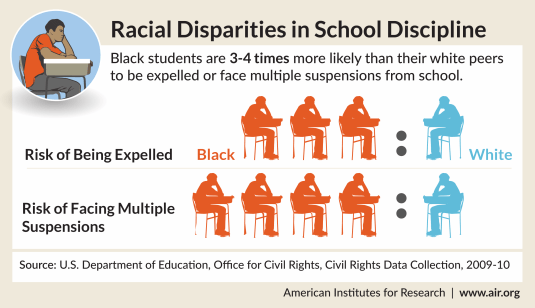
Racial Disparities in School Infographic-AIR-hp-sm-01Teachers sit helplessly by as the school system they belong to sinks slowly but inevitably beneath the waves of societal change.  Like the proverbial fish, teachers are the last ones to see the water.  Asking a teacher how to fix the system is like asking a fish how to fix the ocean.  Adding to the general ignorance are pundits in both the business arena and the political arena who propose solutions based on what worked in the past or worse what they think has worked in the business arena.  Thus, we see proposed solutions such as:

  • More standardized testing for students
  • State wide tests for teacher competency
  • Pay for performance
  • Guards in the school hallways
  • More money for education
  • Smaller class sizes

None of these solutions will work.  None of them have worked.  That is why the rich and privileged have opted to destroy public education by under-funding the present school system.  Teachers all over are clamoring for more money both for salaries and also school improvements.  While teachers and staff certainly deserve a higher pay for the jobs they do, and students deserve decent facilities, none of the changes that money will bring will improve the school system.  There is a simple but profound reason for this and anyone understanding the concepts of systems change and paradigm shifts will clearly know why.

First, in a system all processes are linked, and each impacts the other.  To change a system, you must change the assumptions upon which a system is based.  A paradigm is a set of assumptions that govern how processes are developed and allocated.  As Thomas Kuhn noted in his book “The Structure of Scientific Revolutions” when a paradigm changes what worked in the old paradigm will not work in the new paradigm.  Paradigms change when the underlying forces of a society fundamentally change.  These forces include economic, social, technological, political, legal, environmental and even spiritual factors.

“In order to displace a prevailing theory or paradigm in science, it is not enough to merely point out what it cannot explain; you have to offer a new theory that explains more data and do so in a testable way.” — Michael Shermer

In lieu of a train load of data that would make Michael Shermer happy, would you accept that societal forces have changed rather dramatically from the nineteenth century to today?  Do you think that the type of business model that worked in the late nineteenth century and early twentieth century would still work today?  Do you think Zuckerberg or Musk or Brin or Bezos could run their business like Ford or Carnegie or Rockefeller ran their businesses in today’s world?  I think the obvious answer to these questions effectively addresses the need for a paradigm change.

Yet we are not seeing a paradigm change in education.  Even as I write this, teachers are striking all over America for more money.  We are still trying to run our education system on the principles and assumptions that nineteenth century education was based on.  These include the following:

  • Schooling should not start until about six or seven years of age
  • Students need a standardized education curriculum
  • Students need to proceed in assembly line fashion one grade at a time
  • Students should take courses that match their age level
  • Students need tests and diplomas to ensure that they are qualified to go on to the next level of education
  • Students need to go to school in one place
  • Most education will take place in a classroom
  • The teacher is the expert and knows what knowledge the student needs
  • College is the best place to go after high school
  • Students should go to school Monday through Friday
  • Students should finish school and then go on to a career
  • Public education funding is only through high school

Now, what if all these assumptions were no longer valid?  What if they were valid in the nineteenth and even twentieth century but are no longer valid today?  What if we turned them upside down and built an education system on the opposite assumptions?

  • Schooling should start as soon as possible perhaps as early as two or three years of age
  • Students need a customized education curriculum
  • Students proceed according to their progress regardless of age level
  • Students take courses that match their interests and abilities
  • Students need tests only to determine their level of understanding and not for passing or failing
  • Students need to go to facilities that match their interests regardless of where they are in the community
  • Most education will take place in customized facilities
  • The teacher is a facilitator and has the responsibility to aid the student in pursuing their interests
  • College is not the best place for all students
  • Students can go to school on flexible schedules
  • Students never finish schooling and education is life long and career based
  • Public education funding is life-long as needs and careers change

Can you imagine if we designed an education system based on the above assumptions rather the assumptions in the first list?  You would have a totally different education system.  In some ways, it might be like the change in business models from mass production to mass customization.  We would still have a public education system, but it would be customized to meet the individual needs of each student.

“Given the rapid rate of change, the old paradigm of one-off education followed by a career will no longer work: life-long learning is a must, and it is up to governments and employers to invest in training and for employees to commit to constantly update their skill set.” — Alain Dehaze

student failureMany young people who are now either lost in the present system of schooling or who are ill-served by it would be rejuvenated and excited again. Classrooms would no longer be places where the concept of discipline permeated every minute of instruction.  There would be no such thing as failures or dropouts.  No such thing as staying back or not passing.  No detention or hall monitors.  Vocational education, music, art, and drama would be as important as reading and math and science.  Poor kids would get the same education as DISCPLINErich kids.  All kids would find joy and fun in their education since it would be designed to meet their needs and interests and unique abilities.  People from two to ninety-two would be able to receive the education and knowledge they need to be effective members of society regardless of whether they had yet begun to work or had retired.  Education would be for life.  Public funding would be provided throughout a person’s lifetime.

“Education is not preparation for life; education is life itself.” — John Dewey

Some will read this blog and call my vision either Pollyannish or unrealistic.  I have spent many hours arguing with people over the need for change in our education system.  There is nothing unrealistic or even idealistic about my vision.  It does not represent an ideal.  It represents a decision.  Either we are going to have an education system that benefits all of our citizens or we are going to have a system that only benefits a few.  It is not an ideal.  It is a choice we can make.  Do we have the determination to change a failing system and to look beyond the norms of the past?  Can we take our mental model of education and exchange it for a new model of education?  Either we are going to progress, or we are going to decline.  The direction we go will be based on what we do with our education system.

Time for Questions:

The Socratic Method was based on what?  Why did Socrates feel his method was a better one to instruct his students?  What is “Critical Thinking?”  Do we teach “Critical Thinking” in our schools?  Do you know?  Do you think we should?  Why or why not?

Life is just beginning.

“The function of education is to teach one to think intensively and to think critically. Intelligence plus character – that is the goal of true education.” — Martin Luther King, Jr.


Endless Horizons:  How We Learn and Develop

horizons and clouds

I have a theory about life and about how we grow as individuals. I call this my theory of “Endless Horizons.”  I developed this theory through experience and observation.  I would like to share it with you this week.  It has been a big inspiration in my life and provided a great deal of motivation for me in my journeys.  It involves the ability to accept the unknown but with a difference that is important.  Whereas many theories posit an “unknown and unknowable,” my theory says that what is unknown may just possibly be “over the next horizon.”  Let me explain more.

Once upon a time, I believed that what we see, feel, taste and smell was all that there was.  It did not get any better or worse than what I was already experiencing.  I was usually a very angry guy.  I was ready to physically fight at the drop of a hat or some perceived slur or insult.  My temper and lack of anger management got me into a lot of trouble.  I was arrested for assault and battery.  I had more fights than I can remember.

“Those who improve with age embrace the power of personal growth and personal achievement and begin to replace youth with wisdom, innocence with understanding, and lack of purpose with self-actualization.” — Bo Bennett

how-long-sleep-give-nightmares-1501590827

Perhaps worse was the constant state of fear that it kept my first wife and daughter in.  I never realized how hurtful my temper and lack of anger control was to them.  From my throwing things, to yelling and punching walls, I was like a volcano that might explode at any moment.  Even my sleep time was violent.  I was constantly having nightmares of someone chasing me and trying to kill me.  I would wake up drenched in sweat with my pulse racing a mile a minute.

My first wife and I divorced after sixteen years.  My daughter who was fifteen at the time eventually cut off all contact with me.  I have not seen or talked to her for over twenty years now.

father-daughter-quote-heart

“Building a better life for every child is a lot harder than becoming a world champion. Both goals take dedication and commitment.” — Kim Yuna

I knew I needed some help and I joined a treatment program for violent and abusive men.  About ½ of the men were in treatment voluntarily and about ½ were court ordered.  It was sponsored by the Wilder Center in St. Paul, Minnesota.  I completed the program (which met weekly) for about 16 weeks. After that I continued with a support group for another two years or so.  The support group also met weekly and was restricted to men who had finished the regular treatment program.  I had a buddy (Jerry) whom I could call if my temper flared up.  Jerry was part of my process or control plan for dealing with my anger issues rather than acting out.  There was more to the plan that included walks and other means of cooling off. 

I do not know whether my marriage would have been saved if I had gone through this program earlier.  I do know my wife would have been a lot happier and my daughter would probably still be speaking to me.  Another thing I know is that my nightmares went away.

Getting back to my “Endless Horizon Theory,” I first observed it in the anger support groups that I went to weekly.  Before coming to these groups, most “angry” men were in denial.  It was always, “they or she made me do it.”  “It was not my fault.”  The horizon of most men in terms of their awareness of themselves was very short.  After they went to treatment, they made it to a new horizon of sorts.  From this new horizon, many men could now understand that it was their fault not the fault of others around them.  If they chose to, they did not have to go through life angry, violent and abusive.  Standing at the horizon of having accepted their responsibility for their anger, they could see a new horizon.  This horizon was one of equanimity and if not happiness, at least not misery.  The support groups offered a way to get to this next horizon.  As they say, “Rome was not built in a day.”  Well, dealing with anger problems involves a trip of years.  It would not be an easy journey for many of these men.

I stayed in the group for nearly two years.  Many of the men I met during these two years were also long-timers.  Our support group seemed to grow together as friends and comrades along the journey.  I think many of us made it to the next horizon.  When I arrived there, I saw another horizon just beyond the one I had reached.  We had all assumed that the best we could get would be a life without being constantly angry and explosive.  When I came to this new horizon, I began to understand that there was more that I could accomplish.  The next horizon promised happiness and a positive outlook to life.  Many of us had gone from a negative outlook on life to a neutral outlook and now saw a horizon that promised a positive outlook.

“We must let go of the life we have planned, so as to accept the one that is waiting for us.” — Joseph Campbell

Unfortunately, the Wilder Center did not see that as the role of these support groups.  They saw their mission as helping to curb domestic abuse.  They did not see their mission as helping men grow and develop beyond their ability to control their anger issues.  With the lack of support and even hostility towards our new goal, many of the long-termers in my group simply quit and went away.  I kept in touch with a few men, but the years have melted these relationships away. 

“Growth is painful. Change is painful. But, nothing is as painful as staying stuck where you do not belong.” — N. R. Narayana Murthy

I realized that when I reached one horizon, I could now see beyond it to a new horizon. It was clear to me that there was possibly an infinite number of new horizons.  If one has the tenacity, discipline and determination, there is no end to the development that we potentially can reach.  Another experience gave me more proof for my theory of “Endless Horizons.”

journey_shutterstock_576382054

My second wife Karen and I have both been to two Marriage Encounter weekends.  We went to our first Marriage Encounter weekend about five years into our marriage.  The second weekend was about ten years after the first.  Both weekends had very positive impacts on our marriage, friendship and lives.  My horizon theory was further strengthened by events that happened at both weekends.  I will relate the events at the first weekend.

I was long past worrying about anger issues by the time of our first Marriage Encounter weekend.  I had been trying to be more tolerant of Karen and some of the things that she did that annoyed me.  I had reached what I will call a Horizon of Tolerance.  I thought I was doing pretty good when I could practice tolerance.  When I could not, I would be sarcastic, rude and frustrated.  We went to the first weekend as a means of improving our marriage.  I will forever be grateful to the organizations and volunteers that put these weekends on.  We have found that both these weekends helped us to be better lovers, parents and friends.

Well, during the first weekend, we were having some discussion about the issue of tolerance.  I was pretty pumped up because I thought I was doing pretty good with dealing with this issue.  I made the remark that I thought I was very tolerant.  The response I received caught me by surprise.  It was something to the effect that tolerance falls short of respecting the other person. The speaker explained that tolerance simply accepts what is.  Respect on the other hand sees the benefits and appreciates the value of what is.  There is a significant difference between respect and tolerance.  For instance, we can tolerate minorities or people who are different than we are but that is not the same as respecting them.

I was confronted with a new horizon for my relationship with Karen and our marriage. Again, I realized that this new horizon further supported my “Endless Horizon” theory of growth and development.  I had finally accepted (and thus my theory was born) that there is an endless number of horizons.  Each horizon presents a new possibility for growth.  We cannot see beyond our present horizon, but we can be sure that something new will await us once we reach it.

“Strength and growth come only through continuous effort and struggle.”  — Napoleon Hill

careerhorizons-1024x683

What does it take to reach a horizon?  I said earlier that you must have determination.  It helps to have support and coaching along the way.  As the song says, “I get by with a little help from my friends.”  It also takes commitment to keep trying.  There are lots of potholes along the way. There are dead-ends.  There are large crevasses, boulders and obstacles to overcome.  There are no straight flat highways to the next horizon.  It is not a straight-line journey.  There are times when you will get lost and times when you will go backwards.  But the journey is not to the fittest but to the ones who are most determined.

Time for Questions:

What horizon are you at in your life?  What new horizons have you found in your life’s journey?  What obstacles have you had to overcome?  Have you given up on finding new horizons or are you still searching for new horizons?  Why or why not?

Life is just beginning.

“The journey is never ending. There’s always gonna be growth, improvement, adversity; you just gotta take it all in and do what’s right, continue to grow, continue to live in the moment.” — Antonio Brown

What is wrong with education today? Part 1

Creativity-vs_-Formal-SchoolingMy father always put a great store in my getting an education.  I am not sure if my mother could have cared less.  However, from an early age, it was my dad who always looked at my report cards and wanted to make sure that I was doing well in school.  Oddly enough, his interest in education did not seem to entail putting away any money for college. I remember quite well sometime before I finished high school when I told my dad “I would like to go to college.”  His reply was “Great, good luck.” No mention of money, no talk about how it could happen financially.  Realistically, it was rather a moot point. Most of my high school teachers disliked me; my grades were abysmal, my SAT scores below average and my desire to attend college was well below my desire to party and score with the “chicks.” (Please note this was a colloquialism of the times)

Thus, the future was clear.  The time was 1964.  The Vietnam War was looking for bodies and the military would take anyone who could still breathe.  I checked out the uniform options and decided (with limited knowledge) which uniforms might be the best “chick” magnets.  Based on this rather biased assessment, I decided to join the Air Force and enlisted for four years.  During this time, I partied, drank, read, exercised, partied, drank, read and did less and less exercise.  I honestly cannot say whether my uniform attracted the “chicks”, but I did not seem to want for drink or sex, the two most important things in my life at the time.  One thing not on my radar was “school.”

Often, other enlistees would ask me about attending classes or going nights to a local college.  “John, if we get enough guys interested, we can have Professor So and So come out to the base to deliver the class.”  My typical answer was “Professor So and So can shove his class, I am not interested.”  I managed to stay away from any education for my entire four years (One notable exception being my AFSC training school.  I will talk about his situation in a later blog.) When I married my first wife in 1967, I informed her I had no desire to attend college or ever set foot in a school again.  High School had been enough torture for me.  My favorite class in HS was detention where all the other goof-offs went and we could have a swell time finding creative ways to harass the detention monitor.

I should note a fact here.  I am the only member of my immediate family who ever went to college, not to mention obtaining a Ph.D.  Not my mother, father, brother or two sisters and hardly any of my first cousins, nor aunts, uncles and other relatives ever set foot in a college.  I have subsequently found a long lost and now deceased cousin who also received his Ph.D. but a college education was certainly not typical in my family.  It was rather like getting a winning lottery ticket. It was something that everyone espoused as a greater good, but few if any every obtained a degree or even thought about what it took to get a degree.

At this point, I am boring you with the history of my life and you are probably wondering why and where this story is going?  I want to show you that education was not something that was part of the woof and warp of my existence.  Unlike many people today, I did not have any chart memorized that showed how much a college degree versus no college or versus a high school diploma would be worth. In fact, I would venture to maintain that most of the people I knew in the sixties went to college simply because they wanted to get a liberal arts degree and sincerely believed that Higher Education would make them a better person.  The Democratic Liberal Arts Paradigm was still dominant in education at the time as opposed to what I call the Technocratic Function Paradigm that now dominates education. Today, students by a large margin, go to school to get jobs, make more money and have a planned career. This was not the case in the 60’s.  One is not better than the other as a motive, just different.

Ok, time for questions.  I will continue this blog next week.

What are your beliefs about the value of education?  Do you think older people are wiser than younger people? Does aging lead to wisdom? Does education lead to wisdom?  Can young people be wise and old people be fools?  How much is a Higher Education worth?  Do we have an education bubble in this country?  Should we have free Higher Education for all qualified students?  Should we allow students to leave High School to perform community service or join the military?

Life is just beginning.