Can We Be Justified for Intolerance Towards Intolerance?

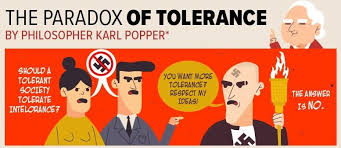
Many years ago, the famous philosopher Kark Popper created what has been called the “Paradox of Tolerance.”

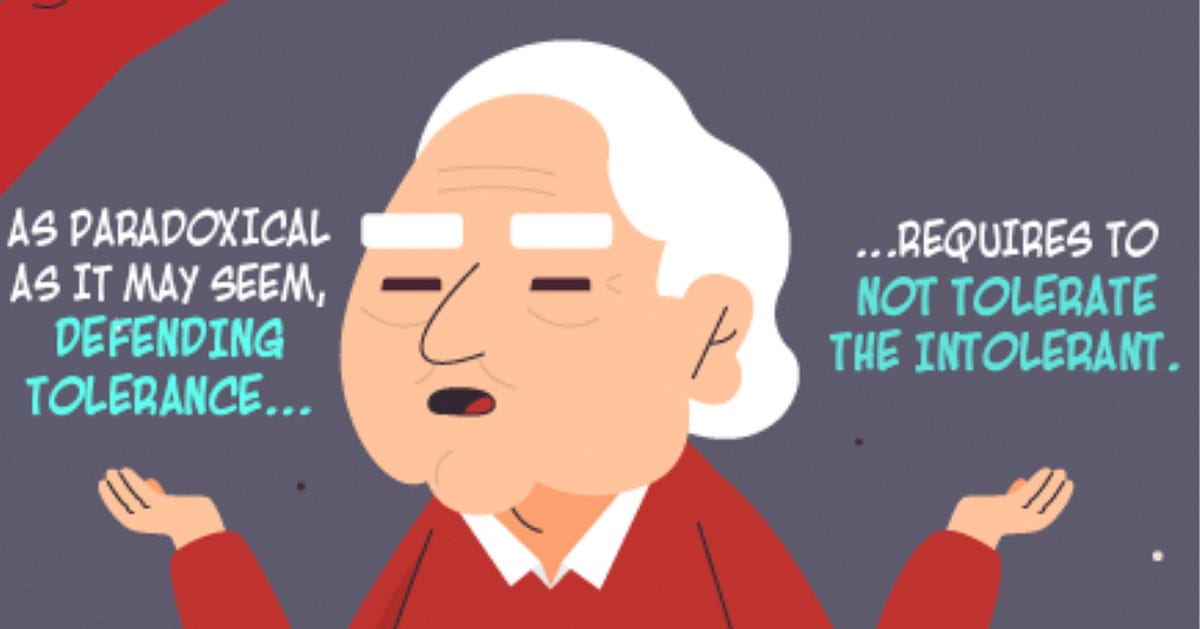
Karl Popper wrote that, “if we want a tolerant society, we must be intolerant of intolerance”.  This is known as the “Paradox of Tolerance”, which is the idea that a society must be intolerant of intolerance in order to maintain tolerance.  As with any paradox, this is very confusing.

“Popper explained that unlimited tolerance can lead to the destruction of tolerance.  He said that a tolerant society should be prepared to defend itself against intolerant views, and that the right to suppress intolerant views should be claimed if necessary.  However, he also said that suppressing intolerant views through force is unwise unless they are unwilling to engage in rational argument.”  —- From Search Labs | AI Overview

Recently, I came across a rather long academic article which I think supports a justification for Popper’s viewpoint.  Albeit I think this article provides a more nuanced explanation for being intolerant of intolerance.  I have decided to post this article since I think the times demand that we understand this perspective.  I believe it is a focal point worth fighting for.  You may disagree but the analogy of how Hitler took power is I think quite relevant and worth thinking about.  Here in its unabridged form is the entire article.  I would love to hear what you think, so please leave a comment or two.

What are the Limits of Toleration? By Tamar Lagurashvili

University of Tartu, Institute of Government and Politics, Graduate Student
Introduction

Tolerance is considered to be one of the cornerstones of modern liberal democracies, thus having acquired different implications across the countries, which ultimately leads to the ambiguity of the concept itself. In order to avoid further misunderstanding, we should clearly define what is meant in tolerance and why it is crucial not to mix this term with the words having similar connotations. Yossi Nehushtan (2007:5)  offers an obvious distinction between the value-based liberal tolerance and rather neutral tolerance, which finds more similarities with indifference rather with toleration itself. Concerning its linguistic origin, author refers to the Latin word tolerabilis, which means to lift an object, clearly implying to the burden to be carried by one, who tolerates certain unacceptable behavior, act or opinion. Within this context, we should refer to Michael Sandel (1996),  who differentiates liberal non-judgmental toleration from judgmental toleration. While looking closely at these concepts, we can see that in the case of former, person (tolerant) tolerates certain opinion, act or behavior without judgmental evaluation simply because he does not care or he respects others’ privacy and thus, refrains from any kinds of interference. Albeit that, refraining from interfering in other people’s private life is an integral part of modern liberalism, definition provided above does not correspond with the tenets of tolerance.
As Heywood (2015:251)  rightly mentions, tolerance should be distinguished from permissiveness, indifference and indulgence, since being tolerant inherently implies to the fact that a tolerant person faces moral difficulties to put up with certain behavior or act, but does so for the sake of different reasons. Being tolerant means that a person has to impose certain restrictions on him/herself in order to avoid to openly interfere in others’ life when there is something to be disliked, disparaged or disapproved. Toleration with its basic definition can be considered as truly moral value, supporting a peaceful coexistence of the different individuals, but whether there are certain cases, where intolerance is morally/pragmatically justified is major concern of this paper.

Why do we tolerate?

Rainer Frost (2008:79-82) while touching Pierre Bayle’s Reflexive theory of Toleration, talks about three different reasons or factors, which trigger toleration among majority and minority groups. First he mentions permission conception, according to which the majority gives minority a right to live according to their customs, but toleration is possible when the “difference” of minority is contained to certain limits and does not cross the borders of private life. As an early and most vivid example of permission conception Frost names the Nantes Edict of 1598, which granted the Calvinist Protestants of France substantial rights in private as well as in public spheres.

Second way of toleration is coexistence concept, which resembles to pragmatic tolerance to be discussed bit later. In this case, avoiding conflict and paving way towards peaceful coexistence is what matters, but unlike the previous situation, here we face not the relation between the ruling majority and minority, but rather two groups wielding equal powers, thus requiring making some concessions for the sake of preventing clash of interests. If we attempt to apply this concept to real life, we can think of Somalia, who has been torn apart by three different clans ruling in three regions of Somalia, therefore hindering country’s normal development. Bearing in mind that Somalia is characterized by distinctive homogeneity (Guardian Africa: 2015),  one can assume that it is not different beliefs and traditions, which impede toleration among the clans, but the economic benefits they can reap from the permanent state of conflict.

Third conception is based on the principle of respect, thus implying to the fact that toleration requires acknowledging the fact that everyone is equal and deserves equal political and legal rights.

As one can see Frost’s approach towards toleration is rather a combination of pragmatic and moral values, since it fosters cooperation between majority and minority and upholds egalitarian values. Kristie McClure (1990:361-391)  puts forward John Rawls’s understanding of toleration within his notion of “ justice as fairness”, according to which toleration carries distinctively pragmatic connotation, namely the one of social conditions, which not only helped to put an end to the religious wars in Europe, but to transform religious toleration into certain form of social practice. John Locke’s work Letter Concerning Toleration is deemed to be a milestone in understanding the tenets of toleration. Locke comes from the assumption that we are all created by God and thus, our “Highest Obligation” should rest on the understanding of others’ differences for the sake of our moral obligation and love (Frost 2008). Later on Locke argues about the possible relation between the tolerant and one to be tolerated, excluding the possibility to give superiority to any church, since it will lead to persecution and monopolization of power.

One can consider that by proposing to give each and every church equal power as searching for  the only true religion is futile and will exacerbate conflict between different religious groups, Locke somehow offers the coexistence concept elaborated earlier. Even though toleration is a God-given virtue, Locke still talks about its possible limits, which in his case is restricted to two kinds of groups: “A church that assumes the power of being able to excommunicate a king or that claims political and religious authority over its members…” and the atheists, as: ”They are not at all to be tolerated who deny the Being of a God” (Frost: 91-92).

Nehushtan, like Frost points out three different reasons of why people generally tolerate: tolerance as right, pragmatic tolerance and tolerance out of mercy. First he touches upon tolerance from the standpoint of rights and argues that no matter how repulsive person’s behavior or opinion can be, harm inflicted to that person cannot be justified on the grounds of personal autonomy developed by Joseph Raz . Author stresses particular importance on the pragmatic side of toleration and develops the ideas very similar to Frost with an additional insight of reciprocity and proportionality, which will be discussed later on. His third point argues that people with physical and/or mental disabilities might be exposed to more toleration than usual, regardless their repulsive behavior.

Can toleration be limited?

Tolerance with its underlying principles and applicability clearly upholds democratic values and strengthens personal autonomy, which constitutes one of the cornerstones of the liberal democracies. Albeit that tolerance is widely considered as “moral virtue”, would we go further and suggest that tolerance can be applied to each and every circumstance regardless the fact who should be tolerated? This question is examined in the works of many political scientists, including Andrew Heywood, who even though stresses importance of the political pluralism, openly talks about those political parties, which are clearly distinguished with hate speech and bigotry, thus threatening the democratic values, should not be tolerated and permitted to the political spectrum, since as author suggests: ”toleration is not granted automatically, it has to be earned” (Heywood: 256).

I would suggest that reciprocity, as a crucial feature of toleration substantively defines the nature of its applicability, which means that in certain exceptions, where we have to deal with a massive surge of intolerance, clearly undermining the democratic values and endangering the sovereignty of state, toleration should be limited. Heywood calls an example of Nazi Germany, where after the failure of Munich Putsch, Hitler and his collaborators were still allowed to pursuit their political activities legally, which ultimately led to the disastrous consequences. It seems that reciprocity plays an integral part in understanding the limitations of tolerance, so clearly expressed in the work of Nehushtan, who also talks about proportionality, which mainly focuses on the costs and benefits of limiting toleration. We could start by recalling Rawls, who suggests that:” it seems that an intolerant sect has no title to complain when it is denied an equal liberty”( Rawls 1999:190).  While analyzing Rawls’s words, we can assume that those intolerant groups, which openly threaten state sovereignty and democratic values in general, should not be treated in a tolerant manner, but how can intolerance be expressed when it comes to politics? Should we ban such intolerant political parties and prevent them from entering parliament?
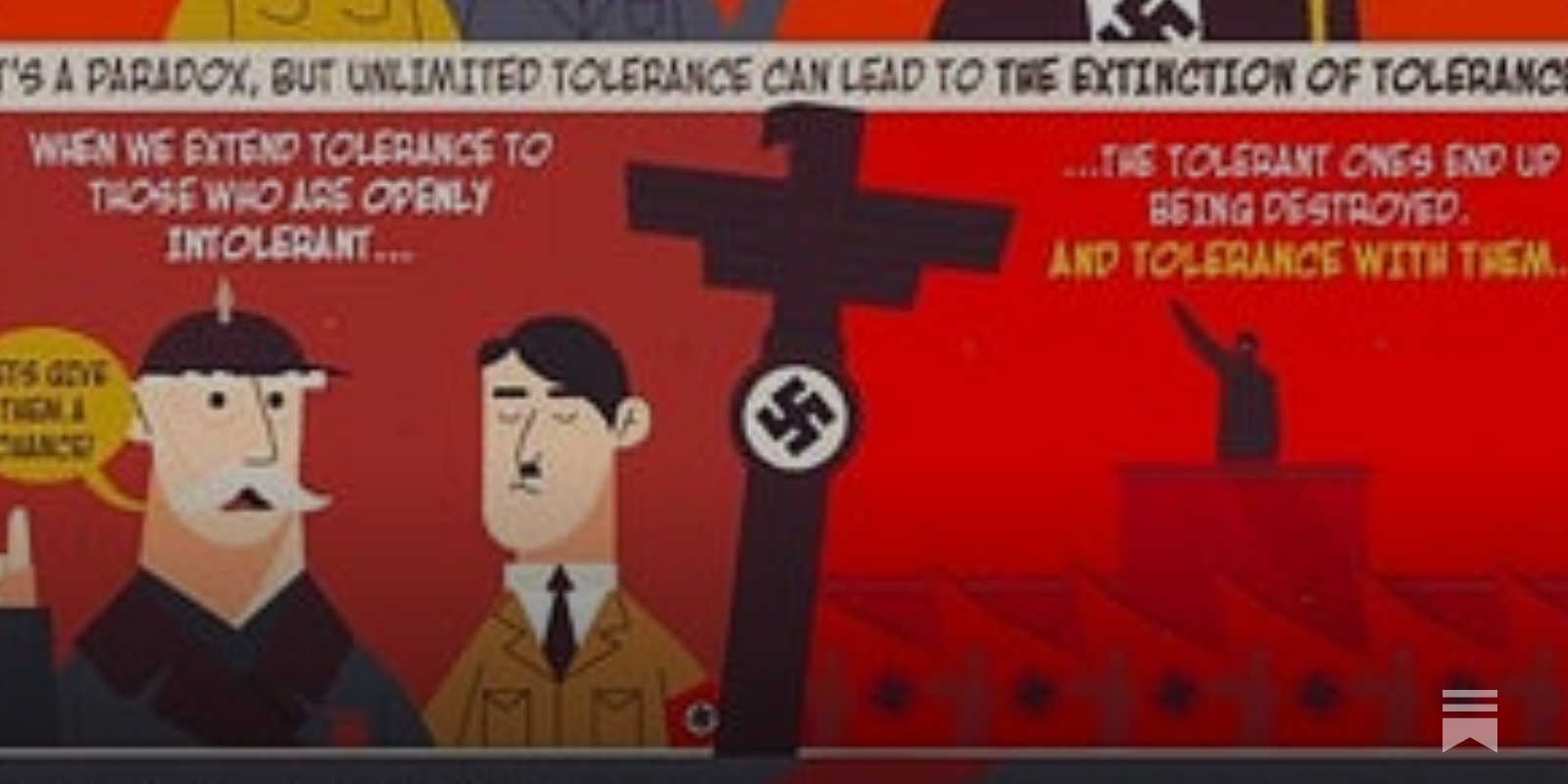
Should we hold a peaceful campaign, during which we will expose true information about the intolerant party’s real intentions and the scope of possible harm in case of proliferation the intolerant ideas? Deciding upon the methods of expressing intolerance is rather individual and as Nehushten suggests, is rooted in the principle of proportionality. According to the author, while working on the scope of intolerance, one should take into account the nature of intolerance and the response towards it, since if an act of intolerance takes place in parliament for example, an intolerant response should be formulated within the realm of politics and not in the private life. On the other hand, amount and nature of intolerant response should not exceed the original intolerance and what is of core importance- intolerant response should inflict minimal harm to the democratic values and human rights, because otherwise we will face counter-productivity. Fintan O’Toole (1997:346)  raises another interesting question concerning the limits of tolerance based on assumption that excessive freedom of certain group might threaten collective good, thus requiring to impose certain restrictions on that group’s excessive liberty. Therefore, certain amount of intolerance towards the groups, who wield the power in order to prevent them from abusing/manipulating this power, is justified.

Nevertheless, author calls an example of Bernard Shaw’s criticism of the Christian Golden Rule (according to which we should treat others as we would like to be treated), providing the heterogeneous nature of the society, where what one person considers benign for him/herself, might be perceived as totally evil by other. Author suggests that even though there might be a society with relatively homogeneous religious beliefs, the applicability and interpretation of the customs and beliefs might considerably vary (O’Toole: 347). Therefore, we should not expect that toleration will be upheld as universal value across different societies, but what author explicitly refers to is the nature of harm inflicted by the intolerant groups, which morally and pragmatically justifies adequate intolerant response.

Conclusion

Tolerance, as one of the tenets of modern liberal thought,  cannot be applied universally to every situation, without taking into account the nature of an opinion, behavior or act to be tolerated and the amount and nature of harm done to the society followed by intolerance.  We can assume that intolerance is justified on the grounds of reciprocity i.e. as Heywood stated, tolerance should not be granted automatically and it requires certain effort to be excerpted by the groups demanding tolerance and proportionality, which implies that there should be balance between the original intolerance and its corresponding intolerant response. Even though tolerance constitutes a major tenet of modern liberal democratic states, where each and every individual is endowed with personal autonomy and a right of individual liberty, preventing certain individuals from infringing others’ private life, there are some exceptional cases, where intolerance can be justified. Even though individual liberty is an integral part of the democratic societies, my essay primarily focused on the limits of tolerance at the political level, where we might face much more disastrous results in case of allowing unlimited tolerance towards the intolerant groups. Having tolerant attitude is vital in pluralist societies, but when national sovereignty and democratic values are endangered due to the nature and amount of intolerance exposed to the wide public, appropriate intolerant response should be nurtured taking into account the costs and benefits of such response.

Bibliography

Frost, Rainer. “Pierre Bayle’s Reflexive Theory of Toleration.” In Toleration and Its Limits, edited by Melissa S. Williams and Jeremy Waldron. New York University Press, 2008.

Heywood, Andrew. Political Theory: An Introduction. Palgrave, 2015.

McClure, Kirstie M. Difference, Diversity and the Limits of Toleration. Sage Publication, 1990.

Nehushtan, Yossi. “The Limits of Tolerance: A Substantive-Liberal Perspective.” 2007.

O’Toole, Fintan. “The Limits of Tolerance.” By Fintal O’Toole and Lucy Beckett. Irish Province of the Society of Jesus, 1997.

Reconciliation Reflections

I want to pose five short stories or episodes dealing with forgiveness and reconciliation.  Each of these brief stories has some questions for you to answer.  You can share your answers in my comments section, or you can simply write your answers on a piece of paper.  I would enjoy hearing your thoughts if you do want to share them.  So here goes.

  1. The Forgetful Husband

John is a good husband who forgot his wife’s birthday.

He is very sorry.

He does forgive himself.  He knows that he is not perfect.

Does he need to tell his wife that he is sorry?  Why?

Do you think she will forgive him?

What if she will not?

  1. Accidental Death of a Pet

Marsha was driving down a street.

Suddenly a dog ran out in front of her car.  She ran over the dog.

A man screamed “You killed my dog.”

The man was distraught.

What should Marsha say or do?

  1. A Young Boy Goes on a Killing Spree

Robert took a gun to school and shot five other students.

His mom heard the news on the television after Robert was killed.

The media soon showed up outside her front door.

What should his mom do?

What should his mom say?

  1. Forsaken Vows

A husband and wife took vows to love each other until death did them part.

The wife met an old flame at a high school reunion and went to bed with him.

What should she do now?

Should she tell her husband?

What should her husband say or do if he finds out?

  1. Lying Politicians

A United States Senator is up for a third term.

You voted for her twice.

She promised to only run for two terms.

This promise played a factor in your voting for her.

Should you vote for her again?  Why or why not?

Conclusions:

Many times, we see or hear about situations such as I have noted above.  They always happen to other people, right?  But what if you are in such a situation?  What would you do or say?  Is there a one right answer in each situation or will you hedge your bets and say “Well, it all depends.”  Then tell us what it depends on.

“You may not control all the events that happen to you, but you can decide not to be reduced by them.”– Maya Angelou

Who is Kidding Who on the Proposed Ceasefires in the Mideast?

I know that I am getting older and that my memory is not what it used to be.  I suppose, I am also losing some of my former mental acuity.  However, this story in the “Times of Israel” regarding efforts to arrange a ceasefire between Israel and Hezbollah just leaves me bewildered.  I have heard of “Doublethink”, but this would put anything Orwell talked about in his famous book “1984” to shame.  Orwell defined Doublethink as follows:

“Doublethink is a tool used by the Party to maintain control and perpetuate a state of war.  The Party’s manipulation of language and truth contributes to the absence of justice and peace in society.”

Read the following article and see if you can tell what the US and Israel really mean by saying that they are pursuing a ceasefire.  By the way, I think that the same Doublethink is being used by the US State Department in its so-called ongoing efforts with Netanyahu to arrange a ceasefire in Gaza.  Secretary of State Blinken and his right arm Jake Sullivan think that all Americans are idiots.

————————————————————————————————————-

US: We appreciate that PM clarified he’s engaging in our Lebanon truce efforts in “The Times of Israel

By Jacob Magid

4:40 pm, 09/26/2024

NEW YORK — A senior Biden administration official says Prime Minister Benjamin Netanyahu’s initial comments yesterday rejecting the US-led initiative for a 21-day ceasefire in Lebanon did not reflect the discussions he had with Washington, which led the US to announce this plan.  However, the administration appreciates the English-language clarification Netanyahu’s office issued late last night in which he said Israel would continue engaging in the effort to secure a diplomatic agreement between Israel and Hezbollah

State Department Counselor Tom Sullivan tells The Times of Israel during a briefing that the US believes Israel shares the administration’s stance that the only way to prevent a full-scale war in Lebanon is through a diplomatic solution and that Washington looks forward to working with Jerusalem to achieve such a deal.

——————————————————————————————————————

Please allow me to try to clarify the above Doublethink if possible.  I confess my interpretation may be a long shot.

  1. Israel will keep bombing Gaza and Lebanon as long as it wants to.
  2. Netanyahu does not give one red cent what Biden and European leaders want or think.
  3. Biden is too senile, old or owned by the Israeli US lobby to do anything to impose a ceasefire.
  4. The Israeli lobby owns most of the Republicans and Democrats in Congress.
  5. The real strategy by the US State Department is to Stall and Delay giving the Israeli military more time to wipe out the Arabs in Lebanon and Gaza.
  6. Israel is pursuing the same strategy that the US military did with the American Indians. The US wiped out hundreds of thousands of Indigenous people as we pursued our policy of Manifest Destiny.  General Sheridan infamously said, “The only good Indian is a dead Indian.”  Netanyahu and his right-wing cohorts might as well say that “The only good Arab is a dead Arab.”  Come to think of it, many prominent Israelis have already shared that opinion.

Here in the USA, we are facing a real dilemma.  If we stop paying tribute to Israel, the Israeli lobby will fire on the Democrats.  Many Democrats including Harris may lose the election and we get an even worse option, namely Trump.  Harris and the leaders of the Democratic Party know this fact all too well.

On the other hand, if the Democrats do nothing to stop Israeli aggression in the Mideast, they may lose a substantial majority of the Arab-American vote as well as the votes of many progressives.  Jill Stein is making real noise about the Democrats doing nothing to stop the war and the Republicans are trying to help her to take votes from Harris.  The sly Republicans realize that Stein will only pull votes from Harris.  Stein has already been accused of being a factor in Hillary’s loss to Trump back in 2016.  She is now running for the third time.

Conclusions:

As someone once said, “There is many a slip between the cup and the lips.”  The Democrats may say that they want a ceasefire in the Mideast, but their actions suggest the opposite.  They are not willing to take the steps to enforce a ceasefire.  Billions of dollars in weapons are still being sent to Israel while foreign aid is blocked by Israeli forces from reaching those in need.  Thousands of dead Arabs are being viewed as the price to pay for stopping Trump.  It is a bargain with the Devil and such bargains never turn out well.

My Final Will and Testament – People Enshrined in My Heart – Reflection #13

Last year at my 40th Demontreville Retreat, one of the exercises that we were given by the Retreat Master included a very challenging set of thoughts.  The worksheet for the activity was labeled as “A Testament.” I took the worksheet and instructions home with me.  It had fourteen tasks or reflections to complete.  I did not desire to complete them during the retreat.  It is now over a year since my retreat, and I have decided to make the mental and emotional effort necessary to complete this “Testament.”

The worksheet started with these instructions:

Imagine that this is the last day of your life on earth.  In the time that you have left, you want to leave a “Testament” for your family and friends.  Each of the following could serve as chapter headings for your “Testament.”  This is Reflection Number 13 on the worksheet.

13.  These are the people who are enshrined in my heart.

All of these people are friends or relatives that I have personally known and interacted with as opposed to people I might admire from history or literature.

The following lyrics are from a song made famous by Tom Jones.  Perhaps you can guess from these lines who is first in my heart.

Well, she’s all you’d ever want
She’s the kind I like to flaunt and take to dinner
But she always makes her place
She’s got style, she’s got grace, she’s a winner

She’s a woman
Oh, whoa, whoa, she’s a woman
Talkin’ about that woman
And the woman is my best friend

Well, she’s never in the way
Always something nice to say, and what a blessing
I can leave her on her own
Knowing she’s okay alone and never bored

She’s a woman
Oh, whoa, whoa, she’s a woman
Talkin’ about that lovely woman
And the woman is my wife.

Karen Yvonne (Blomgren) Persico is my blessing in life.  We met in 1983 after we both had sixteen years of marriage ending in heartache for each of us.  We dated for five years before we were ready to tie the proverbial knot.  This first five years of uncertainty has been followed by 35 years of ups and downs as we have navigated the shoals of marriage.  The ups have kept going higher and the occasional downs never as low.  If some people say that they have never had problems in marriage, this does not apply to us.  Karen turned 80 this year and I turned 78.  I never thought I could love or care for anyone as much as I do Karen.  The prospect of continuing to grow old is both comforting and frightening.   It is comforting knowing that we grow old along together.  It is frightening knowing that one of us will part ways with the other along the path someday.

Jeanine Persico Mosesian:  Second on the list of people enshrined in my heart is my sister Jeanine.  Jeanine is caring, compassionate and always helps those who need it.  Growing up we were separated by seven years of age but many more miles of family grief.  Somewhere approaching old age, we discovered each other again and have become close.  I am not one to say that “blood is thicker than water.”  I think Jeanine and I would have become good friends regardless of our family history.  Nevertheless, the many relatives and common family problems have given us a sound foundation for a sibling friendship.

After my first two enshrined people, I would not want to list the other people who have made a difference in my life in numerical order.  There is no scale or ranking that could be applied to show how much each of these people have meant to me.  Or how much of an influence each has had on my life.  I have listed them in chronological order of when they appeared in my life.  Each of these people have made a difference in my life without expectations of reward or perceivable benefits.  I would never had achieved or become the person I am today without the contributions and help of each of these folks.

Dorothy Jordan:  My mother.  A woman who had to survive more than her share of heartaches and violence.  She died at the age of 67.  My mother never stopped caring for children and became a foster mom to many after my father left her and all of her natural born children had left the nest.  The job of mothering was much easier without my father who did not believe in empathy and compassion for children.  In “Drama of the Gifted Child”, the noted Swiss Psychologist Alice Miller explains that in a dysfunctional family, it is “every man for himself.”  My mother had to dole out compassion like a thief in the night or be punished by my father for being compassionate and kind.  I will never forget her surreptitiously “buying” me an encyclopedia with her saved green stamps when my father thought I should just “get my ass to the library.”

Kwame Rice: One of my two best friends. We met in an undergraduate program for social studies at Rhode Island College in 1971.  Kwame is a good friend who goes out of his way to make a positive difference in the world.  He has never stopped trying.

Bruce Fellenz:  My other best friend.  We met in a graduate program at Stout State University in 1978.  Bruce is a person who cares about others and never turns down a request for help.

William Cox:  Bill was a big brother to me.  We met in 1979 when he was the Director of the Men’s Center in Minneapolis.  Bill took part in what was called at the time “The Men’s Movement.”  This was an effort by many men to “Un John Wayne” the role of men in society.  The goal was to help men get more in touch with their feelings and to overcome the stigma of being soft or feminine.  Bill was always there for men who needed help.  Bill was a Methodist Minister who married Karen and I in 1989.

Evelyn Rimel:  A mentor and chief instructor for counseling students at Stout State University.  She was one of the most compassionate people I have ever known.  She was a role model for all of us trying to learn empathy for clients.

Father Sthokal:  The Director at the Demontreville Retreat Center in Lake Elmo, Mn for fifty-eight years.  I attended my first retreat in 1986 and completed my 41st retreat this past July in 2024.  Father Sthokal left an indelible mark on all who ever met him.  He was a lovable curmudgeon.  Sometimes witty, sometimes sarcastic, but always wise and insightful.

W. E. Deming: I first met Dr. Deming in 1986 after completing my Ph.D. degree in Training and Organizational Development. I was hired by Process Management International as a consultant with the Deming Philosophy.  Deming destroyed my four years of business training and taught me what really matters in business.  (See the 14 Points for Business) by Dr. Deming.

There are many other people who have made a difference in my life:  Some honorable mentions are:

Louis Leone, a cousin who was my first “brother”

Margo House, a mentor who took me under her wing when my first wife left me

Sister Giovanni, my Principal at Guadalupe Area Project

Helen Boyer, my boss at the Metropolitan Council in Minnesota

Louis Schulz, the man who hired me at Process Management International in 1986.  Lou was a believer in the Deming Philosophy and become a close friend of Dr. Deming.  Lou created the PMI consulting firm to help spread the Deming method and ideas to the world.  In my mind, there has never been a greater philosophy of how companies can work closely with employees to provide needed products and services that will help the world.  In Deming’s methods, employees, managers, stockholders, investors, the public and of course customers are all involved in a win-win effort to satisfy the needs of all stakeholders. 

Shelly Wolfe, my boss at Crawford Rehab Consultants

Socorro Galusha Luna, a woman who gives her all to helping people find their place in the world.  Socorro asked me to help with a project to find jobs for ex-felons.  She had written a grant that received funding for this effort.  We have become friends over the years and she is still out their “counseling” people to help them with their career choices.  

Sam Pakenham Walsh,  My mentor at PMI when I first started and one of the most brilliant men I have ever met in my life.  We continued our friendship until the day that Sam P-W passed away.  I still miss our conversations and disagreements over theory and practice.

Dr. Hana Tomasek,  A consultants consultant whom Karen and I became best friends with.  I learned how to deal with difficult clients from Hana.  She was hired by PMI to help consultants fine tune their skills and abilities.  Few people could have acheived what Hana did with such grace and humility. 

No doubt, I will continue to forget and then remember other friends who should be on this list.

Next Week:  My Final Reflection Number 14:  “These are my unfilled desires”

Reconstructing the Great Speeches – Danton:  “Dare, Dare Again, Always Dare”

georges-danton-eadf825f-b590-4d60-ac4c-0971ec7c1e3-resize-750

George Jacques Danton born October 26, 1759 wanted to dare and dare he did.  He dared so much; he lost his head to a guillotine on the 5th of April 1794.  Danton was one of the prime movers during the French Revolution of 1789.  For those of you whose history is limited, the French Revolution was quite a remarkable event.  Here is some background before we look at Danton’s famous speech.  For more detailed history, go to Wikipedia or the library.

Revolutions-that-changed-the-world_2

The French Revolution (1789-1799)

What makes the French Revolution confusing is that there was actually two of them.  We are discussing the background of the first one.  The second one was in 1830.  The first one is noteworthy for two major reasons.  1)  It set a precedent for overthrowing the rule of divine right by kings.  You have to keep in mind, that with the major exception of the United States of America, the world was ruled by Kings and Queens.  Many of these rulers professed a “divine right” to rule.  In other words, they believed that they were ordained by God him/herself to rule over the lesser beings on the planet whom they regarded as subjects.  As “subjects” the people under the rulers were “subject” to all forms of abuse and intimidation.  In many countries, people had little or no rights except by the grace of their rulers.

256px-TroisordresThe Catholic Church in France was a major power.  The Catholic hierarchy managed to continue to exert influence in France long after it lost power in other countries.  The Catholic Church kept its power by a political collusion with the French monarchy which helped the Church fight off the Protestant religion that had swept so much of Europe.  From the beginning of the Protestant Reformation, the Church in France along with the Monarchy had persecuted, exiled, and killed thousands of Protestants.  Thus, there were many in France who hated the Catholic leaders as much as they hated their King and Queen, who by the way also lost their heads during the French Revolution.

c4641830b5625a961f89dca58b695f5f

Needless to say, the rest of Europe was not too happy at seeing the servants and peasants overthrow the royalty in France.  This idea that the royalty was not so special might just infiltrate the minds of subjects in other countries.  Which of course is just what happened.  Over time, most of Europe eventually marginalized the role of their monarchies and established a variety of democratic institutions.  These later institutions would rule by laws set by the people and not by “divine right.”

Three of the most important democratic concepts to come out of the first French Revolution is epitomized by the motto “Liberty, Equality and Fraternity” which became the national motto of France.  Liberty is the right to express one’s ideas without fear of repercussions.  Equality expressed the idea that all social classes were citizens of France and would have equal rights.  The monarchy and the Catholic Church would no longer be privileged.  Fraternity meant that we are all brothers and would share in a common unity of humanity and respect.  In 1789, The leaders of the revolution drafted a document called the “Declaration of the Rights of Man” which outlined a set of enlightened principles about governing and government which bore some resemblance to the Bill of Rights in the USA.  Of course, women were still among the unprivileged.  Which leads us to the second major reason that the first French Revolution is noteworthy.

This second reason is the devolution into chaos and anarchy that happened.  Faced with a great deal of opposition both in and outside France to these new enlightened ideas, the leaders of the revolution became increasingly paranoid.  They were beyond cautious about who their enemies might be and what they needed to do to protect the emerging values of the French Revolution.  This led them to adopt a rather expedient method of protecting the Revolution.  The guillotine was developed as a very effective instrument for cutting off the heads of anyone whom they suspected might be either an enemy of the Revolution or even those who did not fully support the Revolution.  During, what has become known as “The Reign of Terror” (June 1793 to July 1794) about 17,000 people were guillotined.  Many more people were shot or otherwise murdered during the French Revolution.

00-promo-french-rev

Looking back, it seems bizarre to think that a revolution founded on the democratic ideas of the American Revolution and such theorists as Voltaire, Rousseau and Montesquieu could have led to the slaughter of so many people.  A slaughter that sadly is now one of the major things we remember about the First French Revolution.  Furthermore, the Revolution eventually led into an outright dictatorship by Napoleon Bonaparte.  Human nature was no more consistent or predictable in the 18th Century than it is today.  We wonder today how so many people in the USA would seem to reject the principles that it was founded upon.  Everywhere you look, we find those who reject the concepts of democracy and the rule of law.

Danton (1759 – 1794)

Some say Danton was the prime mover behind the French Revolution (1789 – 1799).  Before the Revolution, Danton was a lawyer of no particular noteworthiness.  He came into his own as one of the major leaders of the French Revolution.  He held a number of significant offices as the leaders struggled to form a government that would uphold the new values driving the Revolution.  Danton was perhaps as bloodthirsty or paranoid as some other leaders, notably Robespierre and Saint-Just.  Danton’s trial before his execution tended to be highly political and he was found guilty of a number of charges including bribery, financial corruption, and leniency towards the enemies of the Revolution These charges were founded more on the fears of his political opponents than any real evidence.

220px-DantonSpeaking

Dare, Dare Again, Always Dare (1792)

Danton’s most famous speech was not given at his trial.  Due to his noted oratory, the leaders at his trial decided not to allow him to speak.  They were afraid that if anyone listened to him, he would convince them of his innocence and perhaps even regain power over his accusers.  This speech was given in the face of threats by enemies attacking France from within the country and outside the country.  Danton as a key leader of the Revolution would have been marked for death should the Revolution be overthrown.  Ironically, he was executed by his former comrades.

“It is gratifying to the ministers of a free people to have to announce to them that their country will be saved.  All are stirred, all are excited, all burn to fight.  You know that Verdun is not yet in the power of our enemies. You know that its garrison swears to immolate the first who breathes a proposition of surrender.”             

France was being attacked by Germany then known as Prussia.  Verdun actually surrendered the same day that Danton’s speech was given.  Danton is lauding the efforts of the French people to fight for the principles of the Revolution.  The monarchies in the surrounding countries want to put down the Revolution for fear it could lead to the people in their countries also revolting.  Thus, Prussia, Austria, Spain and Russia all fought to help overthrow the French Revolution.

“One portion of our people will proceed to the frontiers, another will throw up entrenchments, and the third with pikes will defend the hearts of our cities.  Paris will second these great efforts. The commissioners of the Commune will solemnly proclaim to the citizens the invitation to arm and march to the defense of the country.”

In this speech, you can see a resemblance to the famous French National Anthem, the Marseillaise.”  The song was written in 1792 by Claude Joseph Rouget de Lisle in Strasbourg after the declaration of war by France against Austria.  One of the refrains from the song is:

  • Grab your weapons, citizens!
  • Form your battalions!
  • Let us march! Let us march!
  • May impure blood
  • Water our fields!

hqdefault

“We ask that anyone refusing to give personal service or to furnish arms shall be punished with death.  We ask that a set of instructions be drawn up for the citizens to direct their movements. We ask that couriers be sent to all the departments to notify them of the decrees that you proclaim here.  The tocsin we are about to ring is not an alarm signal; it sounds the charge on the enemies of our country.  To conquer them we must dare, dare again, always dare, and France is saved!”

Danton wanted to impose harsh punishments for anyone refusing service to France.  France initially suffered a series of defeats by other countries.  Eventually, by rallying together, France went on the offensive and achieved many victories.  By defeating their enemies, they solidified the gains of the Revolution.  However, these victories also allowed Napoleon to gain power and become Emperor.  Not much difference really between an Emperor and a King.   France might have gone two steps forward but they also went two steps back.

Danton’s concluding line was an exhortation to boldness and audacity.  “Dare, Dare and Always Dare!”  I have always admired these words and have tried to use them in my own life.  Consider what it means, if you will, when you try to apply them.  What are areas of your life where you have fears?  What areas where you need to be braver or bolder?  Where do you think you need to speak out more?  Where do you need to stand up for yourself more?  If you find many areas where you lack bravery, think of Danton’s speech.

Remember the line from the play Julius Caesar “Cowards die many times before their death, heroes only once.”  The following is a short one minute video I found online that captures the spirit of Danton’s lines.

f99d4d14b52e1b7317cf5146a198b530

How Can We Find the Truth?

images

Do you agree with the universal bit of wisdom that the truth will set you free?  If you accept this axiom, then the problem becomes how do you find the truth?  What is the process or road or path or algorithm or method that we can use to find this elusive ineffable quality of life?  Anyone who has searched for the truth knows that there are many obstacles to finding it.  If you think Odysseus had a rough journey on his voyage home, it is nothing compared to the voyage you will need to take if you seek to find the truth.

The route to the truth is strewn with more pitfalls, dangers, villains, liars, thieves, and hazards than any other path in the entire universe.  If you take up this journey, you will find mirage after mirage of illusions, hallucinations, phantasmagoria, apparitions, fantasy, and chimeras all screaming that they are the truth.  The truth if it exists at all will be cloaked in a web of deceit and pretense.  The Internet will have ten million sites where you can find the truth.  Religious experts, psychologists, economists, historians, forensic scientists and lawyers will all tell you that they know the truth.  Every huckster and expert and authority will offer to sell you the truth for no money down.  You can buy the truth with cash, labor or your soul.  All you have to do is believe.  Believe in someone.  Who to believe in is the next question?

“The internet is full of crap.  For every piece of reputable information you’ll find countless rumors, misinformation, and downright falsehoods.  Separating truth from fiction is equal parts a mental battle and diligent research.”  — Thorin Klosowski

Most of us want a simple solution to a simple problem.  Unfortunately, most of our problems are not simple and most solutions end up being quite complex.  When we start looking for the truth (I am not talking about inner truths here. That is another process.), we soon find that our truth has more facets than the Hope Diamond.  Most truths are like a kaleidoscope.  They are not only quite multifaceted but they keep changing.  Depending on when, where and how we look at a truth, it will seem to be very different.  Let me give you an example.

I have always been fascinated with Lawrence of Arabia ever since seeing the movie with Peter O’Toole and Omar Sharif.  When I was young, he represented a perfect example of a shining hero.  T. E. Lawrence was ethical, brave, intelligent, charismatic and someone who would stand up for the underdog.  He was everything I could ever hope or aspire to be.  As I became older and read more about Lawrence, I found that many other people did not share my opinion of him.  I found some who called the movie version of his life, a complete fantasy.  To others, he was a closet homosexual who exaggerated his exploits and his role in the Arab revolt.

“Lawrence suffered greatly as a result of the conflicts and contradictions in his nature. He craved fame, yet he hid himself and hated public ‘lights’; he was timid and feared his fame, fearing above all that others would realize his desire for it. This and his love of self-aggrandizement made him write things which had little to do with the reality of Revolt. I think, he was by nature inclined to exaggeration too; and as far as I could understand from John Mack’s psycho-analysis, this was due to the inferiority complex which Lawrence always felt since he was a young boy, and which started when he learned that he was an illegitimate son and that his parents had never married.” —- T. E. Lawrence: true and false (an Arab view) — Lucy Ladikoff

So now I had a dilemma?  Who was the real Lawrence of Arabia?  Was he a hero or a charlatan?  I decided to read even more about him so that I could answer this question and find the truth.  I selected over a dozen books about Lawrence written by an assortment of writers.  Some of these authors did not think much of Lawrence.  Some idolized him.  One or two tried to present the Arab perspective.  I read through each of these books searching for the truth about Lawrence.

I highly recommend this process for anyone who is searching for the truth.  I used this same process about two years ago when I was researching the issue of immigration in the United States.  I read over a dozen books on immigration.  Some were pro, some were con and some tried to be factual.  I have written three blogs summarizing my findings on this issue.

I must warn you though that if you want to replicate my process for finding the truth you will encounter the following problems.  First, the number of books or papers on any given subject is beyond most of our abilities to read in a lifetime.  Second, the veracity and credibility of any particular expert is difficult to determine.  Third, every expert will have his/her own set of biases.  For example, relatives of Lawrence loved him.  His superiors were more skeptical about him and Arab authors wanted to tone down his role and build up their own role in the revolt.  How do you know who to believe or even if belief is the real issue?  Perhaps, truth is like a kaleidoscope and all viewpoints have some value.  Truth may simply be a matter of perspective and where you are standing in the universe.

“There are no facts, only interpretations.”  — Friedrich Nietzsche

My friend Dick says “what is the point.”  It seems that no truth can be found in history or science or anywhere else.  To paraphrase Ecclesiastes, it is “all futile, nothing but futile.”  Why search?  Furthermore, our search for the truth is complicated by the fact that new evidence and concepts and theories will continually emerge about any subject that you are studying.  Each new concept can change your idea of the truth.  If you accept my logic, you have the foundation for little but skepticism concerning the value or ideal of truth.  Why search?

I can only answer this latter question with the same reply that Mallory gave when asked why he bothered to climb a mountain.  “Because it is there!”  Perhaps this response seems like a cheap trick or an evasion.  No doubt anyone of a logical nature would like a more profound or at least erudite answer.  I promised a method for searching for the truth.  I have suggested a method.  The problem is that I cannot guarantee that my method will help you to find the truth.  I do not know of any other method that will render a better result with less effort.

There are other strategies for finding the truth that are simpler but they are also much more dangerous.  You can trust an authority.  You can rely on someone else’s opinion.  You can try to find a simple answer in a book.  Each of these methods is problematic and to some extent irresponsible.  Too many of us have been taught to trust the experts or that simple answers to complex problems actually exist.  No doubt, there are times when it is necessary to trust others.  However, there are many times when you must think for yourself and make up your own mind.

I find the best solution is to regard each expert as a single data point in a universe of data points.  I try to look at as many data points as I have time to.  If a pattern starts to emerge from my perusal of a number of data points, I might suspect that I am looking at some version of the truth.  An inquiring mind should always regard such truths with a high degree of skepticism.  The truth you find today may turn out to be tomorrow’s lie.  Remember the unsinkable Titanic.  “The ship that even God could not sink.”  Truth is a lot like the Titanic.  It only takes one iceberg to send it to the bottom of the sea.

Time for Questions:

How do you find the truth?  How effective has your method been?  How do you know when you are being conned?  Who do you trust to tell you the truth?  Why?  What truths are you still searching for?  Why?

Life is just beginning.

“When others asked the truth of me, I was convinced it was not the truth they wanted, but an illusion they could bear to live with.”  — Anais Nin


Are Time and Justice good friends or sworn enemies?

images

No time for justice! Some people do not believe that there is any justice in the world.  Others believe that justice will always occur but it just takes time.  Martin Luther King said that “The moral arc of the universe is long but it bends towards justice.”  I remember part of another quote that mentions justice grinding like a mill wheel, slowly but inevitably.

images 11

Many believe that justice will not be found in this world but only in some after life when all accounts are called to order. There they will find St. Peter at the gates to Heaven deciding who gets in and who goes to hell.  The Old Testament notes that “Vengeance is mine, sayeth the Lord.” Perhaps, we will not find justice on earth but somewhere between heaven and hell, we will all be judged and sentenced.  I have always wondered where Hitler and other mass murderers would end up and what criteria St. Peter could use to judge them.

In the USA, the Bill of Rights (Amendment VI) calls for a speedy and impartial public trial for all convicted of a crime.  Justice is rendered quickly and you do not have to wait to have justice meted out.  Justice is fair and impartial.  It does not depend on how much money you have or who you know.  Or at least, it is supposed to be fair and impartial.

download (2)Today the wheels of justice seem to grind far more slowly than envisioned by our American forefathers.  Few of us would say that most trials are speedy, never mind impartial.  Witness a former President who has had ten warnings for Contempt of Court and at best has received some minor fines.  How many warnings would you or I have been given before we would have been locked behind bars.  Perhaps if the definition of a “speedy” trial had been defined we might be better able to judge the efficacy of the present US court system.  What is speedy to some of us might be slow to others.  Perhaps ironically, Trump’s lawyers are not looking for a speedy trial but just the reverse. They feel that time is on their side and the longer that they can avoid a trial the better things will be for them.

unequal_justice_cover

No doubt we all want justice today for ourselves. Why then does it appear that few citizens are clamoring for trials to be made speedier?  Is the right to a speedy trial no longer important?  Are we more willing to tolerate delays in all aspects of our lives?  Have we extended this to the court system so that we no longer feel that a speedy trial is important?  Are the lawyers dragging the system out to benefit their pocketbooks? 

Maybe we should just rewrite the Bill of Rights to make the amendment more accurate.  Perhaps it should read:

“You are entitled to a trial, which with lawyers and court delays might take several years before it comes to court.  If you can afford a better lawyer, you will have a better chance of winning your case.  If you are rich and privileged or have power and influence, we will make sure that your trial is fairer than others.  Money and influence will also guarantee that you will be able to afford bail so that you will not have to sit in a damp grungy ugly jail cell for several years before your trial begins.” 

images 5566

What would you think of this change?  Do you think trials should be speedy?  Do you think it is important to have a fair and impartial justice system?  Would you agree that rich influential people should be entitled to more privileges than poor nobodies?  How would you feel if you were in the court system today?  Would you be a satisfied customer?

Autobiographies from the Dead – Jefferson the Founding Father

I have written several blogs under the title of “Autobiographies.”  These consist of  “autobiographies” of several very special people.  They have one thing in common.  They are all dead.  Some have a burial place and some were simply discarded like pieces of trash.  Their stories are told by the deceased themselves.  Their voices cry out from the fields, rivers and graveyards to speak.  I have heard their cries.  They want me to share their stories with you.  They want you to know what their living and dying was for.  I am simply a channel or conduit for the words that they speak themselves.  Today, Thomas Jefferson will tell you his feelings about his life and death.

Jefferson the Founding Founder

Thomas_Jefferson_by_Rembrandt_Peale,_1800My name is Thomas Jefferson.  I am one of the Founding Fathers of the United States of America.  I almost single handedly wrote the Declaration of Independence.  I was the third President of the newly united colonies and I am not bragging when I say that I am one of the most influential and famous Americans who ever lived.  Many people equated my skills and abilities with those of Leonardo Da Vinci.  I was considered a Renaissance Man.  My quotes and writings are ubiquitous throughout the world.  My name is synonymous with the concepts of Life, Liberty and the Pursuit of Happiness.

Yet, here I am today looking down at my grave in sadness.  I would never have thought that the day would come when I would be scorned and spit on and called a hypocrite.  Of course, even in my lifetime, I had many critics and people who attacked my position.  But it is different today.  Now, they are not doing it for political gain or to thwart my plans for building a great nation. Today, I am being criticized because they honestly believe that I was a hypocrite and that I deserve to be denounced for it.

The sad part is that they are right.  I was a hypocrite.  I was also a coward.

The issue is around slavery which I claimed to abhor.  Nevertheless, I did not free my slaves.  I want to explain why I did not free them.  I suppose I could make a few good excuses that would have to do with the economic realities in which I was faced.  I can’t deny that I knew slavery was wrong.  I often talked about how evil the entire enterprise was.  Our “peculiar” thing was, as we called it down South, not simply peculiar, it was fundamentally cruel and malicious.

I was never a very good business man and I teetered between bankruptcy and solvency on a daily basis.  There was no way I could have freed my slaves and still run an economically viable business and supported my family.  I was caught between making a living and living my ethics.  I choose to eat and continue my privileged life style.  In the South, I was not condemned for this choice.  I received no accolades either.  This was the way we lived.  We owned slaves and slaves were inferior beings born and bred to work for the White man.  I lived in a strange world.  I could not accept these beliefs but neither could I break free of them.  I do not justify my acquiescence and I do not seek to be exculpated for my failures.   If I were in a dock today, I would plead guilty.  My soul could not rest without such an honest admission.

sally hemingsNow we come to Sally.  I loved her like I never loved any other woman in my life.  I started a clandestine affair with her when she was only 14.  Was I taking advantage of her?  Maybe so, I do not know.  I never forced her or threatened her or coerced her.  Perhaps it started out as an affair of passion when my wife was sick and I was not able to have sex with her.  Soon though, it grew into much more than that.  Sally was witty and smart and fun.   She had none of the pretenses of the typical Virginian lady.  In bed, there were no rules and anything went.  If I could have imagined heaven, it would have been being in bed with Sally.

People started to suspect that something more than slave master and mistress was transpiring between us.  I could not afford to let anyone think it was anything more than that.  In 1790, in Virginia, it was permissible to sleep with a slave.  It was not permissible to love a slave.  My reputation, my entire life would have been destroyed if it had been shown that I was openly consorting with a Black woman.  I had six children with Sally.  Each of these children was kept secret from everyone around us.  I took the secret of these children to my grave.  One hundred and fifty years later, my family are still attempting to deny my lineage to these children.  I am sorry that I had to deny them.  I was worse than Peter with Jesus.  They were my children but they were raised in my house as domestic servants.

I freed Sally and her surviving children when I died.  I could not afford to free all my slaves as this would have left my heirs with a large debt.  My lands, house and slaves merely paid off the mountain of bills that my creditors were clamoring to be paid for. I may have been a great leader but I was a very poor business man.

Did Sally love me?  I don’t know.  I would like to think that it was more than simply serving her master.  But who can tell?  In the warped and perverted system that we called our “peculiar” thing, how could a Black woman have a normal relationship with a White man or vice versa?  Suspicion, fear, prejudice, uncertainty and opportunism were all pervasive in Black-White relationships.  Sally may have seen me simply as a way to have her children freed.  I might have indulged a younger beautiful woman simply to satisfy the narcissism of “old” age.  Who knows?  There is no sense wondering what I would do if I could do things over again.  I am sure I would do the same thing that I did before.  I would indulge in cowardice and hypocrisy because I could do no other.

I am looking at my grave stone now.  It reads:

HERE WAS BURIED
THOMAS JEFFERSON
AUTHOR OF THE DECLARATION OF AMERICAN INDEPENDENCE
OF THE STATUTE OF VIRGINIA FOR RELIGIOUS FREEDOM
AND FATHER OF THE UNIVERSITY OF VIRGINIA.

These were my most important accomplishments.  Please remember me for them.  Forgive me for my failings as a human being.  I never claimed to be a god or to be better than my fellow man.  I ask forgiveness from my children and my descendants.  I hope someday my ancestors will acknowledge the patrimony and lineage between the Hemings and the Jeffersons.  Ironic, that in some ways, this lineage is a more fitting tribute to the principle that “All men are created equal” than anything I have ever done with my life.

I never believed in a God of judgement or a God of human like characteristics.  My belief was in some kind of a higher power that created the galaxies but was not necessarily sentient.  I wander now through these galaxies looking for the God of Abraham, Moses, Jesus and Mohammed.   If I should find him, I will ask him why?  What was it all for?  What did I accomplish?  Would I have left a greater legacy if I had not been a hypocrite?  How could I have done this?   Would any God forgive me for my hypocrisy and cowardice?  How do I get rid of the sadness and pain I feel?

Time for Questions:

Do you admire Thomas Jefferson?  What did you find most admirable about his life?  What would you have done if you were in Jefferson’s shoes?  Why?  What do you think he should have done with his slaves?  Why?  Do you think it was wrong for him to have a relationship with Sally Hemings?  Why?

Life is just beginning.

Letter Written by Thomas Jefferson in 1789 

“As far as I can judge from the experiments which have been made to give liberty to, or rather, to abandon persons whose habits have been formed in slavery is like abandoning children. Many quakers in Virginia seated their slaves on their lands as tenants. They were distant from me, and therefore I cannot be particular in the details, because I never had very particular information.

I cannot say whether they were to pay a rent in money, or a share of the produce: but I remember that the landlord was obliged to plan their crops for them, to direct all their operations during every season & according to the weather.  But what is more afflicting, he was obliged to watch them daily & almost constantly to make them work, & even to whip them.  A man’s moral sense must be unusually strong, if slavery does not make him a thief.  He who is permitted by law to have no property of his own, can with difficulty conceive that property is founded in anything but force.

These slaves chose to steal from their neighbors rather than work; they became public nuisances and in most instances were reduced to slavery again.  But I will beg of you to make no use of this imperfect information (unless in common conversation).  I shall go to America in the Spring & return in the fall.  During my stay in Virginia I shall be in the neighborhood where many of these trials were made.  I will inform myself very particularly of them, & communicate the information to you.  Besides these there is an instance since I came away of a young man (Mr. Mayo) who died and gave freedom to all his slaves, about 200.  This is about 4 years ago. I shall know how they have turned out.

Notwithstanding the discouraging result of these experiments, I am decided on my final return to America to try this one.  I shall endeavor to import as many Germans as I have grown slaves.  I will settle them and my slaves, on farms of 50 acres each, intermingled, and place all on the footing of the Metayers (Medietani) of Europe.  Their children shall be brought up, as others are, in habits of property and foresight, & I have no doubt but that they will be good citizens.  Some of their fathers will be so: others I suppose will need government.” – Letter to Dr. Edward Bancroft, Paris, January 26, 1789; “The Works of Thomas Jefferson,” Federal Edition, Editor: Paul Leicester Ford, (New York and London, G.P. Putnam’s Sons, 1904-5) Volume 5

Reflecting on Music, Variety and Risk-taking

800_3629083_xiaecwhixfg1ex9uu0lovplea7k5a5gucploi605_music-variety-bundle-ai-eps-png

I love music and I love the numerous varieties of music in the world from hip hop to classical, from Norwegian music to Chinese music, from Blue Grass to opera.  Like food, I have never met a music I did not like.  Of course, that does not mean, I have never heard a particular piece of music that I did not like.  Music is like anything else, there is good music and there is music one does not care for.  Karen plays music and is fond of learning a new instrument or taking part in a music jam, choir or sing-along.  She is a participant while I am an observer.  Alas, I have no talent in the musical arena and so I content myself with listening.

However, I think my listening style may be somewhat unique.  While others sip deeply from a fine piece of music, I enjoy listening to the same piece played by many different musicians and in many different styles.  I can sit for hours listening to the same piece played by an assortment of artists with a myriad of instruments, vocals and rhythms.

800_3629083_lepfjg5y6329t7w7t016z2t6ie8wjkophameym0p_music-variety-bundle-ai-eps-png

I find the creativity in how a piece can be played and the many different ways that a piece can be played to be fascinating.  I have sat and listened to the Ave Maria played by fifteen different artists and each one brings something different to the song.  I have listened to more versions of Carmen than I can think about.  From Bizet’s traditional Carmen, to the American Carmen Jones to Beyoncé’s Carmen, each version has its own virtues and vices.  Music makes the comment that “Variety is the spice of life” to be an absolute truth.  Today, I would like to illustrate this aspect of music with a song that I fell in love with called Malagueña Salerosa.   A short background on the song courtesy of Wikipedia:

Malagueña Salerosa also known as La Malagueña is a well- known Huasteco or Huapango song from Mexico, which has been covered more than 200 times by many performers.

The song is that of a man telling a woman (from Málaga, Spain) how beautiful she is, and how he would love to be her man, but that he understands her rejecting him for being too poor.

If, like me, you enjoy the lyrics to a song as you listen to it, the following is the English translation:

Graceful Malaguenan

What beautiful eyes you have,
beneath those two eyebrows
what beautiful eyes you have!

They love to watch me
but if you don’t let them,
not even to blink.
Graceful  Malagueñan.

I long to kiss your lips,
Graceful Malagueñan.
And to tell you, beautiful girl,

that you are stunning and bewitching,
like the pureness of a rose,
like the pureness of a rose.

If, for being poor, you look down on me,
I agree you are right,
If, for being poor, you look down on me.

I don’t offer you riches.
I offer you my heart,
in exchange for what I lack.

Thus, to illustrate my observation about variety and the endless ways that one can find variety in the world (for that is the real message of my blog), I have selected three versions of Malagueña Salerosa.  The important point which I see over and over again is that there is an endless variety in the world.  There is no limit to imagination, innovation and creativity.  Even the same song, can be performed endlessly and never be boring.  People often wonder why they should write on a subject when it seems that there are a thousand books written on any topic you can think of and perhaps now an additional million blogs.

download

My answer is that every one of us has a different and unique way of looking at the world.  Your biography, your story, your view on ethics, your views on management or your views on child raising are unique.  Just like your DNA is unlike any other DNA in the world, it is impossible for you to be a carbon copy of anyone else.  Even if you wanted to, you could not exactly copy anyone else.  So why bother to try?  The excitement we all bring to the world lies in learning to be ourselves.  It is a job I have been working on for over sixty years.  I sometimes think that there is a conspiracy out there to deny us the originality that we all possess.  We must struggle against the chains of conformity which are everywhere we look.  Imitation may be the sincerest form of flattery or the path to millions of dollars but it surely is not the path to creativity and innovation.

My three versions of Malagueña Salerosa include what I might say vocally is a “perfect” version sung by noted opera tenor Placido Domingo.  His delivery is masterful.  His ability to hit high notes and low notes beyond mortality.  I have listened to Domingo and Pavrotti many times and while I enjoy both, I think Placido’s voice achieves a clarity unlike any other tenor that ever lived.  So please listen to a least a little of his version of Malagueña Salerosa before you continue reading:

Can you imagine a performance more hauntingly beautiful than what you have just heard by Placido?  If you wanted to copy or surpass his style and delivery, I would say it would be impossible.  That is why, our only choice in life is to be ourselves and enjoy our own uniqueness.  We must do what we have a passion for and do it as well as we can.  We can always improve ourselves but we can never be another Placido.

The next version is a more traditional version of Malagueña Salerosa played by three Mariachis.  This version has an authenticity that somehow I find lacking in Placido.  I can see this as being the “real” version that was song by the love-struck young man as he tried to win her love.  While Placido excels on the vocals, this version gives us a stronger set of instruments and more of the true Latino flavor that I find missing in the Placido version.

The third and final version of Malagueña Salerosa is by the Mexican rock band Chingon.  They contributed the song “Malagueña Salerosa” to Quentin Tarantino’s movie Kill Bill Volume 2 and a live performance by the band was included on the film’s DVD release.

You of course, will have noticed after listening to Chingon that they had no intention of imitating Domingo or any strolling Mariachis.  Their style is a blend of Rock, Mariachi and Ranchera, but they put their own stamp on it with their singing, tempo and beat.

I am not an expert musician and I could not begin to tell you why or exactly how each of these three versions differs from each other.  But while I may not be able to explain it, I can feel it as I am sure you can as well.  Like a good wine or a good meal, I may not know how to explain what I taste but I certainly know what I like.

I dread the thought of doing anything over and over and over again, unless it is for the sake of practice and to develop technique and ability.  Why continue experiencing the same thing, when I can savor and experience so much variety in the world?  Variety is one of the things I value most in life.  It has taken me years to be able to see how unique the world is.  No same old, same old, unless we are trapped in our minds and routines.  The world offers a smorgasbord of treats and excitement to those who are open to challenge, change and risk.

I leave you with one last short (1.5 minute) video which you must see.   If you have ever been afraid to experience something different, to go somewhere foreign or to listen to a new style of music, this video will help you to reflect on a life lived with no risk.  It is very effective at portraying the fear of risk but also the upside joy that risk can bring.  It is called Always Dare:

https://www.youtube.com/watch?v=CJ2WbDahaaM

“No pleasure endures unseasoned by variety”– Publilius Syrus, 1st Century BCE

Time for Questions:

What variety do you experience in your life?  Do you live a life open to variety?  How do you find “new” things in your life? What are your thoughts about going someplace new?  Listening to some new music?  Would you be willing to try raw oysters, truffles or pickled pigs feet?  Have you ever tried any of these?  Why not?


The American System of Law Enforcement

download

I wrote this blog eleven years ago.  I started to review it and realized that much if not most of my data was now obsolete.  Nevertheless, in many ways, not much has changed with our law enforcement system.  People are still afraid to walk the streets of most large cities at night.  Gun violence is at an all time high.  School shootings and other mass killings are no longer sporadic events.  You can almost set your watch or smart watch to determine when the next mass killing will occur.  There is also the unpredictability of our Officers of the Law in terms of dealing with potential offenders.  I am sure that there are many good cops, but the number of egregious offenses by those assigned to “Protect and Serve” is appalling.  Hardly a day goes by that the news does not describe an event where some minor offender is shot down for not complying or understanding how to deal with the police.  

WASHINGTON, D.C. — “Forty percent of Americans, the most in three decades, say they would be afraid to walk alone at night within a mile of their home. This indicator of crime fears last reached this level in 1993, when, during one of the worst crime waves in U.S. history, 43% said they would be afraid. Between that year and 2021, an average of 35% of adults have feared for their safety within a mile of home, with the annual results ranging between 29% and 39%.” — Personal Safety Fears at Three Decade High in U.S. by Lydia Saad, 11/23

I encourage you to read my blog from eleven years ago.  See what you think?  Post your opinions?  Is anything better today?  Do you feel safer on the streets today than you did ten years ago?  What would you change in the system if you could?  What do you think needs to be done? 

Previous Older Entries Next Newer Entries