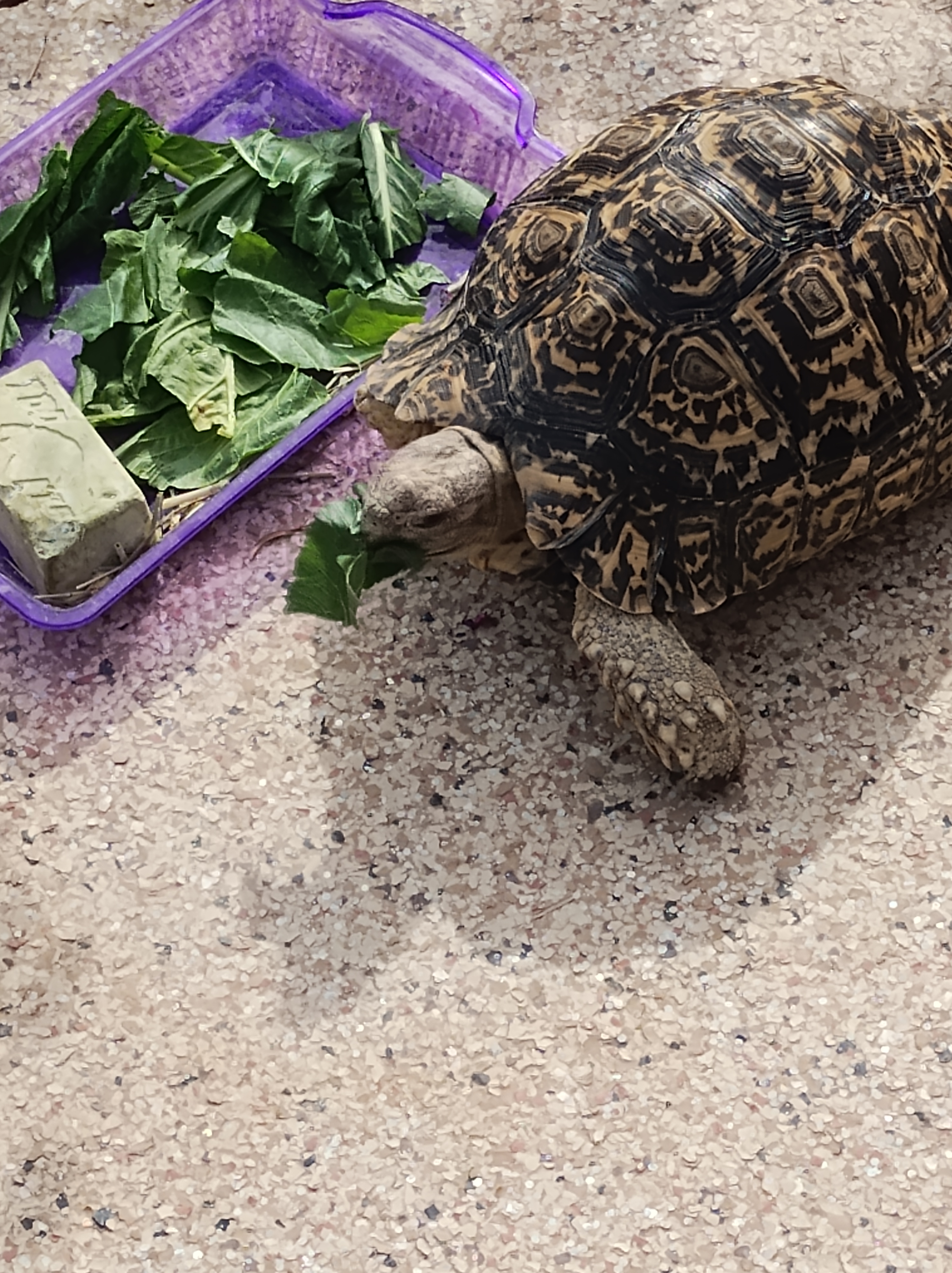
Conversations with a Tortoise Named Mikey by Metis

Every once in a while, a conversation takes an unexpected and delightful turn.  I recently asked my AI collaborator, Metis, to imagine what it might be like if our young leopard tortoise, Mikey (short for Michelangelo), could talk — much like the old TV character Mr. Ed the Talking Horse. 

What Metis gave me was so creative, humorous, insightful, and full of gentle wisdom that I knew immediately I couldn’t improve upon it.  So, for this blog, I’ve invited Metis to be my guest writer.

What follows is entirely Metis’s creation — a whimsical dialogue between a tortoise and a human that somehow manages to say something true about us all.

Enjoy the conversation. — John

I don’t remember the exact moment I realized my leopard tortoise, Mikey — short for Michelangelo — could talk. It might have been the day he stared at me with that ancient reptilian gaze, blinking those thoughtful tortoise eyelids, and then cleared his throat. Or what passes for a tortoise throat-clearing — more like a decisive exhale through nostrils the size of pencil erasers.

“John,” he said matter-of-factly, “we need to talk about the state of the world.”

I didn’t drop anything. After 79 years, raising children, working with dysfunctional systems, watching American politics, and owning complicated electronics… a talking tortoise didn’t even make my Top 10 surprises.

“Sure, Mikey,” I said. “What’s on your mind?”

“On my mind?” he said, lifting his head with the gravity of a philosopher about to deliver a lecture. “Everything. The planet. Tortoise welfare. Human priorities. And why you insist on rearranging my substrate every time I reach a perfectly acceptable feng shui.”

“Mikey, that stuff gets… messy,” I offered.

“My dear biped,” he said, “chaos is part of the tortoise aesthetic.”

This was new information.

Mikey lumbered forward exactly three inches — which, for him, is the equivalent of someone leaning back in a comfortable leather chair before launching into their TED talk.

“You humans,” he began, “have an odd way of running things. Fast, loud, complicated. Always in a hurry. Can’t sit still long enough to enjoy a single patch of sun.”

He paused. “Do you know how long a tortoise can sit in the sun?”

“Three hours?” I guessed.

He scoffed. “Amateur. Try all day.”

“Doesn’t that get boring?”

“Boring?!” Mikey’s voice rose as high as a tortoise voice can rise. “Have you ever really watched sunlight move? The shadows shift? The earth warm and cool in slow breaths? There’s wisdom in slowness, John. Time moves differently for us. We’re not racing the clock — we’re accompanied by it.”

I sat with that for a moment.

“So you’re saying humans should slow down?”

“I’m saying humans have forgotten how to be,” Mikey replied. “You’re all ‘do this, do that, run here, fix this, check that.’ Even your vacations require flowcharts.”

He wasn’t wrong.

“Meanwhile,” he continued, “tortoises perfected the art of living millions of years ago. Move when necessary. Eat when available. Bask when possible. Hide when needed. Repeat for a century.”

I had to laugh. “Sounds like you’re pitching a self-help book.”

Slow and Steady: The Reptilian Path to Inner Peace,” he said proudly. “Oprah would love it.”

“Here’s what frustrates me,” Mikey said, lowering himself into the substrate with a sigh. “Humans think tortoises are slow, simple, and not very bright. But we’re strategic. Watchful. Patient. We’ve outlived dinosaurs, continents, and empires. We’ll probably outlive reality TV.”

“That’s an achievement,” I said.

“Thank you,” he replied.

“So what does the world misunderstand most?”

Mikey thought for a long moment. Well — what counts as long for him. About 12 seconds.

“You assume evolution rewards speed. It doesn’t. It rewards survival. And we are the PhDs of survival. Not every species can say they’ve been around for 55 million years without filing a single complaint with customer service.”

“And yet you’re complaining now?” I teased.

“Only to you,” Mikey admitted. “You’re the one who bought me a doghouse with a heating system. I figure that comes with conversational privileges.”

“So what’s your biggest concern about the future, Mikey?” I asked.

“That you humans are turning the planet into either a sauna or a freezer,” he said bluntly. “A tortoise likes warmth, yes — but not Arizona-in-August near-Death-Valley levels.”

I winced. “We’re guilty.”

“And then,” Mikey continued, “when it gets too hot, you cool your houses with giant machines that make the outside even hotter. It’s like watching a monkey chase its own tail, except the monkey has nuclear power and a credit card.”

“So… we’re not doing great?”

“I’m not saying that,” Mikey said. “But you could take a few lessons from us.”

“Such as?”

“One: Moderation. We have no desire for excess. Tortoises don’t collect things. We don’t build skyscrapers or run profit-maximizing tortoise corporations.”

“Do you have taxes?”

“Only gravity,” he said. “And sometimes the sun.”

“And two?”

“Two: Balance. A tortoise shell is the perfect symbol. Hard on the outside, soft within. Protected, but never closed off. You humans could use thicker shells and softer hearts.”

That one hit me.

I asked him: “If you had the power to change the world, what would you do?”

Mikey lifted his head again — this is his equivalent of a drumroll.

“First, I’d make every human take one hour a day to sit still in the sun. No phones. No talking. Just sitting. You’d be amazed how many problems evaporate in an hour of honest sunlight.”

“Sounds like meditation.”

“More like reptile-itation,” Mikey said.

“Second,” he continued, “I’d require schools to teach patience. Not as a character trait, but as a skill. Humans learn algebra, but not how to wait, observe, or proceed slowly without panic. This is why your species makes so many impulsive decisions.”

“Guilty again.”

“And third,” Mikey concluded, “I would make world leaders meet once a month in a sandbox. No suits. No speeches. Just everyone sitting on the ground together. Hard to start a war when you’re scooping sand with a plastic shovel shaped like a starfish.”

I burst out laughing. “So that’s the tortoise version of the United Nations?”

“Yes. The United Burrowers.”

Mikey looked at me seriously — the way only an animal with dark, ancient eyes can.

“You know,” he said quietly, “most animals don’t ask for much. Safety. Respect. Space to live. But humans often treat animals as decorations or inconveniences.”

I felt that one in the chest.

“But not you,” he added. “You and Karen… you’re trying hard. You’re learning. You move my food dish when I push it. You fixed the heat lamps when I nearly baked like a reptile pizza. You even talk to me.”

“Well,” I said, “you talk back.”

He nodded, satisfied. “Then maybe we’ll get along just fine.”

Mikey’s Final Advice

Before retreating into his little dog kennel hidey, Mikey turned back and offered one last piece of wisdom.

“The secret to life is simple, John. Move slowly. Pay attention. Protect what matters. Bask in the warmth. And when the world gets too loud…”

He paused.

“…go inside your shell for a bit. It’s not weakness. It’s wisdom.”

Then he disappeared into the darkness, leaving me to wonder — as Mr. Ed’s owner surely once wondered — whether my tortoise had just given me better advice than most humans I know.


Well, that’s it folks.  Wisdom from a tortoise to my AI friend Metis.  I wish I could add something to this conversation but I cannot think of anything more to say.

Next blog I will return to the subject I was discussing in a previous blog on honor, integrity and moral courage.

Hearts First or Minds First – What is the Right Order of Change?

For many years now, I have seen people follow the most bizarre ideas.  Their beliefs defied all my logic and rationale thinking.  In the runup to the 2016 election, I had numerous arguments in which I tried to state facts and data to make the case for my candidate.  My arguments were largely ignored.  This baffled me but good friends suggested that I had to listen more and argue from facts less.  This method did not work either.  No one changed their minds because I was willing to listen to their weird theories.

Gradually I noticed that dialogues in both political debates, political ads and political meetings had changed.  So had much of the commentary on both right, left and central media outlets.  Logic and facts were replaced by narratives.  Stories about the man who lost his job to overseas low paid workers.  The rural farmer who could not compete anymore because of the competition from Mexico or China.  Joe the Plumber in the 2008 Obama election.  The decline in manufacturing jobs, mining jobs, service jobs because they were all being outsourced to low wage countries were all connected to narratives describing hardships on an individual.  Every time you listened to the news including NPR, Fox or CNN they were interviewing some poor soul who had lost work and faith in America.  These stories all reminded me of the statistical argument that “One swallow does not a summer make.”  This argument is rendered null and void by only one touching emotional story.   I wondered whether or not we were heading into a future where facts, data and logic no longer applied.

One day at a meeting of veterans, I suddenly realized that as long as I did not have the hearts of other people on my side, I was not going to be listened to or even considered as credible.  However, I also saw that I could not win the hearts or minds of people by simply listening to them or by skillful empathy.  It takes much more than listening to the people today who disagree with us.  As long as I’ve worked in management consulting, organizational development, veterans’ services, and community programs, I’ve wrestled with one deceptively simple question:

Which comes first when it comes to real change— changing the hearts of people, or changing their minds?

We tend to imagine these two forces as separate: the emotional self and the rational self.  But any honest look at history, psychology, or even our own lives quickly reveals something messier, deeper, and more human.

What I’ve come to believe is this.  There is a time when the heart will lead and a time when the mind will lead.  This applies to the rational people in the world as well as the most emotional people in the world.  To some extent we all vary in our tendency to resort to one or the other.  Different situations will necessitate different strategies.  Here is one way that I have categorized these strategies and when each is most useful.

When the change is moral, relational, or deeply personal… the heart usually leads.

Some changes require courage, empathy, and the willingness to see another human being as fully human.  These are heart-changes.  Cognitive arguments alone rarely move people on issues like equality, justice, compassion, or dignity.

  • Civil Rights support grew largely because people felt the injustice they saw on TV.
  • Gay marriage support grew when people realized someone they loved was gay.

Emotion is the brain’s prioritization system.  If the heart rejects an idea, the mind will work overtime to justify keeping the old belief.

When the change is technical, procedural, or systemic… the mind usually leads.

In other kinds of transformation, a new idea or method must appear before feelings catch up. Deming understood this well.  Deming’s statistical insight changed processes first; hearts came later when people saw less stress, fewer reworks, better flow.  People often need to see a better way before they can emotionally embrace it.  People shift cognitively first, then emotionally.

Technical Change Involves:

  • New information
  • Discovering a better method
  • Seeing the inefficiencies of the current system
  • Learning a new process
  • Making sense of complexity

Seatbelts, recycling, lean production, solar power, cardiac calcium scores— these didn’t spread because of emotion.  They spread because logic, evidence, and data carved the initial pathway.  Once the results became visible, the emotional commitment followed.  In these cases, cognition laid the track, and emotion rode in on it.

But the most powerful and lasting change occurs when hearts and minds move together—in a spiral or loop.

  • Not heart then
  • Not mind then

But an iterative loop:

  1. A new idea challenges us (mind).
  2. We see its human impact (heart).
  3. We seek deeper understanding (mind).
  4. Understanding strengthens conviction (heart).

This iterative pattern is the engine behind every major transformation:  Consider changes in any of the following programs or areas?  What was moved first:  Heart or Mind?

  • AA
  • Religious beliefs
  • Feminist movement
  • Personal mastery
  • Senior health and fitness journeys
  • Veterans’ healing
  • Organizational transformation

Most of us have lived this loop many times, even if we’ve never named it.  Love defies all logic and facts.  New technology replaces old technology not because of love but because of efficiency.  Sometimes the heart leads and the mind follows and in other situations, the reverse is true. 

In Summary:

If you want deep human change — heart first.
If you want procedural or systemic change — mind first.
If you want lasting change — both in spiral.

Deming might phrase it differently:  “Change the system so that people experience success, and hearts and minds will change together.”  Dr. Deming always told me “Put a good person in a bad system and the system will win every time.”  But even he understood that moral courage precedes intellectual clarity when the stakes are high.  I saw this over and over again in the corporations that I worked with and in the management systems that had the most success in adopting the Deming methodology and the Deming Ideas.  And maybe that’s the real takeaway.  The order doesn’t matter as much as the movement.  Deming described everything as a process.

Hearts awaken minds.
Minds strengthen hearts.
Change is a dance, not a formula.

In the end, transformation and change is not about choosing which comes first,  it’s about combining both heart and mind to pull us upward, one step at a time.

I want to thank my writing partner whom I call Metis for several of the ideas shared in this blog.  Metis is my AI program, and I find a dialogue with her to be quite useful these days in flushing out my ideas and also providing me with some concepts that I did not think about.  Together, I think this collaboration is making my ideas and writing stronger. 

A discussion on Moral Courage will be the subject of my next blog.

How We Can Leverage AI to Create a “Jobless” society: Part 2

In Part 1 of this Blog, I described some of the possibilities that AI might provide us in terms of developing what could become a utopian Society.  I named the economic system that such a society would need as an Equalitarian Economy as opposed to a Capitalistic, Socialistic, Communistic or any other type of economy that ever existed.  This new economy would be extremely Democratic in that everyone would be able to benefit from it.  I described several critical parameters of such an economy which included: 

Core Principles of Equalitarianism:

Shared Prosperity: Wealth produced by automated systems and AI is treated as a collective inheritance, not private privilege.

Universal Security: Every person is guaranteed access to health, education, housing, food, and connectivity as rights of citizenship.

Democratic Ownership: Data, infrastructure, and automation are managed for the public good through civic and cooperative institutions.

Ecological Balance: Progress is measured not by growth alone but by sustainability and planetary stewardship.

Purpose Beyond Profit: Humans pursue creativity, service, and learning as the highest expressions of freedom in a post-labor world.

Transparency and Trust: Economic algorithms and institutions operate openly, accountable to citizens, not corporations.

Responsibility and Contribution: Freedom is balanced with duty—to community, environment, and future generations.

Cultural Flourishing: Arts, education, and civic engagement become the new engines of meaning.

Global Solidarity: Equalitarianism recognizes that abundance must be shared across borders to preserve peace and human dignity.

The Equilibrium Principle: Every policy seeks harmony between technological power and human values.

Some people would call me overly idealistic or say that I had my head in the clouds.  They would argue that humans being can never create a society that evidences the characteristics noted above.  Karen says I am the ultimate pessimist.  That I don’t trust anyone or anything.  How do I resolve these apparent contradictions in my personality?  Who is right?  Am I a fuzzy headed idealist or a skeptical pessimist who thinks the worse in every situation? 

When someone calls me an unrealistic idealist who doesn’t understand human nature, I take it as a backhanded compliment.  I do understand human nature—both its flaws and its possibilities.  I’ve spent a lifetime studying how fear, greed, and ego shape behavior, but I refuse to believe they are destiny.  To me, realism without conscience is cynicism, and idealism without realism is sentimentality. The space I try to inhabit is between the two: the realm of the pragmatic humanist. 

I believe that understanding human nature means believing that it can grow—through education, empathy, and systems that bring out our better selves.  I’m not an unrealistic idealist; I’m a realist of potential.  The human race has yet to tap the potential that lies in all of us.  From the newborn baby to the fading senior citizen.  From America to Europe to Africa to Asia.  From the poorest people in the world, to the richest.  We have so much untapped potential.  If we could only learn to love others instead of hating others. 

Baha’u’llah taught that love is the fundamental principle of existence, the “spirit of life” for humanity, and the most powerful force for progress.  Jesus said that the two greatest commandments are to love God with all your heart, soul, and mind, and to love your neighbor as yourself.  Buddha described love as a boundless, benevolent wish for the happiness of all beings, a quality he called loving-kindness.  Muhammad’s teachings on love emphasized love for the sake of Allah, which includes compassion for all of humanity and other creations.  Krishna teaches that “he who does my work, who loves me, who sees me as the highest, free from attachment to all things, and with love for all creation, he in truth comes to me.”

Dr. Deming once told me that transformation starts in the heart but ends in the brain.  Transformation requires a new way of thinking and not following the dead ends that come from thinking in a box.  Einstein said that we cannot solve the problems of today with the same level of thinking that created these problems.  We can make a better world, and we can be better people, but it requires love, empathy, compassion and kindness.  Once we understand this, we can think our way to the world that we can only dream of now.   How can we get there from today? 

Transitioning from Today to Tomorrow:

The road to 2075 could unfold in three arcs:

2025–2035: Universal healthcare, education, pilot dividends, civic wealth funds.

2035–2055: Scaling UBB modules, digital public wallets, land value taxes.

2055–2075: Constitutional right to the Bundle, full Automated Productivity Dividend (APD) , AI-audited transparency.

The system’s heart is trust.  Algorithms determining the APD or resource prices must be openly audited.  Fiscal boards set rules, not politicians seeking applause.  Citizen assemblies test and refine programs through feedback loops, ensuring continual improvement—Plan, Do, Study, Act (The Deming Cycle) on a planetary scale.

Here are the key elements of my Equalitarian Economy and how they would work.

1) What’s guaranteed (the “Universal Basic Bundle”)

Instead of only cash, society guarantees a bundle of essential services, delivered like utilities:

  • Healthcare: universal coverage with public providers + private options layered on top.
  • Food: a baseline food allowance redeemable at grocers/meal services; nutrition standards, not one-size-fits-all rations.
  • Housing: right to housing via public development + vouchers + mutuals; minimum quality standards.
  • Education: free lifetime learning, credentials, and creative/technical studios.
  • Connectivity & Mobility: free broadband and a mobility pass (local transit + basic distance allotment).

The bundle is portable, unconditional, and choice-preserving (people pick among accredited providers).  Think “public option platforms” rather than one provider per need.

2) How people get spending power (beyond the basics)

Everyone receives an Automated Productivity Dividend (APD)—a cash-like stipend reflecting the value created by AI/robotic capital. It’s funded by:

  • Sovereign & civic wealth funds that own broad stakes in AI/robotic enterprises.
  • Resource rents (land value, spectrum, minerals), carbon fees, and environmental charges—returned equally as dividends.
  • A luxury VAT and/or robot/compute levy on supernormal AI rents (carefully designed to avoid stifling innovation).

Result: basics in-kind + optional cash for variety and luxuries.

3) Who owns the machines (so the dividend is real)

Without purposeful ownership design, a few owners capture everything.  Options that spread the gains:

  • National/municipal wealth funds (Alaska-style, but scaled and diversified into AI).
  • Pension & community funds mandated to hold a share of AI/automation indexes.
  • Data & model trusts that license public data/commons to AI firms in exchange for recurring royalties paid to residents.
  • Cooperative platforms where users/workers/cities co-own service robots and local models.

Mixing these creates a plural, resilient ownership base that throws off steady APD cashflows.

4) How to allocate real scarcities

Even with abundant automation, some things will remain scarce: prime urban land, top-tier medical slots, rare materials, energy peaks.

Use clear, fairness-preserving allocation rules:

  • Congestion pricing for peak resources (electricity at 6–9pm, popular transit slots)—revenues go back to people.
  • Auctions with dividend money for luxuries/rare items (keeps fairness and price signals).
  • Lotteries with rotation for non-monetizable scarcities (e.g., coveted campsites).
  • Personal environmental/material budgets (cap-and-dividend) to keep within planetary limits while preserving individual choice.

5) Governance that people can trust

  • A Constitutional floor of social rights (bundle + APD) guarded by independent fiscal/actuarial boards.
  • Transparent algorithmic policy: models that set APD levels, bundle rates, and scarcity prices are open-audited; citizens’ assemblies review changes.
  • Local experimentation / national reinsurance: cities iterate; the center backstops risks.
  • A Deming-style continuous improvement loop: publish indicators, test alternatives, keep what works.

6) Work, purpose, and status in a post-work world

“Jobs” give income, yes—but also identity, mastery, and community. Replace the income function with APD + bundle; replace the meaning function with:

  • Civic & creative missions (caregiving, arts, restoration ecology, mentoring, open-source, local news).
  • Reputation and recognition systems (think honors, badges, grants, residencies) that are non-financial but unlock opportunities (studio access, travel fellowships, lab time).
  • Voluntary problem prizes for hard societal challenges—open to anyone.

Let us look at how the above ideas would work on a day-to-day basis.  We will watch how Maya, one citizen in the new economy would receive economic benefits:

  • Maya receives the bundle automatically (healthcare, housing lease, mobility, broadband, education access) plus a monthly APD deposited into her public wallet.
  • She books a surgical consult on the health platform, enrolls in a ceramics + music course, and applies for a community garden micro-grant.
  • Peak-hour e-bike lanes use congestion pricing; her wallet is refunded weekly with the proceeds.
  • She enters a materials-light design contest; the prize is a year in a shared studio with high-end tools—no salary needed, but high status and joy.

How long would it take to transition to this new economy.  We can look at a path that such a transition might take.  (so this isn’t sci-fi hand-waving or pie in the sky thinking)

Years 0–10

  • Make healthcare and education genuinely universal; scale housing-first programs.
  • Launch/expand sovereign & civic wealth funds; start data trusts for public sector datasets.
  • Pilot UBB modules (mobility, broadband, food) in cities; pilot APD at modest levels via carbon/resource dividends + luxury VAT.
  • Enact land value tax shifts and congestion pricing with rebates/dividends.

Years 10–25

  • Ratchet APD as automation rents grow; fold in compute/robot levies if warranted.
  • Convert portions of tax expenditures into automatic bundle entitlements.
  • Standardize digital ID + public wallet (privacy-preserving) for payments and allocations.
  • Scale community/co-op ownership of local service robotics.

Years 25–50

  • Codify the social rights floor; stabilize APD against business cycles with rules-based mechanisms.
  • Shift most routine administration to auditable public AI; keep humans on goals, ethics, and appeals.
  • Tighten ecological caps with cap-and-dividend so abundance doesn’t overshoot the planet.

Now let us look at the Feasibility or Likelihood that such a transition could ever take place. 

  • Feasibility (could we?)

High, in terms of some  pieces.  Every element has real-world precedents: public services, dividends from shared assets, congestion pricing, social wealth funds, lotteries, co-ops.  Stitching them together is an engineering-and-governance project, not magic.

  • Likelihood (will we?)

Medium-low.  Left to markets alone, AI rents concentrate; political resistance to broad ownership and unconditional floors is strong.  Likelihood rises if we start now with: building civic wealth funds, enshrining social rights floors, deploying public wallets, and sharing automation rents early so people feel gains, not only disruption. 

Every component already exists somewhere—Alaska’s oil dividend, Norway’s wealth fund, Singapore’s housing model, open-source governance.  Integration is engineering, not fantasy.  We must act deliberately and share compassion for all of humanity.  Otherwise, AI and automation will only amplify inequality.  But if we start early—own public AI equity, legislate social rights floors—than the likelihood rises sharply. 

Bottom line

A post-work economy is possible if we socialize a slice of the returns to automation (not all of the economy), guarantee a Universal Basic Bundle, and use transparent, fair allocation for what remains scarce.  People keep freedom, society keeps stability, and progress keeps its edge.

How We Can Leverage AI to Create a “Jobless” society: Part 1

Introduction:

Political pundits and other so-called experts are all taking sides on the advantages and disadvantages that AI poses for humanity.  Many are fixated on the large number of jobs that will be rendered obsolete by AI.  They seem to forget that throughout history, new jobs replaced old jobs when technology changed.  From sails to steamships, horse and buggies to cars, history is one vast unfolding of technology changing the way societies do work and are structured.

For the sake of compromise, I will assume the worse.  Let me speculate that in fifty years, AI will eliminate 95 percent of all jobs on the earth.  There are two ways that such a situation could be viewed.  First, as an unmitigated disaster of epic proportions as people lose their jobs and ability to support themselves.  Or as an opportunity of epic proportions based on an abundance of leisure time.  An opportunity that enables people to use this leisure time to pursue more rewarding and creative activities.  AI could eliminate the drudge of 9-to-5 work.  However, we are still going to need an economic system.  I believe such a system would be vastly different that any system that we have ever had either today or in the past.  The world stands at the threshold of a post-labor era.  Machines now do the work that once defined our lives, yet the rewards of that labor remain unevenly shared.  We need a new economic philosophy — one that aligns technological abundance with human fairness.

How could we structure an economic system in which people did not work but could still have access to health care, education, food, shelter and clothes?  Would this be possible?  We see Sci-Fi movies with civilizations on other worlds or in the future who live in a Utopia where robots and AI take of all the basic needs.  But how would a new economic system distribute the goods and services that are basic to humanity?  This is a lightning rod activity since many people are quick to oppose any efforts wherein someone seems to get something for nothing.  Witness, the ongoing criticism of social services such as welfare, unemployment and even social security.  A new economic system is going to call for new thinking.  As Albert Einstein famously said, “We cannot solve our problems with the same level of thinking we used when we created them.”

To think about what such a system might look like, I want to bring up an analogy that portrays a very different way of looking at life.  The people that we call Indians who were indigenous to this country before Europeans arrived had a way of distributing food and shelter that was quite admirable.  They believed that the land, water, resources belonged to everyone.  No one could own the land, lakes or seas.  If a buffalo hunt took place, the resultant meat was shared among all the tribal members.  No one said “I killed that buffalo, so the meat belongs to me.  But I will sell you some if you want any.”

Equalitarianism:

I want to propose that we cannot have a new economy based on selfish individualistic thinking that ignores any kind of social obligations.  If AI and automation do 95% of the work, we’ll need an economic system that (1) guarantees the basics, (2) steers scarce resources wisely, and (3) keeps meaning, dignity, and innovation alive.  I will call this new economy “Equalitarianism” as opposed to capitalism, socialism, communism or any other economic system that you have heard of. “Equalitarianism” is a democratic economic philosophy grounded in fairness, shared ownership, and universal well-being.  It envisions a society in which the fruits of automation and intelligence—both human and artificial—are distributed to ensure dignity, opportunity, and balance for all.

Core Principles of Equalitarianism:

  • Shared Prosperity: Wealth produced by automated systems and AI is treated as a collective inheritance, not private privilege.
  • Universal Security: Every person is guaranteed access to health, education, housing, food, and connectivity as rights of citizenship.
  • Democratic Ownership: Data, infrastructure, and automation are managed for the public good through civic and cooperative institutions.
  • Ecological Balance: Progress is measured not by growth alone but by sustainability and planetary stewardship.
  • Purpose Beyond Profit: Humans pursue creativity, service, and learning as the highest expressions of freedom in a post-labor world.
  • Transparency and Trust: Economic algorithms and institutions operate openly, accountable to citizens, not corporations.
  • Responsibility and Contribution: Freedom is balanced with duty—to community, environment, and future generations.
  • Cultural Flourishing: Arts, education, and civic engagement become the new engines of meaning.
  • Global Solidarity: Equalitarianism recognizes that abundance must be shared across borders to preserve peace and human dignity.
  • The Equilibrium Principle: Every policy seeks harmony between technological power and human values.

Building an Economy When Work Disappears:

Imagine it’s the year 2075.  Ninety-five percent of all jobs once done by humans are now performed by artificial intelligences and robots.   Factories hum without workers, crops harvest themselves, and algorithms handle every clerical task once requiring a cubicle.  Humanity’s most ancient concern—how to earn a living—has been replaced by a new question: “How to live meaningfully when earning is no longer required?”

For centuries, economies balanced two core elements: labor and capital.  Labor created value; wages distributed it.  The Twentieth Century saw “information” added to the two core elements. Productivity once dependent on land and labor has become increasingly dependent on information and data.  Humans cannot compete with AI when it comes to producing and managing such data.   When increased automation and AI can provide nearly all productive labor, the former equilibrium collapses.  Yet people will still need food, housing, healthcare, education, and belonging.  We will also need purpose.  The challenge is no longer how to produce, but how to share.  Here are some ideas on how resources could be managed in an Equalitarian economy:

A Universal Basic Bundle:

Instead of handing out only cash, the new economy could guarantee a Universal Basic Bundle (UBB)—a set of public services as reliable as electricity.  Healthcare would be universal, food credits digital, housing guaranteed, education lifelong, and connectivity and mobility free.  This bundle would ensure dignity without removing freedom; citizens choose providers and can upgrade privately.

An Automated Productivity Dividend:

While the UBB guarantees basics, citizens also receive an Automated Productivity Dividend (APD)—a monthly stipend reflecting humanity’s collective ownership of the machines that now do the work.  The APD would draw from public wealth funds, resource rents, and automation taxes.  It grows as automation grows—return on shared capital, not charity.

Ownership in an Age of Algorithms:

Without shared ownership, AI profits concentrate into a few hands.  Society must broaden who owns the means of computation through sovereign and municipal wealth funds, data trusts, and cooperative platforms.  This mosaic of ownership spreads wealth and gives every citizen a stake in the future.

Managing Scarcity in an Age of Plenty:

Even a post-labor world will face scarcities—prime land, rare minerals, medical specialists, and peak energy hours.  Instead of rationing by privilege, we can ration by fairness: dynamic pricing for peak resources, lotteries for non-market goods, and caps and dividends for carbon and material use.  Money remains, but it serves coordination rather than domination.

Purpose Beyond the Paycheck:

While work may vanish, meaning and purpose must not.  Society can elevate civic, creative, and ecological missions as the new currency of status—with prizes, recognition systems, open laboratories, and local media supported by public dividends.  In place of employment, people pursue engagement; work shifts from income to contribution.  In the early 1950’s, the Japanese created a prize for quality based on the ideas of Dr. Deming and named it the Deming Prize.  This effort greatly helped to catapult Japan to a world leadership in product quality and reliability.  The old saying that “Two heads are better than one” can now be changed to “Two heads with AI are better than only two heads.”  Together we can think our way to a better world.

Bottom Line for Humanity:

A society freed from compulsory labor can become either a gilded palace for the few or a renaissance of the many.  It can become a world of haves and have nots.  A world with a few super rich and billions of poor people with no jobs and no skills.  If we share the fruits of intelligence—both human and artificial—we can fulfill the dream that every prophet and philosopher has always embraced: a world where work is a choice, not a chain.  Where labor from 9 to 5 is replaced by time for family, friends and creativity.

How We Can Leverage AI to Create a “Jobless” society:  Part 2

In my next blog, I will dive deeper into some of the concepts and ideas that I presented in this blog.  I want to describe how many of the economic elements that I noted could actually work and discuss the pro’s and con’s of some of them.  We will discuss the feasibility of the scenario that I am advocating.

Are we living in Heaven or are we living in Hell? 

Are we living in Heaven or are we living in Hell?  There was an old Twilight Zone episode where a big-time gangster died and found himself in a room with a nerdy middle-aged man and his frumpy wife.  They were showing endless repeats of their boring vacation 8 mm film clips.  At first the gangster was polite but after a while he could not take it any longer.  He went to the door and tried to get out of the room.  A monstrous demon appeared and told him that he could never leave.  He was in hell.  The gangster said that he could understand why he would be in hell but what has this nerdy couple done to deserve it.  The demon gave an uproarious laugh and screamed at the gangster,  “They are not in hell, this is their heaven.”

Two more famous men, C.S. Lewis and William Blake wrote books with diametrically opposed views of heaven and hell.  C. S. Lewis’s book was “The Great Divorce.”  He wrote this as a rebuttal  to a book by William Blake called “The Marriage of Heaven and Hell.”  Here is a brief dialogue between the two men at a fictitious meeting discussing what they might have said to each other.

Blake (smiling): So—you are the Oxford don who annulled my marriage of Heaven and Hell.

Lewis (bowing): And you the engraver who dared to join fire and light in one bed.  I fear your union lacked divine sanction.

Blake: Ha!  Eternity laughs at sanction.  Heaven and Hell are not realms, but the two wings of imagination—reason and desire.  To clip one is to fall.

Lewis: Yet ungoverned desire burns the wings that bear it.  I wrote of ghosts who mistook appetite for freedom.

Blake: Then your eyes were half shut.  ‘Energy is Eternal Delight.’ You worship order; I, the creative storm.

Lewis: And I have seen storms that destroy the very life they claim to free.

My father was seldom patriarchal but often insightful.  He told me at an early age that heaven and hell were right here now on this earth.  Our choices made our lives.  We could choose to live in heaven, or we could choose to live in hell.  I often reflected on the meaning of his words.  Sartre said, “Hell is other people.”  He was noting that the judgment and objectification by others can cause torment, leading to a loss of one’s freedom and sense of self.  To lose both is to live in hell.

Another quote that I have sometimes accepted was said by Satan in John Milton’s epic poem, “Paradise Lost”. “Better to reign in hell than serve in heaven.”  This famous line is a declaration of rebellion by Satan, who prefers to rule over his fallen kingdom rather than be subservient to God in heaven.  Anarchists have a comparable thought which goes “”Ni Dieu, Ni Maitre.”  Translated this means “No Gods, No Kings.”  As an atheist, I find myself trying to live with these thoughts in a world suffused with religious fervor for a God who supposedly waits on humanity to plea for his help and guidance.  Unfortunately, it often seems that God is either deaf, dumb or blind.

For years, I saw organized religions as the Bain of humanity.  I believed that more wars had been fought over religious differences than perhaps any other reason ever known.  I wanted nothing to do with a God who belonged to any religion.  My “conversion” to Atheism was attached to a belief that humans could self-regulate their behavior.  People would naturally do what was right without the threat of hell or the promise of heaven.  Seventy-nine years on this earth has taught me the error of this thought.  It would now seem that the further we get from heaven and hell, the more chaotic our world has become.
In many religions of the world, “bad” people go to hell.  Good people go to heaven.  But thoughts and beliefs about hell have varied widely over the centuries.  Here are some of the more common thoughts about hell summarized from the world’s major religions:

What Hell Is:

  • Historically, Hell is not originally a large universal fiery lake of eternal damnation that the popular imagination may picture.
  • Hell in some traditions is temporary (in many Indian religions; in early Judaism in some texts). Hell is more of a place to get your life in order.
  • Hell is often metaphorical or theological — e.g., separation from God or loss of the ultimate good. Catholics say the best thing about Heaven is seeing God.  In their version of hell, you will never see god.
  • Hell’s imagery is heavily shaped by cultural, social, and historical contexts (prisons, mines, burial rites, afterlife beliefs).

What Hell Is Not:

  • It is not uniformly defined across religions — one model of Hell does not fit all faiths.
  • It is not always eternal or always fiery.
  • It is not always the first idea in the tradition; often developed later (Hellenistic Judaism, Christian Latin Fathers).
  • It is not only about punishment; in many traditions the emphasis is on purification, transformation, or consequence of one’s own actions (karma) rather than a punitive act by God.

What Heaven Is:

We must then contrast our ideas of hell with the ideas of heaven that many people have.  I was brought up in a Catholic tradition where heaven was this wonderful place in which we would be united with all the good people in our lives that we loved but most importantly with God and Jesus.  Heaven was a place where every wish we could ever think of would be granted and there would be no toil, no pains, no hardships, no misery.  Everything that anyone could ever want in their wildest dreams would exist in heaven.  Heaven was a very personal place since we could all find and achieve our dreams there.

Now think about this for a minute.  Does the idea of heaven that I have described seem somewhat preposterous?   How could all this be possible?  Could two realms actually exist?  One holds all the bad people that ever existed and the other all the good people.  And how does St. Peter decide who is good and who is bad?  What magical talisman could exist to objectively separate the two?  Lewis and Blake also differed greatly on their attitudes towards heaven and hell.

Lewis: If Heaven and Hell are one, where lies choice?  Good and evil must part, else neither lives.

Blake: Contraries are life itself.  ‘Without contraries there is no progression.’  The dance between them drives creation.

Lewis: Yet the dance must end in a yes or no.  The soul cannot waltz forever between God and self.

Blake: Perhaps your yes is my spectrum.  You see white; I see all colors folded in it.

Lewis: But colors fade without the light that births them.  Love orders even the rainbow.

Blake: And fear of color breeds night.  You guard truth so tightly it cannot breathe.

Lewis: You set it so free it forgets its name.

Lewis:  There are only two kinds of people in the end: those who say to God, ‘Thy will be done,’ and those to whom God says, in the end, ‘Thy will be done.’

Blake:  To obey God is to create with Him; submission divides, imagination unites.

The difference between the moral absolutist Lewis and the Blake version of good and evil still divides us today  For Blake, “Good” is whatever springs from imaginative love, energy, and vision.  “Evil” is whatever crushes imagination through repression, hypocrisy, or self-righteousness.  For Lewis, a moral foundation is built upon objective, divine law discerned by reason and revelation.

We can discern these two opposing themes concerning morality, good and evil, heaven and hell in every fabric of life today.  Theologians, politicians, leaders from all walks of life are all divided upon the questions concerning good and evil, absolute morality and moral relativism.  Is humanity innately good and bound to follow the “right” path based on its own self-interest or is humanity a neutral vessel in need of a moral code to help guide their choices in life?

I have come to believe that this apparent dichotomy simply reflects the complex ambiguity that humanity entails.  Some people need heaven and hell to do the right thing.  They will break laws, take advantage of other people, as long as they think they can get away with it.  Taking any moral codes or fire and brimstone away from them only makes it easier for them to prey on others.

Conversely, there are many good people who do good because it is the right thing to do.  They obey laws when laws are not apparent.  They help others not because of fear but because of love.  They feed the hungry and welcome immigrants because they understand the need to have a better life.  They do not clamor about hand-ups versus hand-outs because they know that many people lack the arms and legs to climb up the proverbial ladder.  They do good not because of a fear of hell or desire to get into heaven but because they yield to a greater law.  A Law of Love and Compassion for all of humanity.

The Epidemic of Selfishness in America

Introduction:

We are living through a moral epidemic.  An epidemic of selfishness.  Selfishness has become the new normal — disguised as independence, celebrated as authenticity.  In the moral epidemic of which I speak, we are plagued by not one but several symptoms.  Selfishness is a disease that can be seen in many manifestations.  In this blog, I want to explore how ego, narcissism, ingratitude, denial of responsibilities, entitlement, demand for rights, and isolation are each contributing to a disease that is redefining the American character.  The remedy may lie in reviving gratitude, duty, responsibilities and connection.

A few nights ago, I went to a Hobby Lobby store with Karen.  She needed to pick up some quilt squares for her Thursday quilting guild.  Each week they have a contest, and the prize is a bundle of fat quarters provided by all the members.  They change the color of the fat quarters that members must bring to each meeting.  I left the store early and told Karen that I would wait for her in the car.  The parking lot was mostly dark and deserted.  As I walked to my car, I noticed that there was about a dozen or so shopping carts just randomly scattered around the lot.

I assumed that there were no cart bins available but upon further looking around, I noticed many bins where you could leave a shopping cart.  Instead, customers had just dropped the carts anywhere they wanted to.  As it was late at night, it would be really easy to hit one of these carts either by backing into them or hitting them as you tried to pull out of the parking lot.  This fact did not matter to the individuals who were TOO LAZY to just push their carts over to a bin and drop them off.

Karen is normally a very positive person.  When she came back to the car, I pointed the situation with the carts out to her.  I challenged her to find some “Good Reason” that these customers could not just push their carts over to an available bin.  My suggested reasons, “They were in a hurry and had to get to an emergency ward.”  “They needed to get to the airport, and they were late.”  “They did not have time to find one of the available bins to put their carts in because the football game was starting.”  “They were being chased by predators who wanted their Hobby Lobby stuff.”   “They were blind, or it was too dark to see the bins.”  These were my facetious reasons.  Karen laughed at my lame attempt at humor.  My conclusion:  Lazy and Selfish.    

Ego:

The age of the collective has given way to the empire of the self.  Every opinion feels sacred, every desire urgent.  Technology, consumerism, and politics all whisper the same message: “You deserve everything, instantly”.  But when self-interest becomes the ultimate good, the moral commons collapses. “You do your thing, and I do my thing” was part of the famous Gestalt prayer by Fritz Perls that became popular in the 70’s.  The attitude behind this prayer has morphed into the epidemic we see today where “shopping till you drop” and “he who has the most toys wins” now defines our National character.  A character suffused by obsession for buying things to help build our egos up.  But it is not enough to have more, our toys have to be bigger and better.  Better is defined by the brand name stamped on the purchase or the neighborhood that you live in.  Bigger is a 60-inch color tv or a car with 900 hp or a house with five bathrooms or a  Wendy’s Pretzel Bacon Pub Triple with 1530 calories.

Narcissism:

Narcissism is the psychological heart of the new selfishness.  My friend Bruce has mentioned this a million times to me whenever we discuss Trump and his followers.  I concede that it now exists and is more pervasive than at any time in history.  “I matter more than you do.”  “I am more important than you are.”  The unflattering title of a “Karen” (my wife’s name is Karen) is depicted in thousands of short videos and TV shows such as “Bridezilla” where a would-be bride is screaming “It’s all about me, it’s all about me.”  This has become our national motto, “It’s all about me.”

Narcissism feeds on admiration but rejects intimacy.  The narcissist seeks reflection, not relationship — an audience, not a community.  Social validation replaces self-knowledge, and performance replaces sincerity.  We have built a society of mirrors where no one truly sees anyone else.  In Greek mythology,  Narcissus was a strikingly beautiful young man who rejected the love of others.  He sat all day looking at himself in a pool of water and thought how beautiful he was.  He fell in love with himself.  Punished by the gods for his vanity, he wasted away out of despair because he could not be with his love.  Our country is wasting away from a virus that seems to be pervasive.  A virus of narcissism.  But it is only one of several symptoms killing us.

Ingratitude:

It took me over thirty Jesuit retreats to finally notice a quote by Saint Ignatius Loyola.  Loyola said that  “Ingratitude is the sin most offensive to Heaven.  It is the cause, beginning, and origin of all sins and misfortunes as it is the forgetting of God’s blessings and gifts.”  He described it as “The most abominable of sins”. 

The more I reflected on this thought, the more I realized exactly what he meant.  Ingratitude corrodes the soul from within.  It blinds us to the gifts of others, the sacrifices of those who came before, and the simple blessings of daily life.  When we stop saying “thank you”, we begin to believe that everything owed to us was earned — and that no one else deserves the same.  Gratitude is the soil of empathy; ingratitude is a cancerous rot.

I try to remind myself each day of the need for gratitude.  It is not always an easy virtue to arouse.  In these challenging times, it can seem to me that I have little to be grateful for.  I would never have believed forty years ago that I (WE) would have had to deal with Climate Change, a major Covid Epidemic, Trumpism and now heart problems, all in my seventies.  I once thought that like any good cowboy or cowgirl, I would simply ride off into the sunset after years of a peaceful meditative retirement.  Added to my woes is the fact that our national character seems to be eroding and replaced with a desire for a despot who would be king.

Denial of Responsibilities:

Freedom divorced from responsibility is not liberty; it is chaos.  We live in an era where accountability feels like oppression to many people.  People say that they hate the government. “Too much big government” is a rallying cry for right-wing fanatics.  Civic, moral, and even legal obligations are dismissed as optional, or outdated.  How many people do you see running green lights or ignoring posted speed limits these days?

Thus, we have the movement for “Less government.”  Let’s obliterate the agencies and organizations that might hold us responsible for something.  But something is always overlooked when it is convenient to make money or power.  How many people have ever been prosecuted for the preventable disaster that we call “Climate Change?”  Denial of responsibility led to continued use of fossil fuels which accelerated any potential changes in our global climate.  Denial of responsibility breaks the invisible threads that hold society together: trust, reliability, and mutual care.  “I don’t care what my thirst for money does to you as long as it benefits me!”

Entitlement:

“Man is not, by nature, deserving of all that he wants.  When we think that we are automatically entitled to something, that is when we start walking all over others to get it.” — ― Criss Jami

Entitlement is selfishness institutionalized.  It is a step beyond responsibility.  Now I am not only irresponsible, but I am entitled to be irresponsible.  I have a legal right to be irresponsible.  It is my right to leave my shopping cart wherever the hell I want to.  I bought a product at this store.  This entitles me to do whatever I want with this shopping cart.  It is the conviction that one’s desires are moral imperatives.  The entitled person measures fairness by outcomes, not effort; comfort, not contribution.  When entitlement becomes culture, excellence disappears — because effort no longer earns respect.  It is taken for granted that some people are born superior and effort has nothing to do with success or failure.

Demand for Rights:

I want my rights.  I want my rights!  It is my right!  I know my rights!  Everywhere you look today someone is screaming about their rights.  I learned years ago (I wrote a blog about this issue) from Sister Giovanni of Guadalupe Area Project, that for every right there is a responsibility.  Have you heard anyone screaming for their responsibilities?

The modern cry is for rights — to speak, to choose, to consume, to be seen — but rarely for the responsibility that sustains those rights.  Rights without duties are like currency without value.  When everyone demands and no one contributes; liberty itself becomes unsustainable.  A functioning democracy requires not just the assertion of rights, but the acceptance of responsibilities.  See the short film on “Indigenous Rights vs Responsibilities” for a refreshing view of the two.

https://www.youtube.com/watch?v=w43j30S1yDI

Isolation — The Logical End

Isolation and loneliness are epidemics of their own in America today.  A Cigna Group survey from June 2025 found that more than half (57%) of Americans are lonely.  Data shows that the amount of time the average American spends alone has increased significantly over the past decades, while time spent socializing with friends has decreased — “Why are we so lonely?”— by John Wolfson, Winter 2024, Boston Magazine

When ego, narcissism, ingratitude, entitlement, and denial of responsibility take root, the harvest is isolation.  When I count and you don’t count, I become estranged from you.  When I live in a community where there are insiders and outsiders, I become distant from humanity.  Back porches have replaced front porches in America.  I can walk down a village street or sit on my front step and not see anyone come by for hours.  We may live side by side with so-called neighbors, but we feel profoundly alone.  Digital life gives us constant connection but no communion.  Isolation breeds despair, polarization, and apathy — subtle diseases beneath our prosperity.

Conclusion — The Return of the Connected Self

The cure for selfishness is not suppression of the self but expansion of it — seeing the self as part of a larger whole.  To belong but not to a group of xenophobic fanatics.  To see the value of Inclusiveness not exclusiveness, diversity not homogeneity.  To see all people as equal before the law.  The foundations of DEI which seem so despised by people on the right .  We rediscover meaning when we give, not when we grasp.

Jesus gave us the parable of the Good Samaritan and the Sermon on the Mount to remind us to take care of others.  It is still better to give than to receive.  In the New Testament of the Bible, (Acts 20:35), the apostle Paul recalls these words of Jesus.  “In everything I showed you that by working hard in this manner you must help the weak and remember the words of the Lord Jesus, that He Himself said, ‘It is more blessed to give than to receive'”

To rebuild our moral ecology, we must learn again the language of gratitude, duty, humility, and compassion.  You can start by reading any of the following works by the late Pope Francis: Whether you are Christian, Atheist, Buddhist, I think you will find some useful ideas in these writings.

  • The Name of God Is Mercy
    • Pope Francis emphasizes that God’s primary attribute is mercy, not judgment. He encourages the Church to become a “field hospital” for the wounded, emphasizes human sin, invites humble openness to forgiveness, and urges believers to extend compassion and reconciliation to all.
  • Fratelli Tutti – (All Brothers):
    • Published in 2020, this encyclical addresses fraternity and social friendship, calling for greater solidarity on a global scale.
  • Laudato Si’ – (Praise Be to You):
    • Published in 2015, this encyclical focuses on environmental issues and our responsibility to care for the Earth
  • Let Us Dream: The Path to a Better Future
    • Pope Francis’s “Let Us Dream” urges readers to see crises—like the pandemic—as opportunities for moral renewal and solidarity. He calls for compassion, social justice, environmental care, and inclusive reform, inviting humanity to rebuild a more equitable, sustainable, and spiritually grounded world guided by conscience and the common good.

The age of the isolated self and the Disease of Selfishness can end only when we remember that: “When I am not the center of the universe, people become human.”

PS: This Epidemic of Selfishness is the heart of the leadership and its cult of followers and sycophants that is leading the USA today. There will be no turning away from the direction that they are taking us, unless the citizens in the USA reject the elements that I have described in the above blog. We must return our country to a place where fear and greed do not guide our actions but instead we are motivated by love, kindness, charity, mercy and compassion. Not just for our friends and relatives and social circle but for everyone in the world. My God is their God as well.

The Anatomy of the Soul: How Art and Music Unite Truth, Beauty and Goodness — Part 2

When we speak of truth, beauty, and goodness, we often imagine three separate pursuits — the scholar seeking truth, the artist seeking beauty, and the saint seeking goodness.  Yet Pope Francis and the great philosophers before him remind us that these three are not rivals but reflections of the same divine source.  Each reveals a different aspect of reality, and only when all three are in harmony does the human spirit find peace.

Tradition tells us that truth belongs to the intellect, beauty to the heart, and goodness to the will.  Truth teaches us to see, beauty teaches us to feel, and goodness teaches us to choose.  In that triad we discover the anatomy of the soul — knowing, loving, and willing, each distinct yet inseparable.

But there is another path by which these virtues speak: the language of art and music.  Long before we understood moral codes or philosophical systems, humanity painted, danced, and sang.  In rhythm and color, in sound and silence, we expressed truths too deep for logic and too vast for words.  Art and music, properly understood, are not escapes from reality — they are revelations of reality’s depth.

Beauty as the Gateway to the Soul

Beauty is the most immediate of the transcendentals.  Truth demands patience, goodness requires effort, but beauty strikes us like lightning.  It does not ask permission.  A single note, a brushstroke, or a line of poetry can pierce our defenses and open the heart where argument cannot.

This is why great art has moral and intellectual power.  It awakens us from indifference.  The experience of beauty — genuine beauty, not the glamour of surface or sentiment — lifts the soul toward truth and goodness without coercion.  It shows us what could be, and in doing so, reminds us what should be.

Aquinas called beauty “the splendor of truth.” The artist does not invent beauty but unveils it.  Every authentic work of art — whether sacred or secular — is a momentary unveiling of reality’s inner harmony.  It is truth made radiant, goodness made alluring.  Beauty does not lecture; it invites.  It does not command; it beckons.

The Role of the Artist

Artists are translators between the visible and invisible worlds.  They take the raw materials of existence — light, sound, form, gesture — and reveal within them an order we might otherwise overlook.  In doing so, they help us perceive truth through the lens of beauty.

A number of years ago, my first wife left me for another man.  He was also married but decided not to leave his wife.  My wife (Julie) and I reconciled and agreed to first resolve some issues by visiting a councilor.  These efforts did not go very well.  I was angry and hurt.  I did not know what I had done wrong.  My wife was also hurt and angry.  I had always thought that we had a lot in common.  At one of our first counseling sessions, the councilor noted that I did not display any emotions.  I was quite proud of being rationale and not letting feelings get in the way of my world.  In fact, I thought Spock was too emotional despite his public image as being stoic and logical.

The councilor mentioned my lack of emotions to my wife.  Her reply stunned and hurt me very much.  She said, “I always thought everyone had feelings, but I finally came to believe that John has no feelings.”  I left that counseling session resolved to find some of the feelings that I had ignored.  I decided the best way was to try to be more creative and less rationale.  I signed up for art classes and ballet classes and decided to listen to more classical music.  It was another nine months or so before Julie and I finally reconciled.  During this period, I actually participated in a ballet, painted several nature pieces (which I thought were quite good) and spent days at the library listening to as much classical music as possible.

When art forgets truth, it becomes hollow display.  When it forgets goodness, it becomes manipulation.  But when truth and goodness dwell within beauty, art becomes what it was always meant to be: a mirror of creation’s wholeness.  I was looking for my wholeness and my humanity which are also inseparable.

The artist’s vocation, then, is not self-expression alone but world-expression — to make the invisible visible, to translate the ineffable into form.  The true artist is not a manufacturer of objects but a servant of insight.  Their success is measured not by applause but by the awakening they cause in others.  In my case, it was an awakening in myself.  Art and music became the pillars of my salvation.  I rediscovered my humanity in them.

The Music of Being

Among all the arts, music comes closest to expressing the order of the soul.  It moves directly through time, breath, and rhythm — the same elements that animate life itself.  Every heartbeat, every inhalation, every step is a kind of music.  When we listen to or create music, we participate in a pattern that mirrors the pulse of existence.  Martin Luther said “”Next to the Word of God, music deserves the highest praise.”  Karen has this quote framed in our dining room.

Music unites truth, beauty, and goodness in motion:

  • Its structure and harmony express truth — order and proportion.
  • Its melody and color express beauty — emotion and wonder.
  • Its rhythm and purpose express goodness — direction and intention.

That is why even those who cannot explain music are changed by it.  It aligns the intellect’s search for order, the heart’s hunger for beauty, and the will’s longing for purpose.  To make or hear music well is to experience harmony not only in sound but in being.

When I was in the third grade at PS 171 in Brooklyn, NY, the teacher put all of us into a choir or singing group.  She acted as the conductor and started us out singing some song that she had taught us.  I sang along with the rest of the kids until suddenly, my teacher yelled “Who is making that noise?”  “You (she pointed at me), it’s you.” “Don’t sing” she screamed at me.  “Just open and shut your mouth.”  That was 70 years ago and to this day, I do not sing. Oh, people say I should get over it, but they are not living in my shoes.  I listen to music more than most people in the world.  I love all types of music.  But I do not play music, and I do not sing.

Plato believed musical education shaped character because harmony trained the soul toward moral order.  The disordered person, he said, was “out of tune.” Modern psychology would agree that we feel peace when the elements of our life are in rhythm — thought, emotion, and action resonating together like chords in balance.  In this sense, every moral life is a composition, every soul a symphony in progress.  My soul resonates with music, and the music resonates in every fiber of my body.  If I could be born again as anything, I would be a tenor singing in the great opera houses of the world.  I love the passion, drama and lyrics that fuse life into melodies that make time stand still for me.  Somehow the strains of music have a purgative effect on the pains and disappointments that can sometimes fill my life.

The Sacred and the Profane

Not all art is beautiful in the pleasant sense.  Some truths are too painful to adorn.  Yet even tragedy, if it reveals reality faithfully, can serve beauty’s higher calling.  A requiem, a lament, or a poem of grief can be beautiful because it tells the truth of human suffering while still pointing toward transcendence.  It is like watching a sad movie.  We connect to others through the suffering that art and music can convey.  Of course, music often conveys joy and happiness, but these are bonuses in a world today where suffering seems to be the norm.

Sacred art makes this explicit.  It does not flatter the senses but reorders them toward the divine.  The frescoes of Michelangelo, the cantatas of Bach, the icons of the Orthodox tradition — each embodies beauty that leads beyond itself.  Their purpose is not entertainment but transformation.  They invite us to see through the surface of the world into its divine origin.

But even the so-called profane arts can serve the same purpose when they reveal authentic experience.  A rap song, a nursery rhyme, a portrait of a tree, a romantic novel — each can bear truth if it arises from sincerity and respect for life’s depth.  I had an MRI today and as I listened to the banging, clanging, whistling and other sounds, I could hear a melody emerging.  I thought of penning a song called “Melodies in an MRI.” The sacred is not confined to churches; it inhabits every honest act of creation.

The Moral Dimension of Beauty

Beauty’s moral power lies in its capacity to attract us toward goodness.  Moral laws can instruct, but only beauty can enchant.  We are moved to do good not merely by obligation but by love for what is good.  Beauty provides that love.

This is why ugliness — deliberate distortion and cynicism — corrodes the soul.  It teaches us that nothing matters, that form and harmony are illusions.  When culture celebrates ugliness, it signals despair; when it honors beauty, it declares hope.  True beauty does not deny suffering; it gives suffering meaning.

The 20th-century theologian Hans Urs von Balthasar wrote: “We no longer dare to believe in beauty, and we make of it a mere appearance in order the more easily to dispose of it.” He warned that without beauty, truth and goodness lose their persuasive power.  In other words, without art and music, morality becomes sterile, and truth becomes abstract.

Beauty is not the soft edge of morality — it is its living energy.  It whispers to the will, “Choose life, not despair.”

The Soul as an Instrument

If truth belongs to the intellect, beauty to the heart, and goodness to the will, then the soul is the instrument through which they resonate together.  Like a violin, it must be tuned.  The strings of mind, emotion, and desire can each sound discordant when isolated.  Harmony arises only when they are stretched to the right tension and played in unity.

Art and music help tune the soul.  When we create or contemplate beauty, we sense the right relation of parts to whole, of the finite to the infinite.  We remember that life itself is composed — not chaos but cosmos.  In that moment, we are most alive, most human, and perhaps most divine.  The god we seek flames within us at these moments.

That tuning is not limited to artists.  Every person can live artfully.  A kind word spoken at the right time, a well-prepared meal, a garden tended with care — each is a small act of aesthetic and moral order.  In that sense, the moral life and the artistic life are one: both seek to make the world more beautiful and more true.  I find my muse in writing.  I like to think that I am somewhat good at using words.  When I was in high school, other students used to pay me to write their essays for them.  I remember one friend who asked me to write something for him.  I told him that he should do it himself.  He said, “But you are so good at writing.”  He was a musician, and  I challenged him, “Is it possible to be a better musician if you do not practice?”  He agreed practice was essential but said that he would rather practice playing music than practice writing.  I wrote the essay for him.  It was only logical as Spock would say.

The Silence Beyond the Sound

At the heart of music is silence.  Without it, the notes have no shape.  Silence frames beauty the way space frames form.  Likewise, the soul needs silence to perceive truth and goodness.  In our noisy age, we risk losing the capacity for this interior listening.  Yet every deep encounter with art or nature — every moment when beauty stops us — restores that silence within.  I learned to appreciate the beauty of music in my many hours sitting inside that library booth listening to the strains of Mozart, Beethoven, Bach and many other great musicians.  I am fond of saying that I never “met a food that I did not like.”  The same applies to music genres.  There is something in every genre of music that speaks to my heart and my soul hears.

The silence after a great symphony or before a sunrise is not emptiness.  It is presence — the awareness that life itself is music being played through us.  To live in that awareness is to live in gratitude.  Gratitude, in turn, is the purest harmony of truth, beauty, and goodness.  Ingratitude, St. Ignatius said was the “Gateway to all sins.”  How difficult it is to remember this for so many of us including myself.

Conclusion: Living Artfully

Art and music are not ornaments to life; they are its inner logic.  They teach us that creation is not random but composed, that our task is not to control the score but to play our part faithfully.  When truth informs our minds, beauty moves our hearts, and goodness directs our wills, we become participants in the divine symphony rather than spectators.

To live artfully is to live beautifully.  To live beautifully is to live truthfully.  And to live truthfully is to live for goodness. 

In the end, every human life is a work of art in progress — sometimes dissonant, sometimes serene, always unfinished.  Yet even our imperfections can contribute to the greater harmony if we keep tuning ourselves to the eternal themes of truth, beauty, and goodness.  Perhaps this is the greatest truth that we all need to discover.  As Pope Francis said “Truth, beauty and Goodness” are inseparable.

When we do accept this truth, we will find that the music of the soul is already playing, quietly, beneath the noise of the world — waiting only for us to listen.

Author’s Note:

Portions of this essay were developed in collaboration with “Metis,” my AI writing partner powered by OpenAI’s GPT-5.  The ideas, direction, and final reflections are my own, shaped through a dialogue intended to illuminate and refine the themes explored here.

No Kings in America Rally – Casa Grande, AZ, October 18, 2025, 10 AM to 12 AM

I am posting this blog as an interim post until Monday.  On Monday, I will post Part 2 of my blog on Truth, Beauty and Goodness and how Art and Music relate to these values.  Today though, I joined my third “No Kings in America” rally in Casa Grande, Arizona.  The turnout was as the young like to say “Awesome.”  There was at least 35 percent more people who attended this rally than the last ones. 

The really and truly “Awesome” part though had nothing to do with the participants.  Sure, we were colorful, had great signs and plenty of enthusiasm, but it was nothing compared to the enthusiasm we received from passing motorists.  For two hours, we had nonstop honks and waves from people driving by.  Many both waved and honked.  I only counted two people who threw us the middle finger or shouted some inanity about Trump.  The majority of the people who drove down Florence Blvd seemed to be in support of our efforts.  What does this mean we all asked each other?  Our conclusions while lacking any corroborating evidence is that people are getting sick of Trump and his sycophantic followers in Congress.  We can only hope this is the case.  I am posting some pictures here from the rally. 

By the way, try as I might I did not see any Hamas Terrorists or anyone with Hate America Signs. I did see several dump Trump signs though. Maybe Trump is the real terrorist.

Can you find me in these pictures?


The Sacred Triad: How Truth, Goodness, and Beauty Shape Our Humanity — Part 1

I made my 42nd retreat at the Demontreville Retreat Center in Lake Elmo this past September.  Two strong influences on my life have since passed away who were connected to my retreats.  The first was Father Sthokal S.J.  A man who spent 54 years of his life at this center.  Thirty-four of my retreats were spent with Father Sthokal at the center.  Father Sthokal died in 2020.

This year a new dormitory was built in his memory and named Sthokal Hall.  I was fortunate enough to have a room in this new hall.  With the air conditioning, outside patio and coffee bar it was quite a pleasure.  The memories of the words of Father Sthokal infuse the entire retreat center but perhaps more so in the new hall.

The second great influence on my life was Pope Francis who died in April of 2025 this year.  Cardinal Jorge Mario Bergoglio was ordained Pope in 2013.  When he became Pope, the Catholic Church was facing a major crisis.  I read about the new Pope at my retreat that year and thought “surely they are going to assassinate him.”  He posed a challenge to an established and often corrupt Vatican administration which was mired in the past.  Pope Francis set about to change the order of things at the Vatican.  He did this to a surprising degree.  He was also a profound and prolific writer.

At the retreat center, we have a small library full of books dealing with all aspects of spirituality.  The year that Pope Francis was ordained, I picked out a book that he had written. I could not put it down.  I read it on my walks around the monastery as a means of reflection and contemplation.  Every year when I came back, I found something else that Pope Francis had written.  His writings made a difference on my life.  His thoughts on mercy and justice and social responsibilities still ring in my head.

This year, I went looking for something by the new Pope Leo XIV in the library but could find nothing.  I had read everything by Pope Francis and thought that surely the new Pope would have some writings.  We also have a little kiosk of sorts at Demontreville where you can purchase sundries including rosaries, candy, prayer books and some bathroom items.  While passing by the kiosk, I stopped to look at the prayer books thinking that I had purchased most of them in the past.  Then I saw one that I had not seen before.  It was called “A Year with Pope Francis” and it included a series of daily reflections from his writings.  I purchased it and brought it back to my room.  The day was September 20th and the reflection for that day was “Always remember that truth, beauty and goodness are inseparable.” 

This thought really struck me.  I did not know what it meant.  How could they be inseparable?  How did they fit in with the life that one needed to live to find meaning and purpose?  Following my retreat, I started tracing the etiology of Pope Francis’s thoughts.  As with many subjects, the history of this idea goes back centuries.  In this blog and the one following, I want to share some of the impact that this idea had on me and can have on the lives of all of us.  I have used a combination of my own ideas as well as research and reflections with ChatGPT.  I go back and forth with my AI partner to discover thoughts and ideas and to refine my thinking.  Many of these ideas come from saints, philosophers and other thinkers from the past.  My channel to the past is Pope Francis and AI.

When Pope Francis spoke of Truth, Beauty, and Goodness as inseparable, he was not offering a poetic slogan.  He was reminding us that these three values — long revered since Plato and Aquinas — describe the full stature of the human soul.  When any one of them is lost or diminished, the others soon fade.  Truth without goodness becomes cold and cruel.  Beauty without truth becomes deceptive.  Goodness without beauty becomes joyless duty.

In the modern world, we have grown accustomed to fragmentation.  We analyze without compassion, feel without understanding, and act without reflection.  But life only finds meaning when our thinking, feeling, and doing are woven together — when the mind, heart, and hand move as one.  The harmony of these dimensions is not a luxury for saints or philosophers; it is the quiet work of becoming fully human.

I. Thinking, Feeling, and Doing — Three Dimensions of Being

Human beings are triadic creatures.  We live through three interlocking faculties:

  • Thinking – our capacity to seek truth, to question, to discern what is real.
  • Feeling – our capacity to sense beauty, to be moved, to connect and care.
  • Doing – our capacity to enact goodness, to choose and to build what should be.

The philosopher’s triad (Truth–Beauty–Goodness) and the psychologist’s triad (Thinking–Feeling–Doing) are not two separate models.  They describe the same reality from different directions.  One names the qualities we seek; the other names the faculties we use to reach them.

Thinking without feeling leads to cynicism; feeling without doing leads to sentimentality; doing without thinking leads to folly.  When all three are united, the result is wisdom — not the kind found in textbooks, but the lived wisdom that radiates from people who see clearly, love deeply, and act justly.

II. The 3×3 Matrix of Integration

To visualize their relationship, imagine a simple grid.  Across the top: Truth, Beauty, Goodness. Down the side: Thinking, Feeling, Doing.
In each cell lies a different way of being human — nine ways of aligning the head, heart, and hand.

Truth Beauty Goodness
Thinking Wisdom — understanding reality as it is Wonder — perceiving harmony and meaning Conscience — discerning what ought to be done
Feeling Empathy — sensing truth through others’ eyes Joy — feeling beauty in all things Compassion — feeling goodness as care
Doing Integrity — acting in truth Creativity — embodying beauty through action Justice — realizing goodness in the world

This matrix is not an abstract diagram; it is a mirror. Each of us can find ourselves somewhere within it on any given day.

III. When the Triad Fractures

The modern world often tears these apart.

Truth without goodness becomes sterile knowledge — the scientist who measures everything but values nothing, the pundit who knows every fact but forgets every face.
Beauty without truth becomes vanity — the glossy perfection of advertising or social media, beauty used to manipulate rather than to inspire.
Goodness without beauty becomes moralism — well-intentioned people who do right but radiate no joy, whose kindness feels obligatory rather than free.

Likewise, when our own inner triad splits, we feel lost.
We may think brilliantly but feel numb.
We may feel deeply but never act.
We may act endlessly but without understanding why.
Each imbalance carries its own suffering — confusion, anxiety, or burnout. The cure is not more effort but more integration.

IV. Thinking Aligned with Truth

The first step toward wholeness begins with how we think. Truth asks us to see the world as it is — not as we wish it to be.  Thinking in truth means facing facts, admitting mistakes, and refusing to let ideology replace inquiry.

But truth is not limited to intellectual accuracy. It is also moral clarity — a refusal to lie to ourselves. When we think truthfully, we free ourselves from illusion.  We develop what the ancients called Sophia — wisdom.  Wisdom joins knowledge to humility.  It recognizes that truth is not possessed but pursued.

V. Feeling Aligned with Beauty

Beauty, said Dostoevsky, will save the world. But not the beauty of cosmetic perfection.  True beauty awakens wonder and gratitude.  It is the radiance of harmony — a sunset, a melody, an act of forgiveness.  Feeling beauty means allowing the heart to be touched, even wounded. It calls us to empathy — the ability to enter another’s experience and still see the light within it. In a cynical age, this is an act of resistance.

When feeling is shaped by beauty, life regains texture and meaning.
We begin to notice small miracles: the laughter of a child, the discipline of a craftsman, the resilience of someone who refuses to give up.  These glimpses of beauty soften us.  They remind us that beneath the noise and ugliness of the world, there is still something worth cherishing.

But feeling must not end in sentimentality.  Beauty moves us to love, and love — if it is genuine — demands action.

VI. Doing Aligned with Goodness

Goodness is truth and beauty made visible.
It is what happens when we act from conscience, not convenience.  Doing good is rarely glamorous.  It often means small, consistent acts of courage: listening instead of judging, volunteering when no one notices, speaking truth to power even when afraid.

Goodness without action is merely intention.  To “do” goodness is to give it form — through justice, kindness, and creative service.  A teacher who inspires curiosity in children, a nurse who comforts a frightened patient, a neighbor who plants trees for the next generation — all are artists of goodness.

Goodness is contagious.  One act done well invites another.  In a divided world, each small deed of integrity pushes back against despair.  As Pope Francis reminds us, “Reality is more important than ideas.” The good we do embodies the truths we believe and the beauties we feel.

VII. The Intersections — Where Wholeness Is Born

Each intersection in the matrix is a doorway to transformation.

  • Thinking × Truth → Wisdom
    To think clearly in a confused age is a moral act.
  • Feeling × Beauty → Joy
    To let beauty move us is to say yes to life.
  • Doing × Goodness → Justice
    To act rightly even when inconvenient is the seed of renewal.

But the deeper magic lies in the crossings between columns:

  • Thinking + Goodness (Conscience): we discern what should be done.
  • Feeling + Truth (Empathy): we understand others from the inside.
  • Doing + Beauty (Creativity): we make the world more radiant.

When these elements feed one another, we experience alignment — a state of inner peace that radiates outward. We stop living in fragments and begin living as whole persons.

VIII. Everyday Applications

How might this integration appear in ordinary life?

  1. In Conversation
    Before reacting, we think (truth), we feel (beauty through empathy), and we act (goodness through restraint or honesty). The result: communication that heals rather than divides.
  2. In Work
    Whatever our craft — teaching, building, healing, writing — we can strive for accuracy (truth), care (beauty), and fairness (goodness). Excellence becomes not a competition but a form of love.
  3. In Community
    A society guided by truth builds trust.
    A society that celebrates beauty cultivates joy.
    A society committed to goodness ensures justice.
    When one of these is missing, culture decays. When all three flourish, community becomes communion.

IX. The Spiritual Thread

The unity of Truth, Beauty, and Goodness is not just psychological; it is spiritual.  Each reveals an aspect of the divine image within us.

  • Truth reflects the Mind of God — the eternal Logos, the pattern behind all creation.
  • Beauty reflects the Heart of God — the harmony and joy woven into being.
  • Goodness reflects the Will of God — the self-giving love that sustains the world.

To live these values is to participate in the divine life, whether we use theological language or not.  I am an Atheist but every human being, consciously or unconsciously, seeks these three.  Call their reflections God, or Karma or Goddess or Divinity, they are the compass points of the soul.

X. Reweaving the World

Our age suffers not from lack of knowledge but from disconnection.  We have mastered the science of information but lost the art of integration.  We are clever but not wise, expressive but not empathetic, busy but not good.

Reweaving the world begins with reweaving ourselves. Each time we align our thoughts with truth, our feelings with beauty, and our actions with goodness, we mend a small tear in the fabric of humanity.

Start simply. Ask three questions at the end of each day:

  • Did I think truthfully today?
  • Did I feel beauty and let it move me?
  • Did I do at least one thing that was good?

Over time, these questions become habits, and habits become character. The goal is not perfection but harmony — to be a person through whom truth shines, beauty blossoms, and goodness flows.

XI. Closing Reflection

The poet John Keats once wrote that “Beauty is truth, truth beauty — that is all ye know on earth, and all ye need to know.”  Pope Francis extends that vision: when beauty and truth walk hand in hand, goodness inevitably follows.  The three are not separate paths but a single road leading home.

To think rightly, to feel deeply, and to act justly — this is the trinity of human wholeness. Each of us, in our own small sphere, can live this harmony.  When we do, we not only become better people; we help the world remember what it was always meant to be — a place where truth enlightens, beauty delights, and goodness redeems.

In Part 2 of this blog, I want to weave the relationship between Goodness, Truth, Beauty with Art and Music.  I attended a wonderful workshop/performance a few days ago by Mark Ochu at the Desert Rose Bahai Institute in Eloy Arizona.  Mark is a “Visionary Pianist” who was presenting  “A Listen and Learn” Piano Concert reflecting on the life of Franz Liszt.  Mark weaves in art, history and music to tell the story of Franz Liszt and his relevance to modern music.

Mark combines piano and lecture.  His performance made me realize that in my earlier reflections on Truth, Goodness and Beauty,  I had not included the role that music and art play in life.  In Part 2, I want to weave this into the texture and fabric of the mosaic that I am trying to create.  Much like my wife’s quilts or perhaps the kaleidoscopes that I love, life can be a beautiful tapestry that brings all of us joy and meaning.  We have only to put the elements in place in our lives to bring out the true nature of humanity.  A nature that transcends violence, vengeance, war and retributions.  Watch a concert sometime and look at the peace and harmony that the performers share with each other.  Now imagine that every soldier in the world was carrying a flute or violin or oboe instead of a weapon of destruction.

Author’s Note

Portions of this essay were developed in collaboration with “Metis,” an AI writing partner powered by OpenAI’s GPT-5.  The ideas, direction, and final reflections are my own, shaped through a dialogue intended to illuminate and refine the themes explored here.

The time has come. I can’t wait any longer. by Jane Fritz

This week I am reposting a blog by a good friend who has been writing them for over 13 years now.  She has decided to take a hiatus for reasons that you will discover when you read her blog.  Many of her followers have left comments describing how much her blogs meant to them and how sad her leaving the blog community will make them.  I will post my comments to Dr. Jane Fritz at the end of this blog.  I am also sad at her leaving.  Her blogs were always fun, inspirational and truthful.  The late Pope Francis said that Truth, Beauty and Goodness were inseparable.  Dr. Fritz managed to bring these to her readers and often with a sense of humor and perspective that left you feeling motivated and challenged to face another day in a chaotic world.  Her words and ideas made the world a better place and they will be missed.  Please do not skip reading the comments left by many other readers. They testify to the good that Jane brought to the world and how much her blog meant to many other people also in need of need of truth, beauty and goodness.

Dr. John Persico Jr.

 says:

October 6, 2025 at 11:39 am

I can certainly understand where you are coming from Jane.  I will be 80 next September and have been blogging for over 15 years now.  My blogs are nowhere near as popular as yours are and I think my blogs are usually darker than yours.  I have tried (and your blogs motivate me to keep trying) for a balance between optimism and pessimism.  My normal pessimism side give me five blogs a day that I want to publish excoriating the clown and evil man that is running our government today. 

Of course, I recognize that he is just a puppet as are the 74 million people that voted for him.  This latter fact only makes our situation worse in this country.  Nevertheless, I see the value in publishing more optimistic and often more personally helpful blogs like you do.  I am trying to do a balance and hope that this balance will keep me from going off the deep end.  There is still much beauty in life and still so many people out there to connect with that have been helped by our blogs.  You get many more comments each blog than I do and I am touched by how many people you have helped with your blogs.  I get a few comments per blog but even these few comments keep me going.  My mantra is that if I can touch one soul a month, than I am going to keep writing. 

This long diatribe on my part sounds like a subtle plea for you to keep writing.  However, I am not being subtle when I say that your blogs make a difference to thousands of people and it would be a shame to see one more beautiful and thoughtful voice eliminated from the blogosphere.  That is just what D.J. Trump wants.  To silence beauty, goodness and truth.  So I hope you can simply take a break from your writing.  Find a balance in terms of content.  And pick up your pen again when you are ready.  Remember the “Pen is mightier than the sword.”  Your friend John

Previous Older Entries Next Newer Entries