3645 – Thursday, May 9, 2019 – Can People Really Change?

Going to see our financial adviser at Edmund Jones today to setup some type of account to cover burial costs.  This was Karen’s idea and I reluctantly agreed.  You might think it was my idea, but it was not.  Next Thursday we are finally going to have a will made up.  This was also something that Karen wanted, and I have dragged my feet on for years.  Funny, how many people have tried to convince me that I will live longer than 3645 days.  Try telling people that you know how long you will live and see what they say.  Are we dealing here with optimism or denial?  I wonder what they will all say when I pass?  What do you think they will say about you when you pass?  Think of five things you are sure they will say.  I dare you.  It is not easy.

countdown clock

Woke up this morning to snow and not sunshine.  Will go out for a run as soon as my motivation level rises.  I am doing a two on, one off, running schedule.  Run two days, take a break.  Today is my second day, tomorrow I take a break.  Over the years, I have run a variety of schedules:  two-one, three-one, one on, one off.  It does not really seem to matter much what schedule I run on; I generally end up running about 60 percent of the days in a given month.  I try to average about thirty minutes per run.  Some months I average 40 minutes or more and other months, I average about 25 or so.  I call it a maintenance schedule rather than a goal driven schedule.  I simply want to maintain my present level of fitness as long as possible.  I am not going to win any Olympic gold medals, so why train as though I am a peak athlete.  I did take two first places in 5k’s last year.  Only because I was the only one in the 70-year-old age group in one.  The other one was more legitimate since I did have some competition.

Woke up this morning, thinking about change.  Sometimes we accept the possibility of change and other times we reject it.   Seems to me that sometimes we accept the possibility when it is only wishful thinking.  Such as some thinking that Donald Trump was going to be a good president and that he was only kidding about things he would do when he was running.  In this case, I use the metaphor that the leopard does not change its spots.  In other cases, we believe that change is possible, and it seems to me that in some of these cases it is hopeful thinking.  We hope that someone can see the error of their ways or that they will wake up and realize that their life is going in the wrong direction.  Such thinking may be realistic as people can and do change.  Is there a difference between wishful thinking and hopeful thinking?  I think there is.

I think something must happen for people to change.  Something precipitates change in people.  Maybe I am wrong, but without some causal factors, I do not think people are going to change.  My sister has been hoping for many years that someday her husband would retire, and they could take more vacations or travel more together. I just talked to her yesterday and she now seems on the verge of accepting that this wonderful dream is not going to happen.  I have thought for years that she was denying reality, but she kept right on being hopeful.   He has recently taken another full-time job at the age of 68 and seems to have no desire to travel or pack his suitcase to see the world.  I think my sister is going to have to wake up and smell the roses all by herself or find some friends to travel with.  That is reality and all the hoping in the world is not going to change it.

So, when to hold them and when to fold them is still the big question for many of us in life or as they say in AA:

God, grant me the serenity to accept the things I cannot change,
Courage to change the things I can,
And wisdom to know the difference.


3646 – Wednesday, May 8, 2019 – Are the Good Old Days of School Over?

My childhood school years were from 1952 to 1964.  I left high school in May of 1964 at age 17 and joined the United States Air force in October of 1964 at age 18.  Back when I was in school, we did not have school shootings, we did not talk back to our teachers, bullying was not a school program and parents did not walk their kids to school or stand at the bus stop until it arrived.

If I had come home from school and told my father that a teacher had been mean to me or even hit me, my father would have asked what I did to deserve it.  Today, if a kid comes home and tells their parents “My teacher was unfair to me,” the parent is likely to call the school principal and request a sit-down meeting with the teacher and the principal.  The parent might even retain a lawyer to get the school to agree to be fairer to her/his little Johnnie or Jane.

Back when I was in school, after school we would go to the park or playground or some nearby field and depending on the season, play football or baseball.  We did not have our mom or dad driving us all over the state to games, tournaments and competitions with teams from other states.  We did not have parents worried that we would not have a high enough batting average to qualify for a state scholarship.  We did not have coaches telling us that we had to choose between attending practice or going to Mother’s day dinner with our mom and grandmother.

A few weeks ago, I was substitute teaching for four days in a Social Studies class.  The teacher had gone to a conference.  I was left written instructions by the regular teacher for each class but for the third period class I could come up with my own assignment.  The students in the third period were dealing with current political issues.  I winged it the first day, but I went home that night and developed an assignment that put two students together on a team to run for mayor and vice mayor of Casa Grande.   Each team of two had to develop a campaign poster and address what they would do for the city in terms of education and economics.  In addition, they had to address current political hot issues such as gay marriage, transgender bathrooms, building a border wall and a few others.  They got to choose from a slate of ten “hot” issues and they had to speak to how they would deal with these issues if they were elected.

On day three of my substitute class, a guy walked into my third period class with black jeans and a black t-shirt marked security.  He started going through my desk (borrowed of course from the regular teacher).  I asked him what he was looking for.  He said he wanted to see my lesson plans.  I showed him the plans and he asked who said I could teach this unit?  I told him the regular teacher had given me permission to develop my own lesson plan.  He then said “You can’t do that.  You are not the regular teacher.”  I politely asked him what he objected to and he said “Some of these topics are inappropriate.  A parent had called up to complain and we have a big problem on our hands.”  I said I would be happy to remove any subjects or topics that he disliked but I noted that most of them were from a “contemporary” issues folder that was on the regular teacher’s desk.  He said that did not matter since I was not the regular teacher. He struck out six of the ten issues and told me to replace them with some less controversial issues.

A few hours later, the head of the Social Studies department came in while I was having lunch and wanted to know what the heck was going on.  The regular teacher (at conference) was getting phone calls from parents and was confused and upset.  I explained my lesson plan again and discussed the changes made after my meeting with Security.  Somewhat satisfied the department head left, but not before telling me that my plans to have students vote for the winning teams could not take place as I had described to the students.  I had told the class that I was going to give the first-place team ten dollars and the second-place team five dollars.  The department head said this could disqualify any potential athletes from a scholarship.  I should find another award.  I suggested a box of chocolates and was told that this could be dangerous since some students were allergic to peanuts.  He left the issue with me.  After school, I discussed it with the principal’s administrative assistant, and we agreed to some gift certificates to McDonalds.  I purchased a ten dollar and five-dollar certificate on my way home from the school.  Later after my wife Karen heard the story, she remarked that these certificates could still be thought of as an in-kind contribution.  I was not moved by her concern.  😊

The students were perplexed at the changes which I described as due to political necessity, but they enjoyed the McDonald’s gift certificates.  The following week I visited the regular classroom teacher to find out what had happened.  She was somewhat confused.  She replied that no one had called her and that she had not received any calls from parents.  She said she had not heard a word from anyone until she arrived back at the school.  She did not understand what all the fuss was about, but she had received good reports from the students in regard to my classroom management and would be happy to have me sub for her again.

I don’t harp on or much believe in the “good old days.”  The good old days in the USA were not so good for Blacks, Asians, Latinos, Women, Disabled, Immigrants, Gays and others.  Perhaps if you were White, there was such a thing as the good old days.  However, I also do not believe that progress is always a straight line forward.  Some of the things I experienced as a child (sadly to me) seem to be lost to the current generation of children.  I think these things had value.  I am not sure why these things were lost or how we can ever find them again.  For me, there is a tragedy in the loss.  Maybe this generation will not miss what they never had or maybe values have changed so that what I might have thought was wonderful would be scorned today.  I guess I will never know the answer to this question:  Are kids better off today then they were yesterday?

“One child, one teacher, one book, one pen can change the world.” 
― Malala Yousafzai, I Am Malala: The Story of the Girl Who Stood Up for Education and Was Shot by the Taliban

3647 – Tuesday, May 7, 2019 – Youth versus Age! Who Wins and Who Loses?

I woke up this morning thinking about the difference between youth and old age.  It seems to me that youth is a time of getting.  A time of gaining things.  We get a career.  We get friends.  We get a spouse.  We get children.  We get a family.  We get money.  We get health.  We get trophies and awards.  We get toys.  We get a home.  Old age is just the opposite.  It is a time of losing.  It is a time of giving.

In old age, we lose our favorite restaurants and eating places.  We lose our favorite beaches as they put another new development up.  We lose our toys as we can no longer balance our bicycles, motorcycles, skis, or whatever.  We don’t dare do the jumps or twists or turns that we were so fond of when we were young.

We lose our careers.  We give up work that for many years defined and provided meaning to our lives. We lose our friends.  We lose our family.  We lose our moms, and pops, and sisters and brothers.  Sometimes, we even lose our children.

We lose our health.  We lose our teeth, our eyesight, our hair, our hearing.  We lose our stamina, our flexibility, our dexterity, our balance, our knees, our hips.  We lose our homes as we can no longer walk up the stairs or clean the kitchen.  We lose our money as it goes to the doctors, the assisted living center, the nursing home, the hospital and then the funeral home.

Everything that we were given when we were young will eventually be taken as we get older.  Perhaps the hardest part of getting old is the letting go of things that we thought had value.  Old age will teach us lessons about value.  It will clarify for many of us what really has value versus what we thought had value.  For some, this realization may come too late.  If youth can be full of hope, old age can be full of regrets.

Old age can sap our spirit.  They say growing old is not for the faint of heart.  I had a cousin that killed himself by hanging.  Another cousin that shot himself.  One of my best friends killed himself three years ago on a sunny Indian summer Sunday morning.  Even the great Thomas Jefferson mused that he had lived longer than he should have and mourned the passing of so many friends:

“one of the misfortunes of living too long is the loss of all one’s early friends and affections. when I review the ground over which I have passed since my youth, I see it strewed like a field of battle with the bodies of deceased friends. I stand like a solitary tree in a field, it’s trunk indeed erect, but its limbs fallen off, and its neighboring plants eradicated from around it.”  — From a letter of Thomas Jefferson to Samuel Brown.

Some of my friends have laughed at the idea that I have only 3647 days to live.  They point out my good health and remark that I am being too skeptical.  However, I often see obituaries that are full of people of seemingly good health who die in their forties, fifties and sixties of natural causes or cause unknown.  Why should I live past the lifetime designated by those experts who compile actuarial tables?  If the odds makers place 40 to 1 on a horse winning, I would be a fool to take less odds unless I knew something that they did not.  I certainly do not know the manner of my death or the time of my death; both of which provide an interesting question for a parlor game.  How many of us would really like to know the exact time and manner of our death?

Tomorrow and tomorrow will bring us each one day closer to death or will it be immortality?

“Then shall the dust return to the earth as it was: and the spirit shall return unto God who gave it.  Vanity of vanities, saith the preacher; all is vanity.” — Ecclesiastes


3648 – Monday, May 6, 2019 – The End of Traditional Religions, Sad!

I am not a very religious person.  Some would say the same but say that they are spiritual.  Frankly, I don’t think I qualify for that epithet either.  Particularly since I don’t know what being spiritual means.  I don’t believe in ghosts, angels, gods, demons, fairies, gremlins, goblins, devils or any kind of enlightened or unenlightened presence in the universe.  I am not sure I even believe in the universe.  I see stars and a sun out there but perhaps it is a conspiracy by right-wing nut cases to make us think there is a universe out there.  Maybe they are projections from some giant movie camera maintained to keep us working and striving and fighting so that we can get to that great nirvana in the sky called Heaven.   I think many may go to the other place which we might call an anti-nirvana or Hell.

Anyway, enough of the two-bit philosophy.  I was going to comment on going to church with my spouse yesterday.  Despite all my negativity, pessimism, cynicism and disbelief she still believes in Jesus, God and to a lesser degree Lutheranism.  I refrain from bringing up some dirt on Luther less in the interest of marital harmony and more in respect for Karen’s beliefs.  She does not tell me that I am full of shit and that my beliefs are idiotic, and I do the same for her beliefs.  Yesterday was one of those days when I accompanied her to church.  Perhaps every few months, I will go to church with her.  Sermons can be very uplifting, and I think one can always learn from hearing someone talk about morality and ethics and whatever else a particular church pastor might have to say.

Karen goes to Pilgrim Lutheran Church and was actually baptized there.  When we moved to Frederic in 2010 (A city founded by Karen’s ancestors among several other families), Karen was excited about being able to attend this church.  We found an older congregation which was very welcoming.  At the time, there was a woman pastor.  She left a few years later and was replaced by a Pastor who supported Bernie Sanders.  He was there several years and left for greener pastures.  They are again being ministered by an older retired pastor who will be a stand-in until they get a new “energized” younger pastor.  Sadly, knowing how long it takes for a church to do a “calling” and knowing the average age of this church population, I might be the only one left to greet the new pastor. 😊

That is my main point.  Statistics all over the US show that church participation and membership in traditional religions is declining.  Young people are either going to hip mega-churches or not going to church at all.  Lutherans, Baptists, Presbyterians, Methodists, Catholics, and Episcopalians are all seeing declines in their memberships.  The number of vacant churches in the USA is staggering.

But statistics are one thing.  It is another thing when you grew up going to church and suddenly you notice that at 72 you might be the youngest member of the congregation.  It does not take a genius to realize that in twenty or so years, the church will be empty (baring some divine intervention or miracle) which to me seems highly unlikely.

Even to my heathen soul, I feel a sadness at the evident change happening.  Just like the decline in family farms, a way of life is becoming obsolete.  I don’t know what will replace the community that is often so evident in these churches.  I have been warmly greeted in Baptist churches, African Episcopal Methodist churches, Baha’i temples and many other places of worship.  While I may not belong to a particular denomination or go to any one church regularly, I still shed a tear in watching a way of life that I grew up with pass into memory.

“I love you when you bow in your mosque, kneel in your temple, pray in your church. For you and I are sons of one religion, and it is the spirit.” —  Khalil Gibran

3649 – Sunday, May 5, 2019 – When Friendships End!

Over the past sixty or so years, friends and friendships have been a puzzle for me.  I have often wondered what happened to many of my once close and sometimes best friends.  There was: Johnny the Communist, Tommie the Evangelical, Steve the Orthodox Jew, Dick the Inscrutable, Greg the Contrarian, Linda the “I haven’t a thing to say to you.”  There was my ex-wife who said, “We don’t have anything in common anymore.”

There were many who I fell out with over McCarthy versus Kennedy and Bernie Sanders versus Hillary.  These I can understand.  It is the ones like Linda (whom I have not a clue what I said or did to her that caused her to decide to stop talking to me) that keep me awake at night.  My ex-wife is also a puzzle since for about 15 or more years after we were divorced we remained friends.  She even came to my second marriage ceremony with Karen along with her brother and sister.  Then inexplicably we have “nothing in common anymore” and I have not heard from her since.

I won’t lie and say it does not matter.  It matters a great deal to me, although I am not sure if it is because I cannot figure out why these friendships ended or because I still care about each of these former and once friends.  I am reminded of the refrain from the famous New Year’s song Auld Lang Syne by Robert Burns, “Should old acquaintance be forgot, and never brought to mind?”  I often wish I could simply forget them and not bring them to mind.  However, that is easier said than done.  These lost friends weigh on my thoughts and conscience too frequently disrupting my sought after tranquility.

The loss of a friend is a very profound chapter in one’s life.  It is not like “losing” something.  You cannot just go to the “lost and found” and retrieve it.  Often, I suspect “lost” friendships can never be retrieved.  Furthermore, you might grieve over something you lost but you will soon get over it.  With lost friendships, you never really get over the grief.  Lost friendships are accompanied by pain, hurt, disappointment, sadness, worry and especially guilt and self-recriminations.  “Was it something I said or did?”  “How was I responsible?”

Even lost loves do not compare to a lost friendship.  With a lost love, it is probably clear who or what was the agent responsible for the breakup.  It is also usually clear, who is leaving whom, since one person typically initiates the breakup.  Breakups of friendships are not as cut and dried.  They may happen over many weeks, months or years as you drift further and further apart.  And as with my ex-friend Linda, I have not a clue as to what I said or did that led to our recent estrangement.  Even my ex-wife told me why she did not want to see me anymore, albeit a very strange explanation for a sixteen-year marriage and a fifteen-year friendship.

Well, time to get on with the day.  I am going to accompany Karen to her Lutheran ancestors’ church today.  A church where Karen was also baptized.  After church we are going to a Swedish Brunch in West Sweden (Where else?) at Grace Lutheran church (A few miles from Karen’s church).  For a “free will donation” they will have the following goodies:

  • Swedish pancakes
  • Swedish meatballs
  • Egg bake
  • Potato sausage
  • Fruit cup
  • Swedish breads

I don’t think that Italians have anything to compare to egg bake and Swedish pancakes, but Swedish meatballs cannot compare to my Grandmother’s Italian meatballs and potato sausage tastes like someone left the good Italian sausage out of the casing.  Oh, I should not forget Lefse.  Karen’s favorite bread in the whole world, which on first taste I once compared to buttered newspaper.  Lefse and even lutefisk have since grown on me and I look forward to a lutefisk dinner now and then.  Mostly then.

That’s all for now folks:

“If you live to be 100, I hope I live to be 100 minus 1 day, so I never have to live without you.”
– Winnie the Pooh


3650 – Saturday, May 4, 2019 – Reflections on My Last Ten Years on Earth.

The title of this blog reflects the number of days that actuarial tables give me to live.  I am now 72 years of age, and when I check the charts for someone with my physical condition and prior health history, they say I can reasonable expect to live another ten years or so.  Since there are 365 days in most years, I figure that gives me 3650 days to spend doing whatever I want.  I love to read and write.  I have over 600 blogs on this site dealing with a wide variety of topics.  My blogs deal with many different themes.  I have written some fictional stories, some inspirational stories and a fair amount of what I would call social and political commentary or satire.

As we all age, we hope to leave some type of legacy for the world to remember us by.  With some people, it is their children and grandchildren.  Other people leave a treasure of money or a vast exotic collection that will inspire future generations.  Many people paint, sing, compose, write or perform.  Very few people will deny that there is some part of them that wants to be remembered for something.  A life without meaning is not a life.

An artist, writer, singer, actor or composer may have completed hundreds of books, songs or performances, but they will be lucky if they are remembered for even one.  I think of people like Theodore Sturgeon, Mary Faulkner, Victor Hugo, Jimmy Driftwood, Prince, Leonardo da Vinci, Spencer Tracy and many other great artists.  Most of us would be hard pressed to remember more than one item in the vast repertoire of these greats.  How many patents can you name that Thomas Edison had?  Probably just the light bulb!  Yet Edison is credited with 1093 patents.  Anyone remembered for even one work of creativity is beyond the norm.

Nevertheless, most of us strive to create a legacy of some sort.  It is a way to feel that our lives had some meaning and that we added some value to the world.  We don’t give up despite the odds being against us.  The vast majority of humanity will die unheralded and perhaps not even have a grave marker to note their passing.  Unfortunately, some will decide that evil is a way to be remembered and sadly they are often right.  Shakespeare said that “The evil that men do lives after them; the good is oft interred with their bones.”

I suffered the last few months from something that I have named “writers depression.”  I have only composed about three or four blogs in the past six months.  I do not call it writers block since I never felt blocked.  Each day I woke with several good ideas that I thought would make a fun or interesting blog.  But each time I started to sit down at my computer, I thought “what’s the point.”  Few people read my blogs.  Few make comments and after ten years of writing blogs, many of what I thought were my best endeavors were the least read of the bunch.

So today, I am starting a new effort.  I am writing my thoughts for each of the 3650 days left in my life.  Maybe these musings will be like the “Dead Sea Scrolls” and found by someone two thousand years from now.  Frankly as Rhett Butler said, “I don’t really give a dam.”  I love to write, and I am going scribble my reflections on a daily or weekly basis.  I feel no responsibility to write each day or even each week.  I simply want to create a narrative to see how I view my life as each day brings me closer to the end.  I have a lot to say, but so do we all.  By the way, this is not a memoir.  It is simply 3650 days in the life of.


The 3rd of Gandhi’s Seven Social Sins: Knowledge without Character.

Several years ago I became very interested in the question of “Character.”  What is character?  How do we develop character?  Are we losing character in our population and if so, why?  I found a number of books on the subject but the one that most impressed me was called “The Death of Character.”  It was published in 2001 and was written by James Davison Hunter.   The book description is as follows:

The Death of Character is a broad historical, sociological, and cultural inquiry into the moral life and moral education of young Americans based upon a huge empirical study of the children themselves. The children’s thoughts and concerns-expressed here in their own words-shed a whole new light on what we can expect from moral education. Targeting new theories of education and the prominence of psychology over moral instruction, Hunter analyzes the making of a new cultural narcissism.

One of the observations that I drew from reading this book is that as a nation, Americans have moved from a perspective of absolute values to a strong belief in relative values or flexible standards.  Wherein once people could be labeled as moral or immoral based on their behavior, today we have the concept of amorality which does not seem to have existed before the 20th century.   Some definitions might help here:

Moral:  Concerned with the principles of right and wrong behavior and the goodness or badness of human character.

Immoral:  Violating moral principles; not conforming to the patterns of conduct usually accepted or established as consistent with principles of personal and social ethics.

Amoral:  Being neither moral nor immoral; specifically: lying outside the sphere to which moral judgments apply.

Character:  The aggregate of features and traits that form the individual nature of some person.

According to Hunter’s research, the American population has moved from a bipartite arrangement in which people fell between the poles of moral or immoral to a tripartite arrangement in which most people would be classified as amoral, immoral or moral.  The percentage of people in the amoral area has steadily increased while the percentage in the moral area has steadily declined since the early 1900s.

I was teaching in higher education from 1999 to 2015 and one question I  routinely asked my MBA and BA students is “What would you do if you were driving down a lonely dirt road and saw a Wells Fargo money bag lying on the side of the road?  Would you return it?”  I suspect that you would be surprised if I told you that less than 3 students in 30 say they would return it.

However, if I ask them the following question, the numbers change dramatically.  “What would you do if you noticed that upon leaving the classroom, Mary had dropped a twenty dollar bill?  You are the only one who has noticed it. Would you return it?”  The replies are unanimous in that all students say they would return it.  Students regard hurting another person that they know as wrong or immoral, but stealing from Wells Fargo is not considered immoral but is rather considered as amoral.  My own teaching experiences over the years confirm much of what Hunter says in his book.  Amorality is rampant among business students.

So we come to an important question.  Can we have an educated and intelligent population (more people getting degrees and going to school) and less morality?  What if more people are becoming amoral and we have less moral people?  What are the implications?  Well, I think the answer is clear here.  Look at corporate behavior.  You have only to read the story of Enron “The Smartest Men in the Room” to see concrete examples of intelligent behavior without a sense of morality or character.   When we look at amoral behavior in people and organizations, a primary question is how long before the amoral behavior becomes immoral and crosses the line to illegal – as it did with Enron, Worldcom, and Global Crossing.

Gandhi says this about his 3rd Social sin: 

“Our obsession with materialism tends to make us more concerned about acquiring knowledge so that we can get a better job and make more money. A lucrative career is preferred to an illustrious character. Our educational centers emphasize career-building and not character-building. Gandhi believed if one is not able to understand one’s self, how can one understand the philosophy of life. He used to tell me the story of a young man who was an outstanding student throughout his scholastic career. He scored “A’s” in every subject and strove harder and harder to maintain his grades. He became a bookworm. However, when he passed with distinction and got a lucrative job, he could not deal with people nor could he build relationships. He had no time to learn these important aspects of life. Consequently, he could not live with his wife and children nor work with his colleagues. His life ended up being a misery. All those years of study and excellent grades did not bring him happiness. Therefore, it is not true that a person who is successful in amassing wealth is necessarily happy. An education that ignores character- building is an incomplete education.”

In my book, “The New Business Values” one of my chapters was on Information.  I outlined a hierarchy of information as follows: Data>Information>Knowledge>Wisdom.   I described knowledge as a set of beliefs, facts or ideas that contained relevance to some goal, need or desire.  In my model, knowledge cannot become wisdom until it is linked to emotions and feelings for others.  I think Gandhi’s ideas of linking knowledge to character probably hits the mark more accurately.  It was my understanding that knowledge without empathy and compassion for others could never be wisdom.

The world is full of knowledge today since scientific belief has replaced religious belief.   However, science can never develop the sense of empathy and compassion as a central part of character development.  Furthermore, character development even more than knowledge, stands alone as a primary developmental need for any civilized society.  Gandhi wisely noted that we have let our passion for commerce and money outrun our passion for purpose and character.

The famous economist John Kenneth Galbraith wrote in his book Economics and the Public Purpose (1973, Houghton Mifflin) that:

“The contribution of economics to the exercise of power may be called its instrumental function… Part of this function consists in instructing several hundred thousand students each year… They are led to accept what they might otherwise criticize; critical inclinations which might be brought to bear on economic life are diverted to other and more benign fields.” 

Galbreath observed over 35 years ago that we are educating MBA students who have become mindless automatons in a corporate system without a conscience.  Having no conscience is one aspect of amoral behavior.  In today’s society and schools such behavior has become the accepted norm.  It’s the “go along” to “get along” mentality that accepts corporate decisions regardless of their impact on people, the environment or even our nation.  The “diversion” that Galbraith speaks of is easily recognized as sports and media entertainment.  Sports and news create 24/7 hours if mostly inane and benign diversions that keep the public’s mind off of character or moral development.  Indeed watching sports figures and media figures today is evidence of a “vast wasteland” in terms of character development.

So where do we go from here?  The picture appears bleak.  We now accept amorality as a legitimate position on the map of character development.  We ignore the development of true character in our schools and churches; in fact, we supplant the development of character with the requisite amorality needed to get ahead in the business world.  The values of the corporation have supplanted the values needed for a kind and compassionate civilization.  Our schools have become prisons and our prisons overflow.  The USA has some of the highest amounts of incarceration in the world.  Our courts have become three ring media circuses designed to show an endless succession of trials whose main points seem to be to titillate and entertain the masses.  Can we escape from this cycle of destruction that we have built for ourselves?

Time for Questions:

Am I too bleak?  Do you think there is more morality in society than I describe? What do you do to develop your own character?  Do you feel that there is enough emphasis on character development in our churches and schools?  What do you think can be done about it?  How do we start?

Life is just beginning.

“Compassion is the basis of morality.”  ― Arthur Schopenhauer

Where did the Drug Crisis Start?

Where did the “Drug Crisis Start?”  Since 1980 deaths from drug overdoses in the USA have steadily increased every year.  In 1999, the per capita rate of drug deaths (Based on 100,000 people) was 6.1 for all drugs while the rate of deaths from opioids was 2.9.  In 2017, the rate was 21.7 for all drugs and 14.9 percent for opioids.

graph

Why are so many dying from Opioids?

safe_image

This article in the Guardian states that the main reason for the increases was the epidemic created by the pharmaceutical industry in pushing drugs for pain relief for very common problems such as arthritis and back pain. 

Thus, while we arrest drug dealers, the real culprits go scott free and become billionaires on the suffering of the US population. 

Certainly there is a causal link between an aging population, increased obesity, back pain, prescription drugs and drug deaths.  But as we should have clearly seen even twenty years ago, the solution is not more PAIN Killers.”

It should have been obvious to the doctors, pharmaceutical executives, FDA and all of our political leaders.  However, truth and reality are too often forgotten when it comes to making profits.  Greed trumps all other considerations and millions of Americans have become hooked on painkillers to alleviate symptoms that can often be treated with much simpler and more effective solutions.

Once Upon a Time, I thought I knew Everything.

searching_for_truth_preview00

The older I get, the less I know.  Isn’t it supposed to work the other way around?  A friend of mine, Jerry, gave me this quote from Bertrand Russell the other day “The trouble with the world is that the stupid are cocksure and the intelligent are full of doubt.”  The Greek philosopher Socrates was once proclaimed to the wisest man in the world. The day before he died, Socrates declared that he knew nothing.  On that same day, the Oracle at Delphi was asked “Who is the wisest man in the world?”  She replied “Socrates is the wisest man in the world.”  This was reported back to Socrates who said “When I was young, I knew everything but now I know nothing.”  The Oracle, who was never wrong, was asked “How can Socrates be the wisest man in the world when he knows nothing?” She replied “Only the wisest man in the world would know that he knows nothing and have the courage and humility to admit it.”

Facts

We go to school to learn many facts and figures.  We study history to learn the story of humanity, we study physics to learn the theory of the cosmos, we study biology to learn how animals grow and develop and we study science so we will know how the world really works.  We learn more and more and are coerced into theories and opinions and positions.  We become more and more certain that we are wiser and smarter.

The more degrees that are conferred on us, the smarter we are supposed to be.  If we are really smart, we begin to feel that all of these facts and data bits are not really helping us to understand the world.  The older most of us get and the more learned most of us become, the more we suspect that there are no truths to the world.  We begin to see that there are always truths behind the truths that we think we have found.  Our profundities become curiosities as we age until at some point they wither away and become obsolete.  How many theories have you seen that were proven wrong?  How many times have you had to eat humble pie because something you were absolutely positively sure about was proven conclusively wrong?

horrible face

I remember seeing a picture in the paper the other day of a man accused of sexually molesting a young girl.  He was accused of pedophilia and charged with a felony offense.  I took one look at the visage staring out of the paper at me and promptly proclaimed “If there were ever a guy who was a pedophile, he sure is.”  A few weeks later, a more complete investigation proved him completely innocent of all offenses and the young girl admitted that she made the story up for some unknown reason.  I was beyond having egg on my face.  You would think that at my age, I would have learned to avoid a rush to judgment.  I can make no excuses for my blatant stupidity.

Every few months, the media finds some new tragedy or murder case to focus on.  A few years ago it was the Trayvon Martin case.  It seemed that every day we were confronted with some new facts that supported a change in who the media wanted us to think was guilty.  Trayvon initiated the encounter.  Zimmerman initiated the encounter.  Trayvon provoked Zimmerman.  Zimmerman provoked Trayvon.  Trayvon was a good kid.  Zimmerman was a good guy loved by all of his friends.  Trayvon was a racist.  Zimmerman was a racist.

quotes-by-martin-luther-king-jr6-min

Tapes, witnesses, photo enlargements, medical information, acoustic information, video tapes, the entire gamut was presented daily with one expert after another telling us what they think.   This same scenario plays itself out over and over again in the media.  The “crime of the century” has been replaced by the “crime of the week.”

Right Way

Each day regardless of what news we read or what cable show we watch, it appears we know more and more about less and less.  What are we doing here folks?  Are they looking for truth or are they selling papers?  Are we voyeurs to some weird witch hunt?  Are we taking sides so we can become right?  If so, we will truly have become a Roman Circus instead of a civilized society of laws and courts and presumptions of innocence until proven guilty.

If we can somehow get pass this media circus that pretends to convey the truth,  there are lessons that we need to learn.  If you remember the famous story Rashomon, you may realize that truth is often a matter of perspective and not hard cold facts.

Time for Questions: 

What can you help do to overcome the types of bias and prejudice that the media often promotes?  How can you avoid your own “rush to judgment?”  What does it mean to “judge not others, less you be judged yourself.”  How often do we see the mote in others eyes but ignore the pole in our own?

Life is just beginning.

“We live in a culture where everyone’s opinion, view, and assessment of situations and people spill across social media, a lot of it anonymously, much of it shaped by mindless meanness and ignorance.”  — Mike Barnicle

Old Times There Are Not Forgotten!

The lyrics from the title song above were written by Daniel Decatur Emmett.  One well known verse is:

I wish I was in Dixie, Hooray!  Hooray!

In Dixie’s Land I’ll take my stand

to live and die in Dixie.

Away, away, away down south in Dixie.

Away, away, away down south in Dixie.

Ironically this song was written by a Northerner and first sung in New York City in 1859.  The first shot was not fired in the Civil War until April 12, 1861 when the Confederates attacked Fort Sumter.  I often heard this song when I was growing up since my mother and I were both born in Alabama.

farm roadsI was born in Fairfield, Alabama and my grandparents had a farm in Ensley, Alabama.  Years later and the farm is now ancient history and Ensley is a bunch of suburban homes adjacent to Birmingham.  The cow paths, chicken barn, pig sties and goat pens are long gone.  The rolling dirt road that once led to the Farmers Grain and Feed store is now a paved two lane highway leading to Walmart and CVS.  I remember feed millmany trips down this road beside my grandfather who always had a large quart canning jar full of ice and water and wrapped in a towel.  When we arrived at the feed store, he would go in to purchase his feed and buy me an RC Cola from the metal soda box on the front dock.  I would sit on the side of the feed store loading dock while the workers would pack his pickup truck with bags of grain and other assorted farm essentials.   My grandfather would have a brief chat with the workers and we would be on our way back to his farm.

Old Farm

My grandfather and grandmother lived in a Quonset hut that they purchased after the end of WW II.  The hut was all metal and “rooms” were defined by hanging blankets.  I do not remember any doors in the hut except the single door leading outside.  Beyond this door was the path that would take you directly to the outhouse.  Other paths branched off this main path to the barn and various animal areas.  My grandfather and grandmother always lived frugally but they did not scrimp on the food.  Breakfast would be grits, brains, bacon and eggs.  Lunch would be fried chicken with collard greens and large baking powder biscuits.  Supper would be fried potatoes, green beans and either roast pork or perhaps barbecued goat.  Fridays we would eat catfish and okra.  I never tired of my grandmother’s southern cooking.

blast-furnaces-of-a-steel-mill-light-j-baylor-robertsMy grandfather supplemented his meager income by working at the Birmingham Steel mill.  I remember when we would go to Birmingham at night.  The sky would be full of smoke and sparks from the various steel mills in the city.  The steel mills dominated ingot of steelthe city architecture and they owned the night.  As we came closer to one of the mills, we would soon see the large red hot ingots lying on their side cooling off in the mill yard.  Occasionally, we could see the huge ladles of red hot ore pouring out their contents into the casting molds.  Sparks would fly everywhere and cauldron of steelthe night sky would be lit up with flames streaking hundreds of feet into the heavens.  It was almost like a fireworks show that went on night after night.  I left the mills and Alabama when I left home in 1964 thinking that I would probably never see either of them again.  I was wrong though.

One after another each of the five major steel mills in Birmingham shut down, unable to compete with more modern methods of making steel.  Soon there were only large rusted metal cities looming ominously over the landscape but devoid of soul and spirit.  The smoke and flames were gone from the night sky.  Each of the mills were torn down and replaced by shopping centers or parking lots until finally only one of the old mills

Steel Mills Birmingham

Steel Mills Birmingham

remained.  Civic minded leaders in a spirit of trying to capture history decided to turn this last steel mill into a museum.  Later on in my life, I toured this museum and visited the various plant areas but it was not the same anymore.  The plant that had killed hundreds of men and took my grandfather’s left foot was now lifeless.  In my imagination, I could see shadows of the dead men who had sweated in the heat of the blast furnaces and stoked coal to feed the hunger of the ovens for fuel and a growing nation for automobiles.  A steel mill that had once been a dangerous fiery roaring tiger was now simply a large cavernous rusty building that echoed in my mind with the mute sounds of the past.

Years after my first marriage was over, I took my second wife Karen down to Alabama to visit the remnants of the clan that my mother had belonged to.  By this time, my grandparents were dead and most of my aunts and uncles were also deceased.  I had never gone south with my first wife and so it had been years since I had visited Alabama.  Karen and I had taken trips together to several different countries.  We had been to England, Scotland, France, Germany and China.  I warned her that going down South would be a culture shock.  I was not surprised when she later told me that the “culture shock” she experienced in the South and with my relatives was greater than any she had experienced on our overseas trips including China.

Karen said she had heard that the South was still fighting the Civil War but she could not believe what she heard and saw during the trip.  Numerous bumper stickers, ain'tfergettintattoos, hats and t-shirts proclaiming:
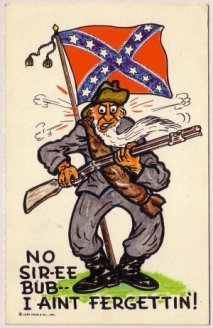
  • Hell no, we ain’t forgettin
  • The South will raise again
  • Long live the Confederacy
  • Nathan Bedford Forest: American Patriot
  • Confederate American and proud of it

And of course, she saw numerous Confederate flags hanging from houses, pickup trucks and motorcycles.  We even found a roadside stand where they were selling Confederate memorabilia and a large sign over the stand proudly proclaiming “Heritage Not Hate” as though the Civil War was about mint juleps and the right of slaves to sing and dance all night long.

red neck shirtIt became apparent to me why I never took my first wife to visit my relatives.  Deep down inside, I was both appalled and ashamed at their ideas and behavior.  During our visit Karen and I listened to more prejudice and bigotry then I had heard in years.  I retreated to an almost catatonic state.  I did not once broach the subject of racism or discrimination despite the abundant evidence of its pervasiveness.  My normal outspokenness for intolerance was stilled in the onslaught of insults and harangues that I heard towards Blacks, Mexicans and other minorities.  It was like a Gordian knot of discrimination and I did not know where to start unravelling it.  On our way home, Karen and I discussed our mutual inability to speak out or take any action in the face of this prolific bigotry.  I perhaps more than Karen was embarrassed that I had said and did nothing.  I had become the silent person who fails to speak out.

We can talk about moving on but I don’t think many of us realize how long it takes to change a culture and to really let go and move on.  There have been and continue to be many changes in the Old South.  Slavery has of course ended.  The plantations are gone and Jim Crow rule is finally over.  The Confederate Flag has even been taken down from most Southern State Capitals.  The symbols and icons of the Old South are fast disappearing.  Nevertheless, in the hearts and minds of many Southerners, you can still hear the refrains from Dixie repeating: “Old times there are not forgotten, Look Away, Look Away, Look Away, Dixie Land.”  When it comes to the South, old times there are still not forgotten.

Time for Questions:

Have you ever been down South?  What was your experience?  Do you have any roots in the South? If so, what changes have you seen over the years?  What do you think it will take to make the South forget the Civil War and move on?

Life is just beginning.

“In the South, history clings to you like a wet blanket. Outside your door the past awaits in Indian mounds, plantation ruins, heaving sidewalks and homestead graveyards; each slowly reclaimed by the kudzu of time.”  ― Tim HeatonDon’t Be Ugly:


Previous Older Entries Next Newer Entries